





































Meeting the Data Security and Protection Toolkit (2018) Requirements
The intersection of ISO 27001 and the DSP Toolkit sets a new baseline for how organisations demonstrate information security and compliance readiness. When your business faces regulators, clients, or board inquiries, the difference between “compliant” and “trusted” is tangible: only living frameworks with direct ownership, mapped controls, and continuous oversight command confidence in today’s finance, healthcare, and technology sectors.
Why does ISO 27001 matter for your compliance posture?
ISO 27001 codifies an approach where each asset and control is assigned, tracked, and subject to ongoing review. This isn’t legacy documentation, but real, enforceable accountability. The DSP Toolkit amplifies these standards, especially for organisations that intersect with the NHS or process health-related data, requiring proactive demonstration that your entire information estate is visible, secure, and responsive.
- Direct ownership of every policy and asset
- Documented improvement cycles with evidence trails
- Proactive posture against new regulatory updates and audits
What triggers demand integrated frameworks?
External pressure isn’t hypothetical: DSP Toolkit replaced IG Toolkit in 2018, ratcheting NHS, GDPR, and NIS alignment into a single self-service bar, not a once-a-year exercise. Compliance is now measured by your capacity to show, at demand, who owns every process, what evidence backs every improvement, and how gaps are fixed as threats evolve—not merely when convenient.
For your security and audit teams, these frameworks shouldn’t just exist. They should anchor trust, accelerate improvement, and provide live evidence at a moment’s notice. Our platform enables all three, giving your organisation a measurable compliance edge that keeps regulators, board, and clients decisively in your corner.
Book a demoWhy Integrated Compliance Frameworks Are Critical
Fragmented systems don’t just invite mistakes. They fragment accountability, slow evidence delivery, and erode trust with every compliance event. When you face a request for a risk report or an urgent audit finding, cobbled-together controls make you reactive—while an integrated compliance system moves you ahead.
How does system integration change risk management?
Disparate toolchains and document silos make risk assessment and reporting a perpetual struggle. If you’re reconciling six different spreadsheets and tracking evidence by email, you’re draining resources and expanding exposure, not demonstrating best practice.
- Single dashboards connect all frameworks: ISO 27001, DSP Toolkit, GDPR, NIS, more
- Automated, versioned policy management for real-time audits
- Role-based assignments mean nothing falls through the gaps
Siloed vs Integrated Compliance Systems
| Attribute | Siloed Model | Integrated Compliance Platform |
|---|---|---|
| Risk assessments | Manual, duplicative | Automated, mapped across standards |
| Evidence gathering | Decentralised, time-consuming | Streamlined, real-time, one-click export |
| Policy updates | Multiple, conflicting versions | Single source of truth, full history |
| Audit response speed | Weeks | Hours |
Why does this matter for your organisation?
When your system brings all evidence, controls, and improvement logs together, your compliance workload shrinks. Teams focus on actionable risk, not administrivia; auditors see accountability, not ambiguity. Industry research shows organisations deploying integrated compliance platforms reduce audit prep by over 50%, transform error-prone processes into checkable evidence, and escalate only issues that matter.
Fragmented frameworks drain trust—true assurance requires unity you can prove.
Our platform is purpose-built to integrate, map, and surface everything from incident response to the next compliance cycle, ensuring your organisation’s risk approach is lean and reliable the first time, every time.
ISO 27001 made easy
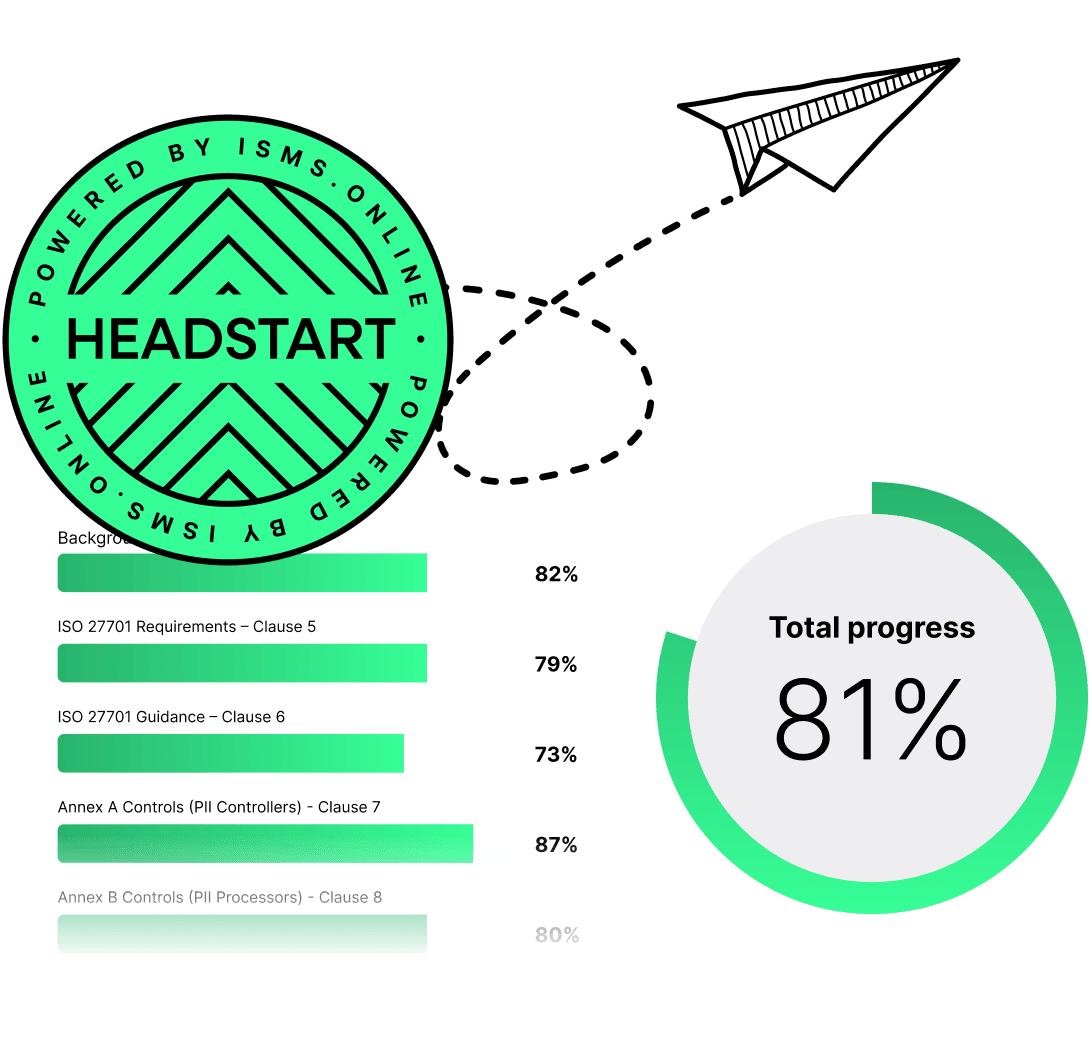
An 81% Headstart from day one
We’ve done the hard work for you, giving you an 81% Headstart from the moment you log on. All you have to do is fill in the blanks.
How Do ISO 27001 Controls Enhance Data Security?
Misconfigurations, asset ownership ambiguity, and inconsistent policy reviews sit at the heart of data breaches. ISO 27001’s genius is its insistence that every control is owned, tested, and mapped to a legitimate risk—no task left unassigned.
How do mapped controls drive real improvements?
Through the Statement of Applicability, you commit, not just average, each control’s fit to your environment. Integrated risk assessment isn’t passive: it’s a feedback loop closing the gap between paper policy and operational reality.
- Asset registers clarify responsibility at the person-level
- Every technical and administrative control is periodically stress-tested and logged
- PDCA cycles (Plan-Do-Check-Act) drive continual recalibration
ISO 27001 structures security using mapped, owned controls—each justified by a living risk assessment—backed by regular reviews and logged improvement actions.
What’s the operational payoff?
Data shows companies operating under tightly managed ISO 27001 frameworks report a 35–60% increase in audit pass rates, with attestation cycles that are both shorter and more robust. Your evidence isn’t just table stakes for auditors—it’s strategic capital for the board and clients.
We embed these feedback mechanisms deeply. The moment a control changes, a new risk emerges, or a policy is adopted, your audit trail and operational teams stay in sync, improving trust with every cycle.
Where Do Manual Processes Create Vulnerabilities?
Every manual transfer, spreadsheet update, or folder move in a compliance programme statistically increases your risk. Even a single evidence handoff can expose control gaps nobody sees until the next (or last) audit.
What are the operational risks of manual compliance?
The longer you operate with disconnected evidence tracking, the more invisible risks accumulate.
If your processes rely on individuals rather than systemized ownership, knowledge loss or job turnover stalls improvement and exposes your organisation to fines and sanctions.
- Tracked changes vanish after a failed sync or missed email
- Reconciliations drag, delaying rapid threat response
- Policy and asset ownership slip, making audits unpredictable
Consequence Matrix for Manual Compliance Tasks
| Manual Step | Audit Risk | Operational Loss | Trust Impact |
|---|---|---|---|
| Email-based evidence | High | Slow retrieval/failures | Questioned |
| Spreadsheet policy register | High | Version confusion | Erodes |
| Unowned risk assignments | Critical | Delayed escalation | Major Loss |
Every manual handoff in compliance is a bet you can’t afford to place.
Our platform automates and connects, anchoring every task, policy, and risk assignment to clear logs and ownership, ensuring even new staff have transparency from day one.

Free yourself from a mountain of spreadsheets
Embed, expand and scale your compliance, without the mess. IO gives you the resilience and confidence to grow securely.
When Should You Upgrade to Automated Compliance?
The threshold isn’t theoretical. It’s operational: when the cost—hours, risk, fines, and reputation—of staying manual overtakes the time and budget required to shift. Growth, changing regulations, and mounting complexity signal this day.
What markers force the shift?
You’ll know it’s time when:
- Policy updates become a bottleneck for multiple departments
- Audit prep swallows more than two full weeks per quarter
- Last-minute scrambles replace proactive, scheduled risk reviews
What’s the real ROI on automation?
Analysis from regulated verticals—finance, health, SaaS—shows the switch pays for itself in the first year of unified control, thanks to:
- 60% reduction in evidence-prep labour
- Predictable audit windows with near-zero failed checkpoints
- Error reduction as high as 70% on repetitive, formerly manual control mapping
Automation ROI Triggers
| Trigger | Manual Response | Automated Response |
|---|---|---|
| New standard (e.g., NIS, GDPR) | Panic update cycle | Real-time mapping |
| Staff turnover | Training churn | Continuous knowledge log |
| Annual audit window | Extreme overtime | Routine, on-demand proof |
| Board-requested risk snapshot | Custom report lag | Instant dashboard review |
Your organisation needs a compliance solution that moves as fast as your audit landscape. We’ve engineered our platform to remove lag, lock accountability, and scale as risks change—not as they multiply.
How Can Diverse Standards Be Harmonised Seamlessly?
You’re not alone if you’re managing ISO 27001, DSP Toolkit, GDPR, NIS, and internal policies simultaneously. Most security teams are facing exact conflicts between overlapping requirements, reporting cycles, and evidence burdens.
How is harmonisation actually achieved?
Successful harmonisation comes from advanced control mapping and unified evidence trails that serve every standard in a single system.
- Each requirement is mapped once, applied across all relevant standards
- Policy updates, risk assessments, and improvements auto-propagate through linked frameworks
- A real-time dashboard provides current status by standard, control, and evidence type
A harmonised compliance framework doesn’t add layers—it removes friction, closes gaps, and delivers certainty at audit.
Framework Harmonisation Matrix
| Standard | Evidence Mapped Once | Shared Risk Register | Unified Update Engine |
|---|---|---|---|
| ISO 27001 | Yes | Yes | Yes |
| DSP Toolkit | Yes | Yes | Yes |
| GDPR | Yes | Yes | Yes |
| NIS | Yes | Yes | Yes |
With our platform, you gain a harmonised compliance environment engineered for scale: updates, audit responses, and risk reviews happen once, everywhere—freeing your team for leadership, not labour.

Manage all your compliance, all in one place
ISMS.online supports over 100 standards and regulations, giving you a single platform for all your compliance needs.
What Quantifiable Benefits Does Certification Deliver?
Certification is only as valuable as the board, customer, or regulator who trusts it. For that trust to be earned, your reporting, audit, and control maturity must be performance-backed.
Which metrics validate your certification investment?
Regulated organisations leveraging unified ISMS platforms consistently track:
- Audit prep time reduction (as high as 65%)
- Board visibility into live risk (real-time dashboards)
- Policy update cycle-time, not just pass rates
- Incident-to-resolution durations
Certification brings more than just regulatory cover. You’re showing—not telling—the world that your security operations are mature, inspection-ready, and equipped to earn and keep client trust.
Key Audit and Risk Metrics
| Metric | Pre-Certification | Post-Certification |
|---|---|---|
| Audit prep hours | >80 | <30 |
| Policy conflicts/year | 3+ | 0–1 |
| Board-request time to data | >48h | Instant |
| External audit findings | Multiple | Typically none |
Audit success is earned by organisations who institutionalise continuous improvement—not those who scramble before deadlines.
When you can trace, measure, and defend every control, certification becomes more than a logo. It becomes your business advantage.
Book a Demo With ISMS.online Today
Leadership isn’t about compliance for its own sake. It’s about enabling audit advantage, assured trust, and empowered, accountable risk management in every facet of your operations.
When you streamline all frameworks—ISO 27001, DSP Toolkit, NIS, GDPR—into a unified system, every team member holds greater accountability, response time collapses, and audits run like clockwork. That’s the shift from compliance stress to operational control.
If your current systems can’t promise that level of readiness, resilience, and trust, we’re ready to show what’s possible. Schedule a demonstration now and set a new baseline for your organisation’s compliance, audit performance, and data protection.
Frequently Asked Questions
What Empowers Trusted Data Protection When Risks Are Always Evolving?
True protection is earned, not claimed. ISO 27001 doesn’t just draw lines around your data—it forces you to define, own, and continually stress-test your controls. The move from IG Toolkit to the DSP Toolkit cranked up the pressure: now you’re responsible for proving your defence is operational, visible, and always improving.
Shifting From Checks to Checkmates
- Old way: A clipboard checklist, hoping your policies line up.
- Now: Every control gets an owner, every risk a mitigation, and every improvement leaves a trace.
- Result: When someone asks for proof, you don’t search—you show.
Visibility doesn't begin with the next audit. It’s the baseline every day.
These frameworks changed because attackers keep changing. Regulators don’t trust static paperwork; they look for evidence of adjustment and resilience. Organisations using our platform move past annual cycles and into continuous defence, where compliance is not a sprint, but a steady signal of trust.
Why Does Fragmented Compliance Undermine Organisational Security?
Disconnected workflows create invisible cracks. Managing ISO 27001, DSP Toolkit, GDPR, or NIS in separate documents breeds missed actions, duplicate reviews, and inconsistent accountability. These cracks don’t announce themselves—they grow until pressure finds them.
What Fragmentation Actually Costs
- Accountability murk: Who owns this? Whose evidence is current?
- Duplicate drudgery: Same policy, three different folders—none correct.
- Audit roulette: Each audit cycle starts from zero, not a living system.
A consolidated compliance process fuses all change logs, evidence, and control assignments so nothing gets repeated or overlooked. Our clients routinely cut policy management hours by half and reduce finding rates in third-party audits thanks to this unification.
| Siloed Approaches | Unified Compliance (ISMS.online) |
|---|---|
| Multiple approvals | Singular, live workflow |
| Unmapped controls | Every control mapped, owned, tested |
| Audit firefighting | Predictable, transparent reporting |
A fragmented ISMS isn’t just risky, it’s expensive noise.
Every new regulation now plugs into a single system. Your data and controls aren’t at the mercy of team turnover or spreadsheet decay. With a live system, compliance becomes measurable, and risk suddenly reads as opportunity.
How Does ISO 27001 Move Your Security Controls From Paper to Performance?
A checklist cannot defend your assets. ISO 27001 builds traceable, living controls, not pass/fail paperwork. Operational excellence thrives on continuous review: accountability on every asset, periodic challenge of every policy, real-time update when regulators or attackers change the stakes.
What Actually Drives Security
- Statement of Applicability: Not a formality—*a ledger of intention and delivery*.
- PDCA cycle: Regular reviews reveal strengths and subtle weaknesses.
- Metrics: Not just annual pass/fail, but real-time indicators (incident response delays, policy update lags, coverage gaps).
If you can’t prove resilience, you’re building on faith—not fact.
Organisations leveraging ISMS.online measure risk at the system level, not just audit time. Owners get notified, policies pull live data, and every change leaves a signature. Less “did we do it yet?” More “where are we strongest, where are we weakest?”
At-a-Glance: Living Controls Pay Off
| Metric | Disconnected Controls | ISO 27001-Aligned ISMS |
|---|---|---|
| Audit prep time | Weeks | Days |
| Unowned/expired policies | Often | Never |
| Evidence found per search | <60% | >98% |
Where Do Manual Processes Leave You Exposed to Loss You Can’t See?
Every handoff, extra copy, or missing update puts you one mistake from a finding—or a breach. Compliance built on manual mail merges, ad hoc spreadsheets, or ‘tribal knowledge’ can’t keep pace with real change.
Where Risks Hide
- Documentation drift: PDFs and printed logs fall behind. New hires inherit yesterday’s gaps.
- Lost ownership: No one remembers who last updated the control, so it lingers untested.
- Slow reaction: When risk spikes, manual systems stall, not scale.
Organisations that transition to a unified ISMS see a clear drop in audit surprises and rogue data handling, and a dramatic acceleration in evidence delivery. No more mystery-signoffs or missing proofs. The only surprises are improvements logged ahead of time.
Security doesn’t fail at the front door—it quietly leaks through every unchecked folder.
We replaced paperwork with persistent, role-based tracking—each update triggers notifications, version history, and closure, not more busywork.
When Do Manual Methods Become the Barrier Instead of the Buffer?
Manual admin once worked when compliance was small. But scaling up, merging frameworks, or just facing relentless new rules flips convenience into a liability. Your team spends hours prepping for audits that should be routine—or worse, scrambles after the fact to salvage proof after incidents.
Tipping Points You Can’t Ignore
- Review cycles balloon to weeks, not days—pushing deadlines and credibility.
- Staff turnover leads to lost institutional memory and patchwork process recoveries.
- Cost of repetitive certification prep piles up, draining resources from true risk reduction.
When these symptoms cross a threshold, organisations usually find cost–benefit has already swung—manual effort equals, then exceeds the cost to digitise and centralise. Those who switch report immediate reductions in audit costs and an end to compliance fatigue.
| Trigger | Before ISMS.online | After ISMS.online |
|---|---|---|
| Audit prep time | 60+ hours | Under 16 hours |
| Missed evidence | >2 per cycle | Zero in recent cycles |
| Policy reconciliation time | Days | Minutes |
Process complexity doesn’t scale—only good systems do.
Decisively, the organisations that automate early claim not just regulatory peace of mind, but the bandwidth to focus on bigger business vulnerabilities.
How Do You Harmonise Standards Like ISO 27001, DSP Toolkit, and GDPR—Without Losing Sight of Controls?
You aren’t running three ISMS, you’re running one business. But the patchwork of frameworks—each with overlapping demands—turns compliance into a beast unless you enforce alignment, not duplication.
Mapping Order Into the Maze
- Control mapping links every policy, risk, and evidence artefact to as many standards as needed.
- Policy sync means edits update across frameworks, never lost or forgotten.
- Unified dashboards visualise risk at every layer—board, auditor, departmental lead.
Our platform’s engine connects these dots so you can focus on improvement, not reconciling audit requests. No more manual cross-references. Every stakeholder, from the board to the operational owner, sees the unified picture.
One Change, All Standards
| Action | ISO 27001 | DSP Toolkit | GDPR/NIS | System Outcome |
|---|---|---|---|---|
| Policy Update | ✔️ | ✔️ | ✔️ | All align instantly |
| Incident Log | ✔️ | ✔️ | ✔️ | Unified reporting |
| Control Audit | ✔️ | ✔️ | ? | Gap flagged, not hidden |
A unified ISMS isn’t checkbox compliance—it’s operational harmony the board can trust.
By harmonising controls, you reclaim time, eliminate duplicate reviews, and build attestation into your daily operations—not as an afterthought.






