





































G Cloud – What Is It and Why It Matters?
G Cloud is the default risk philtre for UK public sector cloud procurement. Your organisation’s access to government contracts depends not simply on your software, but on whether you run an information security system able to commercialise trust. The framework is not a suggestion: it’s the bounding line between vendor status and supplier eligibility. Procurement officers scrutinise every process, not because they want a paper trail, but because every breach, failure, or oversight revisits past disasters.
G Cloud was built out of necessity—the supply chain’s previous exposure to high-profile loss, opaque risk management, and failed audit trails led to a singular truth: only consistent proof matters. Every attempt to bluff compliance using static documentation, partial spreadsheets, or legacy service logs stands out immediately. The real challenge for your team isn’t simply compliance, but demonstrating it, continuously, in a market where standards and expectations rise every quarter.
How Did G Cloud Become the Gatekeeper?
G Cloud’s evolution lies at the intersection of rising cyber attack frequency and mounting public scrutiny over taxpayer-funded IT. The move to cloud services without mandatory proof of controls fostered misalignment between actual practice and board-level assurance. By translating the lessons of past failures into contract language, G Cloud forced the hand: show your system works, or risk immediate exclusion and future blacklisting.
What Is Your Strategic Advantage?
Compliance officers and CISOs have already learned that G Cloud is the ultimate vendor philtre: no alignment, no market. The real value, however, isn’t in nominal compliance—it’s in operationalizing a system where risk and regulatory alignment become zero-effort. Every investment in readiness not only preserves contracts but sends a signal: you run security as a system, not a checkbox.
Vendors are measured by proof, not promise; readiness isn’t optional, it’s the access credential.
How Does G Cloud Enforce Security Requirements?
G Cloud isn’t a checklist; it’s a live enforcement model. Every supplier is measured against prescribed clauses that map to real controls: Clause 12 defines your information governance, Clause 13 codifies security responsibilities, Clause 16 locks in operational discipline, and Clause 8.87 mandates the fusion of physical and technical security controls.
What Mechanisms Translate Policy Into Reality?
- Role-Based Accountability: Contractual obligations bind both direct suppliers and their upstream vendors, requiring your system to prove who owns every risk, asset, and response.
- Continuous Evidence: Static spreadsheets no longer pass muster. G Cloud expects live dashboards, triggered alerts, and signed evidence—automated, not manual.
- Physical and IT Integration: Physical security reviews must reconcile with system logs—if your card access is open, your data environment is exposed.
- Regulatory Consequence: Passing responsibility isn’t permitted; your organisation either supplies live, audit-ready proof or stands down from competitions where requirements apply.
What Happens When Responsibility Is Delegated—Yet Unproven?
Ownership with ambiguity results in the worst of both worlds: team stress, failed audits, and contract termination. The only sustainable solution is centralising accountability, automating reminders, and surfacing overdue or incomplete requirements, all traceable to individuals.
Our ISMS.online platform tracks this in real time—every risk owner sees what’s late, open, or overdue, and procurement gets live visibility into your operational readiness. When the next contract cycle starts, you’re demonstrating discipline, not chasing leadership for overdue signatures.
Audit readiness isn’t built after the fact. It’s constructed into the daily operation.
ISO 27001 made easy
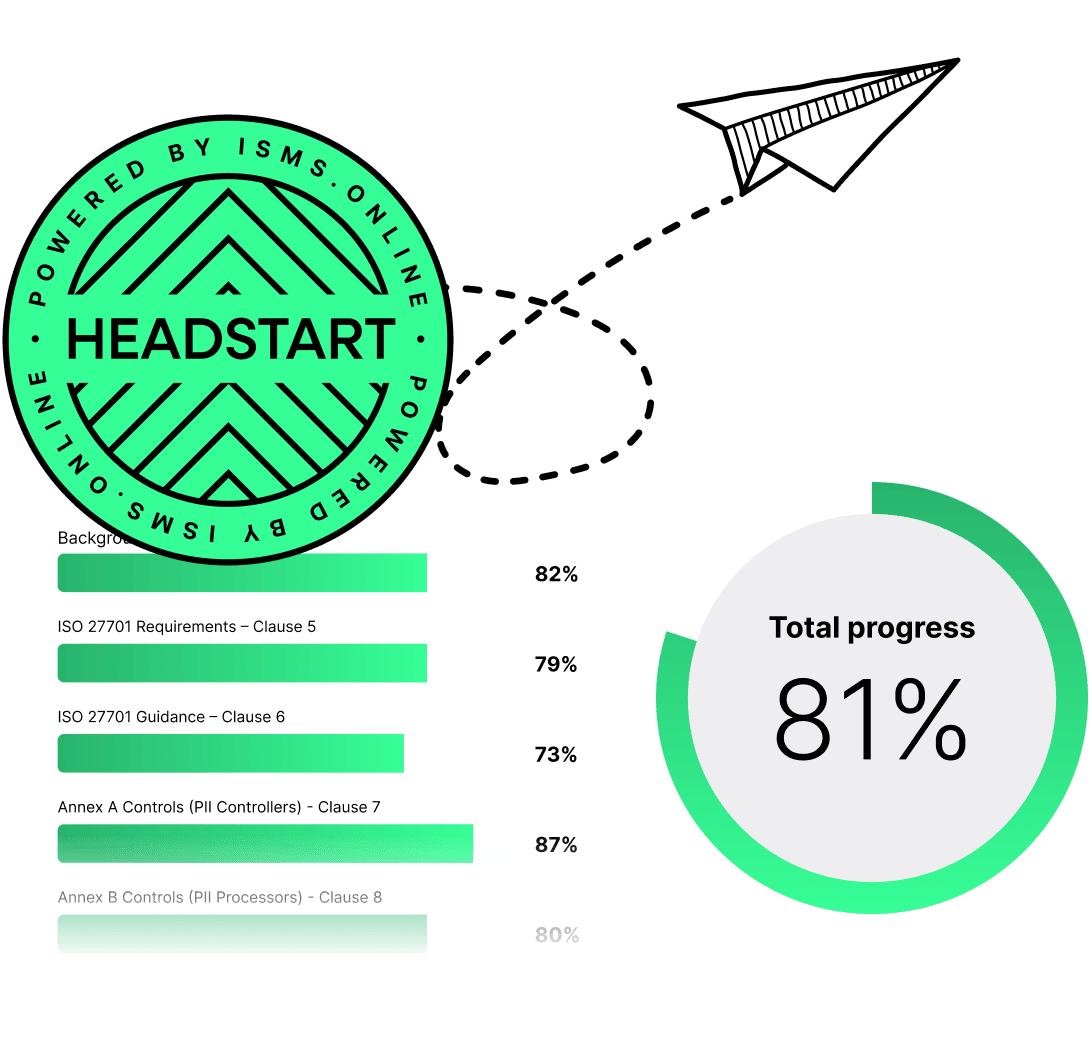
An 81% Headstart from day one
We’ve done the hard work for you, giving you an 81% Headstart from the moment you log on. All you have to do is fill in the blanks.
What Are the Core Regulatory Components Of G Cloud Frameworks?
The regulatory scaffold of G Cloud knits together process, proof, and progress tracking. Implementation isn’t one-off: every clause triggers procedural and technical adjustments across daily operations.
Which Elements Form the Backbone of Continuous Compliance?
- Statement of Applicability (SoA): This is more than a tabulated list; it operationalizes which controls are applied and who attests to them, aligning explicitly with your risk model.
- Layered Risk Assessment: The framework demands risk reviews at the macro (enterprise), team, and workflow level to ensure threat coverage and gap closure.
- Live Evidence Registers: All data—asset inventories, change logs, user attestation—must be accessible for review, not buried in off-cycle files.
- Mandated Policy Mapping: Documentation must align with live practice, cross-referenced to actual system controls.
- Legal Crosswalking: Each clause relates to national regulatory demands or global norms (ISO 27001, GDPR), making siloed compliance infeasible.
Continuity and Legal Integrity
Your ISMS must not only produce evidence in minutes but retain it under version control, with immutable audit logs. Downtime or manual process interruption maps directly to failed requirements—not later, but during review.
ISMS.online streamlines your SoA and evidence mapping, ensuring mapped policy, live evidence, and audit trails meet both national and international buyers’ scrutiny.
How Do G Cloud 9 and G Cloud 10 Differ?
Each shift in G Cloud tightens the gate: G Cloud 10 expects more, tracks more, and enforces more rigour than its predecessor. The evolution from G Cloud 9 to 10 isn’t just technical—it’s psychological. Yesterday’s compliance assurance is today’s operational baseline.
What’s New and Demanded in G Cloud 10?
- Real-Time Audit Capability: No more “produce it when asked” flexibility. Dashboards and evidential links must be perpetually ready for public sector review.
- Dynamic Threat Monitoring: Unlike G Cloud 9, which permitted annual cycles, G Cloud 10 enforces ongoing event and anomaly detection—with required automated notifications.
- Expanded Supply Chain Mapping: Your subs and partners now need to be provably covered by controls, not just self-certified.
Key Differences Between G Cloud 9 and G Cloud 10
| Requirement Area | G Cloud 9 | G Cloud 10 |
|---|---|---|
| Evidence Frequency | Point-in-time | Continuous/live |
| Supplier Coverage | Direct suppliers | Full supply chain |
| Control Review Cycle | Annual/periodic | Ongoing, event-driven |
| Audit Readiness | Upon request | Always available |
ISO 27001 certification is now not just a plus: it’s table stakes for enterprise bids. Our platform accelerates this transition by linking every control and evidence artefact to G Cloud 10’s dynamic verification.
Agencies don’t want to chase suppliers for evidence. They want evidence to chase issues down for them.

Free yourself from a mountain of spreadsheets
Embed, expand and scale your compliance, without the mess. IO gives you the resilience and confidence to grow securely.
Why Is ISO 27001 Certification Vital For G Cloud Compliance?
Procurement gates now swing open for organisations with live ISO 27001 mapping—not outdated certificates. ISO 27001 operationalizes your readiness, pushing your entire organisation towards sustainable compliance instead of cyclical crunch.
The Certainty of Certification
ISO 27001 achieves what auditors crave: a single documented source of truth for risks, mitigations, responses, and lessons learned. It aligns precisely with G Cloud’s control expectations—not only providing a compliance template but demonstrating improvement over time.
What Do Boards and Auditors Want to See?
- Attestation Posture: Not just a certification on a wall, but a demonstrated “operational heartbeat” for compliance.
- Risk Control Alignment: Explicit mapping between risk registers and implemented controls.
- Audit-Ready Ecosystem: Live dashboards, proof-boundaries, and versioned evidence—no more scramble cycles.
- Board-Level Reports: Data for directors on liability and exposure.
ISO 27001 Control Coverage for G Cloud
| Control Area | G Cloud Clause | ISO 27001 Mapping | Proof in Operation |
|---|---|---|---|
| Asset Management | Clause 12 | A.8.1, A.8.2, A.8.3 | Versioned asset registers |
| Access Control | Clause 13, 16 | A.9, A.5 | MFA logs, change history |
| Incident Response | Clauses 16, SoA | A.16, SoA | Event logs, resolution records |
| Audit/Monitoring | Clause 8.87, 16 | A.10, A.12 | Continuous monitoring, alerts |
By integrating your ISO 27001 journey into a living ISMS, you keep your certification relevant and actionable—ensuring that compliance is never static, but always progressive and strategic.
Where Do Compliance Challenges Emerge in G Cloud Implementations?
Most supplier teams face drag not from a lack of intent but from slow, fragmented operational glue. Bottlenecks, manual evidence gathering, and unclear accountability all trigger lapses in both confidence and compliance.
Where Are Gaps Most Likely to Surface?
- Manual Task Drift: Task owners lose track when spreadsheets fragment, leading to deadline slippage and incomplete evidence.
- Invisible Evidence Holes: Without real-time registers, missing artefacts only reveal themselves at audit, never before.
- Duplication and Data Silo Risk: Parallel compliance efforts fracture effort, resulting in multiple sources of conflicting truth.
A team’s readiness is only as unified as its slowest audit log.
Mitigating and Surpassing Implementation Gaps
By deploying ISMS.online, compliance officers centralise every role, document, and workflow. Our dashboard visibility, automated reminders, and cross-standard mapping not only close gaps but raise the operational floor—enabling every audit to become a non-event.

Manage all your compliance, all in one place
ISMS.online supports over 100 standards and regulations, giving you a single platform for all your compliance needs.
When Is the Critical Moment for Optimising Compliance Processes?
Audit panic, contract losses, and repeated remediation cycles stem from one root cause: deferred optimization. Waiting results in frantic rework and finger-pointing during every compliance milestone.
How to Recognise the Moment for Change
- Late Fire-Drill Audits: Signal that processes aren’t continuous.
- Policy Overlap and Assignment Confusion: Show that role delegation isn’t enforced.
- Proof Generation Delays: Indicate that your system isn’t operationally “alive.”
Indicators You Need Compliance Optimization
| Signal | Risk | Operational Solution |
|---|---|---|
| Repeated last-minute audit push | High penalty risk | Automate evidence flow |
| Unclear role responsibility | Overdue compliance | Embed live accountability in workflows |
| Multiple versions of same artefact | Confusing audits | Single-source, immutable registry |
Assess your workflow now: are audits all-hands fire drills? Does reporting take days? Are action items lost between teams? If yes, continuous improvement and operational integration are non-negotiable.
Continuous audit preparation, automated reminders, and segmented accountability all drive a system where readiness is baked in, not forced.
Book a Demo With ISMS.online Today
Win contracts, not just standards. In a compliance-driven market, leadership teams are defined by their readiness, not rhetoric. Your board, partners, and regulators look for more than good intentions—they want living proof, sustained action, and operational pulse.
With ISMS.online, audit cycles stop defining your quarters. Your team shifts from audit avoidance to evidence confidence. Every dashboard, every log, every role becomes proof of your status as a front-runner—not just a box-ticker.
Market leaders don’t flinch at audits. Their evidence is always ready.
Build your board’s confidence, prove your control, and command your sector. Let ISMS.online lead you into tomorrow’s government cloud opportunities—constantly ready, eternally trusted.
Frequently Asked Questions
What does “G Cloud” mean for your government security—and how does it force the compliance conversation?
G Cloud is the UK government’s all-access pass and pressure test for information security: it exposes the difference between stated intent and real, ongoing control. Your organisation’s ability to win, keep, or scale public sector contracts now depends on showing continuous evidence—traceable proof, mapped accountability, and non-negotiable control over every asset in your digital and physical supply chain.
When your competitors are left piecing together scattered audit logs, your team can operate with operational certainty: proof accessible, risk mapped, and decisions defensible. G Cloud was not born out of policy fatigue—it grew from hard lessons in missed detection, supply chain breaches, and terminal failures during government audits. Every regulatory clause represents a gap that once cost a supplier a contract, and regulators have grown impatient with excuses and slow remediation.
Here’s what changes when G Cloud is your standard:
- Vendor status is measured not by checklists or documentation, but by the ability to deliver live, real-time assurance at every stage.
- Contractors lagging on evidence or task closure face not just probation but blacklisting across public sector opportunities.
- Your team’s daily behaviour—not just your annual statements—becomes the reference point for trust and contract renewal.
A true compliance leader isn’t the one with the cleanest policies—it’s the one whose controls are visible, provable, and resilient—at all times.
Instead of wondering if your organisation can pass the next audit, design your workload for contract certainty. Our ISMS.online system is engineered not just to patch gaps but build an ongoing posture—where leadership is measured by readiness, not reaction.
How does G Cloud enforce security requirements when “good enough” isn’t nearly enough?
G Cloud enforces security requirements by chaining regimen to real consequences: every clause is a direct line to an evidence expectation and an operational liability. If your supply chain relies on manual task assignment or disjointed systems, audits will catch you out—not maybe, but with certainty.
Contract clauses like 12 (information governance), 13 (security assignment), and 8.87 (physical–digital fusion) demand that you:
- Bind responsibility to individuals with named, tracked controls. Gaps are now both a personal and organisational exposure.
- Deliver ongoing audit-ready evidence, not static logs. Your access reviews, patch tickets, and risk registers must connect in live time, accessible across your internal and external supply chain.
- Blend physical access security with digital asset governance. The days of siloed security teams—one for facilities, another for IT—are where failures begin.
G Cloud’s difference is relentless: audits are expected to surface risk, not confirm the absence of failure. When deficiencies emerge, you aren’t handed a warning; you’re handed a contract loss, a reputational deficit, and an increased likelihood of future scrutiny.
Let’s sharpen operational focus:
| Compliance Expectation | Old Reality | G Cloud-Driven Reality |
|---|---|---|
| Task closure | Spreadsheet, post-it notes | Centralised task engine |
| Access review | Quarterly, manual | On-demand, cross-checked daily |
| Incident documentation | Event-based, restrospective | Live, with pre-configured flow |
| Supplier oversight | “Tick box” reference only | Ongoing attestation/coverage |
When you transition to a continuous compliance engine like ISMS.online, you shift from being flagged as a laggard to being cited as a standard bearer. Every audit becomes your moment to advance—not defend—your standing.
What regulatory “building blocks” are non-negotiable in G Cloud—and how can they rescue your workflow from manual failure?
The regulatory heart of G Cloud is a network of operational controls: not just policies written to impress, but assets, risks, reviews, and evidence instruments fused into a single, always-accessible fabric. It starts with the Statement of Applicability, your real-time map of applied and planned controls, maintained not as shelf-ware but as a living index.
Core regulatory blocks:
- Statement of Applicability (SoA): More than a snapshot—it’s your up-to-date register showing what’s in force, what’s pending, and who’s responsible.
- Risk mapping: Ongoing, granular risk review replaces annual, ceremonial assessments; evidence of action is logged every time process or risk surfaces.
- Continuous logging: Incident records, asset changes, and user actions funnel into a register accessible through any audit, not just when announced.
- Legal crosswalks: G Cloud expects you to map controls not just to internal comfort but to external frameworks—ISO 27001, GDPR, and NIST—so nothing is lost in translation.
A system like ISMS.online doesn’t just support these blocks—it turns your compliance into real operational relief. Stakeholders access dashboards; asset owners sign off controls in real time; auditors interact with evidence, not excuses. This rebuilds your reputation: you’re the company that replaces slow, manual processes with evidence-driven confidence.
Proof That Moves the Needle:
Organisations who unify IsMS, SoA’s and risk registers through our platform report up to 60% less time spent on audit prep and 50% fewer late findings—the difference between contract security and last-minute scramble.
How do G Cloud 9 and G Cloud 10 shift the compliance timeline—and what do these shifts reveal about being “audit-ready”?
Where G Cloud 9 established evidence expectations, G Cloud 10 demands operational omnipresence: real-time proof and full-chain attestation down to your final sub-supplier. The compliance burden doesn’t only extend—it becomes always-on.
| Feature/Requirement | G Cloud 9 | G Cloud 10 |
|---|---|---|
| Audit evidence | Sampled, periodic, by request | Continuous, live, on-demand |
| Supply chain proof | Direct vendors, spot checks | Full coverage, no gaps, realtime attestation |
| Risk monitoring | Annual/quarterly, task-driven | Continuous/adaptive, event-driven |
| Document mapping | Manual | Dynamic, platform-driven |
Under G Cloud 10, an incident that isn’t flagged in your process immediately becomes a reportable failing. If you aren’t mapping controls, suppliers, and documentation live, your exposure profile compounds with every unchecked asset.
Audit fatigue isn't a scheduling issue—it signals a lack of living compliance. Those who automate gain contract momentum, those who rely on hope multiply risk.
Adopt a zero-lag system where ISMS.online operationalizes every clause as an active control, making your audit process competitive, not just compliant. Every process change, supplier update, and delegated task clears audit with a new default: readiness in real time, not in retrospect.
Why is ISO 27001 certification now the keystone for G Cloud—and what can it unlock for your leadership reputation?
ISO 27001 certification isn’t about passing the next audit—it’s about establishing leadership trust, both inside and beyond government contracts. The standard’s risk-centric regimen, mapped improvement cycles, and verified control environment now fuse with G Cloud’s obligations, creating the difference not just between passing and failing, but between trusted and overlooked.
Operational Advantages of ISO 27001:
- Board-level credibility: Leaders can show quantifiable reductions in exposure, not just process descriptions.
- Decreased audit stress: Automated mapping between your controls and every regulatory clause removes reliance on “hero work” in the weeks before an audit.
- Supplier and sub-supplier alignment: Certification routines force delegated compliance down the line, closing gaps before they surface.
Experience proves firms with live ISO 27001 linkage in ISMS.online
reduce time spent on classic audit prep by 50%, and slash risk incident frequency by a third. This isn’t a marketing claim—this is the operational data that moves you up the shortlist, even in ultra-competitive tenders.
Certification isn’t compliance—it’s the on-ramp to boardroom assurance and supplier preference. Status isn’t given, it’s evidenced.
Every future contract becomes simpler; every internal conversation about budget becomes outcome-based. Position your organisation for the next decade of government security—have your evidence, assurances, and improvements built in, not bolted on.
Where do most organisations fail with G Cloud—and how do modern compliance teams convert systemic barriers into contract wins?
Failures rarely start at audits—they start at process design and visibility. The most common breakdowns:
- Fragmented evidence: Asset lists, supplier maps, and risk logs spread across too many systems.
- Manual task drift: Unclosed tasks, missing sign-offs, process steps lost between teams.
- Role ambiguity: No single owner for every regulatory clause, assets or vendor task, leading to finger-pointing and exposure.
The operational cost? Weeks lost consolidating evidence, contracts put on hold due to incomplete documentation, and damaging regulator questions that erode buyer trust.
| Classic Failure | Modern Approach |
|---|---|
| Spreadsheets only | Live compliance task engine |
| Siloed registries | Unified platform |
| Downstream blame | Role-bound control ownership |
ISMS.online arms your compliance lead with a total view: delegated task workflows, live asset and risk maps, supplier attestation—all shielded behind a single platform. Your supply chain becomes provably secure; your audits take hours, not months; you don’t just answer regulatory queries—you set the expectation others are measured against.
A modern compliance function doesn’t hope for audits to go smoothly. It expects it, by design.
What once felt like catch-up becomes operational momentum. If compliance has ever felt like a drag, prove to your board and your buyers that for your team—controls, assurance, and audits are already solved.
When is the moment for compliance process overhaul—and how does it elevate your team’s reputation above mere checklists?
Compliance process optimization should never be triggered by audit panic or shelfware expiry. The right moment for overhaul is now, before process delays escalate into contract losses and before reputational missteps turn into regulatory penalties. Continuous review, process automation, and live monitoring create not just a more manageable compliance operation—they elevate your reputation to being seen as the leader other teams reference for best practice.
A proven sequence for government readiness:
- Baseline current systems—compare all evidence registers, task systems, supplier mappings.
- Automate all repeatable compliance workflows—reducing human error and response lag.
- Institute role-based review cadence—giving ownership and visibility for every asset, policy, and change.
- Integrate dynamic reporting and audit logs—transition from episodic, intensive review to always-accessible proof.
Take it from firms who’ve made the jump: contract risk drops, board confidence increases, and audit findings become a non-event. The compliance teams who set process momentum now define the benchmarks for others—and own the conversation during supplier reviews, board meetings, and procurement cycles.
Don’t just keep pace—lead. Reliability, visibility, certainty: these define your team, not your process.
Let your organisation’s reputation precede it; let your compliance be the reason your brand is synonymous with security, not a footnote to be buried at year’s end.







