





































Why Gaming Incident Response Is Broken
Most gaming platforms still rely on improvised incident response with scattered chats, unclear ownership and patchy records, even though external stakeholders now expect ISO 27001‑aligned handling. Effective incident response for games means repeatable processes that separate reliability issues from security breaches and connect technical actions to business impact, regulatory thresholds and long‑term learning. Without that spine, every serious incident feels like starting from scratch and leaves you exposed when regulators and executives ask hard questions.
Strong systems matter most when the people you depend on are asleep.
The real impact goes far beyond server uptime
A security incident in gaming is never just “downtime”; it is a combined hit on player trust, live revenue, game integrity and regulatory confidence. If you only track outages and error rates, you miss churn, complaints, chargebacks and licence risk that quietly accumulate after services are restored. A weekend tournament DDoS that also masks account takeovers, for example, can damage both player sentiment and regulator confidence long after the servers look healthy again.
In practice, a serious incident can hit all of the following at once:
- Player trust and willingness to spend.
- Live revenues from tournaments, jackpots and events.
- In‑game economies and item values.
- Licence conditions and suitability assessments.
- Internal morale and retention in security and live‑ops teams.
High‑profile breaches in the sector have shown that lost availability, exposed data and unfair play quickly turn into regulatory scrutiny, fines and long periods of reputational damage. If you replay your last major incident step by step, you may find that business consequences were discovered late, and that almost nobody could explain the full picture afterwards.
Outage management and security incidents get blurred
In many gaming organisations, attacks are treated as reliability problems first, so the response stops as soon as the platform appears healthy again. That mindset hides compromised accounts, manipulated economies and data loss behind a superficial “uptime is restored” storey, leaving you under‑prepared for regulatory questions and future attacks. The pressure to keep a high‑performing, low‑latency service running makes it easy to ignore deeper security questions once graphs stabilise.
Because games are always‑on and highly performance‑sensitive, many organisations treat attacks as reliability problems first. DDoS during a tournament, credential‑stuffing waves, bot swarms or targeted abuse are sometimes handled as mere capacity issues:
- SRE teams scale up, tune rate‑limits and reset services.
- Once the game stays online, the incident is declared “over”.
What often gets missed is whether:
- Player accounts were actually compromised.
- Virtual items or balances were manipulated.
- Data was exfiltrated while the team fought for uptime.
- Any of this reached the thresholds for notifying regulators or payment partners.
That gap between “the game is back up” and “the situation is properly understood and recorded” is where ISO 27001 Clause 8 (operations) and Annex A incident‑management controls expect you to have structure, often supported by ISO 27035 guidance.
Tribal knowledge and hero culture don’t scale
When incident response depends on a handful of veterans, you may recover quickly today but carry silent systemic risk into the next crisis. ISO 27001 pushes you towards documented roles, procedures and governance so that capability survives holidays, staff turnover and growth. Regulators and serious partners are much more comfortable when they see systems rather than individual heroics.
In many studios and platforms, incident success hinges on a handful of experienced people:
- The one engineer who knows the anti‑cheat internals.
- The SRE who has “seen this DDoS before”.
- The compliance lead who remembers what the regulator asked for last time.
If those people are offline, on holiday or have left the company, the organisation becomes fragile at exactly the wrong moment. Regulators, auditors and partners are increasingly suspicious of systems that depend on individuals rather than documented roles, playbooks and governance. ISO 27001 is designed to move you away from that pattern through defined responsibilities, documented information and management oversight.
Metrics reward speed, not trust or compliance
If you only measure how fast you close tickets, you incentivise shallow fixes and under‑invest in proper triage, regulatory analysis and learning. A gaming platform that wants to satisfy regulators and players needs incident metrics that connect speed to trust, fairness and legal duties, not just to closing alerts quickly.
Many incident dashboards still focus on:
- Mean time to detect (MTTD).
- Mean time to respond or resolve (MTTR).
- Number of open versus closed tickets.
These are useful, but they say nothing about:
- Player churn after an incident.
- Chargebacks and fraud losses.
- Complaints to regulators or ombuds services.
- Whether a notifiable breach was reported on time.
If you optimise only for close incidents faster, you can easily under‑invest in proper triage, regulatory analysis, evidence capture and post‑incident learning. A mature, ISO 27001‑aligned approach rebalances this picture by tying incidents back to risk treatment, legal obligations and continual improvement, so your metrics reflect both speed and trust.
Book a demoFrom Firefighting to an ISO 27001 ISMS Spine for Games
If you want to move beyond ad‑hoc firefighting, you need an ISO 27001 Information Security Management System (ISMS) that gives incidents a clear home. That means defined scope, risks, controls, records and reviews that match gaming realities. For your teams, it turns every breach, exploit or outage into structured input for better design, safer features and clearer reporting to leadership and regulators.
Make the scope explicit and gaming‑relevant
You cannot manage or explain incidents convincingly if nobody can state, in plain language, which parts of your gaming platform sit inside the ISMS. A clear, gaming‑specific scope statement becomes the backbone for risk assessments, controls and incident playbooks that match how your business actually runs and how regulators view your services. An effective ISMS starts with a clear scope statement; for a gaming platform that usually means:
- Player account and identity systems.
- Game servers, matchmaking, leaderboards and live‑ops tooling.
- Payment flows, wallets and withdrawal processes.
- Anti‑cheat and fraud‑detection components.
- Critical infrastructure and cloud services.
- Key third parties with access to systems or data.
If you cannot sketch a simple diagram showing what the ISMS covers today, you will struggle to show regulators and partners that incidents are managed within a controlled environment. For CISOs and practitioners, that same clarity also removes arguments mid‑incident about whether a system, tool or vendor is “in scope” for security and compliance decisions.
Treat ISO 27001 as a loop, not a binder
An ISO 27001 ISMS is meant to be a living loop that turns context, risk, controls, monitoring and incidents into continuous improvement, not a static binder that gathers dust. For a gaming organisation, that loop should visibly connect everyday incidents and game changes to updated risks, improved controls and better decisions about live operations.
At its core, ISO 27001 expects you to:
- Understand your context and interested parties.
- Assess information security risks.
- Choose and operate appropriate controls (Annex A and others).
- Monitor performance and incidents.
- Review at management level.
- Improve the system over time.
Incident response is one of the main feedback loops in that cycle: serious events feed back into risk assessment, control design, training, contracts and business decisions. When incidents live entirely outside the ISMS, you miss the chance to show that you respond, learn and adjust systematically, and your teams are left improvising rather than following an agreed pattern.
Bring ISO 27035 into the picture
ISO 27035 complements ISO 27001 by describing a practical incident‑management lifecycle, so using both together lets you show that your high‑level governance and your day‑to‑day playbooks are aligned. In gaming, this means your cheat outbreaks, fraud waves and data leaks all follow the same, well‑understood phases, regardless of which team spots them first.
ISO 27035, the incident‑management standard in the same family, gives you a practical lifecycle:
- Planning and preparation.
- Detection and reporting.
- Assessment and decision.
- Responses (technical and organisational).
- Lessons learned.
For gaming, you adapt those phases to real‑world cases: cheating outbreaks, payment fraud, account takeover, data leaks, game‑economy exploits and targeted attacks on live events. Your ISMS gives you the governance, and ISO 27035 gives you the day‑to‑day operating model, so war rooms across security, SRE, game and payments teams are all working from the same playbook.
Include payments, KYC and other high‑risk flows
Incidents involving payments, know‑your‑customer checks and bonus engines are often where regulators, schemes and banks look first, so an ISMS that ignores these flows is incomplete. You should treat them as part of your security and compliance surface, with explicit risks, controls and reporting paths rather than leaving them to separate teams.
Many gaming companies treat payment gateways, wallets, know‑your‑customer checks and bonus engines as separate responsibilities. From an ISO 27001 and regulatory standpoint, they are part of your threat surface. Your scope and risk assessment should explicitly cover:
- Where cardholder data or payment tokens live.
- How strong customer authentication is applied.
- How AML and fraud monitoring interact with security incident processes.
- What obligations exist in contracts with processors and acquirers.
Regulators and card schemes will expect you to know exactly how incidents affecting these areas are handled and reported. For operational leaders, putting these flows inside the ISMS also prevents last‑minute surprises when a “technical” incident suddenly triggers financial‑crime or card‑scheme duties.
Use change management to avoid “security debt” from releases
Without a simple, security‑aware change gate, regular content updates and monetisation tweaks quietly build up security and compliance debt. ISO 27001 gives you a lightweight way to connect releases to risk analysis and incident planning so “moving fast” does not mean introducing invisible new obligations or exploitable gaps.
Live games change constantly: new modes, seasonal events, monetisation features, promotional bonuses, anti‑cheat adjustments. If those changes bypass a simple risk and incident‑planning gate, you accumulate security and compliance debt. An ISMS gives you:
- A consistent way to assess change‑related risk.
- A place to document new assets, threats and controls.
- A link between product decisions and incident playbooks.
You do not need heavyweight bureaucracy; you need just enough discipline that “we ship fast” does not become “we ship blind”. In many platforms, an ISMS tool such as ISMS.online becomes the natural place to log these changes, track approvals and connect them to downstream incident handling, so you can show both regulators and executives that change is managed, not just pushed.
ISO 27001 made easy
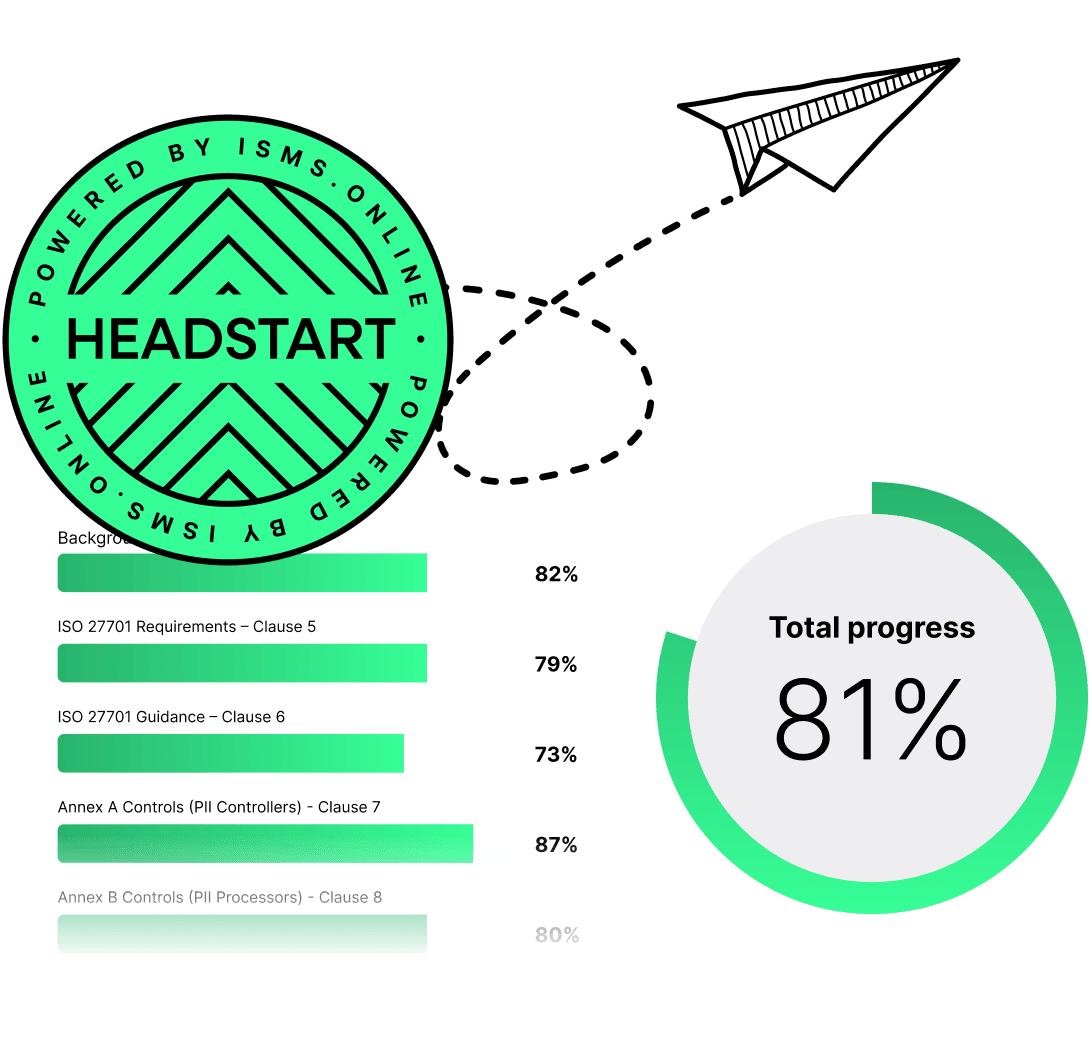
An 81% Headstart from day one
We’ve done the hard work for you, giving you an 81% Headstart from the moment you log on. All you have to do is fill in the blanks.
A Gaming‑Specific ISO 27001 / 27035 Incident Lifecycle
An ISO‑aligned incident lifecycle for gaming reuses the standard phases from ISO 27035 but tailors triggers, roles and evidence to game realities such as cheating, economy exploits and live events. The aim is to ensure every meaningful incident follows one coherent path from detection to learning, no matter where it starts or which team first sees the symptoms.
Prepare: define policies, roles, systems and training
Preparation is where you turn abstract standards into concrete expectations for your platform: who is in charge, what counts as an incident, which systems matter most and how people will be trained before the next crisis. Getting this right makes the rest of the lifecycle faster, calmer and more predictable for everyone involved, and it is more than a generic “incident response policy”. For a gaming platform it means:
- Clear definitions of what counts as a security incident versus an event.
- Documented roles: incident commander, technical leads, compliance and legal leads, player‑support lead, communications owner.
- An agreed severity model that considers technical impact, player impact, fairness, revenue and regulator exposure.
- An inventory of your critical systems, data stores and virtual economies.
- Training and exercises so people know their role before the next big incident.
ISO 27001 expects those elements to exist as documented information inside your ISMS, with Annex A controls around responsibilities, awareness and operations supporting them. For practitioners, that preparation is what turns late‑night chaos into a series of steps you recognise and can execute under pressure.
Detect and report: use game telemetry as well as traditional security signals
Detection in gaming has to blend traditional security tooling with deep game telemetry, because some of your most important signals are unusual behaviour, odd outcomes or economy anomalies rather than obvious attacks. Your process should make it easy for any of these signals to enter the incident queue in a consistent, ISO 27035‑aligned way, so you do not miss early warning signs.
In gaming, some of your most important incident signals come from game behaviour, not just firewalls and endpoint tools. Your detection layer should combine:
- Anti‑cheat events and unusual client behaviour.
- Abnormal match outcomes, win streaks or rankings.
- Economy anomalies: sudden inflation of a currency, item duplication patterns, abnormal trades.
- Authentication and access anomalies: unusual logins, geographic patterns, failed attempts.
- Payment and withdrawal anomalies: spikes in chargebacks, bonus abuse, laundering patterns.
- Player reports and trust‑and‑safety queues.
Your process needs a simple path from “something strange is happening” to “this is now an incident candidate under the ISMS”, with thresholds and responsibilities defined. For CISOs and live‑ops leaders, that blend of telemetry and process is what stops important incidents being lost in support queues or siloed tools.
Assess and classify: decide what really matters
Assessment turns noisy signals into clear priorities, so your teams invest effort where it matters most and engage legal, compliance and leadership at the right times. A written, repeatable classification model is essential if you want consistent decisions, defendable regulatory responses and fewer arguments during the first hours of a crisis.
Once something enters the incident queue, your triage model should quickly answer:
- What is affected: players, staff, partners, infrastructure, game logic, economies.
- How many players or transactions might be impacted.
- Whether personal data, payment data or regulated game outcomes are at risk.
- Whether this is likely to trigger legal or regulatory notification thresholds.
- Which teams and senior stakeholders need to be involved.
Some organisations adapt existing scoring schemes and add business‑specific factors such as tournament impact, jackpot integrity or minors’ accounts. The key is that classification rules are written down, repeatable and understood, so two similar events do not get wildly different responses because different people happened to be on‑call.
Contain and eradicate: stabilise the game without erasing evidence
Containment and eradication in gaming must protect players and game integrity while preserving enough evidence to understand what happened and demonstrate due diligence. Balancing emergency fixes with careful forensic handling is one of the clearest places where ISO 27001 and ISO 27035 expectations differ from a generic “keep it running” uptime culture.
Containment in gaming incidents has both technical and business dimensions:
- Blocking or rate‑limiting traffic during a DDoS without locking out legitimate players.
- Disabling or adjusting an exploited game feature while preserving enough data to understand the exploit.
- Temporarily freezing suspicious accounts or items without causing avoidable harm to innocent players.
- Isolating compromised services or environments while maintaining core gameplay elsewhere.
Eradication may involve patching server and client code, rotating keys and credentials, removing unauthorised tools, cleaning infected hosts or rebalancing an economy. Throughout, ISO 27001 expects you to protect logs and evidence so that later analysis, audits and legal steps are possible, and so that you can justify your choices if regulators review the incident.
Recover and learn: restore trust, not just uptime
Recovery is complete only when gameplay is fair, balances are correct, communications are honest and lessons are captured into your ISMS. A gaming platform that treats incidents this way steadily reduces both technical risk and regulatory exposure over time, instead of repeating the same failures in slightly different forms.
Recovery in gaming has a player‑facing dimension that many generic incident guides underplay. It usually includes:
- Safely restoring services and features.
- Validating that game state and virtual assets are consistent and fair.
- Correcting item balances, currencies and rankings where needed.
- Communicating clearly to players about what happened, what was done and what they should do.
- Working with payment providers on refunds, chargebacks and monitoring.
Post‑incident, ISO 27001 and ISO 27035 expect you to review root causes, update your risk register, adjust controls, refine playbooks and, where appropriate, capture lessons for game design and product roadmaps. Incidents should steadily reduce in both frequency and severity as that loop runs, and you should be able to show auditors and senior leaders how each major event changed your risk and control picture.
Roles, RACI and Cross‑Team Playbooks That Match Real War Rooms
Even the best lifecycle fails if nobody knows who is in charge, how decisions are made or where to find the next step. A gaming‑specific RACI model and a small set of battle‑tested playbooks turn war‑room chaos into coordinated response that auditors, regulators and your own leadership can clearly understand, even months after the event.
Assign clear ownership and decision‑making
A crisp ownership model stops arguments mid‑incident and tells regulators exactly who is accountable for what. Written roles and responsibilities aligned to ISO 27001 leadership and operations clauses also show that you treat incident response as a managed process, not an informal habit that varies by team or time of day.
A practical RACI for gaming incidents typically names:
- An incident commander who owns the overall response.
- Technical leads for security, platform, game backend and client.
- Leads for payments and fraud, where relevant.
- Compliance and legal leads who assess reporting duties.
- A player‑support or community lead responsible for frontline communication.
- A communications or PR lead for public statements.
- An executive sponsor for high‑severity cases.
For you as a CISO or security leader, this structure makes it much easier to brief boards and regulators on who decided what and when, rather than relying on vague references to “the team”. For live‑ops, SRE and game teams, it reduces ambiguity in stressful moments and avoids “everyone and no one” being in charge. Storing RACI charts and role descriptions inside your ISMS, and linking them to incident procedures, makes this governance visible to auditors and easy to keep current.
Build a severity model that operations and compliance both trust
A shared severity model ensures SREs, security, game teams and compliance treat the same situation with the same level of urgency. When the model is co‑designed and documented in the ISMS, it becomes far easier to explain why certain incidents triggered board briefings or regulator notifications while others did not, and you avoid endless debate about whether an event was “really” critical.
A usable severity framework in gaming ties together:
- Technical impact: systems affected, data involved, exploitability.
- Player impact: number of players affected, safety issues, minors.
- Game integrity: fairness of outcomes, tournament impacts, economy damage.
- Regulatory exposure: personal data, payment data, gambling rules, AML.
- Business impact: revenue, contractual penalties, brand risk.
When an event is scored against these factors, the severity should clearly drive:
- Who gets paged and how quickly.
- Whether leadership and the board are involved.
- Whether legal and compliance must assess notification thresholds.
If SREs, security and compliance view severity very differently, confusion is inevitable. The model should be co‑designed, tested in rehearsals and kept under change control in your ISMS, so everyone works from the same playbook and incident commanders can defend their choices.
Standardise a small number of high‑value playbooks
Playbooks capture what works in your most important incident types and make it usable by the next on‑call team. For regulators and partners, they demonstrate that you have thought about specific scenarios that matter in gaming, not just generic IT failures that could apply to any online service.
Most gaming platforms can start with playbooks for:
- Mass account takeover.
- Payment or card‑data compromise.
- Cheating or anti‑cheat bypass at scale.
- In‑game economy exploit or duplication bug.
- DDoS or targeted disruption during events.
- Personal data breach involving players or staff.
Each playbook should contain, at a minimum:
- Entry criteria and severity assumptions.
- Immediate stabilisation steps for each role.
- Key evidence to collect and protect.
- Questions that legal and compliance must answer.
- Decision points for notifying regulators, payment partners and players.
- Exit criteria and handover to post‑incident review.
An ISMS platform such as ISMS.online can hold those playbooks, link them to controls and obligations, and connect them to the rest of your ISMS so that updates are visible and traceable. For practitioners, this turns “what did we do last time?” into “open the playbook and follow the steps”, which is much easier to execute at three in the morning.
Align on‑call, third parties and rehearsal
Playbooks only work when the right people and partners are reachable and practised. Aligning on‑call patterns, vendor engagement and exercises with your ISMS keeps readiness from becoming a set of disconnected calendar invitations and one‑off documents that nobody revisits until something goes wrong.
Playbooks only work if the right people and partners are available and prepared. That means:
- Matching on‑call rotations to playbook needs, not just infrastructure layers.
- Documenting how to involve cloud providers, anti‑cheat vendors and payment processors during a live incident.
- Running regular simulations where all key roles practice together using the same tools and documents.
These rehearsals not only uncover gaps in plans; they also generate evidence that you take preparedness seriously, which regulators and auditors notice. When rehearsals are recorded as activities inside your ISMS, they become visible proof of Clause 7 (awareness and competence) and Clause 9 (performance evaluation) in action and show your leadership that incident readiness is actively managed, not left to chance.

Free yourself from a mountain of spreadsheets
Embed, expand and scale your compliance, without the mess. IO gives you the resilience and confidence to grow securely.
Mapping ISO 27001 Controls to Gaming Regulators and Schemes
Gaming platforms often face overlapping expectations from data‑protection authorities, gambling regulators, financial supervisors, payment schemes and key partners. Mapping ISO 27001 controls to these audiences gives you a single obligations register that guides incident response and helps you speak each regulator’s language. This discussion is informational, not legal advice; you should confirm obligations with qualified counsel in your jurisdictions.
For your legal, security and compliance teams, a clear mapping is the difference between scrambling to recall rules in the middle of an incident and calmly following agreed, documented paths that satisfy your licences and contracts.
Build a control → obligation → evidence matrix
A control‑to‑obligation matrix helps you show how your ISO 27001 controls support specific notification duties, licence conditions and partner requirements. It also clarifies which evidence you will need during investigations, so incidents are recorded with those expectations in mind rather than reconstructed later in a panic.
Start by listing the ISO 27001 clauses and Annex A controls most relevant to incidents, such as:
- Leadership and organisational roles.
- Risk assessment and treatment.
- Logging, monitoring and event management.
- Access control and authentication.
- Incident management controls.
- Business continuity and resilience.
- Compliance and legal requirements.
For each control, add:
- The regulators, schemes and partners that care about it.
- The specific obligations it helps satisfy (for example, breach notifications, key event reports, major incident reports).
- The evidence you will need in an investigation or audit (incident records, logs, minutes, approvals, reports).
This becomes your obligations register and a bridge between your ISMS and the outside world. An ISMS platform such as ISMS.online can make this matrix live by linking each obligation to controls, incidents and documents so that updates and evidence are always in one place.
For CISOs and practitioners, that same matrix shortens arguments during incidents. Instead of debating whether to notify, you can open the relevant row and see the thresholds, timelines and evidence requirements that were already agreed with legal and compliance.
Before you go deeper, a compact view of how incident types align with external expectations can help orient stakeholders.
| Incident type | Primary external audience | Typical obligations |
|---|---|---|
| Personal data breach | Data‑protection authority | Breach notification, follow‑up reports |
| Payment / card compromise | Schemes, acquirers, regulators | Card scheme rules, incident reports |
| Game integrity failure | Gambling regulator | Key event / security failure reports |
| Major platform outage | Gambling / financial regulator | Major incident or outage notifications |
| Fraud / AML pattern | Financial‑intelligence units | Suspicious‑activity reporting |
Cover privacy, cyber and gambling regimes together
Many major gaming incidents blend security, privacy and gambling‑integrity aspects, so trying to handle each regime in isolation leads to slow, inconsistent decisions. A unified view of thresholds, timelines and content requirements helps your legal and compliance teams support incident commanders quickly instead of arguing over which rulebook applies.
Many incidents in gaming have both security and privacy angles. Your obligations register should therefore:
- Capture when a personal‑data breach becomes notifiable to a data‑protection authority.
- Reflect cyber or network‑security regimes that require notification of “significant incidents”.
- Include gambling‑specific expectations for key events, security failures and loss of control over customer funds or data.
For each regime, document:
- The thresholds that make an incident notifiable.
- The timelines for notifying.
- The content required in notifications.
- Any expectations around follow‑up reports.
That way, when an incident happens, compliance and legal are not trying to re‑derive these rules from scratch, and you can give incident commanders fast, consistent advice.
Add AML, fraud and player‑protection triggers
Some incident patterns span security, fraud, anti‑money‑laundering (AML) and safer‑gambling obligations, so your mapping should make it clear when additional regulators or teams must be involved. This prevents parallel, uncoordinated responses that undermine both effectiveness and credibility in the eyes of authorities and partners.
In many jurisdictions, account takeover and payment abuse can be both a security incident and a financial‑crime concern. Your register should therefore:
- Link certain incident patterns to suspicious‑activity reporting thresholds.
- Document who decides when to involve financial‑intelligence units or other bodies.
- Recognise when incidents affect responsible‑gambling controls or protections for minors.
This ensures that security, fraud, AML and safer‑gambling teams respond in a coordinated fashion rather than in parallel silos, and that regulators see a coherent, joined‑up operator rather than disconnected departments.
Keep the mapping alive as laws and standards change
Your obligations register only protects you if it reflects current law and scheme rules. Treating it as part of ISO 27001 change management, with clear ownership and review cycles, helps you show regulators that you track change systematically rather than reacting late to new requirements.
Regulations, schemes and standards evolve. ISO 27001 itself was revised in 2022. To stay current you will need:
- A clear owner for the obligations register.
- A review cycle that considers new or changed rules.
- A simple way to update playbooks and controls when obligations change.
- A record of when each mapping was last reviewed and by whom.
Treat this as part of your ISMS change‑management process, not a one‑off project. For operational leaders, that discipline also reduces surprises; when new rules arrive, you update the matrix once and then adjust playbooks and training, instead of discovering gaps during a live incident review.
Timelines, Decision Points and Communication Across Stakeholders
In a serious incident you are not just solving technical problems; you are racing a set of overlapping clocks for regulators, schemes, partners and players. Encoding those clocks and decision points into your ISMS in advance lets you act calmly during real incidents instead of arguing about deadlines in the middle of the night or relying on someone’s memory of an old licence condition.
Understand and encode the main notification clocks
Most gaming organisations answer to several authorities, each with its own triggers and timelines, so relying on memory is a recipe for late or incomplete notifications. You need simple, written decision paths that convert impact and geography into clear “who, when and how” answers during the first hours of an incident, using your existing control‑to‑obligation matrix as a reference.
While details vary by jurisdiction, most gaming companies need to handle some combination of:
- Personal‑data breach notification to supervisory authorities, often “without undue delay” and within a set number of hours where feasible.
- Notification to affected individuals when a breach creates high risk to them.
- Incident or key‑event reports to gambling regulators when customer data, funds or game integrity are affected.
- Major incident reports to financial regulators or competent authorities for certain payment or critical‑infrastructure outages.
- Rapid notification to acquirers or payment providers if card or payment data may have been compromised.
- Contractual notification to key partners or white‑label clients.
Rather than relying on memory, you create decision trees that:
- Take incident type, impact and geography as inputs.
- Indicate which authorities and partners are potentially in scope.
- Highlight the starting point of each notification clock.
- Show who must be consulted and who can approve.
For CISOs and practitioners, those decision trees are what turn vague anxiety about “timelines” into a checkable list: you can see which clocks started when and what must happen before each one expires.
Step 1 – Map your clocks and triggers
Identify your key regimes (data‑protection, gambling, payment, financial, contracts) and document, in one place, their main thresholds and timelines.
Step 2 – Design simple decision flows
For each regime, create a short flow that links incident type and impact to “notify / consider / no notification” outcomes, with named approvers.
Step 3 – Link flows into your ISMS
Store these flows in your ISMS, attach them to incident playbooks and review them when laws, licences or contracts change.
A small set of practical steps like these makes complex time pressure feel manageable and reduces the chance of late or inconsistent reporting.
Coordinate with payment providers and schemes
Payment incidents often have the strictest forensic and reporting expectations, so involving providers and schemes must be planned, not improvised. Clear criteria, contacts and evidence requirements let your teams move quickly while showing that you respect both regulatory and contractual duties and understand your shared responsibilities.
Payment incidents can be complex because they involve both regulatory rules and contractual duties. A practical model usually includes:
- Criteria for deciding when a payment‑related event is security‑relevant.
- A short list of contacts at acquirers, processors and schemes.
- A description of the forensic and logging requirements expected by those parties.
- Clear responsibilities for ongoing communication, remediation updates and validation of fixes.
Integrating these steps into your main incident runbooks avoids late surprises when card or wallet issues are discovered and reassures partners that you understand your shared obligations. Using your obligations register as the anchor ensures your payment playbooks and notification flows stay aligned when schemes update their expectations.
Plan player‑facing and public communication in advance
Player‑facing communication shapes trust, complaint volumes and how regulators interpret your intent, so it deserves as much planning as your technical response. Templates and review paths help you move quickly without making avoidable statements that need to be corrected later, and they give support teams confidence that they are saying the right things.
Your incident communications to players and the wider public influence:
- Trust and churn.
- Complaint volumes.
- How regulators and the media perceive your response.
Good practice includes:
- Template messages for common scenarios (account takeover, data breach, outage with loss of progress).
- A simple process for localisation and legal review.
- Guidance for support teams about what they can say and how to escalate unusual questions.
- Rules for timing: early acknowledgement, followed by more detail as facts are confirmed.
You should also clarify when, if ever, incidents should be kept confidential to protect investigations or prevent further harm, and how that aligns with your legal duties and licence conditions. For operational teams, having these scripts ready removes the fear of “saying the wrong thing” at the worst possible moment.
Engage law‑enforcement and other authorities appropriately
Some incidents cross the line from technical failure into criminal behaviour or serious financial crime, and regulators increasingly expect you to cooperate appropriately. Pre‑agreed triggers and processes help you support investigations while still protecting player data and your own legal position, rather than leaving staff to guess whether they should call external agencies.
Some incidents, especially those involving organised fraud or criminal behaviour, require engagement beyond regulators and schemes. Your process should answer:
- Which patterns and thresholds justify involving law‑enforcement or financial‑intelligence units.
- Who can authorise such engagement.
- How you protect evidence and maintain chain of custody.
- How you avoid sharing unnecessary personal data while still supporting investigations.
These decisions are easier and more defensible when they are pre‑agreed rather than improvised in the moment, and when your legal and compliance teams have helped design the thresholds and scripts. For CISOs and practitioners, that clarity also reduces personal anxiety about over‑ or under‑reacting.

Manage all your compliance, all in one place
ISMS.online supports over 100 standards and regulations, giving you a single platform for all your compliance needs.
Using ISO 27001 to Reduce Fines and Enforcement Risk in Gaming
ISO 27001 cannot guarantee you will avoid fines or licence action, but it can strongly influence how regulators judge your organisation before and after an incident. When you can demonstrate appropriate measures, clear governance and visible learning, you shift the conversation from “negligence” towards “serious operator managing difficult risks”, which can make a real difference to enforcement outcomes.
Show that “appropriate measures” were in place before the incident
Many enforcement decisions revolve around whether your safeguards were proportionate to your services, data and user base, and they often turn on whether your organisation had done enough in advance, given the nature of your services, the types of data and transactions involved, and the scale and profile of your user base. Being able to show a structured risk assessment and justified control set under ISO 27001 is often more persuasive than pointing to individual tools or one‑off projects that happen to be in place.
An ISO 27001‑aligned ISMS gives you a way to show:
- Documented risk assessments for key systems and processes.
- A justified selection of controls, including those for incident detection and response.
- Evidence of testing and monitoring of those controls.
- Training and awareness programmes for staff.
Certification can help, but even without it, a well‑run ISMS and audit trail are powerful arguments that you were not negligent. For CISOs and practitioners, this also means you can point to a living system rather than a stack of spreadsheets when executives ask, “Are we doing enough?”
Demonstrate strong governance and accountability
Regulators usually look early at who was responsible, what information leadership had and how decisions were made. ISO 27001’s emphasis on roles, management reviews and internal audits supports a governance storey where incidents are taken seriously, tracked and used to drive change rather than quietly minimised or forgotten.
Regulators look beyond technical detail to governance. They want to see:
- Clear roles and responsibilities for security, privacy and incident response.
- Regular management reviews that consider incidents, risks and performance.
- Internal audit or independent assessments that test controls.
- Evidence that board and senior leadership take information security seriously.
Linking serious incidents to board decisions, policy changes and resource allocations shows that you treat them as drivers of improvement, not just unfortunate events. That narrative can be decisive when authorities decide whether you fell short of your duties or are a responsible operator dealing with complex risks.
Connect incidents to wider resilience and player protection
Gaming authorities are increasingly concerned with service reliability, protection of vulnerable players and prevention of fraud, so showing how your ISMS connects incidents to these wider goals can significantly improve your standing. It signals that you understand your social responsibility, not just your technical obligations, and that incident response supports safer play as well as platform stability.
In gaming, authorities are increasingly focused on:
- Reliable access to regulated services.
- Protection of vulnerable players.
- Prevention of fraud and financial harm.
If you can show that your incident response is integrated with:
- Business‑continuity planning and tested recovery strategies.
- Controls for responsible gambling and player protection.
- Fraud and AML systems.
you strengthen your position. It becomes clear that you are managing risks holistically rather than treating regulations as isolated boxes to tick. For operational teams, that integration also means your investments in resilience and safer‑gambling tooling count as part of the same risk storey rather than as separate, competing projects.
Turn post‑incident reviews into visible improvements
After serious incidents, regulators tend to ask first what you learned, what you changed and how you will prevent the same failure happening again. An ISO 27001‑aligned improvement loop lets you answer those questions with specific actions, owners and dates rather than vague intentions, and it gives you a track record you can show in future audits.
After a significant incident, regulators and auditors will often ask:
- What did you learn?
- What did you change?
- How will this prevent recurrence or reduce impact?
An ISO 27001‑aligned approach expects you to:
- Record root causes and contributing factors.
- Track corrective and preventive actions.
- Re‑assess residual risk and treatment plans.
- Verify that new controls work.
Being able to show that loop in action can materially influence how enforcement bodies respond. A simple “before and after” picture of risk ratings and implemented controls for a major incident can make the impact very clear to non‑technical stakeholders. For CISOs, that evidence also strengthens your case in budget and prioritisation discussions with the board.
Book a Demo With ISMS.online Today
Booking a demo with ISMS.online lets you see how an ISO 27001‑aligned, gaming‑aware ISMS can turn fragmented incident response into a structured capability that regulators respect and players can trust. Rather than discussing frameworks in the abstract, you see how real risks, controls, incidents and obligations join up in one environment that fits the way your platform actually runs.
See your current incidents through an ISMS lens
A focused, scenario‑based session lets you replay a recent incident and watch how it would flow through a structured ISMS: from detection to triage, approvals, evidence capture and potential notifications. That shared view helps security, live‑ops, compliance and leadership align on what “good” actually looks like for your platform, based on situations you already recognise.
In a short, scenario‑based session you can:
- Replay a recent incident and see how it would map to risks, controls, evidence and notifications.
- Explore how incident records, approvals and decisions are captured for audit and regulatory review.
- Identify gaps between your current way of working and what a structured ISMS can support.
That makes the benefits tangible for security, SRE, compliance and executives at the same time, and gives you a neutral way to test whether ISMS.online is a good fit before you commit to any change.
Connect your existing tools to a structured backbone
ISMS.online sits alongside your existing detection, ticketing and collaboration tools and gives them a shared spine for governance and evidence, rather than trying to replace them. Incidents, audits and rehearsals become connected objects instead of scattered logs, screenshots and chat fragments, which makes life easier for both practitioners and auditors.
Most gaming organisations already use a mix of:
- Detection tools and telemetry.
- Ticketing and on‑call tools.
- Collaboration and chat platforms.
An ISMS platform such as ISMS.online does not replace those tools; it orchestrates them. You can:
- Trigger ISMS workflows from alerts and tickets.
- Link incidents to controls, risks and obligations automatically.
- Generate reports for auditors and regulators from the same underlying records your teams already use.
That way, every serious event leaves behind a clean evidential trail instead of scattered screenshots and chat logs, and your auditors and regulators see a coherent storey rather than fragments that need to be reassembled under time pressure.
Turn rehearsal and improvement into evidence, not just intention
An effective ISMS turns tabletop exercises, simulations and post‑incident reviews into concrete proof that you prepare, learn and improve. For gaming, that means you can walk regulators through a clear history of how major events shaped your controls, playbooks and design choices, rather than relying on verbal assurances or slide decks that are hard to verify.
A good ISMS platform helps you treat:
- Tabletop exercises.
- Live simulations around major events.
- Post‑incident reviews.
as first‑class objects. You can schedule, run and record them inside the same system that holds your policies, risks and incidents. When auditors and regulators ask how you prepare and improve, you can show them more than a summary report: you can show them the actual history of decisions, approvals and changes.
If you want your gaming platform to look disciplined and trustworthy in front of regulators, payment partners and players, and to move beyond ad‑hoc scrambling towards a structured, ISO 27001‑aligned incident capability, booking an ISMS.online demo can be a practical way to test how well this approach fits your current incidents and regulatory pressures before you decide on your next step.
Book a demoFrequently Asked Questions
How should an online gaming platform structure ISO 27001–aligned incident response from detection through recovery?
You structure incident response around a small number of clearly defined phases that match real gaming incidents and can be evidenced in your ISMS.
Which lifecycle phases make sense for online gaming incidents?
A practical ISO 27001–aligned lifecycle for an online gaming platform usually includes six phases:
-
Preparation
You agree what “security incident” means in your game world and who leads when something breaks. Typical categories include large‑scale cheating, in‑game economy exploits, account‑takeover waves, fraud spikes, DDoS attacks and personal‑data breaches. You define severity levels, RACI, playbooks and escalation paths, then rehearse them. This supports ISO 27001 clauses 4–7 and Annex A.5.1–A.5.2, A.5.24–A.5.30 and A.8.14. -
Detection and reporting
You bring traditional security telemetry (SIEM, WAF, EDR, cloud logs) and game‑specific signals (anti‑cheat alerts, abnormal match outcomes, impossible movements, trading rings, payment anomalies, player reports) into a single triage channel. Anything serious – from infrastructure logs to in‑game chat – can enter the same pipeline. That aligns with Annex A.5.7 and A.8.15–A.8.16. -
Assessment and classification
You score events against dimensions that matter in gaming: technical impact, player impact, game integrity, regulatory/contractual exposure and commercial impact. This lets you separate noise from true incidents and tie severity levels to notification duties and crisis modes, supporting ISO 27001 risk assessment and treatment (6.1) and Annex A.5.7, A.8.8. -
Containment and eradication
You stabilise play and protect players while preserving evidence. In practice that means blocking cheat clients, freezing suspicious assets, isolating services, rotating secrets and capturing forensics before making major changes. Runbooks are built with SRE/live‑ops and payments so fixes don’t cause more disruption than the attack. -
Recovery
You restore services on hardened infrastructure, correct corrupted states and balances, coordinate reversals or chargebacks and plan any make‑goods for players (credits, reruns, cosmetics) against clear criteria. Recovery links to your business‑continuity plans and Annex A.5.29–A.5.30 and A.8.14. -
Post‑incident review and improvement
Within a set timeframe you run a structured review, update risks and the Statement of Applicability, refine controls and detection logic, adjust game design where needed and track corrective actions to closure. This closes the loop with ISO 27001 clauses 9 and 10.
When these stages are defined in your ISMS, your next cheating wave or payment compromise feels like a known script rather than a fresh crisis. If your current “war rooms” mostly live in chat logs and people’s memories, codifying this lifecycle inside a platform such as ISMS.online gives you a shared language, repeatable flow and evidence trail across titles, studios and regions.
How can a gaming platform map ISO 27001 clauses and controls to post‑incident regulatory reporting duties?
You create a concise register that links each relevant ISO 27001 control to the specific notification rules, decision‑makers and evidence you need when an incident occurs.
How do you turn standards and rulebooks into a practical register?
Instead of relying on scattered contracts and legal notes, you normalise obligations into one structure inside your ISMS:
- Row: scenario or obligation (for example, EU player data breach, “key event” under a particular gambling licence, card‑scheme incident).
- Columns: standard/control reference, applicable regulator or scheme, trigger description, notification deadline, decision owner, minimum evidence, status.
This keeps interpretation with legal and compliance teams while giving incident commanders a working tool that can be used in a live situation.
Which regulators and frameworks typically matter for gaming operators?
Most online gaming companies face a mix of:
- Data‑protection authorities (GDPR/UK GDPR, CCPA/CPRA, LGPD and other privacy laws).
- Gambling and wagering regulators by jurisdiction.
- Cyber‑ or operational‑resilience supervisors if you are classified as a critical or important entity.
- Card schemes and acquirers (PCI DSS plus scheme‑specific incident rules).
- Key partners, white‑label clients and marketplaces under contract.
For each, you record the notification triggers, timelines and reporting channels and map them to affected products, brands and territories so the right rules surface when a specific incident is raised.
How do you connect ISO 27001 controls to those obligations in practice?
You identify the ISO 27001 clauses and Annex A controls that drive detection, assessment and notification decisions, for example:
- Roles and responsibilities (clause 5; A.5.2, A.5.4).
- Risk management around accounts, payments, economies and live‑ops (clause 6; A.5.7, A.8.8).
- Logging and monitoring (A.8.15–A.8.16).
- Access control and secure development (A.5.15–A.5.18; A.8.25–A.8.28).
- Incident handling and continuity (A.5.24–A.5.30; A.8.14).
- Legal and contractual compliance (A.5.23; A.5.31–A.5.36).
For each control you capture which notification duties it underpins, who can decide whether a threshold is crossed (for example, DPO, compliance head, CISO, MLRO) and which artefacts show you met the requirement (incident records, DPIAs, logs, licence clauses, notification copies, board minutes).
With this mapping living in your ISMS, an incident commander can open a single entry from within the incident record and see which rulebooks apply, what the deadlines are and what must be recorded. Platforms like ISMS.online make that link explicit so you are not relying on who happens to be on shift to remember when to call which regulator.
What timelines and decision points should gaming companies define for notifying regulators, payment providers and players?
You define notification clocks, decision trees and sign‑offs in advance so incident teams are following a playbook rather than debating fundamentals under pressure.
How do you design notification timing and triggers across audiences?
A workable design for a gaming operator usually includes four elements:
- A consolidated schedule of notification clocks
You maintain a short schedule of timeframes for:
- Data‑protection authorities (for example, “without undue delay” and any specific hour/day expectations once you are aware).
- Gambling regulators’ “key event” or integrity‑failure notifications.
- Cyber‑resilience or critical‑infrastructure obligations where applicable.
- Card‑scheme and acquirer rules when card data or flows may be affected.
- Contractual deadlines in major B2B or publishing agreements.
- Decision trees per audience
For data‑protection authorities, gambling regulators, acquirers, partners and players you build small trees that ask:
- What data and systems are affected, and in which jurisdictions?
- Is there realistic risk to individuals, funds, integrity of competitive play or regulated markets?
- Do explicit thresholds in laws, licences or contracts apply?
- Are there ordering or coordination constraints (for example, regulator before players; law‑enforcement before public disclosure)?
These trees are attached to your incident playbooks in the ISMS so they can be followed directly from incident records.
-
Clear authority and escalation rules
You define who can decide an incident is non‑notifiable, who must sign different notifications, when to involve legal counsel or law‑enforcement and how all of that is logged. That supports both Annex A.5.24–A.5.28 and ISO 27001 clauses 9 and 10. -
Maintained templates and channels
You keep current templates for:
- Notifications to regulators and schemes.
- Player‑facing communications across email, in‑game messaging and status pages.
- Internal briefings for executives, the board and key partners.
In your ISMS these templates are linked to thresholds, owners and approval paths so teams can adapt and send them quickly without starting from a blank page.
When these clocks, trees and approvals live in a system like ISMS.online and are linked to the risks and controls you already manage, your teams can move rapidly without either over‑notifying or missing a disclosure that would create licence or enforcement risk.
How does ISO 27001 help gaming companies reduce fines and licence risk when incidents are reported?
ISO 27001 cannot guarantee you avoid fines, but it can strongly influence how regulators and schemes assess whether you acted responsibly before, during and after an incident.
Which aspects of an ISMS most affect enforcement outcomes?
Supervisors tend to look at three areas where an ISO 27001‑aligned ISMS gives you tangible advantages:
- Preparedness before the incident
They want to see that you:
- Understood the specific risks around your accounts, payments, in‑game economies, tournaments, chat and infrastructure.
- Chose and implemented controls proportionate to those risks rather than simply copying a checklist.
- Documented incident and continuity procedures, assigned responsibilities and provided training.
- Tested your plans through exercises or simulations.
ISO 27001 helps you demonstrate this through structured risk assessments, a Statement of Applicability, policies, records of training and exercises and clear Annex A mappings.
- Quality of response during the incident
They review how effectively you:
- Detected and confirmed the issue relative to your monitoring capabilities.
- Contained the impact on players, markets and systems.
- Preserved relevant logs and evidence instead of wiping or rebuilding too quickly.
- Met legal and contractual expectations for notifications.
- Communicated candidly about impact and remediation without misleading statements.
With ISO 27001‑aligned incident procedures and detailed records (timestamps, decisions, approvals) in your ISMS, you can reconstruct the timeline and show reasoned decision‑making rather than improvisation.
- Governance and learning after the incident
They look for:
- Documented root‑cause and contributing‑factor analysis.
- Corrective and preventive actions with owners and due dates.
- Updated risks, controls and designs where needed.
- Evidence that senior leadership and the board have engaged and endorsed changes.
ISO 27001 clauses 9 and 10, supported by Annex A controls, make this traceable through post‑incident reviews, change logs, management‑review minutes and updated SoA entries.
For a gaming operator, the same incident can lead to very different regulatory outcomes depending on whether you can evidence diligence across these three areas. Using ISO 27001 as the backbone for your incident handling, and recording that work in an ISMS, helps you show that any weaknesses exposed were addressed systematically rather than ignored.
What evidence and metrics should a gaming platform keep to prove ISO 27001–compliant incident response?
You maintain a compact but well‑structured evidence set that covers scope, incidents, technical artefacts, risk decisions and improvements, all cross‑referenced in your ISMS.
Which evidence categories matter most in practice?
For an online gaming operator, five categories usually give auditors and regulators what they need:
- Governance and scope
- ISMS scope statement explicitly including games, platform services, studios, live‑ops and key suppliers.
- Risk‑assessment methodology and risk registers focusing on accounts, payments, economies, tournaments and chat.
- Statement of Applicability, with incident‑related and monitoring controls clearly marked.
- Documented incident, business‑continuity and crisis‑communications procedures with severity scales and RACI.
- Incident records
For each significant incident:
- Timestamps for detection, triage, classification, escalation, containment, recovery and closure.
- Severity rating and impact assessment across players, systems, regulators, schemes and partners.
- Named roles of decision‑makers and approvers.
- Actions taken, covering technical changes, game‑design adjustments and communications.
- Links to notifications sent to authorities, payment schemes, partners and players.
- Technical logs and forensic artefacts
- Authentication and session logs.
- Game server, matchmaking, anti‑cheat and economy service logs.
- Payment, fraud‑detection and withdrawal workflow logs.
- Cloud and network traces, including DDoS and WAF data.
These are referenced from incident records so reviewers can trace from signal to decision.
- Risk and privacy assessments
- Pre‑incident risk assessments and DPIAs explaining control choices.
- Post‑incident reviews of residual risk, changes to priorities and design decisions.
- Improvement and governance records
- Root‑cause and lessons‑learned reports.
- Corrective and preventive action lists with status tracking.
- Policy, standard and baseline updates.
- Management‑review and board minutes capturing discussion and decisions.
Which metrics help demonstrate maturity over time?
You keep a small, stable set of metrics that you can discuss with auditors and leadership:
- Time to detect and contain high‑severity incidents (typical and worst case).
- Percentage of high‑impact incidents with a completed post‑incident review and closed actions.
- Percentage of notifications sent within legal, scheme or contractual timeframes.
- Trend in repeat incidents caused by the same root cause.
- Completion rate for incident‑related training and exercises for key roles.
When evidence and metrics live in an ISMS instead of scattered file shares and chat threads, you can answer “what happened, when, who decided and what changed afterwards” with confidence. Platforms like ISMS.online are designed to hold exactly this mix of records so your incident storey is easy to follow for auditors, regulators and major partners.
How can an ISMS platform like ISMS.online simplify ISO 27001 incident response and reporting for gaming operators?
An ISMS platform gives you one place to model your gaming‑specific incident lifecycle, link it to ISO 27001 controls and manage incidents, obligations and evidence from first alert through review.
What changes when you manage incidents inside an ISMS platform?
For most gaming operators, three shifts have the biggest impact:
-
From ad hoc war rooms to visible workflows
You model phases such as cheat detection, fraud spikes, service outages and data breaches as workflows, each tied to ISO 27001 controls, roles and procedures. Incident commanders follow the same playbook across titles and regions, and you can show that consistency to auditors and licensors. -
From scattered artefacts to a single context
Each incident record holds severity, decisions, approvals and notifications and links directly to:
- Relevant risks and controls in your ISMS.
- Your control–obligation–evidence register for regulators, schemes and partners.
- Technical logs, DPIAs, change tickets, management‑review minutes and training records.
One structured record can support an ISO 27001 surveillance audit, a gambling regulator enquiry and a data‑protection investigation without rebuilding the storey three times.
- From memory‑based decisions to guided actions
When notification schedules, decision trees and templates are stored alongside incidents, teams see thresholds, owners, deadlines and wording where they work, instead of digging through folders or past emails. Workflow rules enforce completion of key fields, trigger reminders for reviews and track corrective actions to closure.
By replaying a recent major incident inside ISMS.online and mapping each step to controls, obligations and evidence, you can quickly see where confusion or gaps appeared – and then harden those weak points. That perspective helps you move from “we got through it” to “we can prove to auditors, regulators and partners that we handled it well and we are better prepared for the next one.”
If you want incident response to become a source of confidence with players and regulators rather than a constant worry, putting ISO 27001 and an ISMS platform at the centre of how you handle incidents is one of the most reliable ways to get there.






