





































When Traffic Spikes Become Security Incidents
Traffic spikes become security incidents when they hide attacks inside legitimate volume and multiply the impact of small configuration errors. ISO 27001 A.8.20 matters because it asks whether your network can still enforce boundaries, see abnormal behaviour and stay available when traffic is five or ten times higher than usual, especially during major matches and promotions.
High‑volume gaming and betting platforms live on the edge of performance and risk: the same surges that delight commercial teams can quietly overwhelm controls and expose gaps in network security. During a major match or tournament, login bursts, in‑play bets, odds updates, streaming, bonuses and partner APIs all intensify at once. Attackers know this and time credential‑stuffing, probing and targeted DDoS so they blend into what looks like successful marketing.
Big nights reveal the risks that quiet days politely hide.
In a quiet hour, it is relatively easy to notice suspicious behaviour or a misconfigured rule. On derby night, SOC analysts see dashboards pinned at maximum, queues forming on key links and alerts triggering faster than they can be triaged. A.8.20 effectively asks whether your network can still separate signal from noise when the volume dial is turned to maximum.
Traffic spikes are also when weaknesses in basic hygiene show up. If inventories and network diagrams are outdated, incident responders cannot say with confidence which zones, hosts or services are actually exposed. That leads to over‑broad mitigations, such as blocking entire regions or products, or to delays while people reverse‑engineer flows from logs. Under A.8.20, that lack of visibility is itself a non‑conformity: you are expected to know how the network is structured and which parts are critical long before an event.
Many gaming operators still rely on legacy “flat network plus perimeter firewall” patterns that grew organically around early products. In those setups, a single misconfiguration during a busy event can bridge player‑facing components, back‑office tools and even payment connectivity in one step. By contrast, a zoned design aligned with A.8.20 isolates gaming traffic from payments, administration and corporate IT, so that a failure or attack in one area has a defined blast radius.
Marketing and commercial teams unintentionally add risk when new landing pages, promo microsites or affiliate integrations are rushed live through informal channels. Each new endpoint introduces fresh inbound paths, DNS entries and content flows that may never pass through the same design, risk and firewall review that core products receive. A.8.20 expects those paths to be within the designed network architecture, not tacked on at the edge.
Finally, spikes expose fragility in monitoring. If logging and telemetry pipelines have not been sized and tested for event traffic, they may silently drop data or fall behind just when you need timely insight. From an A.8.20 perspective, it is not enough to have tools in place; they must remain effective under the real operating conditions of the business, including peak nights and global promotions. Recent ISO 27001 and gaming licence assessments increasingly ask how operators prove that network controls and monitoring hold up under those conditions.
Visual: Side‑by‑side diagram contrasting “quiet hour” vs “event night” network behaviour.
To make the difference between quiet periods and major events concrete, it helps to compare how the same network behaves in each case:
| Aspect | Quiet hour | Event night |
|---|---|---|
| Signal‑to‑noise | Suspicious patterns stand out | Attacks blend into high baseline volume |
| Monitoring workload | Alerts manageable; manual triage viable | Dashboards flood; triage must be prioritised |
| Change risk | Small changes easy to roll back | Missteps propagate quickly across busy systems |
| Attacker opportunity | Limited cover for noisy techniques | Cover for DDoS, stuffing and probing |
These contrasts show why A.8.20 focuses so strongly on network boundaries, capacity and monitoring under stress.
Information here is general and does not replace professional legal, regulatory or technical advice for your specific environment.
Why event traffic is a security problem, not just a capacity problem
Event‑night traffic is a security problem because it raises both the likelihood and the impact of mistakes or attacks at the network layer. A spike multiplies every underlying weakness in segmentation, routing, firewall design and monitoring, turning what would be a minor issue on a quiet day into a visible outage or breach. When every control is working at its limit, a mis‑ordered firewall rule, an over‑permissive security group or a poorly tuned rate limit that seems harmless at everyday volumes can overload backends, expose internal services or create self‑inflicted denial‑of‑service when traffic surges. At the same time, attacks that would stand out at modest volumes blend into peaks that your own marketing team has worked hard to create.
High concurrency amplifies the effect of small configuration errors. A mis‑ordered firewall rule that is unnoticed at one thousand requests per minute can saturate a backend or expose an internal service at one hundred thousand. Likewise, DDoS or brute‑force attempts that would be trivial to spot on a normal day can blend into a peak that marketing has been pushing for months. Thinking about traffic peaks through the lens of A.8.20 means designing network boundaries, controls and observability for the highest credible load, not for the average Tuesday afternoon.
Where flat networks break during spikes
Flat networks break during spikes because they lack clear boundaries, so you cannot protect critical flows without disrupting everything that shares the same segment. The result is either over‑broad emergency changes or hesitation that lets issues grow during your busiest and most visible moments.
Flat networks tend to collapse architectural distinctions between game engines, odds calculation, account management, payment connectivity and internal tools. When traffic spikes, that lack of separation makes it very hard to protect the most sensitive or time‑critical flows without affecting everything else.
During a spike, every rule and route is working harder. In a flat network, it is difficult to apply targeted mitigations such as limiting promotional endpoints, throttling high‑risk APIs or isolating a noisy region because the necessary boundaries are not present. Operators either pull very broad levers that hurt player experience across the board, or they wait and hope the problem subsides. A.8.20 pushes you toward a different model: multiple well‑defined zones with clear trust boundaries and known dependencies, so that high‑volume gaming can continue inside its own protected segment while other issues are contained elsewhere.
Book a demoWhat ISO 27001 A.8.20 Actually Demands
ISO 27001:2022 Annex A.8.20 expects you to design, configure, manage and monitor your networks so that information stays confidential, accurate and available, even under stress. For gaming and betting operators, that means treating the network as a governed system with clear zones and boundaries, justified connections and evidence that those decisions work in practice during real events.
In plain language, most practitioners break A.8.20 into four expectations:
- Defined network architecture: – zones, boundaries and key data flows are documented and agreed.
- Controlled crossings between zones: – gateways and rules enforce least privilege and are reviewed.
- Secured network devices: – routers, firewalls and similar components are hardened and maintained.
- Monitored network activity: – meaningful logs and alerts allow detection and investigation.
The control does not prescribe a specific technology stack, but it does assume that decisions are risk‑based. A small internal reporting tool does not need the same intensity of controls as a public betting API or a card‑processing segment. Your risk assessment should identify which parts of the network carry real‑time bets, personal data, payment credentials or trading tools, and A.8.20 expects stronger design and monitoring around those paths.
These network‑security decisions also connect to capacity, logging and network‑service controls elsewhere in ISO 27001. You design and operate the network as a single system, not a collection of devices.
For cloud and hybrid environments, the control extends across virtual networks, peering, managed firewalls, VPNs and service‑provider features such as DDoS protection. You cannot assume provider defaults are adequate; you are expected to understand how those features work, how they are configured and how they are monitored, and then incorporate that into your ISMS.
Finally, A.8.20 has an evidence dimension. Auditors will look for more than a diagram in a slide. They will expect change records for firewalls and routing, reviews of rulesets, records of capacity and resilience tests and samples of how network events have been detected and handled in practice. An ISMS platform such as ISMS.online can make this manageable by linking your network map, risks, Annex A controls and supporting evidence into one governed view.
Translating A.8.20 into a simple mental model
A.8.20 becomes easier to explain and implement when you translate it into a handful of practical questions that non‑technical stakeholders can understand. This keeps the control practical, grounds debate in clear trade‑offs and helps you use it as a design tool rather than just an audit checklist.
Those four questions are:
- What is the map of your network zones and main paths?:
- Which crossings between zones are allowed, and why?:
- Which devices enforce those decisions, and are they trustworthy?:
- Can you see enough of the traffic to spot trouble and answer questions?:
For a betting operator, that map will show at least an internet edge, public web and API tiers, gaming and odds engines, data stores, payment or PCI‑scoped areas, administration tools and staff networks. Each arrow between those blocks is a potential control point that supports or undermines A.8.20. Framing the control in this way keeps it concrete and gives executives a simple way to ask whether network changes still fit the agreed model.
How A.8.20 links to other key ISO 27001 controls
A.8.20 stands alongside other controls that shape how your network behaves under real‑world pressure. Seeing them as a family helps you avoid narrow fixes that look strong on paper but fail on big nights.
Capacity management influences whether your network and its controls can tolerate tournament‑level spikes without collapsing. Logging and monitoring define how much context you have when investigating strange traffic patterns. The control on security of network services covers how you select, contract and oversee providers such as cloud networks, CDNs or managed DDoS services that sit in front of or inside your architecture.
Treating these controls as one family changes the conversation. Instead of arguing about a single firewall change in isolation, you can ask whether the change is consistent with the agreed network map, with the provider responsibilities you have documented, with the monitoring your SOC can realistically deliver and with the capacity plan you rely on for big events. That is the type of joined‑up thinking auditors and regulators expect to see when assessing your A.8.20 implementation.
ISO 27001 made easy
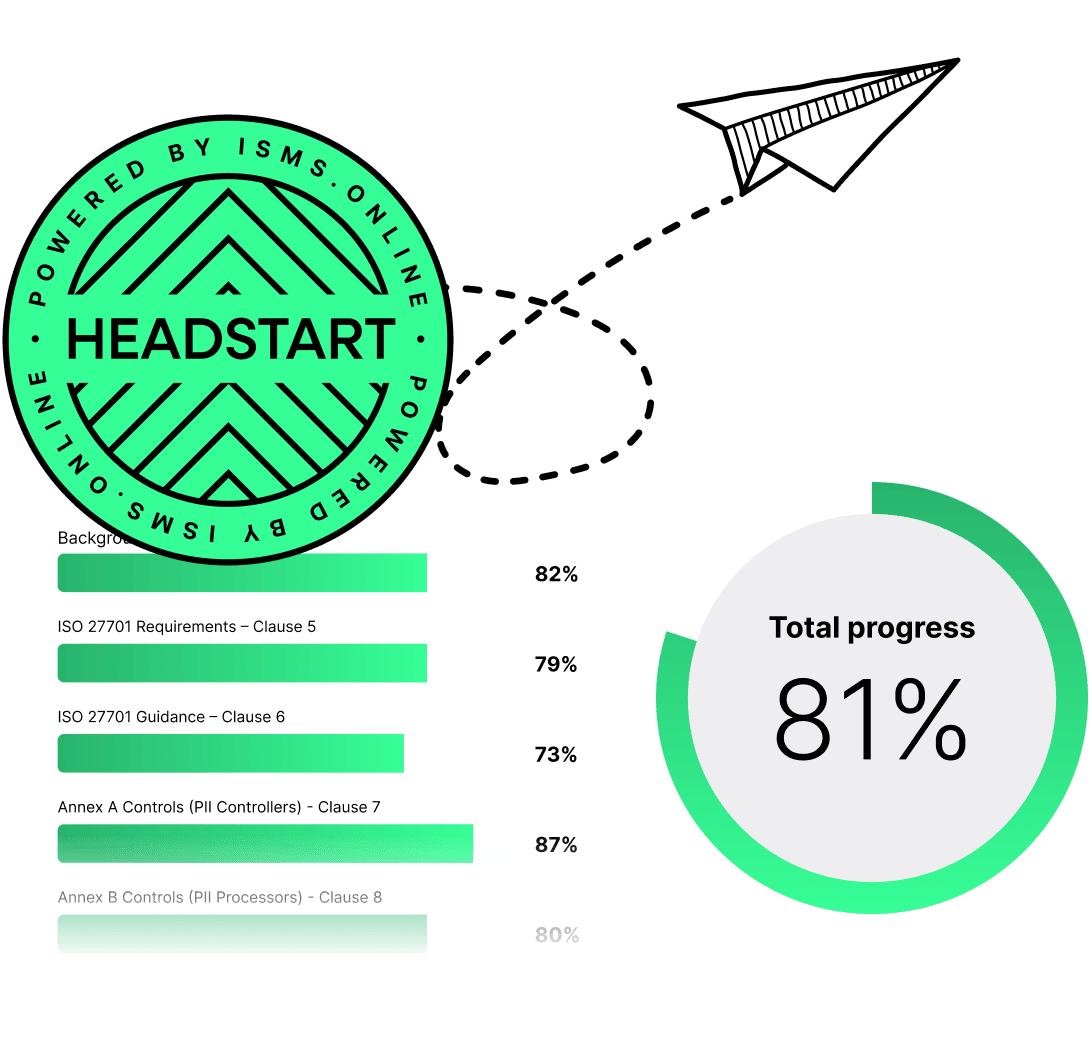
An 81% Headstart from day one
We’ve done the hard work for you, giving you an 81% Headstart from the moment you log on. All you have to do is fill in the blanks.
The Modern Gaming and Betting Network Threat Landscape
The modern gaming and betting threat landscape is shaped by real‑time odds, in‑play bets, bonuses, streaming and multi‑region infrastructure that attackers understand at least as well as your teams. A.8.20‑aligned design starts from an honest view of how these threats actually travel across your infrastructure, not just how your diagrams were originally drawn.
High‑volume gaming and betting networks face a different profile from office productivity or generic SaaS platforms. Real‑time odds, in‑play bets, bonus campaigns and live streaming create attractive targets where timing and availability have direct financial impact. Designing for A.8.20 in this context means understanding those specific threats and how they ride on your network.
Externally, DDoS remains a persistent risk, but has evolved beyond blunt volumetric floods. Attackers mix protocol‑level attacks with more selective application‑layer behaviours such as holding many long‑lived connections open, flooding logins or hammering particular odds or bet types that matter during an event. These patterns are often interwoven with genuine traffic from fans checking odds, watching streams and claiming offers.
Automation is now a dominant component of traffic. Bots scrape odds, test credential pairs stolen elsewhere and probe promotions for arbitrage. Some automation is legitimate, such as price comparison or partner integrations; some is hostile, such as tools for bonus abuse or systematic account takeover. They may all talk to the same endpoints over the same ports as normal users, making simple IP‑based blocking insufficient.
As operators expand geographically, traffic paths become more complex. Players in one country may connect to front‑ends in another region, which then call risk engines, data feeds and payment processors in yet more locations. Without a coherent architecture, new routes appear organically through ad‑hoc VPNs, peering links and cloud connectivity, creating potential choke points and hidden channels that never make it into design documents.
Internal and partner risks add another layer. Traders, risk analysts, customer support and third‑party contractors often access powerful tools across VPNs or remote access gateways. A compromised laptop, a reused password or a malicious insider can use those paths to reach systems that influence odds, settlements or personal data. If those paths are not clearly defined, monitored and segmented, A.8.20 is not being met.
Regulators are increasingly aware of these dynamics. Many now expect operators to demonstrate not only that they have controls in place, but that network design, provider choices, monitoring and response patterns are consistent and documented. In this environment, A.8.20 becomes the organising framework for making sure network security keeps pace with how the business really operates.
Why bots and automation matter so much in betting
Bots and automation matter so much in betting because they blur the line between normal use and abuse while consuming significant network and application capacity on the same endpoints genuine players use. They can create accounts, log in, place bets, claim offers and interact with wallets at machine speed, driving both capacity pressure and integrity risk.
From a network‑security standpoint, this means controls cannot be limited to static allowlists and simple rate limits. A.8.20‑aligned architectures increasingly incorporate API‑aware gateways, device and behaviour analysis and integration between fraud analytics and network‑level enforcement. The goal is to maintain availability and fairness for genuine players while identifying and throttling patterns that indicate scraping, stuffing or abuse.
How multi‑region and hybrid setups complicate A.8.20
Multi‑region and hybrid setups complicate A.8.20 because they add more paths, more providers and more chances for undocumented shortcuts to appear. You stay compliant by making sure every real traffic route is reflected in your zoning model, controls and monitoring.
Modern operators rarely live in a single data centre. Many combine colocation facilities near key exchanges, multiple cloud regions for resilience and scale and third‑party platforms for streaming, data and payments. Each interconnect-whether a VPN, a direct connection or a cloud peering link-is part of the network surface A.8.20 expects you to secure and monitor.
In practice, this means your network architecture must account for all paths that production traffic can take, not just those that were described in an initial design. New regions, cloud accounts or provider links should trigger updates to the architecture diagrams, firewall policies and monitoring coverage. Without that discipline, it becomes very difficult to argue that networks and network devices are being “secured, managed and controlled” in line with the control.
An Event‑Ready Network Segmentation and Zoning Framework
An event‑ready segmentation and zoning framework gives you a repeatable way to contain issues and protect critical flows during spikes, rather than relying on improvised, high‑risk changes. Instead of one sprawling network, you operate a small set of clearly defined zones, each with a purpose, trust level and monitoring approach that can be explained to auditors and regulators.
A practical way to implement A.8.20 for a gaming or betting operator is to start with a clear zoning model. Instead of a tangle of ad‑hoc segments, you define a small number of standard zones, each with a clear purpose, typical components and known trust boundaries. Those zones then appear consistently across data centres and cloud environments.
At a minimum, most operators can identify:
- External / internet zone: – players’ devices and the open internet.
- Edge / DMZ zone: – WAFs, load balancers, web front‑ends and API gateways.
- Application zone: – game servers, odds engines, wallets and internal APIs.
- Data zone: – databases, caches and data warehouses.
- Payment / PCI‑scoped zone: – card or payment integrations and related services.
- Management zone: – monitoring, logging, orchestration and admin jump hosts.
- Corporate IT zone: – staff devices, office networks and collaboration tools.
Each zone is separated by controlled trust boundaries. Firewalls, routing policies, network security groups or service‑mesh rules enforce which flows are allowed between zones, and on which ports and protocols. The default stance is “deny”, with explicit, justified exceptions recorded and periodically reviewed. Between some zones, such as from public internet to edge, there will be heavier inspection. Between others, such as from application servers to databases, controls may focus more on authentication, authorisation and allowed query types.
Segmentation does not have to be purely physical. In cloud environments and data centres, VLANs and virtual routing can provide strong logical segregation with very low latency overhead, as switching and routing are implemented in hardware. Microsegmentation tools or Kubernetes network policies can provide further isolation between workloads inside the same zone, limiting lateral movement without adding extra hops.
Under A.8.20, what matters is that this segmentation is intentional, aligned with risk and kept under control. That means zones are defined in policy, implemented in configuration, described in diagrams and supported by monitoring and change management. It also means you can explain why each zone exists, what it protects and what would happen if it were compromised. Many operators now demonstrate this by tying their zoning model, risks and controls together in an ISMS, rather than keeping them in separate documents.
Visual: Zoning diagram showing internet, edge, application, data, payment, management and corporate zones with arrows between them.
Core zones for a gaming and betting platform
Core zones for a gaming and betting platform group systems with similar risk and latency needs so that you can protect sensitive paths without over‑complicating everything else. This makes both day‑to‑day operations and A.8.20 audits far easier to manage.
For a concrete example, consider an operator with web and mobile apps, multiple game providers, a sportsbook, in‑house odds trading and several payment options. The external zone includes players’ devices and the open internet. The edge zone hosts WAFs, load balancers, web front‑ends and API gateways that terminate TLS and handle initial filtering and routing.
Behind that, the application zone contains game aggregators, lobby services, odds engines, bet placement services, wallet and account services and internal APIs. The data zone includes customer databases, bet history, risk models and caches. A separate payment zone handles direct integrations with payment gateways or card processors and is designed to meet PCI expectations. The management zone hosts monitoring, logging, orchestration, configuration management and jump hosts for administrators. The corporate zone includes office networks, VPN concentrators and business applications.
Each of these zones has clear, minimal paths between them. For instance, public users can only reach the edge zone. Only specific front‑ends in the edge zone can talk to bet placement services in the application zone. Only specific application services can call into the payment zone through an API or secure channel. Only limited administrative paths can reach management interfaces. Documenting and enforcing those patterns is central to A.8.20 compliance and gives your teams a shared language when discussing changes.
Moving from “flat with carve‑outs” to structured zoning
Moving from “flat with carve‑outs” to structured zoning is best tackled gradually, starting with the highest‑risk areas and building confidence with each step. A.8.20 supports iterative improvement, as long as you can show clear intent and evidence.
Moving from a “flat with carve‑outs” network to a structured zoning model is best handled incrementally. You do not need to redesign everything at once; you can start with the highest‑risk areas and build out over time while keeping auditors and internal stakeholders on side.
Many operators are part way through this journey. They may have introduced firewalls and some subnetting, but still have wide, permissive rules between major parts of the estate, often justified as “needed for legacy systems”. Moving towards an event‑ready zoning model does not have to mean tearing everything down at once.
A pragmatic approach is to identify one high‑risk area-such as a set of betting APIs or game servers-and create a clearer, more isolated zone around it with well‑documented inbound and outbound rules. Over time, more services can be migrated into appropriate zones, and broad rules can be tightened into narrower ones. Each small step should include updates to documentation, risk registers and monitoring coverage, so that governance keeps pace with technical change.
For senior security leaders, this is also an opportunity to engage boards and regulators. A simple before‑and‑after diagram showing how event traffic is now contained within specific zones, along with a short explanation of how this supports A.8.20, is often more persuasive than a long list of device changes.

Free yourself from a mountain of spreadsheets
Embed, expand and scale your compliance, without the mess. IO gives you the resilience and confidence to grow securely.
Designing Securely for Massive Match‑Day Spikes
Designing securely for massive match‑day spikes means treating big events as normal operating conditions rather than rare exceptions. A.8.20 expects your network controls, capacity and monitoring to remain effective when traffic is highest, because that is when failures cost you the most.
A sensible starting point is to treat capacity and resilience as security topics, not separate concerns. If WAFs, firewalls, proxies, VPNs or logging pipelines saturate before the application layer during a big event, they become de facto denial‑of‑service controls against your own business. Capacity planning, auto‑scaling patterns and high‑availability designs should therefore explicitly include security components.
Next, you need a clear understanding of your latency budget along critical paths. For example, you may decide that the end‑to‑end round trip for placing a bet from device to odds engine and back must stay under a specific threshold for acceptable user experience. From there, you can decide where you can afford deep, stateful inspection and where lighter, stateless checks, caching or out‑of‑band analysis are more appropriate.
Segmentation can be designed with this in mind. Latency‑sensitive flows, such as bet placement or streaming control messages, should avoid unnecessary hairpinning through many layers of inspection devices. Instead, those devices can be clustered near the edges, between major zones or in front of particularly exposed components. Within a zone, security may rely more on authentication, authorisation and local rate limiting than on repeated full‑packet inspection.
Traffic‑shaping and rate‑limiting policies are also crucial. During spikes, it is helpful to distinguish between trusted partner APIs, known regular bettors, new or anonymous users and unknown sources. You might apply stricter thresholds, captchas or additional checks to higher‑risk categories, preserving bandwidth and resources for core, trusted flows. These decisions should be driven by risk and documented so that they can be explained to auditors and regulators.
For practitioners, there are simple checks you can run this week to reduce surprise on big nights:
- Test logging and metrics at peak: – replay or simulate event‑night volumes and confirm pipelines keep up.
- Review diagrams against reality: – verify peering links, VPNs and cloud paths match what monitoring shows.
- Check security device headroom: – confirm WAFs, firewalls and VPNs have clear capacity margins for expected spikes.
These checks help you spot fragility before it is exposed by a real tournament or promotion.
Finally, match‑day drills can make a significant difference. Combining load testing with simulated attacks or abuse patterns allows teams to see how the network, security layers and observability behave together. Recording these exercises, and the subsequent improvements, creates powerful evidence that A.8.20 is being applied in a practical, iterative way and gives boards greater confidence in resilience.
Visual: Timeline showing pre‑event testing, live monitoring and post‑event review for network controls.
Capacity and resilience as part of network security
Capacity and resilience are part of network security because overloaded controls fail just as surely as misconfigured ones. Under A.8.20, you are expected to plan for, test and document how your network and its security devices behave at realistic peak loads, not just under lab conditions.
In many organisations, capacity planning and security are handled by different teams with different metrics. For a gaming or betting operator, they are tightly linked. If your DDoS protection service, edge proxy or logging system fails under legitimate peak load, your effective security posture collapses, even if application servers are technically healthy.
Under A.8.20, it is reasonable to ask for an integrated view. For a given event or campaign, do you know the expected peak traffic, and have you checked that each layer of the network and its security controls can carry that load? This includes bandwidth, connection limits, CPU and memory headroom and storage or throughput limits for logs and metrics. It also includes understanding failover behaviour: when a region, path or device fails, what alternative paths are used, and are those paths designed and monitored to the same standard?
Keeping latency low while keeping controls on
Keeping latency low while keeping controls on is about putting inspection where it has the most effect for the least performance cost. When you design jointly with product and infrastructure teams, you can meet A.8.20 and user‑experience goals without constant conflict.
Concerns about latency are often raised when security teams ask for more segmentation or inspection. The question “Will more security make the site slow?” is valid; the answer depends on design. It is possible to maintain aggressive latency targets while meeting A.8.20 if you are deliberate about where and how you inspect traffic.
Hardware‑accelerated switches and routers can perform routing and access control with very low overhead. Modern firewalls and WAFs can be deployed close to clients or in front of specific application clusters rather than in a single central chokepoint. Logging and sampling strategies can balance completeness with performance, focusing full‑detail capture on the most sensitive or contested flows.
In practice, the best outcomes come from cross‑functional design. Security, infrastructure, product and operations teams should agree on where controls add the most value relative to their cost in latency and complexity, and document these decisions as part of the A.8.20 implementation. That way, future changes can be evaluated against the same criteria and presented clearly to auditors and senior stakeholders.
Controls for DDoS, Bots and Real‑Time Fraud
Controls for DDoS, bots and real‑time fraud work best as a coordinated stack, not as isolated products. A.8.20 gives you the structure to define each layer’s role, keep it under governance and show that network‑level defences support game integrity and customer fairness.
Effective controls for DDoS, bots and real‑time fraud combine several layers with clear roles rather than relying on a single device or service. A.8.20 gives you the framework to design, operate and evidence this layered defence across your gaming and betting networks.
At the outermost edge, many operators use upstream DDoS mitigation or content‑delivery networks to absorb large volumetric attacks and basic protocol abuse. This protects connectivity and reduces noise reaching your own infrastructure. Closer to your stack, WAFs and API gateways enforce rules on HTTP and API traffic, blocking obviously malicious patterns, enforcing authentication requirements and shaping traffic.
Network firewalls and access‑control lists enforce which IP ranges and ports are allowed between zones. Within application environments, bot‑management and behaviour‑analysis tools distinguish unusual automation from normal user behaviour, looking at device characteristics, request timing, navigation patterns and other signals. Network‑behaviour analytics or anomaly‑detection systems monitor flows, connection patterns and volumes across the network to spot unusual movements or surges that might indicate lateral movement, data exfiltration or a more subtle attack.
For real‑time fraud, integration between network‑level signals and business‑level data is key. For example, a sudden rise in login attempts from new geographic regions, or repeated failed withdrawals from specific IP ranges, may warrant cross‑checks and temporary controls that go beyond what pure network devices can see. A.8.20 supports this by requiring that networks be monitored and that anomalies be detectable; it does not limit you to one specific analytic technique.
None of these layers can be “set and forget”. They require governance. Someone should own the rules and thresholds, understand the implications of tuning them more strictly or more loosely and be able to explain, after an incident, why they were set the way they were. Boards and regulators now routinely ask who owns these levers and how changes are approved.
Visual: Layered‑defence stack diagram from internet edge down to fraud analytics.
Making each layer’s role explicit
Making each layer’s role explicit helps you avoid overlap, blind spots and confusion when an incident occurs. It also creates cleaner documentation for A.8.20 and shows that your design is intentional rather than accidental.
One way to keep a layered defence understandable is to articulate, for each layer, what type of problem it is expected to handle. For example, upstream DDoS services may be tasked with handling volumetric floods and some protocol anomalies. WAFs and API gateways may handle malformed requests, known bad patterns and basic bots. Internal firewalls may handle network‑level containment between zones. Bot‑management tools may specialise in behaviour‑based identification of automation. Anomaly‑detection systems may oversee the bigger picture.
By making those roles explicit in your architecture and documentation, you reduce overlap and confusion. Operators know which system should be investigated and tuned for which type of issue. Auditors can see that the design is intentional. A.8.20 is then satisfied not only by the presence of tools, but by the clarity with which they are orchestrated.
Integrating network security with fraud and operations
Integrating network security with fraud and operations is essential in betting because many meaningful attacks cross technical and business boundaries. When your network view and fraud view share data and playbooks, you can act faster and more precisely.
Attackers may use network‑level techniques to enable bonus abuse, arbitrage or account takeover. Conversely, genuine players may be mislabelled as suspicious if pure network heuristics are applied without business context. To address this, many operators bring together telemetry from WAFs, firewalls, DDoS services and anomaly detection with account histories, bet patterns and device data.
Joint playbooks between network security and fraud teams define how to respond when certain combinations of signals appear. For example, a sudden surge in new accounts from a region that is not running promotions, combined with unusual traffic patterns to bonus endpoints, may trigger joint investigation and carefully scoped controls.
Under A.8.20, these integrated responses still rest on a well‑designed network. Without clear zones, controlled access paths and reliable monitoring, it is very hard to take targeted, proportionate action when an issue is detected. Network teams, fraud analysts and operations leaders should therefore share a common view of the architecture and its controls.

Manage all your compliance, all in one place
ISMS.online supports over 100 standards and regulations, giving you a single platform for all your compliance needs.
Protecting Payments, Personal Data and Live Bets
Protecting payments, personal data and live bets starts with recognising that some network paths carry significantly more risk than others. A.8.20 supports payment standards, privacy obligations and game‑integrity requirements by insisting that the networks carrying those flows are segmented, controlled and monitored to an appropriate standard.
For payments, many operators use architectures that minimise the handling of card data on their own systems. Hosted payment pages, in‑app web views hosted by payment providers, tokenisation and wallet solutions all reduce the amount of sensitive data that traverses gaming networks. Where cardholder‑data environments are unavoidable, they are typically placed in their own tightly segmented zone with strict rules on which application components can communicate with them and how.
Personal‑data protection also depends on segmentation and monitoring. Account and profile services, KYC and AML tools, customer support platforms and data warehouses may all handle identifying information. A.8.20 expects you to know which network segments host these functions, how they communicate and how those paths are protected and observed. It also expects network design to support broader privacy principles such as data minimisation and limited retention where feasible.
For live bets and payouts, integrity matters. If an attacker or misconfiguration can alter odds, selections, results or settlement instructions in transit, regulatory and reputational consequences can be severe. Network security controls can mitigate this risk by ensuring that only authorised systems can send certain types of messages, by encrypting traffic between key components and by placing logging and verification points that detect tampering or unexpected flows.
Payment and personal data flows in a segmented network
Payment and personal‑data flows in a segmented network follow clearly defined routes through well‑guarded zones, making it easier to prove compliance with financial and privacy standards. This builds trust with regulators and partners while reducing the impact of any single compromise.
In a segmented architecture, payment‑related components such as payment gateways, tokenisation services and reconciliation tools reside in a specific zone with their own firewalls and access‑control policies. Game and bet placement services communicate with that zone only through well‑defined APIs, and never see raw card numbers. Staff access to that zone is restricted and monitored.
Similarly, personal data may be concentrated in a set of services and databases with strict rules on which other components can read or write. Telemetry, logs and backups that contain personal data are handled with particular care, ensuring that network paths used for monitoring do not become ungoverned channels for sensitive information. As in the zoning model above, A.8.20 intersects here with privacy requirements, reinforcing the need for visibility and control over where such data travels.
Protecting the integrity of bets and payouts
Protecting the integrity of bets and payouts means ensuring that only authorised flows can influence odds and results, and that unexpected changes leave a trail. Network controls, encryption and logging combine to give you that assurance.
To protect bets and payouts, many operators implement tamper‑evident logging, independent settlement systems or cross‑checks between different systems. At the network layer, this might mean that settlement instructions can only be issued from specific internal services, over authenticated and encrypted channels and that any deviation or replay attempt is detected.
Segregating systems that calculate results, store official game records and handle financial movements can reduce the chance that a compromise in one area leads directly to undetected manipulation. Under A.8.20, these decisions would be visible in the way zones are defined, how routes are constrained and how monitoring is calibrated to spot anomalies. For senior leaders, being able to show regulators a clear picture of these protections is a strong signal of maturity.
Book a Demo With ISMS.online Today
ISMS.online helps you turn ISO 27001 A.8.20 from an abstract clause into a concrete, auditable set of decisions, diagrams and records for your gaming or betting network. By bringing network risks, controls and evidence into a single structured environment, it makes it easier for your teams to stay aligned and for auditors to see how you secure, manage and control your networks.
Meeting ISO 27001 A.8.20 in a high‑volume gaming or betting context is about more than adding devices at the edge. It is about understanding how your business really uses networks, deciding which paths and components are most critical, designing zones and controls accordingly and then proving over time that those decisions are implemented and monitored.
A platform such as ISMS.online can help by giving you one place to map your network architecture, link it to risks and Annex A controls and attach evidence such as diagrams, firewall reviews, change records, capacity tests and incident reports. That turns A.8.20 from a clause in a standard into a set of living artefacts your teams can maintain together and present confidently to auditors, boards and regulators.
If you are planning a certification, a licence application or a significant expansion into new markets, a short, focused review of your current network posture against A.8.20 can highlight the most important gaps to close. Turning those findings into an action plan with owners and timelines is much easier when your ISMS already provides workflows, templates and reporting views that align with the standard.
Running a limited pilot can also be valuable. By connecting existing documents and evidence into an ISMS view for one part of the network-say, your betting APIs and odds engines-you can see how structured governance affects decisions without committing the entire organisation immediately. That experience often helps secure wider buy‑in from technical and non‑technical leaders.
Over time, consolidating tests, approvals and reviews into a single workflow reduces the overhead of preparing for audits and regulator visits. It also improves consistency: the same narrative about how your networks are “secured, managed and controlled” appears in internal reports, external questionnaires and board packs.
Aligning major business milestones-such as tournament launches, new products or entry into regulated jurisdictions-with specific A.8.20 improvements gives everyone a concrete way to see progress. Instead of only updating policies, you can point to completed segmentation work, tested DDoS playbooks and new monitoring capabilities that make a measurable difference to resilience and trust.
Visual: Simple flow of an A.8.20 review from network map, through gap analysis, to action plan inside an ISMS.
What a focused A.8.20 review looks like
A focused A.8.20 review looks at how your real network behaviour lines up with the control’s expectations, using evidence you already have and highlighting practical next steps. The aim is not to redesign everything at once, but to prioritise the changes that most improve resilience and audit readiness.
In practice, such a review typically examines your current network diagrams and zoning model, compares them to actual traffic paths and peering links, samples firewall and routing changes and assesses whether monitoring and capacity cover event‑night scenarios. It then links these findings back to Annex A controls and risk assessments, so that gaps are clearly framed in ISO 27001 terms.
With an ISMS in place, many of these artefacts already live in one environment. That makes it easier to involve security, infrastructure and product stakeholders, agree priorities and track remediation tasks through to completion.
How ISMS.online supports gaming and betting operators
ISMS.online supports gaming and betting operators by providing a governed environment where network architecture, controls, risks and evidence can evolve together. You keep ownership of your technical decisions; the platform gives you structure, traceability and clear stories for auditors and regulators.
For network and security teams, ISMS.online can link your A.8.20 policies, diagrams, device baselines, change reviews and test results into one auditable chain. For compliance and leadership teams, it provides dashboards and reports that show how A.8.20, and related controls such as logging, capacity and network services, fit into your wider ISMS and licencing obligations.
If you want to explore how this could look for your own platform, arranging a focused conversation and demonstration with ISMS.online is a straightforward next step. You can walk through an A.8.20‑focused setup based on real gaming and betting scenarios, ask detailed questions and see how your existing network, tools and evidence could fit into a more coherent ISMS.
Choose ISMS.online when you want your network security storey for gaming and betting-especially around ISO 27001 A.8.20-to be clear, credible and easy to demonstrate to auditors, boards and regulators. If you value structured governance, auditor‑ready evidence and practical support for event‑night resilience, ISMS.online is ready to help your team make A.8.20 a strength rather than a concern.
Book a demoFrequently Asked Questions
How does ISO 27001 A.8.20 specifically change what we do on a gaming or betting network?
ISO 27001 A.8.20 expects you to prove that your network is deliberately designed, segmented and monitored to protect information during real‑world peak events – not just in a lab diagram. For an online casino or sportsbook, that means you can trace a live bet or game session from the internet to your core systems, show where boundaries sit, and demonstrate how you govern those crossings over time.
How should we define and maintain our key network zones?
For most operators, a usable model starts with a small number of clearly defined zones:
- Internet / CDN edge
- Edge / DMZ (WAFs, API gateways, web front‑ends)
- Game and odds engines, wallets, bonus and risk services
- Data and logging platforms
- Payment / PCI enclave
- KYC, fraud and account‑management services
- Management and corporate IT
A.8.20 cares less about the artistic quality of the diagram and more about whether it matches reality. Auditors and gambling regulators will expect:
- Up‑to‑date diagrams that reflect deployed environments (including cloud, colocation and third‑party services)
- Flows marked between zones, including protocol and direction
- Named owners for each zone and for the diagrams themselves
If your architects, engineers and compliance team use different versions of the network map, you will struggle to demonstrate control when an ISO 27001 review or licence assessment arrives.
How do we show that crossings between zones are genuinely controlled?
Every connection between zones should have three things you can show on demand:
- A clear business reason: (“bets API to odds engine over HTTPS”, “KYC pipeline to CRM for account updates”)
- Named technical controls: (firewall rule IDs, security groups, service‑mesh policies, VPN definitions)
- Evidence of review and testing: (change tickets, rule reviews, penetration tests, negative test cases)
Sensitive crossings – such as those into payment, KYC, logging and administration zones – should have:
- Stricter authentication and authorisation
- Encrypted protocols only
- More frequent review cycles and documented test results
If a connection exists but nobody can explain why it is needed, who owns it, or how it was last tested, A.8.20 will be difficult to defend.
What does “managed boundary devices” actually look like in practice?
Routers, firewalls, WAFs, API gateways and load balancers sit at the heart of A.8.20. To convince an auditor, you should be able to produce:
- Standard build or baseline configurations for each class of device
- Change histories with approvals, rollback plans and test notes
- Regular rule and policy reviews, especially after new games, markets or integrations launch
- Patch and firmware records showing how you respond to vendor advisories
- Capacity and failover test results that reflect realistic match‑day or race‑day loads
When something significant happens – a new tournament, a surge in sign‑ups, a major DDoS – the question quickly becomes: “What did you expect this control to do, and what actually happened?”
How much visibility into network traffic does A.8.20 assume we have?
A.8.20 assumes you can see enough to detect and investigate misuse. For gaming and betting networks, that usually means:
- Flow logs for key segments (for example, VPC flow logs, NetFlow, firewall session logs)
- Telemetry from WAFs, API gateways and DDoS protections at the edge
- Alerts from IDS/IPS or anomaly‑detection systems in high‑value zones
- A documented route for these events into your SOC or incident‑response process
If you can correlate, say, unusual bot activity on sign‑up and bonus flows with specific segments, rules and events in your ISMS, you are far closer to satisfying both ISO 27001 A.8.20 and gambling‑regulator expectations.
Using a structured information security management system such as ISMS.online, you can anchor your zoning model, flows, device configurations, changes and monitoring directly to A.8.20 and related controls. That turns what you already do to keep the platform running into coherent evidence, instead of a scramble to recreate the storey before every audit or licence review.
How can we segment gaming, payment and back‑office networks without adding unacceptable latency?
You preserve latency by segmenting around trust and data sensitivity, while designing short, predictable paths for time‑critical traffic. Rather than pushing every request through the same deep stack of devices, you place the most intensive controls where the risk justifies them, and keep hot paths for odds, bets and game traffic as lean and well‑observed as possible.
What does a workable segmentation pattern look like for a betting or gaming platform?
Most operators end up with some variation of the following structure:
- Edge and CDN: Public edge, CDN, DNS, TLS termination where appropriate
- Edge / DMZ: WAFs, API gateways, web front‑ends and lobby services
- Application / game zone: Game servers, odds engines, bet placement, wallets and bonus logic
- Data and logging zone: Databases, logging pipelines, analytics platforms, event stores
- Payment / PCI enclave: Payment gateways, cardholder‑data environments, tokenisation systems
- KYC / identity enclave: KYC pipelines, identity providers, fraud‑detection tooling
- Management and corporate IT: Jump hosts, admin consoles, monitoring, trading tools, office networks
Traffic between zones should be:
- Documented and justified
- Restricted to required ports and protocols
- Protected with encryption and authentication where it carries payment or personal data
Treat this as a living model: when you introduce a new game provider, risk‑management tool or PSP, you should see it land in the right zone with clear flows, not appear as an undocumented side path.
How do we keep live gaming and betting flows responsive across these segments?
For ISO 27001 A.8.20 and regulator expectations, you do not need low latency at any cost; you need predictable performance with clear containment. Practical tactics include:
- Placing latency‑sensitive services (live odds, in‑play bet placement, game‑session coordination) close to the edge with minimal, carefully tuned firewalling in between
- Offloading heavy checks – input validation, authentication, rate limiting, basic bot filtering – to WAFs and API gateways at the front door
- Using high‑performance routing and firewalls where traffic volume is highest, with concise, well‑structured rule sets that are easier to test under load
- Keeping bulk data movement (analytics jobs, reporting, archival) off the same paths that carry live gaming and betting sessions
Handled carefully, segmentation becomes an enabler: hot paths are simple and observable, while higher‑risk functions (payments, KYC, admin) sit behind tighter controls that matter more than a few extra milliseconds.
How does an ISMS help us maintain this design instead of letting it drift?
Designing a good segmentation model once is not enough. A.8.20 expects you to maintain and improve it. An ISMS helps you:
- Record your target zoning model, flows and reasoning once, then update it as the platform evolves
- Link individual flows to identified risks (for example, lateral movement into PCI zones, abuse of betting APIs, exposure of KYC data) and the controls that mitigate them
- Attach change records, firewall reviews, capacity tests and incident reports directly to the zones and rules they affect
When these artefacts live inside ISMS.online, aligned to A.8.20 and other Annex A controls, conversations about “too complex” or “too simple” become easier. You can show how design decisions were made, tested and adjusted over time, rather than debating opinions or relying on whoever has been around the longest.
Which network controls most effectively protect betting APIs and live gaming sessions from DDoS and bots?
The most effective approach is a layered control set that recognises betting APIs and live sessions as higher‑value than generic web traffic, and that can respond predictably under event‑level load. You are aiming for controls that absorb, distinguish and adapt, rather than single devices that either block everything or let everything through when stressed.
What are the key layers we should consider for gaming and betting traffic?
A practical layered approach typically includes:
- Edge DDoS protection and CDN: To absorb volumetric floods, reflection attacks and basic protocol abuse before they hit your core environments
- WAFs and API gateways: To validate requests, enforce authentication, apply rate limits and basic bot rules for HTTP/HTTPS traffic
- Network‑segmentation controls: Firewalls, security groups, service‑mesh or routing policies that strictly limit what can talk between which zones
- Bot‑management and behavioural tools: To distinguish scripted abuse (bonus scraping, credential stuffing, arbitrage tools) from genuine players, based on device characteristics, timing, bet patterns and navigation behaviour
- Flow and telemetry analytics: To surface anomalies such as sudden surges from specific regions, atypical access patterns between services, or unusual east‑west scanning
Each layer must have:
- Named owners
- Clear tuning rules and thresholds
- Runbooks for pre‑event preparation, in‑event adjustments and post‑event review
Without that governance, even the best tools can undermine each other or create gaps when conditions change quickly.
Why does tuning and governance matter just as much as the technology?
Big sporting events often bring:
- Legitimate spikes in registrations and bet placement
- More aggressive scraping of odds and bonuses
- Higher baseline error rates and retries simply from volume and device mix
Controls tuned only for average days can easily:
- Block legitimate traffic when thresholds are hit
- Let abusive behaviour blend into what looks like “busy but normal” use
You reduce this risk by:
- Running realistic pre‑event simulations to understand how controls behave under expected loads
- Defining who can adjust which thresholds and rules on which systems, and how those changes are authorised and recorded
- Capturing the outcome of those changes – both successes and missteps – as lessons learned and as evidence that you manage the network deliberately
When you log DDoS drills, bot‑tuning exercises and post‑event reviews in ISMS.online, they become part of your A.8.20 evidence set instead of being forgotten once the pressure drops. Over time, that record helps auditors and regulators see a maturing approach to protecting your most critical gaming and betting flows.
How does A.8.20 support stronger protection for payments and personal data in a sportsbook or casino?
A.8.20 is the bridge between your control statements and the way payment and personal data actually flow across your network. It encourages you to separate those flows in a way that aligns with PCI DSS, GDPR and sector‑specific rules, and to show how those separations are enforced and monitored day to day.
How should we structure and protect payment traffic under A.8.20?
For card data and payments, most operators aim for:
- A well‑defined PCI enclave where payment processing, cardholder data, tokenisation and reconciliation components live behind strict access controls
- Minimal, clearly justified inbound paths from game, wallet or checkout services, with constrained outbound paths to acquirers, gateways and risk engines
- Strong encryption (for example, mutual TLS) between calling services and payment components, with keys and certificates managed under documented procedures
- Regularly tested firewall, routing and service‑mesh policies, with results compared against PCI DSS requirements and your own risk assessments
Even if you outsource payment collection via hosted pages, mobile SDKs or third‑party wallets, A.8.20 still expects you to understand:
- Where payment‑related traffic flows across your infrastructure
- How those flows are segregated from generic traffic
- Which controls would detect and contain misuse
That understanding needs to be reflected in diagrams, rules and monitoring, not just in supplier contracts.
How should we treat personal data and KYC information from an A.8.20 perspective?
Registration data, KYC documents, device fingerprints and betting histories are highly sensitive. To align A.8.20 with GDPR and similar regimes, you should:
- Identify the systems and services that store or process different categories of personal data (onboarding, KYC, CRM, analytics, logging)
- Group them into specifically labelled zones or enclaves, separate from general game and content delivery traffic
- Restrict connections into and between those zones to what is necessary for journeys such as registration, sign‑in, fraud checks and regulatory reporting
- Review and test those paths whenever you introduce new markets, analytics tools, affiliates or ad‑tech partners that might touch these flows
Ultimately, auditors and regulators will ask a simple question: can you show, with diagrams and evidence, how payments and personal data are separated, which controls sit at those boundaries, how they are monitored, and what you do when something looks wrong?
ISMS.online helps you join the dots by mapping these flows directly to ISO 27001, PCI DSS, GDPR and other controls in one place. That gives you a coherent storey when different teams – security, privacy, risk, operations – are all being asked to explain the same environment from different angles.
How can we stop scrambling for network‑security evidence every time an ISO 27001 audit or regulator review comes around?
You reduce pre‑review stress by designing your normal network‑security work to create evidence continuously, rather than treating audits and regulatory visits as one‑off events. A.8.20 becomes much easier to demonstrate when diagrams, configurations, tests and incident records are already being maintained as part of your ISMS.
What network‑security evidence do auditors and regulators most often expect?
Across ISO certification, licence renewals and ad‑hoc inspections, the requests often fall into the same categories:
- Current network and zoning diagrams: that accurately depict your environments and key flows
- A concise segmentation strategy description, showing how your design addresses specific risks (for example, lateral movement, data exfiltration, DDoS impact)
- Samples of firewall, security‑group and routing changes: , with approvals, test evidence and rollback notes
- Capacity, resilience and failover test results: for core paths, including DDoS protections, VPNs and cross‑site routing
- Monitoring and alerting setups: for flows, edge protections and intrusion‑detection mechanisms, including who owns which dashboards and runbooks
- Evidence of real or simulated incidents and how lessons from them were fed back into design and configuration
If these materials are created only when someone asks, you will always be racing to catch up. If they are managed as part of your ongoing ISMS work, a review becomes largely a guided walkthrough of material you already trust to run the platform.
How does ISMS.online help gaming and betting operators streamline this?
Within ISMS.online you can:
- Keep your network and zoning diagrams inside the control set, with version history, approvals and named owners
- Store change samples, rule reviews, performance tests and incident reports as linked evidence against A.8.20 and related controls (access control, operations, incident management)
- Assign responsibilities and review cycles so diagrams, rules and test logs are kept current as platforms, partners and geographies change
- Reuse the same evidence across multiple standards (for example, ISO 27001, ISO 22301, ISO 27701) and regulatory obligations as part of an integrated management system
That shift turns audit preparation from a last‑minute project into a side effect of how you already manage the network. It also changes how auditors, regulators and internal assurance teams see you: as an operator with predictable, repeatable control over A.8.20, rather than a business that only just pulls the storey together in time.
How can ISMS.online make ISO 27001 A.8.20 implementation and demonstration simpler for gaming and betting networks?
ISMS.online is built to connect your live network with ISO 27001 A.8.20 and the broader Annex L integrated management system that underpins your licences and commercial relationships. Instead of treating network security as something separate that only engineers can explain, you can manage it alongside risks, policies, audits and improvements in one place.
What does this look like for our teams day to day?
In practical terms, your teams can use ISMS.online to:
- Model zones and flows once: , then associate them with A.8.20 and other Annex A controls linked to network, access and operations security
- Attach diagrams, zoning rationales, change records, rule‑review notes, DDoS and capacity‑test results, and incident reports directly to each relevant control
- Use workflows to assign owners, due dates and review cycles, so high‑value segments (betting APIs, payment enclaves, KYC and logging zones) are actively maintained
- Capture evidence from match‑day simulations, DDoS exercises, bot‑tuning runs and real incidents as part of the A.8.20 record, instead of leaving those details in chat logs or individual ticket systems
- Extend the same structure across an integrated management system (IMS), so security, business continuity, privacy, quality and other Annex L‑aligned standards all reference the same set of network controls
That combination means a CISO or Head of Platform can answer questions from ISO auditors, regulators and internal stakeholders with one consistent view, rather than stitching stories together from separate tools.
How does this strengthen how regulators, auditors and partners see the organisation?
When A.8.20 is managed through a structured ISMS:
- You can explain your network posture in accessible language backed by current, linked evidence
- You can show how new products, markets and partnerships systematically lead to changes in zoning, controls and monitoring, not just temporary patches
- You reduce reliance on a small number of individuals by capturing designs, decisions and tests in a shared system
For CISOs, compliance leads and infrastructure managers in gaming and betting, this is a practical way to move from “doing enough to pass” to being recognised as a steady, trustworthy operator when stakes are high. If your aim is to be the platform that regulators, high‑value customers and partners quietly trust, putting ISO 27001 A.8.20 on firm ISMS.online foundations is a strong, defensible step in that direction.






