





































When your game leaves the building: the new outsourcing risk surface
Outsourced development for ISO 27001 A.8.30 is treated as if it happens inside your own studio, under your rules and accountability. Any external team that touches code, builds or tools extends your attack surface, and you remain responsible for how they protect your intellectual property, infrastructure and player trust. Seeing outsourced teams as part of your environment, not “somewhere else”, is the starting point for controls that work in real production. This information is general and does not constitute legal or certification advice.
Healthy outsourcing starts when you assume partners share your risks, not just your workload.
In modern game development, co‑dev partners, art houses, porting teams and freelancers rarely work on isolated files. They typically connect to shared Git or Perforce repositories, build systems, cloud storage for art and audio, telemetry dashboards and internal issue trackers. A weak password at a vendor, an unmanaged laptop or an obsolete VPN client can now be enough to leak a whole season’s worth of content or give attackers a route into your backend.
The practical distinction between “internal” and “external” work has blurred. External teams often sit in the same chat channels, use the same ticket queues and sometimes even share SSO tenants for tools. If you do not deliberately design controls for that reality, your ISMS will be built around a studio model that no longer exists, leaving gaps that players, publishers and auditors will eventually notice.
Why outsourcing changes your attack surface
Outsourcing changes your attack surface because it multiplies the number of paths into your code, content and live‑ops systems. You still own the risk on every one of those paths, regardless of where the people or hardware sit.
Outsourced development means access to your game is no longer limited to your own networks, devices and staff. Third‑party artists pulling textures, co‑dev teams committing code, QA vendors testing early builds and live‑ops partners running tooling all create new routes into your IP and infrastructure. If you do not govern those routes with clear access rules, technical controls and review points, you inherit whatever security practices those partners do-or do not-have in place.
In many studios, external partners now touch build pipelines, telemetry tooling and internal admin dashboards, not just asset folders. That amplifies the impact of simple failures. A shared account left active after a contract ends, a personal laptop used for test builds or a copied repository on an unmanaged server can all become entry points for attackers or sources of leaks that damage revenue, reputation and platform relationships.
First steps: make the invisible outsourcing map visible
To make A.8.30 meaningful, you first need a clear picture of who is building what for you and which access they use. A simple outsourced development map turns vague assumptions into concrete facts you can manage, monitor and present to auditors as part of your ISMS.
Your first practical move is to make your outsourcing footprint visible in a way you can act on. That means going beyond a vendor list in finance and building an outsourcing map that answers blunt questions: who designs, codes, tests or operates anything related to your games, and what exactly can they see or change?
Start by listing every partner involved in development: co‑dev studios, art and audio suppliers, porting teams, QA vendors, live‑ops partners, tool specialists and staff‑augmentation contractors. For each one, record what they can access: specific repositories, branches, depots, environments, databases, dashboards or tools. You are trying to replace we think they only see art with this partner can pull these three depots and run these two dashboards.
Next, classify each relationship by impact. A small concept‑art shop that only receives flattened image references is not in the same category as a co‑dev studio with write access to gameplay systems and matchmaking logic. A QA house that can download near‑final builds has different risks to a localisation agency working only from spreadsheets. This simple tiering gives you a basis for deciding where ISO 27001 A.8.30 needs heavyweight evidence and where a lighter touch is acceptable.
Finally, connect this map to your current governance. Ask who owns each relationship, who approves access, who reviews it and who would notice if that partner were compromised tomorrow. Very often the honest answer is no one person, which is exactly the gap A.8.30 is intended to close. This is also where a structured platform such as ISMS.online can help, by giving you a consistent way to record ownership, access and decisions across projects so you do not depend on individual memory or scattered documents.
Book a demoWhat ISO 27001 A.8.30 really demands of game studios
ISO 27001 A.8.30 expects you to treat outsourced development as if it were happening inside your studio, with the same security rules and accountability still applying to that work, no matter who actually builds the game systems or content. External teams must follow your information‑security requirements for development, and you must be able to show how you direct, monitor and review that work over time; non‑disclosure agreements alone are not enough, because you need evidence of real control.
Plain‑language interpretation of A.8.30 for game studios
In plain terms, A.8.30 says that when you outsource any part of development you still control how that work is done. Your information‑security requirements must be met regardless of who writes the code or creates the assets.
For most studios, “information‑security requirements” include at least confidentiality of unreleased content and proprietary technology, integrity of code and assets, and availability of build and live‑ops systems. Depending on what your game handles, they may also include privacy obligations for player data and regulatory requirements around payments or children’s data. A.8.30 expects those requirements to shape how outsourced development is planned and run, not just how it is described in legal language.
Crucially, the control is not about forcing every vendor to adopt ISO 27001 wholesale. It is about ensuring that the parts of their work that touch your games are done in a way that aligns with your ISMS. That can mean giving smaller partners a clear set of do’s and don’ts, access rules and tooling, while expecting more mature co‑dev studios to demonstrate stronger internal practices and more formal assurance.
How A.8.30 links to supplier and development controls
From an auditor’s point of view, A.8.30 is one part of a joined‑up storey across supplier management and secure development, not a standalone rule. Outsourced development needs to sit comfortably alongside controls such as A.5.19–A.5.22, change management and secure coding, rather than being treated as a special case that lives only in legal documents.
At selection time, you should be able to show how you assess whether a partner is capable of meeting your security expectations. In agreements, you should show where those expectations are written down as obligations. In day‑to‑day work, you should show how access, code review, testing and deployment behave the same way for external and internal contributors. In monitoring, you should be able to show logs, reviews and corrective actions relating specifically to outsourced work.
Auditors typically expect four kinds of evidence for A.8.30: governance documents, contracts, operational controls and assurance activities. The table below gives a simple mapping you can use as a design checklist for your studio.
Introductory snapshot of evidence types an auditor often looks for:
| Area | Typical artefacts | What it proves |
|---|---|---|
| Governance | Outsourced‑dev procedure, risk assessments | You have a structured approach |
| Contracts | MSAs, SoWs, security schedules, NDAs | Partners are bound to your requirements |
| Operational work | Access matrices, repo rules, code‑review logs, tests | Controls exist and are used in practice |
| Assurance | Supplier reviews, findings, actions and follow‑ups | You monitor and improve over time |
You do not need perfect polish on day one, but you do need a coherent storey: this is how you decide who can build your game, this is what you require of them, this is how you integrate and check their work, and this is how you know it is still happening. Over time, that storey becomes a core part of how you explain your ISMS to publishers, platform partners and auditors, especially if you can show it consistently in a platform such as ISMS.online rather than across scattered drives and chat channels.
ISO 27001 made easy
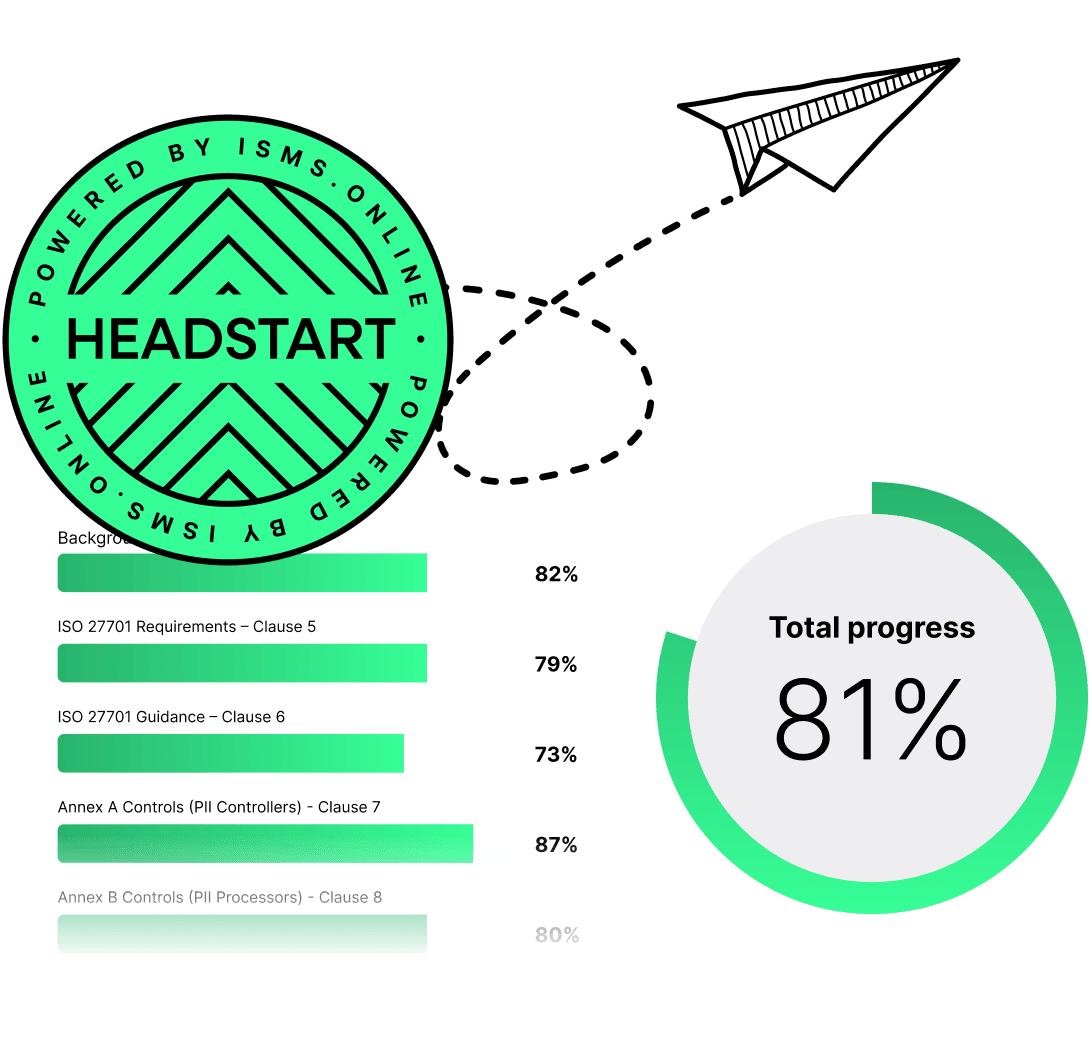
An 81% Headstart from day one
We’ve done the hard work for you, giving you an 81% Headstart from the moment you log on. All you have to do is fill in the blanks.
From ad‑hoc deals to a controlled outsourcing framework
From an ISO 27001 A.8.30 viewpoint, the real leap is moving from one‑off outsourcing decisions to a consistent outsourcing framework, so each project follows the same backbone of checks and controls while still giving producers and tech leads enough freedom to work at production speed and meet creative goals. To comply with A.8.30 without paralysing production, you need a simple, repeatable outsourcing framework that every project can follow, replacing improvised checklists and heroic individual effort with a lifecycle that feels natural in day‑to‑day use so security becomes a routine part of how you work with partners, not a late‑stage blocker that appears just before a build lock.
Designing an outsourced‑development lifecycle that fits production
A.8.30 lands most cleanly when your outsourced‑development lifecycle mirrors your existing production gates; the core idea is straightforward: weave security and supplier checks into milestones you already use, so teams do not feel like they are working through a second, parallel process that only exists for auditors. A practical outsourced‑development lifecycle for a studio therefore mirrors how you already move games through milestones and green‑light reviews, adding security‑relevant gates at moments that already exist rather than inventing new meetings and documents for their own sake, and making those gates visible as part of your ISMS.
Visual: Simple lifecycle diagram showing intake through offboarding for outsourced partners.
A typical lifecycle has seven stages:
Stage 1 – Intake
Decide whether you need an external partner, what they will deliver and what access they would require to do that work safely.
Stage 2 – Due diligence
Check whether the candidate partner can meet your baseline security and privacy expectations, using proportionate questionnaires and, where relevant, existing attestations.
Stage 3 – Contracting
Translate security expectations into binding terms, including clear obligations, responsibilities, incident reporting and any audit or assessment rights you need.
Stage 4 – Onboarding
Turn agreements into concrete access, tooling, orientation and initial training for the partner, with approvals and records you can later show to auditors.
Stage 5 – Delivery
Let the partner do the work using agreed tools, branches and environments under defined controls, with code review, testing and deployment behaving as they do for internal teams.
Stage 6 – Monitoring
Review activity, access and deliverables regularly, escalating issues, logging decisions and feeding findings into your supplier‑review and risk‑management processes.
Stage 7 – Offboarding
Remove access, retrieve or securely delete data and complete close‑down tasks when work ends, including updating your outsourcing map and supplier risk register.
The key is to embed these stages into your existing project governance. For example, you might require that no partner is onboarded before a minimum due‑diligence questionnaire is completed and approved, and that offboarding tasks are part of your project close‑down checklist. This lets you grow control without inventing a parallel bureaucracy or slowing production unnecessarily.
Using vendor tiers and shared tooling instead of one‑off processes
For ISO 27001, proportionality matters: not every outsourced relationship justifies heavy process. Vendor tiering and shared templates let you scale A.8.30 sensibly across co‑dev, QA, art and advisory partners without reinventing documents for every deal or burning goodwill with low‑risk suppliers.
Not every outsourced relationship warrants the same depth of scrutiny. A partner embedded in your codebase and live‑ops stack justifies far more checks than a boutique studio providing stand‑alone audio assets. Vendor tiering lets you capture that nuance in a structured way and explain it clearly to auditors and publishers.
At a minimum, most studios benefit from three tiers:
- Tier one: Partners with privileged or deep access, such as co‑dev studios and core backend or anti‑cheat providers.
- Tier two: Partners with significant but limited access, such as porting houses or QA teams that see internal builds.
- Tier three: Partners with content‑only or advisory roles and no direct access to code or live environments.
For each tier, you define which questionnaires, contractual clauses, security baselines and review frequencies apply. High‑risk partners see stronger requirements and more frequent assurance, while low‑risk partners experience a lighter but still consistent touch.
Shared tooling then makes this real. Instead of each producer building their own spreadsheets and email threads, you provide a standard starter pack: a risk‑assessment template, a security appendix, an access‑request form and a simple checklist for onboarding and offboarding. When a project spins up a new vendor relationship, they start from those patterns and adapt only where justified. Over time, as you learn what works and what slows you down, you refine the templates-not fifty scattered variations. A platform such as ISMS.online can help you keep those templates and decisions aligned across titles.
Game‑specific threats: leaks, engines, anti‑cheat and live‑ops
From a game‑industry standpoint, A.8.30 has to cover threats that generic corporate guidance often overlooks. Storey spoilers, engine internals, anti‑cheat systems and live‑ops tooling create risks that are very different from a standard business application, especially once external studios play a direct role in building and operating your content.
Game development brings threat patterns that generic ISO guidance tends to gloss over: spoiler‑heavy storey content, proprietary engines, anti‑cheat logic, live economies and seasonal events. Outsourced development touches many of these directly. If you ignore those specifics, you risk designing controls that are formally neat but blind to the ways real attackers, leakers and cheat developers behave.
Mapping where the real damage could come from
To align with A.8.30, you need to be clear about which assets and systems would actually hurt you if leaked or compromised; once those “crown jewels” are known, you can trace which external partners touch them and tighten controls accordingly instead of trying to protect everything equally. Game‑specific threat modelling starts by asking what would actually damage you if it escaped or were tampered with: for a narrative‑driven title, that probably means plot, cinematics and key art; for a competitive online game, it is likely anti‑cheat routines, server‑side logic and economy controls; and for a licenced sports or film property, it may be character designs and likeness assets covered by strict marketing and legal commitments.
Typical high‑impact asset categories include:
- Storey content such as scripts, cinematics and key art for unannounced characters or locations.
- Technical assets like engine modules, anti‑cheat hooks, server logic and build or signing pipelines.
- Commercially sensitive data, including economy parameters, promotional events and licenced property designs.
Once you know which assets matter most, trace which external partners ever see them. Does your co‑dev studio compile anti‑cheat modules locally? Does a porting house handle console builds and therefore signing keys? Does a live‑ops vendor manage dashboards that can alter in‑game prices or rewards? Does a QA team regularly download storey‑critical builds to home offices? Each “yes” is a signal that your A.8.30 controls must do more than generically assert “secure development”.
You should also pay attention to grey areas. Spoilers that seem fun for some players may be contractually sensitive for licensors or may undermine carefully timed marketing beats. Similarly, debug data that looks harmless to engineers may contain identifiers or logs with privacy or fraud‑risk implications. Classifying these borderline categories explicitly helps you justify why some partners face stricter controls than others and helps you explain that logic to auditors and publishers.
Special care for engines, anti‑cheat and live‑ops
Engines, anti‑cheat and live‑ops tooling sit at the intersection of technical complexity and business risk, and A.8.30 gives you a strong basis for treating these domains as special cases whenever they are touched by external teams, with stricter controls and clearer evidence than for lower‑impact work. Three technical areas in particular deserve this care in outsourced scenarios-engines and core technology, anti‑cheat systems and live‑ops tooling-because each combines deep technical complexity with high impact if broken or exposed, and each is an area where publishers and platforms now ask detailed questions.
Engines and core technology often represent years of investment and are differentiators for visual fidelity, performance or tool workflows. Allowing an external studio wide, unsegmented access to engine code may be necessary in large co‑dev relationships, but it should not be the default for every supplier. Where possible, isolate reusable engine components from game‑specific logic and limit who can see or modify the former, using separate repositories, branches and environments.
Anti‑cheat systems are especially sensitive. Externalising development here can make sense for specialist expertise, but it magnifies the risk that implementation details leak into cheat‑development communities or that malicious code is introduced into clients. If you involve partners at this level, strict repository segmentation, mandatory code review by trusted internal staff and tightly controlled build environments are essential. You should also be able to show an auditor which accounts have ever touched anti‑cheat code and how those changes were tested.
Live‑ops tooling, from admin dashboards to economy controllers, is another common outsourcing target. A single compromised account here can disrupt events, inject fraudulent items or syphon currency. Any external team that builds or operates these tools should be treated as part of your operational backbone, with strong authentication, network controls, monitoring and clear incident‑escalation paths. A.8.30 provides the justification to insist on that level of care even when short‑term delivery pressure is high, and your supplier‑review records can show how you maintain that standard across seasons and titles.

Free yourself from a mountain of spreadsheets
Embed, expand and scale your compliance, without the mess. IO gives you the resilience and confidence to grow securely.
Designing secure contracts and SLAs with external dev houses
From an auditor’s point of view, contracts and service‑level agreements are where A.8.30 stops being an idea and becomes an enforceable obligation, and for your studio they are also how you make “secure outsourced development” concrete for partners without slowing every negotiation to a crawl or turning producer inboxes into a bottleneck. Contracts and SLAs are where you turn your A.8.30 intentions into something measurable: done poorly, they are dense documents that nobody reads until something goes wrong; done well, they give both sides clarity about what “secure outsourced development” means in practice and make it far easier to demonstrate ISO 27001 compliance and answer publisher questionnaires with confidence.
Building a security‑by‑design contract stack
A security‑by‑design contract stack builds information‑security thinking into the master agreement, NDAs, statements of work and schedules from the outset. That way, every outsourced project starts with a consistent baseline that already reflects ISO 27001 expectations and the supplier controls.
A robust contract stack for outsourced development usually has four layers: a master services agreement, one or more non‑disclosure agreements, statements of work and supporting schedules such as SLAs and security appendices. Rather than treating security as a bolt‑on, you embed information‑security thinking throughout those layers so producers are not forced to reinvent terms under time pressure.
The master services agreement defines the overall relationship. It should set baseline expectations for information security, confidentiality, intellectual property, data protection, incident reporting, audit rights and subcontracting. NDAs then zoom in on what counts as confidential-engine code, tools, unreleased builds, design documents, telemetry samples-and make clear that the partner cannot reuse or disclose them outside the agreed scope.
Statements of work link specific projects or titles to the master agreement. Here you describe what the partner will do, what they need to access, what deliverables they will produce and what environments they will use. Security schedules and SLAs attached to each statement then spell out more concrete obligations: use of multi‑factor authentication, restrictions on home‑working, minimum patching standards, uptime targets for hosted tooling and timelines for reporting and fixing vulnerabilities.
When these elements are standardised, producers and legal teams do not have to rediscover security terms from scratch. They work from vetted templates that already reflect A.8.30 and the supplier controls, adjusting only where a particular engagement truly differs. A system like ISMS.online can help you link those terms directly to controls and risks in your ISMS, so contracts become living artefacts rather than static files.
Turning security expectations into measurable obligations
A.8.30 encourages you to turn high‑level security expectations into obligations that can be measured, reviewed and improved. Clear, testable requirements also make it easier to align legal documents with the operational controls you run in repositories and environments, so your lawyers and engineers are effectively talking about the same things.
For A.8.30, it is not enough to state “the supplier shall keep things secure”. You need requirements that can be checked in day‑to‑day work and at audit time. This is where clear, measurable obligations in contracts and SLAs make a practical difference for both your studio and your partners.
For example, access‑control obligations could state that all vendor staff with access to your repositories and environments must use named accounts, multi‑factor authentication and approved devices. Secure‑development obligations could require adherence to your coding guidelines, mandatory code review and participation in specific security testing activities. Incident obligations might specify maximum times to notify you of suspected breaches, the format of initial reports and expectations for cooperation in investigations.
On the operational side, if a vendor hosts build infrastructure or live‑ops tooling for you, SLAs should include availability targets, recovery‑time and recovery‑point objectives, maintenance windows and data‑retention commitments. Data‑protection addenda should clarify whether the vendor is a processor or sub‑processor for any personal data and what privacy safeguards apply, especially where you handle payments or children’s data.
When you later need to show an auditor how you applied A.8.30, being able to point to specific sections of contracts and SLAs makes life much easier than relying on broad statements of intent. Linking those obligations to controls, risks and evidence items in ISMS.online then shows that they are not just words on paper but actively managed parts of your ISMS.
Technical controls: repos, environments and CI/CD for outsourced development
From a control‑design perspective, A.8.30 is easiest to evidence when your source control, environments and pipelines enforce the same rules for internal and external developers. Well‑designed technical controls show that secure behaviours are the default, not something you rely on people to remember under pressure or during a crunch.
Contracts describe what should happen; technical controls help ensure it actually does. For outsourced development, most of those controls live in three places: source‑control systems, environments and build and deployment pipelines. If you get those right, much of A.8.30’s intent is enforced automatically and can be demonstrated through configuration and logs.
Visual: CI/CD pipeline diagram showing tests, reviews and deployment gates for partner contributions.
Shaping access and environments for external teams
Good A.8.30 evidence often starts with clear access models and environment separation for external contributors, because if you can show that partners have scoped roles, limited access windows and clean offboarding, your outsourced development storey becomes far more convincing to auditors and platform partners. The first principle behind those models is least privilege: give external developers no more access than they genuinely need, for no longer than they genuinely need it, which in practice starts with role‑based access control in your repository and tooling platforms where you define roles for external gameplay programmers, tools engineers, artists, QA testers or build engineers, each tied to a defined set of depots, branches, projects and issue queues.
The first principle is least privilege: give external developers no more access than they genuinely need, for no longer than they genuinely need it. In practice, that starts with role‑based access control in your repository and tooling platforms. You define roles for external gameplay programmers, tools engineers, artists, QA testers or build engineers, each tied to a defined set of depots, branches, projects and issue queues.
From there, you design your repositories and environments to respect those roles. Sensitive components such as anti‑cheat modules, signing keys or platform‑integration layers should live in more restricted areas, with access limited to small, trusted internal groups. Shared game‑logic or content areas can be exposed more broadly to partners. Branch‑protection rules can prevent direct pushes to main or release branches, requiring merge requests, code review and successful automated checks instead.
Environment separation is just as important. External partners should normally work in development or dedicated test environments, not in production. Network segmentation, separate credentials and distinct secrets reduce the chance that compromise in one area will cascade into others. For cloud‑hosted assets or tools, you may use separate accounts or resource groups for partner work, with carefully scoped roles and logging to show how those areas are used.
Crucially, you build joiner‑mover‑leaver processes around these controls. When someone at a vendor joins or leaves a project, there should be a clear path for granting and removing access, with approvals and records. Without that, even the best technical design will accumulate stale, risky accounts that are difficult to explain during an audit.
Using CI/CD and automation to enforce A.8.30 in practice
CI/CD pipelines are a powerful ally for A.8.30 because they can apply the same checks to every change, regardless of who wrote it, and when those pipelines enforce testing, review and signing rules you can prove that outsourced code, assets and configuration follow the same quality and security path as internal work. Modern pipelines are effective precisely because they do not care where a commit came from; they only care whether it passes the gates you set, so every contribution that ends up in your builds has passed through consistent quality and security checks aligned with your ISMS.
Modern pipelines are powerful because they do not care where a commit came from; they only care whether it passes the gates you set. The goal is that every contribution that ends up in your builds has passed through consistent quality and security checks aligned with your ISMS.
Typical measures include requiring all changes from partners to come in via pull or merge requests, never via direct pushes. Those requests must be reviewed and approved by someone with appropriate authority-often an internal maintainer for critical components. Automated checks then run on each request: unit tests, integration tests, static analysis, dependency vulnerability scans, style checkers and any custom security tests you rely on for your game.
For builds, you can require that only your controlled CI infrastructure produces artefacts that go to test or production, with builds signed and traceable back to specific commits and merge requests. Partners may run their own builds for local testing, but only your pipelines produce versions that are distributed more widely to players, publishers or platform holders.
Secrets management and just‑in‑time access complement this. Rather than baking secrets into configuration files partners can see, you store them in a central vault and inject them into your pipelines or environments at run time. For tasks where partners truly need direct access to sensitive systems, you can provide time‑limited credentials or approval‑based elevation rather than indefinite standing access.
Done well, these measures meet several ISO 27001 expectations at once: secure development, controlled changes, traceability and consistency between internal and external work. They also make collaboration smoother, because developers-wherever they sit-work with clear branching models, review rules and feedback from automated tools. That in turn reduces friction when you later have to demonstrate compliance to an auditor or satisfy a publisher’s technical due‑diligence questions.

Manage all your compliance, all in one place
ISMS.online supports over 100 standards and regulations, giving you a single platform for all your compliance needs.
Continuous assurance: monitoring partners against A.8.30 and A.5.19–A.5.22
ISO 27001 assumes that supplier risk changes over time, and A.8.30 is no exception. Continuous assurance shows that you do more than write strong contracts-you actually watch how outsourced development behaves and adjust when reality diverges from plans, rather than waiting for the next major incident or certification cycle.
Even strong contracts and controls are only snapshots of intent. A.8.30 and the supplier controls assume that relationships and risks evolve over time. Continuous assurance is the layer that keeps your understanding up to date and shows that you are paying attention between audits, not just at the start of a contract or when a publisher asks awkward questions.
Setting up a right‑sized review and monitoring rhythm
Right‑sized reviews combine periodic checks with ongoing telemetry so you can see whether partners still meet your expectations; A.5.19–A.5.22 give the framework, and your vendor tiers help you choose the right depth and frequency for each partner so you do not exhaust producers or security teams with unnecessary paperwork. Continuous assurance starts with deciding how often to look again at each partner and what to look at, with high‑risk partners-those with deep code and live‑ops access-perhaps justifying annual or even more frequent reviews, and lower‑risk partners needing only a light‑touch check every couple of years unless something significant changes in their environment or in your games.
A review usually combines several elements. You might send a structured security questionnaire to confirm that key policies, technical controls and certifications are still in place. You may request evidence such as screenshots of configurations, summaries of recent penetration tests or reports of resolved vulnerabilities. For some partners, you may run or commission your own assessments. For others, you rely more on attestation and operational signals.
Alongside these formal checkpoints, your operational telemetry should be feeding into the picture. Centralised logging of repository activity, build and deployment pipelines, environment access and administrative actions lets you see how partner accounts behave in practice. Unusual patterns-such as large access bursts from unexpected locations, out‑of‑hours deployments or frequent failed logins-can trigger targeted conversations or deeper checks.
When reviews or monitoring uncover issues, you record them in a supplier risk register, along with decisions and actions. That register is what you will later show an auditor to demonstrate that supplier risks, including outsourced development, are identified, tracked and treated-not simply noted once and forgotten. Tools like ISMS.online can help you keep that register current and link each risk to controls and evidence.
Making partners part of your improvement loop
A.8.30 works best when partners see security as a shared responsibility, not an audit chore, and building an improvement loop with key vendors strengthens your supply chain and gives you credible stories of joint progress when auditors, publishers or platform owners start asking hard questions about how you manage outsourced work. Continuous assurance is most effective when it is not simply something you do to partners but something you do with them, which involves clear communication, proportionate expectations and a willingness to share lessons in both directions.
For important partners, it can be useful to hold periodic joint sessions where you review security incidents, near misses or findings across your combined operations. These do not need to name and shame; the goal is to spot patterns and agree practical improvements. For example, you might notice that several partners struggle with patch timeliness on build machines, or that incident notifications tend to arrive too late in your own time zone to act quickly.
Targeted training can support this. Short, focused guidance on topics such as secure use of your repositories, handling of debug data or safe remote testing can raise the baseline without demanding full‑scale awareness programmes. Where your own ISMS evolves-say you adopt a new password policy or secure coding standard-you can give partners simple, actionable summaries rather than expecting them to decipher internal documents.
Over time, this kind of collaboration improves not just your own posture but that of your supply chain. For ISO 27001, it gives you a credible narrative that A.8.30 is not a one‑off compliance task but part of how you run your development ecosystem. For your games, it reduces the odds that the weakest link in the chain will be the one that matters most when a new season launches or a major platform promotion goes live.
Book a Demo With ISMS.online Today
ISMS.online helps you turn outsourced development from scattered documents and inboxes into a single, auditable system your studio can rely on, making it easier to apply ISO 27001 A.8.30 consistently across every co‑dev, QA, art and live‑ops partner rather than hoping individual producers remember each step on their own when deadlines are tight. A structured approach to outsourced development is far easier to sustain when it lives in a system built for ISO 27001, rather than in a tangle of documents and spreadsheets, because a central place to define your outsourced‑development framework, map risks and controls to A.8.30 and the supplier controls, and attach real evidence to each relationship makes it much simpler to keep track of who is doing what for your games, under which rules and with which checks.
A structured approach to outsourced development is far easier to sustain when it lives in a system built for ISO 27001, rather than in a tangle of documents and spreadsheets. ISMS.online gives you a central place to define your outsourced‑development framework, map risks and controls to A.8.30 and the supplier controls, and attach real evidence to each relationship. That makes it much simpler to keep track of who is doing what for your games, under which rules and with which checks.
When you use ISMS.online, production, technology and compliance teams work from the same source of truth. Vendor onboarding tasks, due‑diligence questionnaires, contract references, access‑review reminders and supplier‑review cycles become standard workflows instead of ad‑hoc projects. That helps ISO 27001 requirements blend into everyday project management, rather than feeling like a separate compliance track that nobody has time for.
A focused pilot is often a practical next step. Choose one or two high‑risk partners or a flagship title and use ISMS.online to model the full outsourced‑development lifecycle for that slice of your portfolio. As you build risk assessments, contract mappings, access‑control records and review logs, you quickly assemble an evidence pack that speaks directly to A.8.30. You also gain a concrete before‑and‑after storey to share with executives, publishers and platform partners about how you have strengthened your outsourced development.
If you are ready to move from scattered non‑disclosure agreements and heroic individual effort to a coherent, auditable system for securing outsourced development, it is worth seeing how ISMS.online handles your real‑world scenarios. A live walkthrough can show how the lifecycle, risk mapping, contractual obligations and supplier reviews you have just explored can be managed in one place, at the pace game studios actually move.
How a focused pilot builds A.8.30 evidence
A focused pilot project lets you prove that your outsourced‑development framework works for real without having to migrate every partner at once. By concentrating on one title or a small set of vendors, you generate concrete evidence for A.8.30 while keeping change manageable for busy teams.
In practice, you pick a high‑impact scenario-a large co‑dev studio, a core live‑ops supplier or a porting partner that touches builds and signing keys. You then model the full lifecycle in ISMS.online: intake decisions, due‑diligence outcomes, contractual obligations, access approvals, pipeline controls and supplier reviews. Each step produces artefacts you can show to auditors and publishers: risk assessments, decisions, workflows and logs tied back to specific controls.
Because the pilot is narrow, teams can give useful feedback and you can refine templates, workflows and ownership before wider rollout. Once the pilot is complete, you have both a repeatable pattern and a portfolio of real‑world examples that demonstrate how you secure outsourced development in practice, rather than only in policy documents.
What to expect from an ISMS.online demo
An ISMS.online demo gives you a guided tour of how your existing outsourced‑development practices could look inside an ISO 27001‑aligned system. You see how the platform can mirror your studios structure while giving you the discipline and visibility A.8.30 and the supplier controls require.
Typically, a demo walks through how to define outsourced‑development policies, map partners and risks, align contracts with controls, capture access decisions and set up supplier‑review cycles. You will see how producers, tech leads and compliance staff can all work in the same environment, using shared templates instead of building their own tools from scratch. You can bring real examples-such as a current co‑dev engagement or an upcoming port-and explore how they would sit inside the platform.
Choose ISMS.online when you want outsourced development to feel organised, auditable and aligned with ISO 27001, without slowing production to a crawl. If you value clear workflows, shared ownership and evidence that stands up to scrutiny, our team is ready to help you explore what that could look like for your studio in a live session built around your actual titles and partners.
Book a demoFrequently Asked Questions
How should a game studio interpret ISO 27001 A.8.30 when it uses external development partners?
ISO 27001 A.8.30 expects you to treat outsourced development as if it were happening inside your studio, under your secure SDLC and ISMS governance, not as an ungoverned “black‑box vendor” activity. In practice, every co‑dev house, art vendor, porting team or live‑ops partner that touches code, builds or tooling should be working to your secure‑by‑design rules, and you should be able to show how you direct, monitor and review their work across the full lifecycle.
What risks is A.8.30 actually trying to control?
A.8.30 is designed to stop very common but damaging failures:
- A contractor’s laptop with source code or debug tools is stolen.
- A low‑cost vendor mishandles signing keys or build credentials.
- A small supplier becomes the route into your build system or live‑ops tools.
The control pushes you to:
- Decide what you will outsource, on which environments, at what risk.
- Turn those decisions into clear, written, project‑level requirements, not just “be secure” wording.
- Embed requirements into procurement, contracts, onboarding, SDLC and offboarding, not only policies.
- Keep evidence – contracts, access models, review records, build logs – that shows how you stayed in control.
If you can pick any partner and answer, with artefacts, “what are they building, what can they touch, and how do we know they followed our rules?”, you are much closer to what A.8.30 expects from a game studio.
How is A.8.30 different from the other supplier controls?
Annex A.5.19–A.5.22 deal with suppliers in general: selection, agreements, supply‑chain risk and ongoing monitoring. A.8.30 zooms in on outsourced software development work. For a studio, that usually means tying A.8.30 into:
- A.5.19–A.5.22 for supplier selection, contracts and reviews.
- A.8.25–A.8.29 for secure development, testing and change management.
- A.8.31 for separation of development, test and production environments.
Using ISMS.online to link suppliers, risks, secure‑development policies and environment controls shows that external work is governed by the same ISMS as internal engineers, rather than living in a shared drive or someone’s inbox. That joined‑up picture is exactly what auditors, platform holders and enterprise customers look for when they ask how you manage co‑dev and vendors.
How should contracts and SLAs be structured so outsourced work genuinely supports ISO 27001 A.8.30?
You will get the most value from A.8.30 if your contracts make security obligations explicit, consistent and testable, instead of hiding them in generic boilerplate. A simple contract “stack” works well for most studios: a master services agreement, NDA, statement of work and a short security/SLA schedule that points back to your ISMS and secure development expectations.
What role does each contract layer play for A.8.30?
Each layer makes different parts of the control real:
- Master Services Agreement (MSA): Locks in IP ownership, high‑level confidentiality, overall security duties and your right to verify or audit.
- NDA: Spells out what is confidential – engine forks, internal tools, early builds, telemetry – and how it must be protected.
- Statement of Work (SoW): Defines which modules, repos, tools and environments the partner can use for a project, and where their responsibilities start and stop.
- Security & SLA schedule: Sets practical requirements: named accounts and MFA, code‑review rules, secure build locations, incident notification times, offboarding steps and any specific compliance obligations.
From an ISO 27001 point of view, the real question is not “do you have contracts?” but “do your contracts match your ISMS policies, and can you prove you used them for this partner on this project?” Having standard security schedules tied to your secure SDLC and stored in ISMS.online against each supplier makes that very easy to demonstrate.
Which clauses matter most for game studios?
Because games blend code, content and always‑on services, some clauses deserve extra attention:
- IP and tooling: Clear ownership and licencing of game IP, engine branches, build systems and proprietary tools developed or used by partners.
- Access control: Requirements for named, authenticated accounts with MFA and logging; an explicit ban on shared logins to repos, admin panels or live‑ops consoles.
- Secure‑development process: An obligation to follow your secure SDLC – including peer review, dependency management, vulnerability handling, use of your CI/CD and change control.
- Incident reporting: Triggers that cover source leaks, build tampering, compromised accounts and live‑ops tool misuse, not just personal data breaches.
- Data‑processing terms: Language aligned with GDPR or other privacy laws where partners can see player or staff data (for example, crash‑report contents or support tickets).
You can keep this workable by standardising a small family of security appendices for common vendor types (co‑dev, porting, QA, art, live‑ops). When those templates and signed agreements live in ISMS.online, linked to supplier records and related risks, answering “how did you apply A.8.30 here?” becomes a quick look‑up rather than a scramble through old folders.
Which technical controls matter most when external teams access your repos, environments and CI/CD?
The technical controls that protect you best are those that constrain and observe external developers automatically, instead of relying on everyone to remember rules. For most studios this comes down to strict identity and access management in repos and tooling, environment separation, and CI/CD pipelines that treat external code exactly like internal code.
How should you design access for outsourced developers?
A practical pattern is to design access around well‑defined roles and least privilege:
- Define a small number of external roles such as *co‑dev gameplay engineer*, *porting engineer*, *external QA*, *external tools developer*.
- Map each role to specific repos, branches, build buckets, project boards and tools – and nothing more.
- Use branch protection so external accounts cannot push directly to main or release branches; require merge/pull requests and internal review for sensitive areas such as anti‑cheat, entitlement systems, virtual economy, matchmaking and platform integration.
- Keep external identities out of production and live‑ops consoles; they should work in separate dev/test environments with distinct credentials, segmented networks and clear monitoring.
If a partner account is misused, this containment keeps the blast radius small and easy to explain to auditors and platform partners. It also gives you direct evidence of how you applied A.8.30 when someone asks how an external vendor is prevented from “accidentally” pushing straight to live.
How can CI/CD and automation carry most of the security load?
Your CI/CD pipelines are where you can bake A.8.30 expectations into everyday work:
- Run unit tests, code‑style checks, static analysis and dependency scans on every merge request, regardless of who wrote the code.
- Only allow shippable or signed builds to be produced by your controlled runners from protected branches; never rely on local partner builds for anything that can reach players.
- Require approvals or extra checks in the pipeline for high‑risk components (for example, anti‑cheat, commerce, entitlement logic) so reviewing them is part of the flow, not just a guideline.
- Keep build logs, artefact histories and software bills of materials so you can show which commits and dependencies went into a build and when.
When these pipelines are visible, repeatable and mapped to relevant ISO 27001 controls inside ISMS.online, it becomes much easier to reassure auditors, platform holders and business leaders that outsourced development is governed at the same standard as in‑house work, rather than being a bolt‑on blind spot.
How can a studio assess and monitor outsourced development partners’ security posture over time, not just at onboarding?
You will usually get better results by combining risk‑based upfront checks with a simple, scheduled review and monitoring cycle, rather than relying on an enormous one‑off questionnaire at onboarding. High‑impact partners receive more structured attention, and you use your own telemetry to tell you when extra scrutiny is needed.
How do you decide which partners need the most attention?
A clear tiering model keeps things manageable:
- Tier 1: Partners with deep access to your main codebase, build system, signing keys or live‑ops tools – for example, co‑dev houses, engine vendors, anti‑cheat providers, live‑ops platforms.
- Tier 2: Partners with moderate access, such as porting houses, tools vendors and external QA using internal builds but no production consoles.
- Tier 3: Partners with minimal or no system access, such as art vendors, audio studios or localisation providers working only on exported assets.
The more deeply a supplier can reach into code or infrastructure, the more frequent and detailed the reviews should be. Many studios find annual reviews for Tier 1, every 18–24 months for Tier 2, and renewal‑driven checks for Tier 3 a workable starting point, adjusting if risk or scope changes.
What should an ongoing review cycle cover?
For higher‑tier suppliers, a repeatable review cycle might include:
- Confirmation that their certifications, policies and technical controls still exist and still cover your work (for example, the scope of an ISO 27001 or SOC 2 report).
- A short scan for major changes on their side – new hosting regions, subcontractors, offices, tools – and an explicit decision about whether those changes are acceptable.
- A quick check of your own logs and metrics related to their activity: unusual access to repos or build systems, repeated configuration issues, failed builds, or policy exceptions linked to their accounts.
- A concise written summary with findings, decisions, follow‑up tasks, owners and target dates.
What auditors want to see is that this happens by design and on schedule, not only after something has gone wrong. When you keep your supplier register, tier decisions, review notes and follow‑up evidence together in ISMS.online, linked to Annex A supplier controls and specific risks, you can talk about your outsourced development posture with much more confidence.
What common outsourced‑development mistakes catch game studios out, and how does A.8.30 help you avoid them?
Most problems come from everyday oversights rather than sophisticated attacks: external accounts with more access than they need, “temporary” permissions that never get removed, critical modules built outside your controlled pipelines, or partners using unmanaged machines for early builds and debug tools. In games, areas such as anti‑cheat, entitlement and identity systems, matchmaking, telemetry and signing keys are particularly sensitive but are often treated like regular code.
Which weak spots are worth watching closely?
A few patterns tend to crop up across studios:
- Freelancers or small vendors left with repo, cloud bucket or admin access long after their last task ended.
- Co‑dev teams compiling important modules locally on their own hardware, bypassing your build provenance, signing and scanning.
- QA or art vendors running internal builds on personal or shared devices that are well below your security baseline.
- Old “test” environments, debug portals or storage buckets that nobody feels responsible for but many internal and external people can still reach.
- Shared credentials for build servers, admin consoles or monitoring tools used by multiple partner staff.
None of these require advanced exploitation; they quietly increase your exposure until a misplaced device, a phishing attack or a misconfiguration turns them into a breach.
How does treating A.8.30 as a lifecycle help you close these gaps?
If you use A.8.30 as the trigger to formalise an outsourced development lifecycle, these weak spots become easier to spot and address. A straightforward lifecycle might include:
- Intake and risk assessment: Before onboarding, decide the partner’s tier, allowed access, applicable standards and necessary evidence.
- Standard access patterns: Use pre‑defined access templates per tier and role (for example, co‑dev vs QA vs tools vendor) instead of one‑off permissions.
- Onboarding checklists: Ensure accounts exist, MFA is enabled, training is done, NDAs are signed and the right environments are ready before work starts.
- Periodic reviews: For Tier 1 and 2 suppliers, run the monitoring and review cycle you defined and adjust access, contracts or controls if the risk picture changes.
- Offboarding steps: Remove accounts and keys, close VPN and tool access, rotate any shared secrets, and archive partner‑specific data.
When that lifecycle runs through ISMS.online – with suppliers, risks, projects, tasks and evidence tied together – producers, security and leadership can all see the same picture of “who is doing what, where and under which rules.” It also gives you a simple way to answer a hard question from a platform holder, publisher or auditor: “what stops outsourced development being your weakest link?”
How can outsourced developers plug into your secure SDLC without slowing down release schedules?
The most sustainable answer is to have external teams work inside your secure SDLC rather than around it, with clear expectations and automation doing much of the enforcement. When partners follow the same branching strategies, review requirements, testing expectations and release gates as internal teams, you protect the game without having to maintain a separate, fragile “vendor process” that nobody really believes in.
What should day‑to‑day collaboration with outsourced teams look like?
In a healthy setup, outsourced developers behave like well‑integrated remote team members:
- They plan and track work in your issue trackers, sprint boards and roadmaps, alongside internal staff, using shared definitions of priority and status.
- They write code to your standards and definition of done, including any security‑relevant criteria such as input validation, logging, error handling and performance budgets.
- They submit changes through your merge‑request or pull‑request flows into your repos, with automated tests and security scans running by default.
- They receive the same feedback – failed builds, static‑analysis warnings, code‑review comments, dependency issues – early enough to correct problems without crunch, fire‑drills or rollout delays.
Where a partner keeps part of its own toolchain (for example, for art or localisation), you agree controlled integration points: perhaps you accept only code via pull requests, or only ingest assets that pass your own validation scripts. The important point is that nothing reaches your main repos, build systems or live environments without going through your secure SDLC.
How do you keep speed, security and ISO 27001 aligned?
You protect delivery speed by making your secure SDLC predictable, visible and mostly automated:
- Document what “good” looks like for external contributors: branching models, review rules, minimum test coverage, security checks for sensitive components, and clear “stop‑the‑line” criteria when risk is high.
- Encode those expectations into CI/CD pipelines, project templates and checklists, so enforcement comes from tools instead of memory.
- Pilot the combined SDLC with one or two strategically important partners, refine it based on their experience, then use that pattern for new suppliers.
When your SDLC is documented, mapped to Annex A controls and supported by evidence stored in ISMS.online – commits, reviews, pipeline runs, approvals, releases and supplier activities – you create a single storey that speaks to all sides: producers get predictability, security and privacy teams see effective governance, auditors see control and traceability, and partners see a clear, workable way to ship content and features on time. If you want to see how that could look around one of your live projects, building a simple SDLC view in ISMS.online for a single co‑dev relationship is often enough to bring your own teams and external partners onto the same page.






