





































When “good enough” security kills gaming deals
Security that feels “good enough” to your internal teams can quietly kill high‑value gaming deals when operators and regulators start asking hard questions. To move into regulated markets or win tier‑one B2B contracts, you need evidence that looks and behaves like ISO 27001: scoped, documented, repeatable and auditable. The information here is for general guidance only and is not legal or regulatory advice; complex decisions should always involve qualified professionals.
High‑value partners quietly judge you on structure, not enthusiasm.
Why informal controls no longer convince operators
Major operators and publishers now turn up with structured security questionnaires, not casual queries about whether you are “secure”. They expect to see your information security scope, risk assessment, control set, incident history and audit results presented in a way that feels familiar and verifiable. In effect, they benchmark you against the suppliers they already trust, most of whom follow ISO‑style structures, so anything that looks improvised or opaque immediately raises questions about how robust your security really is.
A typical questionnaire drills into areas such as access to game servers and back‑office tools, change control around random number generators and payouts, protection of player data, logging and monitoring, third‑party oversight and disaster recovery. If your answers rely on vague references to “DevOps best practice”, scattered runbooks or undocumented tribal knowledge, confidence drops quickly because they cannot see a consistent system behind your claims.
Visual: Comparison table of informal controls versus an ISO‑aligned ISMS.
This comparison shows how informal controls look next to an ISO‑aligned ISMS:
| Approach | How it feels internally | How it looks to operators |
|---|---|---|
| Informal controls | “We know what we’re doing.” | Ad hoc, hard to verify |
| Scattered documents | “The details are in various places.” | Incomplete, inconsistent evidence |
| ISO‑aligned ISMS | “We follow one clear system.” | Familiar, auditable and repeatable |
| Certified ISMS | “We can prove what we claim.” | Trusted shortcut to deeper engagement |
You can see how a structured ISMS changes the conversation: the same practices become more convincing when they sit inside a clear framework that matches operator expectations.
How missing ISO 27001 blocks revenue
Missing or weak ISO 27001 alignment often shows up as stalled revenue rather than obvious “security incidents”. Deals pause when you cannot produce the kind of structured evidence large partners now expect.
Typical patterns include:
- A large operator pausing integration until they see a credible ISO 27001 roadmap or certificate.
- A major brand’s security team questioning your informal risk management or change control around live games.
- A regulator’s licencing team asking for assurance that your platform follows a recognised security framework.
Without an ISO‑aligned ISMS, you spend weeks assembling ad hoc evidence for each new deal, answering the same questions in slightly different ways and relying on a few people who “know where everything lives”. Deals slip into the next quarter, or never close at all, not because your technology is weak but because your proof is unconvincing.
This is why many gaming and gambling suppliers now often view ISO 27001 as a practical gate to new markets rather than a nice‑to‑have badge. When they enter or expand in regulated jurisdictions, they highlight certification because it reassures operators, regulators and investors that security is being managed systematically.
Why pen tests and hardened cloud are not enough
As you saw in the first section, partners care about the system behind your controls, not just isolated technical evidence. Regular penetration tests, secure cloud baselines and strong engineering teams are valuable, but they do not, on their own, prove that you run an ISO 27001‑style management system. External parties cannot infer a coherent ISMS just from test reports and hardened infrastructure, because those artefacts rarely show how you make decisions, who is accountable or how you keep good practice going as teams, products and markets change.
ISO 27001 is a management system standard. It expects you to:
- Define the context and scope for information security around your products and services.
- Perform a structured risk assessment and treatment process.
- Select and justify controls, often by referencing Annex A.
- Document policies, procedures and responsibilities.
- Monitor performance, run internal audits and management reviews.
- Continually improve based on incidents, findings and changes.
A strong DevOps or site reliability engineering culture gives you a head start: you may already have incident runbooks, on‑call rotas, post‑incident reviews and change tracking. ISO 27001 turns those into auditable, repeatable processes with clear ownership and evidence. Without that glue, external parties cannot tell whether your current good practice will survive team turnover, platform growth or new regulatory demands.
Why this applies even if you are “only” a mid‑size provider
Smaller studios or middleware vendors sometimes assume that these expectations only apply to full operators. In practice, scale matters less than what you touch and who relies on you.
As soon as you handle real‑money transactions, store meaningful player data, integrate with payment providers or offer services to licenced operators, you inherit a slice of their regulatory and reputational risk. That, in turn, drives them to push ISO‑style controls and assurance down the supply chain, regardless of your headcount.
If a mid‑size game tech provider wins a flagship B2B deal with a regulated operator, the contractual security schedule and ongoing audits often look very similar to those used for larger vendors. The difference is that smaller organisations typically have less documentation and fewer people, so the absence of an ISMS hurts more. Investing in ISO 27001 is therefore less about “acting big” and more about making sure your existing strengths show up clearly when partners examine you closely.
Reframing ISO 27001 as a commercial enabler
When you connect slow deals and repeated questionnaires back to disorganised security evidence, ISO 27001 starts to look less like compliance overhead and more like a sales asset. A well‑structured ISMS changes conversations with operators, publishers and regulators.
An ISO‑aligned ISMS gives sales and account teams:
- A defined scope for what is inside and outside your assurance boundary.
- A current Statement of Applicability that lists controls and their status.
- A risk register that addresses gaming‑specific threats such as fraud, bonus abuse, DDoS and game integrity.
- A single place to retrieve policies, procedures and evidence for questionnaires.
Instead of improvising responses, your teams can point to a structured, auditable system that already mirrors the language of operators and regulators. That is why one of the most valuable resources you can invest in is not just a document set, but a coherent ISMS architecture supported by the right tools, templates and sector‑aware guidance.
Book a demoWhy ISO 27001 is now non‑negotiable in iGaming
In many online gambling and iGaming markets, ISO 27001 has shifted from optional best practice to something much closer to basic hygiene. Regulators, testing laboratories and industry schemes increasingly align their expectations with ISO 27001 and its Annex A control set, so you feel that pressure even if you never hold a consumer licence yourself.
Regulators relax when your evidence already speaks their language.
How regulators and schemes embed ISO‑style expectations
Remote gambling regulators have published technical and security standards for remote gaming systems that read very much like practical subsets of ISO 27001. They describe what they expect rather than naming every control, but the structure is familiar once you know the standard. When you compare their sections on access control, change management, logging, incident response and independent audit to Annex A themes, you can see that they are essentially asking you to show ISO‑style governance without necessarily using the label.
These standards focus on topics such as:
- Access control and user management for back‑office systems.
- Protection of game logic, random number generators and payout tables.
- Change management for game code, configurations and payout parameters.
- Network and infrastructure security.
- Logging, monitoring and incident response.
- Independent audits of security controls.
The structure and themes of these requirements closely mirror ISO 27001 Annex A. In some cases regulators explicitly state that their security sections are based on Annex A controls. Even where they do not name the standard, the control language and expectations are clearly ISO‑like, so an ISO‑aligned ISMS gives you a ready‑made way to show alignment.
Industry testing bodies and assurance schemes lean on similar principles. Their seals and certifications, which many operators require from suppliers, expect you to demonstrate governance, risk management, documented controls and regular independent assessment rather than one‑off technical fixes.
Using one ISO 27001 backbone across licences
You rarely need a separate ISMS for each licence or jurisdiction. Instead, you can usually support multiple licences from a single ISO 27001 backbone and then layer on local requirements.
In practice you can:
- Define an ISMS scope that covers your core gaming platform, back‑office tools and supporting infrastructure.
- Build a single risk assessment and control framework using ISO 27001 and Annex A as the backbone.
- Add jurisdiction‑specific requirements, such as data retention or reporting rules, on top of that backbone.
With this model, new licences become a matter of adjusting or extending an existing ISMS rather than designing a fresh set of documents and processes each time. That saves effort, reduces inconsistency and reassures regulators that you are managing security in a coherent way across all markets. Specialist ISMS platforms such as ISMS.online can make this shared backbone easier to maintain while still highlighting local differences where they matter.
How ISO 27001 supports, rather than replaces, privacy law
ISO 27001 does not replace privacy legislation; it helps you implement it in a controlled, auditable way. Data protection regimes such as GDPR, local privacy laws and rules on handling information about minors set legal obligations for how you process personal data, and security controls help you meet those obligations.
An ISO‑aligned ISMS helps you:
- Understand what player data you hold, where it resides and who can access it.
- Apply appropriate controls for confidentiality, integrity and availability.
- Document roles and responsibilities for information security.
- Monitor and improve based on incidents and findings.
If you extend your ISMS with the privacy‑focused companion standard ISO 27701, you gain a structured way to manage personally identifiable information throughout its lifecycle. For gaming organisations, this is especially useful where responsible gambling, anti‑money‑laundering and player protection analytics involve sensitive telemetry and behavioural data.
Why boards and operators now expect formal certification
Boards and commercial leaders increasingly see ISO 27001 certification as a way to demonstrate maturity and reduce surprises, rather than simply as a defensive shield. Certification sends a signal that you take governance and risk seriously across the business.
From a strategic perspective, ISO 27001 certification helps you:
- Demonstrate maturity to regulators and partners.
- Differentiate from competitors who rely on informal security claims.
- Reduce surprises during due‑diligence and technical audits.
- Provide a consistent narrative across markets and business units.
Operators, meanwhile, recognise that ISO 27001‑certified suppliers are more likely to have structured incident management, change control and business continuity in place. That reduces the operational risk to their own brands and licences. The practical question for many gaming tech providers therefore becomes less “should we care about ISO 27001?” and more “how quickly can we build, certify and maintain an ISMS that fits our gaming business?”.
ISO 27001 made easy
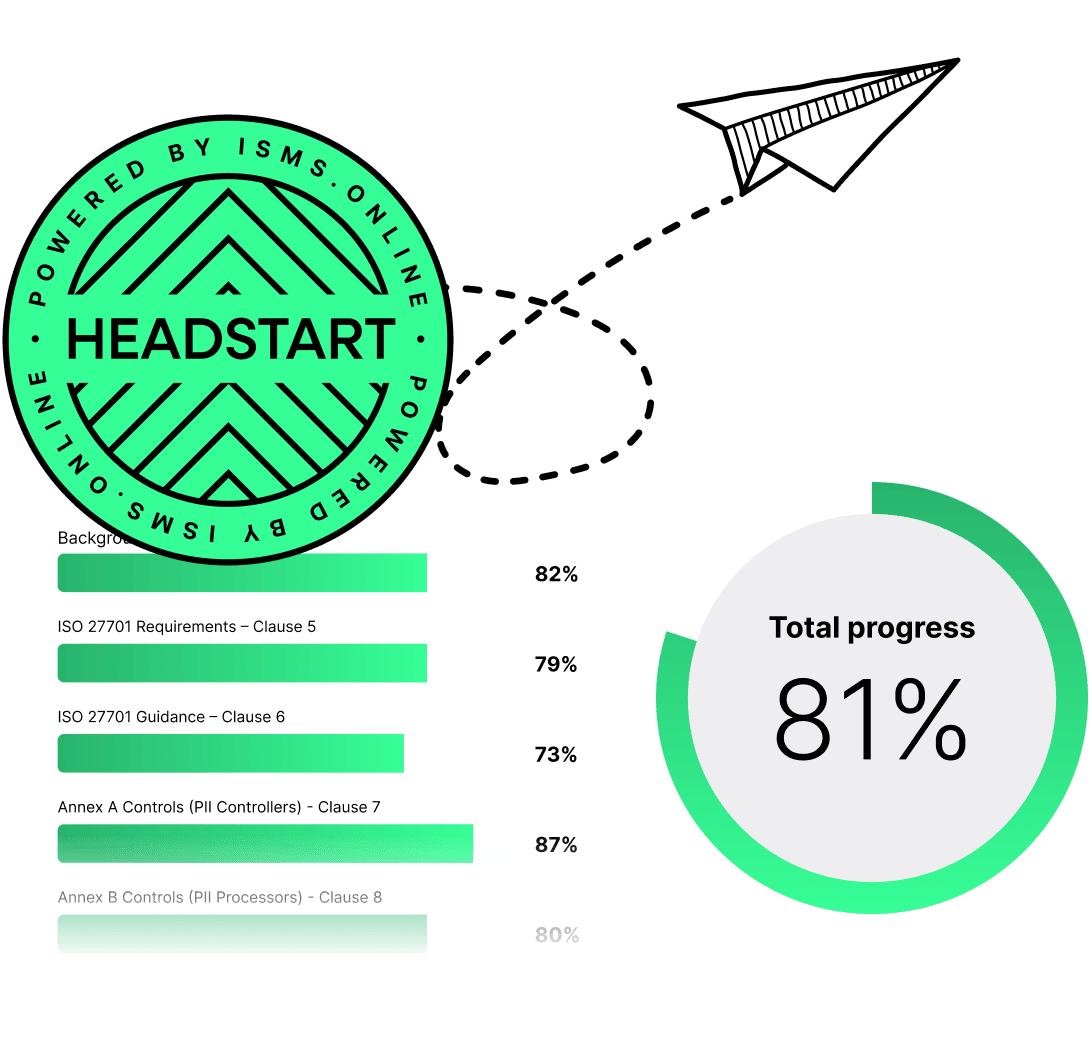
An 81% Headstart from day one
We’ve done the hard work for you, giving you an 81% Headstart from the moment you log on. All you have to do is fill in the blanks.
High‑impact ISO 27001 requirements for gaming tech
ISO 27001 includes a full management system in clauses 4–10 and a large catalogue of Annex A controls. For gaming technology providers, some requirements deliver far more value than others because they address risks around fairness, uptime and regulatory scrutiny.
The management‑system backbone: clauses 4–10
For a gaming platform, the core clauses of ISO 27001 matter because they force you to tie technology decisions back to business reality. They describe how you scope your system, understand your context and turn security from a project into a continuous cycle. Instead of treating controls as a static checklist, these clauses ask you to show how information security supports your strategy, how leadership takes responsibility and how you adapt as your games, infrastructure and markets evolve.
In practice, clauses 4–10 ask you to:
- Define the scope of your ISMS in clear, business terms, such as “all systems and services supporting remote gaming for titles X and Y”.
- Analyse internal and external issues, including regulator expectations, operator contracts, cloud dependencies and organisational structure.
- Set information security objectives that support your business strategy, such as reducing security‑related downtime or shrinkage due to fraud.
- Provide evidence that leadership is actively involved through policies, resourcing decisions, risk acceptance and management reviews.
- Plan and execute risk assessment and treatment activities, then monitor and improve them over time.
These clauses are where auditors and regulators look for proof that security is not an afterthought or side project. They anchor the technical controls in your actual business context, governance structures and decision‑making processes.
Annex A themes that matter most for game integrity and uptime
For gaming technology, some Annex A themes deserve early attention because they protect fairness, availability and compliance in day‑to‑day operations. Focusing here gives you visible risk reduction and strong stories for stakeholders.
Key themes include:
- Access control and identity: – Manage administrative access to game servers, back‑office tools, build and deployment pipelines, database consoles and monitoring systems with least privilege, strong authentication and regular reviews.
- Operations security: – Formalise procedures for change management, capacity planning, backup and recovery, and log management so live‑ops stays stable while you ship frequent updates.
- Secure development and change: – Define secure coding practices, peer review, security testing and controlled promotion of builds, especially for logic that influences randomness, payouts or balances.
- Supplier relationships: – Apply due diligence and ongoing monitoring to cloud providers, content delivery networks, payment processors, KYC/AML services, analytics platforms and outsourced development studios.
- Business continuity and disaster recovery: – Design and test plans and architectures that help your platform withstand or recover from events such as DDoS attacks, infrastructure failures or key third‑party incidents.
When you prioritise your implementation roadmap, starting with these themes helps you reduce the most important risks while also strengthening your commercial storey.
Linking SRE and DevOps practices to ISO requirements
Many gaming organisations already use site reliability engineering or DevOps practices to manage uptime and deployment. These can be powerful assets for ISO 27001 if you treat them as part of the ISMS rather than as a separate discipline that auditors never see. Instead of inventing new processes purely for certification, you can treat existing operational practices as core controls and show how they support your risk treatment decisions and information security objectives.
For example:
- Service‑level objectives and error budgets can inform your risk assessment for availability and performance.
- Incident runbooks, on‑call schedules and post‑incident reviews can serve as evidence for incident management and continual improvement.
- Change advisory practices, deployment pipelines and rollback mechanisms can demonstrate controlled change management.
The key is to document how these practices work, assign clear responsibilities and link them to your risk and control framework. That way ISO 27001 does not slow you down; it captures and strengthens what you already do, making it easier to demonstrate consistency to operators and regulators.
Mapping Annex A controls to real gaming risks
ISO 27001’s Annex A can feel abstract until you connect it to concrete scenarios from your own games and services. A gaming‑specific risk view makes the control set far easier to understand, prioritise and explain.
Building a gaming‑centric risk view
You get more value from ISO 27001 when you start from situations that genuinely worry you, rather than from a generic checklist. For most gaming tech providers, this will include some mix of commercial, technical and regulatory risks. Thinking in terms of real incidents, near misses and “nightmare scenarios” helps your teams engage with the process and makes it easier to explain to leadership why certain controls matter or why some apparently exotic risks deserve serious attention.
Common scenarios include:
- Account takeover, bonus abuse and collusion.
- Payment fraud, chargebacks and abuse of promotions or virtual currencies.
- Cheating that undermines fair play, such as aimbots, wallhacks or manipulated clients.
- Attacks on random number generator integrity or payout calculations.
- DDoS or infrastructure failures that take down match‑making, lobbies or key games.
- Misuse of player data, either via unauthorised access or poorly designed integrations.
- Failures in KYC, anti‑money‑laundering or regulatory reporting interfaces.
Each scenario can then be expressed as an information security risk: which assets are affected, how they could be compromised and what the impact would be on players, partners, regulators and your own business. That step turns Annex A from a long list into a set of tools you can apply deliberately.
Linking risks to control themes
Once risks are documented, Annex A becomes much easier to navigate and justify. Instead of asking “do we need this control?”, you can ask “how does this control help with our real risks?”.
For example:
- Fraud and account takeover touch on access control, logging and monitoring, and supplier management for payment gateways and identity providers.
- Cheating and game integrity relate to secure development, configuration management, access to game logic, protection of keys and secrets, and monitoring for suspicious patterns.
- DDoS and uptime risks involve network security, infrastructure design, capacity management, redundancy and incident response.
- Player data misuse maps to cryptography, access control, secure disposal and, where relevant, privacy‑specific controls.
For each risk, you identify which control themes are relevant and decide whether they are applicable, partly applicable or not applicable in your environment. This mapping is then reflected in your Statement of Applicability, which becomes a clear explanation of why each control is in or out of scope instead of a simple yes/no tick list.
Avoiding common mapping pitfalls
Some gaming‑specific traps arise repeatedly when teams try to link risks and controls, especially when they apply generic examples without adjustment.
Frequent pitfalls include:
- Treating anti‑cheat purely as a technical fraud tool and overlooking the privacy implications of telemetry and behavioural analysis.
- Ignoring supporting assets such as content delivery networks, analytics platforms or logging pipelines because they are “just infrastructure”.
- Underestimating the risk of outsourced game components or content developed by third‑party studios.
- Failing to consider cross‑title or cross‑region risks when you share infrastructure between games.
Good resources and examples can help here: look for guides that explicitly discuss asset classification and risk assessment for online services, then adapt them to your titles, back‑office tools and data flows. Over time, this helps your risk and control mapping feel natural to both engineers and auditors.

Free yourself from a mountain of spreadsheets
Embed, expand and scale your compliance, without the mess. IO gives you the resilience and confidence to grow securely.
Building an ISMS with templates, checklists and policy packs
Starting an ISO 27001 project from a blank page is slow and discouraging, especially when you are already running live games. A gaming tech provider needs a full suite of policies, procedures and records, but much of the underlying structure is reusable from other sectors if you tailor it wisely.
Core ISMS documents you will need
Certification bodies usually expect to see, at minimum, a coherent set of documents and records that show how your ISMS works in practice. These are not optional extras; they are how auditors and partners understand your system and judge whether it is mature enough to trust with regulated content, payments and player data. When those documents are missing, inconsistent or obviously generic, confidence in your overall governance drops very quickly.
Key documents and records include:
- A clear description of the ISMS scope and context.
- An overarching information security policy.
- Supporting policies and procedures for areas such as access control, incidents, change and assets.
- An asset inventory and risk assessment method with a populated risk register.
- A Statement of Applicability showing which Annex A controls you have chosen and why.
- Records of incidents, corrective actions, internal audits and management reviews.
- Business continuity and disaster recovery plans, together with test evidence.
Generic toolkits and policy packs can provide templates for almost all of these. What you add is the gaming context: concrete references to game servers, back‑office tools, live‑ops processes, payment integrations and regulatory interfaces, so the documents feel like they belong to your organisation.
Choosing and adapting templates sensibly
You save significant time when you select documentation packs that are close to your needs and easy for non‑specialists to work with. The goal is not to create perfect documents on day one, but to give your teams a clear and realistic starting point.
When you evaluate template sets, focus on:
- Alignment with the 2022 edition of ISO 27001 and Annex A.
- Clarity and readability for non‑specialists.
- Coverage of cloud and high‑availability architectures.
- Ease of editing and maintaining the documents over time.
Once you have chosen a set, avoid copying entire documents with only superficial changes. Instead:
- Take each template through a short review with technical and operational owners.
- Replace generic examples with references to components in your own architecture diagrams.
- Ensure responsibilities match your actual organisation chart and ways of working.
- Remove sections that clearly do not apply, explaining your reasoning in the Statement of Applicability.
Good resources often include implementation guides and checklists that walk you through this tailoring process so that policies become useful tools rather than shelfware.
Why an ISMS platform is worth considering
Even with excellent templates, managing an ISMS entirely through files and spreadsheets quickly becomes painful as you grow. An ISO‑centric ISMS platform gives you a structured place to run the whole system instead of stitching it together by hand. It also helps you show operators and auditors that information security is managed consistently rather than depending on a few individuals who “know where everything is”.
A dedicated platform can:
- Store policies, risk registers, Statement of Applicability entries and records in one place.
- Track tasks and approvals for changes, reviews and audits.
- Link evidence, such as incident tickets or monitoring dashboards, directly to controls.
- Provide dashboards for leadership, auditors and commercial partners.
Some platforms, such as ISMS.online, explicitly target gaming and gambling organisations, offering sector‑aware content, mappings and example workspaces. Others are more general but still support ISO 27001 efficiently. When you assess them, consider how well they reflect a 24/7 live‑ops environment, how easily they integrate with your existing toolchain and whether they reduce the day‑to‑day effort for the people running your ISMS.
Proving effectiveness to operators and regulators
Documents and control lists are necessary, but on their own they do not prove that your ISMS works. Operators, publishers and regulators want to see that your processes function during real incidents and changes, not just on paper.
Designing meaningful security and resilience metrics
For a gaming platform, useful indicators help you see whether your controls are doing their job and where to improve next. ISO 27001 expects you to monitor, measure and evaluate performance, and sensible metrics make that obligation genuinely helpful. The best measures reflect the realities of live‑ops: how often things go wrong, how quickly you respond, how effectively you prevent repeat issues and how clearly you can explain trends to stakeholders who are not immersed in the technology.
Practical measures often include:
- Frequency, severity and resolution time of security incidents and serious outages.
- Success rates and lead times for changes, particularly those affecting live games and payouts.
- Completion rates for security training and awareness activities.
- Progress in closing internal audit findings and corrective actions.
- Coverage of critical controls, such as multi‑factor authentication for admin access or encryption for sensitive data.
Well‑chosen metrics show trends over time and support conversations with leadership. They help you make the case for investment, explain trade‑offs to product teams and demonstrate to partners that you treat incidents as opportunities to improve, not just problems to fix.
Showing “audit‑ready” live‑ops
An easy way to test whether your ISMS feels real is to pick a recent incident or major change and see how well you can trace it through your records. You are aiming for a clear storey that connects what happened to your documented processes and control objectives.
For example:
- A DDoS attack on your match‑making service triggers monitoring alerts, on‑call escalation, incident logging, communication with operators, mitigation steps and a post‑incident review.
- A critical vulnerability in a game component results in emergency patching, change approvals, testing, deployment, follow‑up checks and documentation.
If each step leaves evidence – tickets, logs, approvals, runbooks, review minutes – and these are linked back into your ISMS, you can show auditors and partners exactly how your controls work under pressure. Service management frameworks and site reliability practices give you much of this structure already; ISO 27001 asks you to connect it explicitly to risk and control objectives.
Integrating your ISMS with existing tools
To avoid duplicate work and extra friction, many organisations integrate their ISMS with tools they already rely on. The goal is not heavy automation but sensible data sharing and visibility.
Common integrations include:
- Ticketing systems for incidents, problems and changes.
- Source control and CI/CD tools for development and deployments.
- Monitoring and logging platforms for technical evidence.
- HR and training systems for awareness and competence records.
For instance, a major incident in your ticketing system should automatically appear in ISMS incident records, and a quarterly access review in your identity platform should link to an access control objective in your Statement of Applicability. Platforms such as ISMS.online are designed to make these links easy to see and maintain, which in turn makes audits smoother and helps internal teams experience ISO 27001 as part of how they already work.

Manage all your compliance, all in one place
ISMS.online supports over 100 standards and regulations, giving you a single platform for all your compliance needs.
Common ISO 27001 pitfalls in gaming – and how to avoid them
Learning from other gaming organisations’ missteps can save you months of rework. Case studies, auditor feedback and sector experience all point to a set of recurring problems when teams pursue ISO 27001 without a clear plan.
Scopes that miss what regulators and operators care about
One frequent issue is an ISMS scope that is too narrow. It may look neat on paper but fails to cover the systems partners truly care about, which undermines trust as soon as someone looks closely. If critical game servers, back‑office tools or cloud platforms sit outside the certified boundary, regulators and operators will question whether the certificate really tells them anything meaningful about the risks they care about most.
Typical scope mistakes include:
- Limiting the scope to corporate IT networks while excluding game servers and back‑office tools.
- Leaving out cloud services or data centres that host critical games or player data.
- Ignoring outsourced development or managed services that materially affect security.
When regulators or operators discover that key components sit outside the certified ISMS, confidence erodes quickly. To avoid this, treat your initial scope definition as a strategic decision. Involve technical, commercial and compliance leaders, and ensure that the systems most relevant to game integrity, player protection and uptime are inside the boundary from the beginning.
Paper‑only controls and template shelfware
Another common pitfall is producing a set of policies and procedures that nobody actually uses. On the surface, you appear compliant; in practice, daily behaviour does not match the documentation.
Auditors can spot this when:
- Staff are unfamiliar with the contents of policies they are supposed to follow.
- Incident handling in practice bears little resemblance to the documented process.
- Change management runs through informal chats rather than the approval workflow described on paper.
The fix is simple but disciplined: every time you create or adopt a control, ask where it actually happens today and who owns it. Then embed it into existing workflows, tools and routines, rather than hoping people will remember a separate document. Over time, this makes your ISMS feel like a natural extension of how you work rather than a parallel universe.
Treating security testing as separate from the ISMS
As discussed earlier, technical testing alone does not prove effective management. Penetration tests, code reviews and red‑team exercises are vital in gaming, but they often remain disconnected from the ISMS if nobody owns the join between findings and risk management.
To make testing count inside ISO 27001 you can:
- Link each major testing activity to relevant risks in your register.
- Map findings to the Annex A controls they are designed to challenge.
- Track follow‑up actions, retests and risk acceptance decisions in your ISMS.
This turns external test reports into powerful evidence that your controls are both challenged and enhanced over time, rather than treated as one‑off exercises that fade into email archives.
Failing to keep the ISMS alive after certification
Finally, some organisations treat ISO 27001 as a one‑off project. After the certificate arrives, momentum fades, and documents drift out of date. Surveillance audits then reveal non‑conformities, and internal confidence declines.
You can avoid this by establishing simple, sustainable rhythms such as:
- Regular risk reviews that consider new games, integrations and markets.
- Scheduled internal audits and spot checks.
- Routine policy and procedure reviews with owners.
- Post‑incident reviews that explicitly consider whether controls or documents should change.
These activities do not need to be heavy‑weight, but they must be regular and visible. Over time, that rhythm turns ISO 27001 from a static badge into a genuine engine of resilience and trust. A focused ISMS platform like ISMS.online can help you embed these routines into everyday work, so continual improvement feels manageable rather than overwhelming.
Book a Demo With ISMS.online Today
ISMS.online helps you make ISO 27001 manageable in a gaming context so you can turn security expectations from a blocker into a growth asset. When stalled operator deals, scattered evidence and rising regulatory demands start to collide, a focused platform can be the difference between “nearly ready” and confidently certified.
What you see in an ISMS.online demo
A short demonstration lets you see how policies, risks, controls, tasks and evidence fit together in a single workspace designed for ISO 27001. You can see how the workspace reflects the realities of game platforms and live‑ops, how it supports auditor expectations, and how it gives commercial teams clearer answers to operator and regulator questions, rather than yet another collection of disconnected files and spreadsheets.
- How core components such as scope, risk register, Statement of Applicability and audit programme are structured.
- How tasks, approvals and reminders help a small team coordinate the ISMS without burning out.
- How existing DevOps, site reliability and compliance routines can be reflected rather than replaced.
Seeing your own scenarios mapped into a live environment often clarifies what needs to change, what can stay as it is and where templates, policy packs and pre‑built workflows can save you time. That clarity makes it easier to commit to realistic milestones and secure buy‑in from technical, commercial and compliance stakeholders.
How to get started without disrupting launches
You do not need to pause releases or delay game launches to begin building a serious ISMS. Many organisations start with a limited scope, such as one platform or region, and expand coverage as they prove value and learn how audits respond.
A practical first move is to set a concrete internal target, such as an intended certification window or a committed date for your first gap assessment. From there, you can align responsibilities, confirm which parts of your architecture should fall inside scope and decide how to phase the work so that live‑ops stability is never at risk.
If ISO 27001 is already on your roadmap, combining that decision with a focused conversation about ISMS.online turns abstract intent into a realistic plan. You give yourself a clear path to unlocking new markets, de‑risking audits and proving to players and partners that your security is as strong and reliable as your games. Choose ISMS.online when you want ISO 27001 to support gaming growth without drowning your team in administration; if you value clear evidence, sector‑aware content and a practical route to certification, we are ready to help.
Book a demoFrequently Asked Questions
Which ISO 27001 areas really matter most for gaming and iGaming tech providers?
For gaming and iGaming, the ISO 27001 areas that matter most are the ones that protect fair play, uptime, payments and player data in 24/7 live environments.
Why do clauses 4–10 matter more than a long control checklist?
Clauses 4–10 decide whether you have a living security system or just a pile of documents.
They help you:
- Bring the real platform into scope (Clause 4):
You define an honest scope that covers game servers, RNG, lobbies, wallets, bonus engines, back‑office consoles, analytics and the underlying cloud and network. If you certify only “office IT”, operators and regulators quickly question whether your certificate reflects the systems they actually rely on.
- Put accountable leadership in place (Clause 5):
You name who is ultimately responsible for information security and how your policy lands with engineering, live‑ops, product, fraud and compliance. That gives your team cover to say “no” (or “not like that”) when a rushed change would hurt fairness or uptime.
- Think in realistic risk scenarios (Clause 6):
Instead of generic “data breach” wording, you assess things like bonus abuse, payout mis‑calculation, fraud spikes, DDoS on lobbies, content tampering and cross‑border data transfers for analytics. Those are the scenarios operators and gambling commissions already worry about.
- Resource and document what you actually do (Clauses 7–8):
You make sure the right skills, playbooks and records exist for:
incident handling; secure coding around RNG and payouts; supplier management for PSPs, ID providers and CDNs; and day‑to‑day change and deployment. That is where an Information Security Management System (ISMS) becomes visible to your engineers and live‑ops teams.
- Show that you learn, not just react (Clauses 9–10):
You schedule internal audits, management reviews and corrective actions around real events such as fraud waves, anti‑cheat issues or major launches. Over time that rhythm is what convinces operators and regulators that your ISO 27001 certificate reflects genuine continual improvement.
If you want this structure without wrestling with spreadsheets, ISMS.online gives you a ready‑made ISO 27001:2022 framework where these clauses, owners, tasks and evidence are already joined up.
Which Annex A themes should gaming providers focus on first?
Most of the risk and scrutiny for gaming and iGaming clusters around five Annex A themes:
- Access control and identity:
Protecting admin consoles, build pipelines, data stores and third‑party portals that can change RTP, bonuses, limits or expose sensitive player and revenue information.
- Operations security:
Aligning change management with your release cadence, capturing the right logs for gameplay and admin activity, protecting balances and entitlements with robust backup and recovery, and planning capacity for large tournaments and campaigns.
- Secure development and change:
Controlling how changes to RNG, payout logic, wallets and bonuses are specified, reviewed, tested and deployed, with clear segregation of duties and protection for build artefacts and signing keys.
- Supplier relationships:
Governing cloud and hosting providers, PSPs, KYC/AML services, game studios, CDNs and data processors so you can demonstrate who does what, in which regions, under which security commitments.
- Business continuity and disaster recovery:
Preparing for DDoS, region or data‑centre loss, database corruption and major supplier outages, with clear priorities for login, deposit, gameplay and withdrawal flows and a playbook for communicating with operators and regulators.
If you align these themes with your actual services and data flows, you answer the three questions stakeholders ask most: “Is play fair?”, “Will you stay up?”, “What happens to money and data when something breaks?”. Using a platform such as ISMS.online makes it easier to keep that mapping live as you add games, markets and partners without reinventing your ISMS each time.
How can a gaming tech provider use ISO 27001 templates and policy packs without ending up with “paper compliance”?
You get the fastest, most credible results when you treat templates and policy packs as draughts you actively reshape, not as frozen wording you drop into your ISMS unchanged.
Which core ISMS documents should a gaming provider put in place first?
Most auditors, B2B operators and platform partners will expect to see the same backbone:
- A scope and context statement that names your games, channels and regulated markets, plus the infrastructure they run on.
- An information security policy supported by focused policies for access control, change and release, incident management, asset management, supplier management, logging and monitoring, and business continuity.
- An asset inventory that covers player data, RNG and game engines, match‑making, back‑office consoles, analytics tooling, integrations and cloud services.
- A practical risk method and a populated risk register with scenarios such as account takeover, bonus abuse, payout errors, payment fraud, DDoS and data misuse.
- A Statement of Applicability that explains which Annex A controls you use, how they apply to gaming‑specific risks, and which you exclude with justification.
- Records of incidents, problem reviews, corrective actions, training, supplier assessments, internal audits and management reviews.
Well‑designed ISO 27001:2022 policy packs, such as those embedded in ISMS.online, give you templates for all of this so you are not starting from a blank screen.
How should we adapt ISO 27001 templates so they match our platform and people?
You turn templates into a working ISMS by tailoring them to your architecture and team structure:
- Use your own language:
Swap phrases like “information systems” for game clusters, orchestration stacks, RNG microservices, compliance reporting feeds and payment gateways so engineers and live‑ops recognise what you mean.
- Tie roles to real job titles:
Map “system owner” and “service manager” to specific SRE leads, platform managers, heads of fraud, live‑ops managers and compliance officers. That makes accountability obvious in both audits and day‑to‑day discussions.
- Prune carefully and explain why:
Remove clearly irrelevant controls (for example, removable media handling if you are cloud‑native) and capture your reasoning plus any compensating measures in the SoA so auditors and operators can follow your logic.
- Make the documents part of your normal work:
Run reviews, approvals and tasks through a central ISMS platform such as ISMS.online. That creates an audit trail showing when you last reviewed a policy or risk, who signed it off and what changed – which is exactly what regulators and enterprise customers look for when they ask how you stay current.
Handled this way, templates become accelerators, not constraints, and you can reach a defensible ISO 27001 position in a fraction of the time it would take to draught everything from scratch.
Which ISO 27001 resources actually help gaming and iGaming technology teams, rather than adding noise?
The most useful ISO 27001 resources for gaming teams are the ones that balance accuracy about the standard with clear relevance to always‑on, regulated platforms.
What types of ISO 27001 resources should we prioritise as a gaming provider?
Four categories tend to deliver the most value:
Plain‑language explainers tailored to online services
Short explainers that unpack clauses 4–10 and Annex A using examples from online games, wallets and analytics help non‑specialists understand what matters. Longer pieces or webinars focused on topics such as “evidence for fairness and RNG integrity” or “ISO 27001 in regulated gambling” give deeper guidance without falling into abstract compliance language.
Document kits and policy packs that know the 2022 standard
Document packs that include policies, risk and opportunity registers, SoA templates, incident and change procedures, continuity plans, audit schedules and training records are most effective when they:
- Are aligned to ISO 27001:2022, not older versions.
- Assume cloud‑native, API‑driven architectures.
- Show which clause or control each document supports, so you maintain traceability.
Training and enablement that is specific to each role
Your ISMS lead and internal auditors will usually need formal ISO 27001 training. Other teams respond better to concise, role‑specific sessions, for example:
- Developers and SRE learning how change, logging and access controls are expected to work in CI/CD pipelines.
- Fraud and risk teams understanding how their work feeds the risk register and incident records.
- Product managers learning how to consider information security and privacy when designing new features or market entries.
That makes the ISMS relevant for each audience instead of feeling like a generic compliance lecture.
ISMS platforms that are designed around ISO 27001
A dedicated ISMS platform saves large amounts of effort compared with spreadsheets and shared drives. ISMS.online, for example, provides:
- A single workspace for policies, risks, controls, actions and evidence.
- ISO 27001:2022‑aligned structures and content, including options tailored to gaming and gambling.
- Built‑in workflows so reviews, approvals and tasks create an audit trail without you having to design that from scratch.
When you review resources, look for clear references to ISO 27001:2022, recognition of high‑availability and multi‑region designs, and language that product and engineering teams can understand. That combination makes it much easier to embed information security into decisions about new games, promotions and markets.
How should we map ISO 27001 Annex A controls onto game servers, wallets and payment flows without getting lost?
The simplest way to build a useful mapping is to start from your own services and realistic threats, then connect them to Annex A themes so auditors and regulators can follow your reasoning.
What is a practical Annex A mapping method for gaming teams?
A repeatable approach looks like this:
1. List the services and assets that drive your business
Capture the components that matter most, such as:
- Account, identity and player profile systems.
- Game servers, orchestration layers, lobbies and match‑making.
- RNG engines, payout and bonus calculators, jackpots and house balance logic.
- Wallets, cashier front‑ends and payment integrations.
- Anti‑fraud, risk scoring and manual review consoles.
- Operator portals, reporting and regulatory exports.
- Cloud accounts, networks, observability platforms and administrative endpoints.
This inventory underpins both ISO 27001 and any future frameworks like SOC 2 or NIS 2.
2. Write a few realistic scenarios around each asset
For every major service, write short, believable situations such as:
- A popular release causes cascading matchmaking failures during a large sporting event.
- Attackers use credential stuffing to hijack accounts in one jurisdiction.
- A jackpot configuration error leads to over‑payments and dispute risk.
- A PSP outage blocks deposits for several hours in a key market.
- Internal anti‑fraud thresholds leak and get systematically exploited.
Keeping scenarios grounded in your platform and markets makes risk workshops far more productive.
3. Link scenarios to Annex A control families instead of individual lines
For each scenario, decide which Annex A themes should respond:
- Account takeovers: → access control, secure authentication, monitoring and alerting, supplier management for identity providers.
- Fairness or payout tampering: → secure development life cycle, segregation of duties, change and release management, key management, logging.
- Capacity or availability failures: → network security, performance and capacity management, continuity, incident response, supplier management for CDNs and scrubbing.
- Payment disruption: → supplier relationship management, alternate routing, continuity planning, incident communication, financial controls.
- Data leakage: → cryptography, access control, data retention and disposal, unusual‑access monitoring, privacy controls.
That gives you a clear chain from “this is how we make and protect revenue” to “these are the control themes we rely on”, which resonates strongly with both operators and auditors.
4. Keep the mapping current in your ISMS
Record and maintain the mapping in your risk register, SoA and control catalogue:
- Each risk references the Annex A themes applied.
- Each theme lists the services, processes and suppliers it covers.
- Evidence records show where an assessor can see the control in action.
Visual tools like risk‑versus‑theme heatmaps make this easy to explain in workshops and audits. In ISMS.online you can link risks, controls and evidence directly, so when you introduce a new fraud engine, payment provider or deployment model, the related risks and controls stay aligned instead of drifting apart.
How can we show operators and regulators that our ISO 27001 controls really work for 24/7 live operations?
You earn trust by demonstrating how controls behave during real incidents, not by pointing only at policies. Stakeholders want to see that your ISMS informs decisions when the platform is under pressure.
What does convincing “evidence in action” look like for gaming and iGaming?
Three patterns tend to resonate:
1. Being able to replay meaningful incidents in detail
Choose a small number of substantial events – for example, a fraud spike, a DDoS attack or a payout defect – and be prepared to walk an assessor through:
- How the issue was first detected and which monitoring signal or alert triggered action.
- Who took ownership, which runbook they followed and how severity was agreed.
- What actions were taken technically and operationally, and on what timeline.
- How you communicated with players, operators, partners and regulators.
- What changed afterwards in your risks, controls, procedures or training.
You support that storey with tickets, logs, dashboards, incident reports and updated ISMS records rather than relying on recollection.
2. Tracking a small set of meaningful performance indicators
Rather than reporting every possible number, focus on metrics that show the health of your controls, such as:
- Number and severity of security incidents and production problems over time.
- Mean time to detect and mean time to recover for significant issues.
- Proportion of successful versus rolled‑back changes for high‑risk components like RNG, payouts and wallets.
- Completion rates for training and control tests in teams that affect fairness, money or data.
- Age and closure rate for audit findings and corrective actions.
Feeding these indicators into internal audits and management reviews supports a credible continual‑improvement storey for regulators and B2B customers.
3. Connecting your ISMS to the tools you already use to run the platform
In practice, a robust ISO 27001 implementation is woven into:
- Ticketing and incident management tools.
- CI/CD and configuration management pipelines.
- Observability and security monitoring platforms.
- Identity systems and admin consoles.
- Supplier status and escalation channels.
When significant events in these tools automatically produce evidence in your ISMS – approvals, logs, incident references, review outcomes – you show that ISO 27001 is part of how you operate, not a separate layer for audit season. ISMS.online is designed around that model, so you can demonstrate live controls efficiently instead of recreating evidence by hand before each assessment.
What ISO 27001 mistakes do gaming tech providers make most often, and how do we design an ISMS that avoids them?
Gaming and iGaming companies tend to encounter the same traps: scopes that undermine trust, controls that diverge from reality and ISMSs that stagnate after the first certificate.
Where do ISO 27001 projects usually go wrong in gaming – and what should we do instead?
Three issues stand out:
1. Scope definitions that look neat internally but weak externally
Overly narrow scopes that cover only office IT or a single back‑office tool may seem easier to manage but immediately trigger concern from operators and regulators who fear that live game environments or payment services sit outside the certified boundary.
You reduce that risk by:
- Involving leaders from technology, commercial, risk and compliance when deciding scope.
- Ensuring services that drive fairness, uptime, money and data – plus their supporting infrastructure – are clearly in scope.
- Documenting any temporary exclusions, the compensating measures in place and when you will revisit those decisions.
2. Policies and procedures that nobody genuinely follows
Controls that bear no resemblance to day‑to‑day practice are quickly exposed. Common symptoms include:
- Change processes describing CAB meetings and maintenance windows that do not exist.
- Incident runbooks that do not reflect how SRE, fraud or support teams actually manage outages.
- Access rules that ignore how contractors, game studios and partners really work.
A more effective pattern is to:
- Start from what your teams already do and improve it, instead of importing unfamiliar processes.
- Name an owner, supporting systems and expected evidence for each key control.
- Regularly test alignment by taking a recent incident or change and comparing what really happened with what your ISMS claims; then adjust one or both until they match.
3. Treating the ISMS as a one‑off project rather than an ongoing system
If you stop updating documents after the initial audit, new games, markets, suppliers and team changes quickly make the ISMS unreliable.
To avoid that:
- Set realistic cadences for risk reviews, internal audits, policy updates and management reviews that reflect your release cycles and planning rhythms.
- Use an ISMS platform to assign tasks, send reminders and track completion so reviews continue even when people move roles.
- Treat real incidents, supplier issues, regulatory changes and architectural shifts as triggers to revisit affected risks and controls, not just as items to close in a ticketing system.
When your scope is honest, controls match behaviour and review cycles are protected, ISO 27001 becomes a way to codify and showcase the best parts of how you already run the platform. ISMS.online is built to support that style of “living ISMS”, giving you enough structure to reassure auditors, operators and regulators while still letting game, product and live‑ops teams move at the speed your market demands.






