















Why Leading Companies Now See GDPR as a Business Asset, Not a Cost
Every board understands the reputational and financial consequences of non-compliance—but what’s often missed is how a fragmented GDPR process dilutes competitive strength. Fragmented documentation, manual task follow-up, last-minute data chases—each symptom quietly erodes your team’s confidence when an audit, deal, or regulator request lands.
What’s Changing the Stakes for Compliance Officers and CISOs?
Current research shows that organisations mapping data, risks, and responsibilities in a unified environment cut audit preparation time by up to 40% and slash fine incidents by double digits. When data mapping, risk tracking, and reporting live in separate silos, no amount of effort can prevent costly gaps.
Reputation is not a deliverable. It’s the net result of how quickly your company can prove compliance when it matters most.
How Do Unified Strategies Deliver Continuous Proof?
A continuously updated system isn’t just an administrative upgrade. It’s a confidence guarantee—for your board, clients, and partners. Real leaders move beyond static checklists to centralised, living controls that keep you ready for the next audit or incident, not scrambling after the fact.
To operate confidently in high-stakes markets, your company must not only say it complies; it must demonstrate this in real time, with traceability, evidence, and zero excuses.
Book a demoWhere Are Documentation Gaps Costing You Audit Readiness?
How Does a Modern Data Inventory Prevent Audit Failure?
You face increasing pressure to prove what data you hold, who has access, and how it flows—not just in a crisis, but in every routine review. Regulators no longer accept half-completed inventories or asset trackers maintained as individual Excel sheets. Audit failures and compliance fines are now most often triggered when documentation is missing, fragmented, or out of sync with operational reality.
What’s the Direct Route to Always-On Evidence?
- Integrate data mapping and records processing: Build a single source of truth that covers assets, data flows, responsibilities, and version history.
- Automate documentation upkeep: Use platforms that connect asset inventories to policies and incident logs, reducing the manual burden and error risk.
- Link inventory and risk: Tying inventory tracking to risk and incident history unearths unseen vulnerabilities and accelerates response time when validation is demanded.
Data Documentation Weaknesses vs. Unified Processing
| Weakness | Siloed Approach | Unified System (ISMS.online) |
|---|---|---|
| Version drift | Common | Eliminated: auto-updates and role locks |
| Evidence collection time | Days to weeks | Minutes with instant traceability |
| Audit pass rate | 70–80% (industry) | 95–100% with live inventory + workflow logs |
Keeping core documentation in a central system is no longer a nice-to-have; it’s the operational minimum for organisations who aim to minimise audit disruption and maintain client confidence during due diligence.
ISO 27001 made easy
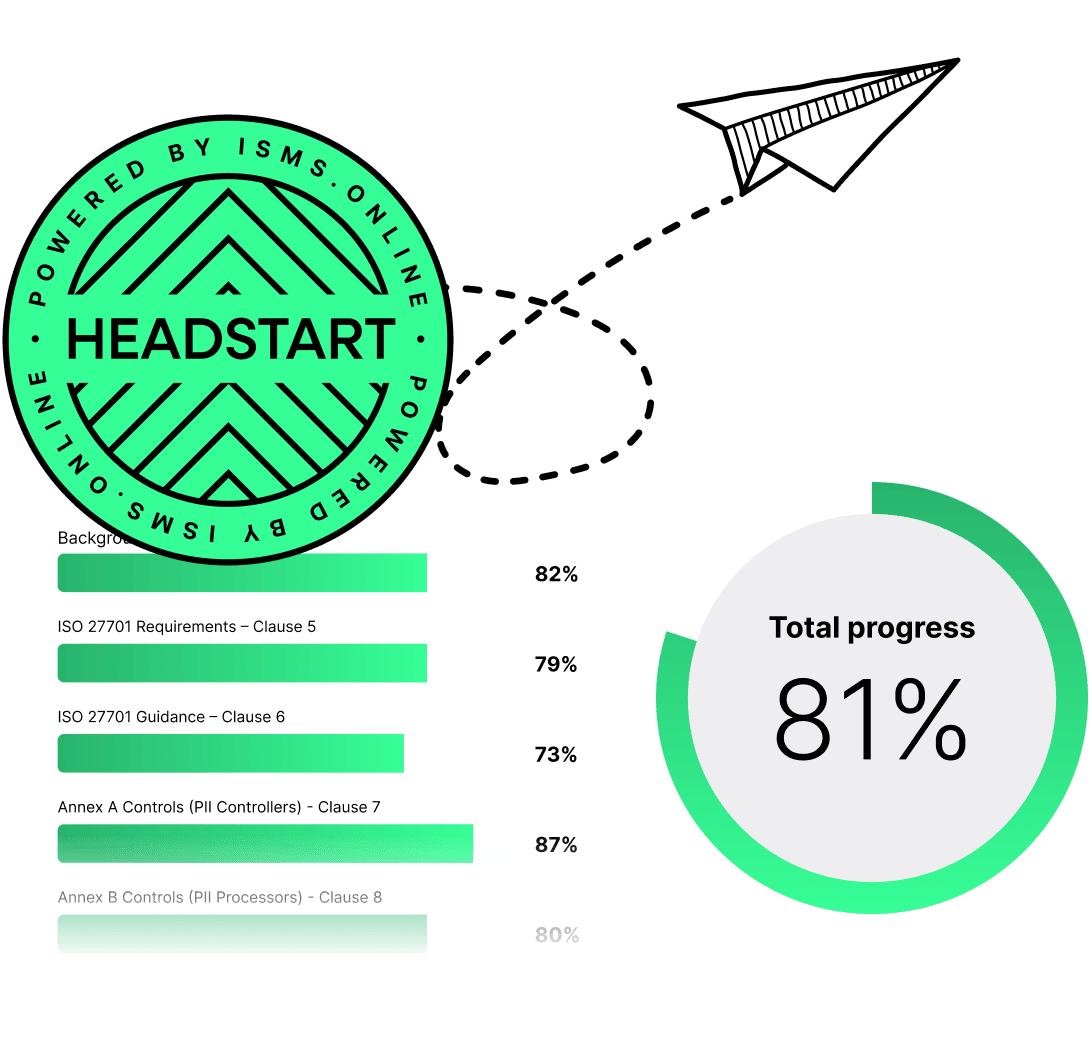
An 81% Headstart from day one
We’ve done the hard work for you, giving you an 81% Headstart from the moment you log on. All you have to do is fill in the blanks.
How Are Next-Gen Risk Programmes Closing Exposure Faster?
Why Is Live Risk Monitoring a Board-Level Expectation?
Risk registers living in yesterday’s static files are invisible the moment conditions change. A live approach means integrating risk detection, escalation paths, and closure progress right into your ISMS—automatically flagging changes as new vendors, assets, or policies update.
How to Achieve Expectations
You achieve measurable risk reduction when your team logs, tracks, and resolves each risk in the same system that governs assets, incidents, and policy updates—providing directors with immediate evidence of active risk management and direct ROI on their compliance investment.
How Do Automated Risk Workflows Defend the Business?
- Escalate at speed: System-driven workflows channel urgent risks to responsible owners for same-day analysis.
- Score and report clearly: Dynamic dashboards and automated scoring allocate response to highest-value risks first.
- Close the loop: Resolution logs, with audit trails, supply instant boardroom answers and streamlined reporting for annual returns, accreditations, or regulator requests.
When Risk Management Gets Real
When an employee forwards sensitive information to a personal device, your ISMS flags the policy break, triggers a risk review, and logs action—all before a regulator or client asks you to prove your vigilance.
Putting automated risk management at the centre of your compliance programme builds trust, and proves continuous intent—not just point-in-time adequacy.
Why Does Policy Management Decide Audit Outcomes?
What Sets Polished Policy Frameworks Apart in 2025?
A policy (document) isn’t a control until it’s reviewed, mapped to risk and evidence, and monitored for drift. Annual policy rewrites without continuous mapping to operational practice are now a visible signal to auditors and premium clients that a company lacks resilience.
What Moves Policy from Weakness to Strength?
- Leverage standardised, regularly updated policy packs: Rarely can an internal team keep up with regulatory churn. Use systems that monitor regulatory updates and trigger reviews based on changes, not pre-set dates.
- Embed policy review as an active workflow: Steering policy sign-off and versioning through workflow tools ensures every control shift is evidenced and time-stamped for your next client or audit.
Policy Management Comparison
| Area | Old Model | Continuous Review (ISMS.online) |
|---|---|---|
| Update Frequency | Yearly or ad hoc | Trigger-based, with audit log |
| Dependency Audit | Manual, often missed | Automated cross-linking |
| Audit Pass Rate | Unpredictable | 95–100% with live compliance triggers |
By connecting policy and controls management into your ISMS, each procedural update is tracked, versioned, and surfaced as evidence any time it’s needed—building unassailable confidence with every new audit or client pitch.

Free yourself from a mountain of spreadsheets
Embed, expand and scale your compliance, without the mess. IO gives you the resilience and confidence to grow securely.
When Should You Trigger GDPR Assessments and Compliance Requests?
What’s the Hidden Risk in Delayed or Ad Hoc Reviews?
Most leadership teams discover response gaps only under pressure: during auditor interviews, high-stakes sales cycles, or regulatory queries. Compliance resilience isn’t a calendar—it’s a living schedule of assessment triggers tied to operational reality and delivering on-demand, audit-quality documentation.
ISMS.online Is the Answer
By enabling your system to schedule, escalate, and log Privacy Impact Assessments, Legitimate Interest Reviews, and Subject Access workflows in real time, your obligations are always met preemptively—removing risk from both missed deadlines and untraceable evidence.
How Are Proactive Reviews Automating Trust?
- Build escalation into workflows: Reviews and requests that ride active notification and approval trails—never left to inbox fate.
- Document closure and compliance evidence: Each assessment is logged, versioned, and tied directly to a unique audit event.
- Proof for clients and regulators on demand: With instant download and direct access to closure logs, delays never erode trust or escalate into missed opportunities.
Scheduled Compliance Assessments—Manual vs. Automated
| Process | Manual Review | System-Driven (ISMS.online) |
|---|---|---|
| Scheduling | Calendar-based | Triggered by workflows/risks |
| Evidence Link | Searched when needed | Always attached to request/closure |
| Audit Success | Variable | Predictable, repeatable |
The leaders in 2025 treat assessments as rolling offence, not defence—ensuring client and board confidence never wavers.
How Does Integrated Incident and Continuity Management Signal Maturity?
Can Your Organisation Demonstrate Readiness Before the Incident?
Incidents will test every gap your controls have left behind. The organisations that emerge with their reputation and value unscathed do so because they have blended incident and business continuity planning into their compliance foundation, not layered them in as afterthoughts.
We Have the Solution
Integrating incident response with a centrally managed ISMS ensures instant detection, escalation, and resolution logs—creating a defensible record for clients, insurers, or investigators. It also delivers the only kind of resilience the board cares about: verifiable, repeatable, real-world readiness.
What Does Best-in-Class Integration Offer?
- Unified notification and containment workflows: Every alert cascades through role-assigned review and action.
- Drill history and recovery logs: Continuous tabletop exercises keep the operational reality ahead of policy documentation.
- Proof-driven recovery: Boards and auditors receive not just plans, but drill results and recovery logs—immediately accessible, never left to recollection.

Manage all your compliance, all in one place
ISMS.online supports over 100 standards and regulations, giving you a single platform for all your compliance needs.
Where Does Oversight Become Your Command Post, Not a Bottleneck?
How Are Real-Time Controls Changing the Compliance Conversation?
Oversight, when built as an extension of daily work—not as periodic policing—transforms compliance officers from enforcement to enablement. Dashboards live-feed task status, open risks, and policy drift directly to responsible teams, slashing internal bias in favour of truth and transparency. By automating reporting, task reminders, and evidence capture, you create trust between business functions—making compliance a competitive advantage, not a delay.
How Does This Oversight Deliver Lasting Differentiation?
- Automatic, role-based reminders: Teams close out tasks because the system expects it, not just the boss.
- Single pane of operational visibility: IT, risk, HR, and operations operate from the same exact data—not outdated or mismatched versions.
- On-demand audits and trend reviews: Your company shifts to audit readiness as the normal path, not an expensive project.
Oversight Evolution—Old vs. New
| Oversight Function | Legacy (Siloed) | Unified Command (ISMS.online) |
|---|---|---|
| Task Closure | Rely on memory/emails | Tracked, time-stamped, visible to all |
| Trend Analysis | Annual review | Live, with instant drill-downs |
| Audit Readiness | Episodic | Ongoing, frictionless |
Compliance leaders who build oversight into the fabric of the organisation free up operational bandwidth for innovation, growth, and competitive recalibration.
Visibility is strongest when it disappears as a worry—because audit and readiness are indistinguishable from business as usual.
Why Are Leading Compliance Officers and CISOs Making This Their Next Move?
Your brand, your valuation, your client trust—all are downstream of how quickly you can answer the next audit, client, or regulator demand for “show me.” Audit readiness is no longer a department—it’s board-level DNA, encoded in every process and made visible at every inflexion point.
What Does True Audit Readiness Look Like Now?
It’s not only the absence of penalty or failure—it’s the presence of real, live, traceable evidence, always accessible, always current.
Compliance Officer Readiness
A Compliance Officer in financial services knows: the organisation that produces audit logs and policy histories same-day, not same-month, protects both its reputation and its future ability to grow—or to stay out of the headlines.
Brands that set the pace in compliance today—aligned to ISO 27001, GDPR, and sector convention—aren’t just passing audits but defining market standards for readiness, transparency, and assurance.
Your company’s readiness, risk posture, and operational value are only as real as the system that protects and proves them every single day.
Who Sets Tomorrow’s Compliance Standard—The Defensive Company, or the Organisation That Anticipates?
The companies that transform compliance from a “burden” into a source of trust stand out. In the eyes of customers, partners, insurers, and regulators, these organisations keep operational risk in check and readiness at arm’s reach—regardless of what changes next quarter.
Setting the standard isn’t about reactive box-ticking—it’s the everyday, proactive discipline of surfacing proof before anyone asks. With ISMS.online as your unified protection platform, you demonstrate that your programme lives (not just exists)—giving your business the reputation and performance edge that makes others follow.
Now is your moment to be the company that competitors benchmark against, not the legacy operation that catches up when it’s already too late. Stand behind evidence, readiness, and trust—at every stage.
Frequently Asked Questions
What Changes When Your GDPR Compliance Becomes Unified—Not Fragmented?
Fragmented compliance isn’t a mistake—it’s simply what happens when organisations try to meet new controls using yesterday’s tools. The audit anxiety, the scattered files, and the policy rework sessions stem from too many systems chasing too many tasks. When compliance officers or CISOs finally unify the critical strands—data mapping, risks, policy reviews—those constant delays and missed details fade. Reputational damage always starts where accountability ends, and nowhere is that more exposed than in system silos.
Instead, a platform-driven Information Security Management System (ISMS) or Integrated Management System (IMS) brings all of your company’s evidence, improvement logs, and controls into live, traceable focus. Now, when your board or a regulatory inspector demands proof, you don’t reconstruct—your team simply reveals. This isn’t about being ready for the audit season; it’s about remaining ready every day.
Centralised systems routinely reduce errors up to 40%, turning review cycles into growth signals instead of threat points. If your executive team values momentum and market trust, integrated compliance isn’t an upgrade—it’s your new baseline.
Momentum in compliance isn’t built by waiting for proof; it’s shown by delivering it live—when scrutiny is highest.
How Does Bulletproof Documentation Protect Your GDPR Posture?
Auditors don’t care how hard your team works; they care that every action, asset, and transfer is current, visible, and matchable to a responsible name. Scattered lists, spreadsheet fatigue, and that one indispensable spreadsheet whisperer on your ops team—these are operational hazards in disguise. The gap isn’t knowledge, it’s certainty. Losses don’t come from the breach; they blossom from not being able to show who did what, when, and why.
A documented ISMS or Annex L-aligned IMS changes the equation. Your asset register, risk logs, and process maps don’t just live in separate files; they’re linked to controls, role assignments, and versioned histories. When a regulator walks in, you’re not scrambling. Every asset, every process, is connected and current—a web of evidence that speaks for itself.
- Review triggers: are built in, not retrofitted.
- Audit logs: extend from the asset register straight to incident histories.
- Documentation breakdown: Your company can instantly see if, where, and how asset controls diverged from stated policy.
| Common Failure Mode | Manual/Siloed Compliance | Unified ISMS/IMS |
|---|---|---|
| Asset registry drift | Inevitable, error-prone | Continuous, role-assigned, versioned |
| SAR evidence retrieval | Days to find | Minutes, always linked |
| Audit stress factor | High, unpredictable | Low, operationally routine |
What happens when an executive needs proof at speed? Your system’s a leadership asset, not an administrative burden—making you the ally they remember, rather than the scramble they regret.
Why Does Embedded Risk Assessment Decide Whether the Board Sleeps or Stares?
Reputation and velocity live or die with risk exposure—and nothing spirals boardroom confidence toward zero like the phrase “we’re not sure, we’ll look into it.” The cycles where risk is “managed” reactively, with annual checklists or email ping-pong, is precisely where boards lose faith and audit nerves become panic.
With ISMS.online—or any contemporary ISMS you standardise—risk registers aren’t passive, they’re operational. New threats, vendor shifts, data use cases: each triggers assignment, forces mitigation, and logs closure. The dashboard doesn’t just surface open risks, it spells out business value: which issues carry real operational liability, and which ones are closed because actual people did actual work.
Quantitative risk signals aren’t about dashboard prettyfication; they’re what fund the next security round and justify your resource asks. Compliance success is now inseparable from your risk engine’s ability to pull in every micro-threat, tie it to an owner, and record how your company responds before the regulator calls.
When your evidence of mitigation is as easy to present to the board as it is to resolve, you’ve engineered decision certainty.
The CEO isn’t losing sleep over policy alignment; she’s watching the risk metre. Leadership means showing your readings, not reporting excuses.
What Transforms Dusty Policies Into Operational Leverage?
A “policy” is just a well-written liability unless it’s mapped to a control, continuously updated, and proven in action. Every CISO or compliance lead knows the board’s real interest isn’t in your binder—it’s in knowing that what’s written is what’s real, and that it changes on purpose when the landscape shifts.
The real art comes from making updates routine, versioning every control, and forcing approval flows that leave no part of your business a mystery to auditors. When GDPR tightens or Annex L scope evolves, you shouldn’t scramble—you cascade. Prescriptive policy packs, mapped against controls and evidence logs, mean that a single change triggers coordinated shifts across assets, people, and ops. Approvals, reviews, or errors become visible not just to a compliance officer, but to every stakeholder who matters.
- Scheduled reviews: become cultural, not calendar-based.
- Control-effect mapping: closes the loop, letting you show not just what’s updated, but how it altered operational resilience.
- Audit evidence: isn’t backfilled—it’s seeded at every change, with a trail mapped to the responsible.
| Policy Management | Legacy Mode | Living ISMS/IMS |
|---|---|---|
| Update frequency | Once/year, if lucky | Triggered by threat/regulator change |
| Reviewer accountability | Slippery, delayed | Role-tracked, time-stamped |
| Audit response velocity | Unpredictable | Routine |
The compliance leaders who transform update cycles into competitive signals, elevating every review from paperwork to boardroom asset, are the ones whose initiatives multiply—not get budget-capped.
When Do Timely Assessments and Requests Decide if You’re In Control or at the Regulator’s Mercy?
Compliance build-up isn’t the threat—it’s the moment lag catches up and reveals a gap. That’s why DPIAs, legitimate interest tests, and subject access requests aren’t about forms. They’re about rhythm—whether your system keeps assessments ahead of demand, or waits to react as bottlenecks form.
With an integrated ISMS, workflow-driven scheduling moves every meeting, request, and review from backlog hell to on-time resolution. Not only are assessments prompted by operational triggers—new projects, regulatory changes, risk signals—but every action is versioned, closed, and retrievable on demand. Internal vigilance translates into external trust; what you’ve done lines up perfectly with what you told the regulator you’d do.
Behaviours that used to be random, error-prone, and panic-inducing now become cultural reflex—because rhythm isn’t managed by panicked email reminders, but by a system that never misses a beat.
| Compliance Assessment | Trapped in Manual Cycling | System-Led, Timed for Opportunity |
|---|---|---|
| Request closure | Variable, untraceable | Predictable, time/cause-logged |
| Regulator response | Defensive, apologetic | Proactive, assertive |
| Internal trust | Erodes with every scramble | Built one routine trigger at a time |
Request automation isn’t artistry—it’s your guarantee that regulatory windows don’t close before your evidence is ready. Rhythm isn’t luck; it’s built into your organisation’s DNA.
How Does Real Incident Management and Business Continuity Turn Setbacks into Signals of Trust?
Crises divide companies into two camps: those caught unprepared, and those who transform setbacks into signals of strength. Incidents will happen—no platform or policy prevents every mistake or breach. The question that builds or destroys leadership reputation is always: what did you do next?
A modern ISMS, or an Annex L-integrated IMS, doesn’t just log incidents. It ties every event to a living playbook, triggers an uninterrupted chain of response ownership, and makes sure that every lesson learned feeds not only the next plan, but also the audit and insurance evidence that proves your maturity.
Recovery—the least glamorous part of governance—is now visible, inspectable, and continuous. Scheduled drills ensure that continuity isn’t theory or myth, but muscle memory. When outside scrutiny arrives, your history of real response decisions, learning, and adaptation is ready without the need for narrative spin.
- Escalation patterns: are codified, not reliant on memory.
- Post-mortem reviews: feed the next iteration, tightening every playbook.
- Continuity isn’t argument; it’s data-backed, traceable, and ready for scrutiny.
| Incident/Continuity Response | “It’ll Be Fine” Coping | Proof-Driven Leadership |
|---|---|---|
| Escalation/assignment | Fuzzy, unreliable | Rule-based, unbroken chain |
| Learning integration | Patchy, people-dependent | Systematised, perpetually evolving |
| Board trust | Vulnerable | Robust, proactive |
Real compliance isn’t about never failing—it’s being able to show, whoever asks, exactly how you turn mistakes into proof of progress. Ownership is the only guarantee your leadership isn’t just trusted, but respected.