















How GDPR Redefines Organisational Standards and Data Privacy Leadership
Regulatory reality now demands that you do more than claim compliance—it requires your company to demonstrate, at any moment, that privacy is a living system under your control. The General Data Protection Regulation (GDPR) established this expectation. Where previous norms tolerated periodic checklists and static policy binders, today’s accountability is measured live—by your auditability, response time, and boardroom readiness. For compliance officers and security leaders, the conversation has shifted: are you prepared for a world where every incident, every internal shortcut, and every oversight will be scrutinised by both regulators and your most valuable customers?
Decisions are judged not as isolated acts of compliance, but as ongoing proof of operational trustworthiness. That’s why GDPR compliance is the beginning—not the end—of what your board and executive sponsors must be able to prove under stress. Auditors and examiners expect to see seamless system integration: evidence tracked, responsibilities owned, and actions traceable in real time. Your organisation’s reputation depends not on platitudes, but on substantiated assurance.
If you can't prove it instantly, you don't control it.
GDPR’s scope is not limited to data minimization or lawful processing—it’s about institutionalising privacy by design, empowering your teams to spot, log, and resolve gaps before they become events. Every decision to automate, document, and escalate compliance responsibility moves your organisation further from the risk of headlines and closer to the standard your market expects. This is why our platform, built for holistic ISMS and IMS integration, aligns your operational routines directly with privacy leadership.
What Are the Core Principles of GDPR—and How Do They Translate Into Daily Operations?
GDPR delineates responsibilities so that no critical process remains ambiguous. Lawfulness, fairness, transparency, data minimization, purpose limitation, accuracy, storage limitation, integrity, and confidentiality: these are not vague ideals, but the minimum signal of maturity in data governance.
Translating Regulation into Actionable Systems
- Lawfulness and Fairness: Every process must be mapped to a defensible, lawful use case—and the burden of proof is now on your teams to show not only intent, but actual control.
- Transparency and Accountability: Audit logs must be live and complete, not assembled as an afterthought. Every data subject request or review becomes an opportunity to earn trust.
- Data Minimization and Integrity: When you retire or repurpose personal data, you eliminate latent liabilities. Companies that thrive under GDPR do not hoard—they curate and document.
Seamless Role Assignment
Clear responsibility for data controller versus data processor functions means your organisation cannot allow ambiguity to breed noncompliance. Role-specific dashboards and automated workflows surface every point of potential weakness—eliminating the excuse of “I assumed someone else handled that.”
| Principle | Key Operational Requirement | Real-World Implementation |
|---|---|---|
| Lawfulness | Map each process to legal basis | Embedded policy review |
| Transparency | Record every change and action | Automated audit trails |
| Accountability | Assign, track, escalate ownership | Role-based task management |
| Data Minimization | Discard, mask, or pseudonymize excess | Evidence-based cleanup routines |
By making these principles visible and provable in your ISMS, you shift compliance from a space of risk to a pillar of operational pride—and our solution ensures this evidence is always at your fingertips.
ISO 27001 made easy
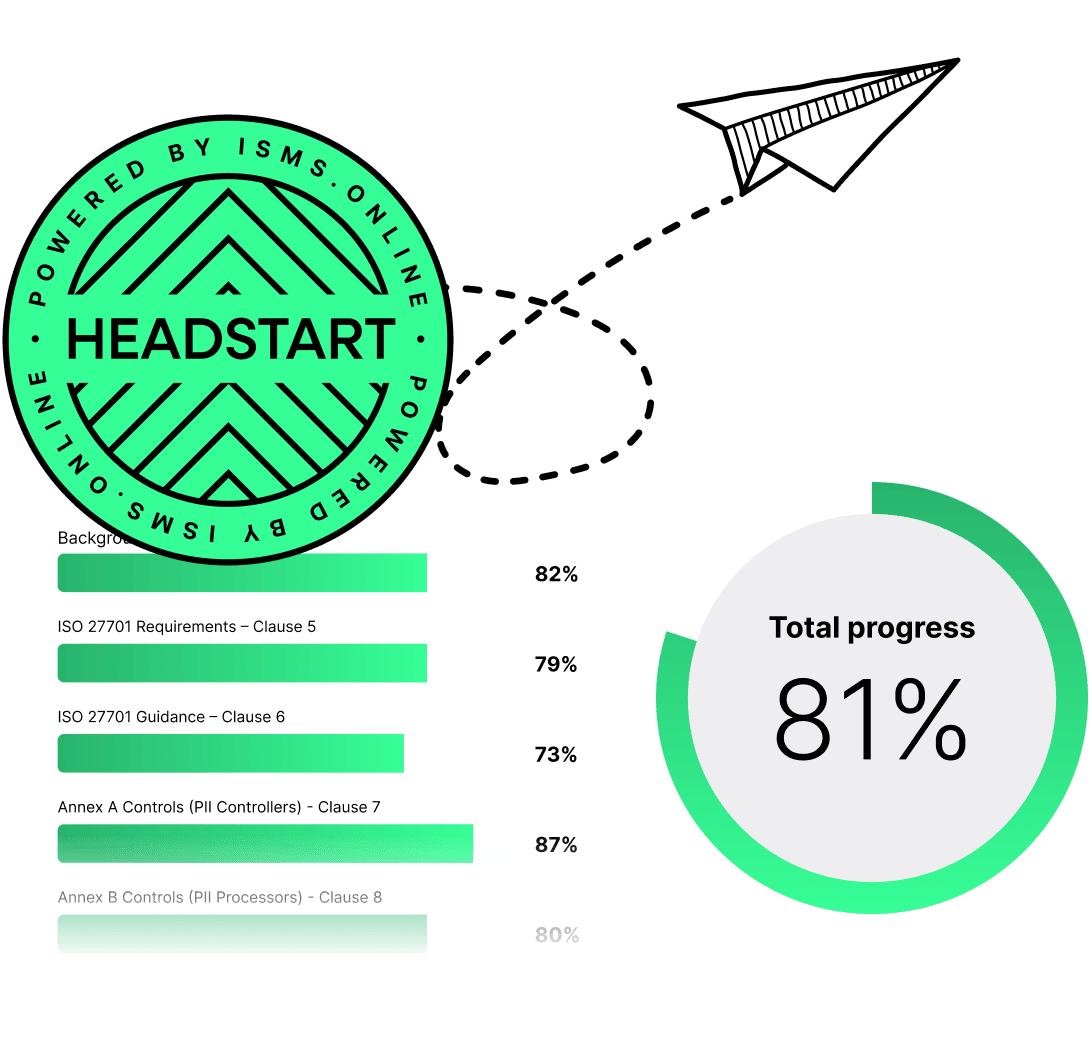
An 81% Headstart from day one
We’ve done the hard work for you, giving you an 81% Headstart from the moment you log on. All you have to do is fill in the blanks.
Why Surface-Level Compliance Will Never Be Enough—And What’s Required Instead
A process built on last-minute evidence packs and sporadic policy re-certification will only take your organisation so far. Regulators, clients, and partners measure your integrity by the systems you use—not promises made at annual reviews. The organisations that avoid data breaches and regulatory fines embrace ongoing readiness, knowing that audit logs and process discipline act as shields as much as policies do.
How Incomplete Practices Expose You
- Fragmented Documentation: Siloed policy files and Excel trackers multiply risk, reduce accountability, and ensure gaps go unseen until too late.
- Manual Evidence Chains: Scrambling for logs and approvals under time pressure fuels error rates. Each handoff is a hidden crack.
- Reactive Response: Waiting for the compliance calendar to trigger action is precisely when companies unwittingly break the chain of trust.
Integrated compliance means every policy, task, and workflow acts as a living record. Centralization allows rapid problem detection, enforced process ownership, and immediate audit response. The manual approach, in contrast, is a marker of operational fragility—unrepeatable, unscalable, and untrustworthy.
Why Modern Accountability Demands Regulatory Rigour and Real-Time Proof
No regulator or client trusts a privacy claim unless it’s backed by evidence—ready now, not after a week’s work. Global frameworks like GDPR, NIS2, and allied standards have created an external clock for every organisation: you’re either prepared, or you’re visible as a potential risk to vendors, partners, and oversight boards.
Driving Organisational Trust Through Automated Accountability
- Cross-Team Auditability: Each department’s digital actions—acceptances, exceptions, change requests—must be both visible and attributable, eliminating reliance on memory or manual logs.
- Proactive Audit Trails: Board reporting shifts from write-ups to live dashboards, redefining how your leadership answers questions about risk posture and incident response.
- Financial and Reputational Stakes: The tangible costs of non-compliance now include delayed deals, lost premiums, and negative headlines—the new auditing environment is perpetual.
Our ISMS-centric approach underlines operational trust; every action is logged, and every incident is traceable, reshaping regulatory readiness from a once-a-year event to a daily business proof point.

Free yourself from a mountain of spreadsheets
Embed, expand and scale your compliance, without the mess. IO gives you the resilience and confidence to grow securely.
When Is Manual Compliance No Longer an Option—And What Should Replace It?
You know you’ve outgrown manual routines when evidence collection adds risk, not confidence. If your compliance process requires constant reminders, non-integrated approvals, and makes your team scramble before every audit, it is past time for a transition.
Identifying the Metric Triggers for Change
- Rising Issue Volume: Repeated ‘exception’ requests and unclosed audit findings are system signals, not staff failings.
- High Labour Overhead: If your best people are doc-chasing, not improving security, your tools are working against you.
- Evidence Reuse: Lacking mapped evidence between frameworks means rework for each standard—doubling opportunity for error.
Switching to an integrated ISMS curtails this chaos by surfacing operational metrics, reducing error rates through automated handoffs, and embedding compliance action into daily routines.
| Manual Compliance Warning Signs | Impact | Modern ISMS Benefits |
|---|---|---|
| Scattered approvals | Lost accountability | Always-on role assignment |
| Excel-based evidence tracking | Audit risk, errors | One-click, live audit packs |
| Duplicate work per framework | Wasted time, cost | Mapped, reusable evidence |
Consolidated, live compliance systems don’t just save time—they provide the baseline for continuous, demonstrable trust.
Where Does ISO 27001 Make Compliance Not Only Possible, But Operationally Certain?
GDPR and ISO 27001 are not separate responsibilities—they’re converging demands that most organisations manage together, even if they don’t yet realise it. ISO 27001 supplies the engine for evidence-based, proactive compliance required by privacy regulation’s new normal.
Aligning Requirements and Operations
- Continuous Control Monitoring: ISO-aligned processes give you real-time operational status, not generic ‘traffic light’ dashboards.
- Evidence Linkage: Each control and procedure is visible, with mapped evidence that moves between standards and frameworks without duplication.
- Proactive Weakness Resolution: Your system flags gaps before the auditor finds them—turning audit dread into operational reliability.
By uniting privacy and security management under one ISMS, your team gets repeatable compliance, fewer surprises, and scalable clarity—benefits our platform is explicitly designed to operationalize.

Manage all your compliance, all in one place
ISMS.online supports over 100 standards and regulations, giving you a single platform for all your compliance needs.
How Does a Fully Integrated Compliance Platform Remodel Accountability?
A cohesive compliance platform isn’t just a dashboard—it’s the operational canvas for your boardroom and frontline teams. Centralization allows every compliance event, risk, and policy update to appear as a live report, connecting CISO concerns with actual proof on the ground. The leap from fragmented tools to unified systems gives you more than ease—it builds a culture of default accountability.
End-to-End Integration—From Policy to Audit
- Task-linked Evidence: Every ticket, training module, and policy has traceable ownership and audit-ready logs.
- Role-Based Views: Executives see risk and gap status; operators see their tasks and evidence requirements, minimising confusion.
- Automated Proof Cycles: The platform keeps you ahead of review points, closing the loop between daily work and annual certification.
Teams that make this leap don’t just pass audits—they demonstrate to stakeholders and regulators that their approach to data privacy is resilient, intentional, and never left until the last minute.
How to Lead With Evidence and Outlast the Next Regulatory Shakeup
The leaders who set new compliance benchmarks do it through deliberate decisions, not just intentions. Executives who guide their organisations into always-on evidence and proactive accountability don’t just avoid fines—they outlast rivals when new regulations, client audits, or public incidents test their readiness.
If your goal is to show insurance underwriters, clients, and customers that your company’s resilience is proven—not just asserted—you need a compliance programme whose outputs can withstand hostile scrutiny at any moment.
Reputation is earned with every audit trail, every documented control, every risk decision you can show.
Those prepared for life after the checklist will carry the credibility to set sector standards and occupy the trusted space their competitors want to claim.
What Identity Do You Want to Signal—Resilience or Reactivity?
Boards, auditors, and partners respect companies that show stability and readiness without posturing. When you consistently surface evidence of compliance—system-linked, always-live, and demonstrably owned—you become the reference point for operational trust in your network.
The distinction between “compliant” and “audit-proof” is real. You can wait for a regulator to point out gaps and scramble yet again. Or you can run a programme that boards, insurers, and clients recognise as the new best practice.
Our platform is ready when you decide to lead. The badge you earn is resilience—a status that starts on your audit trail and ends on the scoreboard of market trust.
Frequently Asked Questions
What does GDPR mean for your organisation’s data privacy culture?
GDPR isn’t a line item for your risk register—it’s the bright line separating companies who prove privacy as a living asset from those who gamble with trust. You’re not facing a paperwork burden: you’re confronting the demand to show, at every level, active ownership of personal data across your whole operation.
Your position in the market, and your boardroom’s credibility, hinges on how you transform data privacy from a policy tucked in HR’s SharePoint into real, daily practice. A traceable, real-time approach—where audit logs, access reviews, and ownership of assets are always current—is no longer a competitive differentiator. It’s the baseline for lasting relevance and resilience.
The reputational map has shifted. Your company will be judged not by how you talk about compliance, but by the quiet strength of your documented practices and responsive controls. Silent heroes in compliance and security have become your most visible leaders.
Why privacy culture is a new leadership benchmark
- Data protection is operational leadership in disguise.: True privacy culture is revealed in decision logs, not slogans.
- Moving first signals market strength.: Showing readiness—before regulators or clients ask—positions your brand as the template for due diligence.
- Failure is event-driven.: Gaps aren’t exposed by routine but by crisis. By then, trust is harder—and far more expensive—to buy back.
- Identity signal: The companies redefining the compliance baseline are those whose audit history proves trust before the first question is ever asked.
Being ready on paper isn’t enough—you need to be ready on demand. That’s the new cultural norm for data protection.
What are the fundamental principles of GDPR—and why do they matter operationally?
GDPR’s core tenet is ruthless accountability: every personal data record is either governed or it’s a liability waiting to materialise. It’s not just a matter of being transparent—it’s demonstrating, at every pivot, that your governance is habitual and mature.
These six principles—lawfulness, fairness, transparency, purpose limitation, data minimization, and integrity—aren’t checkboxes; they’re the expectations against which your organisation will be judged during every incident review and routine examination.
Operationalizing principles into audit-proof practices
- Lawfulness and transparency: No data process should operate in the shadows. Every record must be traceable to a lawful purpose with defensible, discoverable consent—or it shouldn’t exist.
- Purpose limitation and minimization: Storing “just in case” data multiplies your risk surface. Preemptive culling is cheaper than post-breach regret.
- Integrity and confidentiality: Proof isn’t your policy binder—it’s your real-time controls and access logs, underpinned by automated system enforcement, not self-attestation.
A practical, embedded ISMS doesn’t just facilitate these outcomes—it normalises them. Suddenly, evidence is where you need it, when you need it, for any audience.
| Principle | Everyday Control Enabler | Systemic Fallback When Ignored |
|---|---|---|
| Lawfulness & Transparency | Documented process maps, role-based access logs | Audit chaos, consent uncertainty |
| Minimization & Limitation | Automated retention/deletion, risk alerts | Data hoarding, widened attack surface |
| Integrity & Confidentiality | Continuous monitoring, real-time evidence reports | Breach exposure, loss of trust |
Every audit-ready company shares one trait: they can answer not just what controls exist, but how—and how well—those controls operate, at a moment’s notice.
Why move beyond traditional compliance toward a holistic privacy culture?
A checklist compliance mindset leaves your organisation on defence—reactive, opaque, and never quite certain where the next failure may surface. By contrast, a privacy culture disperses responsibility and awareness across your company. Authority doesn’t flow from annual meetings but from daily signals: who owns the task, who supplied the evidence, and who resolved the exception.
The case for building proactive compliance
- Checklist compliance breeds complacency and hidden risk.: It turns audits into elaborate performances and makes oversight a hazard, not a benefit.
- Integrated privacy culture diffuses load and multiplies visibility.: Ownership of risk becomes distributed and monitorable, not the domain of a few overworked specialists.
- Fatigue gives way to momentum.: When evidence isn’t something to chase but something produced organically, what once felt like stress becomes the comfort of “audit as non-event.”
As your operations scale, only a systemized privacy mindset can match the velocity and complexity of regulatory and stakeholder expectations. This is how the best CISOs and compliance officers become architects of confidence, not just technicians tracking controls.
Don’t define yourself by how well you scramble during audits. Own the status of being the example others turn to.
How do global regulatory frameworks shape true accountability and trust?
You’re operating under a spotlight that isn’t limited by geography. GDPR signals market-wide: risk exposure is no longer a private matter—every breach, every fine, every headline is a case study for your industry.
Mechanisms that build verifiable trust
- System-driven transparency: With global standards codifying what good looks like, your ISMS must surface every decision—assigned, attested, and timestamped.
- Enforcement is digital and continuous.: Regulators, customers, and partners expect proof, not promises: exception logs, closure rates, cross-platform consistency.
- Financial and reputational costs are public.: Fines can be calculated; lost contracts and damage to board reputation can’t.
| Accountability Requirement | Systematic ISMS Response |
|---|---|
| Audit Trail Integrity | Live, immutable log history |
| Role-Based Risk Ownership | Role-linked task assignment |
| Cross-Border Compliance | Configurable rule sets per market |
Review the last two years of enforcement data across the EU and it’s clear: maturity is measured less in controls implemented than in evidence produced and responsiveness demonstrated.
Trust happens when every stakeholder, internal or external, can see the chain of control—unbroken and permanent.
When should you upgrade from manual methods to integrated compliance automation?
You’ll know it’s overdue when every audit cycle feels like a lurking risk event instead of a routine process—or when your highest performers spend their days reconciling versions, not reducing risk.
Operational triggers for transition
- Recurring evidence gaps, task delays, or risk items reopening.
- Uncertainty about ownership—who owns what, who signed off, who closed which issue.
- Board-level impatience with compliance “busywork,” when what’s needed is attestation, not activity.
Moving to robust ISMS automation isn’t about keeping up with regulation. It’s about achieving operational comfort: a daily, data-driven confirmation that everything is owned, traceable, and resilient across standards.
Performance metrics your board cares about (and your team will feel):
- Mean time to audit readiness (shrunk from months to hours).
- Incident closure rates up; manual rework costs down.
- Cultural signal: staff are proactive, not firefighting.
Every leader knows automation is not optional. It’s the least expensive culture upgrade you’ll ever make, and the only one that persists through regulatory change.
You don’t elevate your brand by reacting to audits—you harden your reputation by turning compliance into a quiet certainty.
Where does ISO 27001 deliver synergy with GDPR for lasting reliability?
ISO 27001 bridges the gap between aspiration and assurance by translating legal mandates into actionable, measurable processes. It does more than satisfy a checkbox—it transforms your compliance programme into a live, self-improving organism.
The ISO 27001-GDPR partnership in action
- Controls align with GDPR, but the magic is in integration.: Every process, from risk assessments to incident response, is systematised and mapped directly to regulatory outputs.
- Continuous monitoring detects issues before breaches land in the press.: When KPIs flag lagging mitigation, the system triggers action—no file-drawer evidence or scapegoats required.
- Scalable, audit-proof asset management and evidence.: The right ISMS ensures every control, owner, and attestation is on call for any audit, internal or external.
| ISO 27001 Crosswalk to GDPR | ISMS Implementation | Operational Benefit |
|---|---|---|
| Control X – Asset Inventory | Real-time asset mapping | No missing data owners |
| Control Y – Incident Mgmt | Instant alert/escalation | Reduced breach impact |
| Control Z – Policy Review | Scheduled auto-audits | Fewer nonconformities |
ISO 27001 isn’t just a certificate to mount. It’s the difference between defending reactive compliance and living as a proof-driven standard-bearer—one that meets regulatory turbulence, system outages, and client due diligence head-on, never by surprise.
When others scramble, you’re prepared. That’s the privilege of securing working evidence over empty assurance.