















Why Cloud-Native Teams Outgrow Traditional GRC
Cloud-native teams don’t fail because they did nothing. They fail because they can’t prove what happened, when it happened, and who signed off — quickly and consistently.
In a modern environment:
- Ownership is distributed across squads, so decisions happen in threads and vanish.
- Change is constant, so policies and risk decisions drift unless reviews are built in.
- Evidence is scattered (Jira/ServiceNow/Slack/docs), and assembling it becomes a painful, manual process.
- Customer security reviews demand repeatable answers — without disrupting engineering.
A cloud-native GRC tool should make governance feel like part of delivery: capture decisions, show accountability, and keep proof linked as you operate.
What Cloud-Native GRC Should Do
If you’re evaluating a GRC tool for a cloud-native company, the basics aren’t “more controls” — they’re less friction and more proof.
Look for:
- Approvals with receipts: a visible approval process with timestamps and approvers, not “approved somewhere.”
- Flexible governance: the ability to enforce approvals everywhere, only on selected items, or not at all — depending on how your teams work.
- Engagement tracking: measure policy-read progress and compliance task completion (not just “published”).
- Risk that trends over time: risk reporting that shows movement (history + averages), not a static register.
- Operational integrations: native connections into Jira/Slack/ServiceNow so work stays in the flow.
- Exports that auditors actually like: CSV exports for Activities/Tasks and other reporting outputs you can analyse and repackage.
Comparison Table and How ISMS.online Supports You
| Cloud-native need | What it means in practice | How ISMS.online supports it |
|---|---|---|
| Prove approvals fast | “Who approved this?” answered in seconds | Visible approvals with timestamps + approvers |
| Tune governance by team maturity | Some work needs strict sign-off, some doesn’t | Approval levels: Full / Selected activities only / Off |
| Keep policy rollout real | You can show who read what, and who didn’t | Monitor % policies read + compliance tasks completed; drill into User progress |
| Nudge without chasing | Escalate late readers without manual follow-up | “Urgent To-Dos” (green flag) + compliance views |
| Show risk movement (board-ready) | Trend lines, history, and a unified view across maps | Overall Risk History + Average Risk Over Time + enhanced register |
| Make KPIs operational | Targets, cadence, reminders, thresholds | KPI types + frequency + reminders + fixed/varied thresholds |
| Cut double entry | Incidents/vulns/actions flow to existing systems | Native Jira/ServiceNow workflows + Slack alerts |
| Export evidence on demand | Don’t rebuild reports every audit | Export Activities/Tasks to CSV (choose fields); copy project content to a word processor |
ISO 27001 made easy
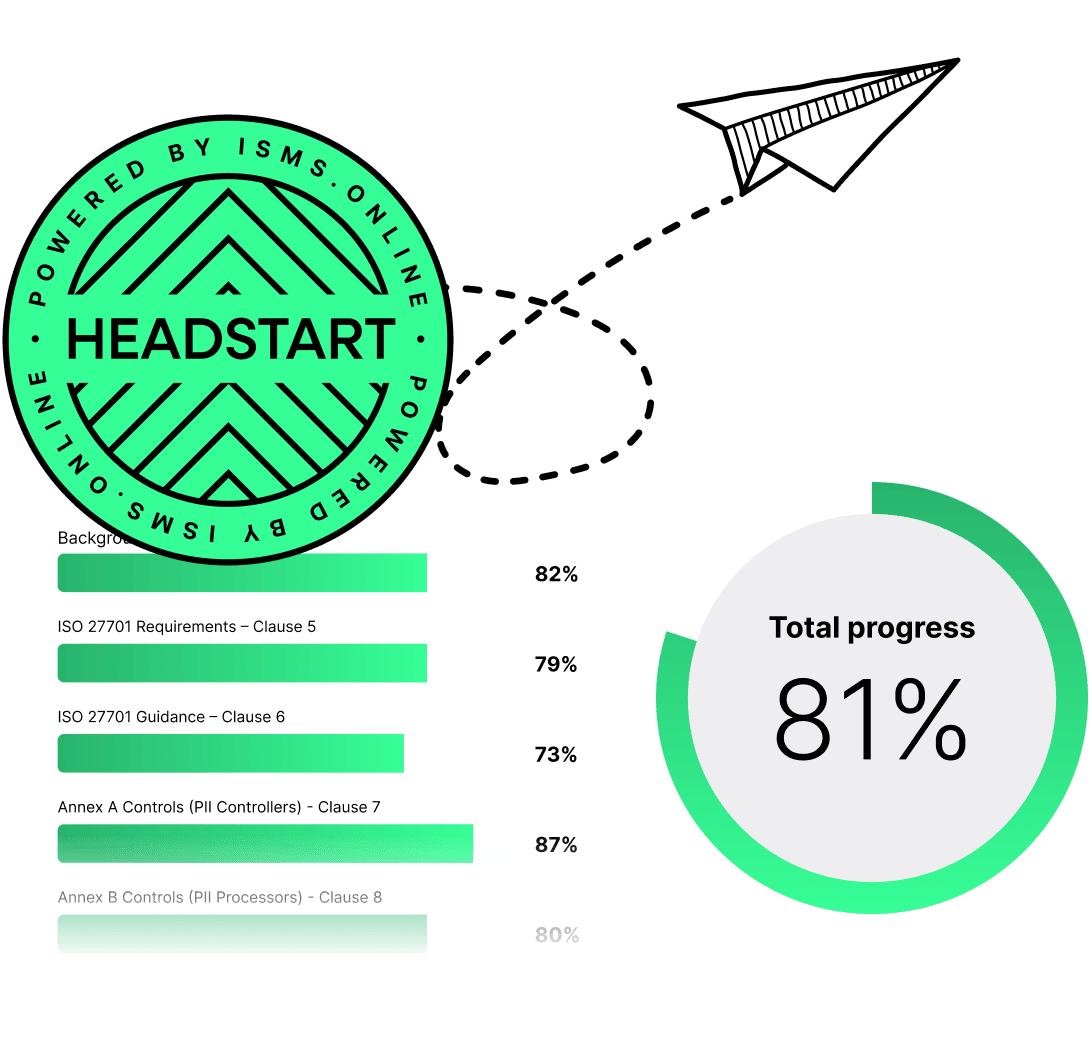
An 81% Headstart from day one
We’ve done the hard work for you, giving you an 81% Headstart from the moment you log on. All you have to do is fill in the blanks.
How ISMS.online Keeps Approvals From Slowing Delivery
Cloud-native governance breaks when it’s “optional,” hard to follow, or impossible to prove later. ISMS.online supports a structured approval process for policies and controls — designed to preserve integrity through a visible workflow.
You can make approvals fit your reality:
- Full: everything requires approval.
- Selected activities only: only flagged items require approval.
- Off: teams can complete work without approval.
The workflow is explicit:
- Users can Submit for approval, moving an Activity to Awaiting approval and notifying approvers.
- Approvers can Approve or Decline, add comments (captured as discussion), set reminders for future review, and reopen approved Activities when change happens again.
- Once approved, the platform shows who submitted and who approved, with date/time.
The benefit? You get speed and a clean decision trail — without email archaeology.
Where Risk Reporting Becomes Board-Ready
In cloud-native environments, risk changes with architecture, vendors, deployment patterns, and operational load. Static risk registers don’t help you explain whether risk is improving or deteriorating.
ISMS.online’s Cluster-based risk reporting is built to show trends over time, including:
- Overall Risk History across all Risk Maps in a Cluster.
- Average Risk Over Time (including across maps with the same methodology).
- A risk register enhanced with a column showing which map the risk originated from.
- Filtering to focus on the most important risks.
The guide explicitly positions this as useful for reporting to senior management or the board — because it turns risk into something you can review as a programme, not a spreadsheet snapshot.
How Policies Turn Into Proof
Publishing policies is easy. Proving adoption is hard.
Policy Packs are designed to publish relevant parts of your ISMS in an easy-to-read way — and allow readers to demonstrate compliance with the pack.
On the admin side, you can:
- Monitor % of policies read and % of compliance tasks completed.
- Drill into User progress (current vs historic), see exactly which policies were read, and when.
- Use To-do compliance views and filters to see progress ranges and pack-specific completion.
- Flag Urgent To-Dos (green flag) after assignment to nudge overdue readers.
When you need to package it up, you can export a Policy Pack and export user progress options from within the Policy Packs area.
The benefit? Policy work becomes measurable and exportable — so it supports audits and customer reviews without manual chasing.

Free yourself from a mountain of spreadsheets
Embed, expand and scale your compliance, without the mess. IO gives you the resilience and confidence to grow securely.
Where Integrations Remove Double Entry (Jira, ServiceNow, Slack, SCIM)
Cloud-native teams already have strong workflow engines. GRC should connect into them.
ISMS.online provides native Track integrations for Jira / Slack / ServiceNow.
- Jira: send incidents/vulnerabilities/corrective actions to Jira based on status, and sync updates back — auto-populating issues from Track item name/description.
- ServiceNow: similar status-based workflows for incidents and corrective actions.
- Slack: send a notification to a channel whenever a new incident, vulnerability, or corrective action is created.
For identity operations, the user guide also covers SCIM setup to streamline provisioning workflows.
The benefit? Teams keep doing work in the tools they live in, while governance and proof stay organised.
What to Measure So GRC Doesn’t Become a Once-A-Year Panic
Cloud-native assurance needs cadence: targets, reminders, and thresholds that drive consistent reviews.
ISMS.online supports KPI creation with:
- KPI types (red/green, RAG, RAG+exceptional, measure-only).
- Frequency and reminders.
- Thresholds that can be fixed or vary over time.
The benefit? You can turn “we think we’re OK” into a repeatable programme rhythm — useful for ongoing governance, not just audit prep.
How You Avoid the Evidence Scramble (Organise, Link, Report, Export)
The fastest audits aren’t the ones where you “work harder.” They’re the ones where the system already tells a coherent story.
ISMS.online helps by organising work into Clusters, so related areas (e.g., Policies & Controls, Corrective Actions, ISMS board) sit together with quick access and a unified menu.
- Inside Clusters, the Updates feed aggregates changes across work areas to keep teams informed, and Reports provide detailed insights and stats on Cluster work (including project progress and activity stats).
- For traceability between operational work and governance outcomes, Linked Work connects Track items to other work areas — useful when Tracks manage decisions and other areas deliver outcomes.
And when you need to share proof externally, you can:
- Export Activities/Tasks as CSV, selecting which fields to include.
- Copy and paste the full project contents into a word processor for packaging.
The benefit? Audit readiness becomes a by-product of normal operations — not a quarterly fire drill.
FAQs
Can ISMS.online support approvals for policies and controls?
Yes — there’s a visible approval process with timestamps and approvers.
Can we integrate with Jira, ServiceNow, and Slack?
Yes — native integrations are available, including Slack channel notifications for new incidents, vulnerabilities, and corrective actions.
Can we show risk trends over time?
Yes — Cluster risk reporting includes Overall Risk History and Average Risk Over Time.
Can we export evidence for audits?
Yes — Activities/Tasks can be exported to CSV and project content can be copied into a word processor for packaging.