















What Does “GRC Tool Implementation” Actually Include?
A proper GRC implementation isn’t just configuration — it’s operating model + workflows + data + adoption. Teams typically need help to:
- Turn goals into a workable operating rhythm (owners, approvals, reviews, reporting)
- Set up structure so GRC work has a “home” (not a scatter of documents and spreadsheets)
- Migrate and clean up the essentials (assets, risks, actions, evidence)
- Enable people to do their part consistently (without becoming tool experts)
On ISMS.online, many customers anchor this work in a Cluster so related work areas sit together in one hub — making it easier to run the programme as a system rather than a set of disconnected modules.
Why Do So Many GRC Tool Rollouts Stall?
Most implementations don’t fail because the tool is “bad” — they fail because the rollout doesn’t create habits.
Common stall points:
- Unclear ownership → nothing gets updated
- Messy migration → people don’t trust what they see
- No day-to-day workflow → governance only happens in meetings
- No visibility → leadership loses interest
ISMS.online helps avoid “silent failure” by giving you a Cluster Dashboard that shows ISMS performance at a glance and highlights the state of Tracks, Risk Registers, KPIs and Policy Packs — so you can spot drift early and drill into what’s behind the numbers.
What You Should Expect at Each Stage
| Stage | What good implementation support does | What you should end up with | Early blocker to remove |
|---|---|---|---|
| Discovery | Align scope, goals, roles, cadence | A simple rollout plan + owners | No sponsor / fuzzy scope |
| Build | Configure work areas & reporting | A working environment people recognise | Over-customising too soon |
| Populate | Import + validate baseline data | Clean registers with clear ownership | Inconsistent categories/naming |
| Adopt | Train + establish tasking habits | Work happening in-tool weekly | “Someone else will do it” |
| Assure | Connect items + export/report routine | Audit-ready views and repeatable evidence | No review cadence |
ISO 27001 made easy
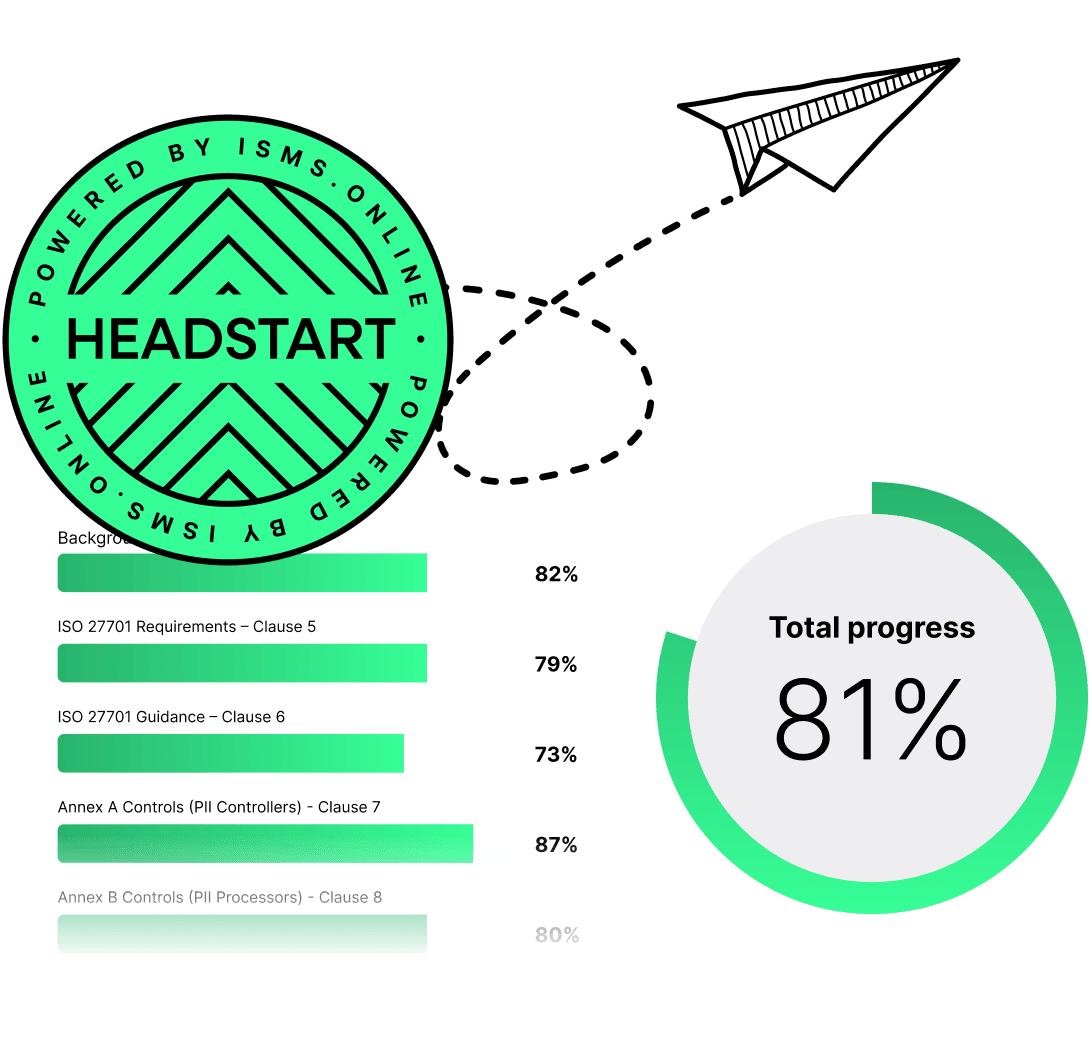
An 81% Headstart from day one
We’ve done the hard work for you, giving you an 81% Headstart from the moment you log on. All you have to do is fill in the blanks.
How Do We Implement ISMS.online So It Sticks?
The goal isn’t “go live.” It’s go live with a rhythm.
Our approach is:
- Agree outcomes first (what must be true in 30/60/90 days)
- Design around roles (who owns, who reviews, who approves)
- Build lean (minimum viable workflows that will be adopted)
- Stabilise (remove friction before scaling)
A practical enabler here is the Dashboard’s ability to show cluster-wide progress across the work areas you’re running, so programme owners can manage by exception rather than chase.
And when you need a repeatable structure for a specific standard or internal process, ISMS.online supports creating projects based on a framework — a predefined project structure designed to help you achieve a set outcome.
Where Should You Start With Data and Structure?
If you start by importing everything, you usually import chaos.
A better order:
- Define your core registers (assets, risks, actions, key policies)
- Agree categories and naming (so filtering/reporting works later)
- Import only what you’ll actively maintain (archive the rest)
ISMS.online’s User Guide documents importing into work areas (including the need for consistent categories and clean formatting), which helps make migration predictable rather than painful.
Who Owns Adoption and How Do You Make It Effortless?
Adoption is where implementation either becomes a living system or a static repository.
ISMS.online supports adoption mechanics you can build into your rollout:
- Policy Packs present ISMS content in a user-friendly way and make it easier to keep policies updated and demonstrate compliance.
- Within a Cluster, the Discussions, Documents and To-dos area provides a consolidated view, and the To-do list can also show project Activities and Track Items that have been added to the Cluster — useful for “one queue” execution.
Implementation is where you turn those capabilities into habits:
- owners know what they own
- reviews have a cadence
- tasks have due dates
- progress is visible without chasing

Free yourself from a mountain of spreadsheets
Embed, expand and scale your compliance, without the mess. IO gives you the resilience and confidence to grow securely.
How Do You Show Progress Fast and Prove It When Asked?
Buyers searching for “GRC tool implementation services” usually want two things:
- visibility (what’s happening), and
- proof (can we evidence it).
ISMS.online gives you both:
- The Cluster Dashboard provides visibility of what’s happening across work areas and helps identify workflow status and overdue items.
- ISMS Overview shows links within your ISMS (controls/risks/assets) in a table format, with filtering and an Export option to output as a spreadsheet.
- The ISMS Overview Report visualises how Controls, Risks and Assets connect when you’ve used Linked Work, and helps identify items without associated risks.
- For measurement, you can add KPI readings (with notes/supporting documentation) that appear in the KPI table and on the KPI graph.
That’s the practical benefit of implementing ISMS.online well: reporting becomes a by-product of the work, not a separate reporting project.
How Does It Connect to the Tools You Already Use?
Implementation is also about reducing manual effort and making GRC part of the flow of work.
ISMS.online documents native integrations (including guides) for tools like Jira, Slack, and ServiceNow.
For identity lifecycle, our User Guide explains SCIM, including that it enables automatic provisioning and deprovisioning between your identity provider and ISMS.online and requires support to enable SCIM and provide the endpoint/token securely.
Which Delivery Model Is Right for You?
Implementation services land best when they match the customer’s capacity and urgency:
- DIY (platform-led): best when you have internal time and a clear model already
- Assisted implementation: you own the programme; we accelerate structure, migration, enablement, reporting
- Led rollout: best for tight timelines — build + onboard + stabilise, then hand over with a runbook
ISMS.online also supports working with external parties during rollout through guided collaboration mechanisms (e.g., cluster-level visibility and structured work areas), which helps keep delivery organised and auditable.
FAQs
How long does a GRC tool implementation take?
A usable baseline can be live quickly; maturity comes from the next 60–90 days of adoption and cadence.
What’s the biggest risk in implementation?
Unclear ownership — if nobody owns updates, the tool becomes a document store.
Can you migrate our spreadsheets and registers?
Yes — expect cleanup and category alignment first, then import and validation.
Will this help with audits?
Yes — when you connect work and use exportable views, audits become far less manual.
Do you integrate with Jira/Slack/ServiceNow?
ISMS.online provides native integrations and user guides.
Can we automate joiners/movers/leavers?
Yes — SCIM enables automated provisioning/deprovisioning.