















What You’re Trying to Achieve When You Assess Vendors at Onboarding
A vendor onboarding risk assessment tool should help you make a clear decision (approve / approve with actions / reject) and keep a defensible record of how you got there. In practice, you’re answering four questions every time:
- What will this vendor touch? (systems, data, facilities, processes)
- What could go wrong, and how bad would it be? (impact + likelihood)
- What evidence supports our decision? (docs, attestations, contract terms, notes)
- What happens next? (follow-ups, remediation, review cadence)
The common trap is treating onboarding like a one-off form. The result: evidence lives in five places, the decision lives in someone’s inbox, and follow-ups evaporate.
With ISMS.online, suppliers can be managed collaboratively using Accounts with Contacts and Contracts, alongside Notes, Documents, Discussions and Tasks—so the decision doesn’t get separated from the proof.
Where Vendor Onboarding Usually Gets Messy And Expensive
Most breakdowns are predictable:
- Spreadsheet sprawl: assessments in one file, evidence in another, approvals in email.
- Inconsistent checks: different teams ask different questions, so “risk ratings” aren’t comparable.
- No decision trail: you can’t quickly show what was reviewed, by whom, and when.
- Too much friction: low-risk suppliers get enterprise-level scrutiny, onboarding stalls.
- No in-life management: changes and renewals happen without a reassessment rhythm.
The cost isn’t just compliance risk—it’s slow procurement cycles, duplicated effort, and firefighting later.
What Good Looks Like – One Supplier Record Your Team Can Actually Use
Vendor onboarding moves faster when Procurement, Security, Legal, and the service owner all work from the same “truth.”
In ISMS.online, supplier relationships can be managed using Accounts, with Contacts and Contracts in one place so teams can coordinate relationship management.
How that becomes a real benefit day-to-day:
- Less rework: vendors aren’t re-explaining themselves to different teams.
- Better handovers: when roles change, the onboarding context stays intact.
- Fewer missed steps: outstanding actions are visible, not hidden in inboxes.
A practical detail that matters: recording interactions in Notes keeps the latest updates visible to everyone and reduces duplicated work.
ISO 27001 made easy
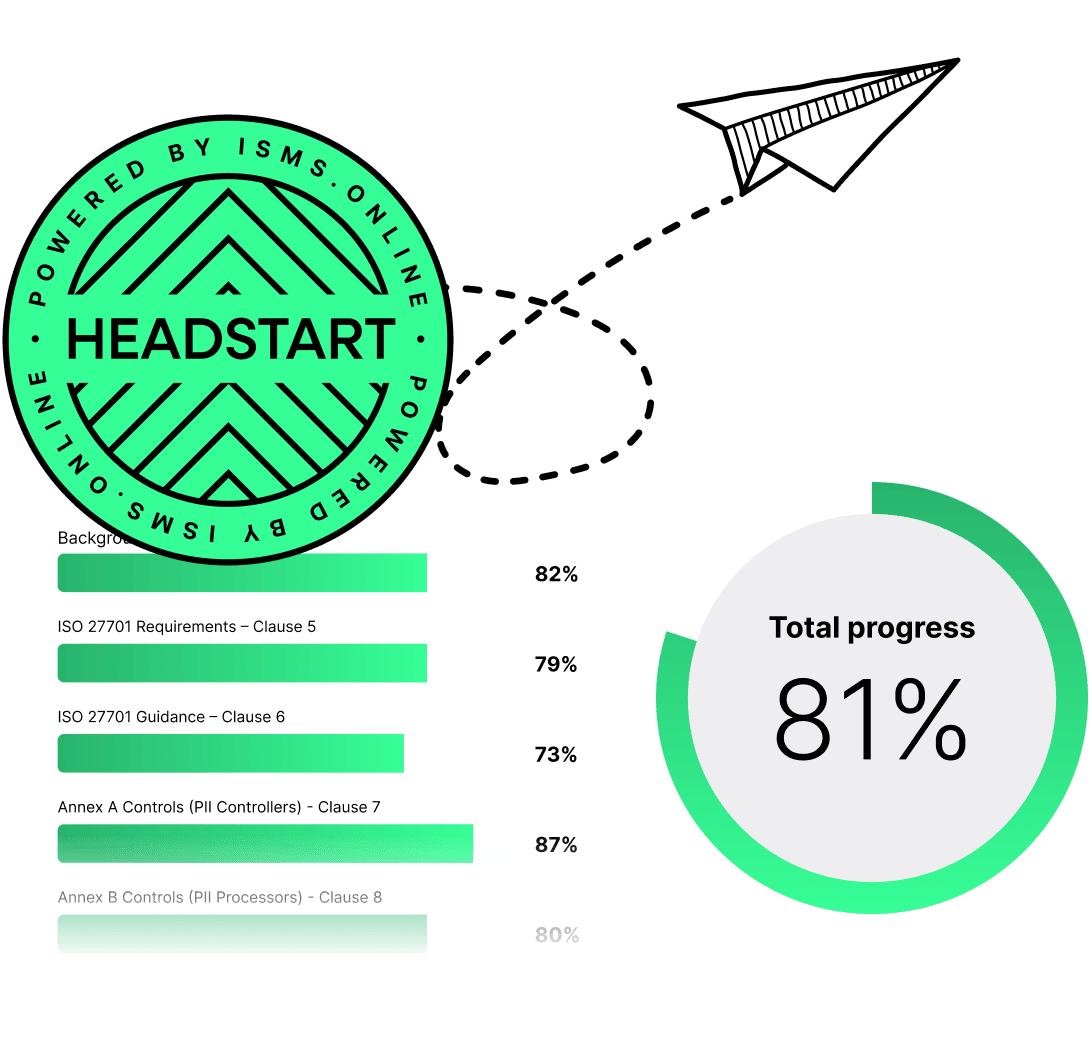
An 81% Headstart from day one
We’ve done the hard work for you, giving you an 81% Headstart from the moment you log on. All you have to do is fill in the blanks.
How to Capture Evidence and Decisions Without Creating Admin Overhead
Most “vendor risk tools” fail because they feel like extra admin. The trick is to make evidence capture feel like normal work.
ISMS.online supports this with lightweight building blocks you can reuse:
- Notes to log interactions and decisions (many teams paste emails into Contact notes for a more efficient audit trail, and even use notes during calls)
- Documents to store evidence and supporting files
- Discussions to retain decision logic in one place (handy when an auditor asks “why?”)
- Tasks / To-do’s so follow-ups don’t disappear; tasks and activities can be collected into a central To-do list space
If you run onboarding via a structured project, Track Items also support assignment, status, due dates, and sharing notes/discussions/documents inside the item—so supplier actions can be governed like any other work.
How to Keep Onboarding Proportional With Risk Tiers
If every vendor gets the same assessment, you’ll either slow everything down or water down checks until they stop meaning anything.
A risk-based approach is about assessing suppliers based on risk & importance—the consequences of contract failure—using tiers from Very Low through Very High.
A Simple Tiering Model You Can Use Immediately
| Tier | What it means (impact if it goes wrong) | Typical onboarding depth (example) | Typical outcome (example) |
|---|---|---|---|
| Very Low | Negligible/no damage, no meaningful cost or consequence | Light checks + standard terms | Approve |
| Low | Low damage, negligible cost or consequence | Basic due diligence + minimum requirements | Approve / minor actions |
| Medium | Some damage/loss, some cost exposure but not prospect-threatening | Targeted evidence + owner sign-off | Approve with actions |
| High | Serious (not complete) damage, large cost exposure, affects prospects | Deeper assessment + tighter requirements | Escalate / approve w actions |
| Very High | Severe damage, very large cost exposure, “no prospects” scenario | Critical vendor governance | Escalate / reject unless mitigated |
A ISMS.online benefit: once tiers are defined, you can keep the tier, evidence, discussion, and follow-ups together in the supplier Account—so onboarding stays consistent across teams.
What to Do When Onboarding Uncovers Gaps You Can’t Fix Immediately
A vendor assessment is only useful if outcomes get managed after the decision. That’s where programs often fail: the pack gets “completed” and the real work vanishes into inboxes.
ISMS.online supports mapping and treating risks and demonstrating links back to the controls/policies selected to address threats and opportunities.
Two practical outcomes:
- Residual risk stays visible (instead of becoming “we’ll sort it later”)
- Actions have owners and dates (so “approve with actions” doesn’t become “approve and forget”)
If your risk methodology is specific, risk maps can be customised (e.g., scoring, labels, review periods) so vendor risk aligns to how you run risk internally.

Free yourself from a mountain of spreadsheets
Embed, expand and scale your compliance, without the mess. IO gives you the resilience and confidence to grow securely.
How to Connect Vendor Onboarding to the Rest of Your ISMS
Customers and auditors rarely ask for a questionnaire—they ask for traceability.
Linked Work keeps the chain intact
ISMS.online’s Linked Work lets you connect Projects, Risks, Contracts, Contacts, Track Items and more, with links visible in both places. That turns onboarding into a navigable chain: supplier → contract → risk → action → review.
ISMS Overview gives you a table view you can export
ISMS Overview shows links within your ISMS in a table format, with filtering and export to spreadsheet. So when someone asks, “show me how supplier risks tie to controls,” you’re not doing email archaeology.
Approvals make sign-off provable
Activities can be submitted for approval, status moves to “Awaiting approval,” and approvers can approve/decline with comments. You can also assign “Approval” permissions within work area membership.
How to Keep Vendors Under Control After Onboarding (Renewals, Reviews, Change)
Most third-party issues happen after onboarding: scope expands, systems change, sub-processors change, or renewal happens quietly.
Contracts management inside Accounts is designed to capture details in a standard way and support reviews, renewals, and performance tracking—so supplier relationships don’t freeze in time. Add tasks and linked work and you can make reassessment routine:
- renewal review tasks
- evidence refresh requests
- “material change” reassessments
- follow-up closure checks
For operational visibility, the Cluster Dashboard provides an overview of what’s taking place across the ISMS, including workflow status and overdue items—useful for preventing supplier follow-ups from stalling.
How to Roll This Out Quickly
If you already have a vendor spreadsheet, the fastest route is: import → tier → run onboarding on the next ten suppliers → iterate.
ISMS.online provides an Accounts and Contacts import process via CSV template, with documented requirements (minimum items, matching fields, keep as .csv), supported by the data importing service.
A pragmatic rollout plan:
- Define tiering + minimum evidence per tier
- Import vendors (or start with top 20)
- Operationalise follow-ups with tasks + linked work so onboarding outcomes become managed actions
FAQs
Is this just a vendor questionnaire tool?
No—questionnaires are inputs. The goal is a decision trail plus follow-ups you can prove.
Can we keep an audit trail without drowning in admin?
Yes—teams commonly use Notes (including pasted emails), supported by Documents and Discussions.
How do we stop low-risk onboarding becoming a bottleneck?
Use risk/importance tiers and keep “Very Low/Low” checks lightweight.
What if a vendor can’t meet a requirement?
Record the residual risk and track actions with owners and dates—don’t let it die in email.
Can we link supplier onboarding to risks and other work?
Yes—Linked Work connects Contracts, Contacts, Risks, and more.
Can we import our vendor list?
Yes—Accounts and Contacts can be imported via CSV using the documented import process.