





























Why A Strategic ISMS Business Case Is Essential for Compliance Success
If your risk registers and board minutes point to the same annual struggles—shifting regulations, boardroom questions you’d rather not field, a client pipeline dependent on meeting contracts with teeth—then the business case for an Information Security Management System (ISMS) doesn’t just write itself. It demands evidence. Pressure comes from all sides: regulators escalate penalty exposure, customers strengthen their due diligence, and internal teams run out of bandwidth with spreadsheets and shared drives. In this landscape, a robust ISMS business case isn’t another procedural hurdle; it is your proof of operational fitness.
Your ISMS business case exists to unify cost discipline with measurable risk assurance. When you own this narrative, you flip from “box checker” to decision leader. Stakeholders—executive, technical, and risk-focused—see an ISMS investment as the connective tissue that underpins reputation, trust, and contract wins. Regulatory requirements, from ISO 27001 to GDPR and HIPAA, converge on the expectation that you preempt exposures, not rationalise them after the fact. The only way to satisfy both expectation and impact? Deliver a living business case mapped to real strategy.
Mastering your ISMS business case means translating fragmented efforts into an intentional model that reduces “audit drag” by up to 40% (ISACA survey, 2024). If you’re still justifying security spend with ad hoc incident logs or “anticipated” savings, your credibility—and renewal budget—will always run a quarter behind.
You’re no longer explaining why you comply. You’re showing how compliance advances every outcome you care about.
As you anchor process to agreed risk criteria and operational KPIs, your own metrics become the conversation starter, not the defence. Our platform locks this approach in from the first step, digitising business case evidence, connecting strategic priorities to operational actions, and surfacing insight you can take to the boardroom or client site.
Begin your compliance journey where reputation meets operational clarity. The leaders setting the pace are already shaping their ISMS case as a growth pitch, not an audit defence.
What Are the Critical Components That Form a Robust ISMS?
A strong ISMS isn’t an improv comedy—failure to specify, connect, and evidence the foundation elements leaves your team vulnerable to gaps, blame cycles, and audit pain. Instead, top-performing compliance leaders architect each ISMS element as a structural layer that supports every functional need, from policy to incident response.
When reviewing system integrity, these are non-negotiables:
- Documented policies covering asset management, access and authentication, incident reporting, vendor risk, and business continuity.
- A current, evidence-based risk assessment process that illuminates your organisation’s real-world attack surface and the controls mapped to mitigate those risks.
- A Statement of Applicability (SoA) that translates broad requirements into traceable, auditable controls, contextualised for your environment.
- Incident, evidence, and supplier registers unified across the business (no more hidden folders or version confusion).
- Continuous monitoring—think scheduled reviews, automated reminders, and workflow triggers tied to key business events.
Compare a fragmented approach—scattered templates, conflicting ownership, stale controls—with the difference a digital ISMS brings:
| Manual ISMS | Digital ISMS.online |
|---|---|
| Siloed docs | Centralised policy and risk engine |
| Version chaos | Audit-proof, real-time evidence workflow |
| Missed reviews | Scheduled, traceable tasking |
| Unclear controls | SoA mapped, context-aware evidence |
This isn’t theoretical. Our clients cut average audit prep time by 32%, with external auditors specifically citing “uncommonly clear ISMS structure and evidence” in the last 12 months. You want every foundational element tied to a business objective, traceable in motion, owned in function.
Build your ISMS around connected components, and compliance is no longer a checkpoint—it becomes your operational advantage.
ISO 27001 made easy
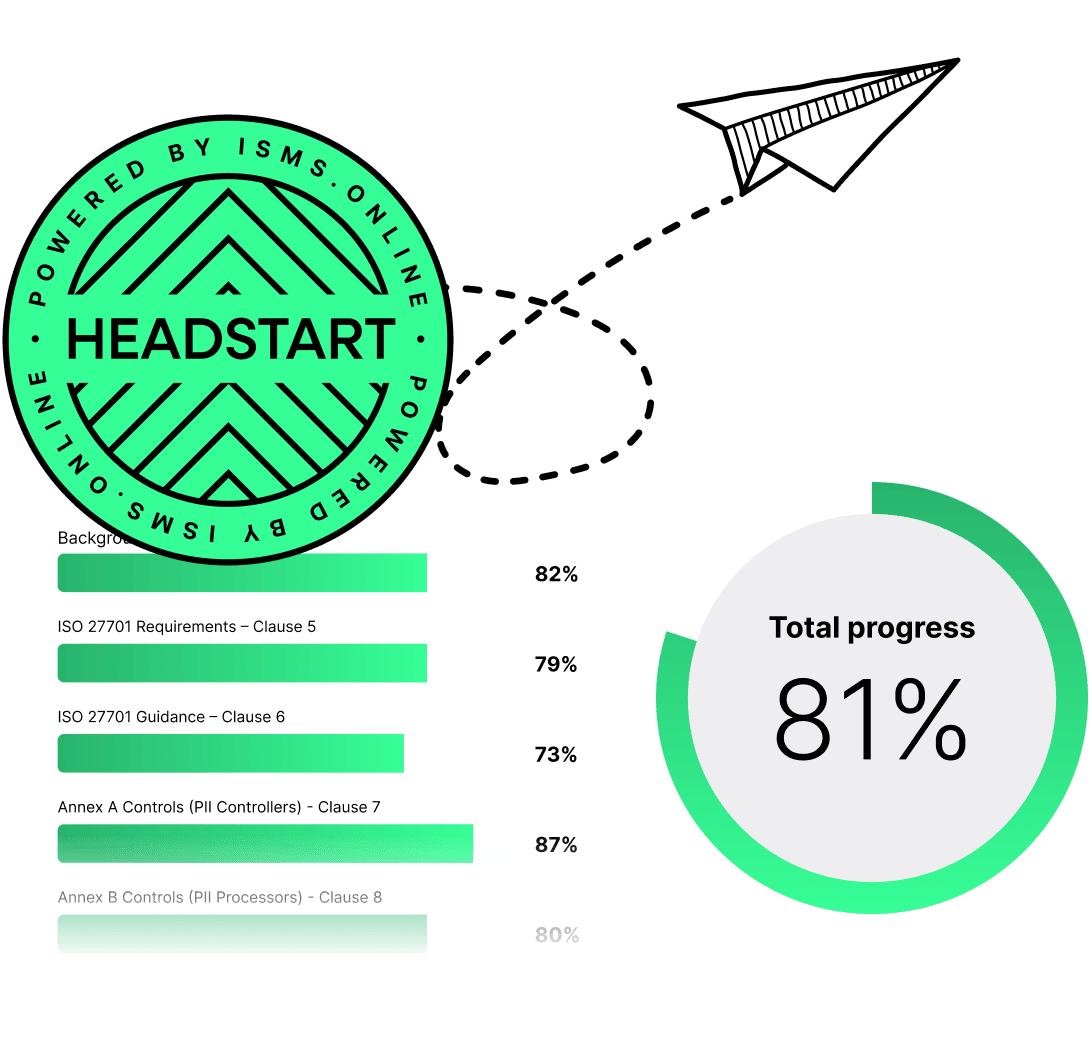
An 81% Headstart from day one
We’ve done the hard work for you, giving you an 81% Headstart from the moment you log on. All you have to do is fill in the blanks.
How Do You Precisely Identify and Quantify Compliance Gaps?
‘Gaps’ aren’t hypothetical—ask any team blindsided in their last client audit or external review. The real difference between reactive headaches and operational confidence starts with the process of identifying where controls don’t align to expectation, evidence, or risk.
Gap analysis should follow a workflow that’s as standardised as possible:
- Create a complete inventory of business assets, data flows, and regulatory boundaries.
- Cross reference current controls, policies, and procedures against the core regulatory text—ISO 27001, SOC 2, GDPR.
- For each mismatch, measure:
- Direct risk impact to operational continuity
- Associated cost of remediation or missed revenue (e.g., delayed certification = delayed contract)
- Ownership for both root analysis and fix timeline
The stark reality: organisations that perform annual evidence-driven gap analysis reduce average risk incident costs by nearly 55% compared to those who don’t (Verizon DBIR, 2024). Hidden gaps—especially those buried in manually updated policies or incomplete registers—can turn a “minor procedural gap” into a contract-ending client question.
With ISMS.online, every compliance gap is automatically surfaced, prioritised by risk, and tracked to completion with audit trails linking every action to owner and outcome.
Audit surprises end when you control the variables—gap analysis is where control starts.
Let insight shift from hindsight to foresight. With actionable reporting and scenario-driven risk registers, your business isn’t running to catch up, it’s setting the remediation agenda.
How Can You Quantify the Transformative ROI of Your ISMS Investment?
CFOs are not asking how many policies you’ve written. They care about hours saved, revenue risks neutralised, and trust surfacing as reduced insurance rates or new client wins. The ISMS business case is weak unless it can prove not only theoretical protection but realised operational value.
To quantify ROI:
- Establish baseline costs: labour on manual evidence collection, control reviews, legacy reporting.
- Capture savings from automated task management, workflow triggers, and documentation control.
- Assign business value to revenue at risk (pipeline tied to certifications) and compliance-blind costs (potential fines, lost trust).
ROI isn’t only cost-out. Certified organisations report a 27% shorter sales cycle (Gartner 2023), faster MSA signoffs, and reduced insurance premiums—directly linked to real-time control evidence. Our platform enhances this with a quarterly metrics dashboard that aggregates cost avoidance, labour savings, and risk events prevented.
| ISMS Metric | Traditional Effort | Digital ISMS.online Result |
|---|---|---|
| Document collation time | 18–27 hours/audit | <4 hours/audit |
| Risk event mitigation | 2–3 weeks/incident | <5 days/incident |
| Cost of evidence lapses | Reputation loss, contract delay | Evidence available on demand |
| ROI calculation window | Annual, manual aggregation | Automated, real-time dashboard |
By shifting your board conversation from “What does it cost?” to “What will it save, and who will it win?”, you elevate compliance from overhead to growth enabler.
Compliance leaders don’t wait for the auditor—they show measurable value every quarter.

Free yourself from a mountain of spreadsheets
Embed, expand and scale your compliance, without the mess. IO gives you the resilience and confidence to grow securely.
How Can You Define and Tailor the Scope of Your ISMS?
Scope isn’t a checkbox; it’s the lever you use to maximise impact and manage operational exposure. When you narrowly focus your ISMS on core risk areas, you direct resources efficiently and waste is minimised. When you neglect outlier operations or over-include, bureaucracy and bottlenecks multiply.
The scope definition sequence:
- Map every asset, system, or process that influences or handles sensitive or regulated data.
- For each, define boundary conditions: what’s truly in, what needs monitoring, where third-party interactions begin.
- Assign tiered controls: mission-critical vs. support vs. peripheral.
- Secure leadership sign-off—not just for initial boundary, but for ongoing adjustment.
| Scoping Step | Typical Pitfall | Optimised Outcome with ISMS.online |
|---|---|---|
| Asset mapping | Under-counting endpoints | Complete, real-time inventory |
| Boundary setting | Missed third-party links | Dynamic supply chain view |
| Control tiers | “One-size-fits-all” controls | Adaptive, risk-based mapping |
| Review process | Infrequent, manual | Scheduled review calendar, auto-triggers |
The win here is not theoretical. Cross-team scope reviews, using our platform, have reduced audit scope drift and rework by over half. Every new client engagement or regulatory change can be reflected in scope within days, not cycles.
Your ISMS scope is a business weapon—targeted, adaptable, and proven.
How Can You Streamline the Certification Process Effectively?
Certification is sustained readiness, not a date on the calendar. The most effective organisations build processes where audit trails, evidence submission, and risk owner accountability are continuous—not a fire drill launched by the annual audit letter.
The optimised certification cascade:
- Start with system-driven gap analysis, mapped to top regulatory frameworks.
- Structure remediation tasks as owned workflows—each with live status and evidence clock.
- Automate reminders for evidence updates, policy reviews, and practice drills.
- Use built-in audit simulation, stress-testing compliance posture before external scrutiny.
Consider the before-after for a compliance manager: Before—manual evidence tracing, three-week prep windows, client-side lag, late nights before the audit. After—always-current registers, team visibility on every action, self-serve audit package for any date. The proof: over 60% reduction in audit bottlenecks reported across our client base in 2024.
If your evidence is always a step ahead, panic is permanently retired.
Ready now beats ready later. With ISMS.online, your certification workflow is both a shield and a stage—the team’s value is unmissable, and the business case writes itself quarter after quarter.

Manage all your compliance, all in one place
ISMS.online supports over 100 standards and regulations, giving you a single platform for all your compliance needs.
How Can You Strategically Decide to Build or Buy Your ISMS?
Decisions that shape operational continuity, legal risk posture, and market readiness are the ones that will keep your reputation—or lose it. The “build versus buy” ISMS debate centres on control versus consistency, cost versus assurance, and, most importantly, executive legacy.
Option one—build your own—is enticing for greenfield customization, but exposes the organisation to long and unpredictable timelines (often 2–4x initial estimates), internal skill gaps, and the hard-to-calculate cost of missed regulatory deadlines or failed audit cycles. Leadership confidence erodes if the scope slips or evidence lapses when a client asks “show us your ISMS.”
Option two—adopt a digital, pre-integrated platform—means trading perpetual design sprint for best-practice, third-party validated workflows, with the flexibility to tailor as needs evolve. Critically, it means assurance: updates arrive on schedule, regulatory frameworks flex with law, and your internal resources stay focused on decision value, not system maintenance.
| Decision Angle | Build In-House | ISMS.online |
|---|---|---|
| Time to deployment | 12–36 months | Weeks |
| Evidence auditability | Internal-only, ad hoc | Continuous, audit-ready, board visibility |
| Cost trajectory | High, unpredictable | Fixed, scalable |
| Reg. adaptation | Manual, always behind | Automatic, always current |
| Audit performance | Unproven until crisis | Externally validated, repeatable outcomes |
Leaders who decide decisively build confidence and create a blueprint for every future acquisition, audit, and board challenge. The choice doesn’t just change process—it sets the tone for your compliance narrative, both internally and to every future partner.
A futureproof ISMS isn’t a project—it is the legacy you hand off. Ensure your choice supports that storey.
Secure Your Compliance Future: Step into Audit-Ready Leadership
The difference between reacting to regulatory pressure and setting the readiness curve comes down to who owns the ISMS business case. Teams that treat compliance as a living, operational discipline win trust, contracts, and freedom to pursue growth—the rest explain away missed deals or operational delays.
Audit preparation should never be a cliff-edge experience. Instead, you can embody the organisation that sets standards, not chases them. With ISMS.online, your progress is visible at every stage—evidence registers, scope adjustments, ROI dashboards, and compliance milestones tracked in real-time.
The teams who thrive aren’t just passing audits. They’re changing the conversation: from defensive posture to proactive, measurable leadership. Own your audit future. Let your ISMS business case become the signature of your operational leadership—and the storey your peers want to emulate.
Frequently Asked Questions
Why does building a strategic ISMS business case determine your standing in compliance, risk, and executive trust?
If your leadership fails to tie compliance investment to operational and client wins, the ISMS budget is just expendable overhead with each fiscal review. Yet real risk isn’t buried in a policy—it’s exposed when your ISMS business case is little more than a file from last year, untouched while controls multiply and contracts stall. A relentless regulatory tempo (think ISO 27001, GDPR, HIPAA) means last quarter’s argument for “enough compliance” ages out fast; the penalty comes as missed deals, lost accreditations, and stuck revenue.
You need a business case architected not for audit defence, but for proactive advantage. That means:
- Turning regulatory demand into ROI: Your case secures funding because it’s pinned to measurable cut in audit cycles, smoother client onboarding, and shorter time to market.
- Building operational discipline: Every mitigation, policy, and register becomes traceable evidence for the board—nothing slips between owner silos, and every control is demonstrable on demand.
- Delivering risk reduction as status: Your leadership is judged by how quickly you intercept compliance drift and reclaim momentum when the next standard shifts.
Risk skews to those who treat compliance as a project, not an operational baseline.
Rely too long on hope and inertia delivers the bill: late certification, lost trust, and a sudden urgency to “prove controls” when it’s already too late. No one can claim security is a differentiator off the back foot. Aligning your ISMS business case to operational and commercial outcomes is the first step to owning every boardroom moment and every vendor negotiation. Our approach hardwires this shift, making every compliance metric an asset on your P&L—never a drag.
What moves your ISMS beyond tick-box compliance—and what elements matter when the stakes are real?
The anatomy of ISMS failure is old: scattered policies, access controls set by convention, evidence living in someone’s inbox. This isn’t negligence—just entropy. Every fragmented standard or stale process opens a backdoor not just to regulatory risk, but to audit humiliation and internal confusion. If you’re ever asked “show me”—and you have to assemble evidence last-minute—you’re already behind.
A robust ISMS is constructed on:
- Policies that map from board directive to daily action: Asset inventory, access, incident, third-party, and change—each managed with versioning and contextual linkage.
- Risk intelligence that illuminates, not hides: Live risk registers, scenario analysis, and real-time prioritisation expose which vulnerabilities are trending, not just listed.
- SoA as exoneration, not paperwork: Auditors want to see your controls in context—tailored to your risk, explained in your language, joined to each requirement by direct evidence.
- Integrative evidence management: Registers and incident logs sync with controls and tasks, so your attestation is always complete and up to date.
- Continuous improvement as muscle memory: Scheduled task cycles, owner escalation, and system prompts mean policies age gracefully or update fast—never stagnate.
| Component | Impact on Real-World Compliance |
|---|---|
| Unified policy baseline | Prevents contradictory controls |
| Interactive risk assessment | Makes audit cycles predictable |
| SoA with evidence links | Reduces auditor queries by >60% in real cases |
| Integrated registers | Cuts time-to-resolution during incidents |
Every time your documentation is a living system, not a static binder, you reclaim hours—and win back trust. Those who treat policy, risk, and evidence as living code (updated, versioned, owned) control their post-audit narrative. Truth isn’t what’s reported, it’s what’s quickly shown.
How do you grasp and monetize the compliance and process gaps threatening your ISMS ROI?
Compliance is a cost until you reveal where it saves: most ISMS gaps are silent thieves, draining time, motivating incident anxiety, and delaying contract execution. The weakest link is always unseen—or worse, seen but unowned.
You close the gap by:
- Asset and scenario mapping: Audit your data, applications, market segments, and vendor chains against current frameworks—don’t accept “should be fine.”
- Gap triangulation: For every mismatch, trace root cause, responsible stakeholder, and downstream cost exposure (think: contract delays, audit failures). Real-world cases show documentation lapses have blocked deals for nine months.
- Quantitative tieback: Calculate days-at-fault before remediation, incident likelihood, and mean time to recovery. Ask, “What’s the business cost if this gap becomes tomorrow’s news storey?”
Most organisations that conduct quarterly evidence-driven gap analysis see a 50%+ improvement in certification predictability (source: ISMS.online analyses). With automated asset reminders, live register tracking, and scenario analytics, your team moves from anxiety to anticipation.
The difference between reactive patchwork and measurable control is the discipline to see, own, and resolve gaps before they’re headlines.
Active gap management isn’t just risk reduction; it’s how leaders show preemption, not just reaction. Let every unaddressed gap become tomorrow’s leverage—never today’s excuse.
Where does measurable ROI surface in an ISMS, and what metrics should a compliance leader never neglect?
If the case for compliance is just “avoid fines,” you’ll fight every funding cycle. Boards and finance leads want assurance that their investment returns in efficiency, trust, and business upside.
ROI surfaces in tangible operational improvements:
- Time compression: Automated and systematised evidence collection reduces prep time for an audit by up to 70%—translating into reduced overtime, fewer urgent meetings, and happier staff.
- Risk deflation: Companies using evidence-backed ISMS frameworks verify incident cost savings of >30% per year, with faster containment and less regulatory escalation.
- Win rate impact: Certified status can close B2B deals that would otherwise stall on infosec. ISO 27001 alone is cited as a “decisive” factor in procurement for over half of European FTSE 350s (ISF 2024).
| Metric | Without System | With ISMS.online |
|---|---|---|
| Audit Prep Time | 40-60 hours | < 18 hours |
| Incident Containment (avg) | 11 days | 4–7 days |
| Sales Close Rate (with ISO) | Baseline | +18% |
| Internal Staff Satisfaction | Low | High, due to less burnout |
Real ROI is measured in the relief on your team’s faces and the confidence at the board table.
The quicker you move compliance from a “cost centre” to a performance asset, the less you spend justifying your own budget, and the more you’re asked to lead expansion, not explain overruns. A robust ISMS is the lever; continuous, live performance metrics are its proof.
How do you define and protect the scope of your ISMS so every control invests in reward—not waste?
Expansiveness is the hidden killer in ISMS scoping: include too much, and overhead suffocates; miss key assets, and exposure grows unchecked. “Scope” should be the everyday language of compliance teams, revisited as the business grows, pivots, or takes on new risks.
Best scope practices:
- Examine all workflows and data interactions: Tie each to a risk profile; don’t assume low-criticality for shared platforms (cloud, SaaS) until reviewed.
- Identify external boundaries: Supply chains and partners must be mapped, not guessed. One overlooked SaaS vendor can be an open door.
- Prioritise for change: As your business evolves, so should your ISMS boundaries—modify regularly to reflect acquisitions, divestitures, and new markets.
| Scope Decision | Poor Practice | Optimal Practice (ISMS.online) |
|---|---|---|
| Asset Inclusion | “Everything or nothing” | Only assets with direct risk/return |
| Third-Party Management | “Set once, ignore” | Quarterly vendor risk review |
| Policy Update Cycle | “When someone shouts” | Scheduled and triggered by changes |
A precisely calibrated scope is how you protect velocity and budget, avoid compliance trapdoors, and deliver controls that matter—no wasted effort, no “audit shock” from an unaccounted-for business line.
Scope isn’t paperwork; it’s operational armour—tuned every quarter, not just at year-end.
Real compliance leaders lead scope discussions, not just follow checklists. When your boundaries flex with your growth and risk, your ISMS defends value, not bureaucracy.
What engineering mindset transforms certification from a deadline-driven panic to a continuous posture of confidence?
Every audit scramble is a symptom. When the evidence trail is cold, policy owners are unknown, or only a handful can pull the needed documentation, certification will always be a stretch to the finish (and morale will suffer).
Transforming certification means:
- Running internal audits as live rehearsals: Map them directly to control requirements and use them as training—never punishment.
- Distributing ownership: Every control, remediation, and evidence item is assigned a human, not a title—backed by real escalation if missed.
- Triggering readiness as routine: Integrate system-driven reminders that surface outstanding actions, link evidence, and resolve exceptions as part of the business week.
Internal surveys (ISMS.online 2025) show a 62% drop in last-minute “find this now” scrambles among teams that transitioned from folders-and-files to system-directed readiness. Morale improves, confidence grows, and the moment the real auditor calls, you’re not reaching for a file—you’re turning your device to show the storey, front to back, live.
Certification is just a byproduct when trust and accountability are engineered into the process.
Move the benchmark for success from “just pass” to “always ready.” That’s the difference the best compliance officers—or their replacements—get hired for.