





































ISO 17025:2017 — The Non-Negotiable Standard for Laboratory Confidence
Modern accreditation is no longer a differentiator; it is the baseline for any laboratory engaging customers with exacting demands or contractual obligations. ISO 17025:2017 is the reference point that clients, auditors, and boards expect you to exceed—not simply match. Every data point, calibration, and piece of equipment must stand on a chain of documented, traceable evidence. No guesswork is tolerated when a single error can compromise an entire legal or regulatory review.
Institutional trust fades the instant a test loses its evidence chain. Labs that can’t account for the details are judged, not questioned.
What Are the Core Objectives—and Why Can’t You Ignore Them?
The principal goal is to anchor your laboratory’s credibility on proven repeatability and technical competence. ISO 17025:2017 bridges regulatory frameworks such as ISO 9001, ISO 15189, and regulatory protocols in the pharmaceutical, engineering, and food sectors. The standard’s requirements are directly mapped to evidence your ability to validate results in any jurisdiction and pass scrutiny in global cross-border audits.
Technical Lens: What Must Your Operation Document and Prove?
- Every result: Must be defendable, repeatable, and free from unverified procedures.
- Every process: Needs explicit SOPs and signed, version-controlled policies—your internal “chain of custody” for methods and evidence.
- Every audit: Should instantly yield a complete trail—from analyst to instrument to result.
Labs that operate on legacy habits or partial compliance will see cost and trust erode. The moment you’re asked, “Is your data traceable and standards-compliant?” hesitation is a reputational red flag.
Book a demoThe Essential Structure of ISO 17025: Functional Compliance Without Weak Points
What must a laboratory have in place to confidently attest to ISO 17025:2017? The standard is not “one size fits all,” but rather a detailed matrix of operational and technical requirements that every organisation must translate into actionable, well-documented routines.
Calibration, Validation, and Evidence Control in Action
Effective laboratories build robust routines around the following:
- Personnel Competency — Every analyst must be periodically evaluated, retrained, and signed-off within documented criteria and revalidation cycles.
- Equipment Calibration and Validation — Meticulous logs of calibrations, with traceability to national/international standards, and documented outcomes of all method validations.
- SOPs and Method Documentation — All operational and testing procedures must exist as accessible, version-controlled policies; deviation logs, change requests, and rationale form an inseparable audit chain.
- Quality Control and Data Integrity — Cross-referenced logs, routine proficiency testing, and clear badge trails for data edits, corrections, or exceptions.
- Corrective and Preventive Action (CAPA) Systems — Nonconformities aren’t just flagged; they’re tracked to closure with evidence of proactive—with each instance reinforcing, not eroding, trust.
Comparison Table: ISO 17025 Component vs. Operational Risk
| Component | Without Systematic Control | With Full ISO 17025 Integration |
|---|---|---|
| Personnel Competency | Ad hoc, variable, unprovable | Traceable, standardised, auditable |
| Equipment Calibration | Fragmented, unreliable logs | Routine, error-proof, proven chain |
| SOP/Method Documentation | Outdated, staff-dependent | Version-controlled, linked to action |
| Data Quality Controls | Manual, error-prone | Automated, flagging at input level |
A compliance officer or CISO who treats ISO 17025 components as discrete, rather than interconnected, opens the door to evidence gaps. Our unified systems enforce these connections by design, not hope.
ISO 27001 made easy
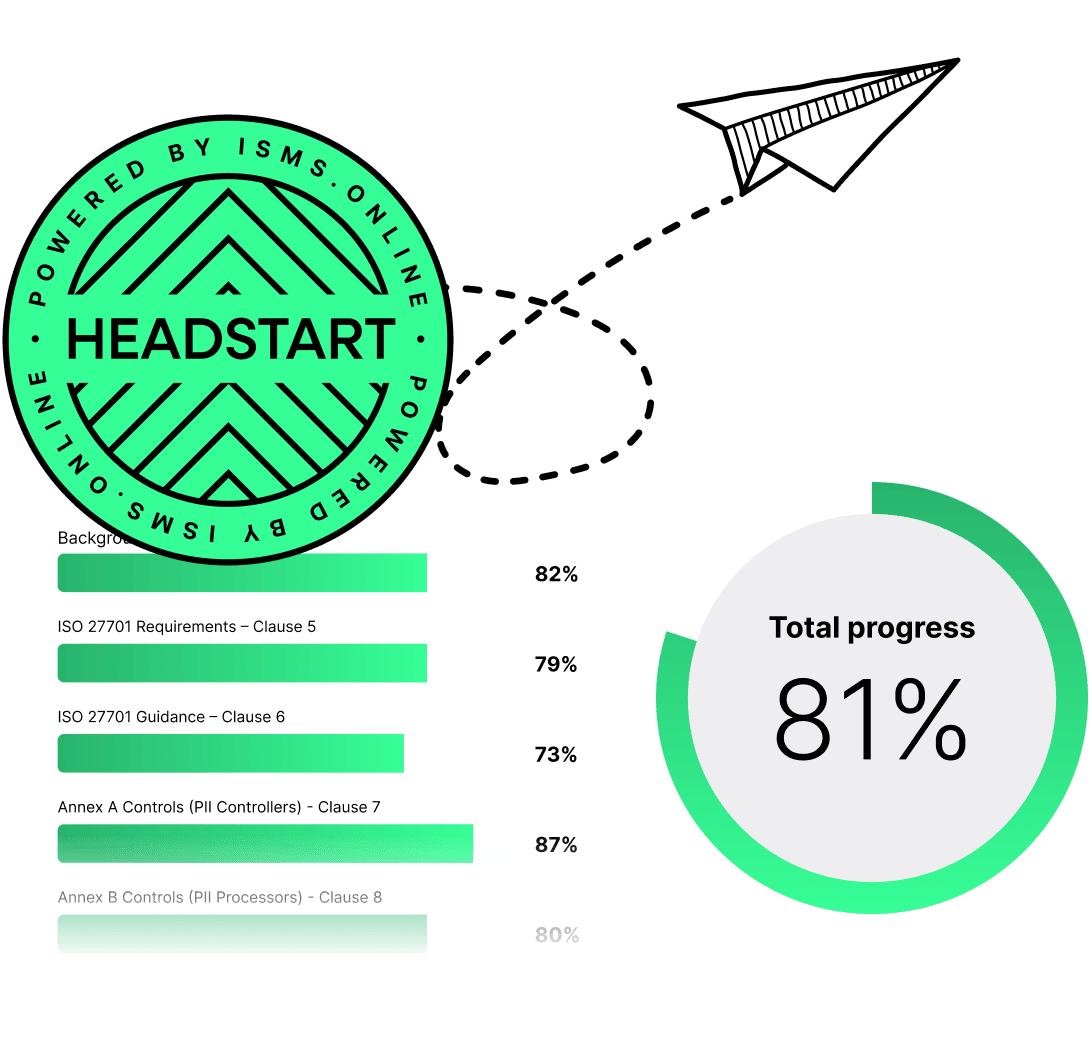
An 81% Headstart from day one
We’ve done the hard work for you, giving you an 81% Headstart from the moment you log on. All you have to do is fill in the blanks.
Laboratory Competence—Measured, Proved, Defensible
All confidence in your laboratory’s output is built not on faith, but on metrics that survive external review: proficiency test scores, calibration precision, audit log integrity, and closure rate of nonconformities. These are not “nice-to-haves” for your board—they’re essentials for retaining contracts, avoiding investigations, and justifying investment in new technology.
The Non-Negotiable Metrics of Accreditation
- Proficiency Testing Records: — Benchmarking against industry and interlaboratory baselines.
- Audit and Nonconformity Trend Analysis: — Recurring findings trigger escalation, not acceptance, and provoke operational changes with real impact.
- Calibration Error Rates: — Calibrations that drift, equipment out-of-cycle, or missed recalibrations are treated as reportable events, not data points.
- Close-Out Effectiveness: — Nonconformities that linger signal to auditors and customers your system tolerates risk. Immediate, well-documented remediation is expected.
A single misaligned metric can undo months of preparation. Instantly accessible, defensible numbers are the foremost badge of competence.
Benchmarking Table: Expected KPIs for Proactively Compliant Labs
| KPI | Minimum Acceptable | Benchmarked Leader |
|---|---|---|
| PT success rate | >90% | >98% |
| Audit nonconformity closure | <15 days | <5 days |
| Calibration log completeness | 100% | 100% |
If your lab cannot answer “show me your metrics for last quarter” in under five minutes, your audit posture is weak—no matter your certifications.
Accreditation—Why “Compliant” Is No Longer Enough
Where market perception matters, being “compliant” is simply invisible. Customers will not reward the baseline; they expect visible, third-party-accredited status as minimum entry to their vendor lists.
What Steps Separate the Accredited Leader from the Average Laboratory?
- Gap Analysis and Baseline Review: Every clause must be mapped, and gaps objectively measured.
- Internal Evidence Chain Assembly: Documentation isn’t “for the auditor”—it’s your operational shield.
- Proficiency Proof & External Validation: Benchmark performance, participate in PT, and document immediate responses to findings.
- External Audit Orchestration: Preparedness means every questioned process instantly produces an evidence trail.
Accreditation Outcomes: Market Leadership Table
| Outcome | Unaccredited Lab | Fully Accredited Lab |
|---|---|---|
| Trust Factor | Under Review | Prequalified |
| Tender Wins | Conditional | Open/Invited Bidder |
| Audit Burden | High, recurring | Streamlined, faster |
| Retention | Fragile | Secure, often multi-year |
Labs that reach for formal accreditation take nothing for granted. They achieve visible, auditable separation from the average, move to the front of buying lists, and become referenceable in their sector.

Free yourself from a mountain of spreadsheets
Embed, expand and scale your compliance, without the mess. IO gives you the resilience and confidence to grow securely.
Documentation and Record-Keeping: The Audit Chain in Practice
Your documentation is your primary operational defence—not just a bureaucratic requirement. Every misplaced form or undocumented correction becomes audit friction, regulatory risk, or, at worst, legal exposure. Documentation done right means readiness is operational, not reactive.
Digital Control and the Real-Time Evidence Chain
- Centralised Document Management: Every process, SOP, and policy revision must exist in a single, versioned, and accessible repository.
- Audit-Ready Recordkeeping: No more midnight searches for calibration logs or compliance papers lost in staff drives.
- Automated Change Tracking: Each edit, approval, and exception forms a self-building audit chain, never dependent on human memory.
Scenario: A client requests a specific calibration certificate for tests run six months prior. If it takes you more than 10 seconds to find, your operational controls are exposed.
When documentation is a reflex, not a chore, you have audit-readiness—anything less is an operational risk.
Implementing high-integrity documentation should not cost you time. ISMS.online combines digital workflows and real-time automation so compliance supports—rather than stifles—your team.
Certification Journey: Orchestrating a Risk-Free Pathway
Securing ISO 17025:2017 isn’t sprinting through a checklist. Every phase, from initial assessment to the final audit, is an opportunity for improvement—or a risk for delay and expense. Well-run teams structure their certification process as a project with defined milestones, roles, and escalation paths.
How Do Proactive Operations Move Through Certification Faster?
Step-by-Step Workflow
- Initiate Gap Analysis: Compare every process and documentation asset with each clause’s demands; prioritise vulnerabilities.
- Remediation and Training: Assign remediation tasks with deadlines; validate with targeted training, not generic slide decks.
- Evidence Collection: Build the audit trail as you go—don’t retroactively chase missing logs.
- Internal Audit Simulation: Run dress-rehearsal audits with independently assigned roles; document findings and rapid closures.
- External Audit: Present your complete evidence chain, not excuses, and clear findings in days, not weeks.
| Phase | Objective | Action | Proof Artefact |
|---|---|---|---|
| Gap Analysis | Define baseline | Process/routes vs. clauses | Gap matrix report |
| Remediation | Close vulnerabilities | Assign & log task completion | Updated SOPs, logs |
| Evidence Coll. | Assemble audit proof | Link all supporting records | Audit trail, changelog |
| Internal Audit | Test readiness | Simulate & log findings | Audit report, NCR log |
| External Audit | Secure certification | Present evidence/documentation | Cert, audit confirmation |
A digital-first platform accelerates every phase by forcing operational clarity, eliminating time lost to ambiguity, and ensuring every action builds the audit chain.

Manage all your compliance, all in one place
ISMS.online supports over 100 standards and regulations, giving you a single platform for all your compliance needs.
The Unseen Costs of Manual Compliance: Risk, Reputation, and Recurrence
Manual processes were once necessary; now, they are a ticking risk. The more time and mental energy your team devotes to finding, updating, and verifying compliance artefacts manually, the more you’re exposed to audit penalties, contract loss, and error-driven remediation costs.
How Do Manual Tasks Amplify Compliance Threats?
- Disjointed Recordkeeping: Policy and evidence scattered across staff, drives, or locations creates irretrievable gaps and unconfirmable actions.
- Reactive Responses: The time spent finding missing files or backdating records is time not spent improving compliance posture.
- Hidden Financial Costs: Regular rework, failed audits, and loss of tenders all rise the longer you rely on patchwork processes.
Every audit should confirm our lab’s strengths, not reveal our oversights. Anything less is an unacceptable risk.
Case in Point: Manual vs. Digital Incident Response
| Response Workflow | Manual-Dependent | Digital/Integrated |
|---|---|---|
| Audit preparation | Weeks | Minutes |
| Issue traceability | Verbal trail | Logged, automated |
| Error detection | Post-issue | Proactive/flagged |
| Escalation protocol | Undefined/variable | Pre-set, time-logged |
Organisations that fully automate compliance—internal triggers, reminders, evidence logs, and escalation—outperform those who treat documentation as an afterthought.
Become the Benchmark for Laboratory Standards
Moving your compliance from “box-tick” to market leader starts with a single decision—refusing to tolerate ambiguity in your operational chain. The laboratories that get recognised, recommended, and retained are those whose certifications are never in doubt, whose processes never drop a link, and whose teams lead through readiness, not repair.
Why Now?
The frameworks and automation now exist. As CISO or compliance lead, your identity is clear: to deliver confidence, efficiency, and verification at every audit checkpoint, every client proposal, every future opportunity.
Prove that your laboratory isn’t waiting for validation—it’s already the reference point others aspire to match.
Book a demoFrequently Asked Questions
Why does ISO 17025:2017 move beyond compliance and become the asset that protects your reputation?
ISO 17025:2017 is the only internationally accepted standard that converts laboratory promises into verifiable, defensible evidence. It fuses technical skill, process discipline, and real-world risk management—shaping every decision in your lab into a point of competitive difference. Your policies, calibration logs, and audit chains don’t just tick boxes: they defend your every claim under the toughest client, regulatory, or investigative scrutiny.
Key aspects that translate to operational confidence:
- Every method and process is mapped to measurable, documented outcomes—from sample intake to certificate release.
- Results are underpinned by recurring skill validation, traceable calibration, and continuous root-cause learning—not guesswork or memory.
- ISO 17025 ties together global trust, boardroom credibility, and day-to-day audits by making every link in your process transparent.
| Compliance Practice | Weak Lab (“Paper Compliance”) | Advanced Lab (“ISO 17025 Disciplined”) |
|---|---|---|
| Method documentation | Untracked or siloed | Standardised, signed, revised |
| Calibration logs | Incomplete, date-lagged | Chain-of-custody, gapless |
| Internal audits | Backfilled, reactive | Real-time, flagged, trend-tracked |
Your real asset isn’t your last certificate—it’s the trail of trust you leave for every future audit, renewal, or client.
What component failures most often sabotage laboratory credibility under ISO 17025:2017?
Uncertainty isn’t just a technical term—it’s where reputations are lost. Calibration that can’t be traced, SOPs that live in someone’s memory, or logs that evaporate before the audit: these process weaknesses are visible to every regulator and customer. A cohesive Information Security Management System (ISMS) removes “best effort” from your vocabulary.
Core safeguards you need in place:
- Personnel training is a logged, repeating cycle—not a “set-and-forget.”:
- Method validation evolves with standards, not months behind.:
- Equipment checks are prompted before expiry, not realised in client recalls.:
- Every change, exception, or outlier is signed, explained, and tracked to resolution.:
Failures to systematise these essentials don’t just add work—they jeopardise contracts, breach duty of care, and compromise legal defensibility.
“Labs that operate in the grey zone between documented and ‘we’ve always done it this way’ risk exposure the moment scrutiny arrives.”
ISMS.online acts as your operational backbone—enforcing rigour, surfacing gaps, and supporting you through every policy and log chain, so reputation is never an open question.
What proof metrics turn laboratory “competence” from PR to board-level currency?
You aren’t measured by how much you try—only by what you can prove. Real performance surfaces in controlled, comparative metrics: proficiency test wins, closure rates on nonconformity, days of calibration lead time, and the water-tightness of your evidence when challenged.
Benchmarks that define value:
- External proficiency test results and interlab comparisons—never industry average, always top decile.
- Zero-lag closure on nonconformance, with not a single outstanding corrective action at next review.
- Documented skill progression for every staff member, not just the lead analyst.
- Audit readiness shown in minutes, not days or weeks.
A lab that can’t instantly produce its last five proficiency benchmarks invites doubt before the audit begins.
Every compliance officer knows: you’re only as strong as your last audit. But in the market’s eyes, you’re only as strong as your ability to prove the next one—without hesitation.
Operationalize these metrics through ISMS.online—embedding continuous evidence collection and micro-triggers so “proof” becomes your everyday operational signal.
Why does relying on internal review alone fail in a world demanding transparent accreditation?
Internal compliance cannot unlock market trust—it’s the invitation, not admission. Accreditation by a recognised external body isn’t a luxury; it’s the difference between being an option and being “preapproved” for the next contract. Sector leaders stake their position on the discipline that comes from repeated, unannounced external audits.
Strategic differences only visible in practice:
- Accredited labs demonstrate recurring wins—tenders, projects, stakeholder renewal—because their systems withstand any inspection, not just scheduled reviews.
- Their audit logs become recruitment tools, not just regulatory shields.
- For you, accreditation is less about passing today than being trusted tomorrow.
When external auditors see a system in which every action is validated, every change documented, and every nonconformance resolved, they move swiftly—and your clients notice.
“Procurement never debates whose evidence is best; it debates whose accreditation is hardest to question.”
How does robust documentation and digital evidence turn audits from anxiety to advantage?
Without documentation discipline, your lab isn’t a system—it’s a collection of risks. Reliance on paper trails or legacy PDFs leads to audit paralysis and robs your operation of responsiveness. Digitally enforced record-keeping is more than efficiency; it’s your command post for every test, discrepancy, and requirement.
Why digital, versioned evidence supersedes manual logbooks:
- Every process and deviation has a verifiable timestamp; nothing can be massaged, overlooked, or forgotten before an audit.
- Retrieving last year’s audit trail or calibration certificate shifts from afternoon calls to a couple of clicks.
- Escalation and task-burden can be visualised in real time—reassign, reprioritize, resolve without guesswork.
Scenario: When an external audit arrives ahead of schedule, teams with version-controlled records and auto-notifications never fear the knock; they welcome it as their competitive arena.
Internal reviews scan for issues; digital systems prove accountability and breed external trust.
Our approach at ISMS.online ensures your records are both your shield and your sword—proving compliance, outpacing legacy workflows, and eliminating the seconds of doubt that expose opportunity costs.
What operating rhythm moves a lab through ISO 17025 certification without slowdowns or last-minute panics?
Certification is earned not by explaining intentions but by demonstrating a habit of closed error loops, immediate evidence collation, and leadership in managing every audit fork. Labs that systematise readiness make every audit a proofpoint, not an exam.
What separates those that certify on time:
- Start with a gap analysis that surfaces and assigns every clause vulnerability to an owner and a deadline.
- Route remediation and closure into workflows that continually update evidence pools—no lag, no backlog.
- Simulate audits before they’re scheduled; track root-cause correction to conclusion.
- Prioritise external audits as the proof, not the problem—your processes are built for daily recall.
- Escalate management of open tasks with live dashboards—if it lingers, it’s a warning.
“Momentum isn’t luck; it’s the natural state of a lab that turns audit preparation into daily execution.”
The competitive edge isn’t in having fewer issues; it’s in surfacing, attacking, and streamlining closure so improvement becomes your culture code.
Where does manual compliance most reliably fail—what can digital transformation reclaim?
Manual control means invisible drag: untracked process drift, missed recert famous, expanded error rate, and burdened staff. Every gap not flagged by your systems is one highlighted by auditors or—worst—clients.
Transformative gains that reshape outcome expectations:
- Instant notifications for expiring documents and overlooked calibration deadlines—no scramble, no stakeholder surprises.
- Integrated evidence reuse: a single action updates all related protocols and standards.
- Secure, tamper-proof audit chains—no one “rebuilds” evidence at the last minute.
- Deep reductions in review cycle time and compliance cost.
When a CEO can see their lab’s real-time compliance pulse, reputation rises with every proven metric.
ISMS.online drives your system toward operational resilience and unlocks a status where evidence, trust, and future deals flow naturally to your team, not to those still hoping they’ll “pass” next time.






