





































Why Incident Management Preparation Separates Leaders from the Rest
No modern organisation escapes cyber threats-what sets leaders apart is the calibre of their preparation. A crisis doesn’t wait for your convenience; it exposes whether your team has drilled its response or only filled out paperwork. The pressure isn’t just operational: your clients, regulators, partners, and shareholders now expect robust incident planning, not polite assurances. Organisations that treat incident management as a strategic asset emerge with reputations intact-and sometimes even stronger.
A plan on a shelf offers no refuge when disruption hits; only living routines do.
Neglecting real-world readiness leaves your organisation exposed far beyond a day of downtime. The impact of an ill-prepared response echoes across customer confidence, contract renewal, vendor trust, and regulatory scrutiny. Regulators and major clients increasingly demand proof: evidence that you’ve rehearsed your response, hardened your escalation paths, and ensured people know their part even at 2am. Industry surveys consistently reveal that untested or outdated incident plans contribute to prolonged outages, revenue loss, and compulsory audit remediation.
What If Your Incident Makes Headlines?
Incidents aren’t just about restoring service-they test the trust you’ve built. When your response is smooth, transparent, and well-documented, you show partners and auditors that you understand the stakes and take your stewardship seriously. But if your team fumbles the escalation or can’t produce real evidence of drills and lessons learned, recovery can drag for weeks, and reputational repair may take years.
Board and Regulator Pressure Is Growing
Board directors want to see that incident management isn’t an IT silo but an organisation-wide discipline. Regulatory bodies now expect living documentation-plans, logs, and after-action evidence that survive real-world scrutiny, not meeting-room hand-offs. Prospective customers review incident frameworks before signing contracts, and procurement questionnaires routinely ask for detailed logs, not policy PDFs.
The New Standard: Prove, Dont Promise
Implementing ISO 27001:2022 Annex A 5.24 isnt about ticking compliance boxes; it transforms readiness from static paperwork into a resilient, proactive culture. The only way to earn lasting trust is to demonstrate not just written plans but operational, evidence-based routine. You have a choice: anchor your credibility in rehearsed action-or hope your luck holds.
Book a demoWhat’s Changed in ISO 27001:2022 Annex A 5.24-and Why Does It Matter?
The 2022 update to Control 5.24 marks a turning point. Where older frameworks allowed reactive, annual reviews, the new standard mandates a proactive, cyclical approach. Simulated incidents, role-specific evidence, and regular updates now define compliance as well as resilience. You can’t just file away an incident policy; you must prove it lives and evolves with your business.
Living incident plans are measured not by their length but by their adaptability.
What Is Now Expected for True Readiness?
- Documented, rehearsed plans: ISO 27001:2022 5.24 requires you to maintain and continually test your incident management documentation, covering all plausible threat scenarios.
- Clear role assignments: Specific individuals (not just departments) must be named for each stage, with deputies and escalation paths clearly mapped.
- Proof of regular drills and improvements: Auditors and business partners demand logs of simulations, after-action reviews, and updates made based on lessons learned.
- Responsive change cycles: Organisations are expected to adjust their plans as staff, technology, or risk landscapes shift-not just in a yearly review.
- Compliance Kickstarters: need templates and checklists that prove action, not just intent.
- IT/Security Practitioners: must log drills, lessons, and improvement cycles to pass tougher audits.
- CISOs/Leaders: require dashboards evidencing frequency of both drills and policy changes.
- Privacy & Legal: need records that demonstrate effective notification and regulatory processes, not just intent.
Why Does It Matter Now?
Major incident stories have shown that “annual review” is an anachronism. Board and regulator expectations have leapt forward; today, readiness is measured by practice, not pronouncements. The penalty for lagging behind isn’t just operational chaos-it’s lost deals and higher compliance costs.
ISO 27001 made easy
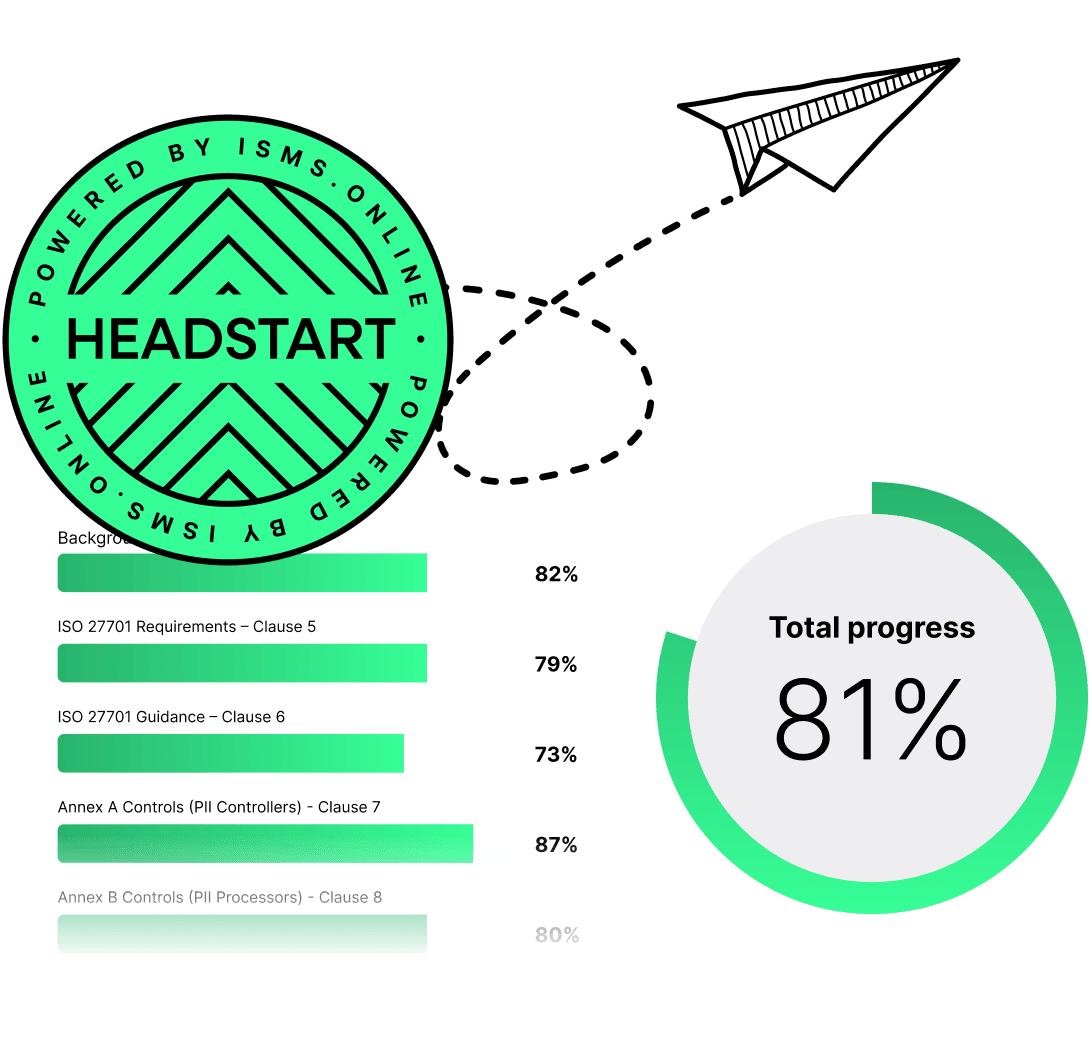
An 81% Headstart from day one
We’ve done the hard work for you, giving you an 81% Headstart from the moment you log on. All you have to do is fill in the blanks.
How Do You Build an Incident Management Plan That Works Under Pressure?
A plan that fails on paper is harmless; a plan that fails during chaos is devastating. To be genuinely ISO 27001:2022-ready, your plan must work for every team member-in the heat of a crisis.
Incident management is only real when everyone can follow it under stress.
Core Attributes of a Resilient Plan
- End-to-end mapped lifecycle: Articulate each phase-reporting, detection, escalation, response, resolution, lessons learned-and define handoffs between roles.
- Concrete, human-readable workflows: Provide visual diagrams and concise checklists; avoid jargon that only experts understand.
- Accessible, actionable documents: Plans should be digitally accessible-even on mobile-for both employees and suppliers, with permissions managed to enable, not hinder, action.
- Real-time evidence capture: Build in live logging of every escalation, decision, and corrective action.
Tactical Blueprint
- Frictionless Reporting: Deploy immediate reporting tools-hotlines, digital forms, or Slack integrations-to ensure incidents aren’t trapped in emails or informal channels.
- Role Assignment & Ownership: Assign specific people, not placeholders, for each stage of incident response; ideally backed by org structure and clear deputy mapping.
- Simulation Scheduling: Systematically schedule threat-specific drills (phishing, data breach, ransomware, supply chain compromise), aiming for at least semi-annual coverage.
- After-Action Protocols: Automate a post-event lessons-learned workflow: what unfolded, what went wrong, corrective action, and policy linkage.
Practitioner’s Checklist
- Validate that anyone on the team-new joiners or senior leaders-can initiate and escalate an incident at any time.
- Store live contacts for rapid escalation; test quarterly.
- Run and log both “tabletop” and live-fire drills, capturing gaps and improvements in each cycle.
- Link every documented improvement to a specific incident or simulation.
Case Insight
A growing SaaS firm, by moving from annual policy review to quarterly, role-specific drills, reduced their average incident containment time from nine hours to under three. Their audit outcome was not only a clean bill of health, but increased confidence from a strategic customer who witnessed their after-action evidence through ISMS.online.
How Should You Assign and Empower Roles to Ensure Reliable Response?
Teams fail or prevail based on shared choreography. When people know their part-and trust that deputies are just as ready-performance under fire is vastly improved.
A well-drilled team responds on instinct; confusion is always costly.
Leadership and Segregation of Duties
- CISOs/Leaders: Appoint phase leads for every stage, with visible deputies for redundancy. Ensure the structure is logged and updated after each personnel or org shift.
- IT/Security: Document triage, technical containment, escalation, and recovery ownership, ensuring technical skills match assigned roles.
- HR/Privacy/Legal: Explicitly define at which point privacy incidents, staff issues, or regulatory notifications must be invoked, and by whom.
- Third Parties & Vendors: Define how and when key suppliers are looped in or notified, reflected in contract SLAs.
Best Practices
- Keep a live, accessible directory of roles, contacts, and deputies.
- Mandate cross-functional participation in at least annual simulations-and record outcomes and blockers for action.
- Establish clear hand-off points so no one assumes the next step is “someone else’s job.”
Enable Board and Executive Participation
Board and senior execs should complete at least one drill per year, integrating their risk and response role into the organisational rhythm. Their participation signals cultural buy-in and satisfies rising regulatory demand for top-down accountability.

Free yourself from a mountain of spreadsheets
Embed, expand and scale your compliance, without the mess. IO gives you the resilience and confidence to grow securely.
How Do You Assemble Audit- and Board-Ready Evidence Without the Last-Minute Scramble?
Audit time should not feel like a fire drill. Transforming incident records into trust signals requires systematic documentation-secure, timestamped, and policy-linked.
Board trust is earned not by what you intend, but by what you can prove instantly.
Essential Evidence Practices
- Centralise logs, drills, after-action reviews, and escalation templates in a secure evidence bank.:
- Timestamp entries on creation, not retrospectively.: Retroactive documentation unravels legal defensibility and audit credibility.
- Keep a drill register: capturing who participated, role coverage, scenario tested, and gaps found.
- Trace every lesson learned to demonstrable policy or workflow change: (e.g., “After Q1 drill, automated escalation to data privacy officer was implemented”).
- Automate dashboard generation: for executives: time-to-resolution, incident trends, and compliance coverage.
Productivity Insight
Implementing tool-assisted evidence management freed one security team from 80% of their pre-audit scramble time. Board reviews shifted from defensive postures to confident, strategic discussions backed by accessible, real-time dashboards.
What Common Traps Undermine True Resilience and Compliance?
Some failings are as consistent as the headlines that follow them. Knowing-and preempting-these pitfalls separates the merely certified from the truly resilient.
You can outsource paperwork, but not accountability or responsiveness.
The Blind Spots
- Limiting response to IT: Entire orgs must be involved; privacy, HR, legal, and vendor considerations are vital.
- Complex, confusing documentation: Overly technical, ambiguous, or inaccessible plans lead to delays and errors.
- Annual reviews (and nothing more): Modern environments change too quickly; quarterly cadence should be standard.
- Ignoring third parties: Most major incidents trace back to a supplier; include key partners in simulations and escalation charts.
- Leadership detachment: When executives avoid drills, the “it’s not my job” culture persists, sabotaging swift recovery.
- No after-action follow-through: Documenting lessons learned but failing to implement improvements is a missed opportunity-and a growing audit risk.
Disclaimer
The guidance herein supports robust implementation of ISO 27001:2022 Annex A 5.24 but must always be tailored to your local regulatory environment, risk appetite, and internal skill base. Engage legal and regulatory advice as needed.

Manage all your compliance, all in one place
ISMS.online supports over 100 standards and regulations, giving you a single platform for all your compliance needs.
Can You Quantify the Difference? Laggard vs. Leader Performance
The gulf between compliance “tick-boxers” and high-resilience organisations becomes stark in the numbers-and in board and customer reactions.
| Organisation Type | Avg. Incident Downtime | Audit Pass Rate | Recovery Speed | Board Confidence |
|---|---|---|---|---|
| **Laggard** | 5+ days | 60% | Weeks | Low |
| **Average** | 1–2 days | 85% | Days | Moderate |
| **Leader** | <12 hours | 100% | Hours | High |
Practised resilience leaves no room for luck; it trades panic for performance.
Organisations with quarterly drills, cross-role reviews, and after-action improvements consistently outperform those who treat incident planning as a shelf requirement (avisoconsultancy.co.uk; isaca.org). Board trust and customer retention follow where confidence in readiness is demonstrable.
Beyond the Table
Firms tracking live drill participation, policy updates tied to lessons learned, and incident logs with real-time dashboards show double the board’s perception of readiness and halve incident recovery times compared to laggards.
Transform Incident Planning into Living Resilience: How ISMS.online Powers Every Step
Everything explored here-tested plans, live role directories, role-based drill tracking, central evidence banks, and executive dashboards-is enabled natively by ISMS.online. Rather than piecing together spreadsheets and isolated templates, you gain daily assurance that readiness is lived, not assumed.
Resilience isn’t a project-it’s the habit formed by daily, intentional practice.
- Compliance Kickstarters: Get operational fast with guided templates, drag-and-drop plans, and instant onboarding. Accelerate your path to first audit success without getting stuck in the standards maze.
- IT/Security Practitioners: Centralise logs, automate reminders, and link evidence to every improvement. Free your team from admin purgatory and focus on strategic security work.
- CISOs and Security Leaders: Monitor simulation and incident performance in real-time, align all frameworks under a unified dashboard, and equip the board with defensible trust metrics.
- Privacy & Legal: Customise escalation chains, ensure GDPR or sectoral notifications are never forgotten, and maintain defensibility via immutable logs and evidence tracking.
Picture a dashboard mapping each incident phase. Detection triggers both IT response and privacy escalation, human resources and executive roles activate at designated thresholds, and evidence is automatically captured with every move-visible to all stakeholders. No chaos, no manual scramble, no uncertainty.
Act Now; Build Habits Before Crisis
Living resilience means never leaving response to chance. Transform your incident management into a daily culture, where evidence flows effortlessly and every stakeholder is audit-ready at a moments notice.
Identity Call to Action:
Step beyond shelf-ware and compliance optics-make robust, operational incident management your blueprint for trust, agility, and leadership. Embed living resilience into your organisation now, so when the unexpected hits, youre recognised as the team that didnt just react-you led.
Frequently Asked Questions
Why does readiness under ISO 27001:2022 Annex A 5.24 matter more now-and how does it reshape real-world incident outcomes?
Readiness under ISO 27001:2022 Annex A 5.24 is the modern dividing line between a business simply “getting by” and an organisation that protects trust, value, and continuity-no matter the threat. This clause elevates incident management from passive policy to a rehearsed organisational instinct: regulators, customers, and insurers now judge your response not by words in a manual, but by evidence that your people, process, and records are alive, current, and actionable.
In practice, readiness means every staff member knows how to report-even if IT or management is unavailable. In rehearsals, even the most junior hire can demonstrate what happens next and why their action matters. According to independent research, over 60% of organisations will face a security incident annually-and the majority admit to being unprepared when it actually happens (Aviso Consultancy, 2023). The costliest failures aren’t caused by exotic attacks but by confusion, delays, or missed signals in the first hour.
True incident resilience is a practised habit, not a policy on a shelf.
When your programme is reviewed, drilled, and visible, you transform surprises into routine actions. This not only minimises direct losses but preserves client, board, and employee trust-a factor consistently linked to faster recovery and long-term customer retention. Your ability to demonstrate readiness is now a competitive differentiator, not just an audit requirement.
How has Annex A 5.24 redefined the meaning of an “audit-ready” incident response programme?
“Audit-ready” no longer means a thick binder or signed-off PDF-it means a demonstrable record of living, functional incident management that operates in the real world. Auditors and regulators increasingly demand end-to-end transparency: up-to-date process ownership, logs from live (or realistic simulated) incidents, clear evidence of regular reviews, and real playbooks-tested, updated, and accessible to all stakeholders, not buried in IT.
Current best practice is to maintain not just a written plan, but digital receipts: evidence logs, recordings or notes from simulation exercises, post-incident reviews that triggered improvements, and board-level reporting all linked in a single source. Auditors may now interview random team members to check that incident reporting, escalation, and mitigation steps are understood and not just delegated to “someone in IT.” Tabletop drills, red/blue team exercises, and scenario reviews are expected evidence. If you rely on outdated contacts, unexplained gaps, or improvements that stay on paper, you risk not only findings-but erosion of trust from management and regulators ((https://knowledge.adoptech.co.uk/5.24-information-security-incident-management-planning-and-preparation)).
An unpracticed plan is invisible during crisis; only action, rehearsal, and linked improvement show readiness under real scrutiny.
A living programme also demonstrates that you regularly review and adjust your procedures following changes in staffing, business context, or new threats-making your readiness always current and provable.
What steps form the backbone of a truly ISO 27001:2022-compliant incident management plan?
A resilient Annex A 5.24-aligned programme starts with active culture, not just documentation. Here is a blueprint used by compliance leaders:
1. Instantly accessible reporting mechanisms
Every individual-regardless of technical skill-can raise an incident via an easy, prominent, and well-known channel (such as a digital form, “panic” button, or hotline).
2. Clear ownership and stepwise documentation
Each phase-detection, triage, escalation, response, closure, and improvement-is mapped and assigned to named leads and deputies. Backup ownership is planned for absences, with handoff processes rehearsed.
3. Continuous training and simulation
Quarterly or event-driven drills (tabletop, scenario, adversarial) are conducted, gaps identified, and lessons embedded in refreshed plans. Logs from these exercises are securely archived, forming auditable proof of the loop in action ((https://www.sans.org/white-papers/401/)).
4. Centralised, timestamped evidence library
Every step, from real incidents or practice drills to after-action reviews, is documented in a searchable, resilient, and access-controlled “evidence bank.” This eliminates fire drills before audits, and allows your board or reviewers to check progress at any moment.
5. Real change follows every incident
Every review or debrief must produce, assign, and track specific improvement steps. Their closure and impact are directly linked to individual incident or drill records-proving continual improvement is not theory but daily discipline.
| Blueprint Element | Description |
|---|---|
| Reporting Channel | Easy, visible, tested for all staff-not IT-only |
| Role Ownership | Names, deputies, and backup procedures listed |
| Drill Cadence | Quarterly/event-linked, logs stored in evidence bank |
| Evidence Management | All records, improvements, and KPIs centralised |
| Board Reporting | Near real-time, is actionable-not just after the fact |
This approach takes resilience from being a “tick-box” to a reliable, business-driving capability.
Why can role assignment and fresh training determine the success or failure of incident response?
During a real crisis, ambiguity quickly leads to costly confusion or delay. It is essential that every stage-alerting, triage, escalation, containment, and closure-has an active owner and a secondary (deputy), both trained and rehearsed. A resilient programme assigns specific responsibilities by function: privacy, legal, communications, HR, and supply chain, not just the “usual suspects” in IT (BSI, ISO 27001).
Trusted teams don’t improvise in crisis; they perform roles rehearsed in business-as-usual.
Regular onboarding of new hires and refresher training for all staff means no weak links arise if someone leaves or shifts roles. Each simulation or drill teaches not just policy but muscle memory-staff act under pressure as naturally as in routine operations. These logs double as proof for auditors and, increasingly, as risk reduction metrics for insurers.
Which evidence, logs, and artefacts distinguish true audit leaders from laggards?
Strong organisations maintain a single, always-updated source of truth for all incident management records:
- Live incident logs with accurate timestamps and role signatures (never “reconstructed” after the fact)
- Drill and training records, with details of participants, tested scenarios, and feedback/action items
- Improvement logs tightly tied to both incident and drill reviews, tracked through closure
- KPIs and board dashboards, illustrating not only the number of incidents and performance versus target, but how lessons were learned and embedded
In contrast, laggard organisations rely on best-effort collations-siloed emails, static files, or memory-that rarely stand up to scrutiny by auditors, insurers, or boards ((https://cpe.checkpointlearning.com/CourseContent/Content/TRTA/699576/ebook/print_preview.htm)). Real audit leaders make latency between learning and proof close to zero, ensuring resilience is visible and independently verifiable.
What common mistakes weaken incident programmes, and how can they be prevented or reversed?
Some patterns consistently trigger audit findings, fines, or high-profile failures:
- Overcomplex plans: lead to paralysis in crisis; keep every step clear and minimal.
- Restricting response to IT: means business, privacy, or partner-related incidents fall through the cracks.
- Irregular review cycles: (annual only) result in outdated contacts or steps.
- Shelfware documentation: gathers dust while real readiness fades.
- Third-party blind spots: are now a favourite vector for attackers; suppliers need to be included in planning and drills.
- Surface-level drills: miss escalation, media, or executive decision-making-leaving the biggest risks untested.
To avoid or fix these, organisations must:
- Make plans accessible, short, and regularly rehearsed
- Schedule reviews not just annually, but whenever staff, business, or tech changes occur
- Include new hires and non-technical staff in training and simulation cycles
- Securely centralise all artefacts-so audit and board review become a confident confirmation, not a frantic search
- Tie incident reporting and metrics to board priorities-forcing continual organisational buy-in
Organisations that treat resilience as culture-not compliance-outperform and outlast the rest.
When you embed these habits and evidence tools with ISMS.online, audit success and true resilience flow together: incidents move from anxiety to opportunity, and your organisation earns board, customer, and regulatory trust by design.






