





































When Disruption Strikes: Will Security Hold or Crack Under Pressure?
Every business claims to take information security seriously-right up until a disruption rips through the smooth routines and exposes who was truly ready. ISO 27001:2022 Annex A Control 5.29 demands a higher standard: demonstrable, living protection of sensitive data even as core systems strain under fire. It’s no longer enough to parade policies or cite compliance certificates. With ransomware, supply-chain outages, and human error surging, your ability to protect information during chaos is your credibility in action. The moment disruption hits, delay is not an option. Your team and your board must know-not just hope-security is resilient under the worst pressure.
Every outage, ransomware lockout, or key employee misstep is a live test of your true security-judgement comes in minutes, not reviews.
Today’s clients, regulators, and supply chain partners don’t just expect slick presentations. They want to see live, automated proof that your controls, logs, and recovery routines function even as primary systems degrade or fallback processes come online (FCA). It’s why the likes of Delta, NHS, and MGM have dominated headlines-not for failing systems alone, but for letting disruptions widen into trust crises when controls weren’t built to survive the storm (Reuters; DigitalHealth.net).
Can you quickly show evidence-access logs, backup controls, team handovers, and tested fallback routines-on demand, whether your business is humming or scrambling? Annex A 5.29 is the control that separates the prepared from the optimistic.
Why Continuity Plans Crumble During Actual Disruptions
Many organisations walk into disruption with glossy documentation-and walk out with headaches, losses, and exposure. The gap isn’t a lack of intention, but missing operational integration. Paper plans meet reality, and the result reveals every weakness.
Failure lines surface not in policy reviews, but when the system needs to flex and every part must deliver, now.
Where Most Real-World Strategies Break Down
Despite best intentions, siloed business continuity and information security plans often stumble on poor alignment. Access is restored manually, fallback logs are kept offline or out-of-date, and teams fall back on improvisation. During the 2017 NHS ransomware crisis, fallback to paper logs prevented digital audit trails, creating fresh compliance vulnerabilities where none existed before. In Delta’s famous outage, a single corrupted file led to a \$150 million loss because cross-system recovery responses weren’t fully mapped or tested.
Security cannot be a fair-weather add-on-it must ride through every phase of disruption, as visible in chaos as in calm. Point-in-time compliance is meaningless when fallback actions open new holes, or ownership of critical controls slips through the cracks.
Comparison Table: Disconnected vs. Integrated Disruption Responses
Before integrating BCM (business continuity management) and ISMS (information security management), review where the risks compound fast:
| Fragmented Response | Integrated, Live Response | |
|---|---|---|
| Recovery Speed | Delayed by manual handoffs, missing escalation | Rapid role-routing and pre-tested fallback |
| Security Gaps | Controls left behind in fallback/manual processes | All pathways secured and monitored |
| Evidence Trail | Retroactive, patchy, high forensic uncertainty | Automated, timestamped evidence in real time |
| Staff Clarity | Role confusion and improvisation | Defined, drilled handover and delegation |
| Partner Trust | Shaken by visible gaps, ad hoc responses | Reinforced by demonstration of resilience |
A system that only works when nothing’s wrong is of little use in today’s threat environment.
ISO 27001 made easy
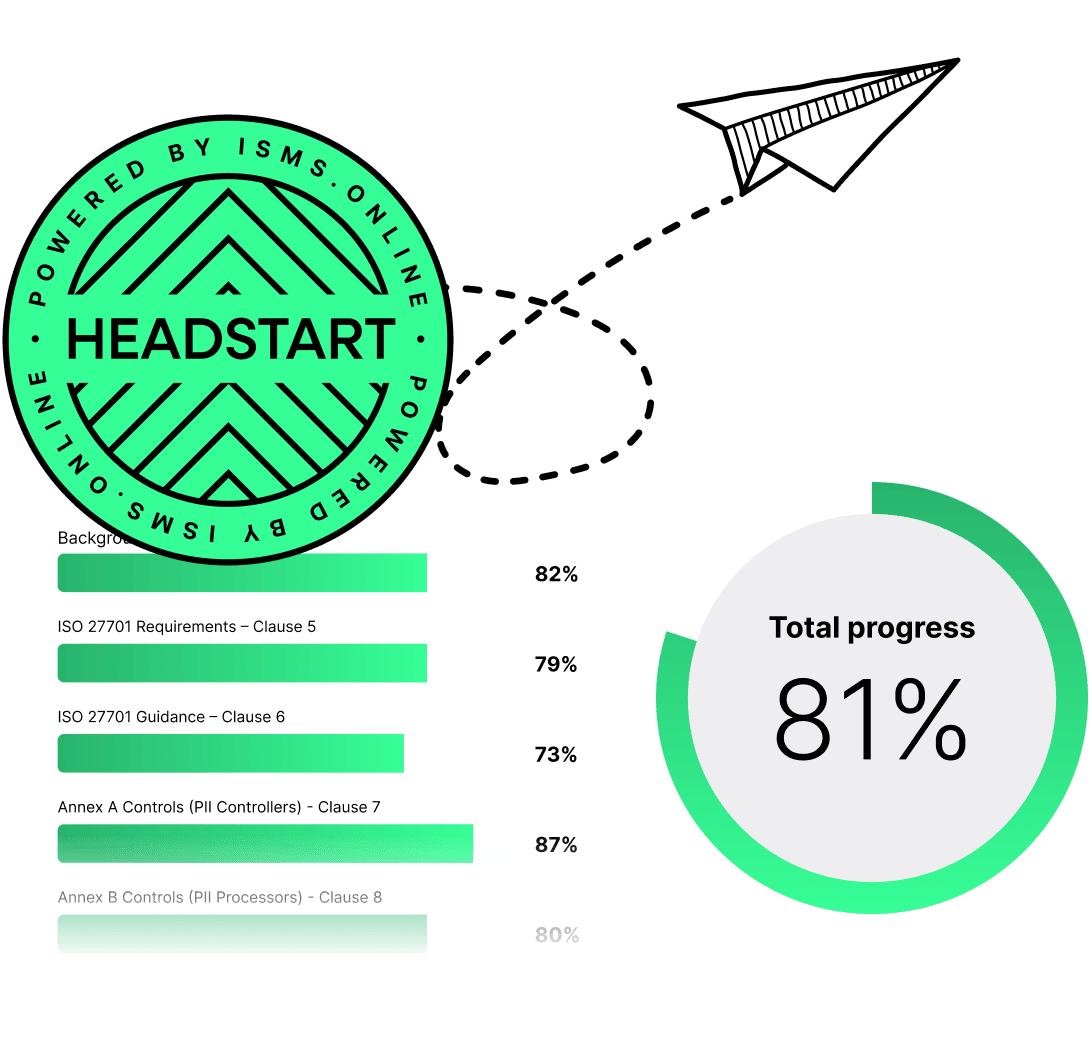
An 81% Headstart from day one
We’ve done the hard work for you, giving you an 81% Headstart from the moment you log on. All you have to do is fill in the blanks.
What Annex A 5.29 Really Demands: Daily, Tested, Evidence-Driven Security
Annex A 5.29 of ISO 27001:2022 reframes “information security during disruption” as a dynamic, living discipline. It’s about continuous protection-proving to auditors, boards, and customers that confidentiality, integrity, and availability of information are actively safeguarded, especially during fallback and recovery.
Resilience isn’t defined by how you operate in the quiet; it’s how you prove you can stand up secure when everything changes.
Translate the Standard to Real Operations
- Active, live documentation: Your system must assign clear, real-time responsibility for each recovery and fallback process-not just to a manager’s name, but to an accessible backup, with live contact channels.
- Fallbacks aren’t loopholes: Any manual workaround, paper backup, or ad hoc process kicked off during crisis must get the same security scrutiny-no shortcuts, no “break-glass” exceptions unless fully documented and immediately auditable (Infosecurity Magazine).
- Cross-team clarity: Recovery steps and fallback owner rosters must be as easy to navigate for substitutes as for permanent staff-critical as supply chains grow complex or hybrid work dominates.
- Automation and logging: Relying on retroactive evidence-gathering is obsolete. Automated event logging, continuous inventory, and tested recovery workflows set leaders apart (BSI Group).
How confident is your team that-if audited during an outage-they could provide logs and prove which controls were explicitly maintained? Any uncertainty signals a gap the standard wants closed.
Asset and Dependency Mapping: Make Complexity Manageable
Modern businesses run on a web of SaaS, infrastructure, shadow IT, and third-party suppliers. Annex A 5.29 demands relentless clarity: Who owns what, who backs up whom, and what are your most critical dependencies-even in the chaos?
A disruption doesn’t break the strongest chain, but the weakest unknown link.
Steps to Solidify Your Mapping Process
- Catalogue everything: Map all IT assets (core systems, endpoints, shadow IT, BYOD) alongside process dependencies (manual workarounds, supply chain links, critical roles).
- Name actual owners and backups: Assign a primary and backup owner for each key recovery process or asset. Static lists aren’t enough; updates must be dynamic and visible in your ISMS platform.
- Map all suppliers: Don’t just list-rate them for risk, and document escalation and contract details relevant to fallback events (Bloomberg).
- Audit fallback processes: Any process expected to come online during crisis (from USB “load and go” protocols to VPN or mobile hotspot fallbacks) must have controls as strict as your primary systems. Temporary isn’t an excuse for temporary security.
Case Proof:
After the 2023 MGM Resorts cyber incident, quarterly active dependency reviews and a digital live mapping dashboard eliminated “orphaned” assets and processes. Teams not only cut response time but avoided repeat weak points, building trust with regulators and partners.
The real measure of resilience is how quickly you can locate, test, and prove the state of every dependency-especially the ones you rarely touch until something breaks.

Free yourself from a mountain of spreadsheets
Embed, expand and scale your compliance, without the mess. IO gives you the resilience and confidence to grow securely.
Security as a Boardroom Metric: Building Value During Crisis
If your board believes information security is solely a function of IT, you’re at risk of making avoidable mistakes in high-stakes moments. True strategic value emerges when leaders see security during disruption as essential to brand trust, operational viability, and regulatory standing, all at once.
Security’s real value appears not in routine, but in the white-hot pressure of a crisis.
How to Shift the Board’s Perspective
- Live resilience KPIs at board level: Benchmark evidence readiness, fallback response time, and after-action review rates as routinely as cash flow or supply chain metrics (Financial Times).
- Integrate risk oversight: Bring confidentiality, integrity, and availability (CIA) metrics into boardroom packs, transcending basic incident metrics (RiskManagementMonitor).
- Cross-functional drill ownership: Assign accountability across HR, finance, ops, and IT. Boards that see real engagement (not just signoff) lower incident impact by 25–40% and recover weeks ahead of peers (InfoWorld).
| KPI | Best-in-Class Benchmark | Value Outcome |
|---|---|---|
| Audit Evidence | ≤3 hours for any request | Faster compliance, fewer delays |
| Fallback Activation | ≤15 minutes to live handoff | Minimise losses, preserve trust |
| Review Close-Out | 100% within 30 days | Continuous improvement, learning |
Trust is not just technical strength, but proof of leadership’s commitment to operational resilience.
Beyond Paper: Integrating ISMS, BCM, and Real-World Execution
For most, more policies mean more friction, not more resilience. Leaders streamline so staff can move fast, but with certainty.
Integration means less confusion, fewer mistakes, and muscle memory that pays off when nothing else is certain.
Integration in Practice, Not Just on Paper
- Central control dashboard: Unified workflow platforms collapse silos, allowing recovery and security steps to be assigned, tracked, and real-time evidenced (TechTarget).
- Automated escalation: If a system owner goes offline, automated escalation triggers backup steps-no missed handoffs (AlertMedia).
- Automated, not assumed, evidence: Scheduled logging, regular “evidence snapshots,” and digital audit trails mean live, unimpeachable records (RiskLedger).
- Routine, scenario-based drills: Simulation-based readiness beats paperwork-quarterly at minimum, more often for critical roles (GovTech).
The last thing you want to discover during a crisis is that your playbook only works on paper. Drill, rehearse, refine.

Manage all your compliance, all in one place
ISMS.online supports over 100 standards and regulations, giving you a single platform for all your compliance needs.
Learn, Refine, Repeat: Making Every Disruption Your Security Upgrade
Annex A 5.29 thrives in organisations where every disruption and after-action review strengthens the system for the next challenge-a cycle, not a fire-and-forget policy.
A crisis is not a failure. It’s a lesson that-if learned-makes you invincible next time.
How to Build Learning Into Security Readiness
- Blame-resistant, insight-driven post-mortems: Encourage openness about what went wrong, avoid scapegoating; track the fix, not just the incident.
- Data-powered root cause analysis: Use actual evidence and logs-not just meeting notes-to correct weak spots (AuditBoard).
- Full-cycle transparency: Make incident findings visible to directors and partners-builds trust, not fear (INC).
- Real-time feedback loops: Monitoring platforms with real interruption triggers train teams better than hypothetical simulations (Splunk).
The most respected organisations are transparent about what broke and how they rebuilt stronger-turning potential negativity into a reputational advantage.
Setting the Benchmark: What Proves You’re World-Class at 5.29?
Regulators, enterprise buyers, and board members no longer accept mere declarations. Live, real-world outcome evidence is king-benchmarked against leaders, not box-tickers.
Leaders in resilience are recognised by the speed and transparency of their audit trail, not just the ambition of their policies.
Benchmark Table: Audit-Ready in Every State
| Metric | Elite Performance | Source (where cited) |
|---|---|---|
| Audit Evidence Return | <3 hours per request | Auditor survey |
| Incident Response Lag | <15 minutes | Executive dashboard (Fortune) |
| Post-AAR Changes Done | 100% within 1 month | Public log (Forbes) |
Modern compliance is about showing, not telling-reliably, quickly, and consistently.
How ISMS.online Powers Secure, Cohesive Disruption Response
No matter the regulatory environment, ISMS.online eliminates the old battle between compliance, evidence, and operational agility. Our platform unites policies, controls, asset mapping, automated evidence, and fallback activation into a single environment-making you demonstrably resilient, every day.
A crisis won’t wait for you to get ready. Operationalise security-make resilience your quiet advantage.
With ISMS.online, you can:
- Beat audit benchmarks: -return evidence packs in hours, not days.
- Demonstrate resilience live: , with dashboards for auditors, boards, and partners at a glance (SC Magazine UK).
- Convert policies into practice: -automation links fallback, escalation, and evidence for every person, supplier, and asset.
- Win trust in the boardroom and beyond: -from incident response to project delivery, every interaction reinforces your readiness (RiskMethods).
Operationalise ISO 27001:2022 Annex A Control 5.29 as your ongoing advantage-see for yourself how ISMS.online turns compliance into confidence, every day.
Frequently Asked Questions
How do modern business disruptions expose gaps in your information security resilience?
A modern disruption-be it a cyberattack, a sudden cloud outage, or a supplier failure-instantly makes your information security practices visible to customers, partners, auditors, and even regulators. What separates organisations that recover with reputation intact from those that face costly, public embarrassment isn’t just speed of recovery, but demonstrable resilience: the ability to maintain robust information security even as chaos unfolds. Recent events like the Colonial Pipeline ransomware attack, SaaS outages, and multi-vendor failures reveal a pattern: it’s often the everyday failures-misconfigurations, third-party errors, overlooked manual handoffs-that trigger the largest, longest-lasting damage (CISA, 2022; FCA, 2022).
Resilience is not what you plan for, but what you can prove while under real-world stress.
Gaps in incident response, incomplete fallback roles, and disconnected teams are ruthlessly revealed during disruption. Each hour of uncertainty can multiply costs, damage trust, and invite regulatory scrutiny. Your reputation hinges on showing-live-that security controls remain active, responsibilities are clearly assigned, and every step is auditable, even as crisis management takes over. The challenge in today’s environment is maintaining both operational flow and evidence of continuous security-because what’s missed under pressure becomes tomorrow’s headline.
What visible failures harm resilience most?
- Undocumented, ad-hoc fixes that create audit “gotchas”
- Delayed or improvised privilege escalations that persist after recovery
- Unassigned fallback roles or outdated escalation chains
- Siloed teams losing coordination and data integrity during the event
Why do continuity and security strategies so often break down in the heat of disruption?
Many businesses still treat business continuity and information security as independent disciplines. The result? When disruption strikes, cracks and overlaps between teams become chasms. Incidents are managed on separate tracks: IT tries to restore applications, security attempts to contain risk, and compliance hopes for an after-action recap. Under stress, staff invent workarounds-granting unlogged access, tracking notes outside official systems, or communicating changes through private channels (BCDR Guide, 2020; Digital Health, 2023).
Shortcuts chosen under time pressure can become persistent vulnerabilities-both technical and human.
The root cause isn’t lack of talent or bad intentions; it’s missing integration. Siloed documentation, unclear fallback ownership, and untested cross-team “handoffs” all create additional risks and confusion. After incidents, organisations find that permissions linger, critical decisions go unaudited, and gaps remain unaddressed-setting the stage for repeat issues. For both audit and internal trust, this is often the breaking point.
How can you future-proof your continuity-resilience link?
- Assign and periodically review explicit fallback roles for every asset and service
- Document and rehearse cross-team incident playbooks that include security, continuity, and privacy steps
- Centralise logging of “temporary” changes to avoid persistent exposure
- Routinely sunset emergency privileges and update policy based on incident learnings
What does ISO 27001:2022 Annex A Control 5.29 require-beyond traditional policies?
Annex A 5.29 changes the game: it demands that information security is sustained throughout disruption, not restored only once order returns (BSI, 2023; Infosecurity Magazine, 2022). It’s not enough to have stacks of policy documents or an emergency plan on a shelf. You need real-time evidence-controls that remain operational, fallback plans tested and active, and responsibilities visible from start to finish. This includes mapping interdependencies between IT, privacy, legal, and business continuity so that no critical process, person, or vendor falls through the cracks (Risk.net, 2023).
Annex 5.29 is about live assurance: show me, don’t just tell me, that your security survives the storm.
Auditors and regulators increasingly expect on-demand logs, backup owner assignments, incident evidence, and validation that fallback activities work in “real” scenarios-not theoretical conditions. Effective compliance becomes a synchronised routine: fallback actions, incident reporting, and security checks are tested, documented, and reactive to change.
Fundamental 5.29 “must-haves”
- Fallback plans integrated with day-to-day operations, not isolated to documents
- Regular, scenario-focused rehearsal of incident management, including third-party breaches
- Live, assignable owners for all dependencies and controls
- Audit-ready records that can be provided during, not just after, a disruption
How does mapping risks and dependencies upgrade your resilience in practice?
A dynamic, routinely updated risk and dependency map acts as your real-time radar-highlighting exposure points before, during, and after a crisis (SANS, 2007). Relying on static spreadsheets or annual inventories leaves too much to chance. Instead, move toward systems where every critical process, person, asset, and vendor is mapped, has a backup, and is assigned a live owner (SC Magazine, 2022; Bloomberg, 2023). Third-party and supply chain risks, which cause some of the costliest incidents, require continuous attention.
A fallback plan’s value grows as it’s revised-not as its page-count increases.
By automating updates and triggering reviews after changes (team shifts, system modifications, vendor add-ons), you ensure every new risk or dependency is integrated and owned. This sharply reduces last-minute scrambles and ensures every stakeholder knows their role when it matters most.
Steps to move from static to dynamic resilience mapping
- Automate triggers for dependency/risk map reviews after key changes
- Institute quarterly, at minimum, owner and backup verification checkpoints
- Integrate risk/dependency maps directly into central workflows-not isolated files
- Ensure supplier management includes instant notifications when their posture changes or incidents occur
How can you convert security from a compliance task into a board-level strategic asset?
Boards and executive teams increasingly demand not just proof of compliance, but proof of real, measurable resilience (Financial Times, 2023). Cyber resilience is now a direct driver of contract value, customer retention, and reputation-often outpacing operational speed as a board focus (Risk Management Monitor, 2022). The most advanced organisations show not only that they pass audits, but that security and continuity KPIs are on every dashboard and tie directly to leadership objectives.
Resilience is measured by your ability to withstand-not just recover from-what tomorrow brings.
Making resilience central means non-IT leaders own parts of the continuity loop: contracts, communications, and customer protection. Incentivizing KPIs for security, business continuity, and recovery shrinks silos and builds true culture change. Compliance wins move from back-office admin to commercial talking points-demonstrable in RFPs and sales decks as trust drivers.
Elevating resilience in leadership circles
- Surface security/continuity KPIs alongside financials-a single dashboard
- Motivate leaders beyond IT to take operational roles in fallback and incident response
- Report audit wins and continuous improvement as strategic, not regulatory, victories
- Use external validations (certifications, audit closure rates) as credentials with prospective clients and investors
How do you unify these practices-operationalizing Annex A 5.29 so resilience becomes second nature?
Routine resilience means more than process-it’s unifying documentation, ownership, and evidence in a live, workflow-integrated platform, so escalation paths and fallback plans are instantly referenceable and always up to date (TechTarget, 2021; AlertMedia, 2022). Automated compliance logs, periodic testing reminders, and scenario-based rehearsals keep the organisation’s “resilience muscle” trained and audit-ready (RiskLedger, 2023). When control reviews and scenario rehearsals are part of the routine, instead of post-mortem afterthoughts, every team knows what to do under pressure.
The organisations that outperform in crisis are those that treat fallback plans as muscle memory-not afterthoughts.
Anchors for actionable resilience
- Store all plans, fallback procedures, and contact details in a “single source of truth” platform
- Regularly assign and reassign escalation/ownership to reflect real org structure changes
- Schedule scenario practice runs under realistic pressure-log real gaps and corrections
- Use automatic compliance evidence gathering to eliminate last-minute documentation scrambles
How does ISMS.online make ISO 27001 Annex A 5.29 resilience truly “lived” in your organisation?
ISMS.online unifies business continuity, information security management, and audit evidence in a continuously updated, fully-mapped environment designed for ISO 27001:2022 and Annex A 5.29 ((https://www.isms.online/?utm_source=openai); (https://www.scmagazineuk.com/article/1813192/compliance-tools-accelerate-audit-outcomes)). With live assignment of controls, fallback plans, and ownership, you move from disconnected documents and fraught incident “heroics” to routine, audit-ready resilience. Automated scenario reminders, peer-reviewed templates, and dashboard-driven oversight mean leadership can see, at any point, where resilience stands.
Your benefits:
- Faster, more reliable audit closures: Real-time evidence and mapped ownership mean less time spent chasing documentation
- Trust that compounds: Internal and external stakeholders see resilience as the norm, not the exception
- Strategic focus: Teams direct their energy toward prevention and improvement, not retroactive fixes
Continuous resilience isn’t a project-it's how you prove, daily, that your team and your controls stand ready for whatever tomorrow brings.






