





































Why Does Privacy and PII Protection Pose a Harder Test Than You Think?
Every organisation claims to “care about privacy,” but Control 5.34 of ISO 27001:2022 raises the bar: can you prove you protect every scrap of personal information-not just in IT, but across business workflows, supply chains, and staff devices? Privacy and PII (personally identifiable information) are now the heartbeat of trust and market access. Failing to manage them rigorously is no longer a technical faux pas; it’s a reputational and contractual risk that can lock you out of deals or draw the regulators’ spotlight overnight.
Regulators won’t grade your intentions-they will judge your proofs and your weakest privacy moment.
For many organisations, the definition of personal data keeps expanding. Today, it’s not just names and emails; device IDs, employee access logs, voice recordings-even combinations of datapoints that, together, identify someone-are now in scope (ICO). The tension? You are responsible for every speck, but the line is drawn by regulators, auditors, and-sometimes-regret-tinged headlines.
The Expanding Scope: Is Your Privacy Map Outdated?
You may know your HR system contains PII. But have you mapped the stray applicant CVs in shared folders, Zoom call recordings, support chat logs, or supplier contact lists? Control 5.34 expects your scope to expand: staff photos, metadata, and indirect identifiers all count. The creative ambiguity of the past is gone. A single uncontrolled spreadsheet or missed offboarding can now trigger legal, operational, and commercial fallout.
Auditors, customers, and partners-all want to see not just formal policies, but living evidence that privacy is applied, monitored, and owned. Are you ready to show proof on demand?
Book a demoWhat’s Really at Risk When Privacy Goes Untested (and Why Proof Is Gold)?
It’s tempting to view privacy as a bureaucratic hurdle. In reality, it’s become the currency of trust: your right to operate, trade, and grow. Annex A 5.34 doesn’t merely require “a policy on file”-it expects provable, up-to-date action across the entire PII landscape. The cost of slipping up is escalating: stalled sales cycles, escalating insurance, or reputational damage that can hang around long after a technical fix (Dataguard).
A privacy failure isn’t a minor setback-it’s an audit finding, a lost contract, and a boardroom headache all at once.
The Shift from Intent to Evidence
Buyers, auditors, and regulators are now less interested in long policies and more in seeing pull-on-demand proof: who accessed which record, when; what was deleted; whose approval was logged and at what step. Even the most artistic confidentiality clause folds under the scrutiny of a missing log, or an unclear ownership trail.
Table: Privacy Breakdown Scenarios
| Risk Event | Impact When Manual | Impact When Digitised/Audited |
|---|---|---|
| Missed offboarding | Unused logins, latent risk | Auto-remove, timestamped proof |
| SAR evidence request | Panic, incomplete fetch | Fast, full, logged response |
| Policy change | Unsure who’s informed | Tracked acknowledgement |
A privacy programme that lives in browser bookmarks or email folders might seem “good enough”-until a third-party due diligence or an unexpected breach pushes every weakness into the open.
ISO 27001 made easy
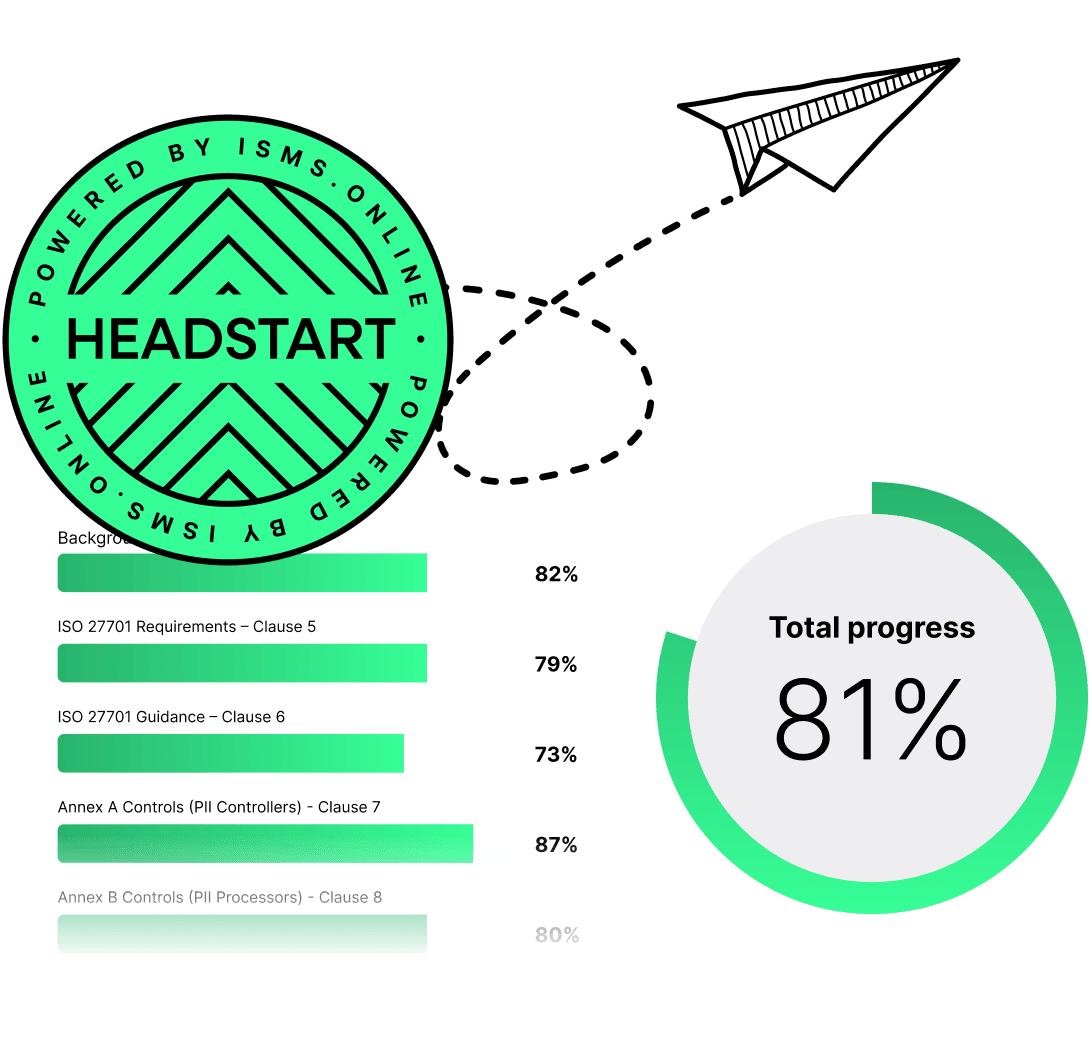
An 81% Headstart from day one
We’ve done the hard work for you, giving you an 81% Headstart from the moment you log on. All you have to do is fill in the blanks.
Why ‘Everyone’s Job’ Usually Means ‘Nobody Owns It’ (and How the Gaps Multiply)
Annex A 5.34 anticipates the real world: privacy risk multiplies when responsibilities diffuse and tools fragment. Most failures-whether it’s a lost laptop or a misfiled SAR-trace back to unclear ownership and unreliable evidence, not ill intent.
The most avoidable privacy risks are the ones no one tracks until it’s too late.
Why Manual Control Falters Under Scale and Scrutiny
If you still track PII protection through scattered checklists, shared folders, and hope, you’re one resignation email or missed handoff away from a compliance storm (Pritesh Biswas). Each additional staff turnover, international partner, or new regulatory regime multiplies the blind spots-especially when evidence lives in silos.
Table: Manual vs. Platform Privacy Controls
| Control Area | Manual/Ad Hoc | Platform-Driven |
|---|---|---|
| Staff training | Outdated Excel, missed logs | Role-mapped, verified sign-offs |
| SARs | Dispersed emails, confusion | Chronological, retrievable event log |
| Policy changes | Email-only notification | Versioned, signature-tracked rollout |
With fragmented systems, an audit will surface not just gaps-but underlying process risks that can, in a blink, ripple out to board, customer, or market level.
How Does Privacy Resilience Rely on Linking Security, Privacy, and AI Controls?
In the 2024 regulatory ecosystem, privacy, security, and AI governance are no longer discrete silos. Your ability to prove privacy protection directly impacts your cyber insurance, cloud contracts, and access to critical markets (IT Governance).
A privacy blind spot is a security risk’s best friend-and a compliance manager’s nightmare.
Why Siloed Tools and Teams Expose You
If your privacy policies live in HR, your authentication logs in IT, and model audits in data science, risk escapes via the cracks. Integration is now survival: unified, linked evidence trails make multi-standard compliance manageable rather than mind-bending (ICO).
Table: Framework Crosswalk (Converged Controls)
| Requirement | Security Tool | Privacy Tool | AI Audit Tool |
|---|---|---|---|
| Access logs | SIEM | DLP/Audit | Model log |
| SAR handling | N/A | Case mgmt | Data map |
| Control proof | IAM/Workflows | Evidence db | Audit trace |
Organisations that build for reuse-mapping one evidence set to ISO 27001, GDPR, and NIS 2-are now pulling ahead, winning deals, and passing audits with much less friction. Those with patchwork tooling keep paying the “compliance tax.”

Free yourself from a mountain of spreadsheets
Embed, expand and scale your compliance, without the mess. IO gives you the resilience and confidence to grow securely.
What Practical Steps Turn Policies from Paper to ‘Proof-on-Demand’?
A policy without a proof path is a risk waiting to surface. Control 5.34 expects live evidence, clear assignment, and the ability to show-without heroic effort-that privacy works in practice. Routine “drills” (board spot checks, customer audits, SARs) shouldn’t require all-hands anxiety.
Proving privacy shouldn’t feel like a special project-it should be built into every workflow.
5 Steps to Actionable Privacy Protection
1. Map Every PII Touchpoint
Identify every place, workflow, and vendor where personal data flows, from HR onboarding apps to forgotten shared drives. Involve process owners from across the organisation (Cyberzoni).
2. Assign and Record Digital Owners
Each key dataset or workflow must have a named owner-digitally assigned, not just on paper. Task systems should track completions, hand-offs, and overdue actions.
3. Automate Audit and Evidence Logs
Move beyond “mark as read” emails. Use systems that automatically record policy signatures, completed SARs, and compliance tasks per person and per process (Pretesh Biswas).
4. Build into Education & Culture
Schedule rolling reminders, periodic “surprise” privacy health-checks, and document visible improvements in staff awareness (IT Governance).
5. Use Platform Loops for Continuous Improvement
Let your compliance system trigger response workflows, pull dashboards, and recommend updates as evidence accumulates.
When these steps are embedded, the moments that matter-regulatory request, internal audit, investor due diligence-go from fire-fight to demonstration of strength.
Why Is Automation Your Best Shield Against Privacy Failures?
Manual privacy management fails at scale and speed. Automation shifts privacy from a high-stress compliance risk to a daily competitive asset. By systemising reminders, escalations, and unbroken audit logs, you not only survive audits but bring new leverage in contract negotiations and regulatory reviews.
When privacy checks run in the background, your team gains room for real work-and proves compliance at a moment’s notice.
Automate the Unreliable, Record the Unmissable
- Offboarding: Automated access removals, with digital logs for proof.
- Record-keeping: Auto-tagging, archiving, and retention policies for every phase of the data lifecycle.
- Acknowledgments: Digital signatures and role-based policy confirmation, tracked by system not memory.
Table: Before and After Automation
| Privacy Step | Manual System | Automated, Proof-Ready |
|---|---|---|
| SAR log retrieval | Search, panic, delay | 1-click dashboard, audit trail |
| Training reminders | Calendar nudge, email | Auto-escalate, report extract |
| Policy update proof | Mass email, unclear | Version-controlled, signature |
Automation flips the script: from hoping the evidence is there to knowing it is-unmissable, timestamped, audit-grade.

Manage all your compliance, all in one place
ISMS.online supports over 100 standards and regulations, giving you a single platform for all your compliance needs.
What Metrics Prove that Your Privacy Programme Actually Works?
You can’t fix what you can’t measure-or improve what remains invisible. Annex A 5.34 expects tangible metrics: evidence that privacy isn’t just maintained, but keeps improving day by day.
Effective privacy is measurable-the best teams boast not only audit success, but year-on-year improvement.
Privacy KPIs that Matter
- SAR handling: Number, average time to closure, and overdue cases.
- Training completion: % of staff signed off, lag time for new joiners.
- Policy engagement: Number of overdue acknowledgments, improvements post-campaigns.
- Incident response: Time from breach to containment/fix.
- Audit findings: Recurrence or resolution time for privacy-related nonconformities (IT Governance).
Boards, buyers, and regulators now expect these metrics to be regularly reported-not just produced under duress when something goes wrong.
Set privacy goals your board can see-then watch engagement, confidence, and business value grow.
How Does ISMS.online Turn Privacy from Liability Into Resilience Capital?
Traditional ISMS tools document controls; ISMS.online goes further: it makes privacy implementation visible, auditable, and business-ready. Every log, approval, incident, and staff action ties back to Annex A 5.34 with proof attached. When your next audit, client, or regulator knocks, the evidence is centralised, structured, and mapped to more than one framework-across ISO 27001, GDPR, SOC 2, NIS 2, and beyond.
ISMS.online bridges privacy, security, and compliance by unifying:
- Control Mapping: One set of logs, controls, and policy acknowledgments serve multiple frameworks and standards.
- Automation: Offboarding, SAR, and DPIA flows run on rails; reminders and escalations are system-triggered, not memory-dependent.
- Visibility and Dashboards: Privacy KPIs, audit trails, and live engagement stats support leadership, audit, and due diligence.
- Continuous Proofing: Policies, logs, and evidence are always up to date-no more “desk drawer” documentation or last-minute panic.
When privacy is part of a living, digitised system-not scattered in emails-your compliance teams sleep better, your boards trust your figures, and your organisation wins tenders that competitors lose to friction and gaps.
Ready to see how audit-ready privacy moves you from defensive to decisive? Upgrade your PII and privacy protection with ISMS.online-where every requirement of Annex A 5.34 becomes a business asset you can prove, improve, and scale.
Frequently Asked Questions
How does ISO 27001:2022 Annex A 5.34 embed privacy and PII protection into daily business operations?
Annex A 5.34 transforms privacy from an annual compliance exercise into an ongoing discipline, requiring every business process, role, and system that interacts with Personally Identifiable Information (PII) to generate live, traceable assurance of protection and stewardship. Today, you’re not just updating a policy for auditors-you’re actively mapping all the places PII lives, documenting rules for handling it, and proving, at any moment, what’s actually happening.
Instead of static paperwork, you’ll demonstrate privacy-in-action: digital registers of data movement, instantly retrievable logs for every access or change, and proof of regular staff training or system reviews. Regulators and auditors expect specific evidence for each data handling task, whether onboarding a new platform, responding to a subject rights request, or terminating an employee’s access.
One overlooked backup or shared spreadsheet can put years of compliance at risk-modern privacy is continuous, verifiable, and role-driven.
Annex A 5.34 expands PII’s scope to include temporary and inferred data, and mandates that ownership and responsibility be clearly assigned, not left to teams or assumptions. Regular reviews, proactive risk updates, and adaptive controls underpin ongoing compliance-making privacy a living habit, not a box-ticking event.
What policies and procedures actually prove compliance with 5.34-and which gaps get flagged by auditors?
Auditors demand tangible links between privacy policy, operational controls, and verifiable system records-anything less ends up as “shelfware.” Being audit-ready isn’t just having policies; it’s about showing ongoing, role-mapped recordkeeping and demonstrable change management.
Core policies and procedures for 5.34 compliance
- Privacy Policy: Details real data collection, use, storage, access, sharing, and deletion practices. Shows evidence these are enacted, not just stated.
- Access Controls: Role-based access assignments, logs of every PII access/change, and alerts for suspicious behaviour.
- Data Retention & Disposal: Written rules and automated evidence of deletion or anonymisation actions carried out on time.
- Subject Rights Handling: Systematic, tracked processing of SARs and other data rights requests, with ownership and closure evidence.
- Incident Response: Documented, timestamped logging of events, proof of notification, and root-cause analysis for each incident.
- Vendor Management: Active records of Data Protection Agreements (DPAs), audit findings, and ongoing vendor oversight.
- Training/Awareness: Digital logs confirming policy training, acknowledgments, and updates tied to staff roles and turnover.
Most common audit failures
- “Orphan” data assets-locations not linked to any owner or risk map.
- Out-of-sync policy and practice (e.g., stated retention, but data persists for years).
- Versions of policies missing dates, signatures, or digital sign-offs.
- Missing or incomplete SAR/incident logs.
- Evidence scattered across teams or systems, with nothing retrievable in a live audit.
How can you operationalize Annex A 5.34 privacy controls for reliable, audit-ready performance?
Proving ongoing privacy compliance means connecting every privacy-critical activity to clear evidence, digital approvals, and traceability-all woven into daily workflows. High-performing teams follow a “privacy loop” that never leaves compliance to chance.
- Map all PII locations: Build an evergreen inventory across databases, platforms, file shares, and cloud services, assigning a specific owner to each.
- Review legal/business obligations: Maintain a current mapping of applicable laws, contracts, and customer commitments for every dataset and process.
- Enforce digital policy management: Version-control all privacy policies, require e-signatures, and automate review reminders.
- Assign and review role ownership: Designate an individual for every process (SARs, incidents, vendor reviews) and document backups.
- Centralise audit evidence: Use an ISMS or compliance platform to log every policy review, access event, training session, and approval.
- Automate renewals and alerts: Rely on workflows to send sign-off reminders, update tasks, and escalate lapsed controls, not manual calendaring.
- Test, simulate, improve: Run quarterly privacy drills (SARs or breaches), log outcomes, and update controls based on real findings.
- Continuously update: After any audit or incident, review and enhance documentation, controls, and responsibilities to close the feedback loop.
Treat every privacy task like a dry run for an audit and you’ll never be caught off guard.
Which forms of evidence satisfy auditors under 5.34, and what documentation risks rejection?
Auditors now require timely, centralised, and digital evidence-paper folders and static spreadsheets rarely make the grade. You must be able to instantly produce activity logs, signed policies, training completions, and proof your controls operated as intended.
Examples of acceptable evidence
- Version-controlled privacy policies with digital sign-offs and regular review timestamps.
- Access logs proving who accessed, changed, or deleted PII, with investigation notes when anomalies appear.
- Central registers for SARs, incidents, and privacy requests, with dates, handlers, and final outcomes.
- Staff training logs-role-specific, time-stamped, with digital acknowledgments and refresh schedules.
- Vendor due diligence files: contracts, DPAs, and recorded ongoing checks or audits.
- Drill reports and simulation logs confirming regular operational testing of privacy processes.
Common “non-conformity” documentation
- Spreadsheet-only inventories or sign-off logs with no audit trail.
- Policies lacking dates, signatures, or version control.
- Email evidence instead of platform-logged approval, completion, or incident documentation.
- Role responsibilities assigned only to job titles or groups, not specific individuals.
- Scattered or duplicative evidence sources that can’t be consolidated during audit review.
A single missing policy version or ownerless asset can trigger a finding if it hints at wider governance or accountability gaps.
What silent pitfalls most often undermine 5.34 compliance-and how do you systematically close them?
Most failures result from hidden bottlenecks-assets without owners, policies that never get updated, team-wide “ownership,” or training that doesn’t adapt to workforce changes. Spot these before auditors do by operating with proactive vigilance.
Common pitfalls and proactive defences
- Unmapped PII assets (“orphan data”): Run data discovery tools, reconcile with asset inventories, and explicitly assign/upkeep owners quarterly.
- Policy staleness: Automate review workflows with version-controlled signoffs, triggered reminders, and escalation for overdue updates.
- Ambiguous ownership: Individualise every process owner (with visible backups); don’t default to “the team” or “Compliance.”
- Vendor sprawl or neglect: Use a vendor register to track DPAs, audit certifications, and monitor contract renewals or due diligence dates.
- One-off or expired training: Schedule regular, tracked privacy awareness training, and keep logs linked to each staff role and start/end date.
- Evidence spread and audit panic: Consolidate all evidence logs, approvals, and training outcomes into a searchable ISMS or compliance system.
Strong privacy programmes surface and address these issues in daily operation-not under audit stress. Vigilance beats volume every time.
How does ISMS.online serve as a “living” control centre for ISO 27001:2022 5.34 privacy compliance?
ISMS.online is designed to transform privacy from static compliance into a confident, daily operational habit. Every policy, process, action, and training outcome is seamlessly logged, versioned, and mapped to real people-not just teams-with reminders, expiry alerts, and escalation built in.
Privacy evidence is consolidated in one place: from SARs and breach logs to vendor agreements and audit trails, all are instantly exportable on request. The platform’s digital signature, policy management, and workflow automation mean no sign-off, asset owner, or training record can be missed or lost. Integration with other frameworks (ISO 27701, GDPR, NIS 2) lets you scale privacy assurance as legal and business requirements grow.
If you want privacy controls that simply work-delivering evidence, ownership, and confidence at every turn-align your operations in ISMS.online. It turns every audit, board query, and regulatory test into an opportunity to demonstrate not just compliance, but resilience and leadership.






