





































Why Secure SDLC Is Where SaaS Growth, Trust, and Audit Resilience Hinge
Every ambitious SaaS company, whether chasing ISO 27001:2022 or the next enterprise contract, faces a pivotal test: can you prove, right now, that your development lifecycle is truly secure-and not just a paper exercise? For a long time, “secure SDLC” was something leaders nodded at in boardrooms, then filed away under “future best practice.” That era is gone.
Increasingly, secure development lifecycle (SDLC) evidence is non-negotiable for buyers, investors, auditors, and regulators. This isn’t just compliance rhetoric: it’s now a critical gate in every B2B procurement, recurring audit, and even routine vendor review. The real market distinction? Companies who treat secure SDLC as “just another policy” are peaked and plateaued. Growth leaders place operational trust at the heart of their SDLC, demonstrating security-by-design not only to auditors, but-more critically-for customers and partners with their growth on the line.
Audit evidence is the bare minimum. True trust comes when your SDLC is visible, not invisible.
The underlying pain is no longer abstract: procurement teams will pause deals or diminish you in vendor scoring if your secure SDLC “proof” is just a doc gathering dust. Investors increasingly want to see how you operationalize control-not just declare it. And with more buying committees scrutinising your privacy and legal stance, questions about how you “build trust into every product cycle” become existential.
If you keep secure SDLC as a static, top-down policy, you’re betting against the direction of SaaS buying and regulatory scrutiny. But shifting to a living, evidence-driven model-auditable, transparent, and role-attributed-turns compliance into a lever for speed, trust, and lasting growth tension.
What Auditors, Customers, and Regulators Want from 8.25-and Why Each Perspective Redefines “Good Enough”
As you prepare to “show your work” for ISO 27001:2022 Annex A 8.25, it’s vital to calibrate not only what you do, but for whom you’re doing it. Audit success is no longer a solo performance; it’s a multi-voice, multi-modal proof for auditors, buyers, privacy watchdogs, and legal.
Auditors are explicit in their ask: show live, time-stamped, role-attributed evidence that security-and now privacy-runs through your entire development process. Nothing less. If a process or policy isn’t reflected in real artefacts-code reviews, security test logs, signoff trails-expect deep probing and possible action items.
For practitioners, this means more than a checklist; it’s about building a pipeline where every key SDLC milestone captures real evidence. If your pipeline doesn’t routine-log peer reviews, security fixes, and privacy checkpoints, your “good enough” just slipped into future audit risk.
The ask isn’t ‘Did you consider security?’ but ‘Is every decision and control recorded, attributed, and ready for a random audit?’
For legal and privacy leads, the bar rises further. Privacy-by-design (GDPR Article 25), documentation of Data Protection Impact Assessments (DPIAs), and explicit links to security controls (ISO 27701) are now folded into the SDLC fabric. This means that your SDLC evidence must show both the technical decisions and the privacy rationale that underpins each release.
Today’s SDLC “good enough” is a data-rich, traceable environment where security and privacy sign-offs are layered and real-an environment buyers, regulators, and auditors now expect as baseline.
ISO 27001 made easy
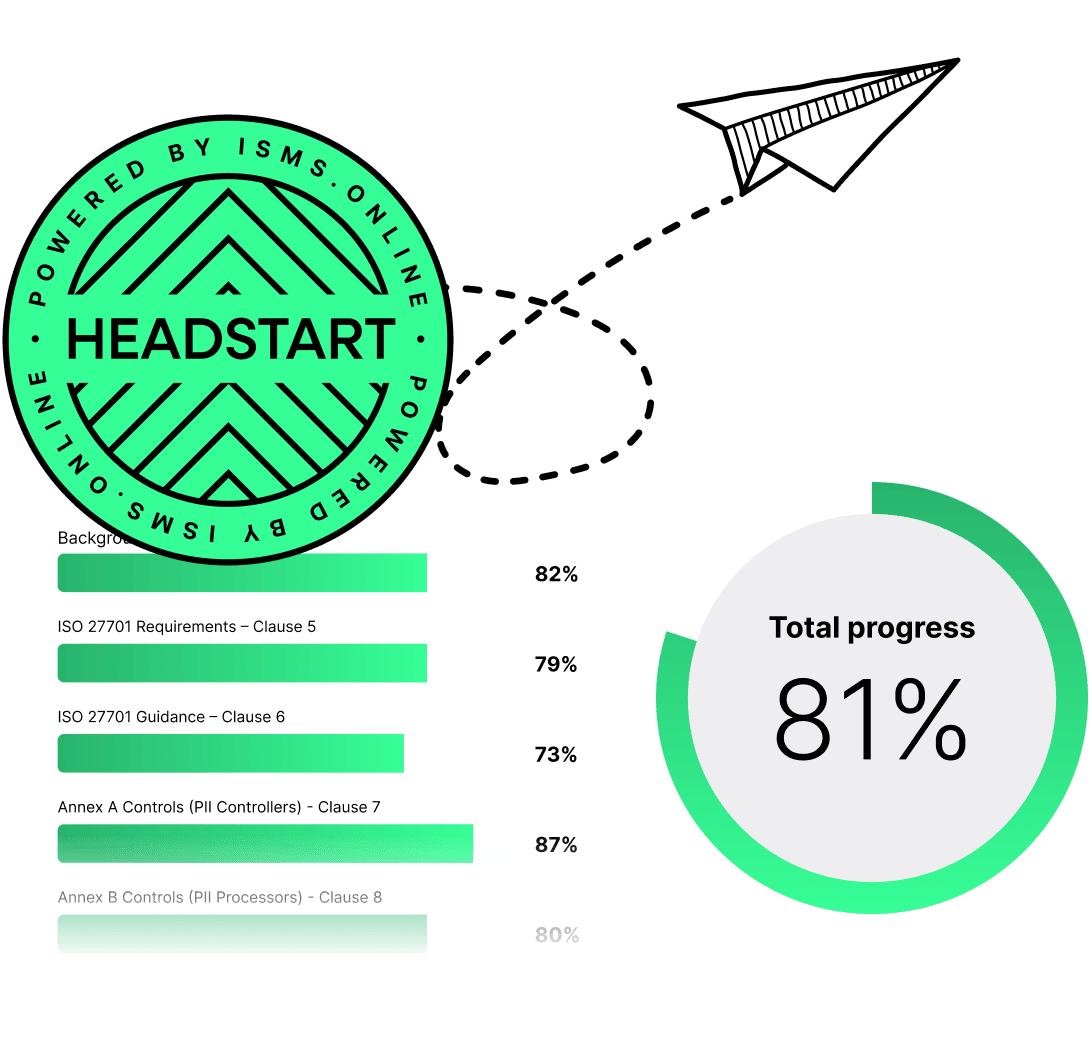
An 81% Headstart from day one
We’ve done the hard work for you, giving you an 81% Headstart from the moment you log on. All you have to do is fill in the blanks.
How “Proof” for 8.25 Survives Audit Day: Artefacts That Pass (and Failing Patterns That Sink You)
When the moment comes-an auditor, buyer, or regulator wants concrete proof of your secure SDLC-will you scramble or lead? The difference is always down to records that are time-stamped, role-attributed, and mapped against each SDLC phase. What passes the audit reality test isn’t storey, but operational substance.
What Actually Gets Accepted?
For practitioners:
- Code review logs with linked comments, IDs, time and date stamps-showing real peer engagement (not cursory “approved” rubberstamps).
- Security test result logs directly tied to user stories or tickets.
- Automated pass/fail results for security tests, with evidence of follow-up on failures.
For CISOs and Security Leaders:
- Audit-ready deployment logs: who moved what code, when, and which controls were checked.
- Risk reviews and sign-offs tracked as part of the change management workflow.
- Internal audit or incident investigation records linked to specific SDLC events.
For Privacy and Legal Officers:
- DPIA/PIA logs with privacy leader signoff.
- Privacy risk mitigations mapped to controls and recorded as accepted/rejected.
For all personas:
- End-to-end signoff chains embedded in workflow tools-not isolated PDFs.
- Lessons learned and retrospectives logged, time-stamped, and owned.
Fail Patterns That Sink Audits:
- Gaps where evidence is “filled in later” or logs aren’t assigned to a phase.
- Reliance on unsigned artefacts and static documents with no version control or author attribution.
- Inconsistent mapping between your risk register, controls, and SDLC activity logs.
Audit surprise? A process that surfaces role-based, signed artefacts is your firewall against last-minute burn-out.
A simple rule: If an artefact can’t be produced live, attributed, and versioned, it will eventually fail a real audit-so design for evidence retrieval, not plausible deniability.
What a Secure SDLC Looks Like in Practice – Real-World Workflows for Every Persona
Words and policies are cheap. Real secure SDLC shows up in the daily functioning of your team, dashboarded for everyone from developer to privacy lead. The days of static checklists are done; maturity now means every SDLC phase is “prove or pause,” not “bluff and barrel through.”
Picture this: a live pipeline dashboard, lit up with green when signed artefacts are in place and visible yellow/pink status if something’s missing. Every gate-requirements, design, dev, test, deployment-holds for sign-off from security and privacy before moving forward.
“`
SDLC Security Privacy Owner Status
Requirements ✔ ✔ Alice(PM) Complete
Design ✔ ✔ Bob(Arch) Needs Review
Development ✔ ❍ Chen(Dev) In Progress
Testing ✔ ✔ Dana(QA) Complete
Deployment ✔ ❍ Leon(Ops) Pending
Retrospective ✔ ✔ Eva(Audit) Scheduled
“`
✔ = artefact logged; ❍ = pending.
Embedded Security & Privacy-by-Design Habits
- Kick-off: No project starts until security/privacy have signed off on requirements, including documented threat models and PIAs.
- User Storey/Sprint Planning: Each ticket carries security/privacy acceptance criteria-gated by defined tests and peer review.
- Development/Code Review: Peer signoffs are logged, security testing is automated, and blockers for failed checks are non-negotiable.
- Testing/Deployment: Automated security/privacy test logs prompt review by diverse stakeholders; go-live is conditional on all artefacts being linked.
- Retrospective: Continuous improvement mapped into SDLC tools; lessons learned become new controls, not “nice-to-haves” on a Confluence page.
When everyone sees their responsibility and sign-off status in one dashboard, security by design becomes daily reality, not CISO wishful thinking.
Enable this environment and your SDLC is no longer guessing at compliance-it broadcasts assurance in real time to your internal and external audiences.

Free yourself from a mountain of spreadsheets
Embed, expand and scale your compliance, without the mess. IO gives you the resilience and confidence to grow securely.
Where Secure SDLC Breaks Down-and How to Engineer Evidence That Outlasts Turnover
Lapses in secure SDLC rarely come from malice. Instead, they trace back to a lack of ownership, backup, and workflow rigour. In a regime where audits slap firms for “unsigned” or missing evidence, the potential for damage is high.
Critical weak points:
- No assigned stewards: Compliance entrusted to a single developer or manager-a recipe for missed artefacts when roles rotate or holidays hit.
- Handovers out of band: Knowledge passed in DMs or unsaved files, leaving audit trails broken.
- PDFs, emails, or isolated files: These do not auto-version or record sign-offs. Only workflow-integrated artefacts provide durable evidence.
- Unattributed or unsigned records: These are instantly suspect to auditors and can break legal defensibility.
High-Resilience Upgrades:
- Assign “evidence stewards” *as roles* throughout the SDLC, with permanent backups.
- Automate reminders and require dual signoff for high-risk steps or when people are out.
- Mock audits quarterly-use feedback to stress-test your evidence retrieval.
- Recognise teams who maintain evidence volume and attribution; incentivise vigilance as a performance driver, not bureaucratic penalty.
In the end, audit resilience is built not just on documentation, but on active evidence management and continuous improvement.
Operationally, the gold standard is a system where, if someone leaves, the workflow does not lose history, ownership, or defensibility.
How to Map SDLC Evidence Across ISO 27001, GDPR, GMP, SOC 2, and NIS 2-Without Drowning in Work
Different standards, common threads: the unique crosswalk for Annex A 8.25 is making one set of artefacts satisfy multiple auditors, lawyers, and buyers. If you build compliance for “just ISO” or “just privacy,” you double effort and halve utility.
Standards Crosswalk Table (Artefact-centric):
Every artefact below, if designed once, supports all four pillars:
| Evidence Type | ISO 27001 8.25 | GDPR Art.25/30, ISO 27701 | GMP/SOC 2/NIS 2 |
|---|---|---|---|
| Secure SDLC logs | **Required** | “Privacy by design” proof | **Required** |
| Design/code reviews | Sign-off mandatory | PIAs & risk assessments | QA/risk evidence |
| Security tests | Traceable & mapped | Data protection test results | Control sufficiency |
| Approval/signoffs | Tracked at each gate | Privacy/data approvals | Production/QA ok |
| Audit trail (access) | Required | Review who saw what, when | Regulatory checks |
| Retention records | Controlled by SoA | Retention schedules, DSAR | Retention/policy |
Table intro: A unified set of artefacts, mapped once, carries you through every major third-party and regulator audit.
For CISO/Privacy leads, design these artefacts to reflect both the technical (SDL) and privacy (PIA, retention) dimensions, so that downstream audits or supplier questions never blindside your compliance posture.

Manage all your compliance, all in one place
ISMS.online supports over 100 standards and regulations, giving you a single platform for all your compliance needs.
Making SDLC Evidence Durable: Assigning, Automating, and Navigating Change as a Team
Staff turnover, new frameworks, and shifting responsibilities are inevitable. Secure SDLC resilience is achieved through unambiguous assignment, routine reminders, and workflow automation. Your “evidence engine” shouldn’t grind to a halt because one person moves on or roles pivot.
Checklist for Lasting Resilience:
- Enforce primary and backup artefact owners for each SDLC checkpoint.
- Automate signoff reminders and overdue task notifications; use tools, not emails.
- Make dashboards with RAG (Red-Amber-Green) scores available day-to-day.
- Hold quarterly “pre-audit drills” and connect readiness to incentive frameworks, not just panic-fueled pushes.
- Review and update escalation contacts-stale routing always delays proof production.
You future-proof your SDLC by putting handover, accountability, and evidence visibility at the heart of your workflow-never as an afterthought.
With this operational backbone, your team is not only ready for expected audits but resilient to change and disruption-making compliance consistency your competitive edge.
See Your Secure SDLC Unlock Growth, Proof, and Confidence-ISMS.online as Your Resilient Engine
A secure SDLC today does much more than prove compliance for auditors-it earns trust, unblocks revenue, and hardens business reputation. With ISMS.online, you operationalise secure SDLC at every turn: setting up fast, tracking progression, unifying evidence, and surfacing resilience to every stakeholder (isms.online).
What you unlock:
- Quick-start templates: for every major standard-Annex A 8.25, GDPR/ISO 27701, SOC 2, NIS 2-mapped precisely to each checkpoint.
- Live dashboards: cascading visibility from developer to privacy lead, through to board and external auditor-assuring nothing slips through the cracks.
- Automated evidence capture and workflow orchestration: -logs, approvals, reviews, renewals are all documented and surfaced instantly for audit sampling or supply chain requests.
- Unbroken proof chains: -your “good habits” become provable artefacts, always ready for that procurement, investor, or regulator query.
Build your compliance system so robustly that it inspires confidence in auditors and investors-and keeps doors open to your biggest deals.
If you’re ready to unlock real growth and risk resilience, don’t just add another policy. Request your Secure SDLC Checklist now and see how ISMS.online can turn your compliance practices into business momentum-empowering you, your team, and your next big win.
Frequently Asked Questions
Who is accountable for secure SDLC compliance under ISO 27001:2022 Annex A 8.25?
Accountability for compliance under Annex A 8.25 is distributed along a defined chain of responsibility from senior leadership to operational teams, with each stakeholder mapped to precise duties at every development phase.
Executive leadership or the ISMS owner sets policy direction, resourcing, and oversight. Project managers-or product owners-coordinate implementation, ensuring that for every SDLC phase (requirements, design, test, release), there is a clearly named artefact steward and a designated backup. Developers, QA teams, and engineers execute secure practices daily, while compliance or information security teams monitor evidence, ensure ongoing process alignment, and manage pre-audit readiness. Documenting this ownership-ideally in a RACI matrix or live workflow register-demonstrates to auditors that secure development is a “living” function, not a paper checklist.
When every team knows exactly who owns what at each SDLC milestone, secure development shifts from a shared myth to a continuous business habit.
Role assignments across key SDLC phases
| SDLC Phase | Accountable Role | Typical Artefacts |
|---|---|---|
| Requirements | Project/Product Owner | Security criteria, storey logs |
| Design/Build | Lead Developer/Engineer | Review logs, threat models |
| Test/Release | QA Lead/Release Manager | Test records, sign-offs |
| Ongoing Ops | ISMS/Compliance Manager | Audit trails, role audits |
What evidence do auditors expect for Annex A 8.25 secure SDLC compliance?
Auditors look for evidence generated “in the flow”-digital artefacts created as teams work-not rushed, after-the-fact paperwork.
Required evidence includes:
- Code and design review logs: with collaborators, timestamps, and resolution records.
- Security test outputs: , such as automated static/dynamic scan results (SAST/DAST), manual test reports, and their linkage to requirements.
- Approval and sign-off trails: naming exactly who approved changes and when, with supporting risk or impact documents.
- Release and change/deployment logs: from ticketing or CI/CD systems, showing signed digital decision points.
- Data privacy artefacts: like DPIAs or evidence of regulatory processing, where relevant.
Auditors will always favour logs from systems like Jira, GitHub, or Azure DevOps, verifying that controls are part of the lived workflow-not static PDFs or out-of-date folders. Artefacts that lack dates, signatures, or clear traceability raise the risk of a nonconformity.
Digital traceability-directly in work tools-is what turns passive records into audit-proof evidence.)*
How can Agile or DevOps teams ensure Annex A 8.25 compliance without slowing delivery?
Security should be part of everyday development, not a conflicting overhead. Agile and DevOps teams succeed at compliance by turning routine work into living evidence:
- Add security acceptance criteria and “abuser stories” to user stories or backlog items.
- Treat PR (pull request) reviews, backlog transitions, and automated pipeline logs as right-sized audit artefacts.
- Integrate SAST/DAST scans into CI/CD; let their results serve as test stage evidence.
- Summarise key security events or lessons learned in each sprint retrospective-these “retros” directly prove improvement.
- Automate reminders, reviews, and approvals inside platforms your team lives in (e.g. Jira, Azure DevOps).
This integration means audit traces accumulate naturally, so you never scramble at the end or duplicate work. Auditors increasingly endorse this approach, respecting compliance functions “baked into” modern delivery pipelines.
Compliance isn’t a brake on Agile velocity-when built into team practices, it removes last-minute friction.
Tips for integrating Agile controls
- Use ticket tags or statuses to flag stories needing security review.
- Rely on automatically captured logs over human-generated reports.
- Deploy dashboards to maintain a live compliance health snapshot.
What are the critical pitfalls and best practices for documenting Annex A 8.25 compliance?
Pitfalls to avoid:
- Leaving responsibility unassigned (or vague, as “everyone’s” job).
- Relying on manual, unsigned, undated, or non-searchable evidence.
- Isolating records in personal folders or outside primary workflow tools.
- Treating security steps as an “afterthought” versus phase-by-phase discipline.
- Publishing policies with no clear artefact linkage.
Operational best practices:
- Assign primary and backup artefact stewards per SDLC phase, and rotate quarterly.
- Build evidence capture into ticketing/code-review/CI tools, not as side tasks.
- Trigger automated peer reviews and checklists at each milestone-not ad hoc.
- Use real-time dashboards to spot missing sign-offs or overdue artefacts.
- Maintain a unified, cross-framework artefact register so a single piece of evidence supports multiple needs.
Leading teams internalise compliance as a continuous process, not just an audit scramble. A live, role-mapped artefact register is invaluable-see the (https://gdpr.eu/checklist/) for practical framing.
Which SDLC artefacts can support ISO 27001, GDPR, SOC 2, NIS 2 audits-and how do you optimise for reuse?
A thoughtfully mapped SDLC means most of your digital artefacts automatically satisfy multiple regulatory demands with little extra effort:
- SDLC/change logs: tick ISO 8.25, GDPR Art. 30, SOC 2, and NIS 2 traceability boxes.
- Review/approval trails: fulfil security, quality, and privacy accountability for ISO, SOC 2, NIS 2, and GMP contexts.
- Test and scan results: back up both security and privacy requirements.
- Retrospective and improvement notes: align to ISO’s “continual improvement” and SOC 2’s monitoring obligations.
- Sign-off/checkpoint records: are universally required-embedding digital approvals within workflow tools accelerates audits.
To maximise cross-standard value, maintain an artefact matrix: a live, standards-linked register within your main dev/project tools. Each artefact entry should reference the frameworks it supports, transforming your evidence base into a multipurpose asset.
See Microsoft’s (https://learn.microsoft.com/en-us/security/engineering/secure-development-lifecycle) for practical examples.
Table: Key SDLC Artefacts and Audit Coverage
| Artefact Type | ISO 27001 8.25 | GDPR Art. 30 | SOC 2 | NIS 2 |
|---|---|---|---|---|
| SDLC/change log | ✓ | ✓ | ✓ | ✓ |
| Code review logs | ✓ | – | ✓ | ✓ |
| Test/release logs | ✓ | ✓ | ✓ | ✓ |
| Retrospective notes | ✓ | ✓ | ✓ | ✓ |
How do you maintain compliance and audit readiness during turnover or rapid growth?
Sustainable compliance is process-driven, not individual-dependent. To protect audit readiness in the face of team changes:
- Dual-assign all artefact stewardship, and review assignments at least quarterly.
- Automate sign-off workflows, reminders, and task trackers to reduce risk of neglected evidence.
- Run mock audits and evidence health checks regularly, ensuring gaps are found before a real audit.
- Bake compliance completion metrics into performance reviews-a living KPI, not a one-off event.
- Store all approval and review records in shared, version-controlled platforms, securing evidence against local loss.
By treating digital artefacts-and their ownership-like relay batons, you guarantee that no single departure or reorg undermines audit resilience.
Your SDLC should handle every handoff like a world-class relay-compliance never breaks, no matter who’s on the team.
Ready to strengthen your secure development lifecycle and breeze through audits? Map clear responsibilities, automate artefact capture, and cross-link evidence to every major standard-transforming compliance from an anxiety to an asset.






