





































Why Delaying Application Security Is the Costliest Mistake You’ll Make
Pausing on application security until after the code is written or updates are rolled out is a sure recipe for mounting risks and surprise audit headaches. It’s not just a technical detail-delaying security integration increases operational risks, slows procurement, and can undermine your team’s credibility with buyers, auditors, and the board alike. Gartner found that by 2025, half of all organisations will suffer breaches linked to late security in the development pipeline. ISO 27001:2022 Annex A 8.26 no longer views security as an afterthought. Instead, compliance now expects you to embed security requirements during every step-from design and procurement to deployment and maintenance. The latest NIST SP 800-218 guidance mirrors this best practice: security must be woven into your product’s lifecycle, not tacked on after delivery.
You’re not protecting just software-you’re safeguarding every deal, every reputation, every growth plan.
When teams integrate security from the earliest planning phases, they sidestep costly surprises and show auditors a culture of proactive, record-ready discipline. Platforms like ISMS.online are designed for this era: centralising updates, automating documentation, and ensuring that everyone from developers to business leaders can see and prove security steps-no more scattered spreadsheets, lost emails, or late-night scrambles (isms.online). Think of every day’s delay as an opportunity for attackers, or a reason for an audit query-don’t give them either.
The best way to pass every audit is to never have to scramble for proof at the eleventh hour.
What’s the True Business Value of Getting Application Security Right-Now?
Application security, once treated as a compliance checkbox, has become a lever for business trust. Risk committees, procurement teams, and sales leaders increasingly prioritise evidence of robust, continuous security. When you adopt security requirements early, you don’t just avoid negative audit findings-you accelerate deal cycles and establish confidence with enterprise buyers. Forrester reports that integrating security up front can shorten procurement by 35% and cut audit findings by a third (forrester.com; isaca.org).
Your buyers and auditors no longer settle for attestations-they want to see evidence flow as part of daily operations.
ISMS.online’s centralised evidence dashboards let you and your stakeholders see progress in real time. Instead of cobbling together proof during live fire drills, you show a living, breathing record of your security implementation and operation. This doesn’t just reassure the auditor; it builds a reputation with partners that security is not a cost, but a value driver.
When procurement, security, IT, and compliance teams all log in to the same dashboard, your audit isn’t an annual panic-it’s a rolling business asset.
A platform that unites security and business leaders accelerates every commercial conversation.
ISO 27001 made easy
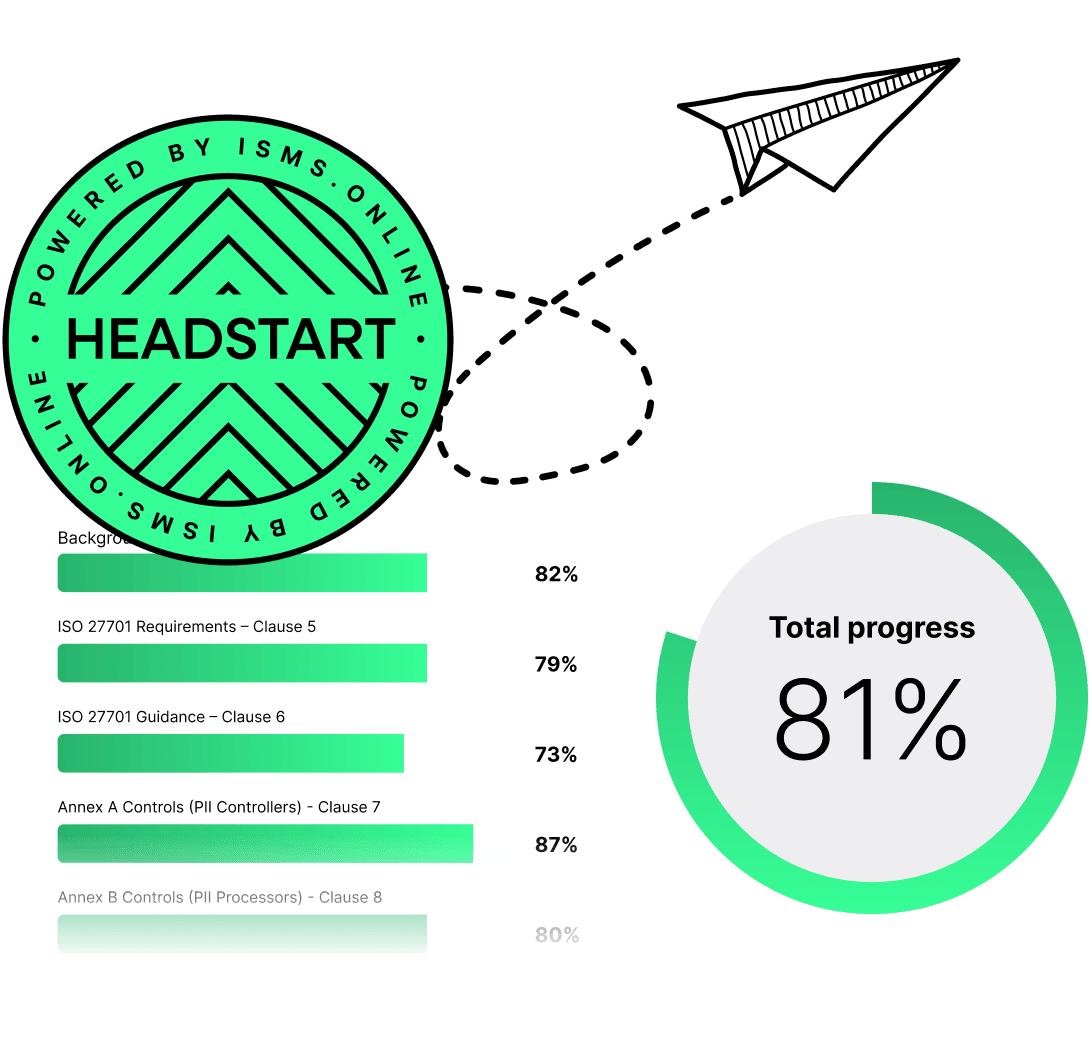
An 81% Headstart from day one
We’ve done the hard work for you, giving you an 81% Headstart from the moment you log on. All you have to do is fill in the blanks.
Why Technical Debt Grows When You Ignore Security Debt
Security shortcuts and deferred fixes always create more work and risk down the line. The cost to resolve vulnerabilities grows exponentially when not addressed early-fixing a defect in design might cost $80, but patching after release averages $7,600. Despite this, the Veracode State of Software Security finds that nearly 90% of vulnerabilities remain unpatched for months.
| Security Missed | Short-Term (Pain) | Long-Term (Risk) |
|---|---|---|
| Requirements skipped | Rush during sprint | Audit findings multiply |
| Delayed patching | Minor disruptions | Increasing exploit risk |
| Evidence scattered | Last-minute panic | Repeat audit failures |
Left unaddressed, every shortcut creates risk that one day will need repayment-with interest.
Modern frameworks such as NIS2 and ENISA now expect continual risk reviews, not just annual check-ins (enisa.europa.eu). The ISMS.online platform bakes reminders and tracking into your workflow so that nothing slips through the cracks. Every security issue becomes a managed, trackable task, not a forgotten timebomb (isms.online).
“The quickest audit fix is never needing a major fix. Reduce your backlogs by fifty percent with issue-tracking that closes the loop.”
How to Tailor Application Security Requirements: Move Past Checklists for Real Protection
Superficial checklists pass only the most cursory audits and create openings for failures down the line. True resilience means aligning controls to the unique risks your application faces. ISO 27001:2022, ENISA, and OWASP all call for tailored security controls based on what the application does, who its users are, and the sensitivity of its data (owasp.org; enisa.europa.eu; iso.org). Generic coverage leaves holes; specificity creates resilience.
| Portal Handling Personal Data | Internal Automation | Third-Party Integrations |
|---|---|---|
| Encryption & pen testing | Access limitation | API review, SLA enforcement |
| User trust = sales velocity | Zero post-audit rework | Faster onboarding, fewer issues |
In ISMS.online, you can map system features to threat models, assign discrete controls, and link them to live risk registers and compliance artefacts. Instead of defending every control equally, focus your energy where real business risk lies.
Protect what matters, prove what’s needed, and shrink the audit surface-specific controls, not bloated spreadsheets.
Always consult a skilled practitioner or domain expert when tailoring security requirements, especially for regulated applications such as those in finance or health.

Free yourself from a mountain of spreadsheets
Embed, expand and scale your compliance, without the mess. IO gives you the resilience and confidence to grow securely.
Why Team Engagement and Security Mindset Are Your Best Audit Insurance Policy
No matter how strong your security policies are, ignoring team engagement will always undermine your compliance efforts. Research shows that when security is championed beyond checklists, teams are up to 90% more likely to consistently comply with best practices. The secret? Make security part of daily routines, not annual events: scenario-based micro-trainings, live reminders, and accessible dashboards outperform static training by 2-to-1 (atlassian.com; proofpoint.com).
Engagement isn’t a side task-it multiplies the effect of every control.
ISMS.online lets risk owners and system leads assign accountability, link staff engagement to control effectiveness, and track completion rates in real time. Teams see how their work appears during audits, making training relevant, not abstract.
“Show staff that security actions are tracked and recognised-they’ll build better habits, and your audit gap will shrink.”
What Secure Coding and Testing Look Like When Done Right-And Why It Matters
Security must be a built-in feature of your development and deployment process, not just a bolt-on. 80% of production defects are caught by rigorous code review and continuous automated security checks (bsimm.com; github.blog). With supply chain and dependency attacks on the rise, auditors and sales committees want not just policies but real proof: code commit histories, test results, deployment logs.
Each secure deployment is a trust signal to your board and your buyers.
Platforms such as ISMS.online integrate seamlessly with modern coding and deployment pipelines. Link every code review, automated test, and deployment activity directly to application security requirements and audit evidence (isms.online). This level of discipline builds a chain of trust from developer to CFO, letting you prove not just intent, but action.
“Secure builds, tested code, automated approvals-every control is connected, traceable, audit-ready.”

Manage all your compliance, all in one place
ISMS.online supports over 100 standards and regulations, giving you a single platform for all your compliance needs.
Why Continuous Evidence Collection Isn’t Optional Anymore
Running around for screenshots, scattered approval emails, and mismatched spreadsheets is not just inefficient-it’s a genuine risk. Auditors and risk managers are stepping up expectations: continuous, centralised audit evidence is now the norm, lowering prep time and reducing audit findings by up to 50% (bsi-group.com; icaew.com).
The faster you can prove a control, the stronger your reputation with buyers and auditors.
With ISMS.online, documentation, change approvals, control implementation, and testing results live in a single dashboard-secure, searchable, exportable. The workflow is transparent: requirements, risk assignments, testing and audit sign-off-no more “did we capture that?” embarrassment.
- Document the control
- Assign a clear owner
- Schedule and capture validation tests
- Support auditor sign-off
- Export live reports instantly
“Don’t let last-minute fire drills define your audit season-continuous visibility means no surprises, only confidence.”
How a Continuous Improvement Culture Unlocks Security & Growth
Security and compliance maturity cannot stand still. As new threats emerge and standards evolve, organisations with sustained review and re-set cycles thrive-seeing compliance workloads drop by 40% and business metrics outperform by 22% (securityforum.org, grc20.com). Quarterly or monthly improvement cycles, built on live workflow and evidence dashboards, mean that every gap becomes an opportunity-and every win is visible to both auditors and executives.
- Review controls and risks regularly
- Update policies as threats and operations change
- Assign and complete improvement actions
- Leverage workflow automation for delivery and reporting
- Benchmark progress every annual cycle
Growth-focused security isn’t about policing; it’s about enabling better, faster, more reliable business outcomes.
ISMS.online steers your improvement process-not just tracking gaps, but making improvement cycles visible and collaborative. That’s how you transform security from a checkbox to a business accelerator.
“Show your board the value of improvement cycles-tie every security action to measurable business benefits.”
From Compliance Anxiety to Leadership: Why ISMS.online Turns Security into a Competitive Advantage
Many teams still treat ISO 27001 Annex A 8.26 as a burden-an obligation marked by late nights, anxious waits for auditor reviews, and hope that nothing critical was missed. Yet true leaders in compliance flip that script, using next-gen compliance platforms to give their business the dual advantage of speed and credibility. ISMS.online streamlines the process: every requirement, owner, approval, and real-time report is logged, tracked, and export-ready, cutting panic and multiplying business confidence (isms.online; techtarget.com).
When clients, auditors, or executives want proof, you’re not scrambling-you’re sharing a dashboard of dependable results.
Embracing ISMS.online means your security narrative shifts from reactive compliance to proactive trust and leadership. If your competitors are still stuck in panic mode, it’s the strongest signal that you’re ahead.
Ready to put audit pressure behind you? Take the next step: empower your team, support control owners, and link every action to measurable success. Security, trust, and growth-locked in for every future release.
Frequently Asked Questions
Who holds ultimate accountability for ISO 27001:2022 Annex A 8.26, and how should application security ownership be formalised?
Every critical application or information system governed by Annex A 8.26 must have an explicitly named “application security owner”-someone with authority to define, approve, and regularly update security requirements for that asset. While security is truly a team sport-development, operations, compliance, procurement, and business stakeholders all share responsibilities-it is the presence of a single accountable owner per system that prevents oversight gaps and satisfies auditors. For in-house apps, this owner might be an Information Security Manager, Product Owner, or Lead Engineer; for SaaS and vendor-managed systems, it could be a Procurement Lead or assigned SaaS administrator. Developers and DevOps teams are the primary implementers and documenters of specific controls, while compliance or risk leaders steward review cycles, evidence linking, and periodic role reassignment as projects evolve. Procurement teams enforce contractual security requirements downstream. All these assignments must be clearly recorded within your ISMS (for example, ISMS.online), reflected in onboarding checklists, ownership tables, and evidence repositories-then reviewed at each business or system change.
Application Security Accountability Matrix
| Role | Core Responsibilities |
|---|---|
| AppSec Owner | Define, approve, and review requirements; maintain primary evidence |
| Developer/DevOps | Implement and document controls, respond to audit requests |
| Compliance/Risk Lead | Oversee periodic review, connect controls to business risk, update register |
| Procurement/SaaS Lead | Enforce supplier controls through contracts and onboarding |
| Internal Audit | Validate ownership, evidence traceability, and continuous review |
Assigning a named, empowered owner for every business-critical application is your first shield against audit surprise and security drift.
What documentation and evidence secure a clean ISO 27001 8.26 audit outcome?
A successful 8.26 audit hinges on your ability to prove, with living documentation, that application security requirements are business-specific, kept current, reviewed regularly, and fully traceable from risk through approval, implementation, and test. Begin with a tailored Application Security Requirements Policy-avoiding generic templates-and an application register mapping each system to its risk profile, chosen controls, and rationale for any deviation or exception. Approvals, changes, and exception handling should be signed-off by name and date. You’ll need robust evidence chains: code review records, SAST/DAST scan results, penetration test reports, remediation logs, and internal ticket closures. For third-party and SaaS apps, include contract annexes, supplier-provided attestations, and ongoing monitoring documentation. Training records (completion dates, agendas, and learning objectives for Dev, Ops, compliance, and business) are essential, as are workflow exports from your ISMS-showing who proposed, approved, and refreshed requirements at each review. Auditors now expect digital traceability and quick retrieval. Centralise all these records, link them in dashboards or registers, and periodically test your ability to produce a requirement’s “birth to sign-off” trail within minutes, not hours.
Audit-Ready Evidence Checklist
- Custom, business-mapped AppSec Policy
- Register linking each app/system to risks and controls (plus rationale)
- Review, exception, and change logs (named, timestamped)
- Security testing outputs (SAST/DAST, pen-test, code review, fixes)
- Supplier contract/attestation docs for SaaS/external assets
- Training logs (dates, attendance, curriculum)
- ISMS platform exports showing audit trail, approvals, register changes
Nothing reassures an auditor faster than presenting a requirement’s origin, approval, and test result in a single view.
How can Agile and DevOps teams embed 8.26 security requirements without losing delivery speed?
Well-integrated security keeps development velocity high while improving system trustworthiness. Bridge Annex A 8.26 with Agile/DevOps delivery by translating security requirements into user stories or tickets, mapped to business risk and visible on the backlog and in sprints. Use “SEC-REQ” tags and ensure inclusion in acceptance criteria and definitions of done. Automate recurring checks-like static code analysis, dynamic scanning, container security, or dependency audits-as standard pipeline steps, and route results to dashboards or the ISMS for audit evidence. Maintain mandatory checklists in code reviews covering secure input handling, authentication, authorization, and misconfiguration risk. Prioritise rapid feedback: after incidents or audit findings, conduct focused “security retrospectives” to update requirements, document rationale for changes, and push results into registers and training loops. Make all changes, exceptions, and sign-offs transparent to Dev, Product, Compliance, and the AppSec Owner-and ensure notifications reach those accountable. By centralising these artefacts and using live dashboards (for example, in ISMS.online), you make status, deviations, and coverage visible and actionable with minimal admin overhead.
Embedding AppSec Across the SDLC
| Phase | Security Integration Example |
|---|---|
| Requirements | Security user stories/tickets, risk mapping per app |
| Design | Data flow reviews, threat modelling, owner sign-off |
| Build | Automated scans, code review checklists |
| Test | Security test cases, test-to-requirement mapping |
| Deploy | Secure configuration validation; logging and monitoring |
| Operate | Incident learning, review of requirements after changes |
AppSec agility means requirements move hand-in-hand with features-traceable from backlog to live release, all backed by evidence.
What errors cause most 8.26 audit failures, and how do you consistently avoid them?
The most frequent failures stem from blurred ownership (“application security” as a team, not a person); static, boilerplate requirements not mapped to risk; and fragmented documentation lost across email, spreadsheets, ticketing, or shadow IT tools. Refresher reviews are commonly skipped-leaving requirements unaligned with new business risks, regulatory changes, or system upgrades. Automated scans are sometimes used as a checkbox, without follow-up remediation or manual review-missing business logic or configuration errors. Exceptions, when unlogged or unapproved, create audit red flags and open security gaps. And finally, failing to train non-technical stakeholders (business, management, procurement) means unaddressed risks and weak contract controls.
To avoid these pitfalls: appoint and empower an owner for every application; enforce live, mapped registers that link all requirements and exceptions to a current risk rationale; schedule review triggers for major changes; blend automated and manual validation, ensuring that test/fix logs flow back to the ISMS; and cross-train all relevant teams-cyber, operations, and business. Practice periodic evidence drills (“surface every signed-off security requirement for System X in under 3 minutes”) to stay always audit-ready.
Audits are lost when ownership is unclear, rationale is invisible, and evidence lives in ten places. Force all three into a live, reviewable register.
How do you demonstrate that each application security requirement is fit for your unique risks-not just copied from a template?
Auditors and business leaders want proof that every control is tailored-not overbearing, not insufficient-by explicit risk assessment and mapped rationale. For each application or system, conduct and document a business/contextual risk review: consider data sensitivity, user exposure, legal/contractual obligations, system criticality, and business impact. Assign stricter controls (MFA, pen-testing, encryption) where risk is high-for instance, customer-facing or payment-processing platforms-and require documented justification and owner sign-off for any deviation or “lightened” approach. Lower-risk internal tools may have lesser controls with clear rationale. Capture all mapping in an application register, marking risk levels, selected controls, justification, and scheduled review intervals. Tie reviews to incident response cycles and regulatory alerts to ensure controls evolve. Dashboards or ISMS exports should make it easy to view the risk–control–owner–review chain across the portfolio.
Application Risk–Control Mapping Snapshot
| Application | Business Risk | Controls Required | Justification/Sign-off |
|---|---|---|---|
| Customer Portal | PII, financial exposure | MFA, pen testing, encryption | High risk, compliance: annual |
| Payroll System | Employee financial data | Encryption, access review | Mandated by HR/legal, biannual |
| Dev Internal | Non-prod source code | RBAC, limited internet | Lower risk, reviewed quarterly |
Controls earn trust only when every one is justified to actual business risk, never a generic copy-paste.
What practices turn application security requirements (Annex A 8.26) into a strategic business asset?
8.26 becomes a true asset when requirement management shifts from audit afterthought to operational centrepiece-delivering trust and speed as business value. Use a unified ISMS platform (ISMS.online excels here) to centralise requirement creation, review, evidence, and exception handling; automate reminders for scheduled reviews, and use dashboards to flag expiring controls or ownerless systems. Benchmark your approach against peer organisations and frameworks, measuring audit prep time, exceptions, and control effectiveness. Run continuous (not just annual) internal audits and spot checks to keep evidence and approvals up to date-never scramble at audit time again. Schedule periodic cross-functional reviews (IT, Dev, business, legal, procurement) to adapt controls as business, technology, or regulatory context shifts. Publicise security wins across your company and, where approved, with partners or customers-showing how robust, living requirements speed due diligence, accelerate supply chain trust, or win new business. By treating 8.26 as an ongoing trust/power lever-quantified, rehearsed, and always-on-you transform compliance from cost centre to competitive edge.
When your requirement register becomes the hub of confidence-for leadership, auditors, and customers-compliance turns from checkbox pain to growth accelerator.






