





































Why Do Most ISMS Performance Evaluations Fall Short-And What Does Lasting Audit Confidence Look Like?
Many organisations launch their information security management system (ISMS) with conviction-risk registers, policy packs, and control spreadsheets all ticked off. But when it comes to ISO 27001 Clause 9’s performance evaluation, momentum often falters. What’s really at play? Too often, activity masquerades as progress. You may have immaculately filed documents and a full register of meetings, yet these can easily become rituals that no longer serve your business objectives or strengthen audit outcomes.
When performance reviews become routine rituals, real resilience slips through the cracks.
Clause 9 isn’t simply a hurdle for certification. It’s the engine room of continual improvement-a lever not only for passing an audit, but for showing your board and customers that you truly control your security posture and adapt when it counts. Stakeholders look for evidence that risk exposure is genuinely declining and that your teams respond, improve, and embed security into the fabric of daily operations.
The primary reason ISMS performance evaluations stagnate is the legacy of siloed thinking. Security sits isolated, buried in technical teams, or up on the compliance shelf. Reviews often morph into a frantic, once-a-year search for scattered documentation-risks missed, audit findings repeat, and teams produce for “the audit” instead of for the business. Clause 9 only drives real improvement when KPIs, audits, and evidence merge into a continuous system each person understands and owns.
Lasting audit confidence depends on real change, not just paper trails.
If you want a performance evaluation that raises trust, accelerates responses, and secures new business, you need to shift from box-ticking to dynamic, visible improvement. As you read on, you’ll see precisely how that step-change happens-turning Clause 9 from administrative burden into the backbone of security, privacy, and resilience for your entire business.
What Does ISO 27001:2022 Clause 9 Really Require-And Why Does It Matter?
Clause 9.1 and 9.2 aren’t merely checklist items. They set standards for measurable, outcome-focused performance and unbiased, actionable internal audits. This dual focus demands far more than documenting what teams have done-it requires you to prove how those actions materially reduce risk, reinforce compliance culture, and enable faster, stronger business outcomes.
Clause 9.1 insists on KPIs that blend security impact with business relevance. You’re expected to move beyond counting actions (“trainings held”) to measuring whether actual risks have dropped, controls are effective, and staff have absorbed new expectations (enisa.europa.eu). Meanwhile, Clause 9.2 raises the bar on internal audits: independence is mandated, sampling and findings procedures must be robust and repeatable, and each issue is traced back to a named owner-all closing the loop from risk to result.
A transparent, impartial audit turns paperwork into proof-and makes business improvements tangible.
Core Demands of Clause 9:
- KPIs Aligned to Strategy: Link metrics to business outcomes-like incident response times, evidence retrieval, or policy uptake.
- Accountability with Clarity: All KPIs and audits are assigned to specific individuals, not departments.
- Structured Evidence Trails: Objective, tamper-evident records live in secure, centralised systems.
- Independent Audit Cycles: Audits run on fixed cadence, with separation, clear sampling, and trackable findings.
Imagine your ISMS as a living dashboard-where policy impacts, audit closures, and training completion pulse in sync, mapped directly to accountable owners and clear trends. Only then does your ISMS performance evaluation become a true pillar of trust for the business, auditors, and regulators alike.
ISO 27001 made easy
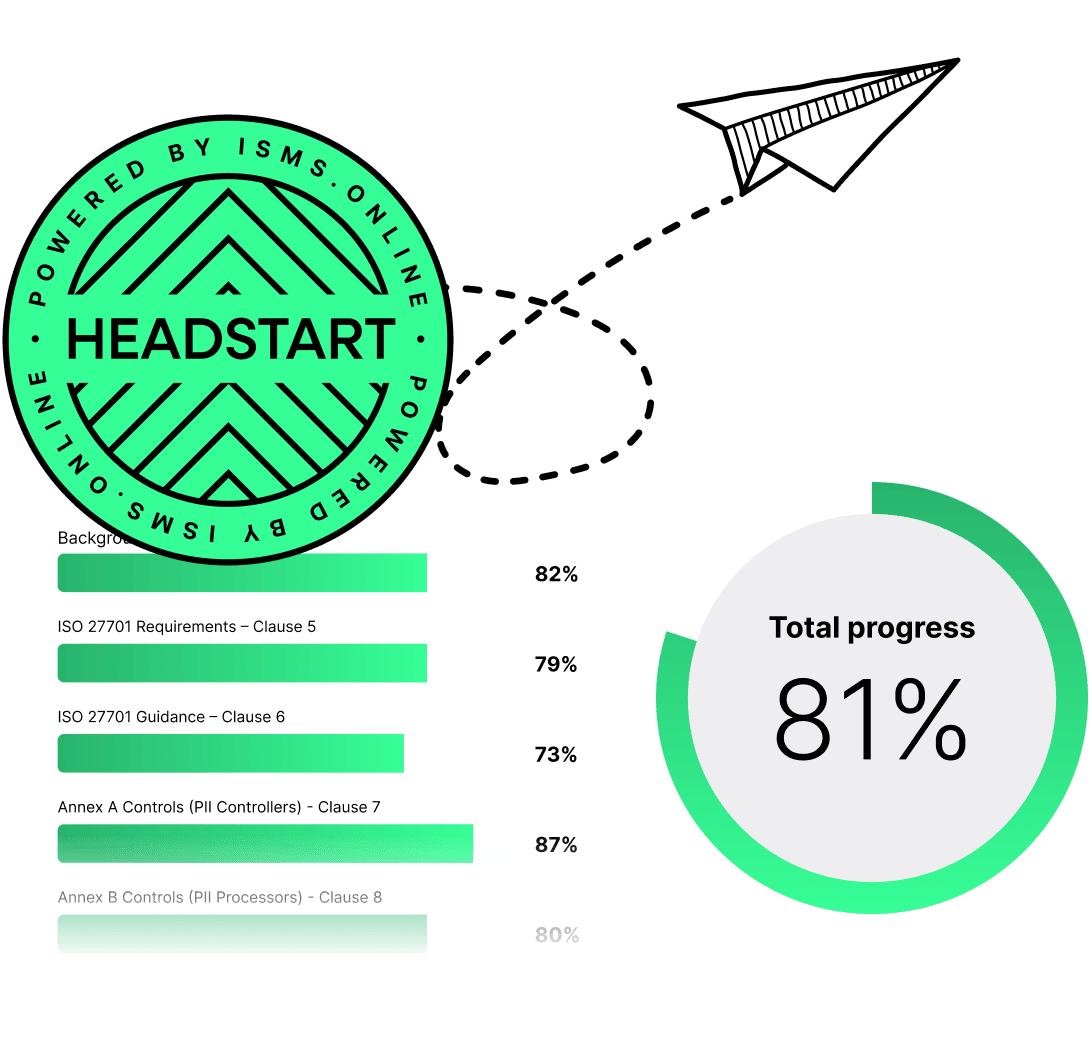
An 81% Headstart from day one
We’ve done the hard work for you, giving you an 81% Headstart from the moment you log on. All you have to do is fill in the blanks.
How Does Audit-Ready Evidence Shift from Manual Churn to Living Proof?
The panic of “audit season” is familiar: last-minute scrambles, mismatched spreadsheets, chasing emails to recover approval logs, or finding out a key incident was logged in someone’s notebook and forgotten. Yet genuine audit confidence can-and must-be built on living systems where evidence is always up to date and instantly accessible.
True audit readiness is when evidence lives where you work-not where you file.
What distinguishes audit-ready organisations?
- Active KPIs, Not Static Snapshots: Your dashboards display live performance-acknowledgement rates, incident closure, SLA attainment-without waiting for an ad hoc export.
- Traceable Improvement Trails: Each audit finding closes with timestamped evidence and owner attribution.
- Agile Evidence Retrieval: Respond at a moment’s notice-whether for a GDPR SAR (Subject Access Request), a board report, or a regulator’s spot check.
A real-time dashboard cuts evidence retrieval to seconds-privacy, security, and risk teams see exactly where they stand. (ISMS.online Resource Guide)
| Evidence System | Manual “Audit Scramble” | Living, Automated ISMS |
|---|---|---|
| Data Storage | Disconnected sheets/folders | Central dashboard (searchable) |
| Task & Approval Tracking | By email or offline notes | Auto-logged, always current |
| Audit & Regulator Reports | Static exports, manual collation | Instant export, dynamic metrics |
| SAR/Legal Fulfilment | Paper/pdf, slow lookup | Tracked, timestamped, actionable |
This technical maturity doesn’t just ease audits. It enables directors, Data Protection Officers, and regulators to see immediate proof of action and real change. For today’s compliance landscape, nothing less will do.
Which Clause 9 Metrics Actually Drive Security, Business, and Compliance Forward?
The trap in performance evaluation lies in choosing metrics that don’t change behaviours or outcomes. Metrics matter when they focus teams on meaningful actions, expose weak spots, and fuel continual improvement.
High-Impact KPIs (What Great Looks Like):
- Incident Closure Speed: Tracks mean days from discovery to completion-demonstrates real agility, not just reporting discipline.
- Policy Engagement Rate: Measures the proportion of staff who’ve actively acknowledged new or updated policies-shows cultural buy-in.
- SAR Fulfilment Rate: Evaluates the proportion of subject access requests closed within mandated timeframes (GDPR) (isms.online).
- Audit Actions Completion: Percentage of audit-mandated improvements closed within SLA-proves operational follow-through.
- Evidence Retrieval Latency: Time to produce proof of action-reflects process maturity and readiness under scrutiny.
Weak KPIs (The Red Flags):
- Counting meetings, open incidents, or total tasks issued-stacking “busy metrics” that miss true security or compliance improvement.
| Metric | Formula (Simplified) | Why this Matters |
|---|---|---|
| SAR Fulfilment % | (Closed on time / Received) x 100 | Privacy programme health |
| Policy Engagement Rate | (Ack’d / Assigned) x 100 | Cultural adoption |
| Incident Closure Speed | Avg. (Closed – Open date) | Operational resilience |
| Audit Remediations % | (Closed in SLA / Total actions) x 100 | Process discipline |
| Evidence Latency | Time to retrieve proof, seconds/mins | Audit & board confidence |
KPIs only matter if they change what teams do Monday morning-and reassure your board.
Best practice: Assign each high-impact KPI an owner, and spotlight their impact in monthly reviews. Let the data drive improvements and transparent conversations across teams, up to the board.

Free yourself from a mountain of spreadsheets
Embed, expand and scale your compliance, without the mess. IO gives you the resilience and confidence to grow securely.
Why Does “Audit Panic” Still Happen With Certified Systems?
Even with a “compliant” certificate, two chronic errors cause audit stress to persist:
- Point-in-time Mentality: Systems focus on prepping for audit day, not ensuring evidence or improvements exist day-to-day.
- Fragmented Ownership: Many are responsible, yet no one is accountable for lagging evidence or overdue actions.
True resilience is founded on evidence that’s always-on, for every framework.
Symptoms:
- Frantic file-hunting before the audit.
- Rush to complete policy acknowledgements, update risk logs, or close last-minute actions.
- Managers uncertain about evidence status or timelines for completion.
How leading teams overcome it:
- Automated, Audit-Aligned Dashboards: Different views for CISO, legal, practitioners-always current.
- Proactive Notifications: Built-in reminders and escalations stop tasks from vanishing into the backlog.
- Fully Linked Evidence: Each action is connected to real outcomes-SoA entries, audit logs, SAR responses, training records-accessible in seconds.
You graduate from “audit panic” to “audit maturity” when up-to-the-minute readiness becomes the lived experience, not a last-gasp effort.
What Role Does Automation Play in Transforming Compliance from Burden to Advantage?
Automation is the lever that moves compliance from an administrative overhead to a real competitive advantage. Automation dramatically shifts the burden off your best people, freeing time for higher-value work and guaranteeing more accurate, defensible records.
Continuous automation means fewer surprises, more trust, and sharper business focus.
Key transformations from automation:
- Automatic Evidence and Approval Logging: Every policy, training, risk, and remediation is timestamped and retrievable by role (isms.online).
- Ownership Mapping: Each improvement, control change, or staff training is owned-and system-tracked, both for recognition and accountability.
- Real-Time Role-Based Dashboards: CISO, privacy leads, and practitioners see the information that matters to their responsibilities, driving routine and strategic action (enisa.europa.eu).
Moving to an automated living ISMS is like switching from a pocket diary to a shared cockpit dashboard-everyone knows where they stand, every day.
For leaders and their teams, this means regulatory confidence, effortless internal reporting, and the ability to respond instantly to new controls, frameworks, or regulatory shifts.
Momentum cue:
Imagine compliance reviews becoming a tool for internal acceleration, not a drag-see how real-time KPIs and audit logs are delivered in ISMS.online.

Manage all your compliance, all in one place
ISMS.online supports over 100 standards and regulations, giving you a single platform for all your compliance needs.
How Does Audit Performance Fuel Business Growth, Not Just Reduce Risk?
The true test of an ISMS isn’t just audit survival-it’s whether your controls and documentation drive contract wins, faster sales cycles, and resilient culture.
A living audit process is more than compliance. It’s your organisation’s trust engine.
How high-performing teams leverage Clause 9:
- Real-Time Audit Packs: Instantly export full evidence packs for regulators or customer questionnaires, cutting response times and boosting confidence.
- Board-Ready Dashboards: Share concise, actionable performance metrics that show improvement, not just activity.
- Recognition Loops: Surface staff who achieve KPIs or close improvements, and celebrate them in leadership updates.
| Input | Example ISMS.online Output |
|---|---|
| Policy Acknowledgements | Real-time engagement leaderboard |
| SAR Fulfilment | Up-to-date privacy compliance dashboard |
| Audit Findings | Visibility of open/closed actions |
| Multi-Framework Mapping | Custom export by ISO 27001, GDPR, NIS 2 |
Making improvement trends visible builds momentum and trust-internally and with every customer.
When performance evaluation feeds directly into faster decision-making, bid success, audit passes, and talent retention, you’ve started turning compliance into a true driver for growth.
What Does Real Continuous Improvement Look Like in ISMS Performance Evaluation?
Clause 9 extends beyond “close the finding and move on.” It expects you to demonstrate repeatable improvement and system learning-where every lesson is recognised and used to raise the bar.
Every improvement linked and shared compounds the value of your ISMS for everyone.
Mechanisms for sustainable improvement:
- Contextualised Actions: Every policy change, evidence upload, or risk mitigation links directly to the audit trail and highlights at management review (enisa.europa.eu).
- Complete Team Visibility: From executive sponsors to practitioners, improvement metrics and progress are transparent.
- Feedback & Recognition: Contributors to KPIs, closed findings, or impactful suggestions are surfaced via newsletters, dashboards, or reviews.
Over multiple cycles, this approach transforms compliance from a defensive cost into a learning flywheel-continually boosting security maturity, privacy confidence, and business reputation.
How Does Clause 9 Enable Multi-Standard Compliance-And Why Does That Matter Now?
Most organisations now face overlapping obligations-ISO 27001, GDPR, NIS 2, SOC 2 and more. Running compliance in siloed tracks is a recipe for wasted effort without Clause 9’s harmonising data muscle.
Strong KPIs and evidence for ISO 27001 don’t just tick a box-they power resilience across every framework.
| Requirement | Shared Evidence via Clause 9 KPIs & Logs |
|---|---|
| ISO 27001 | Audit logs, SoA, policy evidence (centralised) |
| GDPR (Article 30) | SAR logs, training completion, incident actions |
| NIS 2/SOC 2 | Control mapping, remediation, risk closure stats |
Best practice: Use ISMS.online’s mapping to automatically translate actions and KPIs into the language of each framework (isms.online; enable-iso.com). One set of improvements, multiple compliance outcomes. This not only reduces aimless duplication but creates a universal “muscle memory” across risk, privacy, and security teams.
Multiplied audit power means every hour invested in compliance pays off a second or third time-less friction, more strategic value.
Ready to Build Lasting Audit Confidence and Compliance Resilience with ISMS.online?
Audit confidence is built every day, not just in the run-up to certification. Resilience is the product of transparent improvement-owned by the whole team.
Whether you need to take your first steps with performance templates (Kickstarters); roll up unified dashboards and board-level KPIs (CISO); achieve regulator-grade evidence linking (Privacy/Legal); or transform to automated task management (Practitioners)-ISMS.online is designed to accelerate your ISMS, simplify evidence, and raise your business’s standard of trust.
- Kickstarters: Structured, guided evaluation templates with tracked actions.
- CISO/Board: Unified evidence and KPI dashboards, cross-framework mapping.
- Privacy/Legal: Instant audit trails for SARs, policy engagement, and GDPR defensibility.
- Practitioners: Automation removes admin, supports recognition, and ends the spreadsheet scramble.
Turn every audit, improvement, and KPI into a business win – download your ISO 27001 KPI tracker, or request a walkthrough of our dashboards, SAR logs, and cross-framework evidence workflows today. Compliance becomes your edge, your proof of resilience, and your foundation for growth-with ISMS.online as your guide.
Frequently Asked Questions
Who must play an active role to ensure ISO 27001:2022 Clause 9 performance evaluation is robust?
You can only build a resilient Clause 9 performance framework by engaging a cross-functional team-never by relying on a single compliance lead. Effective evaluation depends on clear inputs from line managers (who set and track KPIs close to business risk), IT and security practitioners (who monitor controls and surface technical incidents), internal auditors (providing impartial Clause 9.2 reviews), and executive management (who validate, challenge, and resource improvements). Privacy or legal professionals often join this circle to ensure regulatory requirements aren’t overlooked. If each role owns a lived share of measuring, reviewing, and acting-and these connections are visible-performance evaluation becomes a living habit, not just a once-a-year scramble. This collective momentum builds real resilience: you’re no longer rushing for evidence or patching weak reviews at audit time.
Performance review, done together and on routine, makes ISMS maturity visible-turning audit from stress into reinforcement.
How do responsibilities break down for each participant?
| Role | Core Responsibilities |
|---|---|
| ISMS/Compliance Lead | Orchestrates documentation, keeps records current, unifies feedback cycles |
| Line Manager/Owner | Designs & tracks KPIs, escalates persistent gaps |
| IT/Security Practitioner | Monitors controls/incidents, logs evidence, flags technical blockers |
| Internal Auditor | Conducts independent audits, tests controls, drives closure on findings |
| Executive Management | Reviews trends/metrics, validates reviews, directs improvements |
| Privacy/Legal | Ensures data protection compliance, addresses regulatory risk in the loop |
What step-by-step approach secures Clause 9-and keeps auditors satisfied?
Clause 9 compliance thrives on connected action and evidence, not paperwork overload or checkbox meetings. First, anchor your ISMS objectives in real operational risks, not just regulatory minimums. For each key objective, assign vital KPIs and a single owner; document measurement cadence and thresholds ((https://www.nqa.com/en-gb/resources/blog/March-2021/iso-27001-non-conformities)). Centralise evidence-store incidents, logs, and policy acknowledgements so they’re version-controlled and accessible ((https://cyberzoni.com/standards/iso-27001/clause-9-1/)). Schedule independent internal audits, log findings with clear ownership, and enforce closure checks. Management reviews need to do more than confirm past minutes-expect each action and open risk to be traced through to a final decision and improvement ((https://www.bsigroup.com/en-GB/iso-27001-information-security/ISO-27001-requirements/)). Repeat this loop reliably: set, measure, challenge, improve, and document.
Where do Clause 9 audits typically go off the rails?
- KPIs and actions not genuinely tied to top ISMS risks
- Evidence dispersed in emails/drives or unmanaged versions
- Internal audits handled by non-independent or conflicted reviewers
- Management meetings ritualised-minutes filed, actions overlooked
Consistent chains-ownership, action, evidence, follow-up-are what pull you through tough audits and personnel turnover.
How do you set Clause 9 KPIs that drive real improvement, not just fill dashboards?
Start by asking, “If this went wrong, who in the business would care most?” That risk defines your first KPIs-these might include: “mean time to resolve a security incident,” “percentage of staff with up-to-date policy training,” “time to close SARs or audit actions,” or “number of overdue corrective actions” (get sample KPIs from ISMS.online’s guide). Every metric gets a named owner and review cycle. Build dashboards or logs with trend views-not just raw numbers, but the journey over time. Crucially, track context: when metrics drop, was it resourced? When they improve, did business risk fall? Actionable KPIs always trigger a review if they cross a threshold; those that don’t inspire action should be refined or dropped.
Sample Clause 9 KPI Table
| KPI | Why Track It | Accountable Owner |
|---|---|---|
| % staff trained (current month) | Proves security awareness | HR / Compliance Lead |
| Average incident close time | Tests operational agility | IT/Security Manager |
| Audit action closure % | Monitors continuous improvement | Internal Auditor / ISMS |
| SAR closure days | GDPR compliance readiness | Privacy Officer / Legal |
If a metric never fires a review, or nobody acts on it, it’s just noise-redesign for real value.
What evidence convinces an auditor that Clause 9 performance evaluation is real-not just a file of reports?
Auditors seek living chains of cause, action, and improvement. Satisfy them with:
- Live dashboards or evidence logs: Trends tracked, named owners, regularly updated.
- Centralised incident and action records: Each event assigned, timestamped, and tracked to closure.
- Internal audit schedules & findings: Checklists, results, corrective actions, and closures-linked and accessible.
- Management review records: Minutes show clear continuity from open issues to resolution, with new risks flagged and acted upon.
- Documented improvements: Evidence chain shows how a weak metric, audit, or incident sparked policy or control changes-and how that change was later tested.
Aim for audit evidence that clicks through: incident detected ➝ documented action ➝ validated improvement. If you can’t tie each step, you risk auditor scepticism-and compliance fatigue.
What are the classic Clause 9 pitfalls, and what fixes make them disappear?
Most failures are rooted in fragmented evidence, orphaned metrics, or gaps in review. Five recurring pitfalls-and durable solutions:
| Pitfall | Typical Cause | Correction |
|---|---|---|
| KPIs not risk-aligned | Chosen by habit, not threat | Review risk register; design metrics with management buy-in |
| Scattered, stale evidence | Manual, siloed record-keeping | Centralise on one platform with version control |
| Non-independent internal audit | Team lacks separation or focus | Alternate impartial staff or bring in external perspectives |
| Audit findings unresolved | No clear owner or review period | Assign, schedule, escalate until closed out |
| Management reviews as ceremony | Box-checking dominates | Document actions, ensure follow-ups, require outcome tracking |
Resilience only comes when review is systematic, accountability is named, and your records live where evidence can’t be misplaced.
How does automation-and specifically ISMS.online-make Clause 9 review both easier and more reliable?
Automation transforms Clause 9 from a patchwork of reminders into a seamless feedback system. ISMS.online ties every action to a timestamp, owner, and evidence log ((https://www.isms.online/blog/iso-27001-2022-implementation-guide)). Dashboards, incident queues, and audit logs are all linked-closing out surprises and letting trends be reviewed at any time. Automatic reminders ensure reviews, audits, and corrective actions aren’t forgotten. Management sees every weak spot before the auditor does. Export-ready logs mean fast regulatory submission or external audit, validated against live system records-no more digging for proof. Staff can focus on fixes and improvements, not manual admin.
When every audit action, review, and metric is tracked automatically, Clause 9 becomes about real progress, not paperwork. Resilience-and confidence in your ISMS-is built one closure at a time.
When the whole organisation sees Clause 9 as a continuous, shared cycle, performance reviews become part of business rhythm, not a compliance chase. Explore how ISMS.online’s unified platform turns audits into a demonstration of modern, credible governance.






