















Defining and Establishing ISO 27001 Risk Assessment
Every secure organisation relies on a clearly structured risk assessment that does more than tick boxes—it sets the standard for measurable, defendable information security. ISO 27001 frames risk assessment as a continuous, data-driven workflow connecting business priorities with evidence-backed controls.
What is Risk Assessment in an ISO 27001 Context?
ISO 27001 risk assessment is a systematic approach to identifying, analysing, and managing threats to your information assets. It requires you to map every vulnerable point—assets, people, workflows—against business priorities and regulatory compliance needs.
A robust risk assessment aligns the right controls with the real exposures your operation faces—turning audit demands into strategic certainties.
How Does the CIA Model Guide Practical Risk Evaluation?
Risk decisions depend on tracing threats through the pillars of confidentiality, integrity, and availability (the “CIA” triad), evaluating the concrete impact of each. The process demands specific answers to three central questions:
- What losses do you risk if confidential information leaks?
- How much business interruption results from accidental data corruption or unauthorised changes?
- What’s the business cost if systems are offline when teams or clients need them?
What’s the Value in Documenting Every Step?
Precise, traceable documentation turns assumptions into repeatable, defendable controls. Internal reviews become streamlined; external audits shift from adversarial to confirmatory. Documentation also powers agility—when threats evolve, the evidence base for change is already in your ISMS.
If you can’t show your work, you can’t prove you’re secure. Transparency is the backbone of trustworthy compliance.
ISMS.online Perspective
Our platform turns these principles into intuitive workflows: mapping assets, risks, and controls into a centralised ISMS—aligned not just to audit, but to real business priorities.
Book a demoMandated Requirements: How Clause 6.1.2 Structures the Assessment Process
Clause 6.1.2 defines the minimum viable method for real risk control. It prescribes a cyclical, evidence-driven process encoded in your ISMS—no shortcuts, no superficial compliance.
How is the Risk Assessment Process Structured According to Clause 6.1.2?
The clause requires a clear sequence:
1. Identify all in-scope information assets (databases, people, software, hardware).
2. Apply the CIA model to each asset.
3. Define, document, and justify risk acceptance criteria—who decides, for what assets, at what thresholds.
4. Quantify each risk using a standardised metric (often likelihood × impact).
5. Prioritise remediation and set review intervals.
Fast-Facts: Clause 6.1.2 Documentation Demands
| Mandate | Description | Audit Impact |
|---|---|---|
| Asset Register | List & ownership of information assets | Zero ambiguity, traceability |
| Risk Criteria | Thresholds for what’s “acceptable” vs. action required | No arbitrary choices |
| Risk Scoring | Likelihood × impact with history/logging | Audit trail, evidence base |
| Control Mapping | Each risk mapped to matched control | Accountability, rapid response |
Why Audit Trails and Documentation Standards Matter
The best internal audits show the rationale behind each risk rating. ISMS.online’s audit logs and workflows capture every decision, justification, and review—making storey-building effortless for the real audience: your board, clients, and regulators.
What If Criteria Aren’t Consistent?
Inconsistency breeds doubt, slows audits, and exposes organisations to regulatory risk. A single missing justification or acceptance rationale can unravel months of work. That’s why our documentation engine prompts for validation at every key stage—nothing left to luck or memory.
ISO 27001 made easy
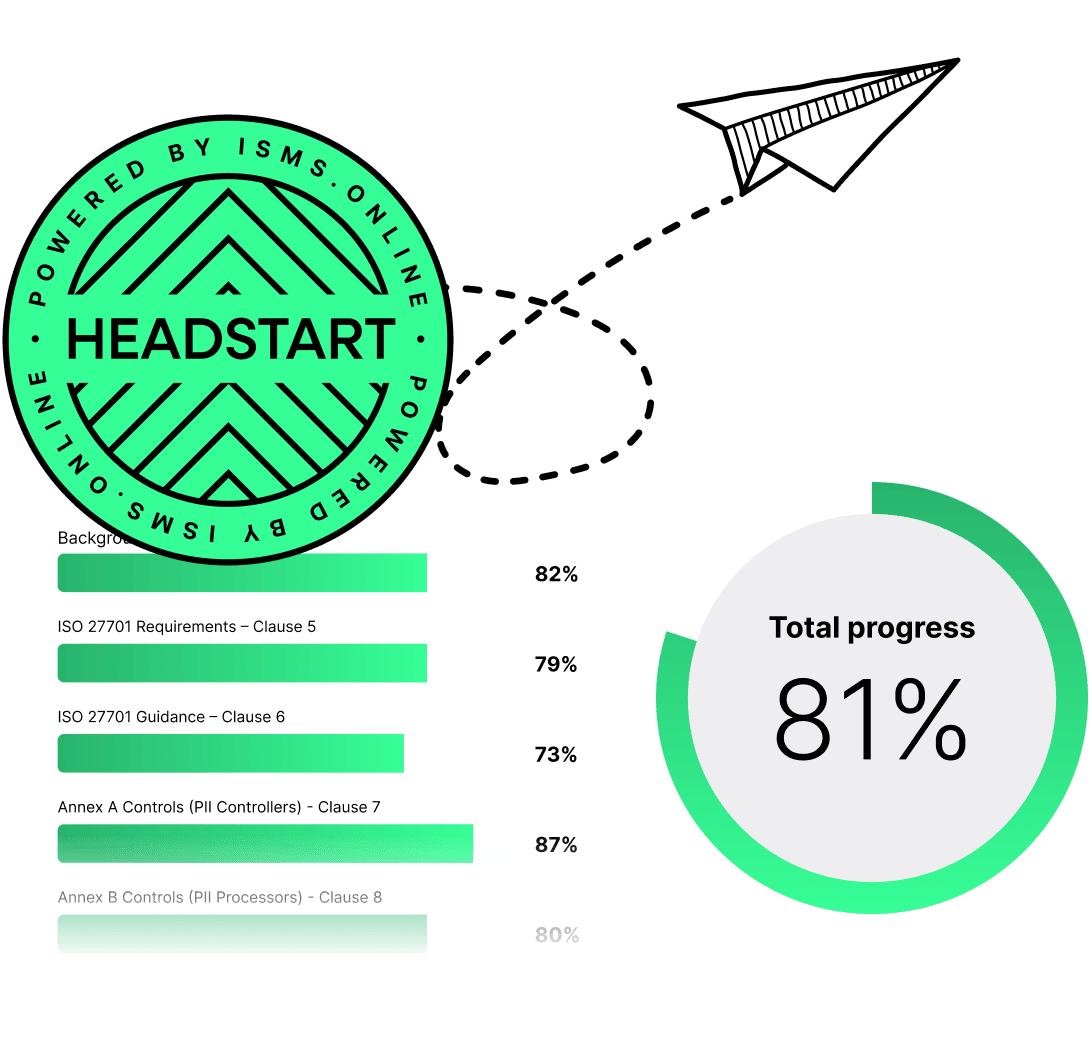
An 81% Headstart from day one
We’ve done the hard work for you, giving you an 81% Headstart from the moment you log on. All you have to do is fill in the blanks.
Why Evaluate Confidentiality, Integrity, and Availability in Risk Assessment?
Every missed risk in information security traces back to an ignored aspect of confidentiality, integrity, or availability. The CIA triad forces teams to dissect risks methodically, so no exposure gets lost in a black box.
What Makes Confidentiality the Backbone of Trust?
Confidentiality failures—think data leaks, unauthorised access, intellectual property theft—aren’t just IT problems. They’re operational failures that corrode customer trust, trigger regulatory fines, and create lasting reputational damage.
What’s at Stake with Integrity?
Integrity issues can be silent: corrupted databases, unauthorised changes, transactional discrepancies. When caught too late, they’re costly to fix and even more painful to explain to stakeholders.
The mistakes most teams defend longest—they’re usually integrity breaches, hidden for months until a crisis hits.
Availability—More Than Uptime Figures
Availability failures go beyond downtime stats. Can your business function when access is slow, partial, or blocked under duress? The real test: how quickly can you restore service after malicious or accidental disruption?
Checklist: CIA Model Evaluation Essentials
- Map every asset to all three CIA dimensions.
- Capture the specific costs and business interruptions exposed by gaps.
- Build evidence that every risk decision ties back to risk tolerance and operational need.
Our workflows embed CIA consideration at every stage—so your team never overlooks a silent exposure.
How Can Automation Streamline Risk Assessment and Enhance Efficiency?
Manual tracking is a trap—errors, version drift, tragic surprises at audit time. Automation shifts your risk management from error-prone defence to confident operations, logging every action and decision as it happens.
What Are the Practical Impacts of Digital Risk Registers?
- Risk entries are prompted, not forgotten.
- Stakeholders receive reminders, follow-ups, and escalating nudges by role and deadline.
- Risk scoring history is always available for audits and periodic reviews.
- Systematic control mapping links mitigation to active evidence collection.
| Manual Process Challenge | Automated Solution | Business Outcome |
|---|---|---|
| Forgotten register updates | Scheduled prompts, forced closure | Audit ready in less prep time |
| Inconsistent scoring | Standardised scales & analytics | Defensible, explainable outcomes |
| Orphaned treatments | Workflow-linked assignments | No more lost accountability |
Why Is Continuous Audit Readiness Now Mandatory?
Being audit-prepared means more than storing PDFs or old emails. Evidence must be live. Audit logs, decision justifications, and reporting all connect back to a real-time source that doesn’t require heroics two weeks pre-audit.
No team has ever regretted being audit-ready three months out. Most wish they’d started sooner.
Our automation engines remove the scramble—every record, every decision, every signoff, ready to produce on request or surprise review.

Free yourself from a mountain of spreadsheets
Embed, expand and scale your compliance, without the mess. IO gives you the resilience and confidence to grow securely.
What Are the Essential Steps for a Comprehensive Risk Assessment Process?
Process drift is a hidden killer in compliance. You need steps that are precise enough to be defendable and flexible enough to meet evolving business needs.
Fundamental Steps to Execute a Complete Risk Assessment
- Inventory and classify all assets (hardware, software, data, people, suppliers).
- Map each asset to its CIA dimensions and highlight specific business impacts of loss or compromise.
- Identify and document possible threats and vulnerabilities for each asset.
- Assess and score the risk (often via likelihood × impact).
- Assign clear ownership for every risk—including mitigation, monitoring, and escalation.
- Plan treatments and control implementations with assigned deadlines and review periods.
- Monitor, review, and update the register regularly as business and threat landscapes shift.
A Thorough Risk Assessment
A thorough risk assessment relies on sequenced steps: asset inventory, CIA mapping, threat documentation, risk scoring, owner assignment, treatment planning, and routine review—ensuring every detail is both actionable and traceable.
Why Are Roles and Responsibilities Essential?
Ambiguity leads to failure. Each risk needs an accountable owner with the authority and resources to respond. Our workflows guarantee no gap goes unnoticed and every team member’s remit is explicit.
How Can Risk Prioritisation and Quantification Enhance Strategic Decision-Making?
The difference between a defensive audit and a strategic compliance function is quantification. When you can measure, compare, and visualise—risk gets managed, invested in, and improved.
How Does Quantification Drive Decision Clarity?
Assigning a numeric score to every risk (likelihood × impact) transforms hunches into business cases. Visual tools such as heatmaps display exposure patterns, guiding C-suite and board-level focus where it counts most.
| Risk Metrics | Value to Leadership |
|---|---|
| Quantitative scoring | Informs resource allocation |
| Heatmap visualisation | Highlights critical clusters |
| Trend tracking | Shows effectiveness over time |
| Role/resolve link | Strengthens accountability |
What Tools Secure the Process?
- Automated dashboards (role-based) keep ongoing risk status visible.
- Trend analysis highlights cost avoidance, not just compliance.
- Board- and auditor-ready reporting ensures your storey is always ready to tell.
Show me your metrics, and I’ll show you your future. Anything else is just a storey.
Our platform provides quantifiable insights—not guesses—direct from your register to your executive table.

Manage all your compliance, all in one place
ISMS.online supports over 100 standards and regulations, giving you a single platform for all your compliance needs.
Where and How Should Evidence and Audit-Ready Documentation Be Managed?
Defence isn’t just about what you know—it’s about what you can prove under pressure. Your register, policies, and trail of evidence must speak for themselves, even if a key player is unavailable.
What’s the Payoff of Centralised, Automated Evidence?
- Consolidated evidence means no last-minute scrambling for documentation.
- Real-time audit trails deliver instantaneous updates and proof of every action.
- Version controls mark, track, and lock compliance at every decision point.
Evidence Control Comparison
| Challenge | Manual Documentation | Centralised, Automated Platform |
|---|---|---|
| Version drift | High risk | Controlled, logged, and visible |
| Retrieval speed | Slow, inconsistent | Instant (role-based permissions enforced) |
| Audit transparency | Subjective | Objective with full timestamped chain |
Documentation is your silent defence. With every log and timestamp, you trade uncertainty for confidence.
Every feature in ISMS.online exists to close documentation and audit gaps before they emerge—evidence is always available, always verifiable, and always reflecting your true compliance posture.
How Does Immediate Action Redefine Compliance Performance?
Proactive organisations make risk assessment and evidence capture a business norm—not an afterthought. This operational shift is the bridge from passing a one-time audit to owning ongoing, defensible security leadership.
What Operational Gains Emerge When You Move First?
- Lead time is turned from risk into opportunity—issues surfaced before they can escalate.
- Teams work from a single, clear set of assignments: operational efficiency increases, compliance anxiety drops.
- Board-ready reporting and live dashboards make every meeting a chance to prove return and resilience.
What Identity Does Predictable Compliance Shape?
Your organisation is perceived not only as compliant, but as a benchmark for others. The brand impact is real: client confidence, auditor affirmation, and industry influence converge when you lead on adoption—not when you chase standards from behind.
Experience this shift by seeing how ISMS.online builds backbone into daily practice, not crisis management. When your compliance is as ready as your business ambitions, leadership becomes inevitable.
Book a demoFrequently Asked Questions
What Makes ISO 27001 Risk Assessment Distinct and Unforgiving?
A genuine ISO 27001 risk assessment isn’t a checklist—it’s a disciplined blueprint for how your organisation can (and will) fail when stakes are highest. Unlike routine risk audits that map hypothetical dangers or regurgitate policy, ISO 27001 risk assessment spotlights live weaknesses, quantifying them with forensic precision.
How Does an ISO 27001 Risk Assessment Actually Work?
- Identify and categorise information assets: —not just by type, but by operational and reputational impact.
- Map threats and vulnerabilities: meticulously, focusing on real-world exploitability and likelihood.
- Rigidly use the Confidentiality, Integrity, and Availability (CIA) triad: to weigh business disruption, legal exposure, and trust erosion.
- Document every decision path: so an auditor (or a client’s board) can trace the logic—no guesswork or memory.
- Tie every step to an Information Security Management System (ISMS): that’s built to endure evolving threats.
True ISO 27001 risk assessment forces you not just to see where you’re weak, but to anchor every decision in data, context, and evidence—so even under scrutiny, your rationale stands.
Operational confidence isn’t a mood; it’s a line-by-line defence.
How Does Clause 6.1.2 Stop Compliance Drift—and What Happens If You Ignore It?
Clause 6.1.2 is the hard border between real compliance and theatre. It transforms subjective security efforts into traceable, auditable decision systems.
What Does Clause 6.1.2 Enforce?
- Explicit risk identification for every asset in ISMS scope: , including third-party and process dependencies.
- Mandated risk criteria: —not just thresholds, but a consistency score auditors can interrogate line by line.
- Peer-reviewed documentation: . You’re not allowed to “just know”—every owner, score, and outcome is recorded and justifiable.
- Risk treatment linkage: —every risk requires a mapped and scheduled action (transfer, mitigate, accept, avoid).
- Ongoing review cycles: —static assessments are forbidden; you must routine-check for relevance and decay.
| Process Area | Clause 6.1.2 Expectation | Business Consequence |
|---|---|---|
| Asset Inventory | Comprehensive, current, mapped to owner | No missing responsibilities |
| Risk Criteria | Defined, justified, traceable | No arbitrary limits |
| Documentation | Audit-ready, change-tracked, peer-checked | Outcomes are never “lost” |
If you cut corners or delay—history shows audit failures, regulatory fines, and incident liability skyrocket. Regulators don’t accept oral history, and neither should your business.
Key Takeaway
Clause 6.1.2 enforces discipline by denying you shortcuts; compliance is earned through transparency, not plausibility.
Why Does the CIA Model Still Matter—And How Does It Expose Boardroom Blindspots?
The CIA triad—Confidentiality, Integrity, Availability—is your permanent lens for weighing digital risk. It’s not academic; it’s the table stakes for trust.
Dissecting the CIA Impact:
- Confidentiality: Leaks are more than PR flares—they alter competitive standing and can collapse contracts overnight.
- Integrity: When data is tampered with (even invisibly), business decisions become liabilities, and recovery is both slow and incomplete.
- Availability: Service interruptions cost more in lost trust than most cyber insurance claims will ever cover.
Applying CIA to Live Threats
| Vector | CIA Failure | Real-World Fallout |
|---|---|---|
| Ransomware | Availability | Missed payroll, late shipments, reputational black marks |
| Insider threat | Confidentiality | Trade secret loss, IP lawsuits |
| SQL injection | Integrity | Database corruption, fines, irreversible business error |
Proving CIA discipline in every risk decision isn’t just for the auditor. It’s your only way to answer “What would destroy value tomorrow?” and not be caught flat-footed.
When every breach, disruption, or compliance failure is mapped to CIA, you gain the foresight to fix exposures, not just apologise after the fact.
Visibility is a system, not a hunch. CIA keeps risk out of the dark.
What Happens When You Replace Manual Risk Churn With Streamlined Reporting?
Relying on scattered spreadsheets and manual signoffs breeds invisible drift—risks lost, updates missed, controls forgotten. Streamlined, ISMS-driven risk management ends drift by creating a living, integrated record tied to business reality.
Where Does ISMS.online Deliver Immediate Leverage?
- Continuous risk ownership: Each risk is assigned, tracked, and updated—every stakeholder becomes both visible and accountable.
- Integrated decision trails: Every change, escalation, and review is timestamped and role-mapped. Audits become validation, not an endurance test.
- Automated reminders and review cycles: Out-of-date risk never gets a pass; the system escalates, notifies, and requires resolution.
- Evidence convergence: Every supporting document, test, and countermeasure connects to the right risk entry—no lost context, no duplicate work.
A North American distributor used to “complete” risk assessments by quarter’s end using four spreadsheets and dozens of emails. In their first ISMS.online cycle, summary reporting dropped from weeks to hours, and the board cited “unprecedented transparency” during its external review.
What Steps Are Non-Negotiable for a Risk Assessment You Can Defend Under Audit?
No asset is too small, and no control can vanish into a spreadsheet—systematic rigour replaces ad hoc review.
The Only Audit-Proof Pathway:
- Catalogue: Inventory every asset, tag with ownership and business impact.
- Classify: Link each asset to threats, vulnerabilities, and CIA impact zones.
- Score: Apply risk ratings—likelihood and consequence—mapped to business and compliance objectives.
- Assign: Make every risk someone’s explicit responsibility, not a department’s vague problem.
- Plan: Deploy scheduled remediation, timelines, and required documentation.
- Recertify: Build periodic review and recertification into the workflow—stale assessments fail first.
Most audit failures begin with lost accountability and end with old risk records. Auditable assessments persist because responsibility—and the path to action—is always assigned and reverified.
Ownership is the bridge from intention to resilience; when accountability is visible, so is security.
How Does Quantifying Risk Create Strategic Authority—Not Just Firefighting?
Subjective risk is an argument; quantified risk is a business case. Applying data-driven scoring means risks move up or down the agenda with purpose and clarity, not guesswork.
Why Quantification Beats “Gut Feel” Every Time
- Standardised scales: align teams, boards, and auditors on what really matters.
- Heatmaps: provide at-a-glance prioritisation, keeping urgent risks in the crosshairs.
- Trends over time: reveal where progress happens, and where new threats emerge—enabling true continuous improvement.
- Linkage to treatment: ensures that control assignment and resource budgeting are never based on the loudest voice, but the riskiest target.
| Quantification Tool | Board Agenda Leverage |
|---|---|
| 5-point risk scales | Creates scorecards for resource prioritisation |
| Risk heatmaps | Visualises hotspots for immediate mitigation |
| Audit-ready metrics | Accelerates endorsement and approval cycles |