





































When Patch Tuesday Becomes Audit D‑Day
When you handle patching as a “best‑efforts” task instead of a defined, risk‑based process, every major vulnerability can turn a routine patch cycle into an audit crisis because you cannot show how you discover, prioritise and treat issues within agreed timelines. For a modern MSP, customers and auditors – and increasingly insurers – expect you to evidence a structured Annex A.8.8 process rather than informal good intentions. Audit‑focused patch management checklists and similar assessment templates increasingly frame this as a structured control with documented processes and records, not just activity (as reflected in independent patch management audit checklists).
For most MSPs, technical vulnerabilities sit at the uncomfortable junction of customer expectations, noisy tools and tightening standards. In the past, patching was “best efforts” and reports were cobbled together from exports and spreadsheets; now expectations have shifted towards risk‑based service levels, clear ownership and hard evidence. Modern vulnerability‑management guides for security professionals explicitly promote risk‑based SLAs, clear ownership and structured evidence, rather than informal, spreadsheet‑driven patching (for example, in practitioner‑oriented vulnerability management guides for security teams).
The 2025 ISMS.online survey shows that customers increasingly expect their suppliers to align with formal frameworks such as ISO 27001, ISO 27701, GDPR, Cyber Essentials, SOC 2 and emerging AI standards.
That shift is not just about security maturity; it is about survivability of your service model. A single high‑profile vulnerability can trigger urgent customer questions, contractual scrutiny and detailed ISO 27001 Annex A.8.8 conversations. Case studies and community guidance on vulnerability management report that widely publicised flaws often trigger urgent customer questions, contractual review and deeper conversations about how Annex A.8.8 or similar controls are being applied, especially in managed service environments (as discussed in resources such as the FIRST vulnerability management guide). If patching still lives in disparate RMM (remote monitoring and management) policies and ad‑hoc tickets, those conversations become stressful and defensive instead of calm and factual.
A governance platform such as ISMS.online can help by giving you a single place to connect policies, risks, SLAs and evidence, so you are not scrambling across tools when someone challenges how you manage vulnerabilities.
Complexity without clarity is what quietly turns Patch Tuesday into audit D‑day.
It is worth being explicit: information here is general and does not constitute legal, contractual or certification advice. You still need to interpret standards and risk in your own organisational context, ideally with qualified professional support, and different auditors or certification schemes may emphasise different aspects of Annex A.8.8.
Why “best‑efforts” patching is no longer enough
“Best‑efforts” patching is no longer enough because it creates activity without the structured control and evidence Annex A.8.8 expects. You might work hard every week, but if you cannot show how vulnerabilities are discovered, prioritised and treated within agreed timeframes, auditors and customers will still view your approach as uncontrolled. Summaries of Annex A.8.8 requirements commonly describe it as a control for establishing a managed, risk‑based approach to technical vulnerabilities rather than leaving treatment to informal routines (as reflected in many Annex A.8.8 overviews).
The core problem for many MSPs is not a lack of work; it is a lack of structure. Engineers are busy every day approving updates, responding to vendor alerts, handling customer change windows and firefighting incidents, yet when someone asks basic questions such as “Which critical vulnerabilities are older than seven days?” or “Which customers are outside their agreed patch SLA?”, the answers require manual digging.
That gap between activity and demonstrable control is precisely what Annex A.8.8 exposes. The control expects a defined, risk‑based process, not just good intentions. In practice, that means being able to show how you stay informed about vulnerabilities, how you identify them in each customer estate, how you assess and prioritise them, how you treat them and how you review whether the process is working.
How exposure and compliance gaps show up in real life
Exposure and compliance gaps usually show up first as everyday friction rather than dramatic incidents. If you see recurring confusion, delays or “known but deferred” issues, you are probably already outside the spirit of A.8.8, even if no‑one has written a formal finding yet.
Weak technical vulnerability management usually reveals itself long before an auditor writes up a non‑conformity. Common signs include:
Around 41% of organisations in the 2025 ISMS.online survey said that managing third‑party risk and tracking supplier compliance is one of their biggest security challenges.
- Different teams using inconsistent severity models and terminology.
- Scanner findings piling up with little linkage to patching or risk decisions.
- Recurring incidents tied to “known but deferred” vulnerabilities.
- Customer security questionnaires taking days to answer because evidence is scattered.
When an external auditor or a large customer finally reviews Annex A.8.8 in detail, those symptoms translate into findings such as “vulnerability management is ad hoc”, “no clear treatment timelines by severity” or “exceptions are not documented or approved”. Remediation under time pressure is never comfortable.
A small matrix helps crystallise the contrast between informal patching and structured Annex A.8.8 management.
A simple comparison of patching approaches
The following table highlights the practical differences between “best‑efforts” patching and an A.8.8‑aligned vulnerability process.
| Aspect | “Best‑efforts” patching | A.8.8‑aligned vulnerability management |
|---|---|---|
| Process definition | Informal habits and tribal knowledge | Documented, risk‑based lifecycle |
| Evidence | Ad‑hoc exports and spreadsheets | Structured records linked to policies and controls |
| SLA clarity | Vague “monthly patching” statements | Timelines by severity and asset criticality |
| Exception handling | Silent delays and undocumented decisions | Formal risk assessment, approval and review dates |
Why MSP leaders should care before something goes wrong
MSP leaders should act before a major incident or painful audit forces change, because vulnerability management is both a high‑impact risk area and a visible proof point of your wider security capability. When you align A.8.8 with clear SLAs and governance, you improve security outcomes, sales confidence and operational predictability at the same time.
Most organisations in the 2025 ISMS.online State of Information Security report say they have already been impacted by at least one third‑party or vendor‑related security incident in the past year.
For an MSP operations director or service owner, patching is often seen as a low‑margin, noisy obligation. However, it is also one of the most visible proofs of your overall security capability. Strong, ISO‑aligned technical vulnerability management:
- Helps reduce the likelihood and impact of incidents rooted in unpatched systems, in line with national cyber security guidance that highlights timely vulnerability management as a key control for limiting breaches (for example, guidance on vulnerability management within 10‑step security programmes).
- Makes sales and renewal conversations about risk more confident.
- Shortens the time needed to respond to security questionnaires and audits.
- Differentiates your service from competitors who still rely on vague we patch monthly statements.
Shifting from unstructured patching to a disciplined, A.8.8‑aligned model is therefore not just about passing audits; it is about protecting revenue, reputation and engineering capacity. The next step is understanding exactly what Annex A.8.8 expects so you can design to that target rather than guessing.
Book a demoWhat ISO 27001 A.8.8 Really Expects
In an MSP context, ISO 27001 Annex A.8.8 expects you to run a systematic, risk‑based vulnerability process rather than occasional scanning and hopeful patching. The control focuses on how you stay informed, identify relevant weaknesses, assess their risk, treat them in a controlled way and demonstrate that this happens consistently across all relevant customer environments. High‑level summaries of the control consistently describe it as requiring a managed, risk‑based process for technical vulnerabilities, rather than ad hoc scanning alone (as in common A.8.8 requirement outlines).
Annex A.8.8, titled “Management of technical vulnerabilities”, sits within ISO 27001’s wider emphasis on risk‑based controls. In plain language, it requires you to show that technical vulnerabilities are found, understood, prioritised and treated in a way that matches business risk, not just technical noise.
Around two‑thirds of organisations in the 2025 ISMS.online State of Information Security report say the speed and volume of regulatory change are making compliance significantly harder to sustain.
Although the full wording sits in the paid standards, common interpretations by practitioners and auditors converge on the same core expectations. Understanding those expectations clearly is the first step towards designing patch SLAs and workflows that satisfy both customer needs and certification requirements, noting that individual schemes and auditors may emphasise different details. Practitioner commentaries and auditor‑facing articles frequently converge on these themes, emphasising process, prioritisation and continual improvement when interpreting A.8.8 in real organisations (for example, community write‑ups of A.8.8 implementation considerations).
Industry guidance and auditor feedback often stress the same themes: clear governance, defined responsibilities, risk‑based timelines and evidence that the process is reviewed and improved over time. Professional bodies and governance articles on vulnerability management echo this, highlighting governance, role clarity, risk‑based remediation targets and continual improvement as markers of a mature programme (as seen in vulnerability management articles from professional institutes).
Breaking A.8.8 into practical obligations
You can turn Annex A.8.8 into practical obligations by framing it as five simple questions you must answer with evidence. If you can show a clear “how” and “where recorded” for each of these, you are close to what most auditors want to see in practice.
You can think of A.8.8 as asking five simple but demanding questions:
-
How do you stay informed?
You need a defined way to learn about new vulnerabilities: vendor advisories, vulnerability databases, security mailing lists, managed threat intelligence feeds and similar sources, chosen and documented in a deliberate way. -
How do you identify what affects you?
You must be able to map external vulnerability information onto your actual assets and technologies across all managed customers, so that you know which findings truly apply. -
How do you assess and prioritise risk?
Severity scores alone are not enough. You are expected to consider exploitability, asset criticality, exposure and business impact so that decisions are grounded in real risk, not just tool output. -
How do you treat vulnerabilities in a timely, controlled way?
Treatment includes patching, configuration changes, compensating controls or risk acceptance, all under appropriate change management so that fixes are both fast and safe. -
How do you monitor and improve the process?
You should review whether your vulnerability management is effective, track metrics, learn from incidents and update your approach when threats or environments change.
If you can answer these questions with clear processes, records and responsibilities, you are already close to what auditors expect to see for Annex A.8.8.
Common misinterpretations that cause audit pain
Common misinterpretations of A.8.8 tend to come from assuming that tools or occasional efforts automatically equal compliance. You can avoid a lot of audit pain by challenging these assumptions yourself before auditors or large customers do it for you.
The first misunderstanding is “we scan, therefore we comply”. Scanning is necessary but not sufficient. Auditors look for how scan results feed into risk assessment, how prioritisation works, how quickly different categories are treated and how exceptions are handled when normal SLAs cannot be met.
The second is treating “timely” as a vague aspiration. Security guidance and auditor practice usually expect you to define concrete timelines by severity and context. For example, critical vulnerabilities on internet‑facing, business‑critical systems are often expected to be assessed and treated in days rather than weeks or months, unless there is a documented, approved reason. Security guidance from national agencies and other references usually expects organisations to define concrete timelines by severity and context; for instance, government ransomware and vulnerability‑remediation advice urges rapid handling of high‑risk, internet‑facing vulnerabilities, reinforcing the direction of travel even when exact timeframes vary by organisation (see, for example, national guidance on responding to ransomware outbreaks).
A simple scenario illustrates the point. An MSP might run regular scans but have no defined timelines or exception process. When a critical, internet‑facing vulnerability stays unresolved for several weeks, an auditor can legitimately record a finding for weak technical vulnerability management, even if patches were eventually applied.
Extending A.8.8 beyond operating systems
Annex A.8.8 applies to more than operating system updates; it covers technical vulnerabilities wherever they appear in the stack. If you only focus on Windows or Linux patching, you may leave significant exposures – and audit gaps – in middleware, network equipment and cloud configurations. Application and vulnerability‑management guides repeatedly point out that weaknesses can arise in middleware, network devices, cloud services and custom applications as well as operating systems, and recommend whole‑stack approaches (for example, the OWASP Vulnerability Management Guide).
Another subtle trap is to interpret “technical vulnerabilities” as “operating system patches”. In reality, the scope is broader. You are expected to consider:
- Middleware and databases.
- Network devices and appliances.
- Cloud services and configurations.
- Custom applications and third‑party code.
That does not mean your MSP must own every patch; it does mean your process and documentation should clearly explain who is responsible for what, how you monitor coverage and how exceptions are handled when something cannot be patched on schedule.
A governance platform such as ISMS.online is helpful here because it lets you link Annex A.8.8 to specific policies, risks, controls and records across all of these technology areas, without losing track when estates and relationships grow. Once these expectations are clear, you can design a vulnerability management lifecycle that turns individual CVEs (Common Vulnerabilities and Exposures) into managed business risk rather than constant firefighting.
ISO 27001 made easy
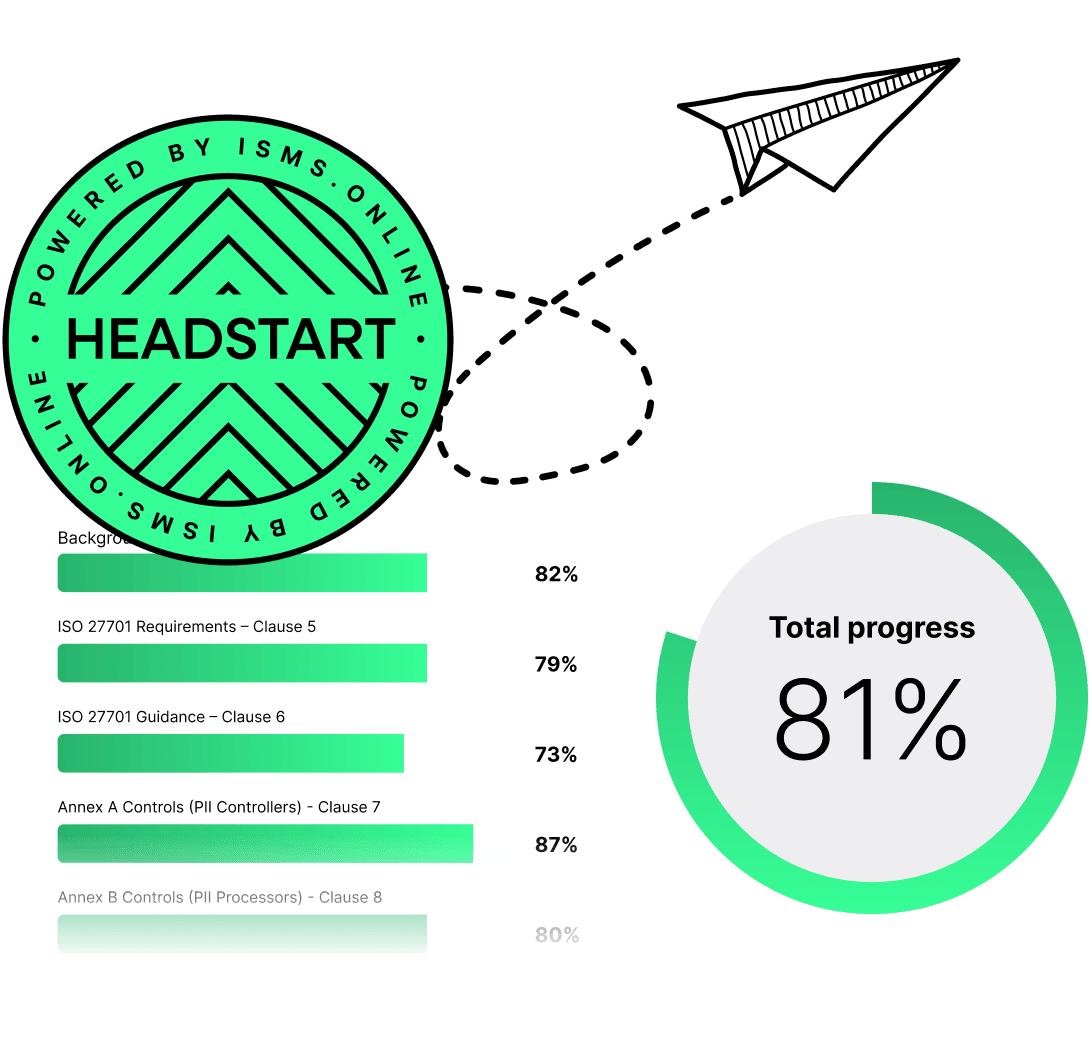
An 81% Headstart from day one
We’ve done the hard work for you, giving you an 81% Headstart from the moment you log on. All you have to do is fill in the blanks.
From CVEs to Business Risk: A.8.8 as a Lifecycle
You gain control of technical vulnerability management when you treat it as a lifecycle that runs from discovery to closure, not a series of isolated tasks triggered by individual CVEs. For an MSP, that lifecycle must span multiple customers, technology stacks and contract types while remaining simple enough for engineers to follow in the middle of noisy operations.
A useful way to design that lifecycle is to start with how CVEs and advisories arrive, and then map the journey through assessment, prioritisation, treatment and verification until you have clear closure and evidence. This also makes it easier to show auditors that every vulnerability follows a defined path from detection to outcome.
Step one: define discovery in a structured way
Discovery needs to be deliberate, repeatable and documented rather than occasional scanning when time allows. In an MSP, that means combining several discovery methods in a planned way, recording which you use for which customers and making sure every in‑scope environment is covered at an appropriate frequency; it is more than pointing a scanner at an IP range once a month and typically involves several channels:
- External and internal network scanning across all customer environments in scope.
- Agent‑based scanning on servers and endpoints where agents are deployed.
- Cloud configuration and workload assessments for major cloud platforms.
- Application‑level checks for web applications and APIs.
- Threat intelligence and vendor advisories for emerging issues.
The key is to document which of these methods you use for which customer segments, how often and how the results enter your workflow. A.8.8 expects that this is intentional and repeatable, not accidental.
A structured discovery approach also makes it easier to show customers that you are not relying on a single tool or scan type, but are deliberately combining techniques appropriate to their risk profile.
Step two: build a risk model that goes beyond CVSS
A simple, transparent risk model that adds business context to CVSS scores is essential if you want your patch decisions to stand up to audits and customer scrutiny. When everyone understands how you classify risk, SLA targets and exceptions feel deliberate rather than arbitrary.
CVSS (Common Vulnerability Scoring System) scores are a good starting point, but they do not capture business impact by themselves. To make patch decisions that stand up to scrutiny, you need to combine:
- Technical severity: – how dangerous the vulnerability is by design.
- Exploitability: – whether there is known exploitation or public proof‑of‑concept code.
- Asset criticality: – how important the affected system is to the customer’s business.
- Exposure: – whether the system is internet‑facing, accessible from untrusted networks or deeply internal.
By combining those factors into a simple risk‑tiering scheme, you can define clear treatment targets. For example, a critical, actively exploited vulnerability on an internet‑facing payment gateway sits in your highest tier and deserves the fastest attention.
Even a lightweight, well‑explained risk model can transform previously subjective debates about “how fast is fast enough?” into more objective discussions anchored in agreed criteria.
Step three: define treatment paths and closure
Your lifecycle needs clear treatment paths for each risk tier and an agreed definition of what “closure” means; otherwise, vulnerabilities will linger in limbo or disappear from view without being properly resolved. Making closure explicit also makes your process far easier to evidence to auditors.
Once risk tiers exist, they should drive treatment paths. Typical options include:
- Deploying vendor patches under normal or emergency change processes.
- Adjusting configurations, such as disabling vulnerable services or tightening access.
- Implementing compensating controls like network segmentation, web application firewall rules or increased monitoring.
- Formally accepting risk for a period, with documented rationale and conditions.
Closure should not happen when a ticket is closed; it should happen when the vulnerability is verified as treated (for example, through a targeted rescan) or when a risk acceptance decision is logged. A lifecycle view makes that distinction explicit and auditable.
Designing Risk‑Based Patch SLAs for MSPs
Risk‑based patch SLAs translate your vulnerability lifecycle into clear expectations for how quickly issues will be assessed and treated. When you define them carefully, they become a bridge between security, operations and commercial commitments rather than a source of tension or unrealistic promises.
For MSPs, designing those SLAs is both an operational and a commercial decision. Timelines must be aggressive enough to satisfy customers and auditors, but realistic enough that engineers can actually meet them without constant overtime and burnout.
Turning risk tiers into timelines
You should convert each risk tier into specific “time‑to‑assess” and “time‑to‑remediate” commitments that align with your capacity and your customers’ risk appetite. Clear definitions here remove ambiguity and make it easier to handle exceptions honestly when the ideal is not possible.
Start by deciding what “time‑to‑assess” and “time‑to‑remediate” mean for you. A simple model might be:
- Time‑to‑assess: – the time from initial detection or notification to a documented risk rating and assigned treatment plan.
- Time‑to‑remediate: – the time from initial detection to implementation of the chosen treatment (patch, configuration change, compensating control or accepted risk).
You can then map those to risk tiers. For example, for production, business‑critical systems:
- Critical vulnerabilities may need assessment within one business day and treatment within a short, clearly defined window.
- High vulnerabilities might have assessment within a few days and treatment within a couple of weeks.
- Medium vulnerabilities might allow a longer window for treatment, provided the risk remains acceptable.
- Low vulnerabilities might be treated on a normal monthly or quarterly cycle.
These are illustrative ranges, not prescriptions, but they are broadly consistent with what many auditors and professional guidance documents expect to see when remediation windows are justified by documented risk and applied consistently (including articles from professional bodies on vulnerability management practices).
A short example helps. An MSP may initially promise very aggressive remediation for all high and critical issues. After measuring real effort, change failure rates and customer window constraints, they may adjust to different targets for internet‑facing versus internal systems, explaining the rationale transparently to customers.
Accounting for asset criticality and environment
Different environments warrant different timelines, so your SLA framework should explicitly acknowledge asset criticality and exposure. That way, you can move faster where risk is highest without committing unrealistic response times for less critical systems.
Timelines should also reflect where vulnerabilities live. You might define faster targets for:
- Internet‑facing systems versus internal‑only systems.
- Systems processing regulated or highly sensitive data versus low‑sensitivity environments.
- Shared infrastructure that could impact many customers versus isolated systems.
Conversely, non‑production environments or low‑impact internal tools might justifiably operate on slower patch cycles, as long as that difference is documented, agreed with the customer and revisited when circumstances change.
By making these distinctions explicit, you reduce arguments about “special cases” and encourage more honest conversations about where risk is really concentrated.
Aligning SLAs with change and service management
Patch SLAs must align with your change, release and service management processes so that engineers can actually meet them. If timelines ignore maintenance windows or approval flows, you will quickly fall out of compliance and frustrate both teams and customers.
Patch SLAs do not exist in a vacuum. They need to line up with:
- Maintenance windows and change freezes agreed with customers.
- Approval processes for emergency, expedited and standard changes.
- The capacity of your teams to test and roll back problematic updates.
It is often helpful to explicitly connect severity tiers to change categories. For instance, critical vulnerabilities on critical systems might follow an emergency change path with rapid approvals, while medium‑risk issues use standard changes scheduled during routine maintenance.
When you write patch SLAs into contracts or service descriptions, be transparent about how these interactions work. That reduces the risk of promising timelines that cannot be achieved within agreed operational constraints. Once SLAs are in place, the next challenge is making sure roles, scope and exceptions are clearly documented so those commitments work in the real world.

Free yourself from a mountain of spreadsheets
Embed, expand and scale your compliance, without the mess. IO gives you the resilience and confidence to grow securely.
Documenting Roles, Scope and Exceptions
A.8.8 expects you to document who does what, which assets are in scope and how you handle exceptions, especially in shared‑responsibility MSP models. When those points are unclear, patch SLAs fail in practice and audit findings arrive quickly because no‑one can show where responsibilities really sit.
Even the best risk‑based SLAs will fail if roles, scope and exception handling are ambiguous. In MSP environments, the shared‑responsibility question – “who exactly does what?” – is often the main source of broken expectations and audit findings.
Annex A.8.8 does not require you to own every patch; it does expect you to clearly document how technical vulnerabilities are managed across all parties.
Clarifying responsibilities with a simple matrix
A simple responsibility matrix brings clarity by showing, for each major activity in the vulnerability process, who is responsible, accountable, consulted and informed. This stops assumptions creeping in and gives you a concrete artefact to show auditors and customers.
A responsibility assignment matrix is a practical way to make shared responsibilities explicit. For each major activity – such as scanning, patch deployment, approval of downtime, verification and risk acceptance – define who is:
- Responsible (doing the work).
- Accountable (ultimately answerable).
- Consulted (providing input).
- Informed (kept up to date).
You can create one matrix per customer or per service type, and reference it in contracts, runbooks and audit evidence. That matrix becomes especially important where you manage only parts of the stack – for example, operating systems but not line‑of‑business applications, or infrastructure but not custom code.
When challenged by customers or auditors, the matrix gives you a concise way to show that responsibilities were thought through and agreed, not left to assumption.
Defining scope and out‑of‑scope areas
Clear scope statements help everyone understand which assets and environments your vulnerability process covers, and which are outside the MSP service. Without this, you can easily end up blamed for exposures you never agreed to manage, or overlook important systems that should have been included.
Scope is another frequent source of confusion. To satisfy A.8.8, you should be able to show which assets and environments your vulnerability management process covers, and which sit outside the MSP service.
Examples of items that may be out of scope include:
- Lab systems used for testing by customer teams.
- Legacy operational technology with strict change constraints.
- Shadow IT or unmanaged SaaS services.
Being explicit about these boundaries does not absolve anyone of risk; it simply makes responsibilities transparent. Where exposure is high but patching is difficult, you may agree separate projects or risk‑mitigation plans.
Handling exceptions and non‑patchable vulnerabilities
A formal exception process turns unavoidable compromises into managed, auditable decisions rather than quiet SLA breaches. When you log risk assessments, compensating controls and expiry dates, you show auditors that you are controlling risk rather than ignoring it.
No real environment can meet ideal timelines for every vulnerability. Applications break, vendors delay fixes and customers sometimes veto downtime. That is why a formal exception process is essential.
A good exception process usually includes:
- A trigger (for example, an SLA breach is imminent or a patch is too risky).
- A documented risk assessment.
- A decision on compensating controls, such as segmentation, extra monitoring or temporary restrictions.
- Explicit risk acceptance by an appropriate manager.
- An expiry or review date.
Recording exceptions in a central register, and referencing them in your risk management records, turns unavoidable compromises into managed, auditable decisions rather than silent failures.
ISMS.online can help by giving you a single place to keep responsibilities, scope statements, exceptions and related risks alongside the Annex A.8.8 control, so nothing drifts when people or contracts change. With responsibilities and exceptions under control, you can then design an end‑to‑end workflow that engineers can follow consistently.
An End‑to‑End Vulnerability Handling Workflow
You need an end‑to‑end workflow that carries every vulnerability from detection to verified closure, with evidence at each step, if you want Annex A.8.8 to feel controlled rather than chaotic. In an MSP, that workflow must sit comfortably alongside your existing RMM, PSA (professional services automation) and change tools instead of competing with them.
Once responsibilities, scope and SLAs are defined, the next step is to design a workflow that engineers can actually follow. The aim is simple: every vulnerability should have a clear route from detection to closure, with evidence attached at each key step.
In MSP environments, that workflow must coexist with the existing toolchain – RMM platforms, vulnerability scanners, ticketing systems, change management tools – without creating more friction.
Connecting discovery tools to work management
Your workflow should start where vulnerabilities first appear – in scanners, monitoring tools or vendor advisories – and then flow automatically into your work management system. If someone has to manually recreate findings as tickets, your process will be slow, error‑prone and difficult to defend to auditors.
A practical vulnerability handling workflow often starts like this:
- A scanner or monitoring tool identifies a new vulnerability.
- The finding is enriched with asset data and risk context (severity, exploitability, criticality, exposure).
- A ticket or work item is automatically created in your service management system, with appropriate priority and SLA targets.
From there, human judgement and existing processes take over. Engineers investigate feasibility, coordinate with customers on change windows, test patches or configuration changes where necessary and prepare implementation steps.
The key is that this path is defined, repeatable and documented, not reconstructed from memory every time a major issue appears.
Your vulnerability workflow should tightly link to change and release governance, so patch work is both fast and controlled. When auditors review A.8.8, they will often sample changes to see whether treatment followed appropriate approval and testing steps and whether exceptions were handled as designed.
Patch work must respect change and release governance. That means:
- Ensuring changes are logged and approved according to risk.
- Aligning implementation with maintenance windows and downtime agreements.
- Having rollback plans for critical systems.
For high‑urgency vulnerabilities, you may need a special emergency path that streamlines approvals while maintaining basic safeguards. For routine vulnerabilities, standard change procedures are usually sufficient.
By explicitly linking vulnerability tickets to change records, you can later show auditors that treatment was controlled, not improvised, and that emergency changes were used appropriately rather than as a default.
Verifying outcomes and feeding back improvements
Verification and feedback loops close the workflow and demonstrate continuous improvement, which is a recurring expectation in ISO‑style standards. If you skip these steps, you cannot credibly claim that your vulnerability management is effective or improving over time.
Verification is often the weakest link in vulnerability workflows. It is not enough to assume that a patch job succeeded; you should:
- Rescan affected systems to confirm the vulnerability is gone or mitigated.
- Spot‑check complex changes or high‑risk systems.
- Update asset and risk records to reflect new status.
When something goes wrong – perhaps a patch caused an outage or a vulnerability remained open – use that as input into continuous improvement. Small adjustments to scan schedules, change testing practices or communication routines can dramatically improve reliability over time.
Platforms such as ISMS.online make it easier to record these workflows, link them to A.8.8 and related controls, and demonstrate that improvement is not just talked about but actually tracked.

Manage all your compliance, all in one place
ISMS.online supports over 100 standards and regulations, giving you a single platform for all your compliance needs.
Measuring Patch Performance and Proving It
To prove Annex A.8.8 is effective, you need a small, meaningful set of vulnerability metrics that link directly to your SLAs and risk model. When you track and explain these numbers, customers and auditors gain confidence that your process works in practice, not just on paper.
Even the best‑designed vulnerability management process will be questioned if you cannot show how well it performs. Customers, auditors and internal leadership increasingly expect metrics, trends and explanations that connect patching to risk reduction. Security risk‑management literature routinely emphasises metrics and trends as a way to demonstrate control effectiveness, including programmes that focus on building information security risk‑management from the ground up (for example, guidance on security risk‑management KPIs and dashboards).
Measuring patch performance is therefore not just about operational dashboards; it is a core part of demonstrating Annex A.8.8 effectiveness and your wider security maturity.
Honest trend lines reassure nervous customers far more than glossy, context‑free promises.
Choosing a small, meaningful set of metrics
A compact metric set aligned to your SLAs is better than a crowded dashboard no‑one trusts or understands. Focus on measures that answer “How quickly do we treat risk?” and “How much risk remains?” at any point in time, both for your MSP as a whole and for each customer.
It is easy to drown in data, so it is helpful to focus on a concise metric set linked directly to your SLAs and risk model. Commonly useful metrics include:
- Mean time to remediate vulnerabilities by severity tier.
- Percentage of vulnerabilities treated within SLA, again by severity.
- Number or age of outstanding critical and high vulnerabilities.
- Number of open patch exceptions and how long they have been active.
- Coverage metrics, such as percentage of in‑scope assets scanned within defined frequencies.
These metrics should be viewable at both aggregate MSP level and per‑customer level, so you can manage your overall service and support transparent conversations with individual clients.
Turning metrics into customer and auditor confidence
Metrics only build trust when you present them honestly, show trends and connect outliers to realistic explanations and actions. When you share this picture with customers and auditors, you signal maturity rather than spin and make it easier to discuss changes or investments.
Raw numbers are not enough; how you present them matters. For customers and auditors, you want to show:
Only about one in five organisations in the 2025 ISMS.online survey reported avoiding any form of data loss over the previous year.
- Clear alignment between SLAs and performance, such as how often critical vulnerabilities meet the agreed timeframe.
- Trends over time, highlighting whether performance is stable, improving or deteriorating.
- Context for exceptions, explaining which items are outside SLA and why, along with compensating controls and planned actions.
Many auditors and governance frameworks encourage organisations to bring their own metrics and improvement plans to the table rather than waiting to be told what is wrong, because it signals ownership of the control environment.
Understanding the cost and effort side of SLAs
Good SLA design depends on understanding the real cost of patching in people time and service impact, not just risk reduction. When your metrics cover effort and change outcomes as well as vulnerability counts, you can negotiate realistic timelines and staffing that protect both security and your teams.
Metrics should not only cover risk; they should also illuminate effort and impact. Tracking factors such as:
- Engineer hours spent on patching by severity tier.
- Change failure rates linked to patch work.
- The proportion of out‑of‑hours versus in‑hours changes.
helps you understand the real cost of your SLA commitments. That understanding is essential when negotiating timelines with customers, planning staffing levels and justifying investments in automation or process improvement.
An ISMS platform such as ISMS.online can tie these metrics back to your Annex A.8.8 control, risk records and improvement plans, giving you a single, coherent view of both effectiveness and cost. When you are ready to act on those insights, it becomes natural to look for a governance backbone that makes Annex A.8.8 easier to operate and prove.
Book a Demo With ISMS.online Today
ISMS.online helps you turn Annex A.8.8 from an abstract requirement into a practical, auditable vulnerability management programme that works consistently across all your managed customers. When you bring policies, risks, SLAs, exceptions and evidence into one environment, you can move from defending “best‑efforts patching” to showing a disciplined, risk‑based service that stands up to scrutiny.
Within one environment, you can:
- Capture your A.8.8 policies, risk assessments, controls and procedures in a structured, repeatable way.
- Record shared‑responsibility decisions with each customer, including scopes and responsibility matrices.
- Define and review risk‑based patch SLAs and tie them to real workflows across your toolset.
- Log exceptions, compensating controls and risk acceptances with clear ownership and expiry dates.
- Store scan summaries, change records and performance metrics alongside the control they support.
Your existing RMM, PSA, scanners and monitoring platforms continue doing the technical heavy lifting; ISMS.online sits above them as the governance and evidence layer. That means you can keep familiar operational tools while dramatically improving how you explain and prove your technical vulnerability management to customers and auditors.
If you want A.8.8 to feel like firm ground rather than a moving target, it makes sense to choose a governance backbone that reflects the way your MSP actually works. When you value risk‑based clarity, audit‑ready evidence and a manageable path to maturing your patch SLAs and workflows, ISMS.online is ready to support you and your customers.
Frequently Asked Questions
How does A.8.8 really apply to an MSP in day‑to‑day operations?
For a managed service provider, A.8.8 is about running a disciplined, end‑to‑end vulnerability lifecycle across every customer estate, not just reacting to loud alerts. In practical terms, it starts when a weakness first appears on your radar and only ends when you can show it was assessed, treated or formally accepted, and then re‑checked.
What should engineers be doing each week to satisfy A.8.8?
In a normal week, your engineers should be able to trace a clean line from “we heard about this issue” to “here’s the outcome and why”:
- A predictable way to receive and review advisories and scanner output (vendor feeds, RMM alerts, PSIRT bulletins, mailing lists).
- A reliable method to map each finding to specific customers, assets and environments, using an up‑to‑date inventory or CMDB.
- A shared, simple risk model (for example, CVSS plus exposure and business impact) that drives consistent prioritisation and target timeframes.
- A rule that every validated finding becomes a record in your ITSM or ticketing tool, so nothing depends on memory, chat threads or email.
- Evidence that changes ran under change control and were verified afterwards (rescan, config check, spot test), or were consciously accepted with a review date.
If you can sit with an auditor, open a real advisory or scan result, and walk them through the linked ticket, approval, implementation and follow‑up check, you are showing A.8.8 operating in real life. When you capture that same journey against the A.8.8 control in ISMS.online, you turn “how we work” into something visible, repeatable and easy to defend in customer meetings and certification audits.
How can we turn A.8.8 into patch SLAs that engineers and customers can actually live with?
You make A.8.8 deliverable by turning your risk model into clear, achievable timelines that match how your teams and customers already work. Rather than vague promises like “we patch promptly,” you define how quickly you assess and how quickly you treat, by severity, exposure and asset type.
How do we design severity‑based timelines without setting ourselves up to fail?
Many MSPs find a simple tiered model works well once it is agreed and automated:
- Critical, internet‑facing, business‑critical assets: assess within one business day; remediate or apply strong interim controls within a short, agreed window.
- High severity: assess within a few days; remediate within a period such as 10–15 business days, aligned with customer change windows.
- Medium and low: include in routine maintenance windows (monthly or quarterly), unless the combined risk is high or a regulator insists on faster action.
You then tune the model:
- Relax timelines for non‑production, isolated or low‑impact systems where the residual risk is clearly lower.
- Tighten timelines where contracts, regulators or your own appetite require faster response.
The key is to write down the logic, agree it per customer, and embed it into your ticketing and change processes so that priority, due dates and escalations happen automatically. When those SLAs, their rationale and the A.8.8 control all live together in ISMS.online, your engineers see the rules in context and auditors can see how your intent, implementation and results line up.
Auditors look for a closed loop: every vulnerability should follow a consistent path from discovery to decision and verification, with clear owners at each step. The exact choice of scanner, RMM or ITSM platform is less important than how you join them into one coherent flow.
How do we connect scanners, RMM, ticketing and change into a single defensible process?
A robust, MSP‑friendly workflow typically follows these stages:
- Discovery – Scanners, RMM alerts, vendor advisories and threat intelligence feeds send findings into a central queue.
- Enrichment – Each item is linked to specific assets, environments and, where appropriate, customer business owners.
- Assessment and prioritisation – Your agreed risk model assigns severity and target timelines based on exposure, asset type and business impact.
- Treatment – Tickets are raised with owners and due dates, referencing standard or emergency change procedures as appropriate.
- Verification – Follow‑up scans or checks confirm the vulnerability has been addressed or that compensating controls work as intended.
- Closure or documented acceptance – Records are closed with evidence, or a nominated risk owner accepts residual risk with a planned review date.
Putting that flow on one process diagram, then backing it up with real tickets, change approvals, exception records and simple reports, makes it straightforward for an auditor to see A.8.8 as “in place and effective.” Storing the diagram, your RACI, and supporting evidence beside the A.8.8 control in ISMS.online gives you a repeatable storyboard you can reuse for new auditors and security‑conscious customers.
How do we stay compliant with A.8.8 when we cannot patch or have to defer remediation?
You stay aligned with A.8.8 when “we can’t fix this yet” becomes a visible, time‑bound risk decision with extra safeguards, rather than an item that quietly ages in a backlog. ISO 27001 expects the same discipline for exceptions as for successful patches.
What should an exception and compensating control process look like for an MSP?
A practical, defensible exception process usually covers five essentials:
- A defined trigger, such as failed testing, vendor restrictions, customer change freeze or unacceptable business disruption.
- A written record linking the vulnerability, affected assets, current risk rating and specific reasons for delaying remediation.
- Documented compensating controls, for example tighter access control, additional monitoring, segmentation, rate‑limiting, temporary service changes or user guidance.
- Named risk owners on your side and, where appropriate, the customer side, with explicit sign‑off on the decision.
- A review date and clear criteria for retesting and revisiting the choice, so exceptions do not become permanent by default.
Keeping these entries in a central exception register, linked to your risk log and to A.8.8 in ISMS.online, shows that overdue or complex items are actively governed and not forgotten. It also changes internal dynamics: engineers are no longer blamed for delays driven by business, regulatory or customer constraints, because everyone can see who made which call and when it will be reconsidered.
Which vulnerability metrics genuinely demonstrate that our patching is under control?
For A.8.8 you do not need a dashboard crowded with charts; you need a small, stable set of measures that prove you follow your own rules and that serious exposure does not quietly build up. Those same measures give customers, boards and regulators confidence that your vulnerability handling is steady and predictable.
What KPIs work best for MSP customers, boards and auditors?
Most MSPs get real value from tracking a short list of vulnerability indicators:
- Mean time to remediate by severity: , especially for critical and high findings.
- Percentage of items closed within SLA: , segmented by customer, environment and asset class.
- Current count of open critical and high vulnerabilities: , including the age of the oldest.
- Number and age of active exceptions: , and the proportion with future review dates already assigned.
- Coverage indicators: , such as the percentage of in‑scope assets scanned within schedule or the share of key estates under active scanning.
When you can show these KPIs over several months, with short explanations for spikes or improvements, you have a straightforward storey for service reviews and audits: you are not just reacting, you are steering. Housing the KPIs, their definitions and the A.8.8 control in ISMS.online gives everyone the same single source of truth, rather than competing spreadsheets and screenshots.
How can ISMS.online make running and evidencing A.8.8 easier for an MSP?
ISMS.online does not replace scanners or patching tools; it provides the governance layer that turns the way you already discover, prioritise and treat vulnerabilities into something that looks organised, auditable and ISO‑aligned. For A.8.8, that means one place to hold the policy, process, roles, SLAs, exception handling and metrics that wrap around your operational platforms.
What changes when A.8.8 is anchored in an ISMS instead of scattered across different systems?
When you anchor A.8.8 in ISMS.online, you and your team can, from a single environment:
- Show the documented vulnerability management policy and how it links to Annex A, your risk register and your statement of applicability.
- Walk through the agreed risk model and SLA matrix that you apply across customers, including any contractual or regulatory variations.
- Open real tickets, change records, exception approvals and summary reports that are explicitly linked back to the control and to specific risks.
- Present dashboards and summaries that explain performance across estates in a way that customers, auditors and managers can follow without technical deep dives.
That cuts the time you spend hunting through consoles, inboxes and shared drives before assessments or customer reviews, and lets you put more effort into improving exposure management itself. Because ISMS.online sits above your tooling, you can swap scanners, RMM platforms or ITSM systems without rebuilding your compliance storey each time. Over time, that makes it much easier to present your organisation as the MSP that treats vulnerability management as a dependable, ISO 27001‑aligned service, rather than a noisy background chore that only looks tidy in the week before an audit.






