





































Are You Really ‘Too Small’ or Just One ISO 27001 Project Away from Enterprise-Ready?
For many twenty‑ to hundred‑person MSPs, a lack of visible security proof-not headcount-often becomes a major barrier to enterprise opportunities. Larger customers frequently rely on structured third‑party governance criteria, so when they cannot see how you manage risk, they tend to default to safer‑looking brands or certified competitors, even when your technical capability is similar. Independent third‑party risk research highlights how strongly bigger organisations depend on demonstrable security and governance when choosing suppliers. This information is general and does not constitute legal or compliance advice; you should always take professional advice before making regulated decisions.
Growth often stalls not from demand, but from missing proof you are safe.
For a smaller MSP, that proof gap shows up everywhere. Security questionnaires drag on, procurement adds extra conditions, or opportunities simply fade when risk and compliance teams get involved. From your side, it feels as though you are being punished for your size rather than rewarded for the service you provide.
ISO 27001 gives you a way to flip that script. It lets you show that, despite being a lean team, you understand your risks, manage them systematically, and are prepared for scrutiny from larger customers. Instead of arguing that you are “not like other small providers,” you can place a recognised framework on the table and let it carry much of the burden of proof. Studies on third‑party governance and supplier risk echo this pattern: when buyers can map a provider onto a recognised framework, they are more comfortable moving ahead.
What’s Really Holding Your Growth Back?
If your revenue is stuck in small, price‑sensitive accounts while the market grows, a credibility ceiling is probably constraining you. That ceiling appears when security questionnaires stall, procurement grows nervous, and deals quietly die as soon as risk teams arrive, regardless of how hard your engineers work behind the scenes.
From the outside, enterprise buyers do not see your hustle or your engineers’ skill; they see a relatively small supplier handling valuable data with informal governance. Without visible discipline around policies, access, incidents and suppliers, they assume more risk than they are comfortable taking, so they favour providers that can evidence a structured approach.
Over time, this pattern of small wins and large losses compounds. You win plenty of smaller contracts but struggle to land the larger, more stable agreements that would transform your business. The technical work is not the issue; it is your ability to demonstrate that you manage security and compliance deliberately rather than informally.
Why Size Matters Less Than How You Manage Risk
ISO 27001 is fundamentally risk‑based, not size‑based, so it cares about the impact of a failure more than the number of people you employ. The standard asks whether you understand the information you hold, the threats you face, and the controls you use to manage those risks in a repeatable way. It does not demand that you build a huge security department or copy a bank’s security stack.
If you already hold administrative access into customer systems, manage backups, and influence uptime for critical services, you are already “big enough” in risk terms to justify an information security management system. The real question is whether you choose to formalise what you are doing or continue relying on goodwill and reputation. Enterprise buyers increasingly reward the former with larger, longer contracts, because formal governance is easier for them to justify internally.
Seeing ISO 27001 this way also takes pressure off the idea that only certain MSPs “qualify” for certification. If you can describe what you do, write it down, assign owners and measure whether it is working, you can build an ISMS that matches your scale. You are not pretending to be a global enterprise; you are proving that you manage risk responsibly.
Why Now Is the Right Time to Rethink Too Small
In many markets, stronger focus on third‑party risk from boards, regulators and insurers has made security assurance a standard part of buying managed services. Guidance from cybersecurity agencies that focus on SMEs and supply chains reinforces the expectation that organisations obtain structured assurance from their providers rather than relying on informal assurances.
Around two-thirds of organisations in the State of Information Security 2025 report say the speed and volume of regulatory change are making compliance significantly harder to sustain.
If you look back over the last year and list the opportunities that faded once security and compliance came up, you may find a meaningful volume of potential revenue that never reached contract. Even if your existing customers are not yet demanding ISO 27001 by name, their risk teams, auditors and insurers are already moving in that direction and tightening expectations around supplier governance.
The MSPs that respond early can reposition themselves as enterprise‑ready while others are still saying were too small. Certification does take effort, but a well‑planned approach means you improve governance as you go. By the time competitors realise buyers now treat ISO 27001 as standard, you are already using it as part of your growth storey rather than chasing a new minimum bar.
Book a demoWhy Do Enterprise Buyers Hesitate to Trust Smaller MSPs?
Enterprise buyers often hesitate to trust smaller MSPs because they cannot see predictable governance behind your promises, and that hesitation is frequently more about governance visibility than an inherent dislike of smaller suppliers. Their concern is less about your size and more about the risk that your controls are inconsistent, undocumented, or dependent on a few key people. ISO 27001 provides a language and framework that closes this gap.
When a corporate risk or security team looks at your proposal, they are not judging your character or effort. They are asking whether your organisation will behave in a predictable way when something goes wrong and whether they could explain that behaviour to their own board. If they cannot see evidence of that predictability, they will treat you as a higher‑risk supplier, no matter how friendly or responsive you are.
If you are the founder or managing director who ends up answering every questionnaire, you may feel this disconnect acutely. The people who like you day‑to‑day are not always the ones who sign off risk, and that is where a structured management system becomes more persuasive than personal assurances. Third‑party governance studies underline this reality: buyers rely heavily on formal criteria, artefacts and certifications when making supplier decisions.
How Your MSP Looks Through an Enterprise Risk Lens
When enterprise risk teams assess suppliers, they look for clear evidence of control across governance, access, change, incidents and suppliers. They use familiar checkpoints so they can compare very different providers in a consistent way and explain their decisions internally if something goes wrong.
Around 41% of respondents in the 2025 ISMS.online survey said that managing third-party risk and tracking supplier compliance is one of their main information-security challenges.
Common enterprise checkpoints often include:
- Clear governance roles and decision‑making routes for security.
- Defined access and change controls for sensitive systems and data.
- Documented processes for incident response and supplier oversight.
If your policies are scattered in shared drives, change approval lives in chat threads, and incident handling depends on whoever is on call, you appear fragile, even if your engineers regularly save the day.
From their perspective, a smaller MSP without a documented management system looks like a potential single point of failure. Supply‑chain and SME cybersecurity research from regulators and industry groups regularly highlights under‑governed smaller suppliers as concentrated risk points within wider ecosystems. They worry that a breach at your organisation could ripple across many of their internal teams and data stores. Without a structured way to show how you identify, treat and review risk, buyers must either impose heavy additional controls or move on.
The Hidden Cost of Ad‑Hoc Questionnaires and Governance Debt
Ad‑hoc security questionnaires that arrive late in the sales cycle consume days of senior time and rarely move you closer to a scalable solution. Without a central set of approved answers and supporting evidence, every form becomes a mini‑project, often involving your managing director, technical lead and perhaps an external adviser. This is unpaid work, and inconsistent responses can undermine confidence rather than build it. Industry surveys on vendor risk and remote access also point to the growing volume and effort required to respond to bespoke assessments, especially for smaller providers.
Behind that friction sits governance debt: years of sensible but undocumented decisions on access, logging, supplier selection and incident handling. Nothing is obviously broken, but little is codified. ISO 27001 gives you a structured way to pay down this debt, turning scattered good practice into an auditable system that can survive staff changes and satisfy risk reviewers.
Most organisations in the State of Information Security 2025 survey say they have already been impacted by at least one third-party or vendor-related security incident in the past year.
Reducing governance debt does not mean replacing everything you do. It means capturing the best of your existing practice, discarding habits that no longer serve you, and filling a manageable number of gaps. From there, you can answer questionnaires from a position of strength, using consistent wording backed by real evidence.
How an ISMS Changes the Conversation
An information security management system (ISMS) based on ISO 27001 does three things enterprise buyers care deeply about. First, it shows that leadership has formally accepted responsibility for information security and set clear objectives. Second, it proves you understand your risks and have chosen controls deliberately, rather than accumulating tools by accident. Third, it demonstrates that you measure performance, audit yourselves, and improve over time.
When you can present a defined scope, named roles, a risk register, a Statement of Applicability, and records of internal reviews and audits, the conversation changes. Instead of interrogating basic hygiene, buyers can focus on how you work together, where responsibilities split, and how quickly you can adapt to their needs. That is the level of discussion where you can differentiate on service rather than defending the basics.
Over time, this shift reduces the emotional overhead of every sales cycle. You no longer dread the moment when risk teams join the call, because you have a coherent storey, standard artefacts and a live ISMS behind them. That confidence is attractive to larger customers, even if they never read every document you provide.
ISO 27001 made easy
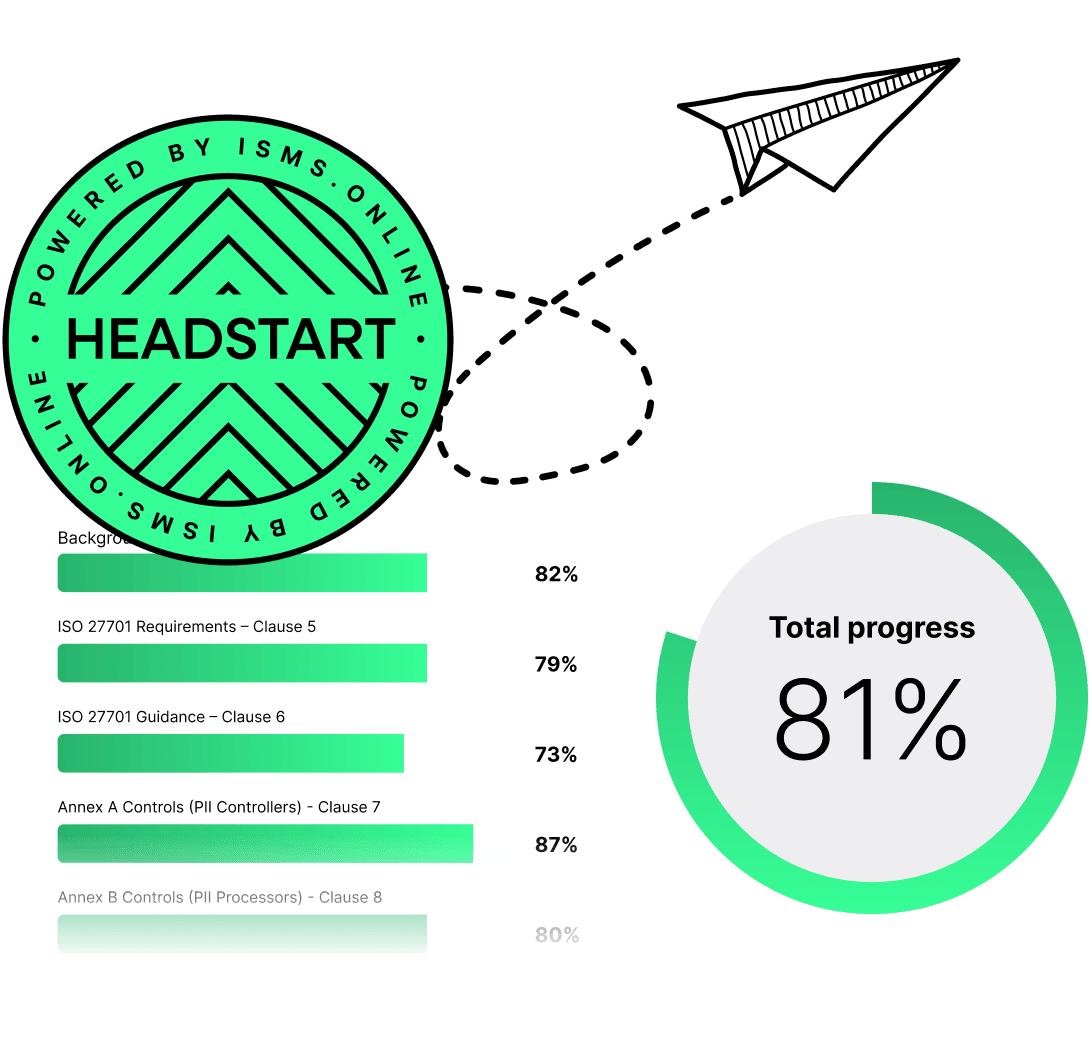
An 81% Headstart from day one
We’ve done the hard work for you, giving you an 81% Headstart from the moment you log on. All you have to do is fill in the blanks.
What Does ISO 27001 Actually Mean for a 20–100 Person MSP?
For a twenty‑ to hundred‑person MSP, ISO 27001 adds a structured, disciplined framework around the security work you already do. You define scope, assign roles, assess risk, choose and document controls, and commit to monitoring and improvement. The aim is not bureaucracy for its own sake, but a coherent way to prove to customers and auditors that you manage information security on purpose.
ISO 27001 asks you to connect the dots between your leadership decisions, day‑to‑day operations and improvement efforts. In practice, that means setting objectives, measuring what matters, and showing that you adjust when things change. You are likely doing parts of this already; the standard turns those parts into a single, repeatable loop that makes sense to auditors and larger customers. Implementation guides aimed at MSPs and other IT service providers consistently stress this point: certification usually formalises and streamlines existing good practice rather than demanding an entirely new way of working.
Seeing ISO 27001 as a Loop, Not a Pile of Clauses
ISO 27001 is easier to work with when you see it as a simple, repeatable loop rather than a stack of clause numbers. You move through a cycle of understanding your context, assessing risk, implementing controls, monitoring performance and improving where needed, and that cycle becomes the rhythm of your governance.
When you look at your own business through this loop, you may realise you already have many of the pieces. You have leadership meetings where security is discussed, tickets where incidents are handled, and tools that enforce controls. The work of ISO 27001 is to connect these activities, make them traceable, and ensure they cover the full life cycle, not just firefighting.
Seeing the framework as a loop also makes it easier to keep it alive. Instead of a one‑off project leading to a certificate on the wall, you are building a system that moves with your clients, services and technology stack. That is what reassures enterprise buyers: not perfection, but visible, ongoing control backed by evidence such as scope statements, Statements of Applicability and internal audit records.
Which Roles and Responsibilities Do You Actually Need?
You do not need a large committee structure to satisfy ISO 27001 in a mid‑sized MSP, but you do need clarity about who does what. Typically there is an executive sponsor (often the founder or managing director), an ISMS manager who coordinates the system, and a handful of service or function owners responsible for particular control areas, such as access, infrastructure or supplier management.
A simple structure might look like this:
- Sponsor: – sets direction and clears obstacles.
- ISMS manager: – coordinates documentation, risk and audits.
- Control owners: – run specific areas such as access, backup or suppliers.
In many MSPs, these roles already exist informally. Someone deals with auditors, someone owns the RMM and backup stack, someone runs change approval, and someone speaks to key customers about incidents. Formalising these responsibilities in an ISMS helps those people pull in the same direction, reduces the risk of gaps, and gives them a structure they can refer to when customers ask how security is governed.
How Annex A Connects to the Services You Already Offer
Annex A of ISO 27001 is a catalogue of security controls grouped into organisational, people, physical and technological themes that often mirror the services you already deliver. Access control, endpoint protection, network security, backup and recovery, logging and monitoring, and supplier oversight are all familiar territory for MSPs.
The useful exercise is to map your service catalogue against these themes. For each control area, ask whether you fully cover it, share responsibility with the customer, or do not address it at all. This reveals where you can document existing practice, where you should tighten operations, and where genuine gaps exist that could become new offerings. Annex A becomes less a hurdle and more a product design tool. Best‑practice guidance on productising security services often uses exactly these control families-access, continuity, supplier risk, incident response-as the backbone for managed offerings.
Thinking this way turns ISO 27001 into more than a compliance task. It becomes a structured way to validate your portfolio, eliminate unprofitable one‑off work, and design services that align with both your customers’ risk obligations and your own ISMS.
How Can ISO 27001 Drive Bigger Deals, Better Margins and Lower Churn?
ISO 27001 helps drive bigger deals, better margins and lower churn by removing security objections and supporting a more premium, trusted positioning. Certification itself does not close deals, but it removes risk‑based blockers, opens doors that were previously closed, and underpins a more robust storey about how you manage sensitive services. Market factors such as competition and product fit still matter, but ISO 27001 stops security concerns being the recurring reason you lose.
Despite the pressure, almost all respondents in the 2025 ISMS.online survey list achieving or maintaining security certifications such as ISO 27001 or SOC 2 as a top priority.
At a high level, ISO 27001 changes three commercial levers for your MSP:
- Bigger deals: – opens doors to larger, regulated and risk‑sensitive customers.
- Better margins: – reduces risk‑driven discounting and unplanned security costs.
- Lower churn: – strengthens trust so renewals and expansions become easier.
This snapshot helps you see where commercial benefits come from before you dive into each area in more detail.
Opening Doors to Larger and Regulated Customers
Many mid‑market and enterprise buyers now treat ISO 27001 as baseline hygiene for suppliers handling sensitive services. Certification bodies and buyer‑facing explainers present it as a widely recognised way to evidence information security management, which is why it often appears as a screening criterion in RFPs and partner programmes. Without certification, it can be significantly harder to pass initial screening, and you may be excluded from some opportunities even when your technical skills are strong. With it, you become eligible for a wider range of tenders, frameworks and partner programmes that explicitly require or favour certified suppliers.
The 2025 ISMS.online survey shows that customers increasingly expect suppliers to align with formal frameworks such as ISO 27001, ISO 27701, GDPR, Cyber Essentials and SOC 2, with emerging AI standards also appearing in requirements.
Even where certification is not strictly mandatory, it often acts as a powerful tie‑breaker. When two MSPs look similar on price and capability, the one that can present an independently certified ISMS, a clear scope statement and a coherent set of policies is easier for procurement and risk teams to approve. That ease has real value in competitive situations where internal risk committees need clean, defensible decisions.
There is also a reputational effect. Once a few larger customers see you as a credible, certified partner, they may be willing to recommend you to peers or bring you into adjacent projects. Analyses of security‑mature suppliers frequently link strong governance and certification to increased partner confidence and referral opportunities. ISO 27001 becomes part of a storey about being “the MSP that can handle serious work” rather than “the small provider we took a chance on.”
Improving Pricing Power and Protecting Margin
Security concerns often show up as last‑minute objections that you address with discounts, free extras or vague promises. Over time, this erodes margin and sets unhealthy expectations. When you can point to an ISO 27001‑certified ISMS, backed by visible controls and regular internal audits, customers are less likely to view you as a risk that needs compensating.
A mature ISMS also tends to reduce the frequency and severity of security incidents. Industry data‑breach reports consistently find that organisations with structured controls and response processes detect problems more quickly and limit their impact more effectively than those with ad‑hoc approaches. Fewer outages, fewer emergency callouts and fewer reputational shocks all translate into lower unplanned costs. Combined with improved eligibility and reduced discounting, those savings help protect and even raise your effective margins, particularly on larger, multi‑year contracts where risk perception heavily influences pricing.
Only about one in five organisations in the State of Information Security 2025 survey said they avoided any form of data loss over the previous year.
Your ability to defend your pricing improves too. When customers can see that your service includes governance, risk management and compliance support, they are less likely to compare you directly with bare‑bones providers. You are no longer selling “hours and tickets”; you are selling confidence, continuity and evidence that stands up under internal and external scrutiny.
Strengthening Retention and Lifetime Value
Customers stay when they trust you and can defend that trust internally, especially when budgets tighten or leadership changes. Customer‑success research regularly highlights trust, reliability and the ability to justify supplier choices to internal stakeholders as key drivers of renewal and expansion. As your customers’ own risk and compliance obligations increase, they will be asked to demonstrate how they oversee critical suppliers. If you can provide concise, credible evidence packs drawn from your ISMS-summaries of controls, audit results, management reviews and improvement actions-you make their lives easier.
By building structured security and governance updates into your regular account reviews, you also remind customers of the value you provide beyond tickets and uptime. That can be particularly important when procurement considers retendering or when new executives, with no history of working with you, want to reassess supplier risk. ISO 27001 gives you a stable storey to tell in those moments, anchored in documented controls and regular internal audit activity.
Viewed over several years, that storey becomes part of your commercial moat. It is harder for a competitor to displace a certified MSP that can show a track record of managed risk, documented controls and steady improvement than it is to undercut a purely operational provider on price.

Free yourself from a mountain of spreadsheets
Embed, expand and scale your compliance, without the mess. IO gives you the resilience and confidence to grow securely.
What Does a Realistic 12‑Month ISO 27001 Roadmap Look Like for an MSP?
A realistic twelve‑month ISO 27001 roadmap for a twenty‑ to hundred‑person MSP can follow a simple path from scoping to audits. It starts with clear decisions on scope and drivers, moves through risk assessment and control implementation, and ends with internal and external audits. Timelines in implementation guides for SMEs and MSPs often describe similar 9–18‑month journeys that follow this same general sequence. The twelve‑month version is ambitious but achievable if you keep governance lean, integrate the work into everyday operations and focus on the highest‑value controls first. For some MSPs, especially with complex scope or limited resources, the same sequence may sensibly extend to eighteen months.
Step 1 – Decide scope, drivers and governance
This step clarifies why you are certifying, which services and locations are in scope, and who will own the ISMS.
Step 2 – Implement policies, controls and evidence in sprints
This step turns your decisions into policies, controls and evidence, built gradually through short, manageable sprints.
Step 3 – Audit, correct and prepare for certification
This step proves the system works in practice, fixes weaknesses and prepares you for external certification audits.
Those steps form a single path rather than three separate projects. You decide what matters, build the system into your existing work, then prove that it runs for real before inviting an external auditor to look.
Enterprise‑ready MSPs picture winning similar work repeatedly by making their proof of security as repeatable as delivery.
Setting Scope, Drivers and Governance Upfront
For the first couple of months, you should focus on decisions rather than documents to avoid building the wrong system. You decide why you are pursuing ISO 27001, which services and locations will be in scope, who will sponsor and run the ISMS, and what success will look like in commercial terms. You also perform a high‑level gap analysis to understand where you stand against the standard’s requirements.
Defining a lean governance model early prevents later confusion. You do not need several committees, but you do need a named ISMS manager, an internal auditor, and identified owners for major control areas such as access, infrastructure, application support and supplier management. If you are that technical lead or ISMS manager, it helps to negotiate realistic time commitments so this work can sit alongside existing sprints without overwhelming you. A dedicated ISMS platform such as ISMS.online can make it easier to keep scope, risks, policies and responsibilities in one place rather than scattered across documents and folders.
Implementing Policies, Controls and Evidence in Manageable Sprints
The next six or so months are where most of the visible work happens as you translate decisions into practice. You document and approve key policies, complete a structured risk assessment and treatment plan, and implement or tighten controls around areas such as access, logging, backup and recovery, change management, incident response and supplier oversight.
Rather than treat this as a separate, monolithic project, you can weave many of these tasks into existing sprints and service meetings. For example, a regular change review meeting becomes part of your evidence for change management, and an improved onboarding checklist becomes evidence for access control. The goal is to build the ISMS around how you already work, nudging processes into more consistent and auditable forms.
Using a centralised ISMS platform such as ISMS.online helps here too. Instead of relying on shared drives and email, you can manage policies, risk registers, tasks and evidence in a structured environment, reducing the risk that key items are missed when the auditor asks to see them. That structure also makes it easier to repeat the same work for new services or locations.
Auditing, Correcting and Preparing for Certification
The final two to three months focus on proving that the system runs for real and fixing what does not. You conduct an internal audit against the standard, hold a management review meeting to consider performance and issues, and address any non‑conformities or weaknesses identified. Auditors commonly look for a defined scope statement, a Statement of Applicability and records of internal audits as part of this evidence. These artefacts are explicitly required by ISO 27001, so certification bodies normally expect to see them when assessing your ISMS.
This is also when you fine‑tune your documentation, ensure that your scope statement and Statement of Applicability are accurate, and assemble evidence packs. Once you and your chosen certification body agree that you are ready, you undertake the external audits. Stage one checks readiness; stage two evaluates how your ISMS operates in practice.
For an MSP that has followed a disciplined twelve‑month plan aligned with recognised implementation guidance, these audits can feel more like a focused review of familiar processes than a stressful surprise. At that point, you can speak to prospects about upcoming or achieved certification with confidence, and your internal team understands how to keep the system running beyond the audit dates.
How Do ISO 27001 Controls Map to Your MSP Services and New Revenue?
ISO 27001 controls map closely to typical MSP services, so you can use the standard to design and sell security offerings as well as secure your own business. Control families such as access control, operations security, communications security, business continuity and supplier relationships mirror areas where MSPs already run managed services. By aligning your catalogue to Annex A themes, you can see where you already provide strong coverage, where responsibility is shared and where there is room for new, billable services.
In effect, ISO 27001 becomes a structured lens on your portfolio. Instead of guessing which offerings to promote or discount, you can see which controls your customers rely on you for today and where they might welcome more help tomorrow. This supports both product design and pricing decisions, and echoes best practice from consulting guidance on productising managed security and compliance services.
Turning Your Service Catalogue into a Control Map
Start by listing your main services, then grouping ISO 27001 Annex A controls into clear, business‑friendly themes. Typical themes include access control, operations security, communications security, supplier relationships, incident management and business continuity. This gives you a language that resonates with both your team and your customers’ risk owners.
For each intersection between a service and a control theme, decide whether you fully cover it, share responsibility with the client, or leave it to others. For example, your endpoint management may fully address patching but only partially address privileged access management, depending on how the customer handles identity. This exercise exposes both audit considerations and commercial opportunities in a single view.
When you have this map, you can prioritise improvements and new offerings. Areas where you already do the work informally, but do not describe or price it, become candidates for explicit services. Areas where you are weak, yet the customer assumes you are strong, become priorities for strengthening or clarifying shared responsibility.
Designing ISO‑Aligned Packages Instead of Hidden Effort
Once you understand the mapping, you can decide how to package your security and compliance capabilities in a way customers recognise and value. Instead of hiding governance work inside generic support fees, you might offer three tiers of ISO‑aligned services:
- Essential: – core hygiene and baseline controls.
- Advanced: – enhanced monitoring, reporting and reviews.
- Enterprise: – governance artefacts, risk workshops and audit support.
A short table can help clarify the differences:
| Package | Focus | Typical inclusions |
|---|---|---|
| Essential | Core hygiene | Patching, backups, basic monitoring |
| Advanced | Greater visibility | Enhanced logging, reports, periodic reviews |
| Enterprise | Governance and proof | Risk reviews, security reports, audit support |
You might also identify gaps that deserve to become standalone services: readiness and gap assessments for clients pursuing their own certifications, managed policy and risk‑register services, awareness and phishing training, or vendor risk assessments. These offerings can be priced and scoped clearly, turning what used to be sporadic, unpaid help into predictable revenue streams, supported by the same ISMS that runs your own business.
Clarifying Shared Responsibilities and Contractual Alignment
A crucial part of productising security and compliance is making shared responsibilities explicit in a named shared‑responsibility matrix. For each service and control theme, you should be able to say who is responsible for which elements: your MSP, the customer, or an upstream provider such as a cloud platform. For example, you might manage multifactor authentication enforcement on devices, while the customer remains responsible for identity proofing and joiner‑mover‑leaver processes.
Contracts and data‑processing agreements should echo these allocations. If your technical controls assume the customer will manage certain identity processes or network elements, your terms should say so clearly. Conversely, if you are taking on the role of managed security or compliance partner, your commitments need to reflect that. ISO 27001 gives you a vocabulary and structure to make these discussions concrete and consistent across deals.
When your contracts, service descriptions and ISMS all tell the same storey, you reduce ambiguity and build trust. Customers know what they are paying for, where their responsibilities lie, and how you will support them when regulators or auditors have questions.

Manage all your compliance, all in one place
ISMS.online supports over 100 standards and regulations, giving you a single platform for all your compliance needs.
How Should You Use ISO 27001 in RFPs, Questionnaires and Sales Conversations?
In RFPs, questionnaires and sales conversations, ISO 27001 should appear as a clear trust signal alongside your broader value storey. The aim is to make it easy for buyers to see that you manage risk professionally without overwhelming them with clause numbers or jargon. When prospects ask how you manage security, a repeatable storey that starts with business outcomes and ends with assurance usually creates more confidence than a long control list. You can then show ISO 27001 as the independent framework that underpins those outcomes, making it easier for non‑specialists to understand the value while giving risk teams the level of detail they expect.
If you are the founder or managing director who ends up joining late‑stage calls to reassure enterprise buyers, a repeatable ISO 27001 storey reduces the strain. Instead of improvising each time, you can lean on standard artefacts and a familiar narrative that your whole team understands.
Leading with Business Outcomes, Backed by Assurance
Prospects mainly want to know that you will keep their services running, protect their data and help them satisfy internal stakeholders. Framing your security approach around availability, integrity, confidentiality and compliance gives them a clear picture of the outcomes they care about before you mention standards.
Once those outcomes are clear, you can position ISO 27001 as the framework that structures your policies, risk management and controls. That makes it easier for commercial sponsors to explain why you are a safe choice and for risk and security teams to map your assurances onto their own control frameworks. You are not just saying “we are certified”; you are showing how certification translates into better decisions and more predictable behaviour.
If you manage your ISMS, risks, policies and evidence in a platform such as ISMS.online, you can also point to the way your assurance storey is maintained in one place rather than rebuilt for each opportunity. That reinforces the idea that you treat security and compliance as day‑to‑day disciplines, not one‑off events.
Building Reusable Evidence Packs and Standard Responses
To avoid repeating the same work for every tender, you can assemble a standard security pack that includes a small set of core documents and summaries. Sales and security‑enablement guidance consistently recommends this approach so that teams are not rebuilding answers from scratch for every RFP. A typical pack might contain:
- ISO 27001 certificate and scope statement.
- A short Statement of Applicability summary.
- High‑level descriptions of key security and privacy policies.
- Overviews of incident response and business continuity arrangements.
This pack becomes your starting point for most security sections of proposals and questionnaires.
Alongside the pack, it helps to maintain a small library of approved answers to common questions that align with your ISMS terminology. Typical topics include how you segregate customer environments, how you manage privileged access, how you log and review activity, and how you vet and monitor your own suppliers. With these pieces in place, completing questionnaires becomes an exercise in selection and minor tailoring rather than reinvention.
Making ISO 27001 Part of Your Playbook, Not an Afterthought
Decide deliberately when and how you introduce ISO 27001 in your sales process so it feels natural rather than bolted on. In many cases, mentioning it early can build confidence and signal seriousness, while the detailed evidence follows later in the cycle when risk teams engage. What matters is that someone owns the storey and the supporting artefacts, and that they are updated as your ISMS evolves.
It is also important to be precise about scope. If your certification covers certain regions, services or environments, you should say so plainly rather than implying blanket coverage. Overstating scope may win short‑term interest but can cause serious problems if customers or auditors later discover discrepancies. A clear, modest claim that matches your certificate will serve you better in the long run.
Even if you are not yet ready to speak to any vendor, you can still use this way of organising your ISO 27001 storey. Aligning your outcomes, evidence pack and standard answers will make future RFPs easier, regardless of the tools you choose.
When you treat ISO 27001 as part of a repeatable playbook-backed by standard packs, approved answers and a live ISMS-you reduce friction for both your team and your buyers. Risk reviewers know what to expect, sales teams know how to respond, and your organisation stays aligned as you pursue larger opportunities.
Book a Demo With ISMS.online Today
ISMS.online helps you turn ISO 27001 into a practical growth engine by centralising risks, policies, evidence and audits in one place. That structure makes it easier for your MSP to prove enterprise‑ready security, reuse assurance work across opportunities, and support higher‑value deals without drowning in questionnaires and documents.
A well‑run ISMS is how you move from “we’re too small” to “enterprise‑ready,” from ad‑hoc controls to a growth‑ready operating system, and from unpaid governance work to monetised security services. A focused demo shows what that looks like in practice for a twenty‑ to hundred‑person MSP, so you can judge whether the approach fits your plans and ambitions.
What You’ll See in an ISMS.online Demo
In an ISMS.online demo, you see how an ISMS organises around the services and risks you already manage. The session typically walks through risk registers, policy management, evidence collection, internal audit planning and management reviews, showing how each element fits into a repeatable ISO 27001 cycle.
You also see how the platform supports your commercial goals. For example, you can explore how to assemble security packs for RFPs, align your service catalogue to Annex A controls, and track progress against your roadmap. The aim is not a generic tour, but a practical view of how a dedicated ISMS platform could underpin your growth strategy.
How to Prepare So You Get Maximum Value
You get more from a demo when you arrive with a clear picture of where you are and where you want to go. It helps to consider which services you want in scope, which customers or sectors you want to unlock, what internal capacity you have for governance work, and what timescales feel realistic for alignment and certification.
Before you speak to any vendor, it is worth gathering your questions about scope, responsibilities, timelines and budgets, and deciding what success would look like for your MSP in twelve to twenty‑four months. Then, when you book a demo with ISMS.online, you can test how well the platform aligns with those goals and with the way your team prefers to work.
If you want to be seen as enterprise‑ready rather than too small, a short demo can show you what that looks like in practice and whether ISO 27001 is the right growth lever for you. Even if you choose to move more slowly, you will have a clearer understanding of how an ISMS, your service strategy and your commercial ambitions can support bigger deals, better margins and stronger customer loyalty.
A single, focused conversation is often enough to see whether this is the right path for you. When you are ready to explore, booking a demo with ISMS.online is a straightforward next step towards turning security proof into a predictable part of your growth strategy.
Book a demoFrequently Asked Questions
How does ISO 27001 really change the way larger customers judge a 20–100 person MSP?
ISO 27001 changes how larger customers judge your MSP by turning you from a “promising vendor” into a defensible choice their own security, risk and procurement teams can back with confidence.
Why a small MSP can suddenly look “enterprise‑ready”
For mid‑market and enterprise buyers, the real audience isn’t just the person you speak to; it’s their internal security reviewers, risk committee and procurement team. They quietly need to answer:
- What exactly is in scope with this MSP?
- Which security and continuity risks have they identified and treated?
- How do we know their controls will still be working in six or twelve months?
Without ISO 27001, those answers often boil down to “we trust them; they seem solid,” which is hard to defend in a risk committee pack. With an ISO 27001‑certified information security management system (ISMS) you can show, on demand:
- A clear boundary around the services, locations and legal entities you’re certifying.
- Documented risks and treatments: , not vague assurances.
- Planned checks: – internal audits, monitoring and management reviews that keep controls from drifting.
That shifts you from “too small, too opaque” to “we can justify this partner if challenged.” In finance, healthcare and public sector work, just being able to put a valid ISO 27001 certificate and scope statement in the approval pack is often the difference between being short‑listed and being screened out.
If you run your ISMS in a platform like ISMS.online, that storey is also easy to evidence. Policies, risk decisions, incidents, actions and audit findings live in one place with timestamps and approvals, so your contact can export what their stakeholders need in minutes. For a 20–100 person MSP that wants to “belong” in enterprise conversations, that level of structure does more for perceived maturity than logo count or headcount ever will.
What realistic commercial gains can an MSP link directly to ISO 27001?
You can realistically link ISO 27001 to more high‑value opportunities, better win rates, less discounting and stickier renewals, provided your core services are competitive.
Where ISO 27001 tends to move the numbers for growing MSPs
In practice, most 20–100 person MSPs see measurable movement in four commercial levers once ISO 27001 is live and visible in the sales process:
- Pipeline eligibility: – you’re no longer screened out of RFPs, frameworks and partner programmes that list ISO 27001 as a hard requirement or “strongly preferred.” You start seeing opportunities that previously never reached you.
- Win rate in later stages: – deals are less likely to stall or collapse during security review. Your certificate, scope and Statement of Applicability line up with what customer security teams expect to see, so they spend less time trying to translate your answers into their risk language.
- Discount pressure: – when buyers see you as a higher security risk, they often lean on price to compensate. ISO 27001 gives you a credible reason to hold the line: you can show that you invest systematically in protecting their information, not just “doing your best.”
- Retention and expansion: – renewals become less about “are we still safe with you?” and more about growth: extra sites, more users, new workloads. Customers who trust your security posture are more comfortable consolidating services with you.
There is also a quieter benefit: better investment decisions. Once you document risks, controls and responsibilities in an ISMS, you can see which improvements:
- clearly protect margin (for example, reducing outages, incident clean‑up time or ad‑hoc rework), and
- clearly support revenue (for example, controls that unlock a specific, security‑sensitive segment).
That makes it easier to justify security spend to your own leadership. Instead of abstract “we should harden this,” you can point to specific risks being treated and deals supported.
If you want to baseline the impact, track three numbers for six to twelve months before and after certification:
- Opportunities that stall or fail because of “security concerns.”
- Deals where you discount mainly to reduce perceived risk.
- High‑value customers that renew without security being the main argument.
Those are pragmatic, board‑friendly metrics an ISO 27001 programme can change.
What does a manageable 12‑month ISO 27001 plan look like for a 20–100 person MSP?
A manageable 12‑month ISO 27001 plan for a 20–100 person MSP is essentially three loops through the same storey: agree what “good” looks like, wire it into how you already work, then let an auditor test it.
How to pace ISO 27001 across a year without creating a second job for everyone
Most smaller providers succeed with a rhythm along these lines:
-
Months 1–3 – Decide what you’re certifying and why
You define scope (services, locations, legal entities), nominate an ISMS sponsor, and identify which current or target customers are driving the need. You complete a gap analysis against ISO 27001:2022 clauses and Annex A, pick an ISMS platform and select a certification body. At this stage you are clarifying decisions and priorities rather than drafting volumes of documentation. -
Months 4–9 – Build controls and governance into work you already do
You focus on the policies and processes that matter to an MSP: access management, change management, backup and recovery, incident handling, supplier oversight, business continuity. You run a risk assessment, agree treatments and adjust controls. Crucially, you anchor these activities into existing forums – service reviews, CAB meetings, sprint retrospectives, leadership meetings – and capture evidence from those sessions in one place instead of inventing ISO‑only meetings. -
Months 10–12 – Test your storey, then invite the auditor
You run an internal audit, hold a management review, correct obvious issues and ensure your documentation reflects reality. The certification body then conducts stage 1 (documentation readiness) and stage 2 (practice on the ground). If you have genuinely embedded the ISMS in your normal rhythms, this feels like validation, not theatre.
Because most 20–100 person MSPs don’t have a dedicated compliance team, coordination overhead can make or break the project. Using ISMS.online to centralise policies, risks, actions, incidents and audit findings means one or two people can coordinate the journey around their main roles, while giving leadership real‑time visibility. If your aim is “certified in a year, nobody burned out,” securing that single system of record early is often the most constructive first step.
How can an MSP use ISO 27001 controls to sharpen and grow its service catalogue?
You can use ISO 27001 controls to sharpen and grow your service catalogue by mapping your existing services to control themes, then making responsibilities and gaps explicit. That tends to produce clearer offers and uncover natural add‑on services.
Turning control coverage into a clearer offer and upsell roadmap
Start by mapping the services you already deliver against ISO 27001 control areas your customers recognise:
| Core MSP service | Relevant ISO 27001 themes |
|---|---|
| Endpoint management | Access control, operations security |
| Identity & access | Access control, authentication, logging |
| Network services | Communications security, network segregation |
| Backup and recovery | Availability, backup, continuity planning |
| Monitoring & alerting | Logging, monitoring, incident detection |
| Supplier management | Supplier security, information transfer |
For each intersection, work through three simple questions:
- Are we providing this control end‑to‑end, or only a portion (for example, tooling but not log review)?
- What remains clearly in the customer’s hands (policy decisions, legal notifications, HR processes)?
- Is there enough risk and effort here to package a named managed service with defined outcomes, rather than treating it as “best endeavours”?
Doing this systematically gives you:
- Cleaner statements of work: “We manage X; you remain responsible for Y.”
- Fewer awkward surprises when an incident exposes an assumption.
- A structured path to new services such as vulnerability management, vendor due‑diligence, awareness training or managed detection.
Describing services in the same language your customers’ compliance teams use – “this service supports these ISO 27001 control objectives” – also makes it easier for them to justify spend internally.
If you keep this mapping close to your Statement of Applicability in an ISMS platform, you reduce the risk of your commercial promises drifting away from your certified scope. ISMS.online helps you update both the security view and the service catalogue in one place when you add, change or retire services, so growth doesn’t leave your documentation behind.
How should an MSP bring ISO 27001 into RFPs and security questionnaires without sounding generic?
You should bring ISO 27001 into RFPs and security questionnaires by answering in the customer’s risk language and supporting your claims with concise, pre‑approved material from your ISMS, instead of repeating “we are ISO 27001‑certified” in every box.
Building a security pack that reviewers can defend inside their own organisation
A repeatable approach that works well for MSPs includes three elements:
- A short, human security overview:
One or two pages that explain, in plain language, what is in scope, how you identify and treat risks, how you protect availability, and how you respond to incidents and disruptions. This is what your champion can drop straight into an internal risk pack.
- A lean evidence bundle:
Your ISO 27001 certificate, scoped statement, a trimmed Statement of Applicability or control summary, and brief descriptions of key policies relevant to the buyer (for example, access control, backup and recovery, incident response, supplier management). Enough to reassure without overwhelming them.
- An answer library for recurring questions:
Reviewed, reusable wording for standard topics: data residency, environment segregation, privileged access, logging and monitoring, continuity and disaster recovery, subcontractor oversight, shared responsibilities. This library can serve both RFP responses and security questionnaires.
Holding these assets in your ISMS rather than scattered across personal drives means you can respond quickly and consistently. With ISMS.online, for example, you can:
- pull current policy summaries and risk decisions from the same system you use day‑to‑day,
- ensure wording stays aligned with your certified scope and controls, and
- avoid “one‑off” explanations that don’t match what auditors see later.
Security and procurement reviewers notice the difference between an MSP that simply attaches a certificate and one that links ISO 27001 to the customer’s actual risk concerns. If your responses make it easy for them to tell a coherent internal storey – “this partner has an ISMS that supports our confidentiality, integrity and availability needs for this workload” – you dramatically increase your chances of clearing review with less back‑and‑forth.
When is the right moment for a growing MSP to speak with ISMS.online about ISO 27001?
The right moment to speak with ISMS.online is when ISO 27001 is starting to appear on your radar in real deals, and you know you can’t keep improvising answers much longer with the team and tooling you have today.
Practical signals that an early conversation will save effort later
It is usually a good time to talk if one or more of the following feel familiar:
- Larger prospects are asking for ISO 27001 or equivalent assurance, and you are piecing together responses from scattered documents and calls.
- Sales cycles that used to be straightforward are now slowing down or stalling in security review, even when the technical fit is strong.
- ISO 27001 appears on your roadmap for the next 12–24 months, but you are unsure where to start, who should lead it, or how much real effort it will take.
- You would prefer to build once and reuse the work for SOC 2, GDPR or NIS 2, rather than tackling each framework as a separate project.
An early conversation with ISMS.online helps you ground those ideas in what similar MSPs have already achieved. You can see how an ISMS platform:
- organises policies, risks, controls, actions, incidents and audits into a single, shared environment,
- supports a realistic 9–12 month implementation path without hiring a dedicated compliance team, and
- sets you up to extend confidently into new frameworks as customers or regulators demand them.
Often, a short demo is enough to brief your leadership team, align expectations and decide whether now is the right moment to commit. If your ambition is to be seen as an MSP that belongs at the enterprise table, taking that low‑risk exploratory step early is much easier than trying to retrofit structure around you once a strategic prospect has already made ISO 27001 a non‑negotiable condition of doing business.






