





































Why MSP Process Mapping to ISO 27001 Is Now Critical
Mapping your managed service provider processes to ISO 27001 turns everyday work into structured assurance that customers and auditors can trust. By showing how ticket queues, change workflows, monitoring rules and incident playbooks satisfy specific clauses and controls in the 2022 standard, you prove that your MSP runs on controlled, repeatable processes rather than undocumented habits or individual heroics. This guide is for general information only; you should seek qualified professional advice for decisions about your specific legal or regulatory obligations.
The new assurance baseline for MSPs
ISO 27001 has moved from a nice-to-have badge to an increasingly common requirement in tenders, security questionnaires and cyber‑insurance forms. Industry and professional bodies increasingly describe formal security certifications such as ISO 27001 as business enablers for winning and retaining customers rather than just technical checkboxes, reflecting how closely buyers now link security posture and commercial trust. As customers face tighter third‑party risk expectations from their own regulators and insurers, they increasingly focus on how you run and evidence your services, not just on whether you claim to follow good practice. Regulatory guidance on supply‑chain and third‑party security, including recommendations from European cyber‑security bodies, emphasises that organisations must treat key suppliers and MSPs as part of their own control environment rather than as arm’s‑length vendors.
The 2025 ISMS.online State of Information Security report shows that customers increasingly expect their suppliers to align with formal frameworks such as ISO 27001, ISO 27701, GDPR, Cyber Essentials, SOC 2 and emerging AI standards.
For many buyers, the question is now less “Do you have a certificate?” and more “Can you show that your day‑to‑day operations are controlled, repeatable and auditable?”. If you can only answer that with policy documents and a list of tools, you feel the impact quickly through longer sales cycles, heavier due diligence, discounted deals or lost opportunities. An ISMS platform such as ISMS.online can make it much easier to present that evidence consistently across customers and audits, and vendor guidance aimed at MSPs shows how pre‑built ISO 27001 structures and evidence registers can simplify this assurance storey in practice.
Why “it works” is not enough any more
Operationally competent MSPs still struggle to prove that competence in an ISO 27001 context. Tickets get resolved, changes get made, alerts get investigated and incidents are handled, but much of this expertise lives in people’s heads, chat threads and undocumented admin access rather than in a system of record that aligns with the standard.
From a certification or customer‑assurance point of view, three areas usually break:
- Repeatability: Someone stepping in for a key engineer can follow the same documented workflow and get the same outcome.
- Evidence: You can show when a control ran, who approved it and what the result was.
- Coverage: All in‑scope customers receive the same control, not just your largest or favourite ones.
A structured mapping to ISO 27001 forces you to address these points process by process, clause by clause, so that “it works” becomes “it is controlled, documented and provable”.
Mapping as risk and business management, not bureaucracy
Treating ISO 27001 mapping as a business tool rather than just paperwork makes the effort easier to justify. When you think in terms of risk, customer trust and valuation, mapping becomes a way to protect and grow the business, not a side project for auditees.
In particular, strong mapping:
- Reduces reliance on a few heroes by making workflows teachable and auditable.
- Gives you a defensible position with boards, insurers and regulators.
- Turns operational maturity into a commercial asset you can demonstrate.
You are not bolting a new compliance layer onto your MSP; you are surfacing and organising the controls that already exist in your SOC, NOC and service desk. Whether you hold the mapping in spreadsheets or a dedicated platform like ISMS.online, the value comes from the clarity and consistency you create.
The 2025 ISMS.online State of Information Security report found that most organisations had already been affected by at least one third‑party or vendor‑related security incident in the past year.
Once you see mapping in this light, the practical question becomes how to move from individual tickets and scripts to services and workflows that can be described, owned and audited.
Book a demoFrom Ad‑Hoc Tickets to Audited Controls: The MSP Shift
To map MSP work to ISO 27001 you first need to move from isolated tickets and scripts to named, repeatable services and workflows. When you group recurring activities into stable services, you can embed control points in the tools you already use and generate audit‑ready evidence every time a technician follows the process.
Turn tickets into services and standard work
Turning ticket noise into a small set of stable services makes ISO 27001 mapping much easier. When similar requests are grouped into named services and standard changes, service owners, engineers and auditors can see what you deliver and how it relates to specific clauses and controls.
In the 2025 ISMS.online State of Information Security survey, around 42% of organisations said the information‑security skills gap was their single biggest challenge.
Service delivery leaders usually recognise a familiar pattern: dozens of ticket types that really belong to a handful of services. Password resets, user onboarding, device builds and permission changes sit inside access or endpoint management. Patching tasks, configuration tweaks and vulnerability fixes sit inside patch and configuration management.
The first part of the shift is to group these recurring tickets into:
- Named services: such as “Managed Endpoint”, “Managed Backup”, “Managed Network” or “Managed Identity”.
- Standard changes: and service requests with clear criteria, approval patterns and expected steps.
- Exceptions: that really are one‑offs and deserve special handling.
Once work is grouped this way, it becomes much easier to talk about how “Managed Backup” or “Incident Management” support specific ISO clauses and Annex A controls. You are mapping a small set of services, not thousands of individual tickets.
Embed control points in tools you already use
Your PSA or ITSM system can be more than a log; it can become the primary evidence engine for ISO 27001 if you design it carefully. The goal is for every executed workflow to leave a consistent trail that shows which control ran, who was involved and what outcome was achieved.
You can usually achieve this by:
- Defining clear states such as “Pending approval”, “In change window” and “Awaiting customer confirmation”.
- Adding required fields where control decisions are made, such as risk ratings or rollback plans.
- Using templates and automation so every standard change leaves a consistent audit trail.
The outcome is that every time a technician follows the workflow, they are generating evidence that a control is operating as designed. You are no longer trying to reconstruct stories from memory when an auditor or customer asks to see proof.
Make cross‑team work visible
For a managed service provider, some of the most critical controls depend on collaboration between teams. Cross‑team activity is healthy from an ISO perspective, but only if hand‑offs and responsibilities are visible when work moves between service desk, NOC, SOC and account management.
You can support that by:
- Defining which queues and groups own each step in a workflow.
- Using runbooks that show responsibilities and escalation paths.
- Ensuring monitoring alerts and incidents are linked, rather than living in separate silos.
When cross‑team work is visible, it becomes much easier to demonstrate ownership and accountability in RACIs and traceability matrices. With that foundation in place, you can design a simple mapping framework that ties services and workflows to ISO 27001 without turning it into a one‑off spreadsheet exercise.
ISO 27001 made easy
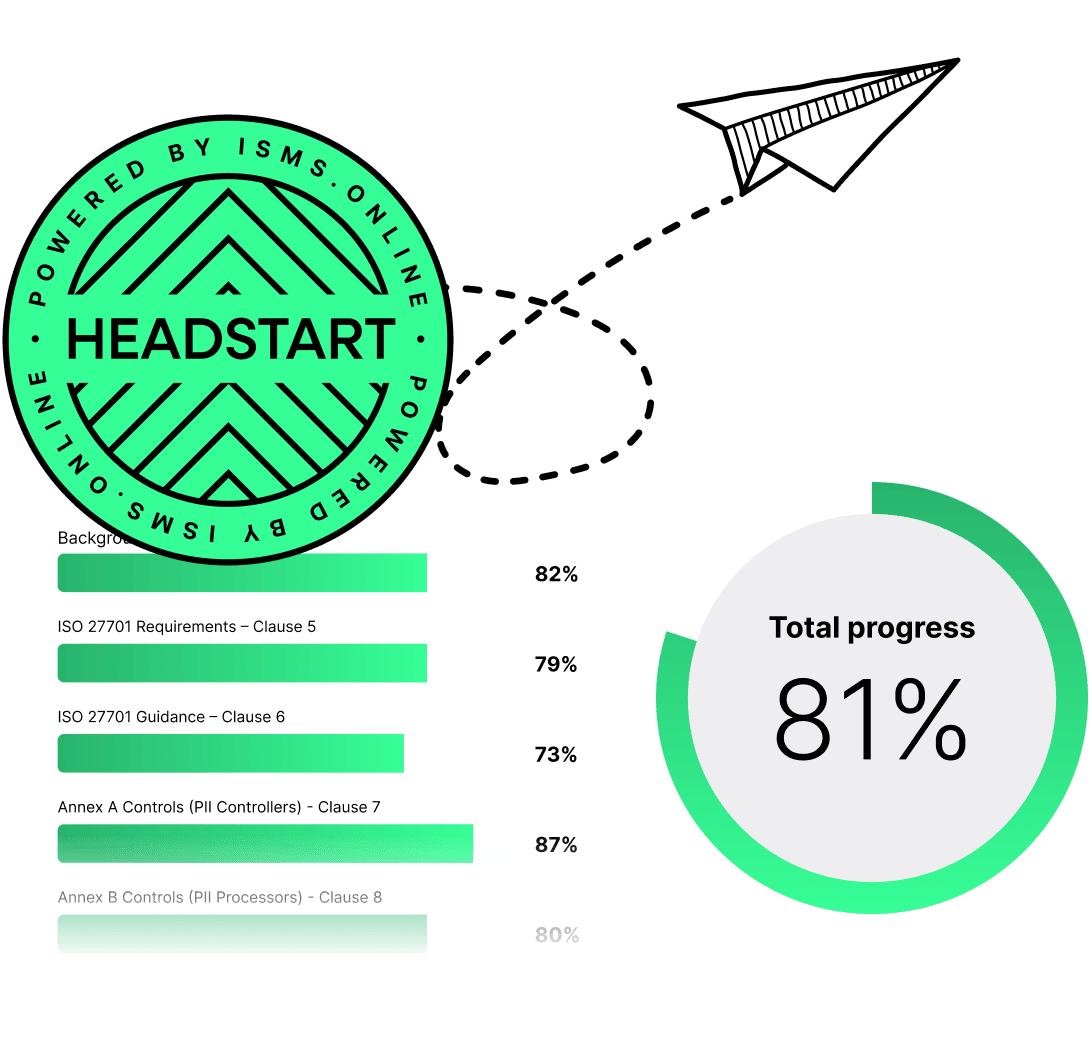
An 81% Headstart from day one
We’ve done the hard work for you, giving you an 81% Headstart from the moment you log on. All you have to do is fill in the blanks.
The MSP–ISO 27001 Process Mapping Framework
A simple mapping framework stops ISO 27001 work from becoming a one‑off spreadsheet and turns it into a reusable asset. By keeping a stable list of ISO requirements and a stable list of MSP services, you can show exactly which processes, owners and evidence satisfy each clause and control across customers and audits.
Once services and workflows are visible, you can define a framework that connects them systematically to ISO 27001 requirements. This is where mapping stops being an ad‑hoc exercise and becomes something you can maintain and reuse for audits, customer reviews and new frameworks.
Every effective mapping sits between two fixed lists: ISO 27001 requirements and your MSP service catalogue. Clarity about both lists prevents scope creep and makes later audits, changes and multi‑framework expansions much easier to manage.
The framework always sits between two stable lists:
- ISO list: clauses 4–10 of ISO 27001 (context, leadership, planning, support, operation, performance evaluation, improvement) plus the 93 controls in Annex A, grouped into organisational, people, physical and technological themes. The 2022 revision of ISO/IEC 27001 explicitly defines this structure, so it provides a natural backbone for your mapping work.
- MSP list: your master list of services and underpinning processes, such as onboarding and offboarding, service desk operations, change management, patching and vulnerability management, backup and recovery, access management, monitoring, incident response and supplier management.
According to the 2025 ISMS.online survey, a strong majority of organisations say the speed and volume of regulatory change are making security and privacy compliance increasingly hard to sustain.
Write both lists down explicitly. The mapping framework is then the set of relationships between items on these lists, plus information about who is responsible and what evidence exists.
Choose your primary mapping view
You can view the relationship between the ISO list and the MSP list in two main ways. Choosing one primary view keeps the framework simple to explain and maintain while still allowing you to pivot for different audiences.
The two common perspectives are:
- Standard‑first: for each clause and control, show which MSP processes and services implement it.
- Service‑first: for each service and process, show which clauses and controls it supports.
Both views are valid. A common pattern is to use a standard‑first matrix for auditors and certification bodies, and a service‑first view internally for service owners and architects.
The table below summarises how these two mapping views typically relate to different users.
| View | Primary user | Best for |
|---|---|---|
| Standard‑first | Auditors, vCISOs | Showing coverage of clauses and controls |
| Service‑first | Service owners, engineers | Explaining how services deliver assurance |
| Hybrid | Compliance leads | Switching between audit and operational views |
What matters is picking one as the primary organising principle and sticking with it so everyone understands how to read the mapping. If you adopt an ISMS environment such as ISMS.online, you can usually pivot between these views from the same underlying data rather than maintaining separate spreadsheets for each audience.
Decide on granularity and artefacts
Choosing the right level of detail helps you keep mappings accurate without creating unnecessary maintenance work. Aim for chunks of activity that are meaningful, stable and easy to explain to both technicians and auditors.
In practice this means:
- Breaking work into chunks that are meaningful and stable, such as “User lifecycle management” rather than separate items for joiners, movers and leavers.
- Avoiding splitting processes so finely that you cannot maintain the mapping when tools or teams change.
Then define a small set of artefacts you will maintain:
- A mapping register or matrix that connects requirements to processes and evidence.
- A Statement of Applicability that lists which Annex A controls are in scope and how they are treated.
- RACI charts: for major workflows.
- A traceability matrix that shows requirement → control → process → evidence → owner.
These artefacts all draw from the same underlying relationships; the framework simply decides how you present them to different audiences. With the framework clarified, the next step is to build a reliable inventory of services and workflows you can map against it.
Step‑by‑Step: Inventory and Document MSP Services and Workflows
An accurate, live inventory of services and real‑world workflows is the foundation of any useful ISO 27001 mapping. When you know exactly what you deliver, how work flows and where evidence is produced, you can scope your ISMS correctly and avoid both blind spots and unnecessary documentation for your managed service provider, so audits become more predictable instead of harder than they need to be.
Key steps to build your service inventory
Building a reliable service inventory is easier when you follow a clear sequence that assigns ownership, captures services, documents flows, links evidence and then baselines the result. These steps give you a stable picture of what you actually deliver before you start mapping clauses and controls.
Step 1: Nominate an inventory owner
Putting a named owner in charge of the service inventory stops it drifting away from reality. When someone is accountable for maintaining the list of services, processes and related evidence, changes in tooling or offerings are much more likely to be reflected promptly in your mapping.
Start by assigning clear ownership. Someone needs to be accountable for maintaining:
- The list of customer‑facing services.
- The supporting internal processes.
- Links to tools, assets and evidence.
In a smaller MSP this may be the head of service delivery; in a larger one it may sit with an operations excellence or ISMS manager. The key is that everyone knows who owns the list and how to request updates.
Step 2: Capture services in a structured catalogue
You cannot map what you cannot name, so the next step is to capture services in a structured catalogue. A simple, agreed catalogue also helps sales, delivery and customers talk about the same things in the same way and reduces confusion in scopes and contracts.
For each service:
- Name the service, such as “Managed Endpoint”, “Managed Backup”, “Managed Network” or “Managed Identity”.
- Describe what it does, who it serves and what value it delivers.
- Note the main inputs (requests, triggers, alerts) and outputs (tickets resolved, reports, changes).
If you already use an IT service catalogue, this is a matter of validating and enriching it. If not, this is your chance to create one that will support both operations and ISO mapping.
Step 3: Map how work really flows
Documenting how work actually flows in your MSP makes process descriptions credible and useful. Real workflows rarely match old diagrams, so you should describe what really happens today rather than how it was meant to work several tools ago.
For each service, identify its key workflows. Typical examples include:
- Client onboarding and offboarding.
- Service desk handling of incidents and requests.
- Change and release management.
- Patch and vulnerability management.
- Backup and restore.
- Access management for joiners, movers and leavers.
- Monitoring and incident response.
Document the real flow of work using simple diagrams or step lists and answer four questions: what triggers the process, what are the major steps and decision points, which roles are involved at each step and what tools they use. The goal is not perfection, but an agreed view that your technicians recognise as truthful.
Step 4: Link workflows to tools, assets and evidence
Linking each workflow to the tools, assets and records it touches turns diagrams into audit‑ready material. This step makes the difference between “we say we do this” and “here is the evidence that we do”.
As you document each workflow, connect it to:
- Tools: PSA queues, RMM modules, monitoring systems, backup platforms or identity providers.
- Assets: servers, endpoints, cloud environments or network segments that fall under the process.
- Evidence: tickets, logs, reports, dashboards, approvals and meeting minutes.
A simple way is to add a small section to each process description listing “Systems used” and “Evidence produced”. Later, when you map to clauses and controls, these entries will show where to find proof.
Step 5: Validate and baseline the inventory
Validation turns a draught inventory into a baseline you can rely on during audits. When the people who actually run the work agree that the descriptions are accurate enough, you can use the inventory with confidence in your ISO 27001 mapping.
Before using this inventory for ISO mapping:
- Walk each process through with the technicians who run it.
- Ask what is missing or outdated and adjust.
- Agree a simple baseline statement such as “valid as of Q2 2025”.
From this point on, changes should go through a light change‑control process so you can rely on the inventory during audits. Once your catalogue and workflows are baselined, you can confidently start mapping them to clauses 4–10.

Free yourself from a mountain of spreadsheets
Embed, expand and scale your compliance, without the mess. IO gives you the resilience and confidence to grow securely.
Step‑by‑Step: Map MSP Processes to ISO 27001 Clauses 4–10
With a trusted inventory, you can now connect your MSP’s real‑world processes to the management‑system requirements in ISO 27001 clauses 4–10. By linking real workflows, roles and evidence to each clause, you show that your information security management system is more than policy documents and that planning, operation, evaluation and improvement all happen through day‑to‑day service delivery rather than just on paper.
Understand clause intent in operational language
Translating each clause into operational language makes it much easier for service owners and engineers to engage. When people see clearly how their work satisfies a clause, they become more willing to help maintain the mapping and to suggest improvements.
You can translate the clauses along these lines:
- Clause 4 (Context): how you define scope, understand key issues and identify interested parties.
- Clause 5 (Leadership): how top management sets policy, assigns roles and shows commitment.
- Clause 6 (Planning): how you perform risk assessments, decide treatments and set ISMS objectives.
- Clause 7 (Support): how you provide resources, competence, awareness, communication and documentation.
- Clause 8 (Operation): how you plan, control and operate processes to treat risks.
- Clause 9 (Performance evaluation): how you monitor, measure, audit and review the ISMS.
- Clause 10 (Improvement): how you handle nonconformities and drive continual improvement.
Write a short, plain‑English summary for each clause. This is what you will use in workshops with process owners and technicians.
Run collaborative mapping workshops
Collaborative workshops are often the fastest way to build useful clause‑to‑process mappings. Bringing service desk, NOC, SOC, change management and risk owners into the same conversation usually surfaces existing good practice that has never been captured formally.
In workshops, work through clauses 4–10 in a structured way:
- For each clause, ask “Which of our processes contribute to this requirement?”.
- For each contribution, record the process name, relevant workflow steps, roles involved and the evidence produced.
Capture this in a simple matrix or spreadsheet. Aim for completeness over perfection; you can tidy later.
The table below shows a simplified example of how MSP processes can map to selected clauses.
| Clause | Example MSP process | Typical evidence |
|---|---|---|
| 4.3 | Scope definition and managed service catalogue | Scope statement, service list |
| 5.1–5.3 | ISMS steering meeting for managed services | Minutes, actions, role records |
| 6.1–6.2 | Risk assessment and treatment workshops | Risk register, treatment plan |
| 7.2–7.3 | MSP security awareness and training programme | Attendance logs, training materials |
| 8.1–8.2 | Change management for managed infrastructure | Change tickets, approvals, test records |
| 9.1–9.3 | Internal audit of services and management review meetings | Audit reports, review minutes |
You would expand this table to cover all in‑scope clauses and processes. For example, a “Managed Backup” service might support clause 6 (risk treatment), clause 8 (operation) and clause 9 (evaluation) through your backup schedule, restore tests and management review of backup performance.
Identify gaps and prioritise remediation
Working through the mapping will inevitably expose gaps and weaknesses. Seeing gaps in the context of real workflows makes it easier to decide which ones matter most and how to fix them without drowning teams in low‑value work.
Typical gaps include:
- Clauses with no supporting processes or controls.
- Processes with weak or missing evidence.
- Responsibilities that are unclear or split in confusing ways.
Record these gaps in a log with clause reference, description, risk impact, proposed action, owner and target date. Then prioritise actions based on risk and business impact rather than clause order. Fixing a gap that affects incident handling for many customers is usually more urgent than refining a management review template.
Embed mapping into governance
Embedding the clause‑to‑process mapping into your normal governance rhythm keeps it current and trusted. When mapping is reviewed alongside risk registers, KPIs and service changes, it remains useful rather than becoming a dusty artefact.
You can do this by:
- Reviewing the mapping at least annually and whenever you add or retire a core service or tool.
- Using it as a reference during internal audits and management reviews.
- Updating it whenever you change a process in a way that affects how a clause is met.
Treat the mapping as a living ISMS artefact and it will support both audits and decision‑making. With clauses covered, you can now turn to Annex A to show how everyday technical work satisfies the detailed controls.
Step‑by‑Step: Map Ticketing, Change, Monitoring and IR to Annex A A.5–A.8
Mapping ticketing, change, monitoring and incident response workflows to Annex A A.5–A.8 shows how ISO 27001 controls live inside your MSP’s daily operations. When each key workflow is tied to relevant organisational, people, physical and technological controls, auditors and customers can see that Annex A is being exercised in practice.
Annex A is where many MSPs feel ISO 27001 “lands” in their world. Mapping everyday workflows like ticketing, change, monitoring and incident response to the A.5–A.8 control set shows how your operations embody the controls in practice.
Classify workflows against Annex A themes
Classifying workflows against the four Annex A themes makes it easier to see which processes you rely on to operate specific control families. This helps you focus improvement effort where it will have the greatest assurance impact.
Annex A in the 2022 edition groups controls into four themes:
- A.5 Organisational: controls such as policies, governance and supplier management.
- A.6 People: controls such as screening, training and disciplinary measures.
- A.7 Physical: controls such as perimeters, entry controls and equipment security.
- A.8 Technological: controls such as access, logging, backup, malware, configuration, vulnerability and technical monitoring.
Summaries of ISO/IEC 27001:2022 confirm that these four themes are the organising structure for the 93 Annex A controls, so using them as a lens for your mapping keeps your view aligned with the standard.
For each core workflow, decide which themes it primarily supports. For example, ticketing for user access changes often maps to A.5 and A.8 (governance and access control), change management to A.5 and A.8 (governance and configuration), monitoring to A.8 (logging and technical monitoring) and incident response to A.5 and A.8 (governance and incident management).
The table below illustrates how a few common MSP workflows typically align with Annex A themes.
| Workflow | Primary Annex A themes | Example control types |
|---|---|---|
| User access changes | A.5, A.8 | Access control, approval and logging |
| Change management | A.5, A.8 | Configuration, testing and rollback |
| Monitoring and alerting | A.8 | Logging, anomaly detection and thresholds |
| Incident response | A.5, A.8 | Event handling, communication and recovery |
This classification helps you think deliberately about which controls you expect each process to implement.
Tag tickets and changes with control identifiers
Tagging tickets and changes with control identifiers lets you pull real evidence against Annex A controls in seconds. Over time, it also gives you useful data on how often controls run and where they may be weak or inconsistent.
You can make the mapping explicit inside your tools by:
- Adding a field to relevant ticket types or change records for “control reference”.
- Defining pick‑lists for the Annex A controls most relevant to that process.
- Training staff to select the control when they perform work that obviously implements it.
Over time, this builds a data set showing how often and how well each control is exercised. It also makes it easy to pull evidence for an auditor because you can philtre by control reference and export real records.
Map monitoring and incident response to controls
Monitoring and incident response are often the most visible parts of your service when something goes wrong, so mapping them carefully to Annex A controls is important. This mapping should reflect both detection and response activities.
For monitoring:
- Identify which alerts and dashboards support which controls, such as log collection and analysis for logging or threshold alerts for availability.
- Document these relationships in your process descriptions and mapping matrix.
For incident response:
- Align your incident categories and severities with Annex A expectations for event and incident handling.
- Ensure your playbooks include steps for classification, communication, containment, root‑cause analysis and improvement that reflect control wording.
- Capture post‑incident reviews and action tracking as part of your evidence set.
By doing this, you show that Annex A is not an abstract list but a set of expectations your workflows already meet.
Clarify shared responsibility for each control
Clarifying shared responsibility for Annex A controls helps avoid disputes when incidents, audit questions or commercial negotiations arise. For MSPs, this is especially important where responsibilities are split between platform, network and application layers.
For each relevant control, decide whether:
- The MSP designs and operates the control on infrastructure and managed platforms.
- The client owns application‑level roles, content and business approvals.
- Responsibility is shared, with agreed retention rules and disaster‑recovery testing.
You can reflect this in your control descriptions, RACIs and contracts. When audit or incident discussions arise, everyone sees the same agreed model.
Test the mapping with real evidence
A mapping only becomes credible when real evidence matches what you claim. Sampling records across controls gives you confidence before an auditor or major customer does the same exercise and asks awkward questions.
Validate your Annex A mapping by sampling:
- Tickets tagged with particular control references.
- Change records for high‑risk changes.
- Monitoring alerts and responses.
- Incident case files and review notes.
Check whether the records show what your mapping claims. If they do, you have strong proof; if not, adjust either the mapping or the workflow until they align. Once Annex A mapping is in place, you can use it to build RACIs, traceability and improvement loops that auditors value and your teams actually find useful.

Manage all your compliance, all in one place
ISMS.online supports over 100 standards and regulations, giving you a single platform for all your compliance needs.
Build RACIs, Traceability and Improvement Loops That Auditors Actually Use
Well‑designed RACIs, traceability matrices and improvement loops turn ISO 27001 mappings into tools that people actually use. Instead of static diagrams, you gain living structures that clarify who does what, where evidence lives and how controls improve over time across your MSP services.
Once mappings exist, the question becomes how to use them to run the business better and satisfy external stakeholders with minimal pain. RACIs, traceability matrices and improvement loops provide practical ways to operationalise the mapping.
Clarify who does what with RACIs
RACI matrices remove ambiguity by stating explicitly who is responsible, accountable, consulted and informed for each important activity. They also help you explain shared responsibility between your MSP and each client in a way that auditors and customers can understand quickly.
Around 41% of organisations in the 2025 ISMS.online survey cited managing third‑party risk and tracking supplier compliance as one of their top information‑security challenges.
A RACI matrix lists:
- The key activities or controls across your processes.
- The roles involved, on both the MSP and client side.
- How each role relates to each activity (R, A, C or I).
For example, in incident response the MSP incident handler may be responsible, the MSP vCISO or service manager may be accountable, the client security contact may be consulted and the client executive sponsor may be informed. Creating RACIs for your major processes demonstrates to auditors and customers that you have thought about governance, not just technology. If you lead service delivery, these charts also give you a practical way to clarify expectations with customers before something goes wrong.
Use a traceability matrix to keep everything connected
A traceability matrix links requirements to controls, processes, evidence and owners so you can answer most audit and customer questions from one place. When maintained well, it becomes the “map of maps” for your ISO 27001 implementation and a reliable way to show how your MSP’s services fit together.
You can think of a traceability matrix as the structure that joins:
- The clause‑to‑process mapping you built earlier.
- The Annex A mapping for operational workflows.
- Pointers to tickets, logs, reports and minutes.
Design it so you can philtre and pivot it easily by client, service, control family or owner. This makes it useful for audits, customer reviews, internal risk discussions and board reporting.
Good traceability turns audits into structured conversations instead of stressful scavenger hunts.
If you already operate an ISMS platform such as ISMS.online, the traceability matrix is often generated from the same underlying records you use for risks, controls and improvements, which reduces duplication and keeps everyone working from the same truth.
Turn mapping into a continuous improvement engine
Mapping really pays off when you use it to choose and track improvements. By reflecting control status and known weaknesses in the same structures you use for audits, you avoid running a separate, disconnected improvement list that nobody trusts.
You can do this by:
- Adding simple status fields such as “Not implemented”, “Partially implemented”, “Fully implemented” or “Automated”.
- Recording known weaknesses or risks linked to specific controls and processes.
- Assigning actions, target states and dates to owners.
Review these regularly in your ISMS or operations meetings. Over time, the mapping becomes a dashboard of how well your controls work and a roadmap of where to invest next in automation, documentation or training. If you own security and risk, this gives you a concrete way to show boards and customers how your control environment is improving between audits. At that point, the remaining question is whether you hold all of this together in spreadsheets or in an ISMS platform built to manage mappings, RACIs and evidence in one place.
Book a Demo With ISMS.online Today
ISMS.online gives you a single place to hold ISO 27001 mappings, controls and evidence so you do not have to juggle spreadsheets, shared folders and ad‑hoc documents. A short, focused demo helps you see how your MSP’s services and workflows would look inside a structured ISMS and whether that approach suits the way your organisation works.
Once your approach to mapping is clear, the real decision is whether you maintain it in separate spreadsheets and documents or use a dedicated ISMS platform to keep everything connected and under control. ISMS.online is designed to be that central place for ISO 27001 mappings, controls and evidence.
See an integrated mapping workspace in action
Seeing an integrated mapping workspace in use is often the fastest way to picture how your mappings will work in practice. Live examples of clause, control, process and evidence relationships give you a concrete view of how your own environment could look.
Instead of juggling scopes in one document, processes in another, controls in a third and evidence scattered across shared drives and tools, you can work in a single environment where:
- ISO clauses and Annex A controls are pre‑loaded and structured.
- Your MSP services, processes and owners are linked directly to each requirement.
- Evidence registers, tasks and reviews sit alongside the mappings they relate to.
Product information for ISMS.online aimed at MSPs describes how pre‑built ISO 27001 frameworks and control sets are available in the platform, so you configure and connect your services to an existing structure rather than building everything from scratch. Seeing this in a demo makes it much easier to understand how your mappings would behave in day‑to‑day use.
Use templates and content that reflect MSP reality
Starting from a blank page is slow and error‑prone, especially when you are under time pressure from customers or auditors. Working from patterns that already reflect MSP realities shortens the path to a credible first version and reduces the risk of missed requirements.
ISMS.online includes ISO 27001:2022 frameworks, policies and templates that can be adapted to an MSP context. The MSP‑focused guidance for the platform highlights template packs and structures designed around common managed services scenarios, so you can start from something close to your world and refine it rather than starting from nothing. Instead of building matrices and registers from scratch, you can:
- Start from patterns that already reflect typical MSP services and workflows.
- Adjust them for your particular PSA, RMM and monitoring stack.
- Focus effort on areas where your mapping has real gaps, rather than on formatting.
This reduces the time and risk involved in getting to a first audit‑ready state.
Collaborate across roles without losing control
Successful mapping is rarely a solo effort, particularly in a managed service provider. Founders, vCISOs, service delivery leaders, engineers and account managers all touch parts of the ISMS and need to see the same truth from different angles without losing control.
In a platform such as ISMS.online you can:
- Assign ownership of controls, processes and actions.
- Give different teams tailored views of the same underlying mappings.
- Track changes and approvals so you always know who changed what and when.
That makes it easier to keep the mapping aligned with reality as services, tools and customers evolve, and it supports both internal governance and external assurance.
De‑risk your decision with a structured evaluation
Exploring ISMS.online through a focused demo and pilot lets you test the fit before committing. By mapping a single service end‑to‑end, you can see how well the platform supports audits, customer questions and internal reviews for your MSP.
A sensible next step is to:
- Choose one core service, such as managed backup or managed endpoint.
- Map it into ISMS.online using your existing workflows and evidence.
- Use that pilot to test how the platform supports audits, customer questions and internal reviews.
If it works well, you can scale the same approach across your portfolio. If not, you still gain a clearer understanding of what your mapping needs to look like, whichever route you take. If you want your ISO 27001 mapping to be a durable, shared asset rather than a fragile project, ISMS.online is designed to help you get there with less friction and more confidence.
Book a demoFrequently Asked Questions
How can an MSP turn existing IT workflows into ISO 27001‑aligned processes without starting again?
You turn current MSP workflows into ISO 27001‑aligned processes by labelling and standardising what you already do, then mapping those flows to clauses, Annex A controls and live evidence your tools produce. The shift is to see tickets, changes, alerts and runbooks as building blocks of an Information Security Management System (ISMS), not just day‑to‑day admin.
What are the most efficient first moves for aligning existing workflows?
Start small, close to reality, and only add structure where it helps:
- Name the services your engineers actually run.: Use the same names and queues you see in your PSA and RMM: managed backup, patching, endpoint management, vulnerability management, identity and access management, change management, monitoring, incident response, onboarding and offboarding. Familiar language keeps your ISMS grounded in real work.
- Sketch how each service really operates.: On a single page, capture trigger, main steps, roles and tools. If your team instantly recognises the flow, keep it. If they push back, refine until the picture matches normal behaviour, not an idealised policy.
- Create a compact mapping table.: Start with five columns: ISO 27001 clause, Annex A control, process name, process owner, and evidence source (for example “change tickets in CAB‑APPROVED queue” or “backup success dashboard”). Leave control IDs until the structure feels right.
- Walk clauses 4–10 with process owners.: Rephrase each clause in plain English and ask, “Which of our workflows already help us do this?” Capture concrete artefacts such as ticket queues, change logs, dashboards and meeting minutes instead of inventing new documents.
- Overlay Annex A themes.: Tag access‑change tickets against access controls, configuration and change flows against A.8 technical controls, and monitoring outputs against logging and incident management. This keeps the standard’s structure intact while staying rooted in your operation.
Once those links exist, tagging tickets and changes with control IDs turns audit preparation into a simple philtre in your PSA, RMM or ISMS tool instead of a last‑minute trawl through exports. When you are ready to make the mapping durable, moving it into a platform like ISMS.online lets you connect clauses, processes, responsibilities and evidence in one controlled environment, rather than juggling multiple spreadsheets and slide decks.
Which everyday MSP processes naturally map to key ISO 27001 clauses and Annex A controls?
Most of your daily MSP activities already support ISO 27001; the usual gap is that these links are invisible or inconsistent. Clause 8 focuses on operation, while Annex A controls A.5–A.8 cover organisational, people, physical and technical controls, so almost everything that flows through your PSA and RMM touches something in scope for an Information Security Management System.
How do common MSP processes align with ISO 27001 in practice?
You can usually start from patterns like these, then refine for each customer:
- Client onboarding and offboarding.: These flows help with clause 4 (understanding context and interested parties) and clause 8 (operation). They map to Annex A themes such as information classification, acceptable use and joiner–mover–leaver lifecycle controls, including access provisioning and revocation.
- Change management.: Structured change tickets and CAB records underpin clause 8 by controlling how changes are requested, reviewed, approved, tested, implemented and rolled back. They align neatly with Annex A controls such as A.8.32 (change management), A.8.9 (configuration management) and A.8.20 (network security).
- Patch and vulnerability management.: Patch schedules and vulnerability scans support risk treatment in clause 6 and connect to A.8.7 (protection against malware), A.8.8 (management of technical vulnerabilities) and configuration‑related controls. They are often your strongest evidence that risks are being treated systematically.
- Backup and recovery.: Backup jobs, retention policies, restore tests and related tickets support availability objectives in clauses 6 and 8 and map directly to A.8.13 (information backup) and disruption‑focused controls such as A.5.29 (information security during disruption).
- Identity and access management.: Joiner–mover–leaver workflows, privilege requests and periodic access reviews span clauses 6, 7 and 8. They map to Annex A requirements for access policies and lifecycle control such as A.5.15 (access control), A.5.16 (identity management), A.5.18 (access rights), A.8.2 (privileged access rights) and A.8.5 (secure authentication).
- Monitoring and incident response.: Monitoring alerts, triage notes, incident tickets and runbooks cover clause 8 (operation) and clause 9 (performance evaluation). They align to Annex A controls for logging and monitoring (A.8.15, A.8.16), event reporting (A.6.8) and incident management (A.5.24–A.5.28).
If you capture those relationships in a concise matrix with process names, clause references, Annex A IDs and a couple of concrete evidence examples per row, auditors and customers can see quickly how your managed services support their ISMS or Annex L integrated management system. The same matrix doubles as a sales and assurance asset when you want to show prospects how your operating model underpins their own ISO 27001 ambitions.
How should an MSP document ISO 27001 mappings so auditors and customers can follow them quickly?
You document ISO 27001 mappings effectively by creating a small set of connected artefacts that let someone trace each requirement from standard text to live operational records in a few clicks. The aim is not volume; it is fast traceability and consistency.
What does an auditor‑friendly ISO 27001 mapping package look like for an MSP?
Three linked layers are usually enough:
- Traceability matrix.: One controlled table showing requirement → Annex A control → process → evidence → owner, with philtres for client, service and control family. An ISMS platform such as ISMS.online supplies clause and Annex A libraries up front, so you link them directly to your services, workflows and records instead of rebuilding the structure for each audit.
- Statement of Applicability (SoA).: A concise explanation of which Annex A controls you implement, how you implement them and where responsibilities are shared with customers. Use the same process names and evidence locations you use in your matrix so language stays aligned and people do not have to translate between documents.
- Process descriptions and runbooks.: Short descriptions or simple diagrams show triggers, key steps, roles and records. If a runbook tells engineers “log a P1 security incident to queue SEC‑INC and start IR‑001,” your mapping should reference that exact queue and runbook ID rather than a generic “security incident procedure,” so auditors can follow the trail quickly.
To make shared responsibilities clear, add a small set of RACIs for major activities such as incident triage, privileged access changes, restore tests and supplier reviews covering both MSP and client roles. When your matrix, RACIs, SoA and process descriptions live together in an ISMS platform, you can connect them to risks, audits and improvement actions so the documentation people rely on stays aligned with how you really operate.
How can an MSP build and use a RACI matrix to clarify ISO 27001 responsibilities with clients?
You use a RACI matrix to turn assumptions about “who does what” into explicit, reviewable agreements for each ISO 27001‑relevant activity. That clarity is essential in shared service models, where auditors and customers want to see exactly where your responsibility ends and the customer’s begins.
What is a practical way to create a RACI for MSP‑delivered services?
A straightforward approach usually follows four steps:
- List key activities across your services.: For each service line, capture tasks such as onboarding and offboarding, access provisioning and revocation, change approval and execution, patch deployment, backup scheduling and monitoring, restore testing, monitoring and alert triage, incident categorisation and handling, and supplier performance review.
- Define specific roles on both sides.: Avoid vague departments. Use roles such as MSP service manager, MSP security lead, MSP engineer, client IT owner, client data owner and client business sponsor so people can see themselves in the grid.
- Assign R, A, C and I for each activity.: Set one Responsible (does the work) and one Accountable (owns the result), then decide who should be Consulted and Informed. For a firewall rule change, for example, the MSP engineer might be Responsible, the MSP service manager Accountable, the client IT owner Consulted and key business stakeholders Informed.
- Embed the RACI across your artefacts.: Reference the matrix in contracts, service descriptions, runbooks and ISO 27001 mappings so everyone is working to the same picture. When a service or contract changes, update the RACI once, then make sure linked documents inherit the adjustment.
Once RACIs are in use, they reduce delays and disagreements during incidents, customer assessments and audits by giving teams a shared, pre‑agreed view of who leads, who signs off and who needs to stay informed. Managing the matrix in an environment like ISMS.online means service changes, new verticals or regulatory updates can trigger RACI reviews automatically, keeping your role definitions in step with your real delivery model instead of buried in old slide decks.
How often should MSPs review ISO 27001 mappings, and who needs to be involved?
You should review ISO 27001 mappings on a cadence that mirrors your audit schedule and rate of change, combining at least one full annual review with targeted updates after significant shifts in services, tools or risk. The aim is to keep mappings accurate without turning maintenance into a constant drain on delivery teams.
What review rhythm works in a busy MSP environment?
Most MSPs settle on a blended pattern:
- Annual end‑to‑end review.: Often aligned with internal audits or ISO 27001 management reviews, this pass checks that all applicable clauses and Annex A controls map to the right services and processes, that evidence pointers still resolve correctly, and that RACIs still match how work is carried out on both MSP and client sides.
- Change‑driven updates.: Trigger a focused review when you introduce or retire major tools (for example PSA, RMM, monitoring or backup platforms), launch or close a core service such as SOC, XDR or cloud security, enter a new highly regulated vertical, or learn from incidents, customer feedback or external audits that reveal gaps in your mapping.
Getting the right people into these reviews keeps them efficient. A vCISO, security lead or ISMS manager usually owns the overall mapping and coordinates the work. Heads of service delivery, NOC/SOC leads and senior engineers provide operational details and highlight where workflows have shifted. Account managers add customer‑specific expectations, while internal audit or quality colleagues help test whether mappings, RACIs and evidence will stand up under external scrutiny. If your mappings, SoA and RACIs sit in ISMS.online, workflows, reminders and dashboards can schedule reviews, record decisions and track improvement actions so leadership sees mapping health alongside the rest of your ISMS performance.
How does using an ISMS platform like ISMS.online change day‑to‑day ISO 27001 mapping for MSPs?
Using an ISMS platform turns ISO 27001 mapping from a document‑heavy exercise into an operational system that links standards directly to the services you run. Instead of maintaining separate files for clauses, controls, services, risks, RACIs, audits and evidence, you work in one structured environment where each item is linked, version‑controlled and easy to review.
What practical advantages does an ISMS platform offer over spreadsheets for MSP mappings?
Teams usually feel the benefits in three areas:
- Quicker, more reliable mapping.: Clause and Annex A libraries come pre‑loaded, so you focus on deciding which requirements apply and how your MSP meets them. You can link each control directly to services, workflows, roles and concrete evidence such as ticket queues, monitoring dashboards, backup logs and change approvals, rather than copying references between sheets.
- Stronger governance and ownership.: Each clause, control, process and mapping can carry an owner, review date and status flag. Internal audits, risk reviews and management meetings draw on the same live data that engineers and service managers rely on every day, reducing surprises and making it obvious when something needs attention.
- Faster, more consistent responses to stakeholders.: When auditors, customers or insurers ask how you handle access management, logging, backup or incident response, you can philtre by control or service and export linked examples instead of constructing answers from scratch. That saves preparation time, speeds security questionnaires and keeps responses consistent across customers, years and frameworks such as ISO 27001, SOC 2 and ISO 27701.
Many MSPs notice an immediate drop in effort for certification, surveillance and customer assessments once mappings, SoA, RACIs and evidence live together in an ISMS. Over time, the bigger benefit is that your ISO 27001 mapping becomes a shared asset for sales, service design and risk conversations, not just a compliance task. If you want your own team to experience that change, spending an hour walking through a real ISMS.online view of your services and controls often uncovers improvements you can put in place well before your next external audit or major customer review.






