





































MSPs at a Turning Point in Trust and Security
MSPs are now judged as much on how they manage security as on uptime, responsiveness, or price. ISO 27001 gives you a structured, externally recognised way to prove that you manage information risk across people, process, and technology, turning security from a vague promise into a visible part of your value proposition.
When trust is vague, buyers default to caution; when trust is evidenced, they default to progress.
Customers, regulators, and insurers increasingly treat you as part of their critical infrastructure, so informal security practices and ad hoc answers to questionnaires are no longer enough. National cyber‑security authorities have highlighted this explicitly: for example, guidance on supply‑chain attacks from organisations such as CISA treats MSPs and other digital suppliers as critical components of their customers’ resilience, not just background IT providers. The change can feel uncomfortable, but it is also a chance to turn security from a hidden weakness into a differentiator that supports bigger, more demanding customers.
A majority of organisations in the 2025 ISMS.online State of Information Security survey reported being impacted by at least one third‑party or vendor security incident in the past year.
Not long ago, many MSPs could grow on technical skills and relationships alone. Today, you are being assessed on something less visible but far more consequential: whether you can prove you manage security in a structured, repeatable way. Enterprise and regulated customers want more than a slide listing tools; they want evidence that you run security as a management system that spans people, processes, and technology.
As expectations rise, you may notice familiar symptoms: security reviews taking longer, more prospects asking for attachments and policies, and more internal time spent “chasing answers” across teams. That is trust debt: the hidden cost of not having a single, auditable storey about how you keep customer environments safe and how you would respond when something goes wrong.
A useful way to see the shift is to compare the “before” and “after” states many MSPs move through when they adopt ISO 27001 and a formal Information Security Management System (ISMS).
| Perspective | Before ISO 27001 & ISMS | After ISO 27001 & ISMS |
|---|---|---|
| Founder / MD | Deals delayed by vague security stories | Certification and ISMS give a clear, independent trust signal |
| Operations | Scattered SOPs and engineer‑by‑engineer habits | Standardised workflows mapped to risks, controls, and evidence |
| Security lead | Spreadsheets, manual tracking, reactive audits | Central ISMS with risks, controls, and audits in one living system |
| Sales / Accounts | Repeating answers for every questionnaire | Reusable assurance pack that satisfies most security questions |
If you recognise the “before” column, ISO 27001 and an ISMS are likely the inflexion point you are approaching. A platform such as ISMS.online exists precisely to help you make that transition, consolidating risks, controls, and evidence into one system that aligns to ISO 27001 and satisfies accredited auditors, so every conversation about security can start from a position of confidence.
How this turning point shows up in your day‑to‑day business
In practice, this turning point rarely appears as a single dramatic incident; it usually arrives as an accumulation of friction across sales, operations, and security. The pattern is the same: more questions, longer reviews, and growing unease about whether your current way of managing security will stand up to scrutiny.
You might see that pattern in moments such as a promising opportunity slowing down at “security review”, a key customer asking tougher questions after a news‑worthy breach elsewhere, or an investor probing your resilience and supplier oversight. These signals show that customers now see your security posture as part of their own risk storey, not just a background IT concern.
Examples often include:
- Sales teams spending more time on security than on pricing or scope.
- Engineers being pulled into last‑minute questionnaire firefights.
- Inconsistent statements about where data lives and who has access.
- Growing anxiety about what would happen if a remote management tool was compromised.
You can treat these as random headaches-or as early warnings that it is time to move from informal reassurance to a recognised, auditable framework such as ISO 27001, backed by a living ISMS.
Why MSP trust now depends on more than tools
MSP trust now depends on the system behind your tools, not the tools themselves. Many MSPs already use strong security products such as endpoint protection, backup, monitoring, and privileged access management. When customers ask, How do you manage security?, they are really asking about the decisions, checks, and accountabilities that sit behind that stack.
They want to know how you decide what to protect, how you check controls are working, who is responsible for what, and how you improve when things go wrong. Without that system, you end up telling different versions of your storey to different customers. With it, you can show a single, coherent picture of risk, controls, and governance-exactly what ISO 27001 is designed to formalise and independent auditors are trained to test.
Book a demoISO 27001 in Plain Language for MSP Leaders
ISO 27001 is the international standard for running an Information Security Management System (ISMS) across your organisation, so you make informed decisions about risk and can prove you follow through. The standard is described by ISO itself as an international benchmark for establishing, implementing, maintaining, and continually improving an ISMS, as set out in its ISO/IEC 27001 overview. For MSPs, it turns security from an informal collection of good intentions into a documented, auditable way of running the business that customers and certification bodies recognise.
ISO 27001 gives you a structured way to decide what is important, put proportionate safeguards in place, and show that you keep those safeguards working over time, without turning security into a separate, theoretical universe. Instead of being a checklist of technical settings, ISO 27001 is a framework for how you run information security as part of the business. At its heart, it asks you to do four things:
- Understand your context and information risks.
- Decide what you will do about those risks.
- Operate those decisions through policies, procedures, and controls.
- Review and improve regularly.
For an MSP, that maps neatly onto how you already think about service delivery: what you support, how you do it, how you know it is working, and how you fix it when it is not.
What ISO 27001 actually is (and is not)
In simple terms, ISO 27001 is a set of requirements for how you run information security as a management system, backed up by accredited certification audits. It covers topics such as leadership commitment, risk assessment, documented information, internal audit, and continual improvement, and it points to a catalogue of reference controls (Annex A) that you consider and apply where relevant.
ISO 27001 is not a rigid technical configuration guide, a guarantee that incidents will never happen, or a badge you can buy without changing how you operate. It does not replace specialist security tools or remove the need for good engineering. Instead, it gives you a common language to use internally and with customers. You can explain which risks you have identified, which controls you have chosen, and why that approach is appropriate for your size, services, and customer base.
This shared language makes security discussions less emotional and more anchored in reasoned decisions. It also aligns with how external auditors think: they expect to see a clear line from risk identification to control design, operation, monitoring, and improvement, rather than a disconnected list of tools.
How an ISMS fits the way an MSP already works
An ISMS fits naturally around the operational machinery you already use to run your MSP, so you do not have to reinvent your entire way of working. If you visualise your business today, you already have many of the building blocks of an ISMS; you typically lack only a unifying structure to tie them together and make them auditable.
Common examples include:
- A ticketing or PSA system for requests, incidents, and changes.
- Monitoring and logging tools for your platforms and customer environments.
- Onboarding and offboarding processes for users and customers.
- Supplier relationships with cloud providers, software vendors, and datacentres.
- Regular team meetings and leadership discussions about risks and priorities.
ISO 27001 does not ask you to throw these away; it asks you to connect them. That means defining which services, locations, and assets are in scope; listing your information risks and how you treat them; writing policies and procedures that reflect how you actually work; and proving with records and metrics that the system runs as described.
A platform like ISMS.online makes that connection easier by giving you a single place to manage scope, risks, policies, controls, and evidence. Instead of wrestling with separate folders, spreadsheets, and ad hoc documents, you can maintain one coherent ISMS that everyone can see and use, and that external auditors can navigate efficiently when they test your controls.
ISO 27001 made easy
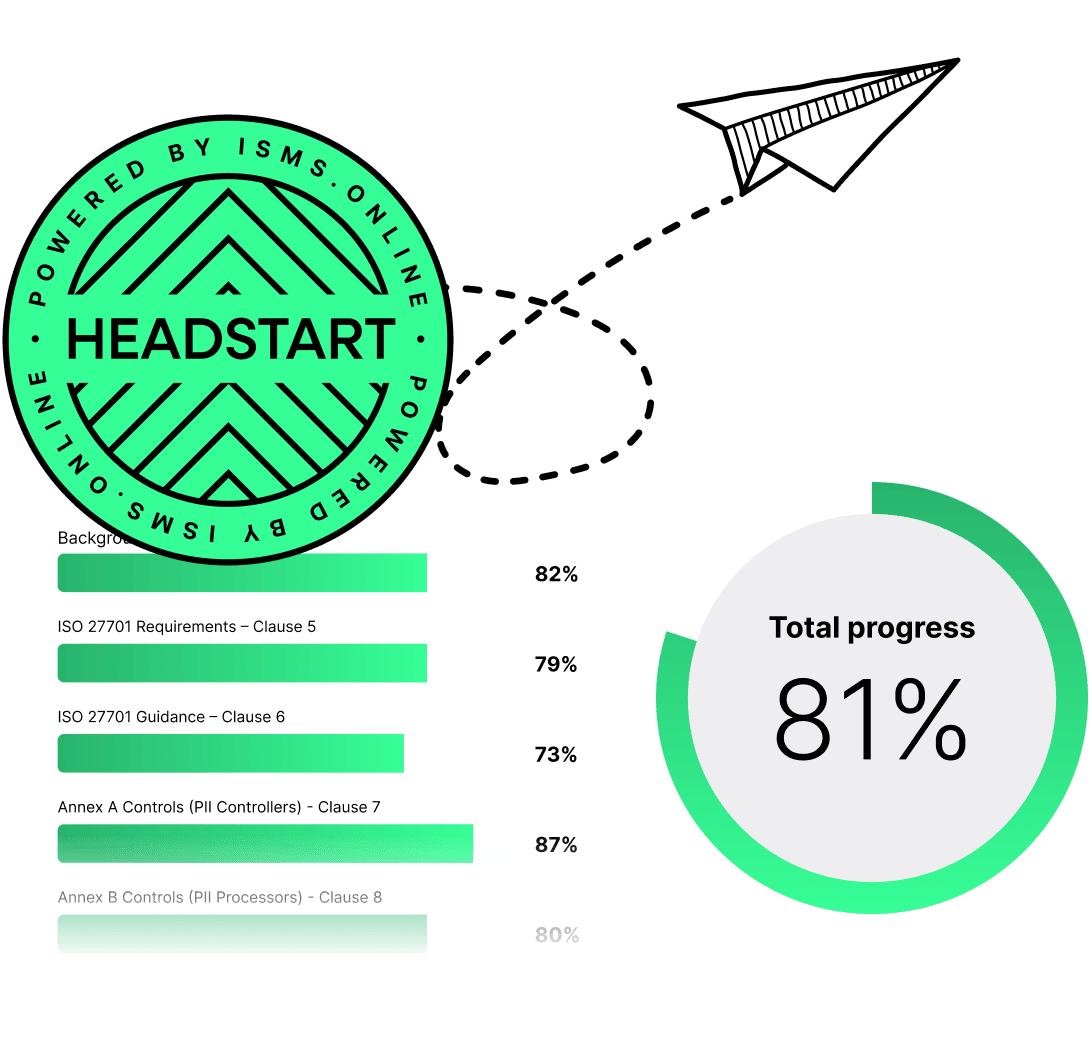
An 81% Headstart from day one
We’ve done the hard work for you, giving you an 81% Headstart from the moment you log on. All you have to do is fill in the blanks.
Why ISO 27001 Is Becoming Non‑Negotiable for MSPs
ISO 27001 has quietly shifted from a nice‑to‑have to a practical gatekeeper for MSP growth and credibility. Your customers are under increasing pressure to prove that their suppliers are secure, and they are expected to show structured evidence, not informal assurances; ISO 27001 is a widely accepted way to provide that evidence in a format regulators, auditors, and insurers recognise.
In many tenders and supplier assessments, ISO 27001 is now a philtre. Certified providers can often move to the next stage more easily, while non‑certified providers may be asked for extra documentation or excluded altogether. Industry research on managed services and buyer expectations, including MSP market trend reports, describes certifications and attestations as practical tools for procurement teams to shortlist suppliers quickly. That does not mean every MSP must certify immediately, but “we’ll think about it later” quietly narrows your options over time and adds to the trust debt you carry.
External forces you cannot ignore
Several external forces are driving ISO 27001 up your agenda, whether or not customers name the standard explicitly. Each of them changes how you are judged as a supplier, even in sectors that do not see themselves as heavily regulated, because buyers map their own obligations onto your controls and audit trail.
In the 2025 ISMS.online survey, around 41% of organisations named managing third-party risk and tracking supplier compliance as a top information-security challenge.
Three trends matter most:
- Regulation: – Laws and guidance on cyber resilience, outsourcing, and data protection increasingly require risk‑based security and supplier oversight. Supervisory statements from financial and prudential regulators, such as the Bank of England’s outsourcing and third‑party risk management guidance, emphasise structured oversight and due diligence over critical suppliers, and many customers translate those expectations into ISO 27001‑aligned requirements for MSPs.
- Procurement practice: – Large buyers standardise security questionnaires and due‑diligence processes. ISO 27001 certification gives procurement teams a straightforward way to tick multiple boxes quickly using a familiar, third‑party‑verified standard.
- Insurance and finance: – Insurers and investors are increasingly factoring cyber risk into their decisions rather than treating it as a background issue. Analyses of cybersecurity and the private sector, such as legal and risk commentary, highlight how better governance and clearer evidence of risk management can make underwriting or investment conversations easier.
If you serve or plan to serve financial services, healthcare, public sector, or mid‑market enterprises, these forces are already shaping how you are evaluated-even if the wording in each questionnaire varies. As standards for critical suppliers tighten, MSPs that cannot demonstrate structured security management find themselves pushed to the margins of higher‑value opportunities.
When security assurance becomes a buying criterion, the absence of evidence behaves like evidence of absence.
Competitive consequences of waiting
Your timing on ISO 27001 affects which opportunities you can pursue and how hard you must work to prove security. Early adopters of ISO 27001 typically find that they can respond faster and more consistently to security reviews, qualify for opportunities where certification is mandatory, and use their ISMS storey in marketing and sales, not just in audits.
By contrast, MSPs that postpone the decision often experience:
- Growing internal workload answering bespoke security questions.
- Confusion about who “owns” security across the business.
- Difficulty articulating a clear, consistent security narrative when it matters most.
All of that is another form of trust debt: time, effort, and opportunity lost because you cannot show your security posture simply and convincingly. As an MSP leader or security owner, your decision to adopt ISO 27001 is therefore not only about compliance; it is about the kind of customers you want, the level of scrutiny you are willing to meet, and the quality of conversations you want your teams to have.
This naturally leads to a more detailed question: which MSP‑specific risks does ISO 27001 actually help you manage, and how does that change what you can prove to customers?
Common MSP Risks that ISO 27001 Directly Addresses
ISO 27001 addresses the risks that are baked into the MSP business model, especially the risks around powerful remote access tools, shared platforms, and broad administrative permissions. Those risks are amplified by the very elements that make your business efficient: remote management and monitoring, shared infrastructure, and wide‑ranging access to multiple customer environments.
When you look back at your last year of incidents and near‑misses, you will probably recognise patterns that ISO 27001 is designed to tackle. Formalising how you handle those patterns is what turns “we fix problems quickly” into “we manage risk systematically”, which is exactly what external auditors and larger customers want to see.
Risks baked into the MSP business model
As an MSP, the biggest security risks arise from the scale and power of your tools and access. Some of the highest‑impact scenarios include:
Only about one in five organisations in the 2025 ISMS.online survey reported that they suffered no data loss in the past year.
- Privileged access misuse or compromise: – Shared admin accounts, poorly managed passwords, or weak multi‑factor authentication can turn your remote management and monitoring tools into an attacker’s shortcut into many customers at once.
- Configuration drift and change errors: – Different engineers using different practices can leave gaps in firewall rules, backup jobs, or monitoring, which attackers or accidents can exploit.
- Supplier failures or weaknesses: – If a cloud provider, software vendor, or security tool has issues, your customers experience them through you, even if the root cause lies elsewhere.
- Data handling uncertainty: – Teams may not share a clear view of where customer data lives, who can see it, how long it is retained, and what happens when a contract ends.
- Inconsistent incident handling: – Some incidents are handled informally, others through tickets, and lessons learned may not be captured or applied consistently across similar services.
These risks are manageable, but only if you treat them explicitly and record how you control them. Relying on “good people who know what they are doing” does not scale when you take on more customers, add new services, or experience staff turnover.
How ISO 27001 maps onto those risks
ISO 27001’s management system and Annex A controls cluster naturally around the areas where MSPs are most exposed, including identity, operations, suppliers, and continuity. Instead of tackling each issue in isolation, you use the standard to coordinate controls across the whole service portfolio in a way that auditors can follow and customers can understand.
The standard helps you improve, among other things:
- Access control and identity management: for staff and shared tools, so administrative access is individual, least‑privilege, and regularly reviewed.
- Operations security: including change management, logging, and monitoring, so configuration changes follow clear rules and can be traced back when something goes wrong.
- Backup and recovery: for both your platforms and customer data, including defined restore objectives and tested recovery procedures.
- Supplier security: for cloud, software, and other third parties, with due diligence, contracts, and periodic reviews that match their impact on your services.
- Incident management: including communication with affected customers and recording lessons learned in a structured way.
- Business continuity and resilience: , so you can continue supporting customers during disruption, whether the problem is technical, physical, or organisational.
By linking each of your key risks to specific controls and procedures, you can answer questions like “How do you manage privileged access?”, “What happens if your RMM vendor has a security issue?”, or “How do you handle backup failures?” with concrete, evidenced answers, not just general assurances. That level of clarity is the difference between hoping a questionnaire goes well and being confident that your responses will satisfy both customers and certification bodies.
Once you understand that ISO 27001 fits your actual risk profile, the next challenge is practical: how do you implement it without overwhelming your teams?

Free yourself from a mountain of spreadsheets
Embed, expand and scale your compliance, without the mess. IO gives you the resilience and confidence to grow securely.
A Practical ISO 27001 Implementation Journey and Sustainable ISMS for MSPs
Implementing ISO 27001 as an MSP can be done in manageable phases that fit around service delivery rather than disrupting it. You do not need to stop everything else; you need a clear scope, a realistic plan, and tooling that turns day‑to‑day activity into evidence. The goal is not just to “pass the audit” once, but to embed a system you can maintain without burning out your team.
A useful way to think about the journey is in three broad phases: scope and gap analysis, design and implementation, and audit and improvement. Each phase builds on the last and should leverage the processes and tools you already have, especially your PSA, monitoring, documentation, and supplier management practices.
Phase 1: define scope and understand the gap
In Phase 1, you decide what parts of your business the ISMS will cover and how far your current practices already align with ISO 27001. A clear, agreed scope prevents arguments later and keeps effort focused on the services and locations that matter most to customers and auditors.
You can turn that into a short, practical sequence.
Step 1: draw and agree the scope
Draw a simple scope diagram that business and technical stakeholders understand. Include key services, customer types, locations, and systems that fall inside the ISMS boundary, so everyone knows exactly which environments, platforms, and data flows are covered.
Step 2: list assets and owners
Identify key assets such as platforms, tools, and data types, and record who is responsible for each. Clear ownership makes later decisions on risk treatment and controls much easier, and auditors will expect to see that responsibilities are defined rather than assumed.
Step 3: run a structured gap assessment
Compare your current policies, procedures, and controls against ISO 27001 clauses and Annex A. Note where you already meet requirements and where you have partial or missing coverage so you can focus effort where it matters, rather than trying to improve everything at once.
Using a platform like ISMS.online at this stage gives you pre‑structured registers for assets, risks, and controls. That turns gap analysis from a blank‑page exercise into a guided review where you fill in and refine, rather than invent structure from scratch, and it helps you demonstrate to auditors that you approached implementation in a systematic, risk‑based way.
Phase 2: design and implement your ISMS
Phase 2 is where you formalise how security works in your MSP so that it can be run, checked, and improved consistently over time. The aim is to design an ISMS that feels natural to operate, not a parallel bureaucracy that nobody wants to touch once the audit is over.
In this phase you typically:
- Write or refine security policies so they match how you actually deliver services, avoiding copy‑paste documents that staff will not recognise.
- Document procedures for access control, change management, backup, incident response, supplier management, and related activities, linking them to real systems such as your PSA, RMM, and documentation tools.
- Link risks to controls and define a risk treatment plan that explains why your choices are proportionate for your size, services, and customer base.
- Train staff on their roles and responsibilities within the ISMS, and record their understanding through acknowledgements or short awareness activities.
You can and should reuse as much of your existing operational machinery as possible. For example, change management may already happen in your PSA system; in the ISMS you define decision points, approvals, and records that make those changes auditable. Incident response may already involve on‑call engineers and standard steps; you formalise escalation paths, customer communication, and post‑incident reviews. Supplier management may already be part of procurement; you formalise security criteria, contractual expectations, and review cycles.
ISMS.online helps by providing templates and workflows aligned to ISO 27001, reducing the effort needed to organise and maintain documentation. That keeps the focus on making real improvements rather than wrestling with formatting or wondering whether you have missed something obvious from the standard, and it makes it easier to show auditors that your policies and procedures are actually in use.
Phase 3: internal audit, certification, and continual improvement
Phase 3 is about proving that your ISMS works and using that insight to improve it. Before you invite an external certification body, you test your ISMS yourself through internal audits and management reviews. The aim is to check whether what you documented reflects reality, whether controls are effective, and where you need corrective actions.
Typical activities include:
- Planning and performing internal audits covering key processes and controls, using impartial auditors where possible.
- Recording nonconformities and improvement opportunities, then assigning and tracking actions through to completion.
- Running a management review that looks at risks, incidents, audits, resourcing, and changes in context, so leadership can steer security deliberately.
After internal audits and a management review, you schedule formal certification audits (Stage 1 and Stage 2). External auditors examine your documentation, interview staff, and sample evidence from your operations. When they are satisfied that your ISMS meets ISO 27001, you receive certification and move into a rhythm of surveillance audits and continual improvement, usually on an annual cycle. Accreditation bodies such as UKAS describe this as an initial three‑year certification period with yearly surveillance visits, as outlined in their ISO/IEC 27001 technical bulletin, so you have regular opportunities to demonstrate progress.
When your ISMS is implemented on a platform like ISMS.online, much of the evidence needed for these activities is captured as your teams work. Change approvals, incident records, risk reviews, and policy acknowledgements all contribute to the audit trail. That makes ongoing maintenance far more manageable and helps you treat ISO 27001 as a living system rather than an annual scramble.
Once your ISMS is in place, the next question is which Annex A controls deserve special attention for MSP services built on cloud, network, and security platforms.
Annex A Controls that Matter Most for Cloud, Network and Security MSPs
Annex A of ISO 27001 is a list of reference controls. In the 2022 version, there are 93 controls grouped into four themes: organisational, people, physical, and technological. This structure is reflected in many explanatory guides to ISO 27001:2022, such as practitioner overviews of the standard, which summarise how the controls are organised to support risk‑based implementation. As an MSP, you must consider them all, but some are especially critical given your services, the tools you use, and the type of access customers grant you.
Rather than treating Annex A as a long, abstract list, it helps to focus on the controls that directly reduce the impact of mistakes or attacks in your environment and your customers’ environments. Those controls both lower risk and give you strong stories to share with customers during security reviews and audits.
Controls that protect your admin pathways
Your remote access and management tools are powerful; if someone misuses them, they can affect many customers at once. Controls that focus on these pathways are some of the most important decisions you will make, and are usually examined closely by experienced auditors.
Priority areas include:
- Strong identity and access management: – Individual accounts, least privilege, multi‑factor authentication, and regular access reviews for all administrative systems, including RMM, PSA, and cloud consoles.
- Secure configuration and hardening: – Standardised baselines for servers, network devices, and cloud resources you manage, so engineers are not improvising per customer and leaving gaps that are hard to detect.
- Logging and monitoring: – Centralised, tamper‑resistant logs for key platforms, with clear thresholds for alerts, defined responsibilities for review, and documented response actions when something unusual appears.
- Use of cloud services: – Controls that govern how you choose, configure, and monitor cloud services on which your offering depends, including vendor due diligence and contractual requirements for security and incident reporting.
Implementing these controls well not only reduces the likelihood and impact of a compromise; it also gives you concrete evidence to show customers that you are serious about protecting the pathways into their environments. For example, you can demonstrate that only named, authorised staff can access a customer’s environment, that access is logged, and that inactive permissions are removed on a defined schedule.
Controls that protect client environments and data
Beyond your own platforms, you share responsibility for how customer environments are protected and recovered. Controls that govern how you design, run, and monitor those environments are central to your credibility as an MSP, especially when customers ask about worst‑case scenarios.
Important control areas include:
- Network security and segregation: – Clear segmentation between management networks, customer networks, and internet‑facing zones, with documented rules and change control for firewalls, VPNs, and routing.
- Backup and recovery: – Documented backup strategies, regular testing of restores, and clear responsibilities for each part of the backup chain (you, the customer, and third parties), so you can talk confidently about resilience rather than hoping backups will work.
- Information classification and handling: – Rules about how different types of customer data are stored, accessed, transmitted, and disposed of, including how you handle logs, support records, and off‑boarding.
- Supplier security: – Due diligence and ongoing oversight of vendors whose services directly affect your customers, including contractual clauses about security, access, and incident reporting.
- Incident management: – A defined process for detecting, triaging, investigating, and communicating incidents, including when and how customers are informed and how you record lessons learned.
You can summarise the benefit of focusing on these control themes in a simple comparison.
| Control theme | Day‑to‑day focus | What it proves to customers |
|---|---|---|
| Admin pathways | How engineers access and manage systems | You protect the “keys to the kingdom” |
| Client environments | How networks, backups, and data are handled | You design and run secure, recoverable services |
| Supplier dependencies | How you choose and oversee third parties | You take responsibility for outsourced components |
When you map these controls to specific services-cloud hosting, managed networks, SOC or MDR services-you create a clear link between ISO 27001 and the outcomes customers care about: availability, confidentiality, and integrity of their systems and data. That link lays the foundation for using certification not only to satisfy auditors, but also to support revenue growth and stronger renewals.

Manage all your compliance, all in one place
ISMS.online supports over 100 standards and regulations, giving you a single platform for all your compliance needs.
How ISO 27001 Certification Translates into Revenue and Retention
Used well, ISO 27001 certification can be a revenue and retention asset, not just an audit cost. The certificate itself is proof that an accredited independent body has examined your ISMS and found it effective; the way you present and use that proof in commercial conversations is what turns it into new business and stronger renewals. Business‑focused ISO 27001 explainers, such as independent overviews of key benefits, often highlight competitive differentiation and customer trust as important outcomes of certification.
Think of certification as a way to answer the most common security questions once, in a structured form, instead of many times in slightly different ways. That reduces friction for your team and gives buyers more confidence in their decision, especially when they are comparing multiple MSPs with similar technical offerings.
Winning new business with a clearer security storey
ISO 27001 certification can make a visible difference in how you win new customers. When you are competing for business, it can:
Almost all organisations in the 2025 ISMS.online State of Information Security survey list achieving or maintaining security certifications such as ISO 27001 or SOC 2 as a top priority.
- Improve qualification: – Some opportunities treat you as eligible where non‑certified competitors must provide extra justification or are excluded at the first security philtre.
- Shorten security reviews: – A well‑packaged assurance pack (certificate, high‑level Statement of Applicability, ISMS summary) can satisfy a large proportion of standard questions, reducing back‑and‑forth.
- Increase trust with non‑technical buyers: – Business decision‑makers may not know every detail of the standard, but they recognise the value of independent verification and the discipline behind it.
Articles on ISO 27001’s commercial impact, such as overviews of certification benefits and requirements, describe buyers using certification as a practical eligibility check in RFPs and supplier evaluations. You can reflect this in practical changes such as adding a concise ISMS summary section to every proposal, making your certificate and core policies available under controlled conditions, and training sales and account teams to talk about your ISMS in business language rather than control codes. Over time, this shifts the conversation from “Can we trust you?” to “How can you help us go further with security and resilience?”.
Many MSPs find that once they are certified, conversations start to move up a level. Instead of being interrogated about obscure technical issues, they are asked higher‑value questions about joint improvement plans, shared incident exercises, or how your services can help them meet their own regulatory obligations. Certification opens the door; your expertise and services then determine how far you go through it.
Protecting renewals and account growth
Certification also matters after the initial sale, when customers periodically review their suppliers or when a high‑profile incident elsewhere raises concerns. Being able to show that you are not standing still on security can make the difference between a straightforward renewal and a difficult re‑tender that invites competitors in on the back of a security scare.
About two‑thirds of organisations in the 2025 ISMS.online survey say the speed and volume of regulatory change are making security and privacy compliance harder to sustain.
Over time you can use your ISMS to show:
- Trends in risk treatment and incident learning that demonstrate improvement rather than stagnation.
- Evidence of regular internal audits and management reviews, showing leadership attention to security.
- Records of supplier assessments and improvements, which reassure customers that you manage your own supply chain.
- Updates to controls as services, technologies, and regulations evolve, proving that your security posture is not frozen in time.
You may see this reflected in stronger renewal conversations in security‑sensitive accounts, greater openness from customers to add services such as managed security, and more constructive positioning when you jointly face regulators, auditors, or insurers. Commentary on ISO 27001 benefits, including independent practitioner and buyer articles, often link certification to higher trust and smoother commercial discussions, even if specific renewal or upsell figures vary by organisation.
Tracking these impacts explicitly-win rate in opportunities where ISO 27001 is mentioned, time spent on questionnaires, renewal outcomes-helps you see certification as an investment with a return, not just an annual audit expense. It also gives you internal evidence to support further improvements in your ISMS and related services, and it naturally sets up a next step: seeing an MSP‑ready ISMS platform in action so you can judge how achievable this is for your own organisation.
Book a Demo With ISMS.online Today
ISMS.online helps MSPs turn ISO 27001 from an abstract standard into a practical, audit‑ready system that supports growth and stronger customer relationships. Choosing to explore it is ultimately about the kind of customers you want to serve and the level of scrutiny you are ready to meet.
Instead of building an ISMS from scratch in spreadsheets and shared drives, you can see risks, controls, policies, and evidence in a single place that aligns with how you actually deliver services and how certification bodies expect to see information presented.
In a short demo, you can see how:
- Risks, controls, and Annex A mappings are managed in one structured view that mirrors ISO 27001.
- Policies, procedures, and records are linked to real operational activity in your PSA, RMM, and support processes.
- Internal audits, corrective actions, and management reviews are planned and tracked, so you can evidence continual improvement.
- Evidence for certification and customer due‑diligence requests is captured and organised as work happens, not assembled at the last minute.
That gives you a concrete sense of how an ISMS platform can reduce trust debt: you spend less time chasing documents and more time improving security and service, and you give both customers and auditors a clearer view of how you manage risk.
What you can expect from your first 90 days
If you decide to move forward, your first three months can be focused and achievable, even alongside the demands of day‑to‑day service delivery. A typical path might look like:
- Weeks 1–4: – Confirm scope, capture or import existing policies and key assets, and run a guided gap analysis against ISO 27001 to prioritise work.
- Weeks 5–8: – Prioritise remediation actions, refine policies and procedures, and start recording evidence naturally as tickets, changes, and incidents are handled in your existing tools.
- Weeks 9–12: – Conduct an internal audit, hold a management review, and prepare a realistic timeline for external certification, including choosing a certification body and aligning diaries.
Throughout, your teams continue delivering services while you build a more robust, auditable foundation underneath. The aim is to embed the ISMS into the way you already work, not to create a parallel bureaucracy that people only think about when an audit date looms.
Deciding whether now is the right time
Only you can decide whether this is the right moment to invest in ISO 27001 and an MSP‑ready ISMS platform. Helpful questions include:
- Are key opportunities or renewals already being slowed or blocked by security concerns?
- Do you rely heavily on a few individuals to know how everything works when customers or auditors start asking detailed questions?
- Would better evidence of governance strengthen your conversations with customers, regulators, or investors?
If the answer to any of these is yes, exploring ISMS.online is a low‑risk next step. You can see how other MSPs have made ISO 27001 achievable, understand what a realistic path looks like for your organisation, and decide together with your leadership, operations, security, and sales teams whether this is the right way to reduce risk and unlock growth.
ISMS.online will not run your MSP for you, but it will give you a structured, standards‑aligned system for managing information security-one that customers, auditors, and your own teams can understand and trust. That is the real value behind the certificate and the reason many MSPs now see ISO 27001 as a strategic choice: a way to reduce trust debt, protect relationships, and create space for more ambitious growth. When you are ready to explore that next step, a demo is the simplest way to see how it could work in your world.
Book a demoFrequently Asked Questions
How long does ISO 27001 really take for an MSP, and what can you do to make that time work for you?
Most MSPs move from first scoping conversation to ISO 27001 certification in about 9–15 months, and the work can usually run alongside your live services if you phase it properly and avoid reinventing processes you already have.
What actually determines whether you finish closer to nine months or fifteen?
The calendar is driven much less by “how hard ISO is” and much more by how your MSP is set up today:
- Operational maturity: – If you already have repeatable ways of handling access, changes, incidents, backups and suppliers, you are largely evidencing and tightening what you already do. If the real process lives in people’s heads or old tickets, you first need to pull that into one consistent way of working.
- Scope discipline: – A commercially honest scope such as “UK/EU operations and core managed infrastructure / security services” is fast to stand up and gives sales something meaningful to lead with. Scoping “everything we might ever do” adds months of documentation and audit effort; scoping too narrowly can leave enterprise buyers unimpressed.
- Decision flow: – A named ISMS lead, a visible sponsor and a simple decision forum (weekly check‑in is often enough) keep risk appetite, exceptions and priorities moving. Without that, questions circulate in email and you quietly lose weeks.
- How you build the system: – A folder structure and a pile of templates will get you there eventually, but most of the delay is “blank page” time and rework. Using an ISMS platform like ISMS.online with MSP‑ready structure, linked work and example content lets you plug real life into a framework that already matches the standard.
If you want a grounded estimate, a short walkthrough of your current practices in an ISMS platform quickly shows which controls are already covered by your PSA, RMM, ticketing and HR tools, and where you genuinely have gaps. That turns “nine to fifteen months” from a guess into a plan you can defend to your board and your customers.
How can you phase ISO 27001 without derailing BAU delivery?
A pattern that works well for many MSPs looks like this:
- 0–3 months – Shape the system:
- Confirm scope, context and interested parties.
- Run a focussed gap analysis.
- Capture your top risks and agree a pragmatic treatment approach.
- Build a simple, time‑boxed roadmap that fits around peak delivery periods.
- 3–6+ months – Build on what already works:
- Tighten policies and controls so they reflect how you actually operate, not how a template thinks you should operate.
- Connect those controls to real workflows: PSA queues, RMM tasks, change boards, HR onboarding, etc.
- Stand up core records (risks, assets, incidents, suppliers, changes) in your ISMS so evidence is collected as you work.
- Engage staff through short, specific Policy Packs instead of one‑off training blasts.
- Final ~3 months – Prove and pass:
- Run an internal audit that mirrors your external audit.
- Hold a management review that makes decisions, not just minutes.
- Address findings that really matter.
- Move through Stage 1 and Stage 2 certification with an accredited body.
Working this way means you do not need a parallel “ISO project” fighting for time. The standard becomes a way of organising and proving the work your MSP already has to do to stay safe, deliver consistently and answer customer questions with confidence.
How much does ISO 27001 usually cost an MSP, and how do you keep that spend under control?
For most small and mid‑sized MSPs, ISO 27001 is a manageable cash cost and a meaningful time commitment, and the real financial risk lies in repeated rework and missed opportunities rather than a single large invoice.
What cost areas should you line up before you start?
You can normally group the spend into four practical buckets:
- Internal effort:
- Time for scoping, gap analysis, risk workshops and agreeing priorities.
- Documenting “how we really work” so that policies and procedures match the run‑book.
- Running internal audits and management reviews.
- In practice, this often equates to roughly 0.5–1 FTE spread over 9–12 months, usually split between an ISMS lead, IT/security, operations and HR rather than a single new hire.
- Targeted external input:
- Specialist support for the parts where an outside view genuinely helps: initial gap analysis, reviewing core documents, or a pre‑certification “mock audit”.
- When you work inside an ISMS platform with a clear structure and pre‑built content, you can buy only the hours that move you faster, instead of paying a consultancy to build and run the whole system.
- ISMS platform subscription:
- A platform like ISMS.online replaces a stack of spreadsheets, SharePoint folders and one‑off trackers with one governed environment that audit‑proofs your work.
- The subscription is often offset by reduced policy rewrites, fewer last‑minute chases and cleaner audits that do not spill over into repeat visits.
- Certification body fees:
- An accredited certification body will charge for Stage 1 and Stage 2 certification and follow‑on surveillance audits.
- Day‑rates and audit duration are based on your headcount, scope, complexity and geography, so an MSP with 40 staff and a focused scope pays very different fees to a 400‑person global provider.
Having a single view of these elements upfront lets you present ISO 27001 as a structured investment in growth and resilience, not an open‑ended cost line. When you can also show the impact on win rates, faster questionnaire handling and higher‑value deals, it becomes a commercial decision, not just a compliance one.
Where do hidden costs creep in, and how can you avoid budget leakage?
Most “unexpected” spend shows up as wasted time and opportunity rather than surprise invoices:
- Policies that are written, reviewed and rewritten because they never truly matched the way engineers and the service desk operate.
- Different teams separately answering near‑identical security questionnaires from scratch.
- Frantic evidence hunts in the weeks before an audit because nobody owned records or centralised them.
- Re‑running internal audits or delaying certification dates because findings were discovered too late.
You reduce that leakage by treating ISO 27001 as a single, shared system of record:
- Capture policies, risk decisions, assets, incidents and supplier reviews once in your ISMS.
- Link controls to tickets, changes and HR events so evidence is generated as a by‑product of work.
- Reuse that evidence for initial certification, surveillance audits, customer assurance packs, due‑diligence questionnaires and QBRs.
If you can see yourself in the patterns above, it is worth taking an hour to map your current approach into a structured ISMS environment. That exercise alone typically surfaces where you are burning time today and how quickly a centralised, MSP‑friendly platform would pay for itself.
How does ISO 27001 practically change day‑to‑day life for engineers and your service desk?
Handled intelligently, ISO 27001 should make the work of engineers and your service desk clearer, faster to hand over and easier to defend to customers, instead of burying them under new checklists detached from reality.
What will your technical teams actually see in their daily work?
Most of the visible change shows up in five practical ways:
- One agreed playbook instead of “tribal knowledge”:
- Joiners and leavers, privilege changes, incident handling, backups, supplier changes and maintenance windows all follow documented, accessible procedures.
- That does not mean writing novels; it means having just enough clarity that a new engineer could pick up an issue without guessing “how we usually do this”.
- Tighter, fairer accountability:
- It becomes straightforward to see who can approve which changes, who owns particular risks, and who is on point when an incident crosses a threshold.
- That visibility protects both individuals and the organisation when customers or auditors ask “who decided this and why?”.
- Faster responses to “prove it” questions:
- Instead of chasing screenshots and crafting one‑off explanations, you can pull structured records from your ISMS and linked tools to show what was done, who approved it and when.
- That saves engineers from repeated interruptions and shortens uncomfortable calls with security‑conscious customers.
- More consistent customer messaging:
- When the service desk explains how you handle security incidents, changes, requests or maintenance, the storey matches your contracts, data processing agreements and security pages, which is how you avoid mis‑aligned promises.
- Less “shadow admin” work:
- If you run your ISMS in a platform designed for MSPs and integrate it sensibly with PSA, RMM, monitoring and ticketing, many of the required records are simply structured outputs of the work engineers already do.
- You avoid building parallel, manual processes that nobody wants to own.
If you want technical teams to embrace ISO 27001 rather than resist it, involve a handful of senior engineers in shaping how controls are expressed and how evidence is captured. When they can see that the system removes repeated questions, protects them in tricky situations and reduces last‑minute scrambles, they are far more likely to champion it.
Which ISO 27001 requirements deserve more attention from MSPs delivering cloud, network and security services?
Every ISO 27001 requirement needs to be considered in your risk assessment, but some areas sit so close to customer impact and regulator interest that they deserve disproportionate attention from an MSP.
Where should you focus first if you want to drive down real risk and pass tough scrutiny?
Five control clusters consistently make the biggest difference:
- Privileged access and identity:
- Named accounts on remote management tools, cloud consoles, hypervisors and customer environments.
- Strong authentication (for example, MFA across all privileged accounts).
- Role‑based access and least‑privilege principles, backed by regular, documented access reviews.
- Network architecture and segregation:
- Clear separation between management networks, customer networks and internet‑facing zones.
- Documented firewall and routing rules; standard change patterns; approvals and rollback plans.
- Evidence that you test and review these controls, not just configure them once.
- Logging, monitoring and incident response:
- Defined logging requirements for critical systems, with logs centralised or routed in a way that supports rapid investigation.
- Clear handling rules for alerts (triage, escalation, closure).
- Incident records that describe what happened, who was involved, what you learned and what you changed.
- Backup, recovery and service resilience:
- Documented responsibilities and recovery objectives that connect your underlying platform with each customer’s data and contracts.
- Evidence of periodic restore testing and scenario exercises, not just green backup job reports.
- Input from both technical and account teams so commitments in SLAs match real capability.
- Supplier and platform security:
- Due diligence and onboarding for key vendors: cloud providers, RMM platforms, EDR tools, data centres, niche SaaS that supports your service portfolio.
- Contractual clauses covering security expectations and incident notification.
- Periodic reviews tied into your risk management, not just a one‑off checklist.
Anchoring your early ISO 27001 work in these areas gives you a strong, credible storey when customers or auditors ask how you protect their environment. An ISMS platform built with MSPs in mind makes it much easier to link these practices to specific controls, track evidence over time and spot where your services expose you to disproportionate risk.
How can ISO 27001 certification help your MSP win, retain and expand higher‑value clients?
For many buyers of managed services, ISO 27001 functions as a simple, powerful shortcut to trust: it shows you run security as a management system, not just as a set of tools and good intentions. When you weave that signal into how you sell and serve, it can materially improve your funnel.
Where does ISO 27001 show up in your commercial performance?
You typically see impact across four points in the customer journey:
- Qualification and long‑listing:
- Enterprises, public bodies and regulated organisations often include “current ISO 27001 certificate” as a minimum gate in RFPs and vendor assessments.
- Without it, you may never know you were ruled out; with it, your MSP often clears the first hurdle automatically.
- Deep‑dive security due diligence:
- A well‑structured assurance pack (certificate, high‑level Statement of Applicability, ISMS overview and a few representative policies) can answer a high proportion of security questions up front.
- That reduces questionnaire volume, shortens security review cycles and makes you look organised and transparent.
- Renewals and QBRs:
- Being able to show how you have identified and treated new risks, improved controls and learned from incidents over the period builds a much stronger case for renewal than uptime statistics alone.
- It helps shift QBRs away from price and tickets closed towards shared resilience and risk reduction.
- Expansion into higher‑value work:
- When your services clearly sit on top of a governed, certified ISMS, conversations about add‑on services (for example, managed detection and response, vCISO support or regulatory reporting) are much easier to justify to risk‑sensitive buyers.
Of course, a certificate only delivers that value when it is visible. That means weaving ISO 27001 into your website, proposal templates, security pages, sales decks and QBR collateral, and making sure customer‑facing teams know how to talk about it in plain language. An organised ISMS environment like ISMS.online makes producing current, customer‑ready material far easier, which in turn helps your team bring security maturity into the commercial conversation naturally.
What ISO 27001 mistakes do MSPs most often make, and how can you set things up differently from day one?
Most ISO 27001 problems in MSPs start as framing problems, not technical ones. The controls themselves are manageable; it is the way the work is scoped, owned and embedded that determines whether the standard becomes a springboard or a burden.
Which missteps should you watch for, and what can you do instead?
Five patterns come up again and again:
- Unhelpful scope choices:
- Scoping too broadly (every region, every service) in one phase overloads people and spreads attention too thin.
- Scoping so narrowly that flagship services or key customer groups are excluded leaves enterprise buyers questioning the value.
- A better path is to start where commercial criticality and operational control overlap, then expand the scope in deliberate phases.
- Template‑driven rather than practice‑driven work:
- Dropping generic policy packs onto the organisation without connecting them to your PSA queues, RMM automations, HR processes and change flows usually leads to uncomfortable audits and distracted teams.
- Starting from “how things actually work today”, then tightening, filling gaps and evidencing those processes, creates a system people recognise and are more likely to maintain.
- Fuzzy ownership and resourcing:
- When ISO 27001 is “everyone’s job”, it quietly becomes nobody’s primary responsibility.
- Naming an ISMS lead, assigning control owners and giving them time in their plans keeps momentum between audits and makes it clear who can say “no” when decisions carry risk.
- Building parallel processes instead of orchestrating existing ones:
- Creating new, standalone workflows for incidents, changes, approvals and reviews doubles the workload and confuses staff.
- Using your ISMS to orchestrate and evidence existing systems (PSA, RMM, monitoring, HR, asset management) makes compliance feel like a natural extension of how you already run services.
- Letting the system hibernate between audits:
- If everything goes quiet after certification and activity only spikes before surveillance visits, the ISMS will always feel like overhead.
- Short, regular internal audits, clear metrics and management reviews keep ISO 27001 tied to day‑to‑day performance and make it easier to show both auditors and customers that security is truly part of how you operate.
Setting the tone from the start that ISO 27001 is how you run the MSP, not just a badge to collect, and choosing an ISMS platform that fits the way MSPs work, changes the experience completely. Your teams gain a single, structured way to show what they already do well, fix what matters and demonstrate to customers that trusting you with their infrastructure and data is a safe, forward‑looking decision.
If you would like to see what that could look like for your own MSP, the next useful step is usually a short, structured walkthrough of your current approach inside an ISMS.online workspace. It turns abstract requirements into concrete decisions, and it gives you a realistic view of what achieving certification – and using it to grow – would involve for your organisation.






