





































Why your MSP toolstack is now your biggest security risk
Your RMM, PSA and cloud consoles are now the fastest route into every client you serve, so they are your highest‑impact security risk. A single compromise of your toolstack can quickly become a one‑to‑many incident that affects every tenant, every service level agreement and your reputation at the same time, so it deserves the same structured governance as any other critical system in your business.
Biggest risks often hide in the tools you trust most.
Information here is general and does not constitute legal, regulatory or certification advice. You should always confirm detailed requirements with a qualified professional and your chosen certification body.
From single‑tenant incidents to one‑to‑many failures
The shift from on‑premises IT to centralised MSP tooling means one compromised console can drive actions across dozens or hundreds of customers at once. Instead of thinking about incidents one customer at a time, you now have to design for the blast radius of your RMM, PSA and cloud administration stack and show, under ISO 27001, how you limit that impact in a repeatable, auditable way.
In a traditional in‑house IT model, an attacker usually had to compromise each organisation separately. As an MSP, you have deliberately centralised remote access, configuration, scripting and administration into a small number of powerful systems. That concentration is what makes your business scalable and profitable, but it also concentrates risk.
If an attacker:
- Steals or guesses one privileged account that works across your RMM, or
- Exploits a vulnerability in that RMM platform, or
- Abuses an integration between RMM, PSA and a cloud admin portal,
they can potentially push scripts, change configurations or deploy malware across many customers in minutes. That is the “blast radius” you have to design for, and that your information security management system (ISMS) must address explicitly.
When you look at your toolstack through that lens, ISO 27001 stops being a compliance badge and becomes a way to prove, to yourself as well as to others, that you have systematically engineered down that blast radius.
Why regulators, insurers and enterprise customers care
Regulators, cyber insurers and enterprise security teams increasingly view MSP platforms as extensions of critical infrastructure because your tooling can reach sensitive systems in multiple organisations. For example, guidance from the UK Information Commissioner’s Office (ICO) on IT service providers treats them as extensions of their customers’ environments and sets expectations for how those providers manage access and security in practice. They are less interested in theoretical vendor capabilities and more interested in how you configure and govern your own RMM, PSA and cloud platforms day to day.
The 2025 ISMS.online survey indicates that customers increasingly expect suppliers to align with formal frameworks such as ISO 27001, ISO 27701, GDPR, Cyber Essentials, SOC 2 and emerging AI standards.
They know your tools can:
- Reach sensitive systems and data in multiple organisations
- Bypass many of your customers’ perimeter defences
- Execute actions with very high privilege
Because of this, you will see more questions such as:
- “How is remote access from your tooling governed and logged?”
- “Which controls do you have to prevent misuse of automation?”
- “Is your RMM included in the scope of your ISMS?”
Enterprise customers ask similar questions, often explicitly referencing ISO 27001. They are not only interested in whether your RMM vendor or cloud provider is certified. They want to know how you configure, operate and monitor those tools and how that fits into a management system that will still be there years from now.
This external pressure turns toolstack governance into a strategic topic rather than a purely technical concern.
What this means for your business strategy
Treating toolstack security purely as a technical hardening exercise leaves value on the table. When you can show that your RMM, PSA and cloud consoles sit inside a structured ISO 27001 ISMS, you do more than reduce risk: you prove reliability to boards, regulators and customers and give your sales team a clear trust storey to tell without needing everyone to be an ISO specialist.
In the 2025 ISMS.online survey, almost all organisations listed achieving or maintaining security certifications such as ISO 27001 or SOC 2 as a top priority.
Prospective clients, especially regulated or larger ones, are trying to distinguish between:
- MSPs who trust the vendor and rely on informal practices, and
- MSPs who can show a structured, ISO‑27001‑aligned way of governing their RMM, PSA and cloud platforms
The second group is typically better positioned to:
- Answer due‑diligence questionnaires more quickly and consistently
- Have more constructive conversations with insurers about coverage and pricing
- Earn higher trust and compete for higher‑value contracts
For founders and Kickstarter MSPs, this structure also makes the first certification less intimidating: you follow a clear set of steps, rather than trying to invent your own method under audit pressure. For CISOs, it becomes a way to talk to the board about resilience rather than just tools. That shift starts when you accept that your toolstack is no longer a background utility. It is a critical asset that must sit visibly inside your ISMS, with owners, risks and evidence like any other core system.
Book a demoThe new threat landscape: RMM, PSA and cloud as a single blast radius
A single toolstack compromise can now affect many customers at once, so you have to treat RMM, PSA and cloud portals as one combined environment. ISO 27001 expects you to understand how attacks can move through that environment and to design controls that limit the blast radius, even when an attacker has already reached a powerful console.
You already know that a compromise in your RMM or cloud admin portal can cascade rapidly across your customer base. The modern threat landscape turns that insight from a theoretical concern into a daily design problem for your ISMS.
How chained weaknesses turn tools into one attack surface
In most MSP environments, risk comes not from one glaring flaw but from small, reasonable decisions that combine into a dangerous chain. ISO 27001 asks you to examine how identity, automation, logging and supplier controls work together across your tools, and to treat that combined behaviour as the attack surface you are defending and proving control over.
In many environments, the following are all true at once:
- The RMM has a small number of highly privileged admin accounts
- The PSA can open tickets that trigger automated actions or changes
- Cloud admin portals share the same identity provider and trust the same accounts
- API keys or service accounts connect these systems with little visibility
Individually, each decision may have been reasonable. Together, they mean a single compromised identity, integration or token can:
- Open or modify tickets to hide activity
- Trigger automation in the RMM
- Alter cloud tenant configurations or identity settings
- Move laterally into yet more systems
From an ISO 27001 perspective, you are no longer talking about isolated controls. You are talking about a composite system where access control, logging, change management and supplier governance all intersect. That is what your risk assessment needs to reflect.
The role of identity and integrations in modern attacks
Modern attackers often spend as much time abusing legitimate features as exploiting software bugs. They focus on how identities and integrations are actually used, not just how tools were designed on paper. Community research and incident write‑ups, including SANS papers on remote access and identity‑centric attacks, consistently describe intrusions where adversaries relied heavily on valid credentials and built‑in management features rather than novel exploits.
They hunt for:
- Shared or weakly protected admin accounts
- Poorly monitored service accounts and API tokens
- Single sign‑on integrations that grant broad access once breached
- Automation that runs with more privilege than necessary
If your risk assessment still assumes that “the firewall” or “the VPN” is the primary barrier, you are out of step with how attacks actually unfold in tool‑centric environments. The 2022 revision of ISO/IEC 27001, together with its updated Annex A structure, adds and reorganises controls with clearer emphasis on topics such as identity, logging, configuration management and supplier relationships, because that is where the risk has moved.
Why “vendor secure” is not the same as “deployment secure”
Vendor certifications and secure defaults do not guarantee that your own deployment is secure. ISO 27001 draws a clear line: vendor assurance is part of supplier management, but you still have to decide how features are configured, who has access and how you monitor the system over time.
Many MSPs take comfort from the fact that their primary tools have their own certifications, secure development processes and good default settings. Those things are valuable, but they do not remove your responsibility.
Typical gaps between vendor assurances and deployment reality include:
- Strong features (like multi‑factor authentication) not being enforced for all users
- Over‑privileged roles created for convenience and never revisited
- Logging features left at default levels, with no central analysis
- Integrations added over time without revisiting risk assessments or contracts
Rather than re‑stating the blast‑radius problem, this is where you join the dots: ISO 27001 does not ask whether a vendor could be used securely in principle. It asks whether you have selected and implemented controls, in your context, based on risk and monitored them over time. That is the lens you will apply to your toolstack in the next sections.
ISO 27001 made easy
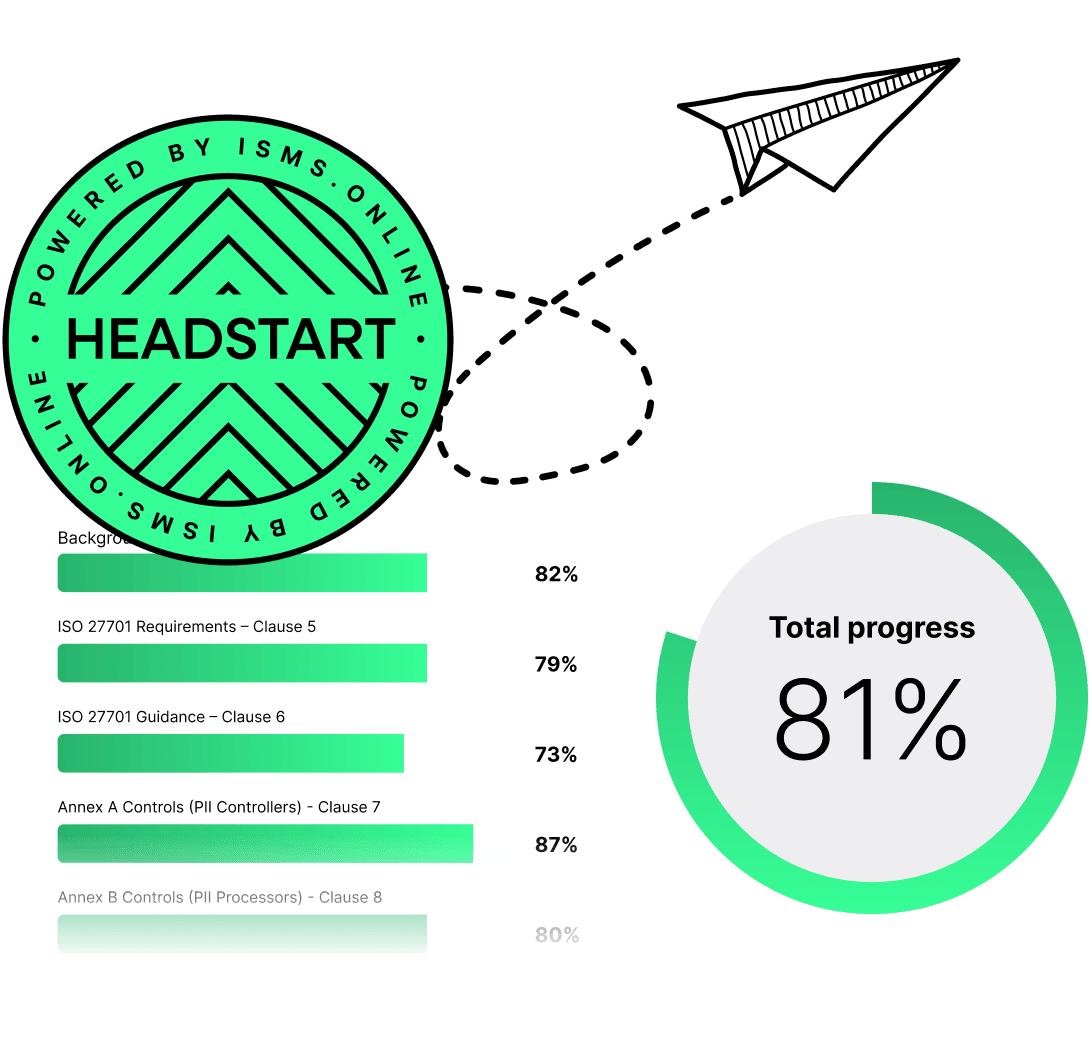
An 81% Headstart from day one
We’ve done the hard work for you, giving you an 81% Headstart from the moment you log on. All you have to do is fill in the blanks.
What ISO 27001 compliance really looks like for MSP toolstacks
ISO 27001 compliance for an MSP toolstack means your RMM, PSA and cloud platforms sit clearly inside your information security management system. You treat them as in‑scope assets with defined owners, risks, controls and evidence, and you can show auditors, customers and boards how decisions about those tools follow the same loop as the rest of your business.
For “Kickstarter” MSPs this should feel achievable, not overwhelming: you are not expected to become standards experts overnight, but you are expected to follow a consistent, risk‑based method and document it. Many MSPs find that once their core tools live inside an ISMS, audit preparation moves from a last‑minute scramble to a repeatable routine that supports bigger, more demanding customers.
At a high level, ISO 27001 expects you to define scope, understand context, assess and treat risks, select controls and continually improve. For your toolstack, that translates into explicit, testable expectations about how you identify critical consoles, assess threats such as privileged misuse or supplier compromise, and prove that real controls are in place and working.
More concretely, ISO‑aligned practice for your tools usually means:
- Scope: RMM, PSA, cloud consoles, backup portals, documentation tools and identity platforms are explicitly listed as in‑scope assets.
- Risk: Risks such as privileged misuse, supply‑chain compromise, tenant separation failures and logging gaps are identified and evaluated.
- Controls: Annex A controls on access, configuration, logging, change, supplier management and business continuity are mapped to specific settings and processes in those tools.
- Evidence: You know exactly which reports, logs, tickets and exports prove that a particular control is designed and operating.
When an auditor asks how you control remote access, you are not scrambling through each platform manually. You refer to a control description, a mapping to RMM and cloud settings and a set of reports or tickets that demonstrate operation.
Choosing which Annex A controls really matter for your tools
Annex A in ISO 27001:2022 lists ninety‑three reference controls, but your toolstack will be dominated by a smaller set. Focusing early on access control, configuration and change, logging and monitoring, supplier relationships and continuity gives you leverage without boiling the ocean, especially for practitioners who already feel stretched. This structure is defined in the current ISO/IEC 27001:2022 standard and is intended to be flexible enough to tailor to different organisations and technology stacks.
Controls that almost always matter strongly for MSP toolstacks include:
- Access control and identity management (for human and non‑human accounts)
- Configuration and change management for critical systems
- Logging, monitoring and event handling
- Supplier relationships and cloud service governance
- Business continuity and recovery for your own operations
Rather than trying to “boil the ocean”, most MSPs find it effective to start from three simple questions:
- What would happen if your RMM were misused or unavailable?
- What about your PSA?
- What about your key cloud management portals?
From there, you work backwards to see which Annex A controls most directly mitigate those risks, then design how each will be implemented through your tools and processes. Your Statement of Applicability becomes the bridge between the standard’s language and your operating reality.
Why an integrated view beats tool‑by‑tool checklists
A tool‑by‑tool checklist can help individual admins but makes it difficult for a CISO, DPO or auditor to see whether the organisation runs one coherent ISMS. An integrated view shows how controls span your identity provider, RMM, PSA and cloud platforms and allows you to reuse work across ISO 27001, SOC 2, NIS 2 and other frameworks instead of duplicating effort.
It is tempting to create separate security checklists for each major tool. While this can help with day‑to‑day administration, it makes it harder to prove that you operate a single, coherent ISMS.
An integrated view will:
- Show where one control, such as privileged access review, is implemented partially in the identity provider, partially in the RMM and partially in the PSA
- Make clear who is responsible and accountable for each element
- Reveal overlaps where you are doing more than you need to, and gaps where nobody is really in charge
An ISMS platform such as ISMS.online can help here. Instead of holding these mappings in spreadsheets or someone’s head, you maintain them in a central system that ties policies, risks, controls and evidence together and keeps them aligned as your toolstack and control frameworks evolve.
For CISOs and senior security leaders, that integrated mapping is also how you move board conversations away from “Do we have ISO 27001?” to “How resilient are we across ISO 27001, SOC 2, NIS 2 and privacy regulation, using one set of controls?”
Annex A‑to‑tool mapping: turning RMM, PSA and cloud into one control fabric
Turning Annex A controls into a practical map of your RMM, PSA and cloud platforms is where ISO 27001 becomes tangible. A simple matrix that connects each important control area to concrete tools, owners and evidence turns a vague sense of “we are secure” into something you can explain, test and improve with confidence.
How to build a simple control‑to‑tool matrix
A control matrix answers four practical questions for each relevant control and links them to specific tools. By starting with a small set of high‑impact areas, you give both practitioners and auditors a clear, shared picture of how your MSP toolstack supports ISO 27001 without drowning anyone in detail.
A control matrix is essentially a table that answers four questions for each relevant control.
Step 1 – Clarify the control outcome
Describe in plain language what the control is trying to achieve and which risk it mitigates.
Step 2 – Identify contributing tools
List which tools contribute to that outcome, such as RMM roles, PSA workflows and cloud RBAC.
Step 3 – Assign responsibilities
Decide who is responsible and accountable for the control and who needs to be consulted or informed.
Step 4 – Locate the evidence
Define where evidence lives, such as specific logs, reports, tickets or configuration exports.
One way to structure this is shown below.
| Area | Examples in your toolstack | ISO 27001 focus |
|---|---|---|
| Access control | Identity provider, RMM roles, PSA roles, cloud RBAC | Least privilege, strong authentication, joiner/mover/leaver |
| Configuration & change | RMM policies, PSA change tickets, cloud baselines | Approved changes, secure baselines, traceability |
| Logging & monitoring | RMM logs, PSA tickets, SIEM feeds, cloud logs | Event logging, log integrity, regular review |
| Supplier & third parties | Tool vendors, cloud providers, integrations | Due diligence, contractual controls, ongoing monitoring |
| Business continuity | Backup portals, PSA service configuration, RMM reach | Recovery objectives, continuity of critical services |
You do not need to start with all controls. Begin with the ones that address your most serious toolstack risks and expand from there.
Clarifying responsibilities with RACI
MSP toolstacks often cross organisational boundaries, so you need clarity on who does what. Using a simple RACI model helps you show auditors and customers how responsibility is shared between you, your clients and your vendors, and gives privacy and legal teams confidence that accountability for personal data is understood.
Many controls related to your toolstack involve three parties:
- You as the MSP
- Your customer
- Your vendors and cloud providers
A responsibility assignment matrix (often called a RACI) helps you state clearly who is responsible, accountable, consulted and informed for each control component. For example, in a cloud environment:
- The customer may be accountable for data classification and some access policies
- You may be responsible for day‑to‑day administration and monitoring
- The cloud provider may be responsible for underlying infrastructure and platform controls
Without this clarity, everyone assumes someone else is handling a particular risk. ISO 27001 expects you to make those boundaries explicit and to support them with contracts, procedures and evidence.
Keeping the mapping alive as your stack changes
The real value of a control‑to‑tool matrix comes when it reflects today’s environment, not last year’s. Treating the matrix as a living artefact in your ISMS means it evolves as you add, retire or reconfigure tools, and it stays useful for both technical teams and senior stakeholders.
Your toolstack is not static. You add new services, retire old ones, change vendors and expand into new cloud platforms. The control‑to‑tool matrix and RACI need to evolve too.
To keep the mapping alive you can:
- Make updating it part of your change management process whenever you adopt or retire tools
- Link it directly to your Statement of Applicability and risk register
- Review it during internal audits and management reviews
An ISMS platform can make this easier by letting you maintain mappings, responsibilities and evidence links in one place, and by prompting reviews when you change scope or context.

Free yourself from a mountain of spreadsheets
Embed, expand and scale your compliance, without the mess. IO gives you the resilience and confidence to grow securely.
Deep dive: securing RMM with ISO 27001 (access, change, logging)
Your RMM is often the single most powerful console in your business, and ISO 27001 treats it accordingly. To satisfy the standard and reduce real‑world risk, you need clear rules for who can use it, how scripts and policies are governed and how activity is logged, so that both practitioners and auditors can trust the outcomes.
Designing strong access control for RMM
RMM access control under ISO 27001 is about more than turning on multi‑factor authentication. You need to ensure every privileged session is attributable to a real person or well‑governed service account, permissions reflect least privilege and joiner‑mover‑leaver processes keep access aligned with roles over time.
For RMM, ISO‑aligned access control usually includes:
- Unique identities for every human and non‑human user
- Multi‑factor authentication for all privileged access
- Role‑based access control with least privilege, so engineers only see and do what they need
- Separation between production administration and test environments
- Restriction of access to management consoles from trusted locations or devices
From a process perspective, you then define:
- How joiners, movers and leavers are handled across the RMM and identity provider
- Who approves role changes and elevated access
- How often access is reviewed and by whom
The key is that every elevated action is attributable to an individual, and that your policies, technical settings and records all tell the same storey.
Governing scripts, policies and automation
The same features that make RMM powerful for service delivery can, without control, make it dangerous. ISO 27001 pushes you to turn scripting and automation into governed assets with owners, approvals and records, so that engineers can move quickly without creating constant audit or incident risk.
RMM platforms are powerful because they allow you to automate. From an ISO 27001 lens, that power has to be controlled. Typical measures include:
- Maintaining a catalogue of approved scripts and policies, with clear owners
- Requiring peer review and, for risky actions, manager approval before deployment
- Ensuring scripts are stored and version‑controlled, not copied from old tickets or chat messages
- Applying changes through formal change records in your PSA, not directly from the console without traceability
When an auditor or a customer asks how you prevent an engineer from accidentally or deliberately running a destructive script across many endpoints, you should be able to show both the process and the records that prove it works.
Logging and monitoring RMM activity
RMM logs are vital both for incident response and for demonstrating that controls operate as designed. If you configure logging thoroughly and route the right data into your monitoring tools, you reduce investigative pain for practitioners and give risk owners, including CISOs and privacy officers, the audit trails they need.
RMM logs are one of your most important sources of evidence. At a minimum, you want to log:
- Session start and end, including who connected and to which asset
- Actions taken during sessions, such as commands or file transfers
- Changes to policies, scripts and agent configurations
- Administrative activities such as role changes and new integrations
Those logs need to be:
- Protected against tampering
- Retained for an appropriate period based on risk and legal requirements
- Periodically reviewed, either manually or via automated rules and a central monitoring system
When something goes wrong, these logs are how you reconstruct what happened. From a compliance perspective, they also support controls on logging, monitoring, incident detection and investigation. For privacy and legal stakeholders, they contribute to records of processing and incident investigation requirements under regimes such as GDPR or similar laws.
Deep dive: PSA and cloud platforms (RBAC, logging, supplier management)
Your PSA and cloud admin portals provide the operational spine of your MSP, so ISO 27001 expects them to be structured in ways that naturally produce evidence as you work. With the right role design, workflows and supplier tracking, these tools support auditors, privacy officers and practitioners instead of creating more manual work.
Making your PSA produce ISO‑ready evidence
A PSA is not just a ticketing and billing system. It becomes a powerful compliance ally when its tickets and workflows mirror your ISMS processes. By structuring categories, approvals and records around incidents, changes, assets and suppliers, you enable engineers to work as usual while generating the audit trails that ISO 27001, and often privacy regulations, expect to see. In practice, for an ISO‑aligned MSP, it becomes:
- The main record of incidents and problems
- The approval engine for changes
- A repository of asset and configuration information
- A lens into supplier performance and risk
To support this, you can:
- Define ticket categories and workflows that distinguish security incidents from general support
- Require approvals and risk assessments for defined categories of change
- Record which tools, such as RMM or cloud consoles, were used to implement a change
- Capture supplier‑related events such as outages, security advisories or failure to meet service levels
By designing your PSA in this way, you make it much easier to produce evidence of how you manage incidents, changes, assets and suppliers, all of which sit at the core of ISO 27001. Many practitioners find that, once these workflows are in place, audit preparation becomes less about trawling through mailboxes and more about running a set of familiar reports.
Role‑based access and tenant separation in cloud platforms
Cloud admin portals now carry many of the control responsibilities once handled by on‑premises infrastructure. ISO 27001 aligns naturally with cloud best practice: clear role design, conditional access, tenant separation and documented baselines that ensure your day‑to‑day operations stay within agreed risk bounds.
Cloud platforms now carry much of the control load for modern environments: identity, networking, logging, backup, encryption and more. ISO‑aligned practice in these consoles usually includes:
- Carefully designed roles for administrators, support staff and automation
- Conditional access policies that factor in device health, location and risk
- Strict separation between customer tenants and between production and non‑production resources
- Baseline configurations for core services, with deviations documented and justified
Your ISMS should describe the principles you apply and reference baseline designs. Your cloud portals and identity provider should enforce them. Your PSA should record the changes, approvals and reviews that affect them.
Embedding supplier management into daily work
Your MSP business depends on vendors for core services, so ISO 27001’s supplier controls are central rather than peripheral. When you embed supplier risk assessment, contract terms and ongoing monitoring into your normal PSA workflows and management reviews, you reduce surprises and give regulators, auditors and customers a clear picture of how you manage third‑party risk.
Around 41% of organisations in the 2025 ISMS.online survey said that managing third‑party risk and tracking supplier compliance is one of their biggest information‑security challenges.
Many of your most important controls are delivered in partnership with vendors: your PSA provider, RMM vendor, security tools and cloud platforms. ISO 27001 expects you to:
- Identify which suppliers are critical and what data or services they handle
- Assess their security posture, including certifications and incident history
- Build appropriate security and notification clauses into contracts
- Monitor them over time instead of only at onboarding
Rather than treating this as a once‑a‑year questionnaire exercise, you can:
- Track supplier risks and reviews as part of your risk register
- Log supplier incidents and service failures in your PSA
- Use management reviews to assess whether suppliers continue to meet your needs and risk appetite
That way, supplier control is woven into your governance fabric, not hanging off the edge of it. For privacy and legal teams, this also supports data protection requirements around processor oversight and breach notification.

Manage all your compliance, all in one place
ISMS.online supports over 100 standards and regulations, giving you a single platform for all your compliance needs.
Governance, documentation and evidence for MSP toolstacks
Even the best‑configured toolstack does not, by itself, satisfy ISO 27001. The standard is interested in how you decide, document and review security measures across your business. For MSP toolstacks, that means policies your teams can actually follow, evidence that falls out of normal work and governance rhythms that keep pace with change.
Building a document set that reflects how you really operate
Effective documentation should feel like a codified version of how you already intend to run your MSP, not a separate “paper ISMS”. When policies, procedures and statements explicitly reference RMM, PSA and cloud platforms, they become useful guides for engineers, reassuring signals for regulators and practical tools for privacy and legal stakeholders.
A typical ISO‑aligned document set for an MSP toolstack includes:
- An information security policy and supporting policies for access control, acceptable use, remote access and supplier security
- A risk assessment and risk treatment plan that specifically mention RMM, PSA and cloud platforms
- A Statement of Applicability that lists applicable Annex A controls and explains how they are implemented through your tools and processes
- Procedures or standards for RMM administration, PSA workflows, cloud tenant management, logging and monitoring
- Supplier management procedures, including criteria for onboarding, assessing and monitoring key vendors
The key is that these documents are not written in generic language. They refer to the kinds of tools you actually use and describe expectations in terms that your teams recognise. For privacy officers and legal teams, they should also show how records of processing, access logs and incident management support obligations under regimes such as GDPR or similar laws.
Making evidence collection repeatable instead of painful
ISO 27001 certification becomes much easier to maintain when evidence is a by‑product of sensible workflows rather than a special activity before each audit. Designing your RMM, PSA and cloud processes with this in mind reduces stress for practitioners and gives CISOs and boards a more reliable picture of how controls perform over time.
Many organisations can pass an initial audit by assembling evidence in a heroic rush. That approach is hard to sustain. For your toolstack, you want evidence to fall naturally out of normal work. Examples include:
- Scheduled access reviews with records of decisions and follow‑up actions
- Change records in your PSA that link requests, approvals, implementations and reviews
- Regular reports from RMM and cloud platforms showing compliance with baselines and detection of anomalies
- Logs of supplier reviews, including summaries of any discovered issues and actions taken
Planning these artefacts in advance and linking them to specific controls saves you time later. An ISMS platform can help by giving you an evidence register that points to the right log exports, tickets and reports, rather than forcing you to keep everything in one place or rediscover it for every audit. Many MSPs discover that once this register is in place, renewals feel more like routine health checks than major projects.
Aligning assurance activities with a fast‑moving toolstack
Internal audits, management reviews and continual improvement loops can feel abstract until they are anchored in the systems you use every day. When you focus those activities on how well your RMM, PSA and cloud platforms actually operate, they become more concrete and more valuable to the business.
About two‑thirds of organisations in the 2025 ISMS.online survey said the speed and volume of regulatory change are making compliance harder to sustain.
Internal audits can concentrate on how well RMM access controls or PSA workflows follow documented standards. Management reviews can look at trends in incidents, changes and supplier issues involving your tools. Improvement actions can address gaps in configurations, documentation or training uncovered in those reviews.
Because your toolstack and client base change frequently, you will not get everything perfect at once. ISO 27001 recognises that; what matters is that you can show a structured loop from issues to actions to re‑evaluation. For CISOs, that loop is also what turns compliance into resilience in the eyes of the board.
Book a Demo With ISMS.online Today
ISMS.online helps you turn ISO 27001 from a stressful project into an organised system around your RMM, PSA and cloud platforms. It gives you a single place to show, with confidence, how your MSP toolstack is governed and monitored.
How ISMS.online wraps around your MSP toolstack
For many MSPs, the hardest part of ISO 27001 is building and maintaining an ISMS that reflects how they really work. ISMS.online gives you a central workspace for policies, risks, Annex A mappings, responsibilities and evidence, so you can link your toolstack directly into your management system instead of juggling multiple spreadsheets and ad‑hoc documents.
Instead of building control matrices, Statements of Applicability and evidence registers from scratch, you can work from proven templates designed for information security management and adapt them to your MSP context. You link your RMM, PSA and cloud controls into that structure, so that access reviews, change records and log summaries are all clearly tied to specific Annex A controls and risks.
Operational leaders benefit because an ISMS platform can mirror your current way of working. You map controls to real workflows, queues and reports rather than inventing parallel processes that nobody has time to follow. Role‑based permissions, task assignment and reminders help keep audits, risk reviews and supplier assessments on track without constant chasing, reducing the burden on practitioners while raising confidence for CISOs and privacy officers.
For “Kickstarter” MSPs, that means a practical path to first certification without having to become standards experts. For IT and security practitioners, it means less manual evidence wrangling and more time for real security work.
What different stakeholders gain from a shared ISMS
A shared ISMS gives each stakeholder a view that matches their responsibilities. Founders and boards see risk and opportunity; security leaders see detailed control status; privacy and legal teams see audit trails; engineers see clear tasks; all of them work from the same underlying truth about your RMM, PSA and cloud platforms.
Different stakeholder groups can all find value in the same system:
- Founders and Kickstarter leaders gain confidence capital: a clear, guided route to certification that unblocks deals.
- CISOs and senior security leaders gain resilience capital: one control fabric across ISO 27001, SOC 2, NIS 2 and privacy frameworks.
- Privacy and legal officers gain trust capital: defensible audit trails for access, incidents and supplier oversight.
- IT and security practitioners gain career capital: automation, clarity and recognition instead of spreadsheet‑driven firefighting.
Client security teams and enterprise buyers also benefit because you can export structured summaries that show exactly how your toolstack is covered by your ISMS, including how you handle access, logging, change and supplier oversight.
If you are thinking about ISO 27001 for the first time, ISMS.online gives you a practical starting point that fits around your toolstack rather than fighting it. If you already have certification, it can cut the overhead of maintaining documents and evidence as your services evolve. A short demo is often the fastest way to see whether this approach feels right for your organisation and how it could help you reduce risk, satisfy auditors and win more security‑conscious clients using the tools you already rely on every day.
Book a demoFrequently Asked Questions
How should an MSP structure ISO 27001 scope so RMM, PSA and cloud tools are clearly “inside” the ISMS?
ISO 27001 scope for your MSP should explicitly name RMM, PSA and cloud admin consoles as in‑scope assets, with owners, purposes, data types, risks and controls all documented in one place. That way you can show customers and auditors that you don’t just use these tools – you govern them.
How do you make “toolstack in scope” concrete?
A clean scope design usually includes:
- An information asset register where RMM, PSA, cloud admin portals, identity providers and backup consoles are all listed with:
- Named owners
- Described purpose and supported services
- Data handled (customer data, credentials, logs, billing data, etc.)
- A risk register that ties those assets to realistic scenarios, for example:
- Compromise of remote access tools
- Ticket or documentation leakage
- Cross‑tenant mistakes when deploying scripts or policies
- Control mappings that link each platform to the Annex A controls it helps implement, such as:
- A.5 and A.8 (organisational and technical controls around access and operations)
- A.5.19–A.5.22 (supplier management for RMM, PSA and cloud vendors)
- A.8.7, A.8.8, A.8.15, A.8.16 (malware, vulnerability, logging and monitoring)
Your Statement of Applicability should then reference real platform behaviours (“administrator roles are limited to X people and reviewed quarterly using report Y”) instead of generic phrases like “we manage access”.
Putting this structure into an information security management system such as ISMS.online helps you hold the storey together: policies, risks, controls and evidence all anchored back to specific consoles and owners, so you are not rebuilding the picture before every surveillance audit.
What does this change for your engineers and account teams?
Day‑to‑day, the scope work should make life clearer, not harder:
- Engineers know exactly which systems are “crown jewels”, who owns them and which configurations are non‑negotiable.
- Access reviews, log checks and supplier reviews are short, scheduled tasks linked to those assets, instead of ad‑hoc requests.
- Account teams can point prospects to a concise description of how you govern your toolstack, backed by evidence packs rather than improvised answers.
If your current scope still talks mostly about “the organisation” rather than the tools your MSP actually runs on, wrapping those platforms cleanly into your ISMS is one of the simplest ways to raise your security credibility without changing your tech stack.
How can an MSP turn Annex A into a practical control matrix for RMM, PSA and cloud platforms?
You can turn Annex A into a practical MSP control matrix by describing a small set of control outcomes and then mapping, in one view, which platforms, roles and evidence deliver each outcome. This keeps engineers focused on what “good” looks like, rather than on clause numbers.
What does a useful MSP control matrix look like in practice?
A lightweight but powerful matrix usually has these columns:
- Control outcome: – a one‑line description, for example:
- “Only authorised staff can run scripts across more than one tenant.”
- “High‑risk changes are approved and traceable before deployment.”
- Related Annex A references: – for orientation only, such as:
- A.5.15, A.8.2, A.8.3 for access
- A.8.8, A.8.9, A.8.29 for change and vulnerability handling
- A.8.15, A.8.16 for logging and monitoring
- A.5.19–A.5.22 for supplier oversight
- Tool implementations: – how each platform supports the outcome, for example:
- RMM: script role permissions, policy groups, approval steps
- PSA: change categories, CAB approvals, standard change templates
- Cloud/identity: RBAC roles, conditional access, privileged identity management
- Responsibilities: – who is accountable and involved:
- Service desk, security lead, operations manager
- Customer tenant admins where shared responsibility applies
- Vendor responsibilities (patch cadence, incident notifications)
- Evidence and review cadence: – where proof lives and how often it is checked:
- RMM audit logs and exports
- PSA change and incident reports
- Cloud sign‑in and admin activity reports
A simple table with control themes as rows (access, change, logging, supplier, continuity) and platforms as columns (RMM, PSA, cloud, identity, backup) is usually enough to get started. When this sits inside your ISMS rather than in a static spreadsheet, it is far easier to keep up to date as you change tools or add frameworks such as SOC 2 or ISO 27701.
Using a platform like ISMS.online, you can link each matrix row directly to risks, policies and evidence, so the same work supports both audits and demanding customer questionnaires.
Why does this matrix make audits and customer reviews smoother?
A clear matrix shortens difficult conversations:
- Auditors can follow a straight line from risk to Annex A row, to platform configuration, to evidence, without you jumping between documents.
- Customer security reviewers can see, at a glance, how you govern shared tools rather than having to infer it from generic policy language.
- Internally, empty or unclear cells stand out quickly, prompting focused improvements instead of broad, unfocused remediation plans.
If you want your next review to feel like a structured walk‑through rather than an interrogation, investing a little time in a concise control matrix that lives in your ISMS is one of the highest‑leverage steps you can take.
Which ISO 27001 control themes give the biggest risk reduction for MSP RMM consoles?
The most important ISO 27001 themes for RMM consoles are access control, change and configuration management, logging and monitoring, and supplier management. Together they determine who can act through your console, how those actions are governed and how quickly you can spot and contain problems.
How do you translate those themes into everyday RMM safeguards?
You can express each theme as a set of concrete expectations:
- Access that matches blast radius:
- Each engineer has an individual account; shared logins are removed.
- Administrative roles require multi‑factor authentication and are limited to named staff.
- Roles are aligned with job functions (service desk, escalation, security) using least privilege.
- Joiner–mover–leaver workflows ensure access changes track role changes, not gut feel.
- Change and configuration discipline:
- High‑impact actions (mass scripts, policy changes, agent removal) always originate from change tickets in your PSA.
- Someone with appropriate authority approves the change, and the RMM shows who executed which action, against which tenants.
- Emergency fixes are logged and reviewed afterwards, with any permanent changes folded back into standard procedures.
- Logging that can support a real investigation:
- The RMM records admin sessions, script runs, file transfers and configuration edits.
- Log retention periods are defined, and high‑value logs are forwarded to central storage or monitoring where appropriate.
- A named owner reviews a sample of activity on a schedule, with a brief note of what was checked and what, if anything, was escalated.
- Supplier oversight tied to your ISMS:
- Your RMM vendor appears in your supplier inventory with security and privacy assurances, incident processes and key contractual clauses.
- Periodic supplier reviews consider changes in features, architecture or incidents that could affect your risk posture.
These expectations map closely to Annex A controls on access, operations, logging, supplier relationships and continuity. When a customer asks, “What stops a compromised RMM account from affecting all our tenants?”, being able to show this structure – backed by live configurations and review notes in your ISMS – is far more persuasive than broad assurances about “trusted engineers”.
If your current answer still relies heavily on informal trust, using ISMS.online to formalise RMM roles, changes and reviews can help you move to a position where you can confidently say you trust your system as much as you trust your people.
How can MSPs design PSA and cloud access and logging so ISO 27001 is supported by default?
You design PSA and cloud access and logging for ISO 27001 by making sure everyday workflows automatically produce the information your ISMS needs. Instead of asking engineers to remember extra “compliance steps”, you shape identities, roles and logs so useful evidence is created as they work.
What does a resilient PSA and cloud access model look like?
A pattern that works well for many MSPs includes:
- A single identity per person:
- A central identity platform provides sign‑in to PSA, RMM, cloud and other admin tools, making it easier to enforce multi‑factor authentication and remove access quickly.
- Local accounts in consoles are phased out or tightly controlled so there are fewer places to forget to revoke permissions.
- Role definitions that follow how work actually flows:
- In PSA, roles define which queues, projects, billing functions and reports a person can use.
- In cloud and identity platforms, RBAC roles map to real responsibilities: for example, “helpdesk admin” for day‑to‑day tasks, “security admin” for policies, and “billing admin” for financial operations.
- Capabilities with broad impact, such as global policy changes or tenant creation, sit behind specific roles with deliberate assignment and review.
- Lifecycle workflows that trigger access changes:
- When someone joins, moves team or leaves, HR or PSA records drive changes in identity, PSA and cloud roles.
- Tickets and access change records line up in time, so you can show an auditor exactly when permissions were granted or removed.
- Logs that tie back to business records:
- PSA tickets provide the narrative around why a change was needed.
- Cloud and identity logs record what changes were made and when.
- For high‑risk actions, you can follow a clear trail from ticket, through approvals, to specific admin activity.
These elements support Annex A expectations around access management, logging, operations and change control. Capturing reviews and adjustments in your ISMS – for example, by recording quarterly access reviews and log checks – demonstrates that the model is maintained, not just designed once.
If you want PSA and cloud platforms to support your ISO 27001 journey without turning into separate “compliance projects”, using ISMS.online to join tickets, roles and review notes together will make it far easier to prove that your design works as intended.
How can an MSP systematically reduce ISO 27001 nonconformities linked to its toolstack?
You reduce ISO 27001 nonconformities by closing the gap between what policies claim and how RMM, PSA and cloud tools are actually used. Most findings relate to shared or unmanaged access, undocumented changes, dormant logs or forgotten suppliers, all of which are manageable when you treat your consoles as governed assets inside your ISMS.
Where do MSPs typically run into trouble, and what can you change first?
Frequent issues and practical counter‑measures include:
- Shared privileged accounts or weak access hygiene:
- Replace shared admin accounts with individual identities; keep “break‑glass” accounts tightly controlled and monitored.
- Define, in your ISMS, exactly when a privileged emergency account may be used and how it is reviewed afterwards.
- Bypassing change process “just this once”:
- Make it quick and simple to raise a change ticket and attach screenshots or script references, so engineers are less tempted to work entirely outside PSA.
- Train teams on which actions on RMM or cloud consoles must always leave a change record, even when time is tight.
- Logs that exist but lack owners and routines:
- Assign named owners for RMM, PSA and cloud logs, with a clear schedule and scope for reviews, even if that is a brief monthly sample.
- Capture review outcomes in your ISMS so you can show an auditor that logs are genuinely used to detect unusual activity.
- Critical suppliers missing from the ISMS:
- Make sure RMM, PSA, cloud and backup vendors appear in your supplier inventory, with recorded security assurances, incident processes and review dates.
- Link supplier records to the related assets and risks, so any supplier problem can be viewed in context.
These adjustments help align your operations with Annex A controls on access, operations, logging and supplier management. When nonconformities do occur, they are more likely to be minor observations, because you can show that the system is in place and actively improving.
If your last audit felt reactive, with people rushing to export user lists and screenshots on the day, using ISMS.online to centralise configurations, checks and evidence can turn your next visit into a confirmation that your MSP runs on a disciplined, well‑governed stack.
How can an MSP turn everyday RMM, PSA and cloud activity into ISO 27001 evidence that impresses customers and auditors?
You build convincing ISO 27001 evidence by proving that the way you already use RMM, PSA and cloud platforms routinely generates artefacts that match your risk and control storey. The strongest proof comes from regular operations – not from one‑off audit exercises.
Which evidence types are most persuasive, and how do you organise them?
Evidence that tends to carry the most weight includes:
- Scheduled access review records:
- Exports of users, groups and roles from each console, annotated with decisions taken and stored alongside the relevant controls and risks in your ISMS.
- A short history of reviews showing that accounts were removed or permissions reduced over time, not just listed.
- Change and incident timelines that join business and technical views:
- PSA reports that show change requests, approvals, implementation and verification.
- Matching activity logs from RMM and cloud consoles, so you can walk someone through what actually happened when a change or incident occurred.
- Configuration baselines and drift reports:
- Documents and reports that define required settings for MFA, logging, backups and endpoint policy.
- Periodic checks or automated reports that show whether real environments match those baselines, with notes on how exceptions were handled.
- Supplier files that show active oversight:
- Concise records for each strategic supplier (RMM, PSA, cloud, backup) including:
- Security and privacy assurances
- Contract clauses relevant to information security
- Past incidents and how they were resolved
- Dates and conclusions of your latest reviews
Organising these artefacts in an ISMS platform, and tagging them to specific Annex A controls and risks, means that when an enterprise prospect or auditor asks how you manage privileged access or respond to incidents, you can provide a focused, labelled evidence pack instead of a loose collection of screenshots.
If you want this level of preparation to become your standard rather than an exception for big deals, using ISMS.online to orchestrate evidence collection and keep mappings current will help your MSP present itself as a trusted, security‑mature partner whose certification reflects real operational discipline.






