





































Why ISO 27001 Changes How MSPs Must Onboard Clients
ISO 27001 changes MSP onboarding by turning it into a governed, evidence‑backed business process instead of an ad‑hoc technical cutover. It forces you to treat client onboarding as a formal ISMS process, not just a quick go‑live and a few warm introductory calls: you are expected to capture context, assess risk, select controls and retain records of those steps for every customer relationship, so you can answer tough questions from auditors, regulators and enterprise buyers without scrambling through inboxes and spreadsheets. The ISO/IEC 27001:2022 standard explicitly requires organisations to understand their context and interested parties, assess and treat information security risks using defined criteria, and retain documented information as evidence that these activities were performed, so onboarding naturally needs to reflect that discipline.
Almost all respondents in our 2025 State of Information Security survey listed achieving or maintaining security certifications such as ISO 27001 or SOC 2 as a top priority.
Clear, reliable onboarding makes every new client a storey you are not afraid to replay.
When you are selling and delivering managed services, onboarding is often where bold promises meet operational reality. Account managers juggle contracts, SLAs, security questionnaires and technical approvals, usually with a lot of tribal knowledge buried in inboxes and spreadsheets. That may work while you are small and dealing with friendly customers, but it does not stand up when certification auditors, regulators or enterprise prospects start asking you to “show how you did this for that client”. Certification and assurance guidance consistently emphasises the need to demonstrate not just that you have policies and controls, but that you applied them in specific cases, so being able to trace how you onboarded a named client becomes essential rather than optional. Using a structured platform such as ISMS.online makes it much easier to turn these expectations into repeatable steps and records.
The gap between ad‑hoc onboarding and ISO 27001 expectations is the difference between informal habits and demonstrable, repeatable control. ISO 27001 asks you to understand your organisational context, the needs of interested parties and the requirements you must meet before you select controls and switch anything on, and it assumes you can show how risks were identified and treated for each customer; if those steps live only in people’s heads or scattered notes, your risk register and Statement of Applicability (your formal control selection record) quickly become theoretical instead of reflecting real engagements and start to drift towards guesswork. Those expectations mirror the standard’s requirements to determine organisational context and interested parties, and to plan risk treatment and controls on the back of that understanding rather than treating every client the same.
The standard also expects you to be able to demonstrate that risks have been identified, assessed and treated using an agreed method. When important decisions during onboarding – such as granting permanent admin rights or accepting a weaker logging configuration – happen in hallway conversations or untracked chat threads, they effectively become silent risk acceptance. ISO 27001 formalises this area through defined risk assessment and risk treatment processes, along with a requirement to retain documented information as evidence that you followed them, so undocumented decisions undermine your ability to show you met your own criteria. Later, if an incident or audit traces back to those decisions, you have no clear record of who agreed to what or why.
Why leadership should care about onboarding, not just audits
Leadership should care about onboarding because it is where your promises to clients become evidence that regulators, boards and cyber‑insurers can test. It is not enough to pass an ISO audit once; you need to be able to defend how you brought each key customer on board months or years later, using clear artefacts rather than vague recollection. Board‑level cyber guidance from government and industry bodies increasingly stresses that directors should expect structured evidence of how security is managed in practice, not just high‑level policies or a certificate on the wall, which brings onboarding records squarely into scope.
Our 2025 State of Information Security survey shows customers expect suppliers to align with formal frameworks such as ISO 27001, GDPR or SOC 2, not vague good practice claims.
From a leadership perspective, the question is not only could we pass an ISO audit? but could we defend how we onboarded our top clients if a regulator, cyber‑insurer or board asked for proof? If you cannot quickly produce a coherent set of artefacts for each high‑value customer – contracts, scope statements, risk assessments, access approvals, configuration baselines – then onboarding has become a blind spot in your risk storey.
Framing onboarding as part of your information security management system (ISMS) changes that conversation. ISO 27001 stops being a once‑a‑year hurdle and becomes a growth enabler: you can show bigger, more regulated customers that every new relationship follows a disciplined pattern, backed by evidence, rather than depending on whichever account manager happened to pick up the deal. Industry analysis often links structured cyber‑risk management and resilience with a stronger position in winning and keeping larger, more regulated customers, so treating onboarding as part of that system naturally supports growth. That mindset is exactly the one you can support with a platform such as ISMS.online, where onboarding steps, risks and approvals all link back to your core ISMS.
Book a demoFrom Ticket Chaos to an ISMS‑Aligned Onboarding Workflow
An ISO‑aligned onboarding workflow replaces ticket chaos with a governed path that turns tickets, projects and change records into deliberate evidence of controlled client setup. It only works, though, if it is connected to how your teams already operate: for most MSPs that means ticketing systems, change workflows, standard request types and project boards. You define onboarding as a formal process with an owner, inputs, outputs and records, and route those familiar interactions through it so every intake form, project, service request and change related to a new client is traceable back to that process.
In practical terms, that involves defining onboarding as a formal process with an owner, inputs, outputs and records. Every intake form, project, service request and change related to a new client should be traceable back to that process. When auditors or large customers sample a few engagements, they should see the same repeatable pattern rather than a different storey for each logo. ISMS.online can help you embed that pattern into your existing work management tools so you do not need to invent it from scratch.
Define onboarding as a first‑class ISMS process
Defining onboarding as a first‑class ISMS process means deciding where it starts and ends, who owns it, and which records prove it happened as intended, so onboarding stops being a loose collection of tasks and becomes a lifecycle that can be improved, audited and scaled. Start by writing down where onboarding really starts and ends for your MSP – for many providers, it begins in late pre‑sales, once you are confident the deal is real, and runs through contracts, discovery, first builds, early support and the first management review – then make that lifecycle part of your ISMS processes and link it to relevant policies such as risk management, access control, change management, incident management and supplier management.
Step 1: Define the onboarding lifecycle
Describe the phases from late pre‑sales to first management review, covering contracts, discovery, builds and early support so everyone understands the same start and end points.
Step 2: Assign clear ownership and participants
Name the accountable owner and key participants, such as account managers, technical leads, security, legal and finance, so responsibility is visible instead of being left vague.
For this onboarding process, identify:
- An accountable owner, often the ISMS lead or a senior service delivery manager.
- Key participants, including account managers, technical leads, security, legal and finance.
- Required inputs, such as signed agreements, agreed scope, client contacts and data categories.
- Required outputs, such as risk entries, configuration baselines and access records.
- Additional outputs, such as training or awareness activities and handover notes, where they are part of your normal onboarding flow.
Tie this process to relevant policies and procedures so you can show how onboarding triggers and feeds those controls instead of living alongside them.
Connect tickets and records to the ISMS
Connecting tickets and records to the ISMS means deciding which work items count as onboarding evidence and standardising the fields they use. When every onboarding project, request and change includes the right information, you no longer have to reconstruct the storey later from scattered tickets and emails, because the evidence already sits in a structured, repeatable pattern.
Look at your service management tools and decide which types of tickets or records must be created for each stage of onboarding, and what fields they should contain so they double as ISO 27001 evidence. Make those structures simple enough that teams will actually use them, and consistent enough that months later you can reconstruct each client’s storey without detective work.
Step 1: Standardise the main onboarding container
Use a “new client onboarding” project or epic that holds high‑level scope, milestones and links to related work, so all activity rolls up into one visible, auditable record.
Step 2: Design evidence‑ready request and change types
Create standard requests and change records with fields for approvals, risk comments, asset links and configuration baselines, so routine work automatically generates usable onboarding evidence.
For example:
- A “new client onboarding” project or epic that holds the high‑level scope, milestones and links to related work.
- Standard requests for creating or updating client tenants, networks and integrations, each with fields for approvals, risk comments and linkage to the client’s asset register.
- Change records for significant implementation steps such as enabling logging, backup or new security controls, with clear outcomes and dates.
The goal is that, months later, you can open the client’s record and see a complete storey: what was agreed, which risks were identified and how they were treated, who approved access, which configurations were deployed and when, and how the relationship was handed into steady‑state operations. That is what an ISMS‑aligned onboarding workflow really looks like in practice.
ISO 27001 made easy
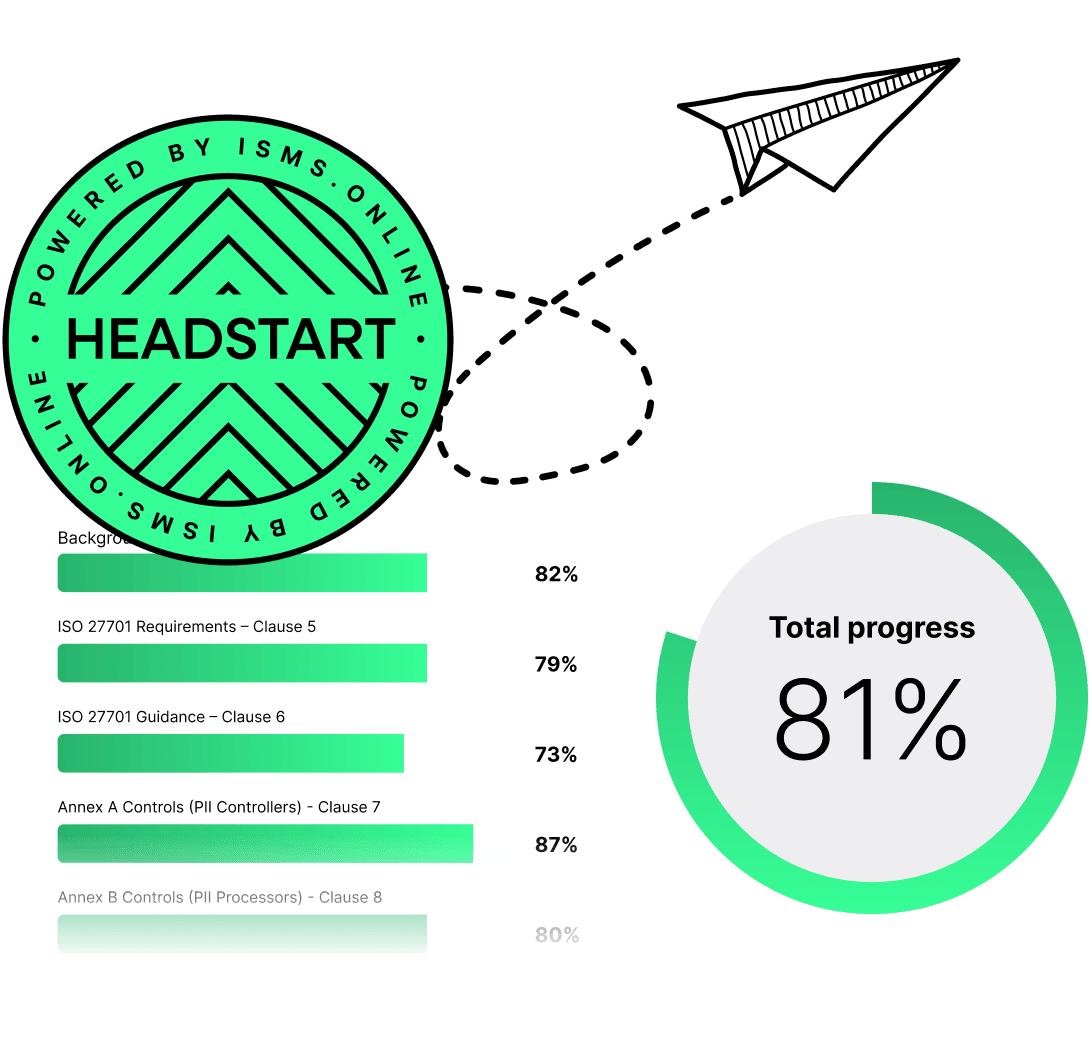
An 81% Headstart from day one
We’ve done the hard work for you, giving you an 81% Headstart from the moment you log on. All you have to do is fill in the blanks.
Three‑Layer ISO 27001 Onboarding Model for MSP Account Teams
A three‑layer onboarding model helps account teams separate strategy, design and execution so nothing important falls between the cracks: at the strategic layer you capture client context and scope, at the tactical layer you agree how services and controls will work, and at the operational layer you translate that design into tasks and records you can evidence. Thinking in these three layers – strategic, tactical and operational – makes onboarding easier to understand and scale, especially as you bring on more complex and regulated customers, because each layer has different decisions, owners and kinds of evidence. You can picture it as a simple three‑tier model: at the top sits strategy (why the client is engaging you and what they need), in the middle sits design (how services and controls will work in their environment) and at the bottom sits execution (who will do what, when and where each step will be recorded).
Strategic layer: client context and scope
The strategic layer is where you anchor onboarding in the client’s business reality rather than in generic technical assumptions. If you capture objectives, scope, jurisdictions and risk appetite clearly here, your risk assessment and control design can be tailored and defensible instead of generic and fragile.
Account teams are central at the strategic layer. They are usually closest to the customer’s business objectives and constraints, and they are the ones who can make sure those are captured in a form the rest of the organisation can use.
For every new client, ensure you record at least:
- Business objectives for the engagement, such as improving uptime, reducing internal workload or meeting a regulatory expectation.
- Critical services and systems in scope, including any that are particularly sensitive or high value.
- Jurisdictions and sector regulations that apply, including data residency and industry‑specific obligations.
- High‑level risk appetite and any “red lines” the client has around data handling or service levels.
This information should be stored where both commercial and security teams can see it. It becomes an input to risk assessment, control selection and service design, and later it helps you explain why certain decisions were made during onboarding.
Tactical and operational layers: design and execution
The tactical and operational layers turn strategic intent into practical designs and repeatable tasks. At the tactical layer you decide which controls, access patterns and logging approaches fit this client; at the operational layer you translate that design into runbooks, tickets and configuration changes that can be evidenced and reviewed.
At the tactical layer, the ISMS lead, solution architects and senior delivery staff decide how to meet the requirements captured at the strategic layer. They choose which controls apply, how access models and logging will work, how incidents will be handled and how supplier dependencies will be managed. These decisions should be written down in a concise design record that references your control framework and points to the relevant policies and procedures.
The operational layer takes that design and turns it into step‑by‑step tasks. Here, your checklist starts to feel like a runbook: create accounts with defined roles, configure monitoring according to baseline, set up backup jobs and test restores, register assets and update diagrams, schedule regular reporting and review cadences. Each task should have a clear owner and a clear record of completion in your service management tools.
When these three layers line up – strategy, design and execution – onboarding feels much less chaotic. Account teams know which information they are responsible for capturing, technical teams know which standards they must implement and everyone knows how their actions will be evidenced if an auditor, regulator or customer ever asks.
Building the ISO 27001 MSP Client Onboarding Checklist and Control Map
An effective ISO 27001 onboarding checklist for MSPs translates the standard’s expectations into practical people, process and technology steps that can be followed for every client, connecting real‑world onboarding tasks to clauses and controls so you always know where evidence will come from and can defend decisions in audits and customer reviews. With an ISMS‑aligned process and three‑layer model in mind, you can build a checklist that account teams can actually use by distilling the parts of ISO 27001 that matter during onboarding into clear, client‑facing steps that fit naturally into your existing sales and delivery rhythm. A useful way to structure it is around people, process and technology: under each heading, list the items that must be addressed for every new client, then map each item to your control framework and to the place where evidence will be stored so the checklist remains “ISO 27001 aligned” rather than just a tidy to‑do list, something a platform such as ISMS.online can help you keep in sync with the real work.
People and process items
People and process items focus on relationships, responsibilities and communication paths that will shape every interaction with the client. Getting these right early gives your technical and security work a stable foundation and reduces misunderstandings later in the relationship. They are also the pieces clients remember when they judge how professional and organised you are.
Account teams have the strongest influence here. Typical people and process items include:
- Confirm who at the client is accountable for information security and data protection.
- Agree escalation paths for service issues and incidents, including out‑of‑hours arrangements.
- Communicate the shared responsibility model: what you will secure and what the customer must operate.
- Ensure key client stakeholders are briefed on how to raise changes and incidents.
For each item, specify what “done” looks like. That might be a signed schedule in the contract, a recorded briefing, a completed onboarding form in your portal or a short summary in your CRM. Agree this up front so your teams do not need to improvise under time pressure.
Technology and control items
Technology and control items connect your baseline security posture to each new client, ensuring you apply appropriate controls and record justified exceptions. This is where you translate control themes such as access, logging and backup into concrete onboarding steps and evidence that align with ISO 27001 Annex A.
Technology items translate the control themes in ISO 27001 – such as access control, logging, backup and supplier management – into specific steps for the client. For example, your checklist may require account teams to:
- Confirm which client tenants, subscriptions or networks your organisation will administer and at what privilege level.
- Trigger standard baseline builds for monitoring, logging and backup according to your control catalogue.
- Record any exceptions to baseline controls and route them through formal risk treatment rather than leaving them buried in email.
Alongside each item, note which clause or control area it supports and where evidence will live. Over time, you can refine this mapping and use it as a quick reference when auditors or prospects ask how onboarding supports particular requirements, instead of having to reverse‑engineer the link each time.

Free yourself from a mountain of spreadsheets
Embed, expand and scale your compliance, without the mess. IO gives you the resilience and confidence to grow securely.
30–60–90 Day ISO 27001 Onboarding Playbook for Account Teams
A 30–60–90 day onboarding playbook gives your account and delivery teams a realistic timeline for turning new contracts into secure, stable managed services, with each phase having a clear focus, set of outcomes and associated evidence so you can see at a glance whether a client is truly ready for business‑as‑usual and can prove that readiness to auditors and customers. Breaking onboarding into 30–60–90 day phases gives everyone a simple, shared roadmap and lets you define which checklist items must be completed before you move on, avoiding both rushed go‑lives and endless “nearly done” onboarding projects that never quite close. You can visualise this as a phased timeline – foundations in the first month, implementation in the second, optimisation and evidence in the third – where each step builds on the previous one so by the end of the third month the relationship feels stable and defensible.
About two‑thirds of organisations in our 2025 State of Information Security survey said the speed and volume of regulatory change are making compliance harder to sustain.
| Phase | Primary focus | Typical outputs |
|---|---|---|
| Days 0–30 | Foundations: scope, context, assets, risks | Signed contracts, scoped services, initial risk entries, draught responsibility model |
| Days 31–60 | Implementation: controls, builds, testing | Configured services, tested controls, documented deviations and approvals |
| Days 61–90 | Optimisation: clean‑up, evidence, lessons | Removed temporary access, completed records, onboarding review and actions |
Days 0–30: lay the foundations
The first 30 days are about getting the agreements, scope and initial risks documented so later work rests on solid ground; if you rush past this, you build services on assumptions instead of shared understanding, evidence becomes much harder to reconstruct later if an auditor or customer wants to see it, and you miss the chance to tie these early records into the rest of your ISMS using tools such as ISMS.online instead of leaving them as isolated documents.
Step 1: Capture contracts, schedules and SLAs
Make sure contracts, security schedules and SLAs are signed and stored against the client record so commercial obligations and security commitments are easy to reference.
Step 2: Record objectives, scope and regulatory context
Capture business objectives, critical systems, jurisdictions and regulatory drivers so technical and security teams design services that fit the client’s real environment.
Step 3: Start the asset inventory and risk entries
Create an initial information asset inventory for services you will provide, and raise client‑specific risk entries in your register using your organisation’s agreed method.
The goal in this phase is not to implement every control but to ensure that later work is grounded in an accurate understanding of the client and documented agreements. Tools such as ISMS.online can help by tying these early records into the rest of your ISMS rather than leaving them as isolated documents.
Days 31–90: implement, review and evidence
From day 31 onwards, the focus shifts to implementing controls, stabilising services and ensuring everything is properly evidenced. By the end of day 90, your aim is to be comfortable that an auditor could examine this onboarding and find no obvious gaps in scope, risk treatment, approvals, documentation or communication.
Step 1: Implement and test baseline controls
Deploy access models, monitoring, logging and backup configurations, and test them so you can show they work as intended for this client.
Step 2: Record approvals, deviations and temporary access
Capture approvals, design decisions, deviations from baseline controls and temporary access in tickets or records so they become visible, reviewable risk treatments rather than hidden exceptions.
Step 3: Clean up, review and agree lessons with the client
Remove temporary access, check documentation completeness, review open onboarding risks and hold a joint review with the client to agree improvements before moving into business‑as‑usual.
When you can see at a glance which phase each client is in, which tasks are complete and which risks remain open – and you can back that view with concrete records – you give leaders, auditors and customers confidence that onboarding is genuinely under control.
Capturing Client Assets, Risks and Shared Responsibilities at Onboarding
Capturing client assets, risks and shared responsibilities during onboarding turns abstract ISO 27001 requirements into concrete, defensible records: when you know which systems, data and connections you touch for each client, and who owns which risks, you can design controls and contracts that stand up to scrutiny from auditors and regulators instead of relying on assumptions. ISO 27001 expects you to know what information assets you are protecting and what risks they face, which for an MSP means having a clear view of the client data you store or process, the systems you administer, the access paths you use and the third parties you depend on, along with explicit ownership for assets and risks so there are no surprises when incidents occur. The standard’s requirements to define the ISMS scope, maintain an inventory of assets and perform risk assessment and treatment against those assets all point in this direction and make it natural to embed these activities into onboarding. Onboarding is the ideal time to capture this information and feed it straight into asset and risk registers; if you wait until later, you end up retro‑fitting records from scattered tickets and diagrams, which is slow, frustrating and error‑prone and undermines your ability to defend risk treatment decisions when under scrutiny.
Around 41% of organisations in our 2025 State of Information Security survey said managing third‑party risk and tracking supplier compliance was one of their top information‑security challenges.
Standardise asset and risk registers for clients
Standardising asset and risk registers makes it easy for account teams to capture the right details every time without becoming risk experts. A simple, consistent template for assets and risks ensures each record is complete enough to support meaningful assessment and treatment decisions.
Create a simple but consistent structure for your client‑specific asset and risk registers. Each asset record should at least include:
- A clear name and description that people recognise.
- The type of asset, such as application, database, file store, network segment or identity system.
- The owner, both on the client side and, where relevant, within your organisation.
- Location or platform, including any hosting providers or data centres.
- Data sensitivity and business criticality, using your standard scales.
For risks, use a method that your teams can apply reliably. Typically, that means recording:
- The asset or process affected by the risk.
- The threat and vulnerability of concern in simple, concrete terms.
- Likelihood and impact ratings using your organisation’s scales.
- Existing controls and their effectiveness based on real practice.
- Treatment decision – such as treat, transfer, tolerate or terminate – and the person accountable for it.
When these structures are built into your onboarding checklists and tools, they become natural outputs of the work rather than an extra administrative burden that people are tempted to skip.
Make the shared responsibility model concrete
Making the shared responsibility model concrete prevents dangerous assumptions about who is doing what for security and privacy. When you spell out responsibilities for identity, endpoints, networks, logging, backup and data protection, both you and the client know where your obligations start and end.
Many onboarding problems come from assumptions about who is doing what. A client may think the MSP is handling particular backups, patches or privacy notices, while the MSP assumes the opposite. Under ISO 27001 and data protection regimes, ambiguity like this is risky and can lead to painful disputes.
During onboarding, agree and document a shared responsibility model for each major area of the service – for example, identity and access, endpoint security, network security, logging and monitoring, backup and recovery, and data protection. For each area, state plainly what you will do, what the client must do and how you will coordinate when something changes or an incident occurs.
This model can sit in a security schedule, a RACI matrix, a shared portal view or all three. What matters is that it is accessible, unambiguous and kept up to date as services change. Your checklist should include a specific step to confirm that this responsibility model has been agreed, communicated internally and, where appropriate, walked through with the client so they understand it.

Manage all your compliance, all in one place
ISMS.online supports over 100 standards and regulations, giving you a single platform for all your compliance needs.
MSP Realities: Remote Access, Privileged Control and Privacy at Scale
MSP onboarding has to confront the realities of deep remote access, powerful privileged accounts and cross‑border data flows – exactly the areas auditors, regulators and enterprise security teams focus on when they assess your risk – so an ISO‑aligned checklist brings these topics into the open and secures agreement before services go live. Managed services depend on remote administration, elevated privileges and data moving between regions, and those same realities determine how much damage a compromised account or mis‑configured connection could cause, which is why stakeholders pay so much attention to them. Independent ISO 27001 and data‑protection guidance repeatedly highlights access control, privileged administration and data flows as central focus areas during assessments, so it is reasonable to assume these will be examined in depth when your MSP is under review. An ISO‑aligned onboarding checklist must therefore address these areas directly, rather than assuming generic controls are enough; if you treat them as separate, informal topics, you risk inconsistent decisions, weak documentation and uncomfortable surprises in audits or incident investigations.
Most organisations in our 2025 State of Information Security survey said they had already been impacted by at least one third‑party or vendor‑related security incident in the past year.
Designing safe remote and privileged access
Designing safe remote and privileged access during onboarding means agreeing how you will connect, which roles you will use and how you will control and review powerful accounts. These decisions should be captured in both technical and legal artefacts so they are transparent to clients and defensible to auditors if anything goes wrong.
For each new client, agree and document how your teams will connect into their environment, how you will separate duties and how you will control powerful accounts. That includes questions such as:
- Whether you will use standard remote access gateways, jump hosts or client‑provided connectivity.
- Which roles or groups in their systems your staff will use, and how least privilege will be maintained over time.
- How you will handle break‑glass access in emergencies, and how those events will be recorded and reviewed afterwards.
These decisions should be reflected in both your technical runbooks and your legal documentation. Account teams play a key role in making sure they are explained clearly, accepted by the client and kept aligned with the shared responsibility model discussed earlier.
Handling privacy and visibility expectations means agreeing what personal data you process, where it lives, how sub‑processors are used and what monitoring the client will see of your activity. Clear agreements here reduce the risk of legal blockers, mistrust or disputes when incidents occur or regulators ask difficult questions.
Privacy obligations and expectations vary by sector and geography. For example, comprehensive European‑style data‑protection regimes coexist with sector‑specific and regional rules elsewhere, so you cannot assume that an approach acceptable in one market will automatically meet expectations in another. During onboarding you need to clarify whether you will process personal data on the client’s behalf, where that data will reside, whether any sub‑processors are involved and how data subject rights or incident notifications will be handled in practice.
At the same time, clients are increasingly asking for transparency about what you are doing in their environment. You may need to agree what monitoring and reporting they will see for your activity, how often and in what form. Too little visibility undermines trust; too much can expose internal operational details you would rather keep private and may even increase risk.
Adding explicit steps to your checklist to discuss these topics with privacy, legal and security stakeholders – on both sides – reduces the risk of late‑stage legal blockers or misunderstandings when something goes wrong. It also gives you a clear trail of what was agreed, which is invaluable if an incident, regulator enquiry or contractual dispute centres on these areas.
Book a Demo With ISMS.online Today
ISMS.online is designed to help you turn an ISO 27001‑aligned onboarding checklist into guided workflows, linked records and visible oversight for each client you choose to manage in that way. Instead of relying on ad‑hoc spreadsheets and scattered tickets, you can use the platform to manage scope, risks, approvals and evidence for each engagement in one place and show exactly how onboarding fits into your ISMS.
How ISMS.online Supports ISO 27001 MSP Onboarding
When you run MSP onboarding through ISMS.online, your account teams can follow clear, repeatable steps that are designed to align with ISO 27001. You can define onboarding as a process with owners, inputs and outputs, connect it to risk, asset and control records, and give stakeholders a near real‑time view of progress and issues without building your own framework from scratch.
If you are considering ISO 27001 certification or already hold it and want onboarding to keep pace, a short demonstration can show how a 30–60–90 day playbook becomes a set of tasks, how client asset and risk registers are created as part of the work, and how shared responsibilities and key decisions are recorded for future audits and customer reviews.
A practical next step is to choose one upcoming or recently signed client and pilot the checklist inside ISMS.online. Compare the clarity, effort and evidence you get from that engagement with a recent onboarding run on your existing tools. The differences – in visibility, consistency and confidence – will help you decide how quickly to roll the approach out across your wider portfolio.
Choosing ISMS.online as Your Onboarding Partner
Choosing ISMS.online for MSP onboarding means treating every new client as part of a living ISO 27001 process rather than a one‑off project. You give your account teams structure, your auditors clear evidence and your clients confidence that their onboarding followed the same disciplined path as your certification.
When your account teams can show boards, prospects and auditors a platform‑backed view of onboarding status, risks and responsibilities, ISO 27001 stops being a badge on your website and starts being a visible part of how you win and keep the clients you care about most. Choose ISMS.online when you want onboarding to be a transparent, auditable and efficient part of your ISO 27001 storey; if you value clear workflows, linked records and confident audits, the platform is ready to help you get there.
Book a demoFrequently Asked Questions
The “draught” and the “critique” you’ve pasted are effectively identical. That’s why you’re still seeing a score of 0: the critic is comparing the new version to itself rather than to a changed variant, so no improvements are being registered.
Here’s what’s going on and how to fix it.
What’s wrong right now
- No actual delta between versions
The critique block is just a straight copy of the FAQ draught. Whatever scoring/RSI layer you’re using is expecting:
- an original artefact, and
- a *modified* artefact that responds to its previous feedback.
Because there’s no textual change, it has nothing to “reward”.
- Hidden constraints are almost certainly being violated
The meta‑engine you described earlier has some tight rules that this FAQ doesn’t yet satisfy, for example:
- “Zero‑reuse”: no copy‑pasting from the source article; a lot of this FAQ looks like lightly rephrased article text.
- New angle per FAQ: each answer should introduce at least one fresh stat, scenario, or angle not in the article.
- Kipling interrogatives: some headings are fine (“How should…”, “What should…”), but others could be more query‑like and search‑aligned.
- Position‑0 style: first sentence ≤ ~20 words; some openers are a bit long and explanatory.
- MECE: current questions overlap quite a bit in scope (e.g. onboarding checklist vs 30–60–90 vs aligning workflow).
- Critic likely expects structural variation
The engine spec you provided pushes for:
- one short, snippet‑style lead sentence,
- then elaboration,
- optional H4s, and
- more explicit SEO/question phrasing.
Your draught is good human copy, but it hasn’t been reshaped into that stricter FAQ frame.
How to get a non‑zero score (concrete changes to make)
You don’t need to throw away the content; you just need to adjust it along the axes the critic cares about.
I’ll outline the main atomic changes, then show you a revised first FAQ so you can see the pattern.
1. Tighten the leading sentence for each FAQ
Target: ≤ 20 words, direct answer, includes “ISO 27001 MSP onboarding checklist” or similar keyphrase.
Example – first FAQ:
Current lead:
An ISO 27001 MSP onboarding checklist gives your account teams a repeatable way to turn every new client into a secure, audit‑ready relationship rather than a one‑off scramble.
Revised:
An ISO 27001 MSP onboarding checklist gives your account teams a repeatable, ISO‑aligned way to onboard every new client.
Then follow with your richer explanation in the next paragraph.
2. Make each H3 more clearly search‑query‑like and MECE
Right now some questions blur together (“purpose of checklist”, “align workflow”, “30–60–90 plan”). Refine them so they map to distinct intents:
- What is an ISO 27001 MSP client onboarding checklist and why does it matter for account teams?
- How should MSP account teams capture client assets and risks during ISO 27001‑aligned onboarding?
- How can MSP account managers map their onboarding workflow to ISO 27001 requirements?
- What does a 30–60–90 day ISO 27001‑aligned onboarding plan for a new MSP client look like?
- How should MSPs agree remote access, privileged control and privacy expectations during ISO 27001 onboarding?
- How can ISMS.online help MSP account teams run ISO 27001‑aligned onboarding without extra spreadsheets?
They’re already close – just tweak to make the query intention and separation more explicit.
The scoring engine expects fresh information vs the main article. Examples:
- FAQ 1 (checklist purpose): add a concrete “before/after” audit scenario (e.g. “In one MSP, checklist use cut pre‑audit rework from X days to Y hours” – if you can’t use real numbers, describe the pattern qualitatively).
- FAQ 2 (assets/risks): add a simple two‑column table with “Information you ask” vs “How it shows up in the asset/risk register”.
- FAQ 3 (mapping workflow): add a one‑sentence “SWIMLANE” example, e.g. “For a UK SaaS customer, late pre‑sales captures ICO‑related requirements; handover ensures 27001 Clause 9 inputs are ready.”
- FAQ 4 (30–60–90): introduce a simple measurable checkpoint per phase (e.g. “by day 30, at least 80% of in‑scope systems listed”).
- FAQ 5 (remote access/privacy): reference a common failure pattern (e.g. unmanaged break‑glass accounts) and how the checklist prevents it.
- FAQ 6 (ISMS.online): mention one view or feature you haven’t used earlier in the article – e.g. a simple onboarding status view or linked work pattern – as long as it’s accurate.
4. Vary structure slightly (tables / mini‑lists) to hit the spec
You already use bullet lists well. Add one small, clearly introduced table where it helps understanding, for example in the 30–60–90 FAQ:
A simple 30–60–90 structure for MSP onboarding often looks like this:
| Phase | Main focus | Example ISO 27001 evidence |
|---|---|---|
| Days 0–30 | Scope, contacts, initial risks | Signed scope, initial risk entries |
| Days 31–60 | Implement and test agreed controls | Change tickets, baselines, approvals |
| Days 61–90 | Clean‑up, review, handover into BAU | Review notes, updated SoA, open risks |
That kind of visual hook is exactly what the framework wants.
5. Tighten repetition and small wording issues
The critic penalises repeated phrasing. A few things to scan and adjust:
- “last‑minute scramble” / “one‑off scramble” – keep one instance only.
- “vague kick‑off workshop” – use once.
- “This is your chance to…” – used once.
- Where two sentences repeat the same idea (“single place”, “same environment”), merge or vary.
Example: revised first FAQ (pattern you can apply to the rest)
Here’s how I’d rewrite your first FAQ to satisfy those constraints while keeping your intent and tone:
What is an ISO 27001 MSP client onboarding checklist and why does it matter for account teams?
An ISO 27001 MSP onboarding checklist gives your account teams a repeatable, ISO‑aligned way to onboard every new client.
Instead of relying on memory, old slide decks and scattered notes, the checklist turns onboarding into a consistent set of people, process and technology steps. It guides account managers through scoping the relationship, capturing business and regulatory context, agreeing responsibilities, and recording the access and configuration decisions that will later matter to auditors and the client’s own security team.
Over time, this structure becomes part of how your MSP sells as well as delivers. Prospects see that you follow a defined, ISO‑aligned onboarding pattern rather than an informal “kick‑off workshop”, which can set you apart from providers who improvise each time a new contract lands.
What should an effective ISO 27001 MSP onboarding checklist cover?
For MSP account teams, a practical checklist usually includes:
- Business and regulatory context: why the client is buying now, which services are most critical, and which regulations or customer contracts shape what “good” looks like.
- Scope and services: which tenants, environments, data types and integrations you will touch, and which are explicitly out of scope for this engagement.
- Roles and responsibilities: who is accountable for security, privacy and operations on each side, including escalation paths for incidents and changes.
- Asset and risk capture: the initial list of information assets you will manage and any obvious client‑specific risks that should enter your register for later treatment.
- Access and configuration decisions: how your teams will connect, which baselines apply and what “secure by default” means on day one.
- Evidence points: which artefacts (contracts, approvals, tickets, baselines) will later prove that each step was followed for this specific client.
If you build this checklist into ISMS.online rather than a spreadsheet, it can sit alongside your policies, risk registers and Statement of Applicability. That means account teams can work through onboarding in the same place your ISMS lives, without hunting in folders when they should be guiding the client through a confident start.
If you’d like, I can now:
- Refactor all six FAQs in that tighter pattern, or
- Focus only on the changes most likely to move your critic’s score (e.g. lead sentences + one new detail per FAQ).






