





































Why MSP risk is different now
ISO 27001 risk assessment matters differently for managed service providers because a single weakness in your environment can harm many customers at once. Instead of protecting one organisation, you are safeguarding a whole ecosystem of downstream businesses that depend on your tools, access and decisions. Shared platforms, privileged accounts and central roles make you both highly efficient and unusually attractive to attackers and highly visible to regulators and large buyers. That one‑to‑many exposure turns your MSP into a concentration point where many customers’ operations intersect, making your risk profile more concentrated and more important to major buyers. When you see your role through that lens, risk assessment becomes a way to understand the systemic impact of your decisions and protect trust in your services, not just a compliance task.
Strong security for an MSP starts with honest visibility of shared risks.
This information is general and does not constitute legal, regulatory or certification advice; you should take professional advice before making decisions that affect your obligations.
Your MSP is a single point of failure
Your MSP acts as a single point where many customers’ systems and data converge, so one compromise can cascade across your portfolio. Remote tools, shared backup platforms and central identity systems give you powerful reach into client environments, and the same reach is available to any attacker who breaks in. That concentrated “blast radius” is the defining difference in your risk profile and needs to be reflected clearly in your assessment.
For a traditional single‑tenant organisation, most risks are contained within one perimeter; a breach hurts that business but often stops there. As an MSP, you sit upstream of many organisations, often with privileged access into their servers, cloud tenants and networks. If a remote management platform, shared backup system or privileged account is compromised, a single malicious action can be pushed to every client that depends on it. Your assessment therefore has to model how your own tools could become the attacker’s easiest route into all of them.
Customers and regulators now expect MSPs to demonstrate a structured, repeatable approach to information security risk, not just a logo on a website. Board and outsourcing guidance from national cyber security bodies, such as material published by the Dutch NCSC, explicitly encourages organisations to ask service providers to evidence formal risk management and alignment with standards like ISO 27001, which has raised expectations for MSPs as part of critical supply chains (national cyber security guidance).
According to the 2025 ISMS.online State of Information Security report, customers increasingly expect their suppliers to align with formal frameworks such as ISO 27001, ISO 27701, GDPR, Cyber Essentials and SOC 2.
Large buyers are under pressure to manage supply‑chain risk, so they bring detailed security questionnaires, due‑diligence calls and contract clauses that probe exactly how you assess and treat risks. Data‑protection and outsourcing guidance from regulators such as the UK Information Commissioner’s Office recommends using structured questionnaires, contractual controls and ongoing assurance for processors and key suppliers, reinforcing this behaviour when those buyers deal with MSPs (data protection regulators). They want to see not only that you are certified, but that you understand the risks created by your role in their operations.
Regulators and national cyber agencies also see MSPs as part of the operational backbone of many sectors, even when you are not formally labelled “critical infrastructure”. Supervisory material from international and financial‑stability bodies, including the Bank for International Settlements and other standard‑setters, treats major ICT and service providers as systemically important nodes in supply chains, which is the same pattern MSPs fit into from a risk perspective (financial stability authorities). Guidance aimed at boards regularly reminds them that outsourcing does not transfer accountability; it adds a new dependency that must be managed. Board‑level briefings from national cyber security centres repeat this message, stressing that responsibility for risk remains with the customer even when services are delivered by an external provider (national cyber security centres). When your customers read that, they pass those expectations to you through RFPs, renewals and periodic reviews, making your risk assessment approach part of how they judge your suitability as a partner.
Why ISO 27001 is becoming the MSP baseline
ISO 27001 is becoming a baseline for MSPs because it gives customers, auditors and regulators a shared language for information security risk. Instead of improvised spreadsheets and ad‑hoc scoring, you work within a recognised framework that defines what should be in scope, how to assess risks and how to link them to controls and evidence. Outsourcing and cloud‑security guidance from national cyber security bodies frequently points large organisations towards ISO 27001‑aligned controls and certification as a recommended assurance signal when choosing key IT and cloud suppliers, which is why many enterprises now treat it as a minimum expectation for MSPs (national cyber security guidance). That familiarity lowers friction in sales conversations and audit rooms alike, because stakeholders know roughly what to expect.
In the 2025 ISMS.online State of Information Security survey, almost all respondents said that achieving or maintaining security certifications, such as ISO 27001 or SOC 2, is a priority for their organisation.
In that context, ISO 27001 risk assessment is attractive because it offers a structured way to answer hard questions:
- What information and systems are you responsible for protecting?:
- What could realistically go wrong, and how serious would it be?:
- What have you actually put in place to reduce those risks?:
These questions are easier to handle when you can show that you follow a recognised standard rather than a custom process. For MSPs, the assessment scope usually covers both your corporate environment and the shared tools you use to manage customers, so you can show how risks and controls span both. These answers help you move conversations about trust, liability and shared responsibility away from opinion and towards a documented, repeatable approach.
Risk assessment as your storey spine
Risk assessment is most useful when you treat it as the backbone of your security storey, not a yearly compliance chore. It connects the external threat landscape and regulatory expectations to the way you architect services, choose suppliers, set service levels and respond to incidents, so your actions stay consistent with your stated risk appetite.
It also explains why particular controls exist, which risks they treat, and which exposures you have consciously accepted or transferred. If you view risk assessment only as a once‑a‑year document for auditors, it will always feel like overhead. If you use it as the structure that keeps your promises to customers and investors honest, it becomes a powerful internal decision tool and an external proof point. Seeing it this way makes it natural to keep the assessment current and to use it when you design services, negotiate contracts and handle incidents.
Book a demoISO 27001 risk assessment basics
An ISO 27001 risk assessment is a structured way to decide which information security risks matter most to your organisation and what you will do about them. Instead of relying on gut feel or isolated tests, you agree a method, apply it consistently to in‑scope assets and record decisions and treatments so they can be explained, reviewed and improved. That shared method becomes part of your information security management system and underpins your ability to show that risks are being managed in a deliberate, repeatable way.
In ISO 27001 this method is part of your information security management system (ISMS) and is revisited whenever your environment or services change. ISO 27001 gives you a recognisable framework that auditors and customers already understand. It sets out what a risk assessment should cover, without locking you into one scoring model or tool. For MSPs new to the standard, it is worth getting comfortable with the core ideas before you map them onto your shared platforms, internal systems and customer relationships. A clear grasp of those basics makes later design choices much easier to explain and defend.
Core concepts in ISO 27001 risk assessment
The core concepts in ISO 27001 risk assessment revolve around understanding what you are protecting, what could happen and how serious it would be. The standard describes risk as “the effect of uncertainty on objectives”, and in this context the objectives concern the confidentiality, integrity and availability of information. This wording reflects the definition of risk used across ISO standards such as ISO/IEC 27001 and ISO 31000, which helps keep terminology consistent in your management system (ISO risk definition). Your method translates that definition into specific scenarios you can score, discuss and treat in a consistent way.
At a practical level, you will work with a small set of recurring concepts:
- Assets: – systems, services, data, people, facilities and processes that store, process or transmit information.
- Threats: – events or actors that could cause harm, from attackers to mistakes, failures or natural events.
- Vulnerabilities: – weaknesses that make a threat more likely or more damaging, such as misconfigurations or missing controls.
- Likelihood and impact: – agreed scales for how probable a scenario is and how serious the consequences would be.
- Risk: – your combined view of likelihood and impact for a specific scenario, expressed on a defined scale.
- Risk owner: – the person accountable for deciding how to handle a particular risk and signing off any acceptance.
These definitions keep discussions clear when you start scoring scenarios, debating priorities and explaining your decisions to auditors or customers. A shared understanding of these terms also helps different teams contribute confidently to the assessment.
The standard risk assessment cycle
The ISO 27001 risk assessment cycle is a documented, repeatable process that guides you from understanding your context to monitoring treatments. The standard expects you to define this cycle clearly so that people can follow it and auditors can see that risks are being addressed in a consistent, structured way. Most certified organisations follow a broadly similar approach that is easy to explain and adapt to MSP realities.
The cycle is simple enough to understand yet flexible enough to fit different business models, including MSPs with many customers. A typical approach breaks down into a small number of recurring steps.
Step 1 – Establish context and criteria
Define the ISMS scope, the services and locations included, and agree how you will measure likelihood, impact and acceptable risk. Make sure these criteria reflect your MSP business model and the potential for one incident to affect many customers.
Step 2 – Identify risks
Build or refine your asset inventory, then identify realistic combinations of assets, threats, vulnerabilities and impacts. Focus first on high‑value shared platforms and critical internal systems before expanding into more detailed scenarios.
Step 3 – Analyse and evaluate risks
Score each scenario for likelihood and impact, derive an overall risk rating, and compare it with your acceptance criteria. Use this comparison to decide which risks need treatment and which can be accepted under defined conditions.
Step 4 – Treat risks
Decide whether to reduce, avoid, transfer or accept each significant risk, and record the chosen treatments in a risk treatment plan. Make sure responsibilities, timeframes and any dependencies on customers or suppliers are clearly documented.
Step 5 – Select controls
Choose Annex A and other controls that implement your treatments, and explain applicability and justifications in your Statement of Applicability. This step turns high‑level decisions into specific technical, organisational, people and physical measures.
Step 6 – Monitor and review
Revisit the assessment at planned intervals and when changes or incidents occur, checking whether risks and controls remain acceptable. Feed lessons learned from incidents and near misses back into your method so it stays relevant and effective.
Thinking about your activities in these steps helps you give clear, structured answers when auditors or customers ask how you manage risk. For an MSP, this same cycle runs over both your own corporate environment and the shared platforms and services you use for customers, so you do not need parallel, conflicting methods.
What auditors expect to see
Auditors expect your ISO 27001 risk assessment to follow a coherent method that is documented, applied and reviewed. Accredited certification bodies, including organisations such as BSI, explain in their public assessor guidance that ISO 27001 audits focus on whether risk assessments are documented, consistently applied and periodically reviewed, rather than on any one template or tool (accredited certification bodies). They do not insist on a specific tool or scoring scale, but they want evidence that risks are being assessed systematically, decisions are recorded and treatments are implemented. Being ready with that evidence removes much of the stress from certification or surveillance audits.
When your approach aligns clearly with ISO 27001, it becomes much easier to answer questions without scrambling. Typically auditors expect to see:
- A documented risk assessment procedure that defines roles, criteria, scales and review triggers.
- A current risk register for in‑scope services and environments, with clear descriptions, scores, owners and decisions.
- A risk treatment plan showing how you will address unacceptable risks, with priorities and target dates.
- A Statement of Applicability that links to risks and explains why each Annex A control is applied or not.
- Evidence that treatments are implemented and effective, such as change records, monitoring outputs or internal audit findings.
Meeting these expectations from the start avoids last‑minute rework before a certification audit or a demanding customer review. For many MSPs, using a dedicated ISMS platform makes it easier to produce these artefacts on demand without hunting through folders and email threads.
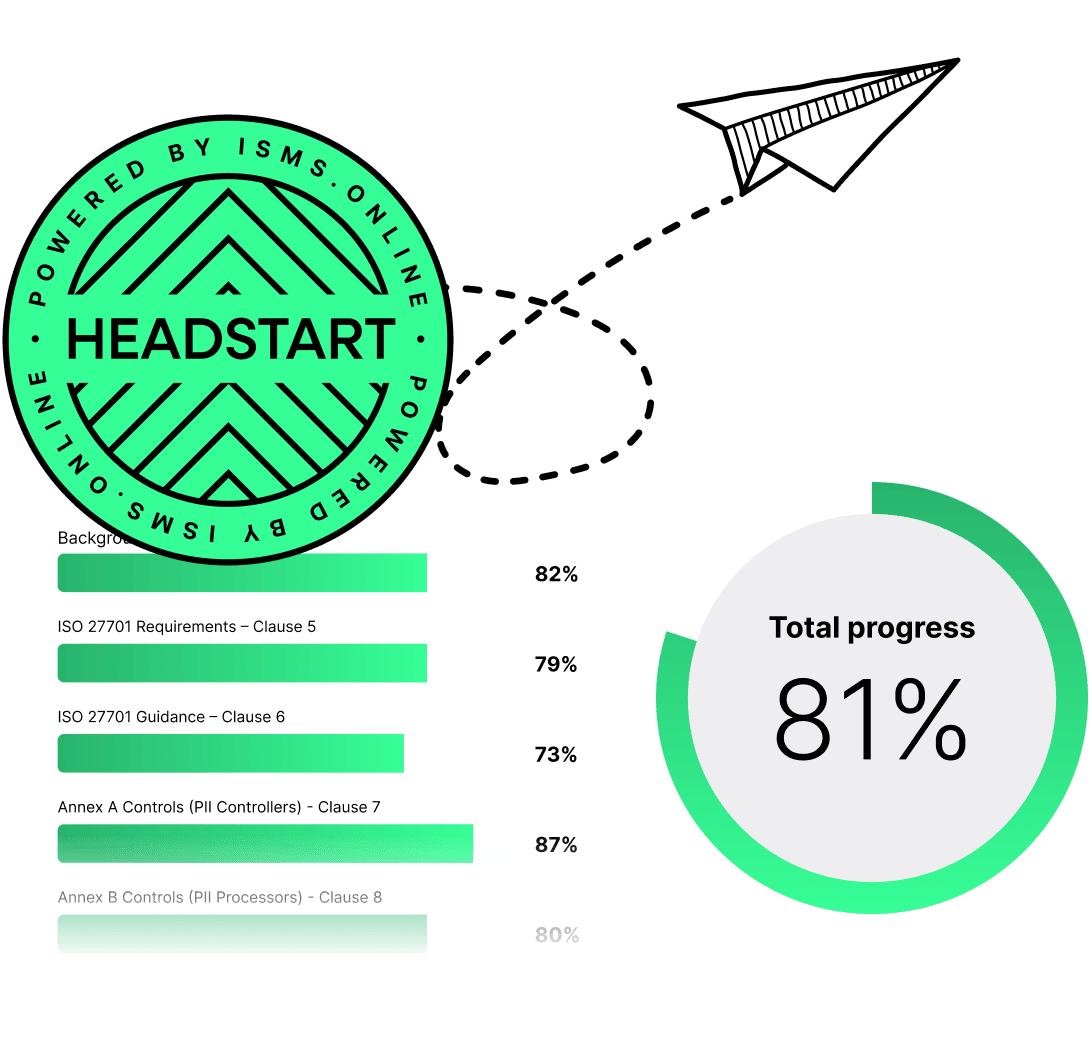
ISO 27001 made easy
An 81% Headstart from day one
We’ve done the hard work for you, giving you an 81% Headstart from the moment you log on. All you have to do is fill in the blanks.
The MSP‑specific risk landscape
Your MSP faces a distinct risk landscape because shared tools and access concentrate impact across many customers. You work with the same basic risk assessment mechanics as any other organisation, but the environment you are assessing is more interconnected, more dependent on upstream suppliers and more tightly linked to your customers’ business continuity. Multi‑tenant tools, powerful remote access, supplier dependencies and complex contracts combine to create a profile that is more concentrated and more consequential than a typical single‑tenant IT department. For MSPs, this landscape is defined as much by relationships and dependencies as by individual systems, so your risk assessment needs to reflect how shared tools and privileged staff operate across customer environments and how regulators and insurers view that concentration of influence. When you model risks in this way, it becomes easier to justify the controls and investments that protect both your business and your customers.
Most organisations in the 2025 ISMS.online State of Information Security survey said they had already been impacted by at least one third‑party or vendor‑related security incident in the past year.
Your shared service stack as an asset
Your shared service stack is one of your most critical assets because it forms the backbone of everything you deliver. Remote monitoring and management tools, ticketing systems, central backup platforms, cloud management consoles, identity platforms and security operations tooling often support dozens or hundreds of customers at once, so any weakness can have amplified consequences.
These are not just technical components; they are channels into many environments. In risk assessment terms, you should treat each shared platform as a high‑value asset and model explicit scenarios around it. For example, consider what happens if an attacker gains privileged access to your remote management console. Think about the impact if a configuration mistake in your backup platform leaves several clients unrecoverable, or if a cloud administration account is abused to create unmonitored access paths. These scenarios are very different from device‑by‑device risks on a single customer site, and they demand different treatments and monitoring.
Shared tools give you leverage, but they also define your largest single points of failure.
People and process risks in an MSP
People and processes are just as important as technology in your MSP risk landscape, because they shape how often vulnerabilities appear and how quickly you spot them. MSPs are often fast‑moving, service‑driven businesses running extended hours or 24/7 rotas, which increases the chances of mistakes under pressure if controls are not well designed and consistently followed.
Engineers may hold elevated rights on many customer systems, and service desk staff regularly handle credential resets and access requests. Common MSP risk scenarios therefore include:
- Misuse or error by staff with privileged access, whether deliberate or accidental.
- Social engineering of service desk staff by attackers impersonating trusted customer contacts.
- Unauthorised changes made under time pressure without proper review, testing or rollback planning.
- Weak joiner, mover and leaver processes that leave ex‑employees with residual access to customer environments.
A mature risk assessment models these human and process factors alongside technical threats and links them to treatments such as training, segregation of duties, approvals, logging and monitoring. These scenarios remind you that culture and workload are part of your risk picture, not just code and configuration.
Commercial, contractual and regulatory consequences
Commercial and regulatory consequences often determine whether a risk threatens the viability of your MSP, rather than just disrupting systems. A purely technical view may understate how damaging a multi‑customer incident can be once contracts, reputational impact and regulatory involvement are taken into account.
A ransomware incident that spreads through your management platform can trigger breach‑notification obligations for multiple customers, create regulatory investigations in several jurisdictions and cause serious concern for your board and investors. Risk‑based data‑protection frameworks such as GDPR make clear that personal‑data breaches at processors and key service providers can create notification duties and regulatory scrutiny for each affected customer, sometimes in several countries at once, so a single MSP incident can quickly become a multi‑party event (risk‑based data‑protection laws).
Only about 29% of organisations in the 2025 ISMS.online survey reported receiving no fines for data‑protection failures in the past year.
Your impact scale should reflect that broader picture if it is to guide good decisions. When you set risk criteria, it is helpful to build in dimensions such as:
- Contractual impacts, including service credits, termination rights and liability caps.
- Customer churn and lost opportunities after an incident.
- Regulatory fines or enforcement action affecting you or your customers.
- Changes to insurance cover, such as increased premiums or reduced availability.
- Cost of remediation and incident handling across many clients at once.
By embedding these factors into your risk criteria, you ensure the assessment surfaces the exposures that truly threaten the viability and reputation of your MSP, rather than just those that cause temporary technical disruption.
Designing an MSP risk methodology and scope
Designing an MSP risk methodology and scope is about creating a repeatable way to apply ISO 27001 across both your own environment and the services you deliver. The method must be robust enough to satisfy auditors, regulators and major customers, but simple enough for your teams to use without needing specialist risk jargon every time they contribute. A clear, well‑explained method reduces friction and builds confidence internally and externally.
The goal is a method that reflects your specific business model without becoming a parallel compliance world nobody wants to maintain. Designing this method starts with scope and context, then moves through criteria and practical structures. When you approach it consciously, you can explain to stakeholders why your method looks the way it does. It also shows how it supports both compliance and real‑world resilience. That clarity also helps you avoid constant reinvention as your customer base grows or new frameworks such as NIS 2 appear. A dedicated ISMS platform such as ISMS.online can help by giving you one place to define, apply and review this method as your services evolve.
Separate but connected contexts: internal vs customer
Splitting your risk assessment into two connected contexts makes it easier to capture how your business really works. One context covers your internal environment: corporate IT, staff, offices, development systems and internal tools that are not directly part of managed services. The other covers the managed services context: the platforms, processes and people you use to deliver services to customers and your interfaces into their environments.
A practical approach is to apply the same risk method in both contexts, but tag each risk with its context and, where relevant, the customers or services affected. This makes it easier to:
- See cross‑cutting risks that affect many customers through a single shared platform.
- Report on risks from the perspective of operations, individual services or specific customers.
- Demonstrate clearly where your responsibility ends and the customer’s responsibilities begin.
Keeping everything in a single, untagged list usually leads to confusion and muddled priorities, especially once you manage larger numbers of customers or services.
Agreeing risk criteria that work across clients
Agreeing risk criteria that work across clients means finding a balance between comparability and flexibility. You need a single set of scales and impact dimensions that you can apply across your portfolio, without ignoring the fact that a similar incident may hurt some customers far more than others. Your MSP likely serves customers with different sizes, sectors and risk appetites, but you cannot maintain a unique scoring model for each one. Instead, you need a standard structure you can explain once and apply many times, while still recognising where impacts differ. This balance is easier to achieve if you separate the model from the commentary that tailors it to particular clients.
About two‑thirds of organisations in the 2025 ISMS.online survey said that the speed and volume of regulatory change are making compliance harder to sustain.
You need risk criteria that are consistent enough to compare risks across your portfolio, but flexible enough to reflect different customer impacts. One approach is to define:
- A single set of likelihood levels, with clear descriptions and simple examples.
- A base set of impact dimensions such as customer outage, data breach, financial loss, regulatory impact and reputational damage.
- Qualitative impact bands that you can interpret differently for particular sectors or service tiers.
When you assess a risk that affects a group of customers, you can score it using this shared model and add notes where certain customers face higher or lower impact. That keeps your risk registers comparable and understandable while acknowledging that, for example, a healthcare customer may see higher regulatory impact than a small retailer from the same incident. Agreeing these criteria with key stakeholders early helps avoid repeated debates every time a risk is reviewed.
Building a maintainable risk register
Building a maintainable risk register is about capturing enough detail to support decisions and audits without creating an unwieldy document nobody wants to update. For an MSP, the register must make sense to engineers, service managers and auditors, and it must cope gracefully with growth in services and customers. If it is hard to navigate, people will bypass it and decisions will drift away from the agreed process. The structure should support both day‑to‑day work and formal reviews.
A risk register is only useful if people keep it up to date and can find what they need quickly. For an MSP, this means capturing enough detail to support audits and decision‑making, without creating a huge, unwieldy document nobody wants to touch. The structure should make sense to engineers, service managers and auditors alike. Common fields include:
- Asset or process affected, described clearly so engineers recognise it.
- Context, such as internal, shared platform or specific service, with optional customer tags.
- Threat and vulnerability description in plain language.
- Existing controls that influence likelihood or impact.
- Inherent likelihood, impact and overall inherent risk rating.
- Risk owner responsible for decisions and follow‑up.
- Planned treatment, target date and current status.
- Residual risk rating after treatment and a planned review date.
You can start with a spreadsheet, but most MSPs quickly find that an ISMS platform is more sustainable. A platform such as ISMS.online can help you structure risks, owners, treatments and evidence in one environment so you are not juggling conflicting versions spread across folders and inboxes. Whatever tool you choose, the test of a good register is whether you can easily answer questions such as “Show me our highest cross‑customer risks” or “Show me all risks that depend on this supplier”.

Free yourself from a mountain of spreadsheets
Embed, expand and scale your compliance, without the mess. IO gives you the resilience and confidence to grow securely.
From risks to Annex A controls, SLAs and security addendums
Turning ISO 27001 risks into Annex A controls, SLAs and security addendums is where your assessment starts to influence real‑world behaviour. The standard does not stop at listing risks; it requires you to decide what to do about them, select appropriate controls and reflect those decisions in how you design and deliver services. For an MSP, those choices flow beyond internal documentation into the SLAs, security schedules and data processing agreements that shape your reputation and liability. A clear link from risk to controls and then into contracts is a powerful way to keep your promises realistic, treat documentation and operations as parts of the same chain and check that commercial commitments are backed by the risks and controls you actually operate.
For an MSP, those decisions flow beyond internal documentation into the SLAs, security schedules and data processing agreements that shape your relationships with customers. A clear link from risk to controls and then into contracts is a powerful way to keep your promises realistic. Thinking this way helps you treat documentation, operational processes and commercial commitments as parts of the same chain. When you update a risk assessment or adjust a control, you can see where SLAs or schedules might need to change. Likewise, when commercial teams negotiate a new promise to a customer, you can check whether the underlying risks and controls actually support it.
Linking risks to Annex A controls and your Statement of Applicability
Linking risks to Annex A controls and your Statement of Applicability shows that your control set is a response to real exposures, not a generic checklist. Annex A of ISO 27001:2022 sets out a catalogue of information security controls grouped into organisational, people, physical and technological categories. That structure mirrors how the control set is organised in the ISO/IEC 27001:2022 standard itself, where Annex A clusters measures into these themes to help you design a balanced control environment (ISO/IEC 27001:2022 standard). You are not expected to implement every control automatically; instead, you use your risk assessment to decide which ones are applicable and why.
That decision process is documented in your Statement of Applicability. A disciplined approach for an MSP is to:
- Take each significant risk in your register and identify which controls would reduce its likelihood or impact.
- Record those control references directly in the risk record so people see how the risk is treated.
- Maintain a Statement of Applicability that lists all Annex A controls, marks them as applied or not and links back to relevant risks and procedures.
For example, a risk about abuse of privileged access to remote‑management tools might link to controls on identity and access management, authentication, logging, monitoring and supplier relationships. This makes it clear to auditors and customers that you are responding systematically to real exposures rather than choosing controls in isolation.
Translating control decisions into SLAs and contracts
Translating control decisions into SLAs and contracts ensures that what you promise on paper is backed by the way you manage risk in practice. Many of the controls you select translate naturally into commitments in your services and agreements, and grounding those commitments in your risk assessment helps you resist pressure to over‑promise. If your risk assessment shows that rapid detection and containment of incidents is crucial for your customer base, that insight should shape how you design monitoring, escalation paths and response targets, and then be reflected in your SLAs and security schedules.
Many of the controls you select translate naturally into commitments in your services and contracts. If your risk assessment shows that rapid detection and containment of incidents is crucial for your customer base, that insight should shape how you design monitoring, escalation paths and response targets. It should then be reflected in your SLAs and security schedules. Typical examples include:
- Monitoring and alerting requirements written into service design for high‑risk platforms.
- Response‑time targets in incident processes that align with assessed risk and system criticality.
- Specific language in SLAs about how quickly you will act on high‑severity alerts and how you communicate with customers.
- Notification obligations and cooperation clauses in security schedules or data processing agreements.
Similarly, treating backup and recovery risks seriously leads to defined retention periods, recovery‑time objectives and test frequencies that become part of your offerings. When these commitments are grounded in documented risk treatment decisions, it is easier to defend them internally and externally, and to avoid over‑promising. These links also help commercial, technical and legal teams stay aligned as services evolve.
What “audit‑ready” looks like
Being “audit‑ready” means you can show a clear chain from risk to control to evidence for any scenario that auditors or customers choose to examine. Instead of scrambling to assemble proof, you can navigate smoothly from a risk description to relevant controls and then to concrete records that show how those controls operate.
When auditors or customers review your ISO 27001 implementation, they will want to see that chain without a scramble across multiple systems. An audit‑ready MSP can show, for a given scenario:
- Where the risk is described, how it was scored and who owns it.
- Why it was deemed unacceptable or accepted, with reference to agreed criteria.
- Which Annex A controls and internal measures were selected to treat it.
- Where operational evidence lives, such as configurations, logs, runbooks, tickets, training records and test results.
- How often the risk and the related controls are reviewed and who is involved.
An integrated ISMS environment makes this much easier by linking risks, controls, documents and records. When someone asks “How do you manage the risk of management‑tool compromise?”, you can pivot from the risk entry to the relevant controls and then to tangible evidence without leaving the system.
Common MSP risk scenarios and treatments
Common MSP risk scenarios and treatments give you a starting library you can adapt rather than reinventing risks from scratch. Many MSPs face similar patterns of exposure, so you can accelerate your own assessment by reusing scenarios and treatment approaches that have proved useful elsewhere. This makes your register richer and more consistent without sacrificing relevance to your specific business.
Although every MSP has its own mix of services, suppliers and customers, risk assessments in this sector reveal recurring patterns. Recognising these common scenarios helps you avoid blind spots and lets you define standard treatment patterns that are easy to apply consistently. It also makes it simpler to communicate your risk posture to internal stakeholders and customers. By naming these scenarios clearly, you can check whether they appear in your risk register, how you have scored them and whether treatments are strong enough for your business. You can then use them as starting points for discussions with service owners, engineers and commercial teams, rather than inventing risks from scratch each time.
High‑impact technical scenarios usually centre on shared tools and platforms that touch many customer environments. They matter because a single misconfiguration, failure or compromise can have widespread consequences, so they deserve careful modelling and clear, well‑defined treatments in your risk register.
These risks often centre on the shared tools and platforms that give you leverage across many customer environments. If they fail or are misused, the effect is felt widely and quickly. Typical examples include:
- Compromise of remote management tools: – an attacker uses your administration platform to deploy malware or change settings across many client systems.
- Misconfigured or failed backups: – backup jobs fail silently, retention is too short or restores are untested, causing data loss or long downtime.
- Identity and access weaknesses: – weak authentication, shared accounts or poor lifecycle management for staff and contractors with broad access.
- Tenant isolation failures: – misconfigurations in multi‑tenant platforms allow unintended access or data exposure between customers.
For each of these, you should model threats and vulnerabilities in enough detail to understand the real exposure. Baseline treatments often include strong multi‑factor authentication, hardened configurations, just‑in‑time access, backup monitoring and regular restore testing, along with robust logging and alerting on sensitive actions.
Supplier and supply‑chain scenarios reflect the fact that your services depend heavily on upstream platforms and vendors. If those suppliers suffer outages or security incidents, your customers may feel the impact before they ever hear the supplier’s name, so the risk often lands at your doorstep.
Around 41% of organisations in the 2025 ISMS.online survey said that managing third‑party risk and tracking supplier compliance is one of their biggest information‑security challenges.
Cloud platforms, software vendors, data centres and network providers all influence your ability to deliver and protect services. Supply‑chain risk is an increasingly visible concern for customers and regulators, so it should feature prominently in your assessment. Global cyber‑resilience and financial‑stability publications from bodies such as the FSB highlight third‑party and ICT supply‑chain disruption as major systemic risks, and regulated firms are encouraged to manage those dependencies much more actively, including through stronger oversight of key service providers like MSPs (supply‑chain risk focus). Common scenarios include:
- Supplier service outage: – prolonged disruption at a cloud or data‑centre provider affecting your ability to deliver services or restore data.
- Supplier security incident: – a vulnerability or breach in a vendor’s product or infrastructure that exposes your customers to risk.
- Weak supplier assurance: – limited due diligence, contractual protections or ongoing monitoring of a high‑impact supplier.
Treatments often combine technical and commercial measures: supplier risk assessments, minimum control requirements, specific contract clauses, service diversification and clear playbooks for communicating with customers about supplier issues. These steps help you anticipate and contain the impact of supplier problems rather than reacting in the dark.
Customer‑behaviour scenarios recognise that not all risk originates inside your MSP; some of it comes from choices your customers make about their own environments. If those choices are not managed and documented, you may end up carrying more exposure than you realised, especially when incidents occur and responsibilities are questioned.
ISO 27001 encourages you to consider dependencies and shared responsibilities, which is especially important when customers decline recommended controls or bypass agreed processes. The standard requires you to define context, interested parties and dependencies when you scope your ISMS and design risk treatment, so decisions that customers make about their own controls naturally fall into that analysis (ISO 27001 requirements). Ignoring these realities can leave you carrying more risk than you intended. Typical patterns include:
- Customers delaying or refusing recommended controls such as multi‑factor authentication or encryption.
- Customers bypassing change processes, creating unrecorded entry points into critical systems.
- Customers reusing administrator passwords or sharing credentials across multiple staff.
In these cases, treatments may include technical compensating controls, clear communication about consequences, and formal risk acknowledgement where a customer declines a reasonable recommendation. You may also need contract clauses that clarify responsibilities and limit your liability when customers knowingly accept higher risk.
This summary table groups recurring MSP scenarios with their main risks and standard treatment patterns.
| Scenario | Main risk | Typical treatments |
|---|---|---|
| Remote tool compromise | Malware or control pushed to many customers | Strong authentication, hardening, logging, monitoring |
| Misconfigured backups | Data loss or extended downtime | Backup monitoring, regular restore tests, retention |
| Supplier outage | Service interruption across many customers | Redundancy, failover plans, supplier contracts |
| Privileged staff misuse | Unauthorised changes in customer environments | Least privilege, approvals, activity logging |
| Customer refusal of controls | Exposure higher than your baseline permits | Compensating controls, risk acknowledgement, review |
Using a simple pattern like this for each scenario in your library helps you embed consistent responses across teams and services. It also gives you a quick way to explain your approach to colleagues and customers who want to understand your priorities without reading full risk registers.

Manage all your compliance, all in one place
ISMS.online supports over 100 standards and regulations, giving you a single platform for all your compliance needs.
Operationalising risk assessment in services and SLAs
Operationalising risk assessment in services and SLAs means letting your findings shape how you design, sell and run managed services every day. For an MSP, that means weaving risk‑based decisions into service definitions, SLAs, internal processes and customer communication so risk thinking is visible rather than trapped in a static document nobody references. If the assessment remains separate from day‑to‑day work, your ISO 27001 effort will not improve real‑world security or resilience. When you instead use it to design services that treat key risks, keep contracts aligned with reality and turn insights into metrics and conversations, customers start to see your ISO 27001 work as evidence that you run services thoughtfully and transparently.
For an MSP, that means weaving risk‑based decisions into service definitions, SLAs, internal processes and customer communication. If risk remains a separate document that nobody references, your ISO 27001 work will not improve day‑to‑day security or resilience. Operationalising risk assessment involves designing services to treat key risks, keeping contracts aligned with reality and turning risk insights into metrics and conversations. When you do this well, customers start to see your ISO 27001 work not as paperwork but as evidence that you run services thoughtfully and transparently.
Embedding risk into service design
Embedding risk into service design ensures that your offerings address the threats and failure modes that matter most before you go to market. Decisions made at this stage are expensive to change later, so letting the risk register shape what is mandatory, optional or out of scope pays off in reduced rework and clearer expectations.
When you build or refine a service such as managed firewalls, backup, endpoint security or cloud management, your risk register should inform what you treat as mandatory, optional or out of scope. That link makes your design choices much easier to defend. A risk‑aware service design process typically uses the assessment to decide:
- Which threats and failure modes you design against by default for that service.
- Which controls are mandatory for any customer taking the service, and which are optional.
- Which features are offered as premium options and which are non‑negotiable minimums.
- What monitoring, logging and reporting are built into the service from the outset.
For example, a managed backup service might set minimum retention and encryption standards based on assessed risk, with optional add‑ons for tighter recovery objectives. A managed endpoint service might require multi‑factor authentication for admin accounts as a baseline rather than a paid extra. When these decisions trace back to documented risks, conversations with product, sales and customers become much more straightforward.
Keeping risk, contracts and operations aligned
Keeping risk, contracts and operations aligned means ensuring that what you promise externally and what you run internally stay in step with your current risk picture. Over time, services evolve, customers change, suppliers are replaced and new vulnerabilities are discovered, so misalignment is almost guaranteed unless you deliberately manage it. If your contracts, SLAs, internal processes and risk registers evolve separately, they will drift apart, which can leave you promising controls you no longer operate or running controls with no clear owner or justification. Alignment therefore has to be treated as a continuous task, not a one‑off project.
If your contracts, SLAs, internal processes and risk registers evolve separately, they will drift apart. That drift can leave you promising controls you no longer operate or running controls with no clear owner or justification. Alignment is a continuous task, not a one‑off project. You can reduce drift by:
- Defining clear triggers for risk review, such as major service changes, onboarding of large or sensitive customers, significant incidents or regulatory updates.
- Linking risk review activities to contract and SLA review cycles, so that material changes in risk treatment prompt updates to customer commitments.
- Making it easy for service owners to see which risks and controls relate to their services and to propose updates when operations change.
In practice, keeping risk, contracts and operations aligned is much easier when you manage them in a single environment. An ISMS platform such as ISMS.online can help by linking assets, risks, Annex A controls and documentation so changes in one area prompt review in the others.
Turning risk insight into client communication and KPIs
Turning risk insight into client communication and KPIs allows you to show customers that your ISO 27001 work has practical value. Customers rarely ask to read detailed risk registers, but they do want reassurance that you understand their exposure and that your services are evolving to manage it. Risk assessment becomes more valuable when you translate internal analysis into client‑friendly messages and measurable KPIs. Your risk assessment can be a rich source of material for communication and internal metrics, as long as you express it in language and measures that people care about.
Risk assessment becomes more valuable when you turn its findings into client‑friendly messages and measurable KPIs. Customers do not usually want to read detailed risk registers, but they do want to know that you understand and manage the risks that matter to them. Your risk assessment can be a rich source of material for client communication and internal metrics, as long as you translate it into language and measures that people care about. Risk insights can feed into:
- Periodic review packs that summarise key risk themes and how you are treating them.
- Dashboards showing trends in incidents, patch compliance or control adoption tied back to high‑priority risks.
- Plain‑language explanations for why you recommend specific changes, such as tightening access controls or altering backup configurations.
Internally, you can align KPIs and incentives with risk objectives. Measures such as time to remediate high‑severity vulnerabilities, completion of agreed control roll‑outs or adherence to change‑management processes help track whether risk treatments are being carried out. If your performance dashboards focus only on ticket volumes and response times, teams may unintentionally undermine the risk posture you believe you have achieved.
Book a Demo With ISMS.online Today
ISMS.online helps your MSP turn ISO 27001 risk assessment into a living system that supports growth, customer trust and audit readiness. By bringing risks, controls, documents and evidence into one structured workspace, you can replace scattered files and ad‑hoc processes with a single environment that reflects how your services actually operate across many customers. A dedicated ISMS platform also helps you keep your assessment current, consistent and useful across both your internal environment and your managed services, so you can see cross‑customer risks linked to shared platforms, track treatments and reviews, and show auditors and customers that there is a clear chain from risk to control to evidence. This kind of structure is difficult to sustain with manual tools alone, especially as frameworks such as SOC 2, ISO 27701 or NIS 2 are added to your scope.
What you can see in an ISMS.online walkthrough
An ISMS.online walkthrough gives you a practical view of how the platform supports the full ISO 27001 risk cycle in an MSP context. In a short session you can see how risks, controls and evidence join up, and how customer and service tagging makes it easy to answer questions without hunting through multiple systems. That concrete view helps technical and commercial stakeholders understand the value quickly.
In a typical session you can see how to:
- Capture assets and risks that reflect your shared platforms and customer contexts.
- Link risks to Annex A controls, policies, procedures and operational evidence.
- Maintain your Statement of Applicability and risk treatment plans in one place.
- Tag risks by customer, service or platform to answer auditor and client questions quickly.
- Assign ownership and track the status of treatments, reviews and actions.
These capabilities make it easier to turn your risk methodology into something teams actually use day to day.
Who should join the conversation
Getting the right people into the conversation from the start increases your chances of designing an ISMS that works in real life. Risk assessment touches several roles in an MSP, so it is worth involving a small cross‑section when you explore tooling and methodology. That mix ensures any changes you make will be practical to operate and well supported by leadership.
Having these perspectives together from the outset reduces later friction and rework. People who usually add value include:
- A security or compliance lead who understands ISO 27001 requirements and existing practices.
- Someone from service delivery or operations who can speak for day‑to‑day processes.
- A business owner or director focused on customer trust, liability and growth.
- A representative from legal or data protection if privacy obligations are a key driver.
When these perspectives share the same view of your risks and controls, you are more likely to design an ISMS that fits your organisation and your customers.
Define success before you commit
Defining success before you commit to an ISMS implementation helps you decide whether ISMS.online is the right fit and how to measure progress. Clear goals give you a way to bring sceptical colleagues on side by showing how the work will make their lives easier or safer, and they provide a benchmark for future reviews.
You can then use those same goals to measure progress over time. Success criteria often include:
- Answering customer security questionnaires consistently and quickly with minimal rework.
- Passing ISO 27001 certification or surveillance audits with few or no risk‑related findings.
- Reducing the time teams spend preparing evidence for audits, tenders and renewals.
- Improving visibility of cross‑customer risks tied to key platforms or suppliers.
- Demonstrating to your board that you are managing systemic risk proactively rather than reacting to incidents.
If these outcomes resonate, ISMS.online is a natural choice when you want ISO 27001 risk assessment to support both your customers and your business. When you are ready, you can arrange a demo to see how your services and risks map into the platform and decide whether it is the right fit for your MSP. Choosing ISMS.online makes sense when you care about turning compliance into a practical, shared system that protects customer trust while enabling growth.
Book a demoFrequently Asked Questions
How is ISO 27001 risk assessment fundamentally different for MSPs than for in‑house IT teams?
For an MSP, ISO 27001 risk assessment is about protecting many customer environments at once, so every decision in your own stack creates multiplied exposure. You are assessing risks across your Information Security Management System (ISMS), the shared tools you rely on and the access you hold into customer systems, not just a single corporate network.
What changes when “one incident” can hit dozens of customers?
An in‑house IT team usually looks after:
- One organisation
- One set of business processes
- One risk appetite and governance model
As an MSP, you work in a very different pattern. You typically:
- Hold persistent privileged access into multiple tenants, cloud platforms and on‑premises infrastructures
- Rely on shared platforms such as RMM, PSA, backup and identity services that span your whole customer base
- Encode security expectations into contracts, SLAs and security schedules, not just internal policies
This means your ISO 27001 risk assessment must go beyond “Can we keep our own systems secure?” and ask “What happens to every affected customer if this particular component fails or is compromised?”
How should MSPs structure risk so it stays manageable?
A practical way to keep this complexity under control is to design your risk method so each entry carries a few simple tags:
- Context: – internal, shared platform or customer‑specific
- Service: – for example, managed backup, MDR, SOC, endpoint management
- Customer: – only where the scenario really is unique to that tenant
That structure lets you see:
- Portfolio‑wide risks: such as “RMM compromise” or “backup platform outage”
- Customer‑specific risks: such as a single regulated client with unusual constraints
A focused ISMS platform such as ISMS.online makes this much easier by giving you a central risk register you can slice by asset, service, customer and context. If you want ISO 27001 to strengthen your managed services rather than slow engineers down, this kind of unified view is often the safest and most sustainable starting point.
Where does this change how auditors will look at you?
Auditors working with MSPs often test whether you can:
- Show how one asset (for example, your RMM) links to many customers
- Explain the business impact of a compromise at service level, not just at server level
- Demonstrate that you treat shared tools, identity platforms and third‑party providers as first‑class information assets
When your risk assessment, Statement of Applicability and treatment plans reflect those patterns, it becomes much easier to satisfy those questions and show that you understand the real exposure that comes with being an MSP, not just a traditional IT department.
How should an MSP scope ISO 27001 risk assessment across internal systems and customer environments?
You should scope ISO 27001 so it clearly covers the organisation you run and the services you deliver, while spelling out exactly where your responsibility ends and the customer’s begins. A strong scope statement reads like a plain description of how your MSP operates day to day, not a dense list of tools and acronyms.
Which internal systems must always sit inside scope for an MSP?
Even if customers never log into them, some elements of your business are so fundamental that they belong inside your ISMS by default. Typical examples include:
- Corporate IT such as email, collaboration, HR, finance and CRM
- Office networks, secure remote‑working arrangements and endpoint devices used by your teams
- Governance components such as policies, documented procedures, risk and incident processes and information security objectives
If those foundations fail, you may not be able to provide services at all. Including them in scope makes it easier to explain to auditors, insurers and customers that you are treating your own house with the same seriousness you propose for theirs.
How do you bring managed services and customer touchpoints into the same ISMS?
Within that same ISMS, you then bring in the parts of customer environments where you have a real role in protection or operation, such as:
- Shared platforms such as RMM, PSA, backup, logging, SOC tools and identity providers
- Cloud subscriptions and on‑premises infrastructure where you hold administrative or operational responsibility
- Access channels like VPNs, remote gateways, bastion hosts and support portals
Rather than writing separate risk methods for “internal” and “customer” worlds, you apply one method consistently, then tag each risk so you can differentiate:
- Internal versus managed‑service impact
- Which service line is involved
- Whether the scenario is cross‑customer or specific to a particular tenant
In a platform like ISMS.online you can reflect this model in your “scope and context” records and then mirror it inside your risk register, Annex A controls and treatment plans. That makes it much easier to answer practical questions such as:
- “Which risks relate to this shared platform?”
- “Which customers would be affected if this supplier failed?”
…without recreating data in multiple spreadsheets or documents.
How do you avoid over‑promising by scoping too broadly?
Smaller MSPs sometimes fall into the trap of claiming every element of every customer environment is in scope, even where they have little influence. A more sustainable pattern is to:
- Be explicit about what you operate, manage or monitor
- Describe what you rely on the customer or other suppliers to run
- Reflect those boundaries in both your risk assessment and your contract wording
Done well, your scope statement becomes something you can confidently share with customers and prospects, because it aligns your ISO 27001 responsibilities with what you actually deliver.
An MSP‑focused risk assessment should always include a set of recurring scenarios that reflect shared tooling, far‑reaching access, critical suppliers and customer behaviour. You can then adjust likelihood and impact per customer or service line instead of starting from a blank page each time.
Across most managed service providers, a handful of themes appear again and again:
- Compromise of remote management or administration platforms that span many customers
- Incorrectly configured or failing backups in multiple tenants, leading to lost data or extended recovery times
- Weak identity, authentication and session management for your own engineers and contractors
- Poor segregation between tenants in multi‑customer hosting, logging or monitoring platforms
Articulating those scenarios in business language-who is affected, which services break, what data is at risk and how long recovery might take-helps non‑technical leaders and auditors engage. From there you can tie each scenario back to specific Annex A controls, which is exactly what ISO 27001 expects.
Which supplier and customer‑driven risks often get overlooked?
Because MSPs sit in the middle of a complex chain, some important scenarios tend to be under‑represented in risk registers:
- Outage or security incident at a key cloud, data centre or SaaS provider that sits under several services
- Insufficient contractual protection (for example, weak SLAs or missing security clauses) with high‑impact suppliers
- Social engineering of your service desk to bypass normal checks and gain access into customer environments
- Customers delaying or declining recommended security improvements, leaving you with “accepted by customer” residual risk
A simple but powerful technique is to create a scenario library in your ISMS and tag each scenario to assets, services and (where needed) customers. ISMS.online supports this pattern, so your team can:
- Maintain a single catalogue of MSP‑specific scenarios
- Reuse them across customers and services
- Adjust scoring and treatments per context
This gives you more consistent coverage, makes audits far smoother and helps you avoid the awkward discovery that a whole class of MSP‑type risks was never assessed.
When engineers and service managers start from a known library instead of a blank form, they can:
- Recognise patterns more quickly (“this new situation looks like our existing RMM compromise scenario”)
- Spend more time talking about treatments and responsibilities rather than debating basic wording
- Maintain a better link between risk, controls, runbooks and contracts
Over time, that makes your risk assessment feel less like a compliance exercise and more like a design tool for stable services.
How do MSPs turn ISO 27001 risk assessment results into controls, SLAs and security schedules customers can trust?
You turn risk assessment into something customers trust when you treat it as a design engine for your services and contracts, rather than a document you update before audits. The key is to show a clear line from a scenario, through the Annex A control choice, into how you actually operate and what you commit to in writing.
How can you make the link from risk to control selection obvious?
For each significant scenario, you decide whether to reduce likelihood, reduce impact, transfer the risk or accept it. In an MSP setting, that often means choosing controls around:
- Authentication and access management for your staff and shared tools
- Monitoring and logging for platforms that underpin many customers
- Supplier due diligence and change control where you depend on third parties
- Prepared incident response steps and communication pathways
When you record these links inside your ISMS-risk → control → rationale-it becomes much easier to explain to:
- Auditors, why particular controls were selected
- Customers, how those controls protect their services and data
- Internal teams, what they must do differently to make the controls real
A platform like ISMS.online simplifies this by allowing you to connect risk entries, Annex A controls, policies and procedures so the chain stays visible.
How do you translate controls into runbooks, SLAs and security schedules?
Once a control is agreed, customers feel the benefit only when it shows up in:
- Service definitions: and minimum standards (for example, mandatory MFA, logging levels, backup policies)
- Runbooks and playbooks: that govern onboarding, changes, monitoring and incident response
- Reviews and tests: -such as restore tests or access reviews-that show the control still works in practice
From there, you can decide which parts of that chain should become contractual commitments, such as:
- Response and escalation times for incidents
- Backup retention and restore objectives
- Timeframes for notifying customers about incidents or major vulnerabilities
- Customer responsibilities for approvals, access reviews or configuration choices
When you draught SLAs and security schedules with that backbone, you can stand behind your promises in security questionnaires, due diligence calls and renewal discussions. ISMS.online helps here by giving you one place to hold the evidence that sits behind those commitments, so sales and service teams are not improvising answers in front of demanding customer security teams.
How does this improve trust during difficult conversations?
When customers or prospects challenge a particular clause-perhaps asking for tighter response times or different logging thresholds-you can:
- Point to the risk scenarios and treatments that drove your current position
- Show where you already exceed baseline standards
- Have an informed discussion about how far you can go without creating unacceptable residual risk
That kind of grounded conversation is far more convincing than generic assurances. It also reinforces your position as a provider that runs services on top of a disciplined ISO 27001 framework, rather than making ad‑hoc, sales‑driven promises.
How often should an MSP revisit its ISO 27001 risk assessment, and what should trigger an extra review?
For a managed service provider, risk assessment works best as a living process that follows the pace of your service and technology changes. ISO 27001 asks you to reassess at planned intervals and after significant changes; the art is choosing a rhythm and trigger list that fit a busy MSP without creating unnecessary bureaucracy.
What regular review pattern works in a managed services context?
Many MSPs find a tiered approach both realistic and acceptable to auditors:
- A comprehensive risk review once a year, covering scope, criteria, top scenarios and treatment effectiveness
- Focused reviews every quarter or half‑year: on the highest‑impact risks and shared platforms such as RMM, backup, identity and SOC tooling
You can align these sessions with:
- Management reviews
- Internal audits
- Wider Annex‑L style governance activities
That way, one set of discussions can feed risk treatment, performance evaluation and continual improvement, instead of forcing your team into separate, duplicated meetings.
Which events should always trigger a targeted risk check?
In a fast‑moving MSP, waiting for an annual review alone is usually not enough. It helps to define a short list of events that automatically prompt a check of affected risks, for example:
- Launch or major redesign of a managed service
- Onboarding of a large, highly regulated or strategically important customer
- Introduction, replacement or retirement of a shared platform or critical supplier
- Serious incidents, near misses or widely exploited vulnerabilities in your technology stack
Each time one of these occurs, the key questions are:
- “Does this change the likelihood or impact of an existing scenario?”
- “Do we need new controls, or stronger versions of what we already have?”
In ISMS.online you can record those change events against the relevant risks, schedule follow‑up dates and attach findings. That gives you a clear trail for auditors and customers, and helps your own teams see that risk assessment is part of change and incident management, not a separate reporting exercise.
How can a smaller or time‑poor MSP keep ISO 27001 risk assessment practical instead of bureaucratic?
Smaller or busy MSPs keep ISO 27001 risk assessment practical by starting small, focusing on the big levers and embedding risk thinking into work that already happens. You do not need a dedicated risk team; you need a process that respects engineers’ time while still satisfying the standard and your customers.
How do you avoid over‑engineering your first risk register?
Trying to catalogue every remote possibility on day one usually leads to frustration and abandoned spreadsheets. A more sustainable pattern is to:
- Begin with a short list of high‑impact scenarios that cover your shared tools, privileged access, backups and a few major suppliers
- Use plain scoring scales (for example “low/medium/high”) so non‑specialists can contribute without learning complex models
- Tag each scenario by service and, where applicable, by customer so you can reuse entries instead of cloning them
That gives you an ISMS that concentrates attention on the decisions that matter most, while leaving space to expand coverage later. ISMS.online supports this style of growth: you can begin with a concise register and deepen it as your services, customers and regulatory landscape mature.
How can you weave risk assessment into work you already do?
Rather than scheduling separate risk workshops that people rarely attend, it is often more effective to bring risk conversations into existing rhythms, such as:
- Change advisory reviews or informal change discussions
- Post‑incident reviews and analysis of near misses
- Quarterly service reviews with important customers
In practice, that might mean:
- Adding a standing agenda item-“Any risks to update?”-to existing meetings
- Capturing decisions straight into your ISMS while the right people are present
- Using the same risk entries repeatedly instead of creating one‑off documents for each meeting
By using ISMS.online as the hub where risks, controls, policies and evidence meet, your team can update information while they are already thinking about a change, an incident or a service review. Over time, that reduces the sense that risk assessment is a separate bureaucracy and turns it into a natural part of how you run and improve your managed services.
If you want to keep ISO 27001 both practical and defensible as you grow, grounding your approach in these habits-and letting a purpose‑built ISMS platform handle the structure-can make a noticeable difference to how confident your customers, auditors and staff feel about your security posture.






