





































Who owns the clock when reporting cyber incidents under NIS 2?
When a major cyber event hits, the first minutes can define not just technical recovery but how your entire business is judged-by regulators, customers, and the boardroom. The reshaping of Europe’s cyber regime by NIS 2 and its Implementing Regulation EU 2024-2690 brings the accountability for incident reporting directly onto the shoulders of senior executives and directors. This isn’t a bureaucratic exercise left to IT after the fact; it’s now a test of board resolve and organisational readiness, visible to regulators and market peers alike.
Boardroom leadership is measured when every minute counts and silence could cost trust.
Board-level accountability: From IT checkbox to executive crisis
Article 23 of the Implementing Regulation isn’t just regulatory fine print; it’s a direct call for company directors and C-suites to hardwire incident response into their own policies, escalation protocols, and-critically-their compensation frameworks. This is a clear shift in global cyber governance: technical signals are no longer the first or only triggers. The true “clock”-the legal countdown-starts when a board-sanctioned authority verifies an incident is potentially reportable.
This means Terms of Reference and board policies must define who has the authority from the very first moment, and that decision log must be maintained and reviewable. The CISO, once seen as a technical custodian, now operates as the strategic lifeline between the incident room and the outside world, representing stakeholder trust and business continuity in every board-level update and regulatory submission.
Making the clock actionable in your ISMS
One of the fastest ways to bring discipline-and auditability-to this doctrine is with documented, role-based escalation trees coded into your ISMS. Each shift and business line should have a named incident lead with real authority to trigger the reporting cadence. Waiting for an elusive consensus slows response and risks breach of duty.
A robust notification protocol, for example, may look like this:
SOC Analyst → Incident Lead → Legal → Board-Exec → CSIRT/Regulator
Every escalation step, from confirming the potential reportability to the board-level sign-off, should be logged and automatically time-stamped within your ISMS.online platform. This eliminates ambiguities about when the clock started and who was responsible, fortifying both your legal posture and internal muscle memory.
Book a demoWhy are non-technical leaders now critical to cyber incident reporting?
Boards and executives are now the public face of incident response, underpinned by clearly defined accountabilities. The reporting timelines-24 hours for early warning, 72 hours for a detailed update, and 30 days for closure-are not simply slot-machine deadlines. Each is a test of operational discipline and systemic trust. These are now woven deeply into the obligations of non-technical leaders: statutory notification templates must be reflected in the board charter, executive performance objectives, and risk committee oversight.
Why this matters: If a critical incident triggers public, sectoral, or regulatory scrutiny, it is the board’s decisiveness and willingness to own the incident that sets the tone for the entire company’s response and recovery.
Regulatory resources:
- ENISA Technical Guidance
- NIS 2 FAQ
When executives own the timer, your response moves from technical function to confidence signal for markets and regulators alike.

Master NIS 2 without spreadsheet chaos
Centralise risk, incidents, suppliers, and evidence in one clean platform.
How do you prevent confusion and decision logjams over incident ownership?
For incident reporting to be defensible, the starting gun can’t be left to chance, a delayed email, or night-shift hesitation. The ISMS should enforce a pre-approved list of incident owners and escalation authorities per business function and vendor linkage-explicitly written into playbooks and tested in drills. Each critical scenario (malware outbreak, vendor breach, supply chain compromise) must specify exactly who triggers formal reporting and at what threshold.
Solving the vendor/supplier split:
Every supplier contract must contain clarity on alerting responsibility-“Supplier notifies client within 1 hour, client triggers regulator process.” Simulate these relationships quarterly, document every ambiguous near-miss, and update workflows accordingly.
Decision and notification workflow:
- Analyst detects anomaly
- Incident Lead triages and verifies
- Legal is notified for data privacy intersections
- Board/Exec is auto-alerted
- Regulator/CSIRT notified by owner within required window
Tracking handover times and deviations is as important as tracking attack details-regulators will examine these logs post-incident.
Does “imperfect, early, and often” trump silent perfection in regulatory reporting?
Yes-every European cyber enforcement regime now prioritises speed and honesty above technical polish. The market has learned that a timely and transparent early warning, even if imperfect, signals mature governance and reduces the risk of punitive scrutiny. Attempting to “wait for confirmation” or “polish the facts” introduces reputational and financial risk far outstripping any benefit gained from a late, technically perfect, report.
Progress trumps perfection when the clock is ticking.
Key ISMS triggers and ISMS.online microcopy for timely action:
- “Start 24h Report”
- “Assign Incident Owner”
- “Upload Decision Log”
Build these calls to action directly into your ISMS workflows, with audit logging and notifications that escalate to the boardroom if timing is violated.
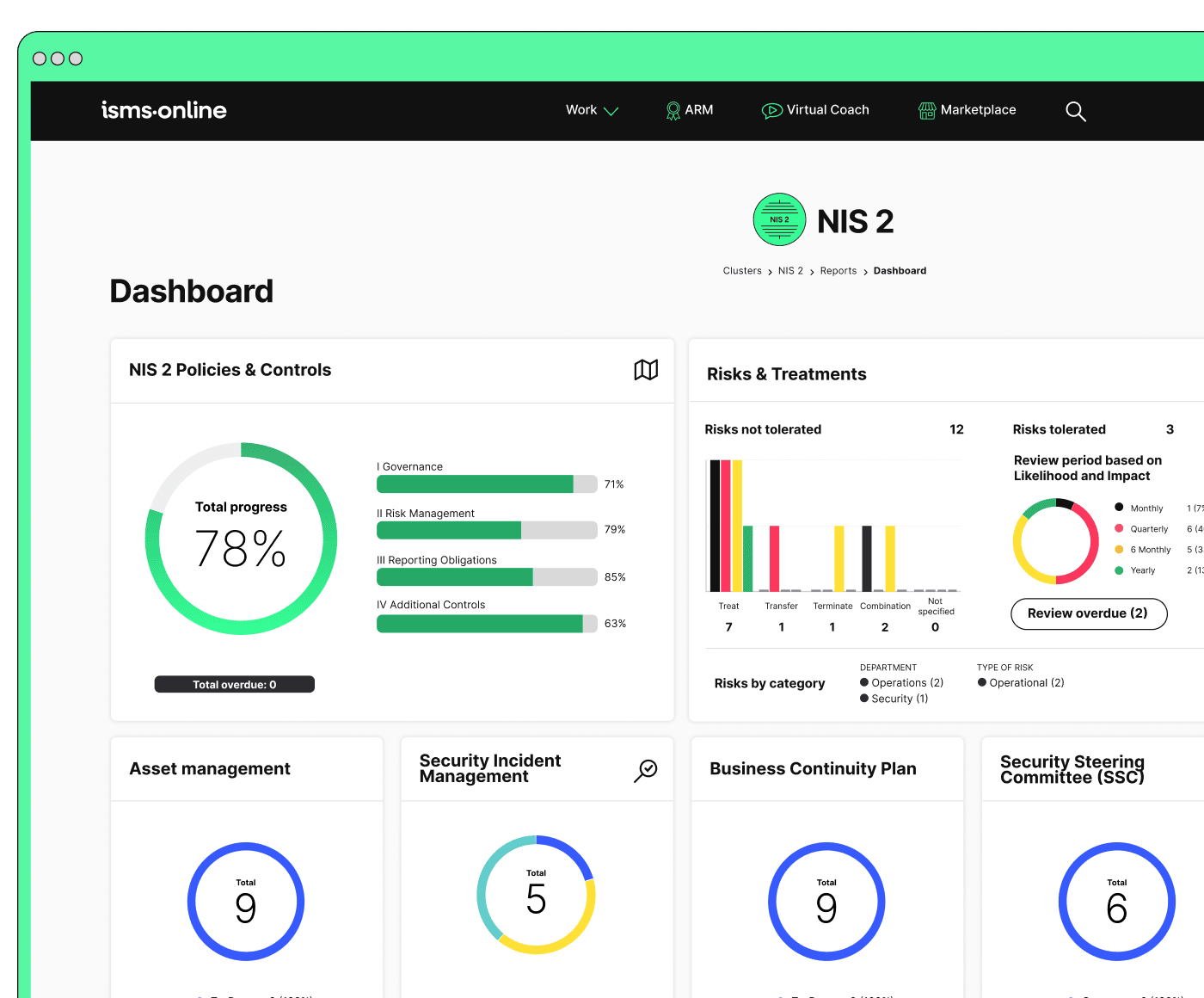
Be NIS 2-ready from day one
Launch with a proven workspace and templates – just tailor, assign, and go.
What really triggers the NIS 2 reporting clock-and what counts as “significant”?
The clock starts not with a sensor tick, but when someone with the authority judges an event likely meets a regulatory significance test (impact to key services, compromise of data, business continuity impact, or regulator-defined threshold). An ISMS reportable event table helps clarify:
| Event | Reportable? | Notes |
|---|---|---|
| 2hr service outage | Yes | >1hr, affects clients |
| Phishing email | No | If intercepted, not material |
| Malware disables staff | Maybe | If impacts core ops, escalate |
This classification deserves annual review and logging of “false alarm” scenarios to calibrate the significance line. Record ambiguous events within the ISMS as internal learning cases, not necessarily external notifications.
What is required at each NIS 2 reporting phase-24h, 72h, 30d?
Knowing exactly what to file at each stage avoids excessive disclosure and compliance failure.
24 hour window-Early Warning Submission
Must provide:
- Basic description of incident/discovery
- Impacted services or data
- Actions underway or planned
- Whether the incident is ongoing or resolved
Less is more here-brevity, objectivity, and clarity matter. Omit conclusions and opinions.
72 hour window-Update Submission
Provide:
- Any new information
- Updated impact analysis
- Forensic or root cause developments
- Mitigation steps in progress or completed
Flag remaining unknowns; it is acceptable to still be investigating.
30 day window-Closure Report
Deliver:
- Root cause
- Comprehensive impact
- Lessons learned and improvements
- Confirmation of completed remedial actions
- Updated control references (e.g., policy amended, staff retrained)
Retention and reporting drill: All incident reports should be stored for 12–24 months; quarterly drills to retrieve historic cases are highly recommended.
ISMS.online UI cues:
- “Submit Initial 24h Report”
- “Upload Update Summary”
- “Add Root Cause”
- “Close and Archive”
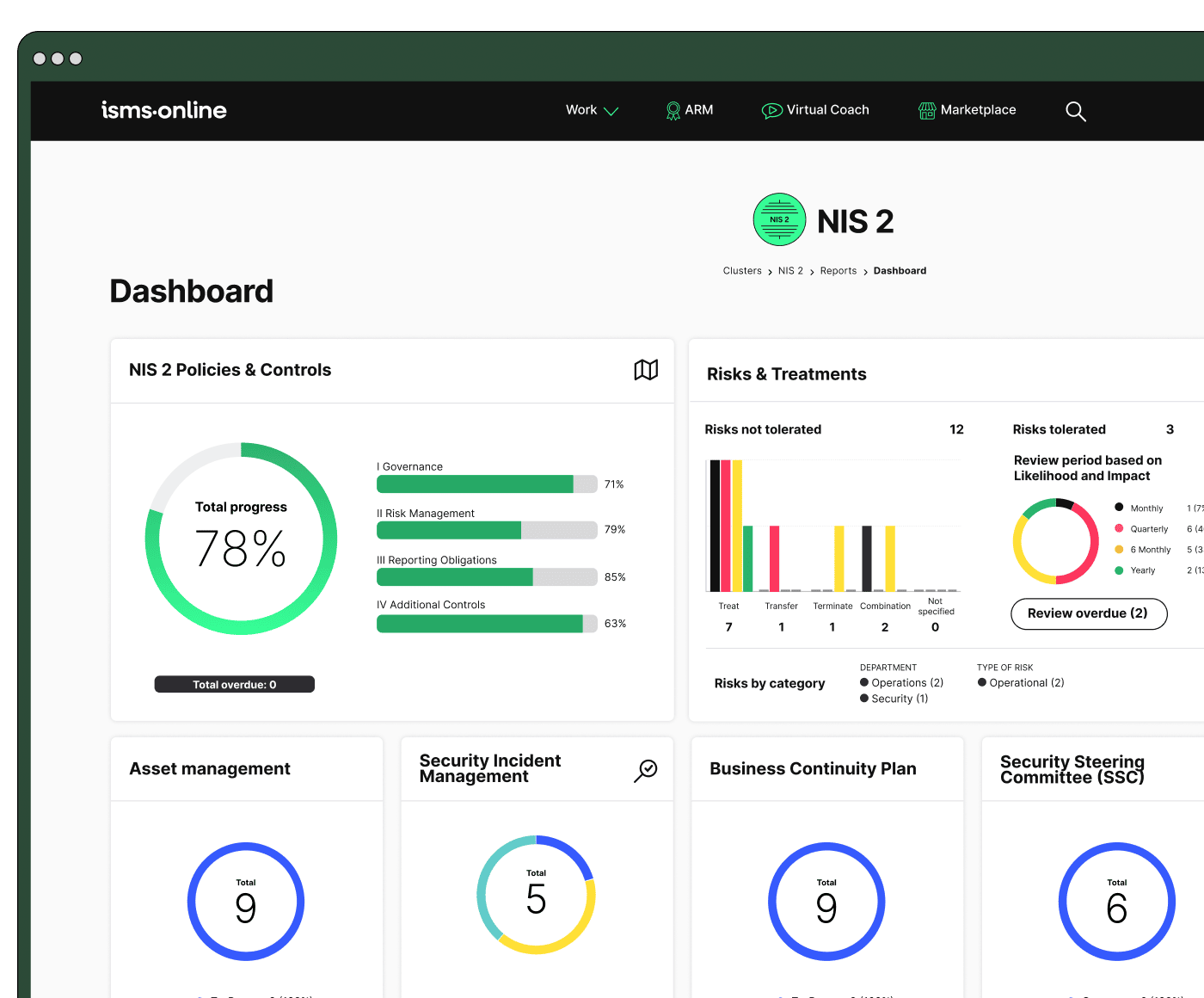
All your NIS 2, all in one place
From Articles 20–23 to audit plans – run and prove compliance, end-to-end.
How do you keep incident reporting meaningful-not just a compliance checklist?
The ISMS must drive a continuous feedback loop-not a one-way “report and forget” process. Implement the following practises:
- Log and review all “near-miss” and “borderline” cases (internal-only) as part of annual policy update.
- Require sign-off from multi-disciplinary panel (Security, Legal, Board, Operations) for closure to reinforce ownership.
- After each major incident, audit not just the timeline, but track documented changes (policies, controls, staff training).
- Actively tune policies with thresholds and templates based on this feedback.
ISO 27001 Bridge Table:
| Expectation | Operationalisation | Annex A Reference |
|---|---|---|
| Timely notification (24h) | 24h incident alert, logged | A.5.25, A.5.26 |
| Iterative updates (72h) | Investigation summary | A.5.28, A.8.15 |
| Closure (30d) | Root cause, evidence file | A.5.27, A.5.35 |
How do you operationalise “significant”-and prevent over/underreporting?
- Codify criteria (hours of disruption, number of records, sector-specific impact).
- Leverage a structured record of previous drills, close calls, and actual incidents-learning grows as your event library matures.
- Set up dashboarded alerts: “Yellow” for hold/review, “Red” for immediate reporting.
- Avoid policy drift by assigning annual review and mapping these criteria directly to business line and process owners.
Decision Table Example:
| Date | Incident | Threshold? | Note |
|---|---|---|---|
| 2024-05-10 | Malware attempt | No | Blocked, logged |
| 2024-06-01 | Switch failure | Yes | Tier-1 outage |
Real-World Ransomware Case (Timeline)
- Day 0: Major encryption event detected, client service affected; incident lead starts clock.
- 24h: Skeleton report sent-cause under review.
- 72h: Update-vector now determined, data recovery assessed, backup status confirmed.
- 30d: Closure-root cause identified, impact mapped, board updated, all evidence linked in ISMS.
How do you build and defend a digital audit trail under NIS 2?
Audit-readiness requires proof of timeline ownership, responsibility, and decision rationale. The key mechanisms:
- Assign dedicated incident/evidence managers (legal, DPO, compliance) for every logged case.
- Store all reporting, logs, screenshots, and records in a structured ISMS archive, with permissions and versioning.
- Quarterly drills: retrieve last year’s major events in under five minutes.
- Approval chains and timestamps must be immutable and checkable.
Audit Folder Structure:
Incidents/

  2024/

    Case-1234/

      24h_Report.md

      72h_Update.md

      30d_Closure_Report.md

      BoardReview.pdf

      Evidence/

        Logs/

        RootCause.pdf
Regulators judge you by dates, owners, and reasons documented, not just actions taken.
Navigating multi-jurisdiction and multi-framework reporting: How do you align NIS 2, GDPR, and sectoral requirements?
Many incidents require parallel reporting: a single data breach may trigger NIS 2, GDPR, and sectoral notification regimes, each with unique timelines and authorities.
A personal data breach in a regulated sector hits entities in two EU states.
- NIS 2: 24h (CSIRT/sector), 72h, 30d (closure)
- GDPR: 72h (DPA notification)
Managed Flow in ISMS.online:
1. Incident triaged against all frameworks-ISMS flags relevant authorities.
2. “Send to All Authorities” workflow auto-fills the correct templates.
3. Reporting dashboard sets deadlines, assigns authority owners.
4. Parallel evidence logs for DPA and sector regulators.
5. Post-incident review ensures both GDPR and NIS 2 lessons are captured.
| Authority | Channel | Template |
|---|---|---|
| National CSIRT | Web portal | CERT-regulator |
| Sector Regulator | Secure Email | ISMS.online Incident Form |
| DPA (GDPR) | Web/email | GDPR 72h Template |
Tip: Schedule cross-regime simulation drills and link all documentation back to unified incident folders.
What is the real cost of missing NIS 2 deadlines-and how to prove “change” after incidents?
Beyond steep fines (€10M/2% for essential, €7M/1.4% for important entities), the greater risk is reputational. Customers, regulators, and boards won’t forget companies who miss incident deadlines or fail to demonstrate systemic evolution.
Authority audits look for robust audit trails and policy change-not just the absence of a fine.
If a deadline is missed:
- Immediately document all communications: decision logs, attempts, rationales.
- Demonstrate good faith and real-time challenges.
- Use each major incident as a root cause for process improvement-upload new playbooks and training records.
ISMS.online: Audit-Ready Compliance and Boardroom Confidence by Design
ISMS.online takes incident reporting from check-box to business signature, embedding every Article 23 workflow into your day-to-day. With rolling dashboards, deadline reminders, template management, and evidence linking, your team stays ready for any authority or audit. Lessons learned become action-not just history.
Choose to lead with compliance that’s visible, verifiable, and organisationally owned. Contact our team to schedule your quarterly simulation or for an audit trail review today-you’ll know your company is ready not just to respond, but to win trust in every moment that matters.
Frequently Asked Questions
What determines when to start the 24h, 72h, and 30-day NIS 2 incident reporting windows under Regulation (EU) 2024-2690?
The timer for NIS 2’s incident reporting windows-24-hour early warning, 72-hour incident update, and 30-day closure-starts not at IT’s first detection but when a designated authority (such as a CISO, DPO, or board delegate) formally recognises the incident as “significant” under NIS 2 and (EU) 2024-2690. This pivotal moment is when your organisation determines an event could substantially disrupt essential services, risk regulated data, cause major financial loss, endanger health/safety, or repeat a previously flagged scenario. Each trigger is tied to a specific owner and policy threshold, documented in your ISMS.online system by timestamped decision and escalation trails.
Resilient teams formalise the clock-and the decision-maker-before regulators come knocking.
Example: ISMS.online Regulatory Trigger Map
| Event Type | Trigger Condition | Clock Owner / Authority | Action Within ISMS.online |
|---|---|---|---|
| Service outage | >1hr or public impact | Board appointee (CISO/COO) | Log, escalate, timer starts |
| Data breach/exfiltration | Any impact on sensitive data | DPO / Legal | Regulator mapping, evidence capture |
| Financial loss | >€100k or material | CFO / Risk Lead | Finance log, incident flag |
| Safety/health impact | Any severity, direct/indirect | Ops / Compliance | Board alert, priority workflow |
| Incident repetition | ≥2 within 6 months, same root | Security / Board | Aggregate review, policy trigger |
How can your organisation guarantee every notification deadline is met-without missing a reporting handoff?
To never miss a deadline, assign explicit owners for each stage of incident management-detection (IT/SOC), triage, legal review, executive authorisation, and notification-mapped as a RACI chain inside your ISMS.online. Each escalation must be timestamped and logged, with clear confirmation at every step: the handoff from technical detection to executive validation is where the “regulatory clock” truly starts. Embedded owner assignments, routine simulation drills, automated reminders, and contractual obligations for suppliers/services all reduce operational ambiguity. With ISMS.online, every incident lifecycle-from alarm to board sign-off-has a digital trail to support swift and compliant reporting, ready for any audit or inquiry.
Deadline discipline is built on clarity of ownership, evidence, and decision-not speed alone.
Notification RACI Chain (Sample)
- Detect: IT/SOC flags anomaly (min–hr)
- Assess: Incident Lead validates severity
- Legal Review: DPO or legal links NIS 2 / GDPR relevance
- Executive Authorise: CISO/Board greenlights notification (timer start logged)
- Report: Designated officer files within 24h/72h/30d, all steps auditable
What are the specific reporting requirements at each notification window, and how does ISO 27001 reinforce your workflow?
NIS 2 enforces escalating reporting content at each window.
24h Early Warning: Provide initial description-affected assets/services, first mitigation, and operational impact. (ISO 27001: A.5.25, A.5.26)
72h Incident Update: Add scope of impact, ongoing investigation results, users/systems affected, and status changes. (ISO 27001: A.5.28, A.8.15)
30d Closure: Supply root-cause, full corrective actions, changes to controls/policy/staff, lessons learned, and proof of closure. (ISO 27001: A.5.27, A.5.35)
Every step, version, and approval must be fully traceable in ISMS.online, with fields and evidence mapped directly to your Statement of Applicability for audit and continuous improvement.
Traceability Table: Incident Trigger to Evidence
| Incident Trigger | Risk Change | ISO 27001 Control | ISMS.online Record/Evidence |
|---|---|---|---|
| Outage | Risk register & SoA update | A.5.25, A.5.26 | Incident log, timer, audit trail |
| Data leak | Security treatment update | A.8.14, A.8.15 | Root-cause, remedial action |
| Repeat events | Control/process review | A.5.27, A.5.35 | Lessons learned, closure linked |
How do you prevent confusion from overlapping NIS 2, GDPR, and sector-specific incident notifications?
Centralising a “notification matrix” inside ISMS.online-mapping which incidents require NIS 2, GDPR, or sectoral regulator notification-avoids unnecessary double-reporting or missed deadlines. Automated triggers prompt only the required notification workflow; executive “hold for review” gates add a safeguard against split-second, unsynchronised reporting. Every report update, evidence attachment, and approval is versioned and syncs across all required stakeholders, eliminating “report drift.” Regular cross-framework drills keep stakeholders calibrated, reducing the risk of conflicting communications or over-disclosure.
Precision and alignment-across regimes and teams-are the foundation of regulator confidence.
What do NIS 2 audits and enforcement focus on, and what are the real-world penalties for missed reports?
Auditors and regulators demand not just clockwork notifications but proof that your response process is controlled, reviewed at board level, and continuously improved. Spot audits will check for:
- Ownership: Documented RACI and decision logs for each incident.
- Audit trails: Versioned, retrievable records-no missing hand-offs.
- Improvement: Lessons learned, policy or control updates, management review proof.
Penalties are material:
- Essential entities: Up to €10 million or 2% global turnover
- Important entities: Up to €7 million or 1.4% global turnover
To avoid the risk of spot-check failures, ISMS.online enables instant log retrieval (target <5 min) and ties every deadline to evidence for appeal or board assurance.
Readiness & Enforcement Table
| KPI | Expected by Regulator |
|---|---|
| 24h reporting compliance | >98% |
| 30d improvement, root cause | >90% with action taken |
| Audit log retrieval (all events) | 100% within 5 min |
How do you build a readiness culture that embeds genuine improvement, not just incident filing?
ISMS.online moves compliance beyond box-ticking by making each incident a live improvement cycle: after-action reviews, cross-team scenario drills, and versioned control/process tweaks are all systematised. Assign responsibility for retrieval testing (“five minutes to prove audit trail”) and schedule periodic board-level reviews. Every incident adds to the organisation’s resilience “muscle memory”-not just for next year’s audit but for tomorrow’s threats. This operationalises compliance as a living, evolving practise and positions your team as leaders in digital trust and regulatory assurance.
Each incident, addressed and analysed, grows your organisation’s resilience-compliance is measured in future wins, not checkmarks.
Why is ISMS.online the best way to guarantee NIS 2 Article 23 compliance-now and as rules evolve?
ISMS.online unifies every piece of Article 23: clear mapping of responsibilities, regulatory trigger matrices (NIS 2, GDPR, sectoral), automated reporting windows, versioned audit-safe evidence, and board-ready dashboards. Every file, approval, and report is permission-controlled, instantly retrievable, and logged for future improvement. With all standards-ISO 27001, NIS 2, GDPR, bank/health/critical sectors-on one platform, your organisation is always prepared for the next regulatory change, the next audit demand, or the next security threat.
Build a compliance culture recognised by boards and regulators-one that treats Article 23 as an enabler of trust and business continuity, not a burden. Use ISMS.online to stay proactive, not reactive, and secure your place among industry leaders.






