





































What Is Article 34? Why Administrative Fines Under NIS 2 Have Changed the Stakes
Your organisation’s cyber-security posture is no longer just a set of best-effort policies-it’s the front line of legal, reputational, and financial exposure. Article 34 of NIS 2 marks a decisive turning point, moving liability out of the IT silo and into the boardroom. For the first time at EU scale, regulators are empowered to impose minimum administrative fines on essential and important entities-levels reminiscent of the GDPR, with immediate impact across critical and digital sectors. This isn’t box-ticking: it’s a demand to prove, on-demand, that your business is resilient-not just compliant on paper.
Fines are no longer theoretical-they’re public judgements on your leadership, processes, and proof.
Board members, CISOs, privacy officers, and IT leads must now demonstrate live evidence of their organisation’s ability to withstand shocks, adapt to incidents, and document continuous improvement. Regulator bulletins routinely highlight non-compliance-and these scars don’t fade quickly. The expectation has shifted from “Do you have a policy?” to “Show us where resilience is lived, measured, and tracked at every layer of your organisation”. For any entity falling under NIS 2’s scope, audit trails, risk registers, and change logs must be accessible at a moment’s notice.
Too many organisations discover their evidence is inadequate only after an incident or during a regulator’s audit. With Article 34 now in force, the reputational damage of a fine lingers well beyond the financial penalty-pricing you out of public tenders, investor reviews, and partner deals.
When the heat turns from technical missteps to executive accountability, smart leaders re-examine how compliance and proof are operationalised-not just documented. Start with an honest appraisal: can you deliver up-to-date, time-stamped, cross-departmental evidence on demand, or will your audit story come apart when the regulator calls? When the answer must be “yes,” you’re already ahead.
How Much? Understanding NIS 2 Fines for Essential and Important Entities
The scale and transparency of NIS 2 fines leave little room for wishful thinking-these penalties are designed to hurt both the balance sheet and the board’s reputation. Article 34 sets the maximum fine for essential entities (like energy, finance, health, digital infrastructure) at €10 million or 2% of global annual turnover, whichever is greater. For important entities (mid-market providers, supply chain operators), the cap is €7 million or 1.4% of turnover-though Member States may set even higher local ceilings.
But penalties are not static. Changes in your organisation’s revenue, structure, or contractual footprint can push you into a higher-risk or higher-penalty bracket, sometimes overnight. Mergers, rapid growth, or landing critical contracts can transform your compliance obligations and your potential liabilities.
The real risk isn’t just the fine amount-it’s the erosion of trust, opportunity, and reputation that follows.
Non-compliance is rarely about a single missed control. Patterns matter: repeated audit gaps, poor-quality documentation, and a weak evidence culture can escalate not only the fine amount, but also the reputational shadow it casts. The smart response isn’t to obsess over ‘the number’-it’s to build a programme that routinely closes every gap, proactively logs every change, and keeps board and senior management directly involved in the compliance loop.
For any organisation hovering near the “important/essential” threshold, set a regular cadence (at least quarterly) to review turnover, legal status, regulatory classification, and roles responsible for compliance reporting. This vigilance is your first buffer against the compounding costs of non-compliance.

Master NIS 2 without spreadsheet chaos
Centralise risk, incidents, suppliers, and evidence in one clean platform.
Fine Calculation Mechanics: What Drives NIS 2 Fines Beyond Your Turnover?
Article 34 is not purely mechanical; regulators combine data-driven thresholds with a flexible assessment of your risk culture and response. The calculation is anchored, but the execution is incisive. Key factors include:
| Fine Assessment Lens | Practical Impact on Your Team / Board |
|---|---|
| Type, seriousness, duration of breach | How quickly, precisely, and thoroughly did you identify and act on incidents? |
| Intent or negligence | Was it accidental, negligent, or a result of systematic lapse? |
| Responsiveness & transparency | Did you notify authorities in time, and with clarity? |
| Prior compliance history | Patterns of improvement help; patterns of denial make your case worse. |
| Quality and accuracy of evidence | Regulator looks first for real-time, conclusive documentation-not best-effort promises or after-the-fact catch-ups. |
Documenting resource constraints, recording process changes, and demonstrating improvement can sometimes abate penalties. Conversely, obfuscation or delay is a red flag for enhanced sanctions. For privacy, legal, and security leads, “audit readiness” now means being able to surface the right evidence, for the right control, at the right time-without panic or improvisation.
ISO 27001 / Annex A Bridge Table
A regulator’s key expectations align tightly with ISO 27001, and map straight into operational controls:
| Regulator Expectation | Operationalisation | ISO 27001 / Annex A Reference |
|---|---|---|
| Risk management | Asset/risk registers always current | Clause 6, Annex A 5/8 |
| Incident preparedness | Playbooks, logs, monitoring, notifications | Annex A 5.24–5.28, 6.1–6.5 |
| Proof of mitigation/actions | Fast evidence, SoA updates | Clauses 9, 10; Annex A 5/8/10 |
A Statement of Applicability (SoA) is the first checkpoint for any auditor: proof of which ISO 27001 controls you apply, justify, or exclude-live, not aspirational. Your Policy Packs and centralised acknowledgment logs give auditors high-confidence signals that your staff aren’t just “aware” but actively engaged.
Equip every compliance and technical owner with a checklist matching these objective criteria, and routinely stress-test: If you needed to surface proof within two clicks, could you? When boards-and regulators-see this in action, trust follows.
What Actually Triggers a Fine Under Article 34? NIS 2 Offence Patterns
Penalties don’t appear from isolated mistakes. Article 34 fines are activated by three recurring categories of failure:
1. Risk Management and Control Lapses
If your entity fails to implement, apply, or update controls under Article 21-and this is caught in an audit, whether scheduled or not-expect regulator attention. Documentation gaps are the fastest way to attract scrutiny.
2. Incident Reporting Failures
Article 23 sets a strict, non-negotiable clock: 24 hours for initial notification, 72 hours for an update. Any slippage-whether due to process, miscommunication, or failure to document-can shift a “near miss” into a punitive event.
3. Serial Non-Compliance
Ongoing audit findings, unfinished remediation, management reviews not completed or not documented, and inconsistent application of controls build a reputation-one that is easily shared across regulators.
Documented intent is no longer enough-a broken evidence chain is a risk multiplier.
Mini-Table: Traceability Examples for Your Audit Team
| Trigger | Immediate Risk Update | Linked Control / SoA | Example Evidence Logged |
|---|---|---|---|
| Late incident report | Incident SOP revision | A.5.24 / A.5.24.1 | SoA, incident/audit logs, notification trail |
| Detected control failure | Risk register entry | A.5.8 / A.8.8 | Risk treatment log, completed To-do |
| Audit repeat findings | Management review minutes | A.5.36 / Clause 10 | Signed minutes, external auditor file |
Play back your last major incident. If every link between control, action, and evidence isn’t immediately visible, your next audit could be a painful one. Systems like ISMS.online are built to automate these relationships-turning a weak chain into a stress-tested one.
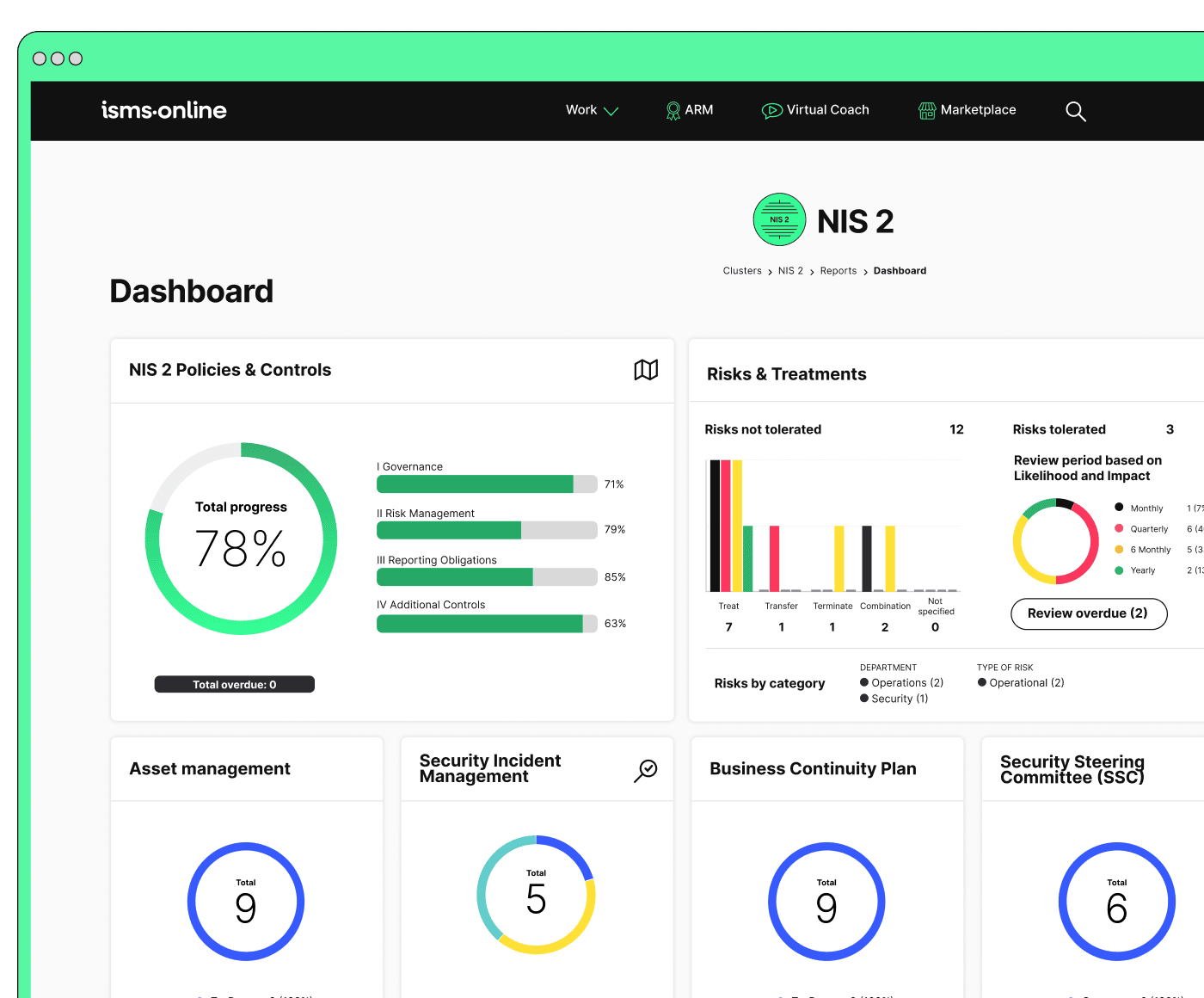
Be NIS 2-ready from day one
Launch with a proven workspace and templates – just tailor, assign, and go.
Cross-Border & Sector Variations: Unifying Compliance in a Patchwork Europe
No two EU Member States are identical in how they implement NIS 2, interpret maximum fines, or publish enforcement actions. Your obligations aren’t defined just by your home base: every market and sector you serve could bring extra risk windows-longer or shorter reporting timelines, mandatory public disclosure, sector-specific weaknesses, or stricter fine ceilings.
For Legal and Compliance leaders, calibrate your baseline up-not down-and hold group operations to the highest available rule, not the minimum. CISOs, set your platforms, logs, and processes to capture the “worst-case” jurisdiction, and escalate updates from the group’s strictest domain. Board oversight must explicitly review your harmonisation practises-these governance logs may be requested in evidence.
One public fine in one Member State rarely stays isolated. Bulletins, press releases, and procurement questionnaires give every potential client a line-of-sight into your risk posture. That’s a commercial shadow, not just a legal one.
If you’re in the cross-border compliance club, designate a harmonisation lead, and put recurring training, risk register syncs, and evidence refreshes on the calendar-before they become a scramble.
Compliance by Design: Automating Audit-Ready Evidence with ISO 27001
It’s not new policies or promises that avert fines-it’s evidence: always live, always accessible, always board-linked. Manual compliance can’t scale or evolve at the speed regulators now expect. CISOs need automation that keeps policy updates, incident reviews, staff acknowledgments, and management oversight aligned as products, teams, and geographies change.
A resilient compliance culture is the only competitive advantage that keeps audits in check and boards out of the spotlight.
In practise, modern compliance automation means:
- Incident reviews: logged and linked to the risk register, with timestamped audit logs for each event.
- Policy acknowledgements and updates: distributed and tracked, with completion rates visible across teams.
- Management reviews: triggered at a set cadence, creating a defensible narrative of continuous improvement.
ISMS.online directly unifies every asset, control, and evidence log-no more spreadsheet silos, no more “lost” change-logs. It means the day a regulator requests your full audit story, you’ve already written it-retrievable in minutes, not weeks.
If you’re stuck juggling policy, risk, asset, and incident data in disconnected systems, schedule your migration workshop now. Customers moving from silos to unified ISMS environments often cut time spent on evidence prep-and audit rework-by more than half.
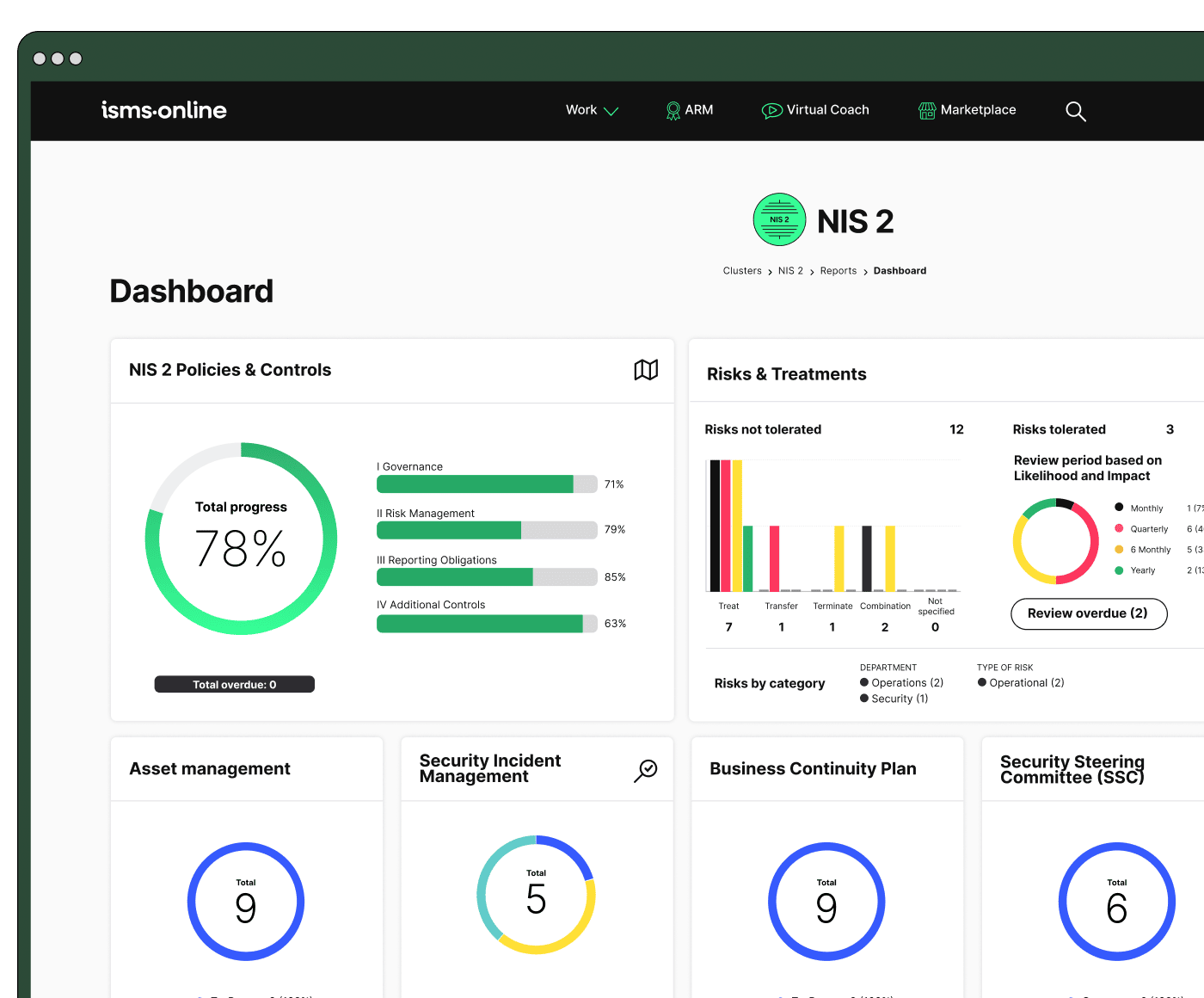
All your NIS 2, all in one place
From Articles 20–23 to audit plans – run and prove compliance, end-to-end.
Contesting, Appealing, and Publishing Fines: How to Defend and Protect Your Reputation
Even when a penalty lands, your organisation has formal rights to respond, contest, or appeal-but the window is tight, and only documented improvement and timely evidence can alter an outcome. Within 30 days of receiving a regulator notice, legal and compliance leaders should be prepared to submit a complete documentation bundle: incident logs, audit minutes, Statement of Applicability, and all mitigation efforts.
Appeals are made via official Member State channels. Regulatory authorities want to see not only documentation, but also timelines, decision-maker roles, and concrete actions taken since the incident. Temporary confidentiality during review can be sought, but findings, penalties, and material action logs are generally published after resolution.
Coordinated discoveries-where an incident also touches GDPR-typically avoid double fines; whichever regime is stricter frames the penalty. Board logs, risk audit records, and “evidence packs” are vital at each point on the timeline: incident → notice → 30-day appeal → disclosure. If these artefacts are at hand and auditable, you’re defending not only against bigger fines but also lasting reputational damage.
In today’s environment, publishing a fine is publishing a judgement on your trustworthiness and board leadership-not just your IT posture.
Assign roles for compliance response and set up “export evidence” workflows now. That way, should a headline hit, your response is timely and credible-not reactive and patchy.
Audit-Ready, Always: Proving Compliance and Building Trust Capital with ISMS.online
With NIS 2 Article 34 now enforced, “audit-ready” is your company’s most valuable intangible asset. Compliance is not just about passing the next inspection-it’s about becoming a trusted operator in your sector, capable of attracting new opportunities and defending stakeholder trust whenever challenged.
In the ISMS.online environment, your risk register, control logs, incident reports, management reviews, and staff acknowledgements are interconnected, timestamped, and always ready for inspection. Features such as Policy Packs, Statement of Applicability, asset and incident registers, and management review triggers make your audit story living and dynamic-never reliant on static documentation.
The organisations most exposed to fines are those left scrambling to “connect the dots” under pressure. With a fully unified ISMS, evidence is always current, logs are always prepared, and boards are always ahead of regulatory shifts. When a regulator, auditor, customer, or partner requests your compliance posture, you lead with proof-not with delay.
Auditors trust what they can verify. Build evidence that’s always ready-and reputation that endures-by integrating compliance resilience into your company’s DNA.
Final CTA: Make compliance resilience your board’s competitive advantage. Don’t wait for a fine to reveal the gaps-choose a unified, audit-ready system like ISMS.online to stay ahead, win trust, and thrive under scrutiny.
Frequently Asked Questions
What does Article 34 of Regulation EU 2024-2690 (NIS 2) mean for business leaders, and why are administrative fines now a direct business risk?
Article 34 of Regulation EU 2024-2690 (NIS 2) imposes mandatory, substantial administrative fines for cyber-security failures across all “essential” and “important” organisations in the EU, moving cyber-security enforcement from an internal IT or GRC concern directly into the arena of board-level accountability and public business risk. For the first time, fines up to €10 million or 2% of global turnover must be imposed and publicised by Member States-not only penalising infractions, but naming the leadership teams whose governance failed. This shift turns “compliance” into a reputational and market-access issue: supplier eligibility, stakeholder confidence, and even executive tenure are now explicitly shaped by cyber-security outcomes, not just policies.
The era of quiet lapses is over: cyber compliance failures are now a matter of public record and corporate credibility.
Cyber-Security risk has become inseparable from business strategy and corporate image. Investigations assess leadership engagement and operational evidence, not just system logs.
How large are Article 34 fines, who is exposed, and what triggers these penalties?
Essential entities-operating in critical sectors like energy, finance, digital services, health, and key infrastructure-face fines up to €10 million or 2% of annual global turnover, whichever is greater. Important entities (including supply chain partners and digital SMEs) face up to €7 million or 1.4%. These are baseline minimums. Many Member States already signal tougher thresholds and stricter timelines, raising the ceiling for sectors with higher national risk.
Your organisation can become “essential” or “important” automatically after a merger, a new contract, or regulatory reclassification, shifting your compliance risk profile almost overnight.
Key triggers for enforcement:
- Failure to implement and continuously operate appropriate cyber risk management and technical controls (NIS 2 Article 21)
- Incident notification failures-missing the 24-hour initial deadline, omitting required 72-hour and final updates (NIS 2 Article 23)
- Chronic or repeat audit findings, especially those unaddressed after previous warnings
Fines are not limited to spectacular breaches; even a single late update or missing control can escalate rapidly if your documentation and management responses are not bulletproof.
How do regulators calculate fines and what evidence can protect your organisation?
Regulators weigh the severity and duration of the breach, your past compliance history, and most crucially, the strength and timeliness of your audit-ready evidence. Factors that mitigate fines include:
- Concrete evidence of Board involvement in management reviews (minutes, action tracker, SoA notes)
- Prompt updates to real-time incident/risk logs and continuous control monitoring
- Documented remediation actions with clear ownership and progress tracking
Without these, especially if your logs are out of date or policies ignored in practise, fines typically escalate.
| Regulator Outcome Sought | Practical Step | ISO 27001 / Annex A Reference |
|---|---|---|
| Proven risk management | Real-time updates to risk registers | Clauses 6, 8.2, Annex A 5 |
| Incident response | Documented alerts and playbooks | Annex A 5.24-5.28, A.6 |
| Demonstrated improvement | Corrective logs, Board review evidence | Clause 10, 9.3, Annex A 5 |
Regulators no longer accept “good intentions” as a substitute for evidence. A living, defensible audit trail is now a non-negotiable business asset.
What compliance failures most often lead to Article 34 fines-and how must your compliance stack evolve?
Regulators consistently penalise:
- Documented gaps between known risks and the controls meant to manage them (e.g., missing or outdated risk/control logs, skipped control tests)
- Late, missing, or incomplete incident notifications-especially where escalation and closure are not recorded
- Persistent audit non-conformities unrectified despite clear warnings
Each control, risk, and audit item must map back to a specific, recent evidence record-not just a policy on paper. Audit readiness is a real-time posture, not a last-minute scramble.
| Trigger Event | Needed Update | SoA/Control Reference | Sample Evidence |
|---|---|---|---|
| Missed incident notification | SOP revision, notice log | Annex A 5.24 | Dated alert record, SoA update |
| Repeat audit gap | Board management meeting, log | A.5.36, Clause 10 | Board approval, tracker, audit report |
| Failed control test | Updated risk/asset register | A.5.8, A.8.8 | Test results, remediation log |
Without cross-linking evidence, enforcement typically presumes systemic management failure.
Do these enforcement rules and risks vary across different EU countries or industries?
Yes-often with material impact. While Article 34 harmonises a firm minimum, individual Member States can and do set higher fines, tighter deadlines, and stricter obligations for certain sectors or ‘essential’ entities. For cross-border operations, the strictest local requirement typically applies. Shifts in sector, supply chain role, or company size can trigger a different status and thus a different exposure to fines-sometimes within a single reporting period. Increasingly, enforcement actions are public, directly affecting procurement processes and market access.
How does ISO 27001 make Article 34 compliance measurable, operational, and “export ready” for audits?
ISO 27001 provides an internationally recognised, regulator-validated baseline for cyber-security management that aligns cleanly with NIS 2 duties. Annex A controls map directly to risk, incident, and evidence requirements under Article 34. By deploying ISMS.online or a similar environment, you can automate and demonstrate compliance with:
- Board dashboards and management review logs tracking status and decisions (Clause 9.3, A.5.36)
- A real-time incident register and documented notification flows (A.5.24–5.28, A.6)
- Action and improvement trackers for continuous remediation and learning (Clause 10.1–10.2, A.5, A.8)
- Statement of Applicability (SoA) with instant traceability between policy, risk, and control records
| Requirement | ISMS.online Workflow Example | ISO 27001 / Annex A Link |
|---|---|---|
| Board visibility | Management Review dashboard/logs | Clause 9.3, A.5.36 |
| Incident handling | Incident register, notice tracker | A.5.24–A.5.28, A.6 |
| Improvement actions | To-Do/actions, SoA logs, exports | Clause 10.1–10.2, A.5, A.8 |
When even a single record is missing or unlinked, you risk escalation and lose appeals leverage. Daily, automated evidence is now a CISOs best reputational defence in the face of public enforcement.
What are your rights to contest or appeal a NIS 2 Article 34 fine-and how does evidence readiness affect your chances?
Organisations have the right to be heard, present mitigating evidence, and appeal through both administrative and judicial processes. However, investigations and fines are often published before appeals conclude, keeping reputational risk high. In cases of cross-regulatory overlap (e.g., NIS 2 and GDPR), only one fine may be imposed-typically the higher-with regulators required to coordinate investigation and penalty. Rapid access to assigned evidence and role-based logs is the only way to rebut allegations or demonstrate proportional remediation on appeal.
The new bar is not audit-ready once a year but always audit-ready-with demonstrable board engagement and living, actionable controls at every level.
Every week you delay operationalising evidence and integrating risk, incident, and controls, you elevate the risk of penalties, lost contracts, and eroding trust among regulators, customers, and your own directors. Now is the time to make daily compliance part of your operational and reputational strategy-not an afterthought in the wake of a penalty.






