





































Why Most Patch and SDLC Failures Hide in the Gaps-Not the Code
The path toward NIS 2-compliant SDLC and patch management rarely unveils itself with a fanfare of new tools or policy sign-offs. Instead, it’s what happens in the quiet gaps-where team handoffs, vendor updates, and fleeting approvals blur accountability-that the biggest compliance risks lurk. If your organisation has ever felt comfortable with spreadsheets, Jira boards, or “we’ve always done it this way,” these shadow zones are almost certainly breeding invisible risk.
The strongest security posture is built in the spaces between handoffs-not in the policies written after the fact.
Invisible Risk, Routine Chaos
In today’s high-velocity agile environments, the lure of speed too often buries process clarity. Handoffs between engineering, operations, vendors, or consultants are whipped through emails, chat threads, and sheets-a process so familiar most teams hardly notice. Yet it’s in these ambiguous transitions where patch gaps, delayed reviews, and missed exceptions stomp into existence, undetected until the regulator-or worse, an attacker-finds them (ENISA 2023). NIS 2 requirements shift this dynamic: each technical task must now be operationally and legally linked to named roles and living, audit-ready evidence.
Why Traditional Workflows Are Weak
Old-school tools like Excel, email approvals, or static PDFs fade the moment a staff member leaves or a supplier is swapped out. There’s no way to know who made the call, what was or wasn’t justified, or why an action was delayed. When you face an urgent due diligence request, an onboarding investor, or-most serious-a regulatory probe, those weaknesses become glaring. Manual traces are brittle and break silently. Under NIS 2, evidence can be demanded at a moment’s notice and is expected to be time-stamped, role-attributed, and instantly retrievable (Gartner 2024).
Fast Isn’t Enough-Proof Must Travel With Speed
The new security and compliance baseline is real-time, role-based, and continuous. No modern SDLC or patch routine can claim compliance if proof is buried in inboxes or the memory of a single engineer. Critical data-from SBOM status to vendor patch logs-must be unified, searchable, and always current. These are not just technical requirements; they’re now central to boardroom credibility, procurement negotiations, and reputational resilience.
Smooth process adoption is the only way to harden your compliance posture. Every transition-whether between humans, teams, or tools-must carry its own record, or risk leaking confidence and control.
Patch Lag Is No Longer a Technical Debt-It’s a Board and Sales Vulnerability
Gone are the days when missed patches were shrugged off as a minor IT backlog. Today, every day a critical patch sits unapplied, the risk multiplies outward-from audit failure and regulatory fines to blocked deals and eroded executive trust. The patch tempo is now a business KPI; delay is a risk with teeth.
Patch lag is no longer an internal matter-every day it lingers, it erodes trust and shrinks opportunity.
Patching Is In the Board’s Crosshairs
Regulators and boards have awakened to one of the root causes of modern breaches: not zero-days or exotic exploits, but delays in closing well-known vulnerabilities (ENISA 2023). From NIS 2 to DORA, the expectation has shifted: boards must actively oversee patch cadence and are accountable for “liveness” of compliance, not just logged activity.
Sales and Audits-The New Patch Audiences
Due diligence no longer tolerates vague promises or outdated logs. Buyers expect not only technical security, but operational evidence and accountability for patch management. A single missed update in a dependency can block a contract or trigger “high-risk” labels in audit logs-often discovered too late. Modern SaaS buyers run automated SBOM checks and demand live dashboards as proof, not point-in-time scans (ENISA 2024).
Common Audit Gaps That Freeze Revenue
| Issue | Business Consequence |
|---|---|
| Patch delays in audit log | Buyer trust erodes, revenue pauses |
| Incomplete SBOM | Contract stalls, due diligence fails |
| Missing approval signatures | Procurement halts, deal on ice |
Each of these gaps is invisible to daily operations, but glaring to a customer or auditor-derailing timelines and confidence with shocking speed (Eur-Lex 2022/2555).
Automation Is No Longer a Luxury-It’s Minimum Defensive Proof
Manual logs, quarterly reviews, or “last updated” footnotes are now evidence of non-compliance. Only live, automated dashboards can keep up, surfacing overdue patches, tracking exceptions, and tying action to named roles. The organisations that treat patch cadence as a competitive and sales asset, not just a technical chore, unlock both higher resilience and faster deals.

Master NIS 2 without spreadsheet chaos
Centralise risk, incidents, suppliers, and evidence in one clean platform.
Why NIS 2 SDLC and Patch Management Are Everyone’s Responsibility (Not Just IT)
There’s an outdated notion that patch management and secure development are “for the tech team.” NIS 2 eliminates this silo: patching, incident response, and SDLC assurance are boardroom-level, cross-functional accountability zones-where legal, HR, and even procurement share the proof burden, not just the technical teams.
Modern compliance expects every leader-technical or not-to stand behind every patch, exemption, and evidence chain.
The Era of Executive Accountability
NIS 2 (Article 20) spells it out: directors are liable for ongoing cyber oversight, not just periodic sign-off (ENISA Board Engagement). Regulatory pressure means every deferred patch and process gap creates a line of questioning for the entire organisation. When the gap is exposed, it is the executive team, not the engineer, who must defend it.
Operationalising Evidence-Not Just Checking Boxes
Auditors have caught up, moving beyond static paperwork to examine living workflows: how ticketing, vendor management, code review, and exception handling operate in real time. They’ll ask: Is legal approving patch exceptions? Does HR track training on security policy? Is procurement enforcing patch SLAs with vendors? If the answer isn’t easily accessible or attributed, the risk will land in the audit finding (PwC 2023).
Security, Privacy, and Resilience-Merged by Design
NIS 2 merges what used to be parallel threads: security, privacy, and resiliency. Vulnerabilities are not simply technical flaws; they’re now potential breaches of data minimization, supply chain integrity, and ultimately, trust (Cloud Security Alliance). Only multidisciplinary engagement-tracked and exportable-can create a robust defence.
Building the Muscle for Frictionless Multi-Role Engagement
When responsibilities are mapped, work tracked, and exceptions surfaced in real time, teams activate a feedback loop that diminishes risk daily-not just during audit season. Adoption rises, fatigue drops, and everyone can show-at pace-that they’re not just “in compliance,” but living it.
What NIS 2 Excellence Looks Like: Always-On, Supply Chain-Aware Compliance
Excellence in patching and SDLC is no longer a quarterly destination. NIS 2 compliance is about living workflows, not static reports. Every patch, new dependency, exception, and approval must be visible, trackable, and linked to accountable owners-both within and beyond your organisation.
True excellence is when every patch and decision is logged, mapped, and ready for review in seconds.
SBOM and Patch Traceability Are Now Front-Page Issues
Running a current, complete Software Bill of Materials (SBOM)-tied in real time to patch status and dependency risk-is central to compliance, procurement, and audit confidence (ENISA 2024). Automated SBOM tracking and role-triggered review notifications ensure visibility for every stakeholder.
Making Supply Chain Flaws Visible Before They Become Incidents
NIS 2 expects you to see through your own boundaries. Every vendor, open-source package, and contractor becomes part of your defence. Exception management must be active, so a missed review or unpatched dependency cannot hide. Each exception, approval, or action must be visible, justified, and mapped to policy (Moldstud Security).
Workflow Simplicity Drives Success (and Adoption)
Complexity is the enemy of sustainable compliance. Simple, intuitive workflows-integrated where people already work-make high rates of evidence capture possible. Sustainable systems prompt the right reviews, escalate gaps, and make defensibility almost automatic.
Compliant Organisations Outpace Their Peers
Teams that get these fundamentals right spend less time prepping for audits, reduce findings, accelerate vendor onboarding, and win trust from customers and boards alike. Compliance is not a static badge-it’s a living, market-driven advantage.
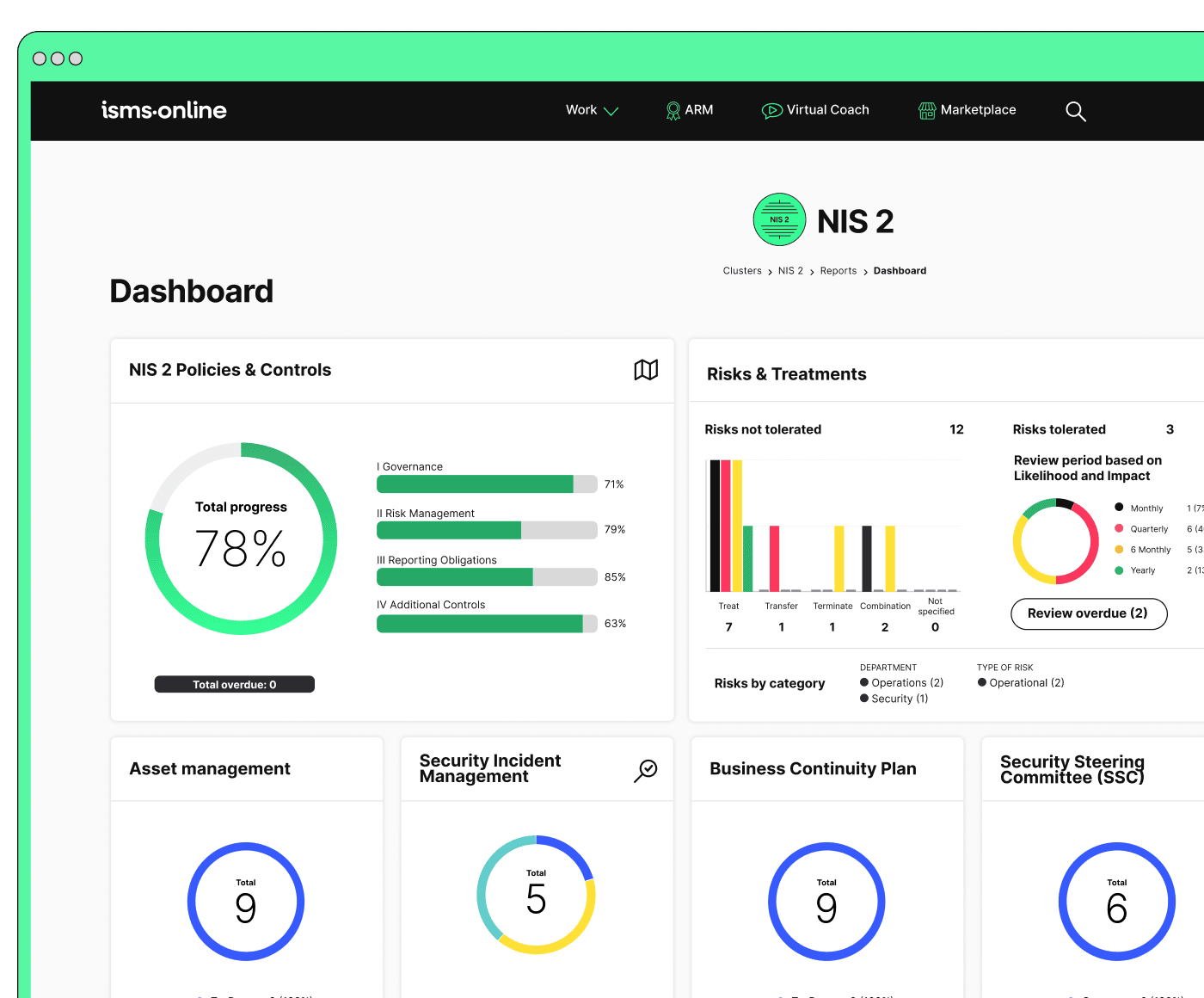
Be NIS 2-ready from day one
Launch with a proven workspace and templates – just tailor, assign, and go.
How ISMS.online Turns Policy into Evidence, Every Action a Click Away
Building living audit trails and role-mapped proof is daunting-unless process and platform are fused. ISMS.online turns policies, tasks, and reviews into operational, audit-ready evidence as a matter of daily flow, not year-end scramble.
With every review and patch, ISMS.online turns actions into audit-ready proof-without extra admin.
Templates Guide, Automation Tracks-Frictionlessly
Prebuilt policy and control templates map directly to NIS 2, ISO 27001, and ENISA requirements. Every action-patch applied, review approved, exception justified-is assigned, time-stamped, and logged by role in-platform (ISMS.online Policy Management). No disconnected documentation-evidence builds as the workflow runs.
Policy Packs Make Procedures Real
Policy Packs are more than PDFs-they are living objects that bind tasks, reviews, and approvals to specific controls, map to your Statement of Applicability (SoA), and show regulators and boards what’s really happening, not what’s written. Policy Packs log acknowledgements, RACI ownership, and periodic reviews, surfacing non-conformance instantly.
ISO 27001 Bridge Table: Expectation → Operationalisation
| Expectation | ISMS.online Implementation | ISO 27001 / Annex A Reference |
|---|---|---|
| Patch tracking and ownership | Assigned patch workflow, real-time approvals | A.8.8 Technical Vuln. Mgmt |
| Evidence on demand | Live dashboard exports, role-mapped reports | A.5.35 Audit; A.8.15 Logging |
| Live operation-reflected policy | Policy Packs bind to actions, evidence, SoA updates | A.5.1 Policies; A.5.21 Supply |
| Multi-role, cross-team tracking | RACI personas mapped, responsibilities traced | A.5.2 Roles & Responsibilities |
| SBOM & supply chain mapped | SBOM upload, patch notifies, supplier alerting | A.5.19, A.5.21 Supplier |
The result: policy and control no longer mean paperwork, but instant, tangible evidence for audits, tenders, and C-level risk review.
Controls Mapping and the End of Compliance Fatigue
Connecting NIS 2, ISO, and ENISA controls used to be hand-crushing work-one change requiring updates across multiple registers, the SoA, and evidence logs. ISMS.online bypasses this pain by automatically mapping every policy and action to all applicable control points, updating the SoA and evidence trail wherever it matters.
True resilience comes when one update secures every framework at once-no mapping fatigue, no missed control.
Dynamic Cross-Standard Mapping
A change in a process or a gap in your workflow automatically triggers updates to every linked control-so operational coverage is assured, and every audit, whether for ISO, NIS 2, or ENISA, receives instant coverage proof. No more update lag between frameworks-every SoA, register, and log evolves together.
Continuous Improvement with System-Driven Trust
Exception management, change approvals, and role engagement are all traced, versioned, and attributed. Each audit-internally or externally-has its own living trail, including missed deadlines, Board/Executive sign-off, and recovery actions logged, validated, and report-ready (ENISA SDLC Guidelines).
Traceability Mini-Table: From Trigger to Proof
| Trigger | Risk Update | Control / SoA Link | Evidence Logged |
|---|---|---|---|
| Supplier patch alert | Supply chain risk | A.5.21, A.8.8 | Patch approval record |
| Deadline missed | Non-conformance | A.5.35, A.5.36 | Exception log |
| SBOM published | New dependency risk | A.5.19, A.5.23 | SBOM upload |
| Role transition | Process gap | A.5.2, A.5.3, A.7.1 | RACI handoff log |
| Incident detection | Incident response | A.5.24, A.5.26 | Remediation report |
This ensures every compliance signal is visible, up-to-date, and mapped wherever it matters.
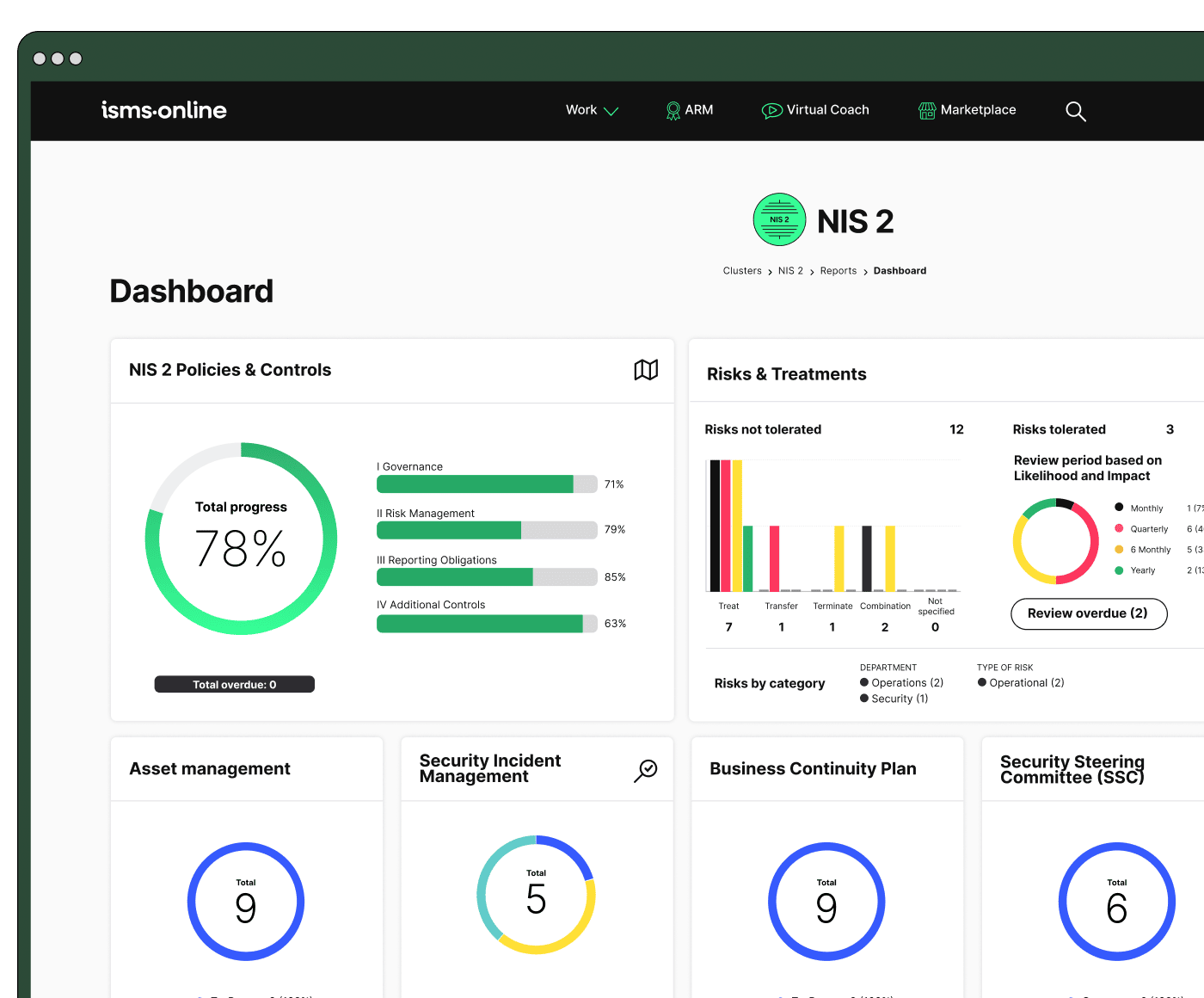
All your NIS 2, all in one place
From Articles 20–23 to audit plans – run and prove compliance, end-to-end.
Why End-to-End Traceability Is the Benchmark for NIS 2 SDLC & Patch Security
The ultimate mark of NIS 2 compliance is not the size of your control library-it’s your ability to instantly trace any trigger, action, and resolution, evidence-ready for any stakeholder. ISMS.online weaves this “chain of custody” through integrations (Jira, ServiceNow, Slack), dashboards, and role-mapped assignments.
End-to-end traceability turns every incident, update, or question into a living proof trail-always one click from report to root cause.
Role-Based, Real-Time Visibility-For Every Team
Whenever a patch stalls, a vendor is late, or a board asks for status, the answer is recorded-not reconstituted. Each workflow is sealed with role-based approval and explicit evidence, ready for immediate inspection or export (ISMS.online Audit Trail). No link is left in the dark; every action is a contribution to your living compliance story.
Automation Keeps the Narrative Complete
With direct links into DevOps and security stacks, every step is chained into a single timeline-alerts, owners, outcomes. The system detects gaps, flags unresolved risk, and prompts remediation. As a result, audit stress becomes audit preparedness, and confidence replaces busyness.
Traceability Mini-Map: Trigger → Audit Chain
| Trigger | Action Recorded | Control Reference | Evidence Type |
|---|---|---|---|
| Vulnerability alert | Patch deployed, owner logged | A.8.8 | Approval record |
| Exception to policy | Approval trail, time-stamped | A.5.35 | Exception justification |
| Board inquiry | Dashboard export, real-time | A.5.36 | Evidence dashboard |
| SBOM alert | SBOM review, risk assignment | A.5.19, A.5.21 | SBOM & risk log |
| Incident analysis | Root cause logged, remediation | A.5.24, A.5.26 | Remediation proof |
Everything is linked, attributed, and accessible-ensuring every internal and external audience receives the trust signals they need.
From Anxiety to Audit Hero: Making Your NIS 2 SDLC Benchmark an Everyday Reality
No organisation was ever admired for its policies, but many are respected for the silent, resilient mastery of their operational proof. With ISMS.online, your compliance journey is not just documented, but lived-so that when the audit or procurement challenge comes, your evidence speaks for itself.
The teams that own their proof don’t fear the audit-they raise the benchmark for everyone else.
Whether you’re a compliance lead needing assurance for a board, a practitioner seeking to escape spreadsheet gaol, a CISO craving resilience you can prove to any auditor, or a privacy officer threading a defensible story for regulators, ISMS.online brings each intention to life.
With every patch, approval, or review mapped and exportable, you’ll transform compliance from sprint to standard-becoming the partner, supplier, or employer that others quietly wish they could emulate.
Ready to become the audit-ready standard-bearer? Accelerate your journey-make your NIS 2 SDLC and patch security the story that buyers and auditors trust without hesitation.
Frequently Asked Questions
Who owns each NIS 2 SDLC and patch management action, and how does ISMS.online make audit evidence automatic?
Every NIS 2-regulated organisation must assign, document, and prove individual accountability for every secure development (SDLC) and patch management action-at a level granular enough for a regulator or board to query “who did what, when, and why?” ISMS.online removes the spreadsheet scramble by automating role documentation, responsibility handovers, and evidence capture at every step.
From risk discovery to patch execution and exception handling, ISMS.online attributes each task to named roles-such as Vulnerability Manager, Patch Lead, Risk Owner, or Incident Response-linking their actions and approvals to defensible audit logs. Role changes, escalating incidents, and handbacks are automatically recorded with time stamps, so no context is lost, even under staff turnover or urgent deadlines.
Accountability lasts longer than any one team member-a clear evidence trail means you’re audit-ready, even when pressure mounts.
Common roles and evidence touchpoints
- Vulnerability Manager: Logs discoveries, assigns patch actions, tracks closure.
- Patch Lead: Allocates patch tasks, validates completion, records approvals.
- Risk Owner: Signs off on Article 23 exceptions, logs rationales.
- ISMS.online Admin: Orchestrates reminders and manages permissions.
- Incident Response: Documents post-patch actions, records lessons for review.
A built-in RACI matrix clarifies every phase and exception, disambiguating ownership for stakeholders and auditors. As responsibilities shift, ISMS.online adapts the mapping, maintaining transparency and accountability without messy manual updates.
What are the five foundation NIS 2 SDLC controls, and how does ISMS.online map them to live audit-ready proof?
NIS 2 (Articles 21 and 23) and ENISA require more than “box-tick” policies: you need living, operational proof of five key SDLC and patch controls-supported by real-world evidence at all times:
-
Documented, Versioned SDLC Policy
ISMS.online provides sector-ready templates that track every revision, review, and approval log, meeting ISO 27001 A.8.25–A.8.32 and NIS 2 alignment. -
Security Requirements Allocation
Each SDLC requirement becomes an assigned, tracked ticket or task, with approval status, owner, and evidence attached. -
Formal Threat Modelling & Reviews
Upload models, assign reviewers, log feedback and remediation-all auto-versioned for traceability. -
Secure Coding & Verification
Code reviews (human or automated: SAST/DAST) and test approvals are embedded in your workflow-linked to both ISO and NIS 2 compliance controls. -
Patch & Change Management
Every patch cycle is workflowed with owner assignment, risk rationale, exception handling, and handover review-every action logged and ready for audit.
| NIS 2 Control | ISMS.online Workflow | Evidenced As |
|---|---|---|
| SDLC Policy | Versioned template, review log | Policy approval trail, revision history |
| Requirements | Assigned tickets/tasks | Owner attribution, completion log |
| Threat Modelling | Reviewer task, feedback log | Model doc, reviewer comments |
| Secure Coding | SAST/DAST, peer approval log | Test results, sign-off records |
| Patch/Change | Owner workflow, exception log | Patch/exception chain, handover log |
Evidence from any workflow phase is instantly exportable for ISO 27001, ENISA, NIS 2, or DORA audits-no duplication, no after-the-fact guessing.
Which ISMS.online automations keep you out of last-minute NIS 2 audit chaos?
ISMS.online eliminates “find-it-fast” audit panics by pre-embedding audit readiness into the daily workflow:
- Live, End-to-End Audit Trail: Every action, review, and assignment is time-stamped, owner-attributed, and mapped to its control or clause (NIS 2, ISO, ENISA), ready for on-demand export.
- Automated Reminders and Escalations: Owners and approvers receive smart prompts; overdue items and exception escalations are surfaced long before deadlines cause audit drama.
- Interactive Audit Matrix & Dashboard: At any point, you can export a dashboard view (matrix) showing controls, owners, actions, status, and evidence-all colour-coded for pending, overdue, or complete.
In a 24/72-hour incident window, one click generates the entire “who, what, when” record. For board or regulator audits, every action has evidence and context-no more scrambled explanations.
How does ISMS.online integrate with Jira, code repositories, and vulnerability scanners to close NIS 2 proof gaps?
ISMS.online stitches Jira, GitHub/GitLab, Bitbucket, and tools like Qualys or Nessus into a seamless compliance backbone-no more tool silos or evidence orphans:
- Jira/ServiceNow Tasks: SDLC/patch tickets created or resolved in Jira or ServiceNow are mirrored and owner-attributed in ISMS.online, ensuring no audit step is lost.
- Code Repositories: Commits, merges, and SBOM updates are linked to workflow steps-ensuring code changes, approvals, and releases are mapped to their required evidence chain.
- Vulnerability Scanners: Alerts feed directly as actionable ISMS.online tickets with assigned owner and evidence; resolution and exception handling are automatically logged.
- API/Connector Support: Automated flows (Zapier, API, native connectors) ensure every action from third-party tools lands in the audit register and dashboard.
Process mapping-from alert to remediation to audit export-means every technical or human input is traceable, reportable, and audit-proof.
What triggers NIS 2 audit failures, and how does ISMS.online “bake in” compliance by design?
Regulators fine for missing, ambiguous, or outdated proof, not for minor policy tweaks. ISMS.online absolves this by default:
- Mandatory RACI & Handover Chains: Role mapping and documented handovers ensure every responsibility shift has an evidence trail-no lost accountability.
- Supplier & SBOM Tracking: All supplier dependencies and SBOMs are logged; your supply chain risk documentation is always review-ready.
- Real-Time Completeness Gaps: Any overdue, missing, or incomplete artefact is flagged-address risks before audits expose them.
- Immutable Exception Logging: Every deferred patch, exception, or risk acceptance is attributed, timestamped, and rationale-logged for reviewer or regulator challenge.
ISMS.online users report up to 90% less time spent gathering audit evidence, with many achieving first-pass audit clearance ((https://www.isms.online/audit-ready-isms/)). With every action “baked in” during daily work, the system makes compliance a default setting, not a time-consuming burden.
How do ISMS.online workflows adapt to country- and sector-specific NIS 2 overlays, and what’s the value of multi-framework compliance?
NIS 2 diverges sharply between sectors (health, finance, energy, digital) and member states. ISMS.online meets this challenge by making every workflow configurable:
- Sector/Region-Specific Templates: Import or tailor frameworks for finance, health, or national overlays (e.g., “UK NIS 2”, “French finance”).
- Tagged Workflows and Assets: Assign evidence, workflows, or templates by jurisdiction and sector-right asset, right stakeholder, right audit.
- Custom Approval and Role Flows: Tailor who is involved at each step, aligning approvals and access by country or contract.
- Multi-Framework Audit Export: Any action can serve multiple frameworks. One control update ripples to ISO 27001, NIS 2, ENISA, and DORA all at once; the audit matrix covers all bases.
| Framework | Workflow Coverage | Key Clauses/Refs | Sector/Tag |
|---|---|---|---|
| NIS 2 | SDLC, Patch, Incident | Art.21, 23, 24, 25 | DE, FR, UK, sector |
| ISO 27001 | SDLC, Asset, Audit | A.8.25–A.8.32, A.5.25–27 | Global |
| ENISA | Threat, Patch, Supplier | Threat mgmt, vuln mgmt | Health, Finance |
| DORA | Supplier, Recovery | ICT chain/cyber incident | EU finance |
That means a single board briefing or regulator request can pull up all required proof-including sector or region overlays-in minutes, not days.
Step into every NIS 2, ISO, or ENISA audit with the assurance that every workflow, approval, and technical artefact is mapped, logged, and attributed-making compliance an asset, not an ordeal.






