





































Why NIS 2 Cyber Hygiene Now Sets the Benchmark
NIS 2 transforms cyber hygiene from a side-note to the touchstone of digital credibility for every organisation in or selling to the EU. The focus is no longer on “are you doing something for awareness?” but “can you prove, down to the individual, that cyber hygiene and training are real, live, and effective?” Compliance is now measured by evidence-logs, engagement records, and demonstrable outcomes-rather than policies filed away for audits. In the current regulatory landscape, over 75% of findings now hinge on human factors or missing engagement evidence (ENISA, 2024). Regulators demand that boards actively oversee evidence of staff training and hygiene,-placing it on par with encryption or access control as a business risk.
When everybody claims they're covered, true resilience means showing exactly how.
Security awareness used to be shuffled between IT and HR, then forgotten until audit season. That approach will not survive NIS 2 scrutiny. Today, every organisation must show live, per-user audit trails: not only what training was delivered, but when, to whom, and how it evolves. This shift especially impacts remote and hybrid teams-proof must span all contracts, geographies, and devices, and the cycle must be ongoing. Internal confidence is no longer enough-only cold, exportable evidence proves compliance to your customers, partners, and regulators.
Consider this: Could you show, at a moment’s notice, that every member of your team is up to date on cyber hygiene-with logs to prove individual engagement, outcome, and follow-up? Good intentions may once have sufficed, but the NIS 2 world only trusts what can be demonstrated, exported, and explained at a click.
Where Are the Real Hazards? The Human-Error Risks Lurking in Plain Sight
While threats grow more sophisticated each year, the main vulnerability in most organisations remains unchanged-human behaviour. Recent reporting is unequivocal: 91% of successful cyber incidents originate with simple, human mistakes-from a reused password, to sharing a document without due care, or one click on a well-crafted phishing email (Verizon DBIR, 2024). These everyday hazards rarely make headline news until the breach is public, but they form the backbone of most security failures.
The biggest risk is the one people don't notice-until the headlines hit.
Routine dashboards and pop-up reminders can dull vigilance, training staff to click first and think later. Attackers know this, exploiting fatigue and policy overload, while compliance systems built on snapshots fail to catch the drift. The latest ISACA data shows that attacks leveraging policy exhaustion are on the rise; NIS 2 mandates that organisations close these feedback loops fast, with learning tied continually to each new incident (ISACA, 2024).
The new audit questions focus not on how IT handled the fallout, but on the root cause: was training timely, relevant, and acknowledged by the affected individual? Did the system spot and act on a lapse-be it a missed refresher, a skipped simulation, or an unacknowledged policy-before a breach or regulatory notification was necessary? Failing to evidence this chain of decisions increases both the risk and the regulatory penalty-Ponemon’s 2024 study put the average regulatory fine for untracked or lapsed hygiene above €1.5 million per event.
Your risk profile is set not by what your platform can declare, but by the habits and engagement of every single staff member-those you can prove, at all times, with audit-grade certainty.

Master NIS 2 without spreadsheet chaos
Centralise risk, incidents, suppliers, and evidence in one clean platform.
Tick-Box Training Fails: The Compliance Trap Most Orgs Fall Into
Before NIS 2, many saw cyber training as a once-a-year event-a bright moment on HR’s calendar, then forgotten. This “checkbox compliance” approach is a proven liability. Boards and audit committees now see the drift: one-third of regulatory enforcement cases cite missing logs or blanket attestations as the key evidence gap (ENISA, 2024). Policy fatigue and log generalisation have real costs.
A single unchecked box may be the only evidence missing for an expensive breach.
Today’s audits ask: Was training truly active and adaptive, or just a passive event? If a breach follows a mass training session with no follow-up, risk spikes, fines rise, and executive scrutiny turns severe.
Why does this matter?
- Auditors cross-check timelines: If training hasn’t occurred near incidents or isn’t continually refreshed, vulnerability is presumed.
- Micro-learning and frequent simulation produce results: Organisations embedding regular, adaptive learning cut incident rates by half compared to annual training alone (ISACA, 2024).
- Logs now demand individual granularity: Who, what, when, how engaged, what followed, and what changed? Team-wide, generic tick-boxes are no longer evidence.
This isn’t mere bureaucracy. When your logs are a year old, or one-size-fits-all, or lack stepwise follow-up, you carry hidden exposure. That’s how internal “assurance” fails, and enforcement action turns public.
Look closely at your programme: Are individual reminders tailored and tracked, or are you reliant on group logs and intentions that dissolve under real scrutiny?
How to Build a Living Cyber Hygiene Programme: Habits, Records, and Culture
Resilience is measured not by hypotheses but by habits-what your organisation does, tracks, and adapts to every single day. NIS 2 and partner standards like GDPR and ISO 27001 now expect more than periodic training-they expect a living, adaptive hygiene ecosystem, captured in day-by-day records and proven improvement.
The healthiest teams treat cyber hygiene like hand-washing, not annual paperwork.
The three foundational pillars:
-
Engagement as a trend: Is your staff’s engagement with hygiene training on an upwards curve-not just high on average, but improving quarter after quarter? Audit teams and boards want to see movement, not just static results.
-
Event-driven learning: Following any incident or suspicious event, does your system assign and evidence fresh, targeted learning modules for the affected users or teams? If your training cadence is fixed and blind to events, you risk silent gaps.
-
End-to-end traceability: Can any action-policy update, risk event, incident, or user decision-be traced in real-time from action to follow-up, with individual names, time stamps, and outcome? Is the evidence audit-ready and exportable at a click?
This is a long way from the annual checklist-real compliance, in NIS 2’s vision, is a continual feedback loop: risk or incident triggers learning, learning updates habits, engagement logs refresh dashboards and board/management reviews, which in turn guides the next policy adjustments and resource allocations.
With ISMS.online, these cycles are lived, not theorised:
- Live dashboards: surface not only compliance logs but engagement outliers, letting you act on silent risk before it turns into a full breach.
- Automated alerts, assignments, and tracking: shift compliance officers away from task-chasing, toward sustaining a smarter, more secure culture by design.
- Role, team, and board reporting: exemplify progress, giving you the audit-ready evidence trail-by user, by policy, by incident, at all times.
Resilience emerges not from declarations or intent, but through habit, attention, and a culture where improvement can be shown at a glance.
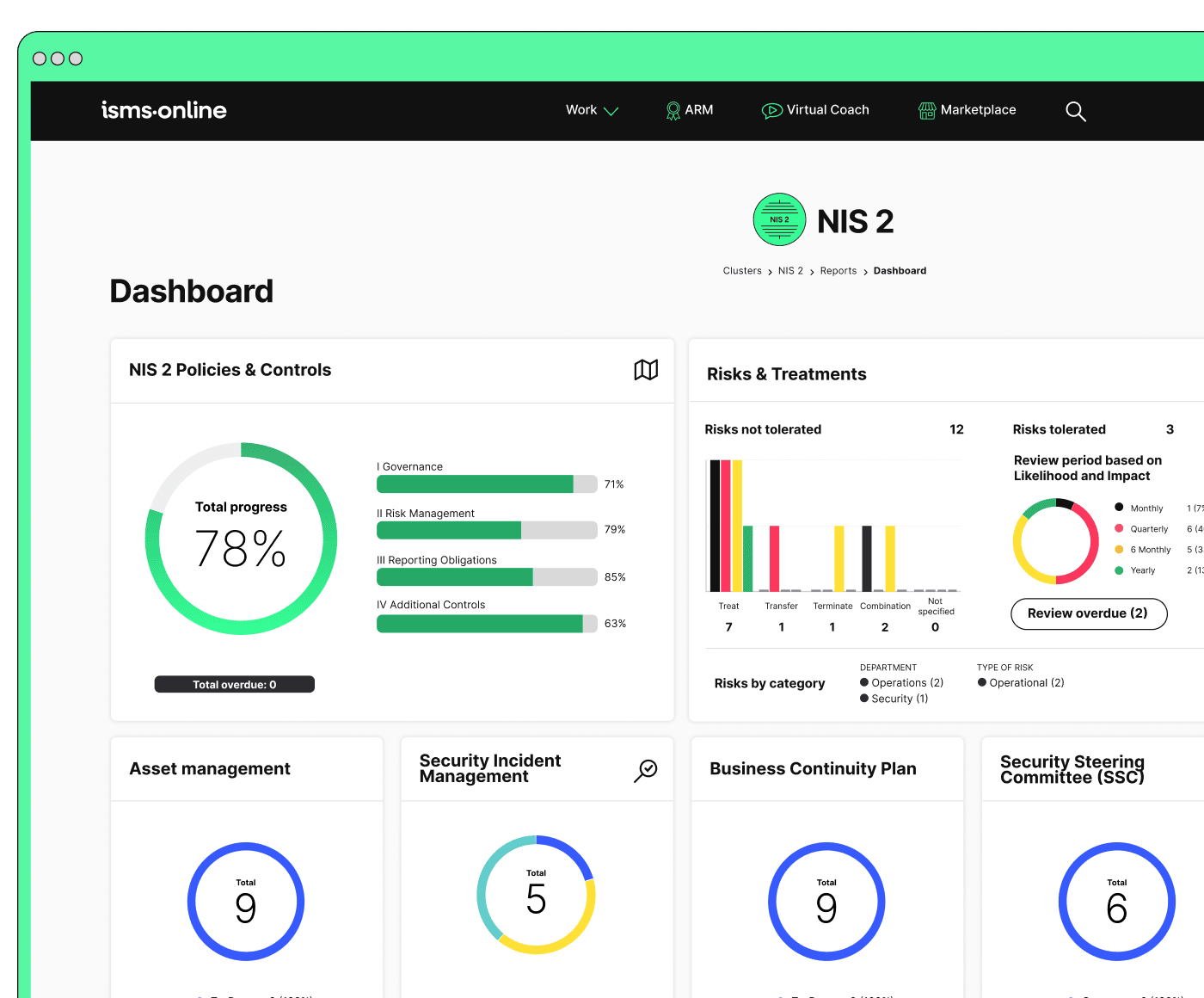
Be NIS 2-ready from day one
Launch with a proven workspace and templates – just tailor, assign, and go.
Automate, Prove, and Personalise Hygiene with ISMS.online Learning
Relying on signatures and intention is obsolete. NIS 2 and parallel standards require proof-for each user, every event, and every type of risk faced by the organisation. With ISMS.online, you orchestrate the full cycle: assigning, tracking, and evidencing both universal and role-specific cyber hygiene for every staff member and contractor (ISMS.online Support, 2024).
- All staff engagement-from initial policy read and simulated phishing drill, to quiz completion and remediation assignment-are logged, timestamped, and mapped per individual.
- Live dashboards: instantly flag any overdue, incomplete, or at-risk users, enabling compliance managers to intervene before an audit, incident, or board review uncovers a lapse.
- Whenever learning is missed, or a user fails a simulation or quiz, the platform auto-assigns retraining, captures new acknowledgements, and maintains a live export-ready trail.
- Engagement records are always individual, linked to policy, incident, and risk register–allowing your organisation to demonstrate, and continually improve, resilience.
Last-minute audit panic is replaced by quiet confidence-every evidence trail is prepped before the request even arrives.
Continuous training becomes an operational advantage-not just post-incident but as a living, daily function, with feedback and improvement surfaced for managers and executives to act on.
Going Beyond “Evidence for Auditors”: Building Real Traces and Outcomes
Modern compliance evidence isn’t a static PDF; it’s a living export of every user’s actions, mapped in real time to relevant policies, engagements, risks, and outcomes. NIS 2, GDPR, and ISO 27001 all expect this level of traceability. Success means linking every learning event-routine or reactive-to its associated risk, role, and outcome.
- ISMS.online ensures unresolved gaps are escalated and closed: overdue training triggers notifications and remediation assignments before the next audit or breach.
- Performance dashboards surface hygiene maturity: , benchmarking improvement across teams and business units-no more relying on patchy or out-of-date averages.
- Organisations using real-time, dynamic learning systems see clear results: incident-to-closure cycles shrink by over a third, regulatory investigation time falls, and repeat events diminish sharply (KPMG, 2024).
ISO 27001 Audit Expectation to Evidence Table
| **Expectation** | **How It’s Operationalised** | **Annex A Reference** |
|---|---|---|
| Staff trained regularly | Automated learning, per-person logs | A6.3, A8.7 |
| Role-based policy mapping | Assignments and attestations per role | A5.1, A5.4, A7.2, A7.3 |
| Incident response proof | Real-time event > assignment tracking | A5.24–A5.28, A8.7, A8.8 |
| Continuous improvement | Engagement metrics and benchmarking | A9.1, A10.2 |
Traceability Examples Table
| **Trigger** | **Risk update** | **Control/SoA link** | **Evidence** |
|---|---|---|---|
| Phishing simulation fails | Retraining assigned, risk updated | A8.7, Malware protection | Quiz log, tracking |
| Missed password deadline | Risk raised, alert issued | A5.16, Identity management | Alert, log update |
| Unattended USB detected | Data risk, asset flagged for review | A8.13, Removable media | Incident log, action |
| Policy update unacknowledged | Policy flagged, compliance alert | A5.1, Security policy | Policy log, dashboard |
| Failed incident drill | Gap flagged, improvement plan launched | A5.24, Incident response | Drill record, notes |
The difference between regulatory friction and fast, case-closed audits is always the actionable, per-user evidence trail.
Organisations lacking this depth of logging consistently face longer investigations and higher fines. Those ready to deliver real-time, role-linked evidence secure regulatory, customer, and board trust-turning compliance from friction to business advantage.
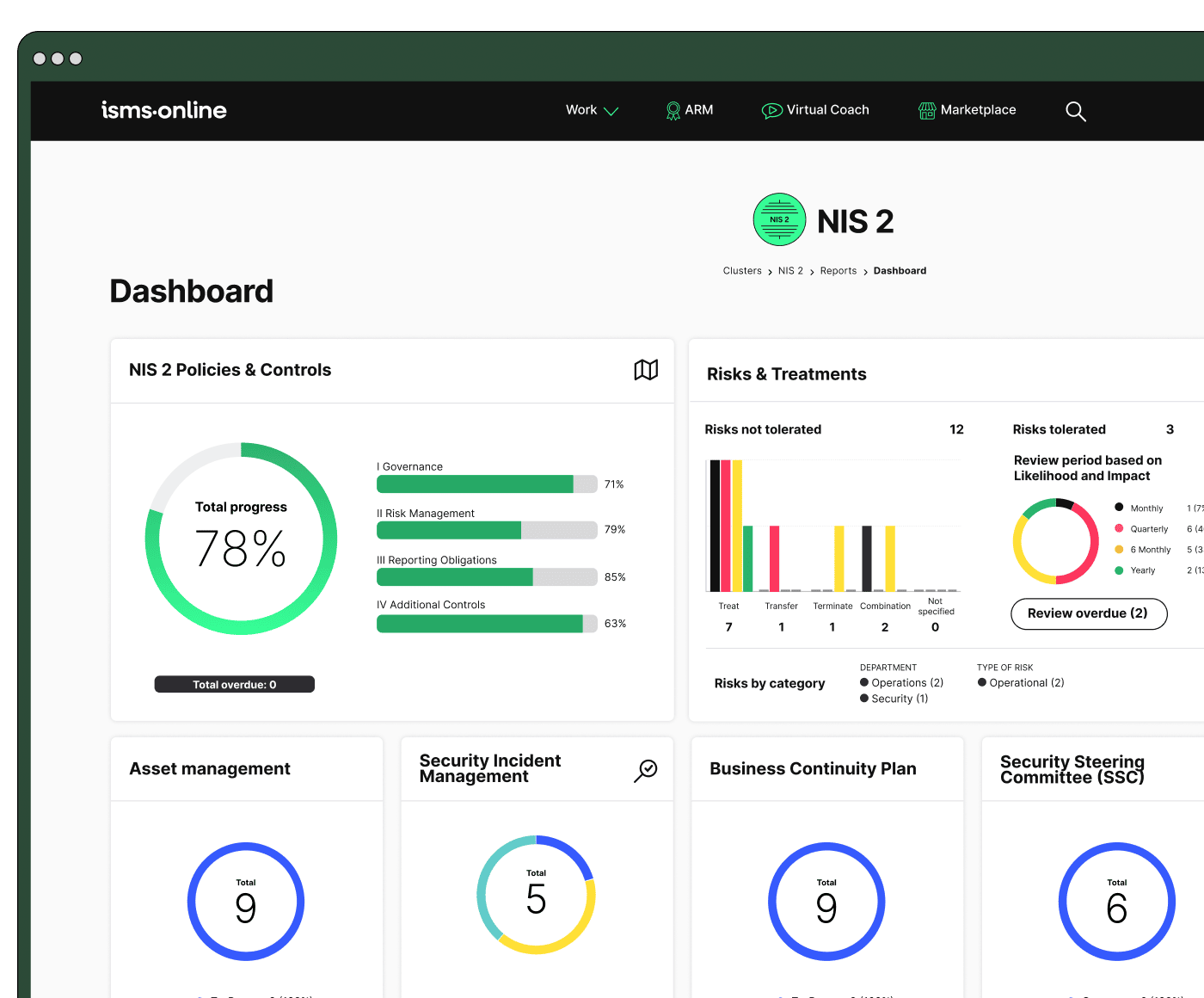
All your NIS 2, all in one place
From Articles 20–23 to audit plans – run and prove compliance, end-to-end.
The Living Compliance Benchmark: Adaptive Hygiene, Continuous Learning, and Measurable Resilience
Security threats are a moving target; NIS 2 requires that your hygiene and training programme be just as dynamic. The old checklist model is a blueprint for eventual exposure-and, in the worst cases, public breach and business loss. The new benchmark is a perpetual loop of micro-learning, gap detection, incident-triggered updates, and real-time improvement records (ENISA, 2024).
- ISMS.online connects all elements-mandatory training, live dashboards, phishing/incident simulation, automatic reminders-so your record is always audit-ready and board-ready.
- When an incident or risk appears, the system auto-assigns tailored upskilling and documents every step, surfacing the story via dashboards and exports that align with each policy and control reference.
- Organisations adopting this “living compliance” approach demonstrably outperform those stuck on snapshots or paperwork alone-KPMG found incident cycles, regulatory scrutiny, and repeat incidents all fell in digitally mature teams (KPMG, 2024).
The only benchmark that matters is a team whose improvement curve is visible alongside their training log.
Invite your leadership to compare the static-for audits only-model with a live compliance dashboard. When success is measured and visible as improvement over time, trust inevitably grows.
Start Smart Security Awareness Training with ISMS.online Today
With ISMS.online, organisations can move from reactive, generic training to proactive, provable cyber hygiene-turning compliance into a force for business advantage and executive trust.
- Deploy up-to-date, role-based NIS 2 learning modules and adaptive policy packs for every team, region, and work type: -configured in minutes and always current with new threats and guidance.
- Track engagement at all levels: via live dashboards, export outcome logs per requirement (ISO 27001, NIS 2, GDPR), and on-demand reporting-evidence ready for board, regulator, or critical client.
- Automate reminders, upskillers, and continuous learning cycles: to ensure every staff member’s training matches their active responsibilities and risk profile.
- Run phishing and incident simulations as part of ongoing programmes: -embedding practical experience, reinforcing learning, and closing audit and resilience gaps before they become problems.
- Produce per-user, per-policy, per-incident evidence at audit depth, on demand: -driving faster audits, fewer penalties, and a credible record of ongoing improvement.
Lead your organisation from compliance uncertainty to provable resilience-become the team that boards, customers, and regulators trust, not on intent but on evidence.
Frequently Asked Questions
Who is required to comply with NIS 2 cyber hygiene and security training, and what new evidence actually counts?
All organisations classified as “essential” or “important” under NIS 2-including digital services, utilities, healthcare, financial institutions, and key suppliers operating in or engaging with the EU-must now implement and prove cyber hygiene and comprehensive security training for every employee, not just IT staff []. Board members and executive management carry explicit accountability: regulatory authorities are no longer satisfied with outdated “policy signed, job done” approaches or single annual training certificates. Instead, they demand verifiable digital evidence-completion logs, attestations, timestamps, and audit trails-that demonstrate your programme is active, risk-aligned, and remedial actions are genuinely tracked. If your organisation assumes “IT will handle it” or relies on informal admin records, this exposes leadership to penalties, lost contracts, and increased personal liability.
Today, board-level protection means having real-time, auditable evidence ready for any regulator, auditor, or client-intent is no longer enough.
ISMS.online closes these proof gaps by automating assignment, completion tracking, and remediation logs-so you transform training from a fragmented task to a defensible, board-level asset.
What sectors and roles are now in scope under NIS 2?
- Energy, water, healthcare, transport, and digital infrastructure
- Financial and insurance services
- Digital providers (cloud, DNS, data centre, managed services)
- Manufacturers, postal/courier, and food/retail with critical supply ties
- All board members, management, and operational staff-not just technical teams
If you deliver, support, or connect with essential services-your whole workforce comes under NIS 2.
What specific NIS 2 requirements define “cyber hygiene” and workforce security training?
NIS 2 imposes clear, binding obligations-requiring organisations to establish, maintain, and document technical and human controls tuned to their true risks and operations []. The regulations go beyond policy:
Cyber Hygiene Practises
- Multi-factor authentication (MFA):
- Patch management, device hardening, endpoint protection
- Password and access control hygiene
- Regular, tested backup and restore
- Incident detection, mandatory reporting, and response drills
Security Training Mandates
- Annual, risk-based security awareness and behaviour training:
- Onboarding, role change, or exposure to new threats requires just-in-time updates
- Phishing and social engineering, remote work, incident reporting, data protection, supply chain security
Evidence Requirements
- Attendance logs and test scores per user and session-beyond “tick-box” status
- Attestations, digital signatures, or acknowledgements for each key policy and module
- Records of remedial actions and targeted retraining after gaps or incidents
- Documented links between policy updates and triggers (breach, legal change, management review)
- Proof that all content and delivery is updated, risk-aligned, and monitored-no static shelfware
| Expectation | Operationalisation | ISO 27001 / NIS 2 Reference |
|---|---|---|
| Role-based, timely training | Automated assignments, per-role statistics | A.6.3, A.7.2 / Art 20–21 |
| Live evidence | Attestations, completion logs, remediation trails | A.5.1, A.8.9 |
| Responsive updates | Retraining linked to risks/incidents | A.5.24, A.5.26 / Art 23 |
ISMS.online matches every requirement to a module, monitoring all updates, To-dos, and user engagement-ensuring your organisation is audit-ready, not just “certification hopeful.”
How does ISMS.online automate cyber hygiene assignment and training evidence under NIS 2?
The days of chasing Excel logs and hoping for a “clean file” at audit time are over. With ISMS.online, you can apply cyber hygiene training and security policy modules by role, department, region, or custom risk group-at scale and in real-time [(https://www.isms.online/platform/cyber-training/)].
Key automation and evidence capabilities:
- Seamless Assignment: HR directory, SSO, and department integrations enrol new hires and surfaced role changes immediately-no manual admin.
- Workflow Triggers: Phishing failures, new threats, or incident learnings auto-assign remedial modules and monitor engagement.
- Real-Time Tracking: Completion status, test results, failed attempts, and non-responsiveness are visible in dashboards-enabling “management by exception” rather than “compliance by spreadsheet.”
- Remediation Loops: Failed tests, missed deadlines, or policy changes trigger follow-up assignments and log every user’s remediation journey.
- Audit-Ready Exports: With a click, produce audit packs that map every login, module, signature, and action to NIS 2 and ISO 27001 controls-timestamped, clause-referenced, ready for regulator, client, or board.
Automate the hard parts-focus your expertise on leadership and risk, not babysitting compliance paperwork.
What reporting features mean you can satisfy board, audit, and regulator demands under NIS 2?
Modern audits, vendor scrutiny, and board oversight demand concrete, real-time evidence. ISMS.online equips you with granular, clause-mapped reports that include:
Core evidence tables produced for every compliance event:
| Audit Trigger | Required Evidence | ISMS.online Example |
|---|---|---|
| Annual audits | Complete per-user logs, test results, signed attestations | Role- and topic-level exports |
| Incident investigation | Records of remedial training and response logs | Automated assignment and closure stats |
| Board/regulator request | On-demand history mapped by role/risk | Clause-referenced audit packs |
- KPI dashboards: Monitor engagement, task completion, policy interactions, and “at risk” departments. See trends and intervene before minor lapses grow into systemic risk.
- Legal and audit support: Self-serve, regulatory-grade documentation-proving not just intent, but outcome.
- Instant proof: From attendance to remediation, every step is timestamped and retained even when policies and staff evolve.
Your next audit shouldn’t depend on hope. Bring the evidence-already mapped, logged, and ready to show leadership and regulators.
How does ISMS.online drive real continuous improvement-not just “tick-box” compliance?
A static training calendar is no longer defensible. Continuous improvement means every incident, test, or policy update closes the gap-not just in files but in your business behaviour. ISMS.online operates as a closed-loop system:
- *After a phishing failure*, a targeted learning module is instantly assigned, closed out, and evidence is re-logged.
- *When an audit exposes a weakness*, an updated policy is issued, acknowledged, and linked learning is delivered.
- *Management gains intelligence* via analytics on training fatigue, policy engagement drift, and repeating risks, allowing proactive action.
KPMG reports that organisations using active, “closed-loop” evidence-training platforms reduce unmitigated vulnerability windows by 35%-measured as faster detection and incident resolution [(https://www.isms.online/platform/training-security-awareness/)]. The outcome: a workforce that is observably safer, regulators and clients who believe your claims, and a board that sees trend evidence of compliance as resilience, not just paperwork.
How can ISMS.online enable NIS 2 compliance for global, multilingual, and sector-specific needs?
Regulated businesses increasingly span borders and operate in complex, sector-specific landscapes. ISMS.online lets you align and adapt evidence-driven training for any jurisdiction, sector, and language-without widening risk or losing audit traceability [(https://www.isms.online/international-standards/)].
- Pan-European coverage: Assign, monitor, and evidence NIS 2 and ISO 27001-aligned cyber hygiene training in all official EU languages and regional dialects.
- HR/LMS integration and auto-enrolment: All modules and assignments update as staff join, move, or change roles.
- Sector and role tuning: Module content is aligned for finance, healthcare, energy, manufacturing, supply chain-delivering only the relevant scenarios, threats, and compliance footprint.
- Mobile-first, field-ops friendly: Whether office-based, in the field, or hybrid, your team can learn and attest securely on any device.
- Board and regulator view: Live dashboards, risk heatmaps, and filterable exports deliver any level of evidence-from region to individual staff-keeping compliance transparent and stress-free.
Evidence Traceability Table
| Trigger Event | Risk Update | Control Ref | Evidence Output |
|---|---|---|---|
| New starter onboarding | Training auto-assigned | A.6.3, A.7.2, Art 20-21 | Module allocation + attendance |
| Phishing test failure | Retraining assigned | A.5.24, A.5.26, Art 23 | Remediation + completion logs |
| Regulatory/board policy change | Content refreshed | A.5.1, A.8.9 | Revision and acknowledgment |
Step beyond tick-box compliance-arm your board and operational team with live proof of resilience and readiness. In the new era of NIS 2 and ISO 27001, reputation, contract pipelines, and operational safety all hinge on your ability to show, not just tell. See how ISMS.online moves you from reactive admin to proactive leadership at every level.






