





































Is There a NIS 2 Certification Badge-or Something Deeper?
For many compliance leaders, chasing a “NIS 2 certificate” feels like a rational shortcut-one emblem, one pass, and done. But this instinct is precisely what NIS 2 rejects. The badge mindset-grabbing a static certificate to display to the board or embed in sales decks-doesn’t exist for the EU’s most ambitious cyber-security directive to date. Instead, NIS 2 delivers something more demanding and rewarding: a living system of verifiable compliance that runs through your business, every day.
No badge is coming-regulators want to see how you manage risk when no one is watching.
The closest thing to a badge in NIS 2 is a continual test: are your policies, controls, and risk models up-to-date and owned, or gathering dust on a shelf? ENISA puts it plainly: “NIS 2 does not require a cyber-security certification in the sense of an accredited, one-time scheme, but ongoing risk management and demonstrable compliance” (ENISA FAQ, 2024).
Why NIS 2 Isnt ISO 27001 or SOC 2
Its tempting to compare NIS 2 to standards like ISO 27001 or SOC 2-both offer a defined and recognised certification process. Auditors deliver a binary yes/no, a valid-through date, and sometimes a public seal. But the NIS 2 journey is fundamentally different: no central issuing body; no expiry date; no public badge-just continuous proof managed through live governance, ready for spot inspection.
This distinction matters enormously for operational leaders and boards. Where ISO and SOC 2 promise a moment-in-time snapshot, NIS 2 expects that snapshot to be fresh, owned, and always audit-ready.
| Feature | Traditional Certification (ISO/SOC) | NIS 2 Compliance |
|---|---|---|
| **Issued Certificate** | Yes, after audit by certifying body | No, proof = ongoing records |
| **Expiry Date** | Yes (1–3 years typical) | Never expires-always live |
| **Pass/Fail Moment** | Yes, annual/semi-annual review | No, continuous-random audits |
| **Status Symbol** | Yes (logo or badge) | No badge, compliance is lived |
| **Proof Format** | Audit report, certificate, SoA | Living evidence, real KPIs |
By embedding this philosophy, organisations are forced-helpfully-away from one-off fixes and towards continuous, discipline-driven ISMS operations. Focusing on a badge leaves gaps: focusing on daily evidence grants actionable control, peace-of-mind, and trust from stakeholders.
Book a demoWhat Is Actually Required for NIS 2 Compliance-and Who Decides?
Boards, CISOs, and risk managers wanting certainty look for a checklist: what do I show an auditor, and who says it’s enough? The reality under NIS 2 is dynamic and unyielding. The EU and ENISA stress that NIS 2 is a regime of “operational assurance”-best practise in action, not a stale paper certificate (ENISA, 2024).
True NIS 2 evidence is the byproduct of operations-it’s what you can prove today, not what you filed last quarter.
Key Evidence Auditors and Regulators Expect
Audit readiness means having an ecosystem of current, connected records-each one traceable, with a clear owner and update cadence. Operational and compliance leaders should assemble and maintain:
- Security policies, risk registers, and controls: directly mapped to today’s risk environment, not last year’s version.
- Management review minutes and action logs: , with proof of ongoing, leadership-level engagement.
- Clear incident response plans and logs of exercised tests or real events: , with outcomes and lessons learned.
- Training completion and awareness evidence: -not just policy assignment, but proven engagement by staff.
- Supply chain and business continuity plans: , updated and routinely risk-assessed.
- Live “lessons learned” documentation and post-incident improvement logs: tracked against specific controls (White & Case, 2024).
The expectation is never static paper-regulators demand demonstrable, up-to-date discipline in every event.
| Triggered Event | Risk Response | Control/SoA Link | Evidence Example |
|---|---|---|---|
| Detected Incident | Conduct review | A.5.24, 8.15, 8.16 | Incident log, lessons learned, retraining |
| Vendor Breach | Supplier audit | A.5.21, 5.19, 5.20 | Assessment update, comms records |
| Staff Role Change | Access review | A.5.16, 5.18, 8.2 | Log, approvals, training |
Every record should be “live”: ready for random inspection, not staged for audit season only.
Can Member States Issue “Certificates”?
A few member states reference ISO 27001 or similar models in local NIS 2 guidance, but none replaces the core NIS 2 duties. No badge or “national certificate” gives immunity. The proof is found in the operational loop-how quickly and defensibly your team responds to an incident, supplier breach, or training gap (Noerr, 2024).
Standards are a backbone-not body armour. Only current, meaningful evidence holds up.
Is ISO 27001 Enough?
ISO 27001 gives a strong operational starting point, especially for documentation, risk, and policy structure. But NIS 2’s higher bar-sector-specific resilience, supply chain scrutiny, triaged responses, and board-level evidence-often exposes gaps. Many ISO-certified companies are being told to improve evaluation cadence, close evidencing delays, and log board engagement (OneTrust DataGuidance, 2024). The message: mapping ISO is not a guarantee-it’s a launchpad.

Master NIS 2 without spreadsheet chaos
Centralise risk, incidents, suppliers, and evidence in one clean platform.
Are You at Risk by Chasing “Certification” Instead of Living Evidence?
The instinct to “get certified” as a mode of organisational protection is strong-and can be a trap. Countless boardrooms feel reassured by paper assurances, yet NIS 2 makes this illusion dangerous. No certificate, cabinet artefact, pay-to-play badge, or purchased stamp-out product grants immunity if it is separated from operational substance.
You cannot outsource trust to paperwork-regulators and customers test what you actually do, not what you hang on the wall.
Why Paper Certificates Lose Value Under NIS 2
NIS 2 is designed to pierce the “tickbox” defence. Director and board liability is explicit: non-compliance can lead to public findings and fines, while ignorance will not shield leadership. Certification vendors or “one-and-done” consultants may promise comfort, but in practise, audit failures nearly always trace back to “looks good on paper” but falls apart under live examination.
| Approach | Short-Term Ease | Audit Resilience | Regulatory Risk | Board Protection |
|---|---|---|---|---|
| Tickbox/Certificate | High | Weak | High (fines/risk) | None |
| Ongoing Evidence Loop | Moderate | Strong | Low (proactive) | Yes-direct proofs |
Case in Point-A Real-Talk Failure Pattern:
A major supplier bought “certification” for NIS 2, imagined themselves audit-ready, and was shocked when a spot audit revealed outdated incident logs, unacknowledged training, and stale supplier assessments. The badge was meaningless-what mattered was the fresh trail of disciplinary action, risk updates, and staff engagement.
Common Paths to Pain: The Tickbox Trap
- Focusing on “audit season” makes you vulnerable to random or post-breach inspections.
- Relying on generic “NIS 2 certificates” leads to vendor lock-in without true resilience.
- Static templates left unreviewed go stale; proactive documentation and testing closes the loop (BDO, 2023).
Boards are not asking for badge collectors-they want teams to prove, in action, their ability to respond, adapt, and recover.
Sustained readiness protects operational integrity far more than any certificate pack.
What “Audit-Ready” Looks Like in a NIS 2 World
Audit-ready under NIS 2 is not a quarterly tickbox-it’s a cultural discipline embedded throughout your organisation. Board leaders, risk managers, and operational teams must treat auditability as an ongoing trait, not a destination.
Audit readiness is a posture, not an event-when evidence is real, you’re never caught unprepared.
Driving Proof Beyond the Checklist Mentality
To truly be audit-ready, you’ll need every artefact-policy, control, incident log, management review-living, attributed, reviewed, and up-to-date. Consider what regulators and auditors look for:
- Incident response plans tested and improved, labelled with staff sign-off and learning loops.
- Risk registers actively maintained, logging all reviews and decisions-not just posted once a year.
- Supplier risk assessments linked to current onboarding, corrective actions, and improvement cycles.
- Management review minutes and action records with participation, not just signatory names.
- Comprehensive staff training, with trackable completion for every assignment, not just “assigned” status.
| Category | Proof Item (Example) | Typical Source |
|---|---|---|
| Incident Response | Log, lessons learned | Incident register, response dashboard |
| Risk Management | Risk register, live KPIs | ISMS, risk platform, linked work |
| Management Oversight | Review minutes, corrective actions | Management review & action logs |
| Supplier Assurance | Vendor assessment, tracked outcomes | Supplier risk module, asset registry |
| Training | Completion records | To-do lists, training management |
The Continuous Evidence Loop
The real test: not “did you file something?” but “is your loop working now?”-can you show, in minutes, how a staff departure led to deprovisioning, or how a vendor incident led to updated assessments?
[Trigger/Event]

      ↓

[Action: Review/Update]

      ↓

[Log: Evidence/Ctrl Link]

      ↓

[Board/Management Review]

      ↓

[Test/Audit]

      ↺ (loops back)
This system rewards real engagement. When risk is found, controls adapt; when incidents occur, reviews tighten; when the board asks for proof, everything is at hand-no last-minute scrambles.
Frontline Readiness: Operations Teams Driving Audit Wins
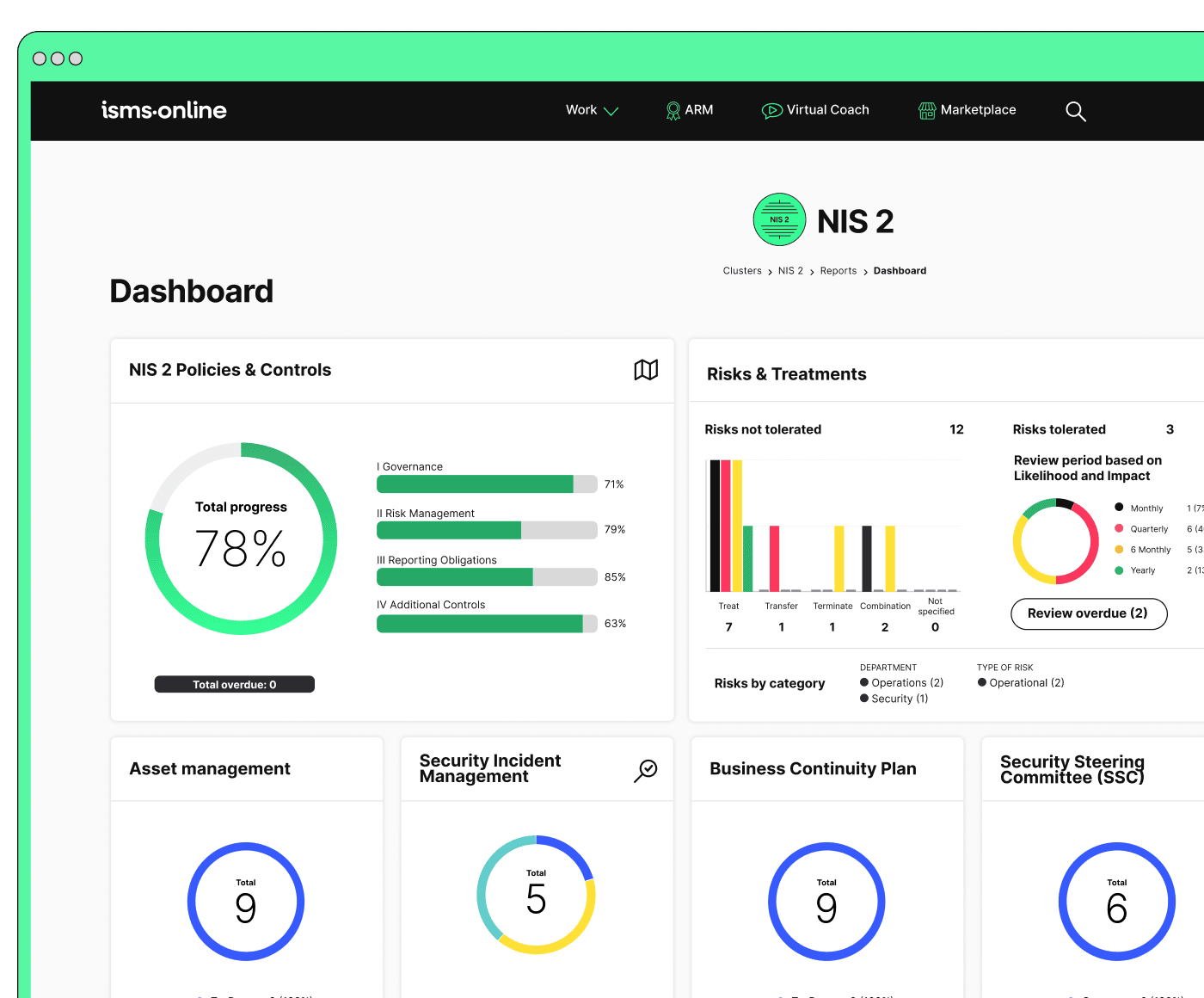
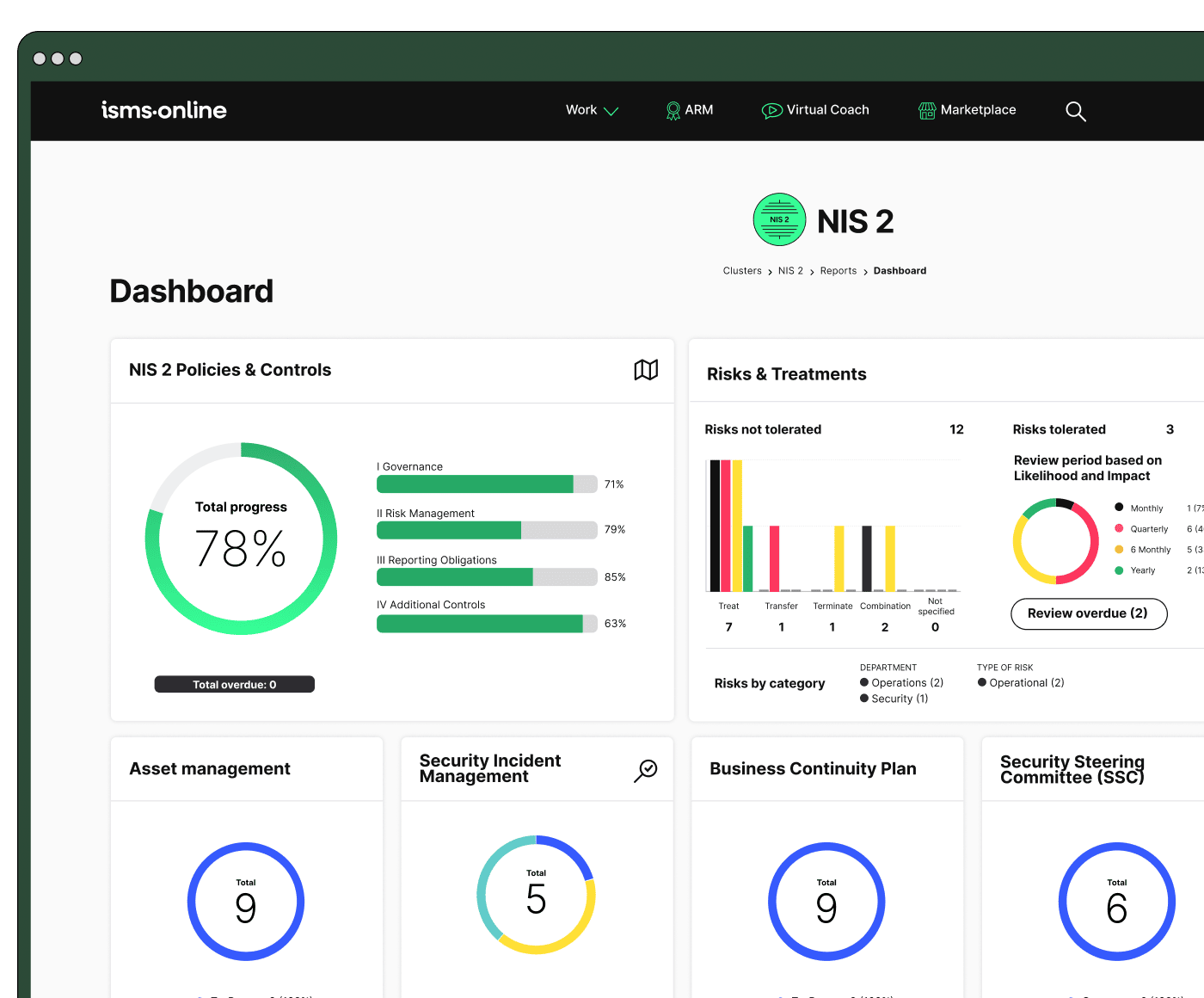
Consider the CISO whose team uses ISMS.online: when an auditor requests proof, they access a single live dashboard, see recent policy edits, access logs, risk reviews, and staff acknowledgements-all mapped to owners and linked controls. This “always-on auditability” sets a new bar: trusted, repeatable, and dynamic evidence that earns stakeholder confidence.
Be NIS 2-ready from day one
Launch with a proven workspace and templates – just tailor, assign, and go.
Is Mapping ISO 27001 Enough for Full NIS 2 Confidence?
ISO 27001 provides an essential foundation-establishing policies, risk routines, and management structure. But NIS 2 asks for more: evidence-in-motion. Where ISO mapping gives you the bones, NIS 2 expects muscle, ongoing activity, and proof that controls are alive and adapting to new risk.
ISO is your foundation-resilience comes from living, not just mapping, the controls.
ISO 27001 and NIS 2: Where the Journey Diverges
Both frameworks insist on risk assessments, policy discipline, tested incident plans, and management buy-in. The gap emerges in operationalising those requirements:
- ISO 27001 gives you static checkpoints: (annual reviews, document control, sign-off), while
- NIS 2 mandates continual oversight and board involvement: (dynamic risk management, supply chain vigilance, rapid breach notifications, ongoing training cycles, and real-time incident evidence).
| Expectation | Operationalisation | ISO 27001 Ref | NIS 2 Additional Layer |
|---|---|---|---|
| Up-to-date risk review | Dynamic register, logged reviews | 6.1/8.2 | Board review, sector reporting |
| Incident response | Tested, exercised, lessons logged | A.5.24/8.16 | 24/72h report, supply chain |
| Staff engagement/training | Logged, tracked, reminders sent | A.6.3/7.3 | Evidence of *actions*, not intent |
The audit-winning move? Connect static controls (ISO) to living, role-assigned, always-on logs and action trackers (NIS 2 compliance loop).
Compliance Loop Schematic
[ISO 27001 Baseline]

            ↓

      [Live Controls]

            ↓

    [Log: Evidence/Reviews]

            ↓

   [Supply Chain Assessment]

            ↓

   [Management/Board Oversight]

            ↓

     [Incident Response/Notify]

            ↺ (loops back)
The strongest organisations build on ISO, then bring their controls to life with live evidence and operational discipline.
How Do You Build a “Compliance Loop” That Actually Works Every Day?
The transformation from list-checking to resilience begins with a compliance loop-a repeatable, living system where every trigger drives update, evidence, and review. This continuous cycle is the heart of what NIS 2 regulators expect and what boards demand for confidence.
Win trust with proof-in-motion-compliance achieved once dissolves with every day’s inaction.
The Compliance Loop-Steps That Anchor Assurance
- Trigger: A new incident, staff/jurisdiction change, or vendor alert.
- Action: Immediate risk review, control adaptation, or training issued.
- Record: Every step logged, tagged with owner, date, and link to relevant policy/control.
- Review: Recurring management or board review cycles-no skipped meetings-where evidence is formally assessed.
- Test: Periodic drills, unannounced spot checks, and scenario testing; close the loop by correcting process gaps.
- Repeat: Stay ready for audits, board inquiries, and regulatory surprises-ownership and evidence are never more than a key-click away.
| Trigger | Risk update | Control / SoA link | Evidence logged |
|---|---|---|---|
| Staff leaves | Access revoked | A.5.16 (Identity Mgmt) | Access log, approval note |
| Incident | Review held | A.5.24 (Incident Plan) | Minutes, retraining logs |
| Vendor breach | Supply audit | A.5.21 (Supply Chain) | Updated vendor list |
Schematic: The Compliance Loop in Action
┌───────────┐    ┌─────────┐   ┌─────────┐   ┌───────────┐   ┌────────┐

 │  Trigger  │ →  │  Action │ → │  Record │ → │  Review   │ → │  Test  │

 └───────────┘    └─────────┘   └─────────┘   └───────────┘   └────────┘

      ↑                                                        ↓

      └───────────────────────── Repeat ───────────────────────┘
To make this a living loop, leading organisations deploy platforms like ISMS.online-where triggers are never lost, every action and review is logged, and audits shift from disruption to routine demonstration.
Boardroom trust depends on this loop-not just on list completion, but on the organisational muscle memory it creates.
All your NIS 2, all in one place
From Articles 20–23 to audit plans – run and prove compliance, end-to-end.
What to Stop Wasting Time & Resources On: “Certificates”, Templates, Tickboxes
It’s easier to invest in ready-made templates or flashy certification offers than in day-to-day operational proof-but NIS 2 makes that a dangerous shortcut. Certification “badges” and all-in-one templates offer temporary comfort, not regulatory assurance or resilience.
False assurance creates hidden risk-only ongoing evidence stands up to real scrutiny.
The Illusion of Easy Wins
- Certificates off the shelf: often fail active audits. Regulators and auditors quickly spot stale logs, unacknowledged policies, and outdated risk reviews. These artefacts are “dead weight”-nice to display, but not to defend.
- Template packs: are usually generic, unadapted to your risk landscape, and can’t capture the evolving context of your organisation or sector.
- Consultancy-driven tickbox kits: may help with initial mapping but can’t anchor compliance without live, local ownership, and operational discipline.
| Approach | Short-Term Relief | Audit Durability | Board Confidence |
|---|---|---|---|
| Certificate/Template | High | Low | None |
| Actionable Platform | Medium | Very High | Complete |
Scenario: Failing the Surprise Audit
A logistics company purchased a comprehensive NIS 2 “kit,” believing compliance was close at hand. But when a regulator demanded a live demonstration, missing links (e.g., unreviewed risks, unopened training tasks) quickly exposed the gap. The switch to ISMS.online, with audit trails, live logs, and task assignments, transformed their reassurance from decorative to actionable.
Where to Actually Invest
- Live ISMS platforms: Centralise, update, and assign ownership for every document, review, and training-ensuring every team knows their role and evidence is ready.
- Distributed ownership: When compliance is everyone’s job (not just the CISO’s), resilience is built in, not layered on top.
The most audit-ready organisations invest in workflows where actions, evidence, and improvement are embedded in everyday operations-protected from the fragility of templates and badges.
Be the Team That Boards Trust with Audit-Ready Resilience
The new benchmark is not an emblem, but ongoing credibility. Boards, customers, and regulators are looking for leaders-across the compliance, security, legal, and operations spectrum-who can demonstrate proof, not just declare it. The shift is seismic: from “badge in the drawer” to “evidence at your fingertips.”
Winning teams aren’t badge collectors-they’re consistency, ownership, and improvement, proven day after day.
What Sets Audit-Ready Teams Apart
- Evidence is always-on: -with risk registers and controls dynamically updated, not just for show but for substance (isms.online).
- Collaboration is embedded: -security, privacy, incident response, risk, supply chain, and board involvement all interlock as roles and workflows, not siloes.
- Resilience skill beats reaction speed: -teams with living ISMS workflows adapt to new risks and regulatory obligations as they arise, not in panic or after failure.
- Recognition is reputation, not luck: -numbers like 100% first-time audit pass show operational mastery rather than surface claims.
- Improvement is looped daily: -notifications for reviews, reminders for training, and integrated evidence logs make compliance cultural and continuous, not calendar-only.
Choosing a platform like ISMS.online means your organisation drives accountability, trust, and resilience for every stakeholder: boards, auditors, regulators, and staff.
Step Up: Lead with Demonstrable Confidence-Not with Another Badge
If youre a compliance leader, CISO, privacy officer, legal guardian, or IT practitioner-the audit-ready confidence you offer your board is your brand. A living ISMS model is your insurance policy for both regulatory surprise and commercial opportunity.
Its time to invest in workflows and systems that build and lock resilience every day-because in the world of NIS 2, assurance isnt a badge: its what you can show, explain, and prove, whenever trust is on the line.
Book a demoFrequently Asked Questions
Why isn’t there a real NIS 2 certificate-and what does “proving compliance” actually require?
You won’t find a true “NIS 2 certificate”-the Directive aims for ongoing cyber resilience, not one-time badges or audit passes. Compliance is proven with evidence of day-to-day operational risk governance: authorities will not accept a certifying body’s stamp or a “seal” as proof. ENISA and the European Commission are clear-NIS 2 involves supervision and real-world checks, not paper-based certification ((https://www.enisa.europa.eu/news/enisa-news/no-nis-2-certificate), (https://digital-strategy.ec.europa.eu/en/policies/nis2-directive)).
NIS 2 vs Certificate Schemes
- ISO 27001/PCI DSS: You can earn a certificate after an external audit, following a standard checklist.
- NIS 2: Legal requirement, supervised by national (or EU) authorities. They expect daily operational controls, living risk evidence, and board oversight at all times-not a “pass/fail” or auditor stamp.
- No fixed badge: “Passing an audit” or buying a NIS 2 “badge” from a consultant offers zero legal protection; authorities want proof your security is working and regularly improved.
A badge expires-real NIS 2 compliance never stands still and cannot be delegated.
How do you actually prove NIS 2 compliance if asked by authorities or major clients?
Proving NIS 2 compliance is not about producing a static document: it’s about being able to demonstrate, at any time, that your governance system is live, evidence is complete, and controls really operate. Supervisory authorities expect dynamic evidence: risk assessments linked to assets and threats, incident and near-miss logs, board meeting minutes on cyber topics, supply chain checks, and living Statements of Applicability (SoA). A PDF “badge” is rejected; traceability and accountability are critical (White & Case, 2023).
Core Compliance Artefacts
- Ongoing risk registers: Date-stamped, tied to assets and threat changes (digital, not static).
- Board/management review minutes: Proving NIS 2 oversight is more than a policy.
- Incident/near-miss logs: With notification times and root cause analysis.
- Supplier reviews: Signed, updated, with record of onboarding and risk status.
- Change logs: Documenting every new threat alert, supplier risk, or incident response fix.
| Audit Trigger | Evidence Required | NIS 2 Article | Typical Proof |
|---|---|---|---|
| Data breach/incident | Incident logs, risk review | Art. 23–24 | Root cause, response timeline |
| Board oversight query | Review minutes, approvals | Art. 20–21 | Management review, SoA update |
| Supplier onboarding | 3rd party risk assessment | Art. 21 | Signed review, periodic updates |
Why are “self-issued NIS 2 badges” or supplier certificates not recognised?
Any “self-issued” NIS 2 badge, vendor “certificate,” or platform-provided “seal” is simply not valid. No regulator, ENISA, or EU country will treat these as legal evidence of compliance-they cannot substitute for living, operational logs and governance. Relying on such evidence puts boards and leaders at direct risk of enforcement and even personal liability ((https://www.enisa.europa.eu/news/enisa-news/no-nis-2-certificate), (https://kpmg.com/lu/en/home/insights/2023/11/nis-2-navigating-the-eu-s-new-cyber-security-directive.html)).
The Flaw With NIS 2 Badges
- No authority accepts these as compliance, regardless of supplier or sector.
- Badges and seals ignore individual organisation risk, sector nuances, and real-time incidents.
- Boards, procurement, and investors demand operation-based evidence-not signs or stickers.
- During an audit, only live evidence counts; “theatre” badges result in failed oversight.
A badge is theatre-operational logs and workflows are what authorities check.
What is the NIS 2 audit and oversight process-and how can you prepare your organisation?
NIS 2 audits and inspections are driven by real events-incidents, sector trends, or authority requests-not annual cycles or checklists. Supervisors may arrive with no notice, requesting to see your live management system, most recent risk/incident logs, board engagement, and supplier status (NIS 2, Arts. 31–34).
Audit Preparation Steps
- Map controls: Each Article 21/23 requirement should have a clear owner, linked SoA, and evidence in your ISMS or GRC.
- Update logs in real time: Every incident triggers a log entry, review, and policy update.
- Supply chain: Supplier onboarding and risk reviews are signed and current.
- Board accountability: Management review cycles recorded with sign-off, actions tracked to completion.
- Scenario drills: Conduct internal checks as if an authority were present-simulate evidence walkthroughs.
| Trigger Event | Risk Update | SoA Link | Evidence Example |
|---|---|---|---|
| Vendor incident | Supply risk | Art. 21/(2)(d) | Approved supplier review |
| Board review | Minutes taken | Art. 20 | Approval log, SoA change |
| Breach response | Post-incident | Art. 23 | Incident record, update |
Who does NIS 2 apply to, and how do you check if you’re “essential” or “important”?
NIS 2 directly affects most EU and EEA medium/large companies and many public sector providers-specifically those listed as “essential” or “important” entities. This covers health, energy, water, financial, digital infrastructure, telecom, and supply chain sectors. Even if you are a supplier, you likely have indirect obligations ((https://commission.europa.eu/business-economy-euro/banking-and-finance/eu-cyber-security-directive-nis2-faqs_en)).
How to Determine Scope
- Essential: Health, energy, digital providers, finance, water, critical supply chain.
- Important: Telecom, logistics, postal, chemicals, food production, public administration.
- Check sector lists: National authority or ENISA publishes sector/entity lists.
- Board-level responsibility: Named director must own NIS 2 compliance by law (Art. 20).
How do you demonstrate “living,” always-on NIS 2 compliance-not just point-in-time?
Ongoing NIS 2 compliance means your audit trails, oversight, risk cycles, and incident logs are always updated and easily produced-platforms like ISMS.online or strong GRC tools outperform static spreadsheets and PDFs. Risk and supplier cycles, policy approvals, and evidence ownership run as continuous workflows, not paper-chases or annual reviews ((https://www.isaca.org/resources/news-and-trends/newsletters/spotlight-on-gdpr/2023/nis-2-directive-eu-cyber-security-basics-and-beyond)).
Key Continuous Compliance Routines
- Platform-driven logs: Change tracking with timestamps, user IDs, and linked controls.
- Automate reviews: Schedule risk assessments, supply checks, and incident reports.
- Scenario run-throughs: Simulate regulatory reviews and test evidence accessibility.
- Management review: Regular board-level meetings with mapped actions and owner accountability.
| System Element | Feature | Proof Artefact |
|---|---|---|
| Policy Approval | Workflow sign-off, timestamps | Management review, approval |
| Incident Response | Linked to risk/SoA updates | Root cause, actions, logs |
| Supplier Assessment | Reviewed, tracked, evidential | Supplier risk file, SoA link |
Why do boards and leaders fall for the “NIS 2 badge” myth-and what’s different about genuine resilience?
When under pressure, boards often embrace badges or one-off “pass” letters as assurance, but NIS 2 requires continual, systemic evidence. The “badge myth” exposes leaders to direct enforcement, reputational damage, and, in many cases, personal accountability (IoD, 2023). Genuine resilience ties operational controls, evidence trails, and board review together-proven daily, not once a year.
Building Real Boardroom Trust
- Cross-reference risk, supplier, and incident events with live board minutes.
- Board-level NIS 2 ownership, not abstract “compliance office” reporting.
- Schedule simulations-authorities can test at any moment.
| Board Assurance | Operational Mechanism | ISO 27001/Annex A Reference |
|---|---|---|
| Always-on validation | Automated review cycles, SoA mapping | Clause 9.3, A.5.35, A.5.36 |
| Supplier compliance | Central supplier evidence/reviews | A.5.19–A.5.23 |
| Live incident response | IR logs, lessons learned, updates | A.5.24–A.5.28 |
What are the practical steps to embed NIS 2 resilience and ensure audit-readiness heading into 2024–25?
Move fast to operationalise compliance-stop chasing badges, schedule real scenario tests, and equip key staff and board with workflow-driven governance.
- Clarify entity status: Is your organisation “essential” or “important” under sector lists?
- Board/accountability assignment: Name directors formally, record in management reviews.
- Deploy a central evidence platform: Excel/Word won’t scale-use ISMS.online or equivalent to connect logs, approvals, and evidence.
- Automate cycles: Setup repeating risk, incident, and supplier review schedules.
- Cross-framework mapping: Ensure controls link to NIS 2, but also DORA, ISO 27001, or sector overlays. Privacy and AI must stay in sync.
- Rehearse audit scenarios: Schedule internal “walkthroughs” and keep evidence lines fresh.
Living compliance proves resilience on any day of the year-never just once for a badge.
Where should organisations seek trustworthy, actionable NIS 2 compliance resources and living guidance?
Rely on sources grounded in sector law, regulatory expertise, and operational cyber practise-not badge vendors, “audit pack” sellers, or generic standards houses:
- ENISA NIS 2 portal: Definitive EU and sector guidance, scenario studies, and FAQ ((https://www.enisa.europa.eu/topics/cyber-security-policies/nis-directive-new)).
- European Commission NIS 2 FAQs: Scope, sectors, timelines, and national links.
- National enforcement bodies: Sector-specific law, enforcement, and deadline signals.
- Legal counsel: White & Case, KPMG, and national experts tracking transposition.
- ISMS.online: Step-by-step implementation, audit prep, living SoA, and workflow system examples.
Action tips to stay ahead
- Monitor ENISA and sector authority updates; join relevant webinars and peer groups.
- Align your evidence cycle/calendar to real-world sector live feeds-not annual reviews.
- Keep logs, approvals, and supplier evidence up to date in your ISMS or GRC.
How can teams and boards make their resilience-and compliance-visible for 2024 and beyond?
Move from “badge mindset” to living compliance: centralise controls, update logs and approvals daily, rehearse evidence scenarios, and ensure board-level oversight is documented and mapped to Article 20 and 21 responsibilities. NIS 2 readiness becomes a signal of strategic strength, not just risk avoidance.
When your compliance system is demonstrable-always ready, always living-you earn trust from authorities, customers, and partners. NIS 2 will reward those ready for real-time review-those still chasing badges, not documentation, remain exposed.
When leadership can show operational evidence at any moment, NIS 2 risk becomes resilience-fit for tomorrow’s compliance landscape.
Ready to streamline your compliance and prove resilience-whenever the regulator knocks?
Connect your controls, automate your evidence cycle, and turn compliance into an operational advantage. That’s the NIS 2 reality.






