





































Is Your Team Genuinely Ready for the October 2024 NIS 2 Deadline-or Just Hoping?
October 2024 marks a new era for EU cyber compliance-and this time, hope is not a workable strategy. NIS 2’s tighter scoping, raised penalties, and direct board accountability raise the stakes for leadership, operations, and every business with EU exposure or customers. Run-of-the-mill box-ticking is out; auditable, real-time evidence and defensible board oversight are the new standards.
You’re not just defending against fines-you’re defending your ability to do business, win contracts, and preserve reputation.
Too many teams still treat compliance as paperwork: “We’ll pull something together at audit time.” Under NIS 2, that mindset can lead to sudden deals lost, angry boards, and regulatory scrutiny before a breach has even occurred. Here’s the reality: compliance is now front-of-house, driving-or losing-revenue every day.
Whats Actually at Stake for You-Right Now
Make no mistake, the new regime is not just about bigger fines. Its about active exclusion from supply chains, deals, and boardrooms for those who cant generate, at a moments notice, board-stamped, digital evidence of live compliance. Procurement teams are screening you out. Supervisors are naming and shaming laggards. Your invisible risks become visible the first time a contract grinds to a halt.
The proof is now as important as the process. Failing to show it means lost business long before fines arrive.
Book a demoAre You Sure You’re In or Out of Scope? Why NIS 2 Applicability Isn’t a Backroom Detail
The most dangerous mistake? Assuming you’re not in scope, only to discover-during a procurement check or a contract renewal-that your services, SaaS products, or supplier relationships drag you under NIS 2’s cycle. What was once a compliance “grey area” is now a risk that echoes across every department.
We thought we were exempt-until the procurement team demanded clause-by-clause evidence before moving forward.
How to Get Classification Right: The Five-Point Play
1. Anchor Everything to National Law:
Each EU state’s Annex I/II determines your must-do list. These lists outrank self-assessed “small business” status or sector guesswork. It’s not enough to check your staff headcount; you need to check what your activities look like under each state’s regulatory lens.
2. Scan Sector-Specific Overlays:
Certain industries (healthcare, digital infrastructure, energy, finance) are wrapped in additional controls and reporting triggers. Your contracts-whether for direct supply or indirect support-matter here.
3. Scrutinise Every Contract:
Modern RFPs and vendor agreements are peppered with compliance clauses. The absence of “NIS 2” in the title means nothing if operational obligations echo its requirements.
4. Control for National Nuance:
Directive 2022/2555 is transposed differently across Member States. What passes today in Spain may require new steps in Poland tomorrow-track your regulatory authority’s bulletins.
5. Govern for the Most Stringent Standard:
Multinational or multi-entity? Adopt the highest bar you face across your footprint. Patchwork compliance is an audit waiting to happen; harmonised controls mean smooth procurement and audit cycles.
| Trigger Example | Compliance Update | Action/Control | Evidence Sample |
|---|---|---|---|
| Landed new strategic client | Update SoA; notify board | Map new coverage; assign | Signed SoA, board minutes |
| Supplier triggers review | Extend due diligence | Supplier risk assessment | Assessment notes, emails |
| Jurisdictional law shifts | Compliance matrix review | Confirm revised obligations | Updated compliance matrix |
Key Takeaway:
If you’re not sure, you’re in. Document every offset or exemption-and prepare to defend it under regulatory or procurement review.

Master NIS 2 without spreadsheet chaos
Centralise risk, incidents, suppliers, and evidence in one clean platform.
How Do Leading Teams Run a Gap Analysis That Passes Real-World Audits?
The old cycle-annual self-assessment, spreadsheet gap logs, “fix it later”-belongs in the past. Under NIS 2, only living compliance survives scrutiny. Auditors, buyers, and even your board want to see continual cycles: evidence that today’s controls work, and that tomorrow’s gaps are found and addressed.
Policy-on-paper is not enough; operational reality is your new audit target.
Making Assessment Survive the Real World
1. Law First, Platform Second:
Start from ENISA’s guidance, your national authority’s mapping, and NIS 2 Articles 21 and 23 (risk management, incident reporting). Ensure every risk, policy, and process links back to a clause or national overlay.
2. Visualise Readiness-Drive Accountability:
Don’t just tally the red-amber-greens-connect them to owner names, past reviews, and next scheduled actions on a dashboard that the board actually sees.
3. Move from Assertion to Evidence:
“Control exists” is meaningless without an approval record, timestamp, or audit trail. Live ISMS workflows (like those in ISMS.online) make this real-spreadsheets do not.
4. Connect Gaps to Owners and Timelines:
Every “fix” must become a ticket, an action in your ISMS, and an item in board or management review minutes.
5. Include Management in Every Step:
Board signatures, reviewer stamps, and minute references are no longer admin-they’re survival mechanisms.
| Expectation | Operationalisation | Standard Ref. |
|---|---|---|
| Board accountability | Minutes with action log | ISO 27001 Cl. 5.3, 9.3 |
| Incident drill/report | Logs, documented tabletop | ISO 27001 A.5.24, A.5.26 |
| Supplier review | Signed supplier assessment | ISO 27001 A.5.19–5.22 |
| Policy lifecycle | Approval/version log | ISO 27001 A.5.2, A.5.9 |
| Trigger | Risk/Process Change | Control Reference | Evidence Logged |
|---|---|---|---|
| New vendor onboard | Supplier due diligence | A.5.19, A.5.20 | Signed risk assessment |
| Malware incident | Training, update risk log | A.5.7, A.6.3 | Training, incident rpt |
| Board review event | Assign/close audit actions | 9.3 | Minutes, signed action |
| Policy update | Approve/release new version | A.5.2, A.5.9 | Approval log, new ver. |
Gap analysis is now a board and audit staple-not a spreadsheet. Make traceability and accountability living parts of your system.
What Makes NIS 2 Control Implementation Work in Weekly Operations-not Just Policies?
Effective compliance is now a rhythmic, all-year discipline, not a project. NIS 2’s demand for operational, auditable evidence means every risk review, supplier diligence, and incident drill should leave a fingerprint in your system-not just on a checklist.
Annual compliance doesn’t hold water-auditors will demand this week’s action, last month’s review, tomorrow’s owner.
The DNA of Effective Controls
1. Cadence-Driven Risk Reviews:
Make major changes or incidents trigger instant risk log updates and require sign-off-not just an annual review. Management should see these updates quarterly at minimum.
2. Incident Response as Practised Reality:
24-hour and 72-hour reporting is no longer theory. Logs of drills, response roles, and actual incident exercise results are now expected.
3. Supplier Governance as Living Process:
Onboarding, contract changes or offboarding must all pass through sign-off and active risk assessment cycles-annual supplier audits are not enough.
4. Automated Evidence and Permissions:
Evidence banks and policy approvals should live in a unified platform, not scattered emails-so every action is tracked, versioned, and instantly retrievable.
5. Feedback and Remediation with Audit Trail:
Every review or audit closes with an action assigned, completed, and evidenced, with board visibility. The days of “open issue, no follow up” are over.
NIS 2 requires live operations, active engagement, and hard evidence-compliance is continuous, not static.
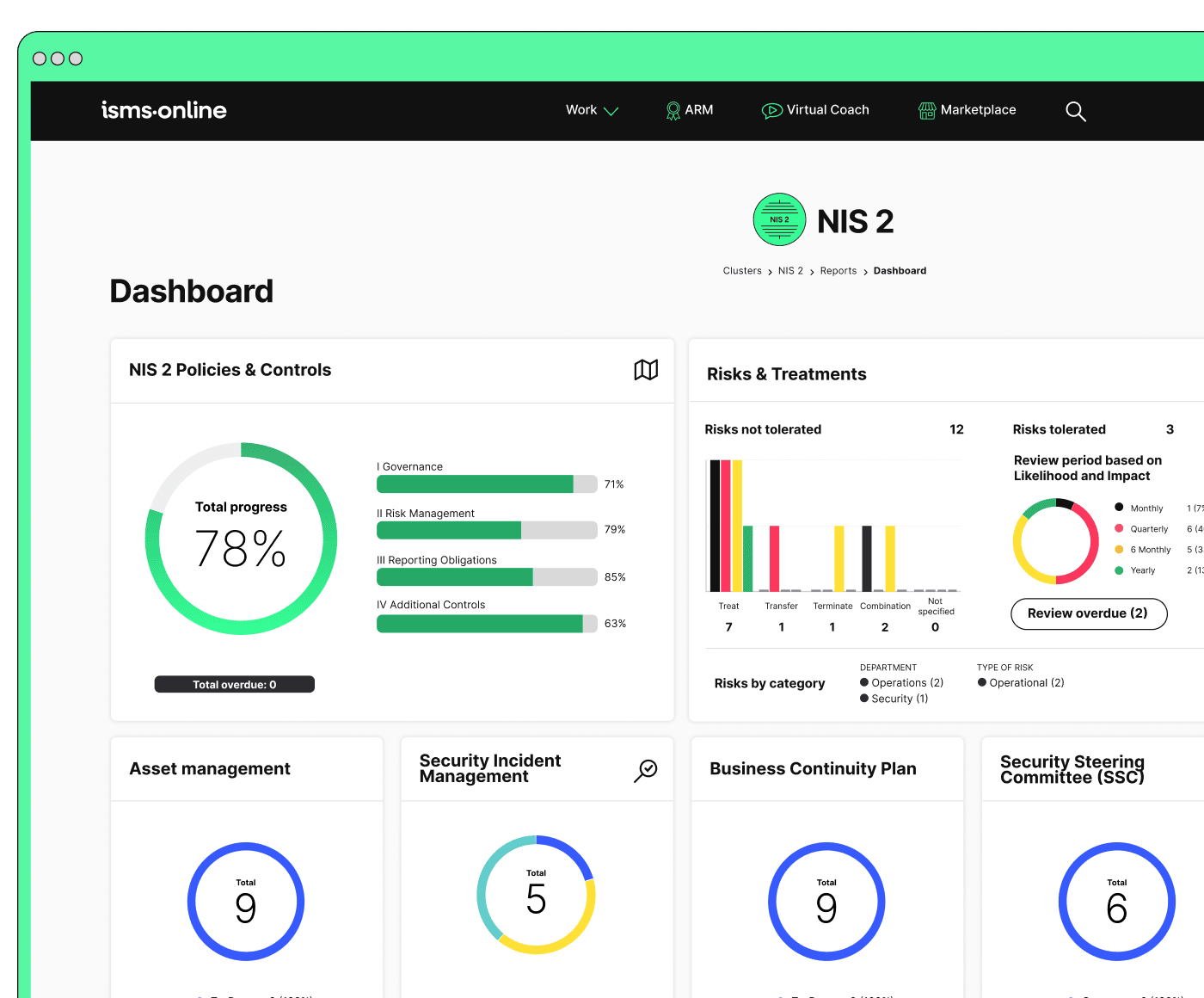
Be NIS 2-ready from day one
Launch with a proven workspace and templates – just tailor, assign, and go.
What Counts as Real Evidence in the Eyes of Auditors, Boards, and Buyers?
Proof is no longer future-oriented (“We will train staff”); it’s now past- and present-tense (“Here is who was trained, when, and by whom”). Best-in-class teams can show a role-linked, versioned, and centralised record at a moment’s notice.
A spreadsheet is not a system of record. Digital trails and approvals are the new compliance currency.
Hallmarks of Audit-Readiness
1. Role-Stamped Version Control:
Show every change, approval, and incident with “who, when, why.” No more nameless updates.
2. All Evidence by Control:
Evidence must tie directly to the NIS 2 article or ISO 27001 clause it supports-no “catch-all” folders.
3. Live Process Walkthroughs:
Audit packs (portfolio exports) should show the thread from incident response, through review, to board sign-off-in hours, not days.
4. Dashboard Monitoring:
Real-time overviews mean you defend to buyers and boards with facts: open actions, overdue reviews, incident status, board sign-offs, and more-all in one place.
| Dashboard Section | Typical Metrics | Audit/Biz Value |
|---|---|---|
| Evidence Completeness | % current by control | Fastest audit proof, lowest risk |
| Board Approvals | # minutes, decisions, sign-offs | Board trust and clear ownership |
| Supplier Risk Status | Traffic-light per supplier | Supply chain resilience, RFP wins |
| Incident Management Logs | # closed, open, overdue, role | Board confidence, rapid response |
Privacy Officer Case
Privacy teams moving from spreadsheets to ISMS.online raised audit completion (72% → 98%) and cut SAR response time (18 → 5 days)-while enabling the board to trace evidence on demand.
Auditors and buyers now expect living records, not best intentions. The right evidence, role-stamped and dashboarded, is now non-negotiable.
Can Your Board Prove Remediation and Lessons-Not Just Policy?
The real sign of maturity under NIS 2 is a loop: issues are found, actions are owned and closed, and the board is accountable for lessons, not just rubber-stamping. Past failings drive today’s improvements-and only systems that log this are truly audit-ready.
Boards gain trust by logging actions, improvement, and learning-before regulators or customers force change.
Board Ownership in the Modern Audit
1. Regular and Event-Based Audit Loops:
Hold management reviews at steady intervals-and after incidents, not just annually. Essential entities should prepare for external, not just internal, audits.
2. Action Ownership Assigned and Tracked:
Each audit gap requires a named, accountable owner, tracked from assignment to closure, with logs accessible to the board and regulators.
3. Board Review with Data, Not Slides:
Dashboards must show questions, actions, and overdue items at a glance-no hiding slow remediation.
4. Lessons to Policy Loop:
Audit failures or incidents generate tracked policy updates, training programmes, or review cycles-each with audit evidence.
5. Regulator-Ready Audit Packs:
On request, present a pack: evidence, timelines, action logs, and approvals visible in one click.
A board that logs, owns, and closes learning cycles is your compliance engine-and the difference between surviving and failing the next audit.
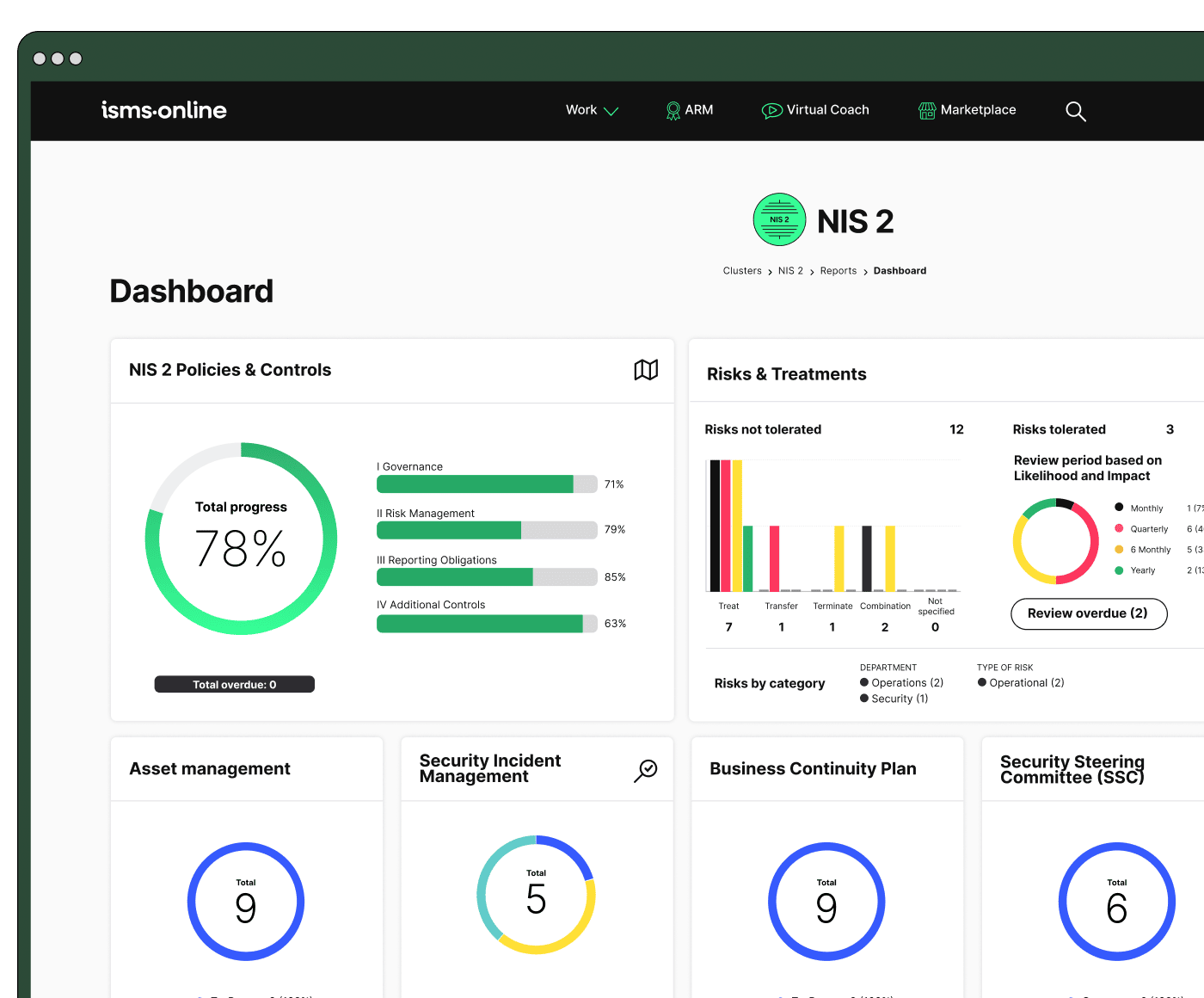
All your NIS 2, all in one place
From Articles 20–23 to audit plans – run and prove compliance, end-to-end.
Is Real Compliance Achievable at Scale-Or Is Automation the Only Way?
Manually tracking evidence, gaps, supplier risk, and board reviews in fragmented tools is not sustainable for any entity in scope. Unified, automated platforms turn what was once a web of admin into a live compliance system.
Manual busywork is now the biggest risk-unified, automated compliance is the only way to scale NIS 2.
Unlocking Compliance with ISMS.online
1. Unified Platform Management:
Risk, supplier, asset, training, and policy management all operate from one control centre-eliminating duplicate effort.
2. Built-In Workflow Reminders:
Auto-generated reminders prompt owners to review, sign off, audit, or escalate issues as needed.
3. Instant Audit Readiness:
Board- and audit-facing dashboards show who has done what, where controls sit, and where actions are overdue-no last-minute logging.
4. Multi-Framework Mapping:
One control can be mapped to ISO 27001, NIS 2, SOC 2, and privacy standards-delivering unified control over evidence, regardless of framework.
5. Automated Supply Chain Insights:
Supplier due diligence, risk scoring, and alerts are triggered and tracked by the platform at every critical juncture.
NIS 2 compliance at scale is not an admin problem-it is a systems challenge, solved by automation and integration.
Make Compliance Your Differentiator, Not Just a Deadline
Time is running out for wishful thinking and ad hoc processes. The NIS 2 deadline is a reset-a chance to put your house in order and make resilience, trust, and audit-readiness central to your business advantage. From gap to improvement, your board, your auditors, and your buyers want to see proof-not promises.
The only gaps you can afford are the ones you find and fix-before a regulator or customer does.
Here’s how to unlock advantage-starting now:
- Request a readiness walkthrough: -Our ISMS.online platform shows your current strengths and gaps, and projects your audit readiness against market leaders.
- Automate your compliance loop: -Assign responsible owners, map evidence, streamline supplier checks, and be ready for buyer or regulator requests every day-not just during audits.
- Move from “compliant” to “compelling”: -Dashboard-driven readiness is now a sales and negotiation strength; procurement wins, board trust, and smoother audits are the result.
Now is the moment to transform compliance from a looming problem into a strategic win. ISMS.online is your partner for this journey to resilience, assurance, and growth.
Frequently Asked Questions
Who actually needs to comply with NIS 2-and what are the real consequences if you get your status wrong?
Any organisation-large, medium, or nimble-that operates in or supplies to “essential” or “important” sectors under NIS 2 is now in the compliance firing line. This web covers far more than classic critical infrastructure: digital infrastructure, SaaS, managed service providers, health, transport, finance, utilities, and their suppliers (even non-EU, if serving EU customers) are caught. If your firm has over 50 staff or €10 million turnover, you’re likely swept in, but sector overlays and national laws mean even micro-entities get captured via contract flow-downs. The ramifications aren’t just regulatory fines. Board members face personal liability; losing a deal or renewal due to failed due diligence is now routine. From late 2024, procurement teams and customers won’t wait for formal enforcement-lack of live digital evidence is enough for instant exclusion. Non-compliance means being locked out of contracts, forced off supply chains, facing public sanction or regulatory action, and even seeing executive names in regulatory reports.
Silent audits happen before a formal one-if your compliance trail isn’t ready, business dries up long before a fine lands.
Applicability Decision Path Visual:
- Locate your sector (essential, important, SaaS/digital, B2B).
- Check staff/turnover vs NIS 2 and national overlays.
- Trace contract flows-are you (or your client) supplying any covered sector?
- Outcome: If ‘yes’ anywhere, you must provide digital, up-to-date compliance evidence on demand-or risk exclusion.
How do leading teams identify true NIS 2 gaps versus the illusion of checklist coverage?
Top organisations treat NIS 2 gap analysis as a living, always-on feedback loop. Gone is the era of spreadsheet tickboxes and annual reviews. Instead, leaders actively map every control and policy against the exact NIS 2 Articles that apply-especially Article 21 (risk controls), Article 23 (incident response and evidence), Article 35 (living compliance proof). ENISA’s sector overlays clarify specifics-pharma, digital, financial-but local regulators may add extra nuances. True gap analysis tracks not just “what’s missing” but who owns fixes, what remediation is scheduled, and the trail of evidence per gap. If your board hasn’t reviewed the action plan, or if live dashboards don’t show real control status, expect red flags in both audits and buyer questionnaires. Auditors now probe for time-linked logs and “closed loop” fixes, not existence of a policy. Procurement officers echo the same: action, ownership, and proof of closure are non-negotiable.
Modern audits focus on who fixed what, when, and with what proof-not just that a policy ‘exists’ on paper.
Gap Ownership Matrix
| Control | Owner | Remediation Date | Status | Linked Evidence |
|---|---|---|---|---|
| Risk Management | J. Smith | 30/09/2024 | Amber | Risk register, policy update |
| Incident Drills | A. Patel | Monthly | Green | Drill log, SoA excerpt |
| Supplier Reviews | L. Evans | Biannually | Red | Due diligence, onboarding |
What counts as “digital proof” of NIS 2 compliance for auditors, procurement, and partners?
Digital compliance isn’t a policy folder or pile of PDFs. The standard now demands evidence that is time-stamped, version-controlled, mapped to the right Articles/controls, and instantly exportable. You’ll need:
- A signed and logged trail for every policy edit, approval, and review, with names and dates.
- Ongoing risk registers showing live status, updated per change, mapped to NIS 2 / ISO 27001.
- Documented incident and drill logs within the 24/72 hour window, including practise runs and post-mortems.
- Supplier onboarding and contract records showing cyber diligence; every update mapped to a trigger (e.g. new vendor, regulation).
- Minutes from board/management reviews with active oversight logged.
- Evidence of policy engagement: staff training records, logs of acknowledgements, dashboard summaries.
- System exports that show risk→policy→action→closure with a clear audit trail for each event.
Scattered files on F: drives or static compliance spreadsheets are no longer valid. Auditors and buyers want a live dashboard and instant digital export-anything else fails scrutiny.
You pass a NIS 2 audit (and win deals) by linking every risk, control, and response log to an owner and event, with timelines and sign-off, all in one place.
Audit-Ready Evidence Table
| Evidence Type | NIS 2 / ISO Ref | Proves |
|---|---|---|
| Board Minutes | Art. 20 / ISO 5.3 | Oversight & accountability |
| Risk Register | Art. 21 / ISO Cl. 6 | Dynamic risk management |
| Policy Logs | ISO A.5.2 / 5.9 | Real-time review & approval |
| Incident Logs | Art. 23 / 5.24, 5.26 | Timely, tested response |
| Supplier Audits | Art. 21 / 5.19–5.22 | Supply chain cyber management |
How do you make incident, risk, and supplier controls operate as a continuous system-not just an audit-time rush?
Compliance has shifted from year-end “paper chases” to continuous, evidence-based operation. The real test is how your controls perform day to day:
- Quarterly incident response drills, each with named leads, logs, and lessons learned-not just policy presence.
- Risk registers updated for every new service, major system, or supplier change-linked to evidence and review dates.
- Supplier reviews and contracts with onboarded cyber clauses, due diligence at sign-on and offboarding, with all actions time-stamped and tracked.
- Dashboards flag any overdue action or broken control, with management notified and sign-off mandatory.
- Every exception or missed deadline triggers an auditable event, followed through to fix with clear evidence and accountability.
Failing now isn’t about one missing document-it’s about missing an activity log or not closing the loop after a failure. Modern compliance is measured by activity, audit trail, and escalation proof.
Resilient compliance is tested outside the audit, not at it: connected logs, closed loops, and visible action keep you safe year-round.
Operations Traceability Table
| Trigger Event | Update Required | Evidence Logged |
|---|---|---|
| New supplier added | Due diligence & contract | Onboarding record, signed doc |
| Incident or test | Policy & risk update | Drill log, risk/action item |
| Regulatory change | Board review & update | Meeting minutes, audit pack |
How do lean or multi-standard teams keep NIS 2 and ISO compliance live-without burning out?
Trying to juggle NIS 2, ISO 27001, GDPR, and more with spreadsheets and siloed templates is no longer viable. Modern teams equip themselves with centralised, workflow-driven compliance platforms that:
- Centralise evidence, approvals, supply chain vetting, policy updates, and incident logs-mapped to all frameworks in real time.
- Automate reminders for reviews, supplier checks, incident drills, and training, ensuring nothing is missed during turnover or team change.
- Map a single update or event across all frameworks (NIS 2, ISO 27001/27701, SOC 2, DORA), ending duplication and piecemeal admin.
- Allow instant digital export for buyer, auditor, or board review-proving your “audit ready health” before the request.
- Absorb changes in team, regulation, or structure without breaking the chain-ensuring evidence and ownership persist.
Teams that automate and unify compliance don’t just save admin time-they manage risk proactively and free up capacity for genuine security work. Burnout is optional; reliability is engineered.
Unified compliance platforms turn audit prep from burnout sprint to measured process-auditors, buyers, and boards can verify your health on demand.
Dashboard Visual:
A real-time dashboard displaying “evidence health” colour-coded for overdue, in-progress, and complete actions, each mapped to an owner and timestamp, spanning both NIS 2 and ISO 27001 requirements.
What can boards and management do right now to turn NIS 2 from a cost into a competitive edge?
Smart boards require signed management reviews (“who, what, when, closed”), oversee every audit gap or incident with traceable accountability, and expect quarterly dashboards covering evidence, supply chain risk, and control status. They integrate regular “lessons learned” from incidents and audits into ongoing training and policy updates. Quarterly audit packs-with timestamped exports, roles, and actions-become discussion tools with buyers, regulators, and investors. By embedding compliance into the central workflow, boards not only meet 2025 NIS 2 expectations but prove diligence, drive procurement wins, and increase trust with customers and insurers. Every management or board review becomes a catalyst for improvement and market advantage.
Compliance leadership is brand value and deal currency-the better your oversight log and digital trail, the higher your leverage with buyers and regulators.
Board Compliance Levers Table
| Board Lever | Output | Impact |
|---|---|---|
| Mgmt Review | Signed dashboard/minutes | Auditor, buyer, investor trust |
| Remediation Log | Role, timestamp, closure evidence | Accountability and closure |
| Audit Trail Export | Digital pack, role-based | Instant, audit/board ready delivery |
How should you start-concretely-to accelerate NIS 2 readiness and resilience before contracts and audits tighten?
- Book a readiness walkthrough on ISMS.online (or equivalent) to surface every in-scope asset, control, and audit/evidence gap mapped to NIS 2 and ISO 27001.
- Assign real owners, automate evidence capture, and deploy mapped templates/workflows to address supply chain and contract vulnerabilities-fast-tracking gap closure.
- Generate audit packs routinely, simulating buyer, auditor, or regulator scrutiny, and resolve flagged issues before they become audit findings.
- Treat evidence and dashboards as daily performance assets, not just annual checklists: automate versioning, ensure incident/policy changes update the audit trail instantly.
- Move now: close gaps, document every action, benchmark readiness against leading teams-and make compliance a durable, differentiating force when buyers, boards, and auditors come calling.
The NIS 2 race isn’t about ticking the box-it’s about sustaining trust, proving resilience, and securing your market position ahead of audits or renewal deadlines.






