





































Is NIS 2 Changing Everything-or Is It More of the Same Bureaucracy?
You’re facing a hard truth: NIS 2 is not just a new set of checkboxes for compliance managers-it’s the emergence of a new trust currency in the supply chain. Whether you’re a compliance Kickstarter fighting for your first ISO 27001 badge, a CISO bracing for board scrutiny, a privacy officer on the hook for GDPR, or the IT practitioner keeping the wheels turning, NIS 2 is here to stay and it bites deeper than traditional regulations.
Only last year, compliance felt like a game of catch-up-so long as you had a passable audit trail, you could bluff your way through. Now, NIS 2 is redefining the rules, with digital evidence, real-time traceability, live approval logs, and supply chain linkages suddenly non-negotiable (ΣA; gtlaw.com; ΣG, enisa.europa.eu). Utilities? Check. Tech suppliers? Check. SaaS or healthcare or logistics? You’re covered too. Procurement no longer trusts cold comfort in PDFs or static spreadsheets; they expect versioning, signatures, and API calls (“live” evidence) at the click of a mouse (ΣR; cyberark.com; ΣO; ec.europa.eu).
When evidence is hidden in silos, even the most diligent teams find themselves firefighting with empty buckets.
So what’s the new expectation? “Checklist compliance” is dead. You need digital, connected, instantly provable trails that span management reviews, supply chain attestations, and every critical event. Today, evidence must be living-not just stored.
| **Expectation** | **Operationalisation** | **ISO/Annex A Reference** |
|---|---|---|
| Checklist evidence is enough | Versioned digital records + approvals | ISO 27001:2022 Cls 7.5, 9.3 |
| Supplier logs kept by the vendor | End-to-end, supply-chain evidence tied to ISMS | NIS 2 Art 21(2)(d), A.5.21 |
| Printable audit trail acceptable | Real-time/API-accessible audit logs + SoA history | ISO 27001:2022 Cls 8.15/8.16 |
The ground has shifted. Platforms, not piecemeal toolkits, are being chosen because they turn evidence into enterprise currency-durable, mapped, and actionable at a moment’s notice. If you view NIS 2 as “just more red tape,” your next audit might not end with a badge, but with a gap you can’t explain. The next section won’t just warn you about these gaps-it will show you who now shares the burden, and what it takes to plug the weakest link.
Who Shares Accountability Under NIS 2-And How Do You Avoid Being Blindsided by Your Partners?
If you believe your vendors can shoulder the blame for compliance lapses, NIS 2 wants a word. Under the new regime, you bear the risk-directly and tangibly-for any disruption, evidence gap, or incident in your supply chain (ΣA; cincodias.elpais.com). One supplier’s incident becomes your board’s and regulator’s problem, not theirs alone.
Your evidence is only as strong as the weakest link-every break comes back up the chain to your boardroom.
National authorities and auditors in 2025 won’t just ask for your documents. They’ll demand digitally linked supply-chain logs, board approvals, and direct audit trails-no matter how long or complicated the path (ΣG; thirdwaveidentity.com). And with transpositions (e.g. Greece, Spain) layering extra requirements, the baseline keeps moving. If your vendor upgrades systems mid-certification or loses access, you must still prove an unbroken chain-of-custody and continuous mapping of every compliance move.
| **Trigger** | **Risk Update** | **Control / SoA link** | **Evidence logged** |
|---|---|---|---|
| Supplier breach | Revise risk register; notify | ISO 27001: A.5.21 | Supplier log, board note |
| Law change | Update policy, flag for review | ISO 27001: Cls 6.1, 7.5 | Versioned doc, update history |
| GDPR processor audit | Reconfirm evidence & map gaps | ISO 27001: A.5.20/NIS 2 | Vendor attest, comms record |
The result? Toolkits and point solutions break; platforms that build digital-first, unified evidence chains win. Audit failures mostly arise not from bad intentions, but from lost links and ownership misalignment. In the next section, you’ll see how fragmentation drives audit fatigue and repeat failures-and what measures break that cycle.

Master NIS 2 without spreadsheet chaos
Centralise risk, incidents, suppliers, and evidence in one clean platform.
Why Fragmented Toolkits Cause Audit Burnout-And Why Patching Just Makes It Worse
Audit dread isn’t laziness-it’s learned helplessness from years of fighting the same broken processes. Scattered spreadsheets, legacy apps, cloud shares, PDF contracts, and orphaned incident emails add up to a compliance maze. Most teams already know where the pain is, but lack one view and one process. ENISA and industry studies confirm up to three times more hours are spent producing evidence when teams operate in “silo mode” (ΣO; enisa.europa.eu; ΣG; gartner.com).
Every time you pause work to hunt for an approval or contract, your odds of passing the audit shrink.
Let’s decompose a typical evidence chase under a fragmented toolkit:
- ISMS and Risk Register: Stuck in Excel; changes tracked… maybe.
- Policies & Change Logs: Spread across PDFs, Google Drive, and email.
- Approvals: Who signed off? Lost in a chain or never happened.
- Supplier Documents: In someone’s inbox, attached to a renewal.
- Incident Response: Separate “risk” app, zero board trace.
Instead of a narrative, you present a montage of disconnected files. The board and auditors see the gaps, and even if you scrape a pass, every missed tie creates a risk and another round of questions. Over 66% of remediation time post-audit stems from these evidence fractures (ΣO; enisa.europa.eu).
One overlooked control, missing supplier contract, or staff handover is all it takes for a functioning process to devolve into panic and rework. That’s why migration is a strategic reset-not a tactical fix. Next up: the 5-step playbook, tested in the field by both first-timers and seasoned CISOs, that keeps every proof in your hand.
The 5-Step Migration Playbook: How to Move from Toolkits to a Platform Without Losing Evidence
A successful migration isn’t a tech project-it’s an accountability process meant to make compliance outcomes unbreakable. Teams that skip steps, underestimate catalogue work, or chase “big bang” moves almost always lose artefacts and create future audit landmines.
Here’s the hard-won, field-proven process used by compliance-led organisations across the EU:
1. Catalogue Everything Upfront
Pull every approval, log, incident, contract, SoA, risk, and evidence artefact into a single list-even “legacy” and duplicates. Missing a control costs infinitely more than over-cataloguing. This isn’t overkill-it’s insurance (ΣO; enisa.europa.eu).
2. Assign New Digital Owners
Every artefact, from an approval to a supplier certificate, must become digitally owned-by a coordinator, role, or team. Vague or shared ownership always risks audit failure when time is tight (ΣG; isaca.org).
3. Import with Platform-Validated Controls
Platforms with secure import, hash logs, and built-in validation let you not just move, but test every artefact’s accuracy and chain. Use signed receipts, time-stamped logs, and run a contained test-audit before going live (ΣA; kpmg.us).
4. Map Old to New: Evidence Linkage
Keep a mapping file. Every imported control, policy, or record must be linked to its historical context-forming a continuous chain of audit custody (ΣR; isms.online).
5. Decommission Legacy Only After Validation
Do not shut down your legacy toolkit or remove access until your new platform produces an end-to-end, audit-ready trail for every artefact. Validate, get sign-off, then and only then disconnect (ΣX; enisa.europa.eu/decommissioning).
| **Step** | **Action** | **ISO 27001 Ref.** | **Evidence Example** |
|---|---|---|---|
| Catalogue | Export all artefacts | Cls 7.5, 8.15 | Logs, cross-check exports |
| Owner Map | Assign digital responsibility | Cls 5.3, 8.1 | Record of new assignments |
| Import & Test | Hash-verified migration | Cls 8.16 | Signed logs, test-audit |
| Map Old/New | Maintain historical mapping | Cls 7.5, 9.3 | Mapping file, platform logs |
| Decommission | Only after validation | A.5.36, 8.34 | Sign-off records, audit trail |
True migration is proven-not assumed-by the integrity and visibility of every last artefact.
Done right, this playbook eliminates years of hidden weaknesses. But what does this look like when technology goes from passive to proactive? The next section reveals how platforms plug audit gaps by design.
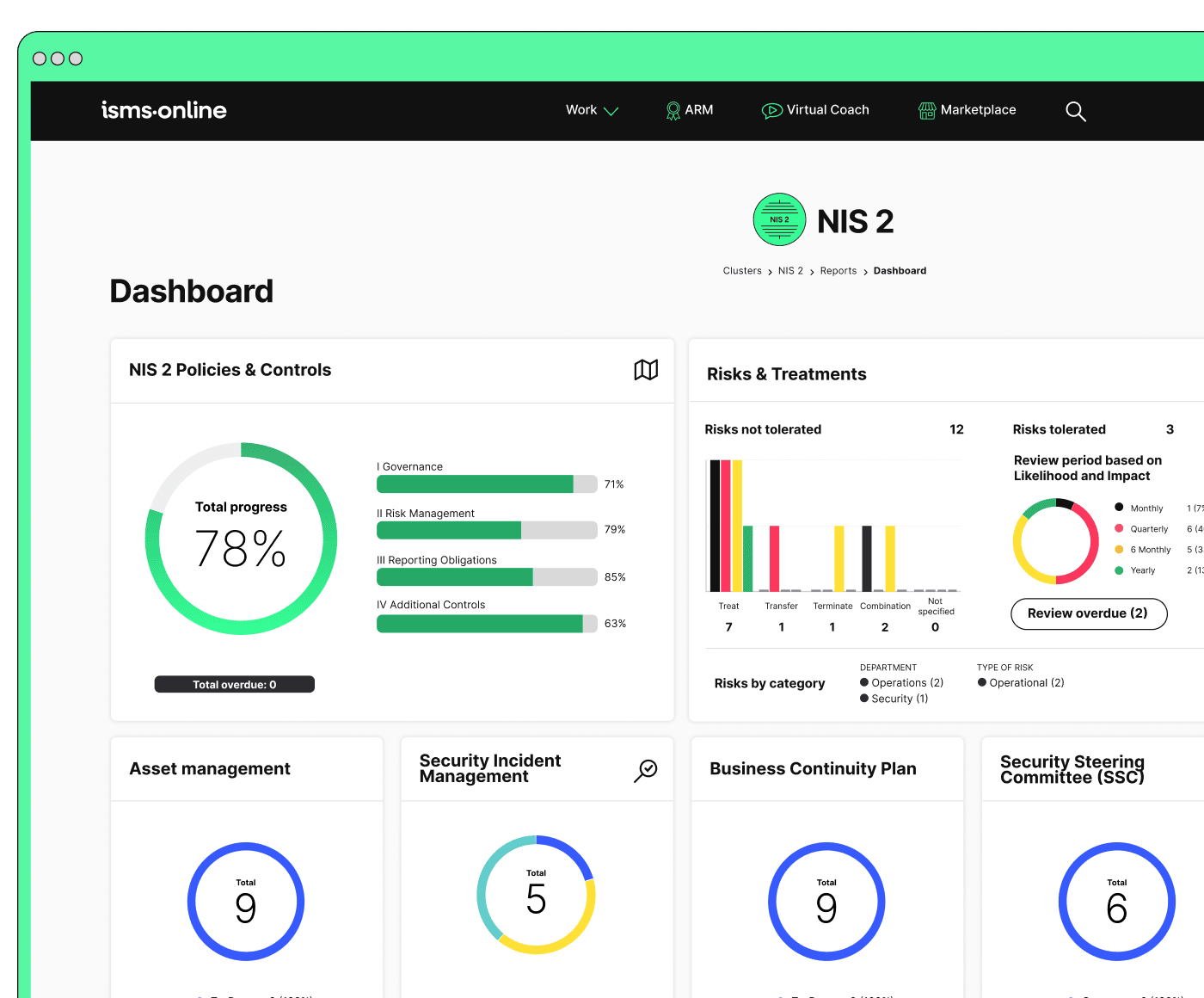
Be NIS 2-ready from day one
Launch with a proven workspace and templates – just tailor, assign, and go.
How Modern Platforms Plug Audit Gaps and Make Evidence Tamper-Proof
Live compliance is not just an aspiration: it is now an operational requirement for NIS 2 and ISO 27001. Digital platforms replace scattered, brittle evidence with tamper-evident logs, role-based sign-offs, and API-ready records. Every time a contract, risk, or approval is updated, the change is logged, versioned, and mapped to the right control-no more teammates hoping busy folders are “good enough.” When ownership changes or staff leave, the platform continues to maintain a clear chain, alerting you to any orphan artefacts (ΣA; forbes.com).
Evidence doesn’t stay lost-gaps are flagged and fixed before audits, not during crisis mode.
Live Compliance Dashboards deliver:
- At-a-glance evidence status (green = complete, orange/red = gap).
- Full traceability of versions, sign-offs, and workflows.
- Click-through to control mappings at the clause and SoA level.
- Alerts for stale, missing, or unmapped records.
- Unbroken links across all compliance events and actions in the platform.
Regulatory guidance increasingly requires this level of control-platforms that automate and visualise it set a new baseline for supply chain resilience (ΣO; enisa.europa.eu/nis2-self-assessment).
In a platform, compliance action is real-time-your map to every control is as current as your last task, not your last annual review.
Next, you’ll see what that means for ISO 27001 and NIS 2 Statement of Applicability (SoA): in a live environment, updating a policy or onboarding a supplier means control ownership and evidence chain update is instant and continuous.
Live ISO 27001 & NIS 2 Control Mapping-Not Just Checklists, But Living SoAs
For the first time, forward-looking platforms turn SoAs from annual admin pain into live, navigable cockpit views. Rather than compiling at audit time, every event-policy change, incident, or supplier update-dynamically updates the relevant control, clause, and SoA mapping (ΣG; iso.org).
The live SoA is where compliance stops being tickbox and starts being proactive resilience.
Practical Mini-Case:
A health tech firm migrates to ISMS.online for both ISO 27001 and NIS 2. Risk logs, board sign-offs, supply chain attestations, and staff training records are auto-mapped to controls A.5.20 (supplier), A.8.15 (logging), and A.5.34 (PII and privacy). When a new vendor is onboarded, A.5.21 is updated in minutes, with the SoA “live” reflecting status. Auditors can drill in by clause, role, and evidence-no more two-week data scramble.
| **NIS 2 Article** | **ISO 27001:2022 Control(s)** | **Operational Touchpoint** |
|---|---|---|
| Art. 21(2)(d) – Supply | A.5.20, A.5.21, A.5.19 | Supplier audits, risk, SoA |
| Art. 23 – Incidents | A.5.24, A.5.25, A.5.26 | Event logs, dashboards |
| Art. 20 – Board Overs. | Cls 5.3, A.5.4, 9.3 | Mgmt review, sign-off trails |
Compliance is now continuous: every event, control, and record updated as you work, not as you dread audit.
Ready for the final barrier? Ensuring your traceability never breaks-no matter what changes in staff, law, or system-means every proof, from day one to today, is just a click away.
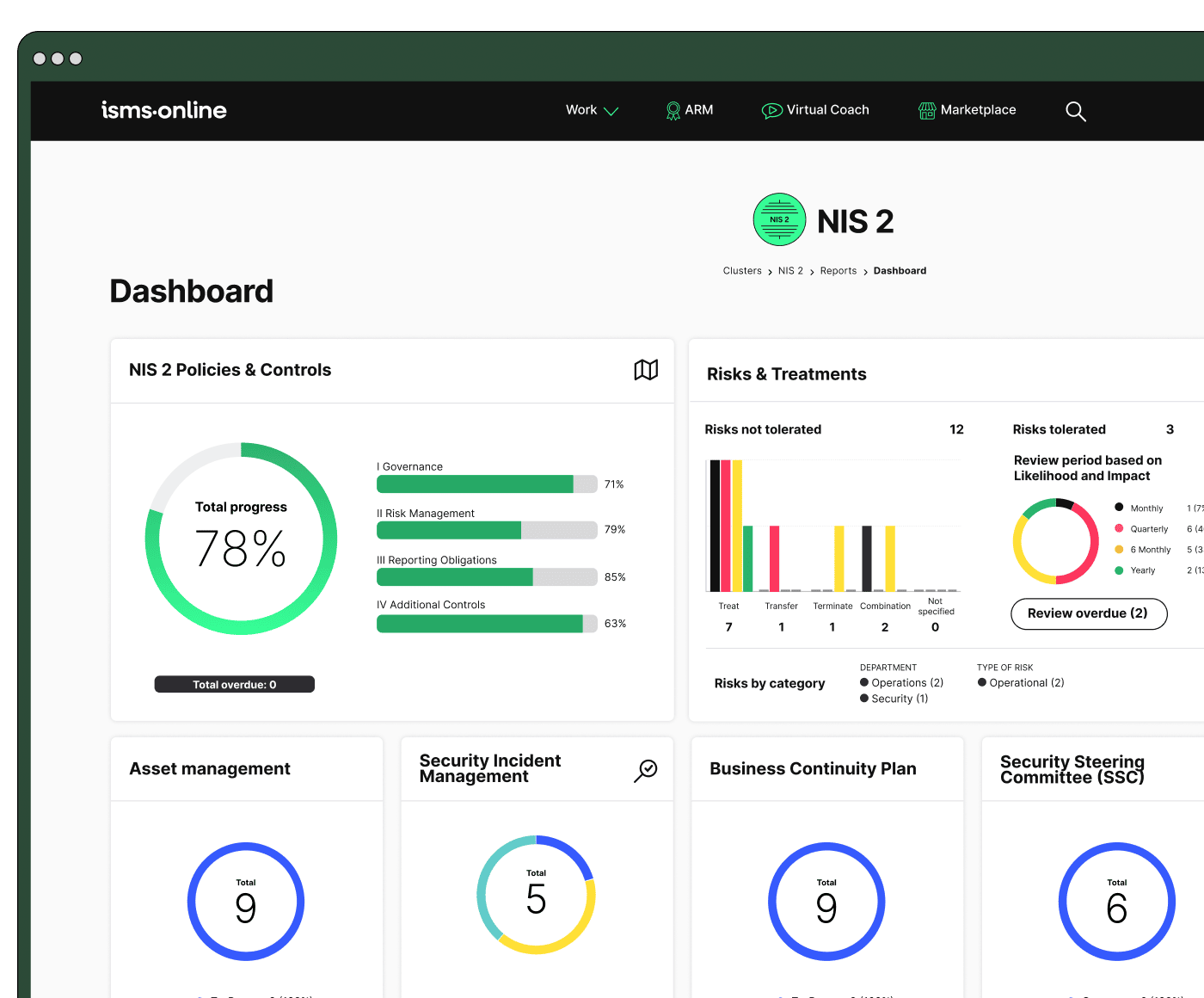
All your NIS 2, all in one place
From Articles 20–23 to audit plans – run and prove compliance, end-to-end.
Never Lose Traceability Again: End-to-End Evidence, From Onboarding to Audit
The nightmare scenario for any compliance lead: asked by an auditor, “Can you show me every approval, every handover, every export for the last three years?”-and discovering hard breaks in the evidence chain. Perpetual traceability means every action, owner, and artefact remains anchored indefinitely, with parent-child links, time-stamped logs, and airtight sign-offs at every step (ΣR; thirdwaveidentity.com).
The true test of compliance: recreating your whole story, instantly, long after roles or tech stack have changed.
Best-in-class ISMS platforms run perpetual checkpoints-a vendor risk update triggers risk mapping, a management review triggers version checks, a terminated user prompts for access removal and evidencing, all tracked and handed off with complete logs.
| **Trigger** | **Risk update** | **Control / SoA link** | **Evidence logged** |
|---|---|---|---|
| Supplier update | Risk register updated | A.5.20, A.5.21 | Supplier goods, risk log |
| Staff left | Access review forced | A.8.1, A.8.5 | Access log, revocation |
| Law changed | Policy review prompt | Cls 6.1, A.5.36 | Policy update, SoA entry |
Even if your organisation doubles in size, pivots to new verticals, or undergoes a merger, you remain audit-ready, every day, every change-no more “audit panic.” Now, let’s see how all this translates to surviving regulators, boards, sales cycles and future frameworks.
Audit Survival & Futureproofing: Proof, Speed, and Operational Outcomes
Compliance doesn’t mean compliance anymore unless you can prove it-to customers, boards, and regulators-fast. The winners are those who treat every logged action, every chain, every crosswalk as “proof capital,” ready on demand.
Platforms (like ISMS.online) push your programme forward, not just against NIS 2 but every new regulation (DORA, AI Act, US supply chain regs). You survive audits, unlock deals, and sleep easier, because:
- Audit readiness is continuous: (health checks, reminders, dashboards)
- Legal updates map instantly: (policy links, SoA, evidence chains)
- 1-click audit packs: (auto-generation of reports and SoA)
- Transparency breeds trust: -internally and externally
| **Trigger** | **Outcome** | **Board/Regulator Proof** |
|---|---|---|
| Overdue action | Automated reminders | Dashboard, SoA, evidence |
| Legal update | Policy changed, control mapped | SoA, policy, audit log |
| New audit | Instant reports, live status | Audit pack export |
If you want to sleep before audits, treat your compliance evidence as your primary business currency.
Make Every Evidence Chain Visible: Why ISMS.online Delivers Audit Confidence
The final move? Test-drive a platform like ISMS.online, where stepwise migration, onboarding accelerators, sector frameworks, and at-a-glance dashboards are standard-not upcharges. You don’t just “store” evidence-you connect every artefact, version, approval, risk, and control, with ongoing versioning and traceability. Every role-Kickstarter, CISO, privacy lead, practitioner-gets what they need, with Board, regulator, and auditor confidence as built-in outcomes.
Don’t let a lost log or missed approval undo a year’s progress. Compliance is your chance to prove trust and value, not just pass an external check. The companies that embed proof at every step see faster sales, easier audits, calmer boards, and a team that finally feels free from audit dread.
In a platform world, compliance is cheered, not feared-ready to prove, improve, and adapt for every demand.
Ready to move forward, on your terms? Get your ISMS.online migration map-and finally leave compliance chaos in the past.
Frequently Asked Questions
Who leads a NIS 2 migration and how do teams maintain evidence continuity?
A successful NIS 2 migration is always a cross-functional, multi-owner endeavour-but it revolves around a clearly appointed Programme or Compliance Owner. This individual, often reporting to the board or executive leadership, translates audit and regulatory mandates into a coordinated project plan and orchestrates subject-matter leads in Security/IT, Internal Audit, Legal, Privacy, HR, and Supply Chain. Security/IT acts as custodian for technical evidence, logs, and digital integrity checks; Risk and Audit bridge record traceability; Legal and Privacy ensure national overlays and jurisdictional requirements are recognised; HR and Supplier Management supply training and third-party artefacts.
Continuous evidence control is possible only when every artefact’s mapping, import, validation, and review is assigned and tracked-with actions and approvals all logged in platforms like ISMS.online. This system manages role-based permissions, approval flows, and a living audit trail so evidence remains regulator-ready, never siloed or at risk of orphaning.
True NIS 2 evidence continuity only emerges when every business domain shares ownership-compliance is a team sport, not a solo sprint.
What are the five operational steps to migrate NIS 2 compliance without risking evidence gaps?
Migrating NIS 2 compliance is less about “moving files” and more about redesigning living evidence for defensibility. The safest and most regulator-aligned approach unfolds through five sequenced controls:
1. Inventory and Assign Ownership
Catalogue every artefact-legacy policies, contracts, risk logs, audit trails, incidents-across all relevant business units and systems. Assign a named owner for each, clarifying future responsibility.
2. Schema Map and Role Matrix
Reconcile fields and metadata with your target platform’s schema (e.g., ISMS.online), ensuring every artefact is mapped to proper access, retention, and approval structures.
3. Perform Secure, Auditable Imports
Execute migration with validated imports, digital fingerprinting (hash, signature), and detailed audit logs. Always begin with pilot batches and verify before bulk upload.
4. Reconcile and Annotate Legacy References
Preserve links to legacy IDs, source systems, approval chains, and change histories. Attach recon notes for each migration, enabling clean “before and after” audit tracebacks.
5. Validate, Approve, and Only Then Decommission
Run a dry-run internal audit, confirm all artefacts are present and linked, flag missing records, and require sign-off from internal/external audit. Only then decommission legacy systems to avoid evidence loss.
Migration flow visual:
Inventory & Owners → Schema Map → Secure Import → Reconciliation → Audit Signoff & Decommission
Every transition acts as a control point; skipping any phase creates traceability risk-especially under NIS 2’s regulator gaze.
How do platforms like ISMS.online validate, collect, and safeguard NIS 2 compliance evidence post-migration?
Modern ISMS platforms enforce three layers of evidence integrity and audit-readiness:
1. Digital Validation & Immutable Audit Trails
Each artefact is hash-validated at import, digitally signed, and time-stamped. All user actions-edits, approvals, comments-are compiled in a tamper-evident audit history, creating an indelible chain.
2. Structured and Automated Evidence Capture
API, integration, and workflow automation ensure evidence (incidents, HR logs, board minutes) flow in context from source systems-never “floating” outside oversight. Manual entries require contextual metadata, signoff, and record of who did what.
3. Role-Segregated Retention and Export Controls
Access policies align to business/legal need-to-know. Retention adheres to ISO 27001 Clauses 8.15/8.16 and NIS 2-specific rules for jurisdictional privacy or data residency. Evidence is exportable by legal entity, country, or business unit, supporting audits at any layer.
Without digital validation, automated collection, and structured preservation, compliance platforms invite orphaned evidence and failed audits.
Which KPIs prove your NIS 2 migration and compliance are audit-ready in daily operations?
Audit readiness is a rolling, measurable standard-not a one-off claim. The most evidence-driven organisations track:
- Evidence Coverage Ratio: Proportion of required artefacts identified, assigned, and validated post-migration (target: 100%).
- Orphaned Artefact Count: Records with missing owners, sources, or approvals (should be zero).
- Audit Export Completeness: Percentage of successful audit exports yielding full, mapped evidence packs for every domain.
- Gap Resolution Metric: Mean time to resolve flagged evidence gaps or mapping errors.
- Policy Review Cadence: Speed and frequency of policy refresh and re-approval cycles.
- Incident Response Compliance: % of notifiable incidents logged within 24/72-hour NIS 2 deadlines.
- Traceability Error Rate: Instances where the audit trail is broken or mapping fails.
- User Adoption Rate: Workflow compliance among all contributors-high rates indicate a living evidence culture, not “compliance theatre.”
Best-practise dashboards surface these signals to compliance leads, risk committees, and auditors-earning trust and supporting real-time operational improvement.
How do platforms ensure national overlay, supply chain, and multi-entity complexity under NIS 2 are covered?
A migration fails if it ignores the layered, pan-European demands of NIS 2:
- National/Sectoral Overlay Mapping: Artefacts can be dual-tagged to both EU directive and local transposition (e.g., German BSI, French LPM), ensuring compliance with ALL applicable frameworks.
- Supply Chain Inclusion: Supplier artefacts-contracts, certifications, incident logs-enter the same approval/review flow, with versioning and direct mapping to incident and risk records. This closes the infamous “third-party” evidence holes.
- Entity and Group Segmentation: Records, signoffs, and audits are filterable by entity, site, or territory, ensuring group-wide or subsidiary-specific compliance-critical for cross-border or M&A-heavy orgs.
- Integration with Regulator Portals: APIs allow direct import/export to national platforms, supporting breach, risk, or mandatory reporting with full traceability and minimal manual re-entry.
Platforms like ISMS.online are engineered to unify these layers so you’re audit-ready for ENISA, local CSIRTs, or supply chain reviews-no matter how global or complex your governance model.
What are the most frequent migration failures that lose evidence-and how does ISMS.online fix them?
Top risks:
- Missed artefacts, especially legacy or supplier evidence left out of pre-migration inventory.
- Field or owner mismatches, causing artefact orphaning (no assigned owner after migration).
- Inadequate validation-skipping digital fingerprinting, audit log review, or pilot migration steps.
- Premature decommission of old systems before gap-checks and final sign-offs.
- Ad-hoc team adoption-contributor non-engagement, leading to incomplete evidence workflows.
ISMS.online prevents failure by:
- Requiring multi-stage checklists, role-based validation, and import sign-off at every phase.
- Mapping all record fields, IDs, and source links digitally, never by hand.
- Surfacing real-time dashboards/alerts for missing or mismapped records, so no gap hardens unseen.
- Enforcing onboarding and engagement: in-app guides, approval enforcement, audit triggers.
A validated, evidence-driven migration isn’t just a move-it is a system that prevents loss, drives ownership, and is always ready for regulator or board review.
What signals truly convince boards and regulators of NIS 2 audit readiness?
Boards and auditors demand daily, defensible proof-intent or “tick box” evidence does not suffice.
Signals that satisfy even the toughest scrutiny:
- Immutable, Attributed Audit Chains: Every record is mapped, versioned, and attributed by user and role-sliceable by jurisdiction, entity, or period.
- Role-Coded, Timestamped Approvals: Approvals are tied to named roles, legal mandates, and time-based controls.
- Live Compliance Dashboards: Current status, overdue actions, coverage gaps, and operational risks are visible at all times-not just before an audit.
- Instant Audit Exports: With a single action, complete, regulator- or board-ready evidence sets are available-no scraping files, no lag.
- Rapid Forensic Tracebacks: Every incident, audit, or question is traceable from initial record to final action, across all legal domains.
External validations-from ENISA, ISO 27001, or analyst reviews-reinforce board and regulator trust in the system and the stewardship of your compliance team.
What single NIS 2 migration step moves the audit needle most for any jurisdiction?
Bring every compliance artefact, from every source or format, under the same audit, ownership, and approval “roof”-a unified ISMS platform like ISMS.online, with digital mapping, evidence traceability, and compliant exportability built in.
Build the journey with a guided checklist, run sample audits early, train contributors thoroughly, and demand role-based approval and signoff at every phase. When your entire chain is mapped, validated, and instantly audit-ready, you transform regulatory risk into operational confidence, gaining not just compliance-but board and regulator trust.
Integration makes evidence accessible; mapping makes it reliable; but centralised audit readiness makes your compliance future-proof-whatever changes NIS 2 brings, your house stays in order.






