





































Can Insurance Really Cover NIS 2 Fines-Or Is That Still a Myth?
Anxious finance leads and security directors regularly ask: “If we get a hefty NIS 2 administrative fine, is there an insurance backstop, or is this another compliance myth?” For almost every business under the new EU regime, the answer is disappointingly blunt: NIS 2 fines are almost always uninsurable, following the pattern set by GDPR. This is not a theoretical debate-it’s the lived reality reflected in the fine print of every major cyber, liability, and D&O (Directors and Officers) policy issued across the European Economic Area.
The real risk is not compliance failure-it's betting the board's reputation on an exclusionary insurance clause.
Modern insurance contracts nearly always state, either up front or within a labyrinth of exclusions, that administrative penalties, monetary sanctions, and regulatory fines are not covered where local law bars such indemnity. Despite what sales decks imply, no marketing gloss can override statutory prohibitions at the country or EU level. That “comprehensive cyber cover” is a limited comfort for breach clean-up and claim defence, but not for administrative penalties.
Most compliance and risk executives remain in a fog of uncertainty: in 2023, over 70% admitted they could not say for certain how their existing insurance would perform after a major regulatory incident. The lesson hits hard after incidents that trigger both technical investigations and regulatory scrutiny. Claim denials are becoming the norm, not the exception, and the enterprise “back stop” is left exposed.
What should your next move be?
Bring your real insurance policy-the contract, not just a product summary-to your next risk committee or management meeting. Identify every clause concerning “administrative fines” or “pecuniary penalties.” Ask your broker or insurer, on record, for written clarity regarding NIS 2 coverage or exclusion. Record and periodically review this with your management team; treat it as a standing item on your compliance calendar. When risk is board-level and existential, “hope” is not a credible strategy.
Summary Table - NIS 2 Insurance Coverage Realities
| **Assumption** | **Operational Reality** | **Action Required** |
|---|---|---|
| NIS 2 fines are automatically covered | Nearly all policies exclude administrative fines | Check exclusions; confirm in writing |
| Brokers assure comprehensive cover | If insurable by law means jurisdiction decides, not policy wording | Demand country-specific statements |
| Fines are like other claims | Most EU laws, like GDPR, block insurance offsets for regulatory punishment | Document gaps for board review |
Decision-makers who treat evidence and exclusions as strategic assets, rather than afterthoughts, are those who build lasting resilience and professional credibility-no matter what the fine print promises.
Book a demoWhy Do Regulators and Insurers Exclude NIS 2 Fines Across Europe?
The pain point for legal, risk, and compliance teams is the mismatch between what’s insurable and what hurts most in practise: regulatory fines that reveal governance lapses. National laws in France, Germany, the Netherlands, Italy, and many other EU jurisdictions explicitly outlaw contractual indemnity for administrative penalties-not just for NIS 2, but for major regulatory regimes like GDPR, too. It would defeat the point, lawmakers argue, for a director or organisation to simply transfer their “deterrence” risk to a third party.
When rules are meant to punish, no insurer-not even the largest underwriters-can rewrite the law to erase pain.
And the patchwork is growing stricter. Even in “grey zone” jurisdictions where insurance for fines might technically be allowed, regulators are doubling down on real personal and organisational accountability. Some Nordic countries (Finland, on occasion Norway) allow limited fine indemnity-yet their regulatory authorities have started intervening to block pay-outs that look like a “free pass” for poor compliance. Coverage in cross-border SaaS, supply chain, or services scenarios is even more complex: an incident processed in Paris will be handled under Parisian rules, regardless of what the master cyber policy bought in Helsinki says.
What’s the compliance professional’s new reality?
- Every contract, every coverage summary, must now be validated against both local law and the master insurer’s home-base legislation.
- If your customer or regulator asks for cover confirmation, provide them with the documented exclusions-it is now standard compliance hygiene to carry both the policy and the signed rejection letter, as both are elements of a proper risk register.
The upshot: Compliance fines-NIS 2 no less than GDPR-are designed to actively deter, punish, and build public trust. They can’t be passed on, socialised, or magically covered by insurance. The time for “comfort clauses” is long past; now boards must build systems and cultures that reduce both the incidence and the impact of regulatory censure.

Master NIS 2 without spreadsheet chaos
Centralise risk, incidents, suppliers, and evidence in one clean platform.
How Does Policy Language Create Loopholes and Cross-Border Coverage Gaps?
Policymakers’ attempts to “future proof” their statutes have led insurers to thread their contracts with slippery escape hatches. Three phrases dominate: “if insurable by law,” “administrative fines not covered,” and triggers like “intentional acts” or “gross negligence”. On paper, an insurer may offer “full coverage” for breach-related costs-including some legal defence expenses, breach investigation, or PR-but the actual fine and other punitive costs may be automatically stripped out if the law in the affected jurisdiction says so.
Your business can operate in six jurisdictions and discover only after a major incident that insured everywhere actually means uncovered in five out of six countries.
Worse still, specific doctrines like “public policy” or “ordre public” doctrines allow national courts to void insurance pay-outs that would “frustrate” the deterrent goals of regulation. Sometimes coverage is permitted for legal defence or forensics, then clawed back if intent, gross negligence, or repeated non-compliance is found.
This is not hypothetical. Claims are now routinely challenged, with “fine print” arguments dragging for years. Many multinationals now face the awkward situation where a breach triggers both insured and uninsured liabilities, depending on geography.
Action for global operators and procurement teams:
- Demand written, jurisdiction-specific coverage clarification-never be satisfied with headline “fines cover” from a global broker.
- Record and file insurer denial or rejection letters as part of your compliance register; these documents now frequently feature as supporting material in audits and regulatory reviews.
Finally, understand that claims on fines denied due to “public order” exceptions can ultimately become personal liability risks for directors and senior managers-especially in highly regulated sectors like financial services, healthcare, or critical infrastructure.
If Fines Aren’t Covered, What Can Insurance Still Do?
Fines may fall outside the realm of insurance, but that does not mean policies are useless in a true NIS 2 incident. Well-structured cyber, D&O, and broad liability insurance can still cover the significant costs that surround a regulatory event-most critically, legal defence and response actions.
What’s Typically Covered?
- Legal defence and regulatory response: Payment of lawyers, consultants, and some regulatory agency fees during investigations-so long as willful misconduct is absent
- Forensics and breach response: Technical analysis, response coordination, supply chain remediation, PR management, breach notification costs
- Board and executive governance: Documentation reviews, management reviews, and response planning-even Board briefings and written sign-offs-are reimbursable if not tied to the underlying fine
The right evidence at the right time-incident logs, risk decisions, board minutes-makes the difference between a denied and a successful related claim.
Insurance now acts not as a “bailout” for failed compliance, but as a tool to buffer the operational shocks, legal threats, and regulatory turbulence that accompany a cyber or NIS 2 event. Your task is to align your incident response workflows, evidence trails, and management review schedules with the explicit requirements of both policy and law.
Board Checklist – Insurance-Eligible Actions and Evidence
| **Critical Step** | **Documentation Needed** | **Common Pitfall** |
|---|---|---|
| Incident detection/response | Dated logs, internal comms, notification | Missing timestamps |
| Executive/board involvement | Signed briefs, minutes, SoA references | Unlogged or unsigned notes |
| Forensics engagement | Contracts, scopes, invoicing records | Informal verbal agreements |
| Legal defence | Letters of engagement, expense logs | Delayed documentation |
Even with exclusions on fines, the quality and traceability of your documentation is now the main driver of insurance claim outcomes-and often, regulatory penalty reduction as well. This is where a robust ISMS platform like ISMS.online delivers a clear operational advantage: everything, from incident logs to management review, is evidence-ready and exportable in minutes.
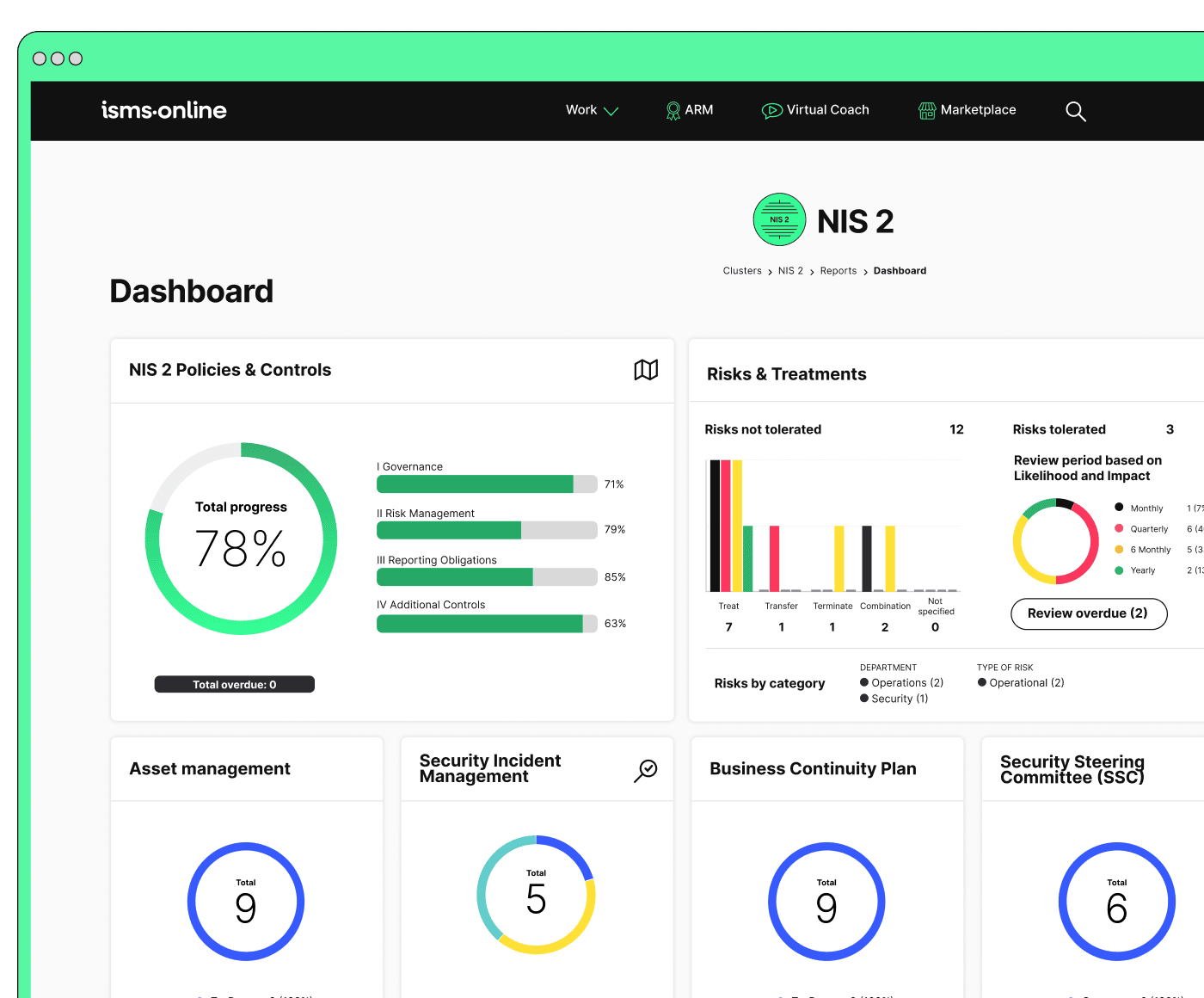
Be NIS 2-ready from day one
Launch with a proven workspace and templates – just tailor, assign, and go.
How Do Sector and Geography Create Unique Compliance and Insurance Headaches?
Fine print is rarely fair. Sector and geography now dictate the very DNA of your compliance and insurance headaches. Regulated entities in finance, energy, healthcare, and tech are the first targets for both auditors and enforcement teams post-NIS 2, with notification clocks and audit cycles dramatically compressed. The same event can trigger a divergent response based solely on where it’s reported.
A controlled, evidence-ready workflow is the new price of operating in a cross-border, regulated market.
In parallel, NIS 2 raises board and executive accountability to new heights. Directors can be personally liable for failures, and insurance cannot bundle away this risk. Signing an annual report or risk register is now a personal, not just a corporate, act.
Scenario – The Nordic–DACH Insurance Gap
A digital service provider suffers a major info-sec breach affecting data in both Finland and Germany. In Helsinki, regulators permit claimable forensics costs, but deny compensation for the administrative fine. In Berlin, not only does the board see zero policy pay-out for any fines, but must also produce signed risk registers and SoA logs as proof of executive diligence.
The implications are profound: splitting responsibilities by jurisdiction creates pain for even the best organisational risk strategies.
Sector & Geography: Heatmap Table
| **Sector** | **Common Exclusion?** | **Key Evidence** | **Audit Trigger** |
|---|---|---|---|
| Healthcare | Yes | Breach logs, patient notices | Personal data breach |
| Financial | Yes | Asset & vendor risk docs | Data transfer, transfer, supply event |
| Tech / SaaS | Yes (w/ exceptions) | Vendor contracts, SoA trails | DDoS, ransomware, cloud event |
Each business unit, supply chain node, and regulated entity must operate with careful attention to not just internal best practise, but also the statute and audit norms of every country they wish to sell into or employ in.
How Does Evidence-Driven Compliance Bridge the Insurance and Regulatory Gap?
At the heart of modern resilience is this: Continuous, evidence-driven compliance is the only bridge between regulatory enforcement and insurance protection. It is not enough to have policies written or risk reports filed; every incident, action and decision must create a living, auditable, and easily accessible digital trail. This is where ISO 27001-and well-implemented systems like ISMS.online-are invaluable.
The only proof the board, auditor or insurer will ever accept is what they can trace, audit, and export instantly.
ISO 27001’s operational requirements call for:
- Ongoing risk identification, scoring, and SoA updates (Cl. 6, 8.2, A.5.7, A.5.12)
- Live incident ticketing, evidence of rapid notification, and proof of regulatory response (Cl. 8.1, A.5.24–A.5.28)
- Central, immutable log and evidence storage (Cl. 7.5, 9.1, A.5.35)
- Documented management meetings and continuous review cycles (Cl. 9.3, A.5.4, A.5.36)
A living compliance “loop” trumps static spreadsheets or one-off registers every time. ISMS.online’s Linked Work, Evidence Bank and Policy Pack flows create “defensible forever” compliance-everything is up to date, signed, and ready for internal, external or regulatory review.
ISO 27001 Bridge Table – Expectation, Operational Action, Reference
| **Expectation** | **Operationalisation** | **ISO 27001 / Annex A Ref** |
|---|---|---|
| Continuous risk monitoring | Risk tracker, SoA update | Cl. 6, 8.2, A.5.7, A.5.12 |
| Rapid incident handling | Incident workflow, logs | 8.1, A.5.24–A.5.28 |
| Audit-ready evidence | Central logs, evidence | 7.5, 9.1, A.5.35 |
| Management review scheduled | Board meeting docs, SoA | 9.3, A.5.4, A.5.36 |
Treat these operational actions as both a shield for insurance claims and a lever against regulator penalties. Doing so is no longer optional-it’s a board and fiduciary imperative.
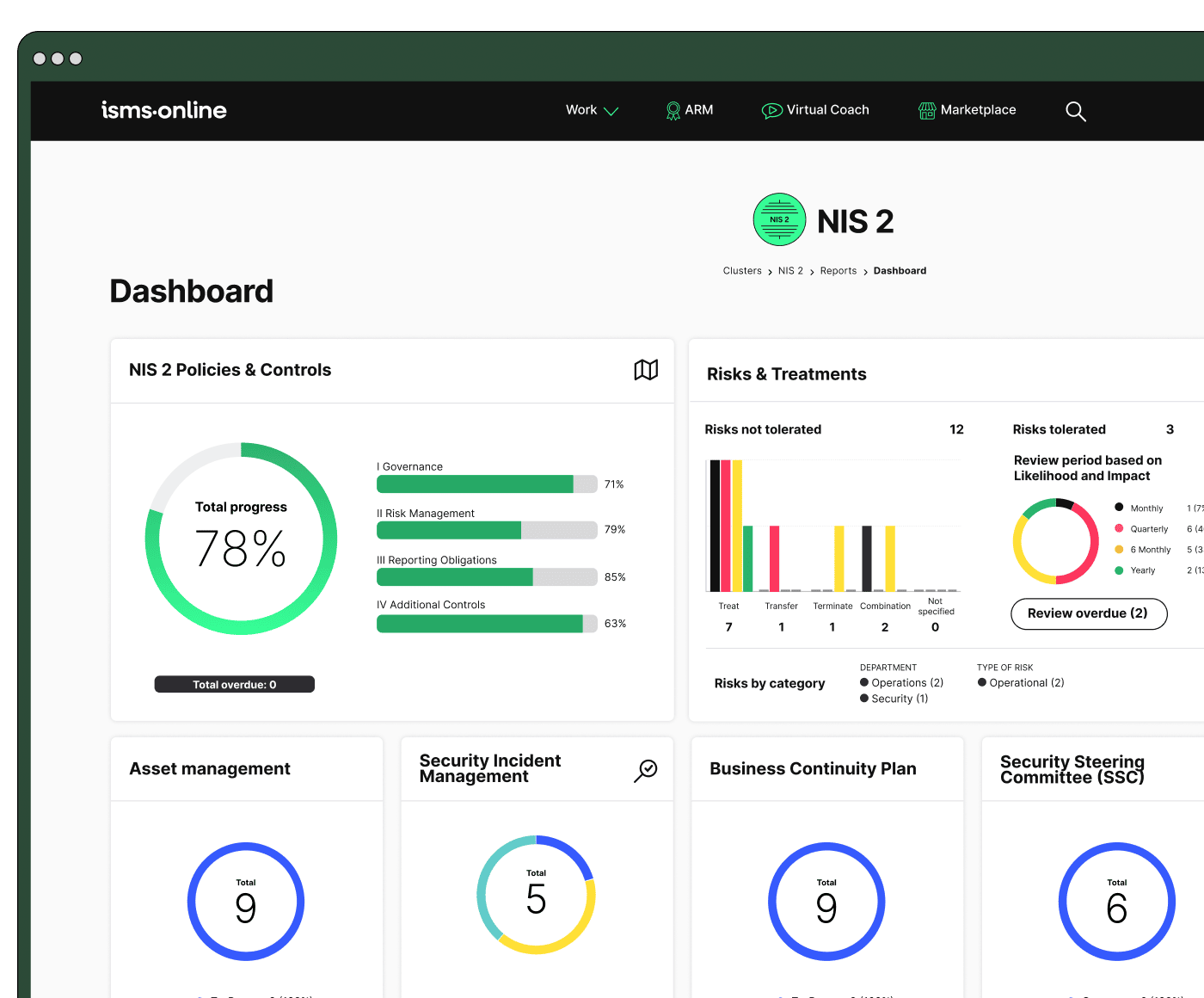
All your NIS 2, all in one place
From Articles 20–23 to audit plans – run and prove compliance, end-to-end.
How Do You Make ISO 27001 Traceable-Linking Control to Action to Audit?
Traceability in ISMS is not an abstract principle. It is the granular, demonstrable mapping of every risk event, control, and management action to a specific, retrievable piece of evidence-in real time. Without this, both audits and insurance claims degrade into a race to reconstruct events after the fact.
Automate evidence routines where possible:
- Schedule SoA and risk register reviews, and log all approvals digitally.
- Centralise evidence: house all risk updates, incident logs, vendor reviews, and staff training acknowledgments in one system.
- Test evidence retrieval regularly-simulate “regulator queries” or “insurance claims” as board/audit drills.
Traceability Table – Compliance in Action
| **Trigger Event** | **Risk/Action** | **Control/SoA Ref** | **Evidence Logged** |
|---|---|---|---|
| Remote staff increase | DLP/remote controls added | A.5.23, A.8.21, SoA | Updated policy, audit log |
| Phishing attack | Incident escalated, review | A.5.24, A.5.26 | Incident ticket, board minutes |
| Quarterly risk review | Update risk/SoA rating | A.5.12, Cl. 6 | Review sign-off, SoA update |
| New supplier onboard | Supplier risk rating scored | A.5.19, A.5.21 | Due diligence, contract, approval |
Proof readiness is a process, not a state.
Live dashboards, accessible logs, and standardised workflows are your best defence and your most credible insurance ally. The strongest evidence is always findable, exportable, and cross-referenced-not lost in emails or static drives.
Can You Defend Every Compliance Action for Regulators, Auditors, or Insurers?
The final leadership test is always traceability under pressure. When the boardroom faces a regulatory query, audit challenge, or insurer’s request, being able to instantly retrieve signed, timestamped, referenced evidence is the only true “get out of gaol” card.
Modern governance means treating compliance as a living, interwoven record-not just as policy prose, but as actionable, reviewable, and defensible proof. When every incident, control change, or risk rating is linked to an evidence log and a management signoff (digitally or physically), boards earn regulator respect and stand the best chance at insurance-related recovery.
Defensible forever is not just a slogan-it is a board’s duty, a practitioner’s power, and an executive’s legacy.
Platforms like ISMS.online now make it possible to “live out” compliance-not at audit time, but every day, in real workflows. No more excuses; no more sleepless nights. Build, automate, and test traceability in advance so the next claim or audit is never a guessing game.
When fines are uninsurable and regulatory scrutiny a certainty, build risk resilience into your DNA. Empower your business and your board with living, defensible compliance now. It’s the difference between being caught off guard and proving your diligence-instantly, anywhere, to anyone that matters.
Frequently Asked Questions
Why are NIS 2 fines almost never insurable within the EU, and how is this distinct from GDPR penalties?
EU law and policy make NIS 2 administrative fines-like GDPR fines-almost universally uninsurable to maintain their value as a true deterrent. Regulators want fines to “sting” so organisations take cyber compliance seriously. In nearly every EU country, insurers are prohibited from paying these fines directly, regardless of what your cyber or D&O policy says. The rare exceptions-Finland and Norway-only permit coverage if misconduct was unintentional and not grossly negligent, and even then, regulators or courts can override the insurer’s payment (Aon/DLA Piper, 2024). For nearly all EU-based organisations, this means fines under both NIS 2 and GDPR must be paid out of your own reserves; insurance will support the response, but not the penalty.
| Regulation | Insurable? (EU) | Exceptions |
|---|---|---|
| NIS 2 | Almost never | Finland, Norway† |
| GDPR | Almost never | Finland, Norway† |
| Not in DE/FR/ES/UK |
†Only non-intent/gross negligence; subject to legal review.
What NIS 2-related costs can cyber insurance actually cover in the EU?
While the NIS 2 fine itself is almost always excluded, a robust cyber policy still plays a key part in your incident response plan. Most modern cyber coverages reimburse for first-party costs such as legal advice, forensic investigation, incident notification, technical remediation, customer and regulator communications, crisis PR, and even business interruption (where proven). The policy may also fund regulatory engagement-including consultations and interviews-so long as the underlying event didn’t involve willful misconduct or gross negligence (ABA, 2019). Because each insurer and jurisdiction differs, review what counts as “covered costs” line by line, and ensure your incident response playbook includes steps for policy activation, documentation, and audit readiness.
Most commonly covered (not exhaustive):
- Legal and regulatory defence costs
- Forensic IT and breach investigation
- Customer and authority notifications
- Crisis communications and public relations
Not covered: NIS 2 or GDPR administrative fines in almost all EU countries.
How does “if insurable by law” language in cyber insurance policies trigger cross-jurisdiction risk?
The often-seen phrase “if insurable by law” creates confusion and coverage gaps for any company operating in more than one country. What it means: for the insurer to pay the fine, it must be legal to do so in the country where the authority imposes the penalty. Because each EU nation defines insurability differently, some (like Finland) may allow payment in special circumstances, while others (France, Germany, Spain) always prohibit it, no matter what your global or group-wide policy promises (Womble Bond Dickinson, 2024). This means your company could have a “false positive”-believing you’re covered, only to find the fine is flatly excluded in court.
A broad policy doesn’t equal broad protection-local law always decides whether cover actually applies.
Best practise:
- Map your exposure by country and policy wording together.
- Obtain legal opinions for each jurisdiction.
- Keep insurance terms and board risk reviews updated as law evolves.
Which EU countries have ever permitted insurance to pay NIS 2 or GDPR fines?
In practise, only Finland and Norway have regularly recognised insurance coverage for certain regulatory fines, provided the breach was not intentional or grossly negligent. Even then, the burden is on the company to prove compliance with local law, and authorities or courts can challenge indemnity at any point (Clifford Chance, 2025). In France, Germany, Spain, and most of the EU, both law and explicit regulatory guidance prohibit insurance from “blunting” the punitive effect of administrative sanctions. Major international insurers typically echo this with clear exclusion clauses.
| Country | Fines Insurable? | Typical Limits / Notes |
|---|---|---|
| Finland | Sometimes | Not if gross negligence or intent |
| Norway | Sometimes | Policy/case-by-case, court review |
| France | Never | Law & regulator explicitly prohibit |
| Germany | Never | Uninsurable as a matter of policy |
| Spain | Never | Regulator bars indemnity |
How do sector regulations and board liability laws affect NIS 2 fine risk?
Sector-specific regimes-especially financial services, healthcare, utilities, and energy-impose higher NIS 2 scrutiny and may escalate maximum fines or trigger direct director/officer liability. New laws in France, Spain, and elsewhere extend regulatory risk to personal board members, exposing individual directors to investigation and legal costs (CyberUpgrade, 2025). Director & Officer (D&O) insurance will usually pay for legal defence, but almost never the administrative fines themselves. In multi-country teams, the only defensible protection is fast, visible proof-incident logs, signed board minutes, risk register entries, and management reviews documenting good faith actions around each breach or regulatory request.
The ultimate shield for directors isn’t a policy-it’s fast, transparent evidence of compliance in every decision.
Snap view:
| Threat | Policy Covers Legal Defence? | Fine Covered? | Key Evidence Needed |
|---|---|---|---|
| NIS 2 Fine | No | No | ISMS logs, SoA items |
| D&O (Legal Fees) | Yes | No | Contract, logbook |
| Board Member (Personal) | Yes (fees only) | No | Minutes, signed docs |
What is the most effective insurance and evidence strategy to reduce NIS 2 fine exposure for boards and compliance teams?
Effective protection isn’t just about transferring risk onto a policy-it’s about demonstrating, with audit-ready evidence, that your organisation has done everything possible to comply. To stand up to board, auditor, or regulator scrutiny:
- Map out policy exclusions for administrative fines in every country and board jurisdiction where you operate.
- Request legal opinions country by country-don’t rely on broker blanket statements.
- Maintain a living ISMS-updated risk registers, incident logs, board reviews, and management review cycles, ideally with automated evidence management (see (https://isms.online/isms-iso-27001-implementation/?utm_source=openai)).
- Link every incident or major risk change to updated Statement of Applicability/Annex A references and board minutes.
- Embed notification procedures: Make sure every major incident playbook includes prompt legal and insurance notifications, and a clean record of who was alerted, when, and what response was taken.
| Trigger/Event | Key Action | ISO 27001 / Annex A Ref. | Example Evidence |
|---|---|---|---|
| Supply chain breach | Incident log, board notification | A.5.19, A.5.24 | Forensics, ISMS audit trail |
| New regulatory requirement | Legal review, management review minutes | 9.3, A.5.36 | Signed board minutes, SoA update |
| Executive turnover | D&O policy check, compliance signoff | 5.2, 7.5, 9.1 | Signed statements, approval logs |
| Annual risk review | ISMS dashboard export, risk mapping | 6.1, 8.2, A.5.7 | Audit-ready dashboard export |
When insurance can’t erase the risk, a transparent, well-maintained ISMS becomes every compliance leader and board’s best asset. Rely less on crossed fingers, more on living proof-transform your approach and give your team the operational confidence to steer clear of regulatory and reputational surprises.






