





































Why Are Privileged Accounts the “Master Keys” in NIS 2?
Regulatory leaders are waking up to a hard truth: privileged accounts aren’t just another technical burden-they are the master keys to every digital door in your organisation. Under NIS 2, privileged access defines the boundary between routine operations and existential risk. When a single account is overlooked, left with default credentials after a team member leaves or persists in a vendor’s system long after a contract ends, months of compliance groundwork can unravel overnight. You need to know, at any moment, who can change, access, or override your critical workflows-across cloud, SaaS, infrastructure, and supply chain.
The riskiest administrator is the one your inventory fails to remember.
ENISA makes it unambiguously clear: privileged account abuse is a leading cause of system compromise across Europe’s critical sectors (ENISA, 2023). The implications are immediate and wide-ranging-dormant admin credentials from ex-employees, legacy supplier logins, “temporary” superuser access, SaaS platforms with silent escalation, and DevOps backdoors all become threat vectors if left unmanaged.
NIS 2 Article 21 deliberately widens the scope: It’s not just classic IT administrators. The regulation covers anyone who can create, change, delete, or override key functions or data-across internal teams and external partners, through direct or delegated access [EU NIS 2 Directive, Art 21]. If the team is stuck arguing, “Does this cloud backup account really count?” or “Should we track those emergency vendor logins?”-you’re no longer just exposing a gap to an auditor, but to a determined attacker.
The reality is simple: ‘privilege sprawl’ and “orphaned admins” don’t just violate compliance. They undercut board confidence, inflate incident costs, and kill resilience by stealth. Most damaging of all, they turn identity management into after-the-fact justification, rather than a living foundation of your cyber defence and governance story.
How Do NIS 2, ISO 27001, and Real-World Practise Connect?
Understanding how NIS 2 connects to ISO 27001 isn’t just helpful for winning the audit-it’s essential for survival under regulatory scrutiny. NIS 2 tells you what you must do: inventory, restrict, monitor, and frequently review privileged accounts. ISO 27001:2022 provides the “how”: the operational scaffolding-policies, process controls, evidence trails, and improvement cycles that turn regulatory intent into daily discipline. Where these frameworks intersect, auditors and insurers see two signals: your compliance isn’t a one-time statement but a set of working, testable living controls.
| Expectation | Operationalisation | ISO 27001 / Annex A Reference |
|---|---|---|
| Inventory **all privileged accounts** | Live registry; ownership; linked systems and vendors | A.8.2, A.5.18, A.5.15 |
| Least privilege & segregation enforced | Role-based access, SoD, dual sign-off, time-boundedness | A.8.2, A.5.3, A.5.18 |
| Monitor & log all privileged actions | Immutable logs, alert review, anomaly detection | A.8.15, A.8.16, A.8.5 |
| Periodic audit/review | Quarterly review/attestation, evidence trace to register | 9.2, A.8.2, A.5.35 |
| Immediate revocation | Automated triggers (leaver, contract, incident); closure | A.8.18, A.6.5 |
ISMS.online bridges these frameworks through centralised registers, automated reminders, cross-linked workflow triggers, and real-time ownership assignment. Instead of a fragmented spreadsheet and last-minute audit scramble, you work from a single, living source: policy, workflow, and evidence become one verifiable voice.
Audit anxiety melts away when policy, workflow, and evidence speak with one voice.
For organisations running both NIS 2 and ISO 27001, ISMS.online’s “linked work” and cross-mapping features remove manual cross-referencing: risk logs, admin registers, SoA approvals, and evidence exports all tie to the same live ledger (Continuity Central). When auditors or boards ask “how do you know who controls your master keys?”-your register and evidence are just a click away.

Master NIS 2 without spreadsheet chaos
Centralise risk, incidents, suppliers, and evidence in one clean platform.
How Do You Build-and Keep-an Accurate Register of Privileged Accounts?
A privileged account register isn’t a static spreadsheet-it’s a living system, evolving with your business and growing threat landscape. Most legacy “inventories” fail for one simple reason: inertia. Shared credentials, dormant accounts, break-glass logins, and SaaS admin roles multiply quietly, often across systems and business units. You need a proactive process-a systematic immune system for identity risk-that never lets yesterday’s privilege become tomorrow’s breach (SearchSecurity).
Hidden accounts aren’t overlooked-they’re open doors waiting to be tested.
ISMS.online Inventory Protocol:
1. Map all privilege domains: Beyond IT admins, cover cloud, SaaS, applications, suppliers, emergency accesses, and automation.
2. Assign real owners: Every account, every privilege, every third-party. No anonymous or “shared” credentials.
3. Automate reminders and triggers: Reviews are automated, driven by events and schedules-never reliant on memory.
4. Supplier and asset linkage: Asset and supplier registers ensure every connected privilege is visible, reviewable, and tied to contracts (ISMS.online Asset Management).
Orphaned admin accounts are often uncovered in incidents, audits, or internal reviews. When this happens, capture and action the gap-logging not just the fix but the learning as evidence of continuous improvement (IT Governance). ISMS.online dissolves spreadsheet sprawl and ambiguity, so when asked “who has which key, right now?” your answer is up to date, complete, and audit-ready.
How Do You Assign, Limit, and Test Privileged Access in Practise?
Privilege assignment, under both NIS 2 and ISO 27001, moves from “trust the admin” to “prove every privilege, function, and exception.” Ownership and necessity are paramount; segregation of duties (SoD), dual sign-off, and temporary escalation are standard, not exceptions (ACM 2023).
| Trigger | Risk Update | Control / SoA Link | Evidence Logged |
|---|---|---|---|
| New admin appointment | SoD assessment, least privilege, risk owner nomination | A.5.3, A.8.2 | Approval log, SoD matrix |
| Emergency privilege escalation | Dual/urgent sign-off, auto-reversion, risk condition log | A.5.3, A.8.2 | Dual sign-off, timelock logs |
| Departure or role change | Immediate review/revoke, SoA update, offboarding workflow | A.8.18, A.6.5 | IAM logs, removal confirmation |
| Scheduled/periodic review | SoD check, exception reporting, overdue removal tracking | A.5.35, A.8.2 | Review attestation, export |
| Policy/process update | Matrix/SoA revision, refresh approvals & controls | 6.1.3, A.5.15 | Policy version log, sign-off |
The weakest link is always the privilege left hanging after roles change.
ISMS.online embeds these flows into everyday work: appointing a new admin, handling an urgent escalation, offboarding a supplier, or updating process triggers a workflow and ties every step to a register entry and approval audit trail. Exception handling is not hidden: every missed event, delay, or failure is transparent and actioned-turning compliance risk into evidence of diligence, not neglect.
Illustrative Scenario:
A vendor leaves unexpectedly. ISMS.online triggers immediate review and automatic alerts-any linked admin rights (on SaaS, cloud, or internal systems) are flagged for removal, with evidence exported for audit. The result? Contained risk, complete audit trail, and recoverable time for your IT and compliance teams.
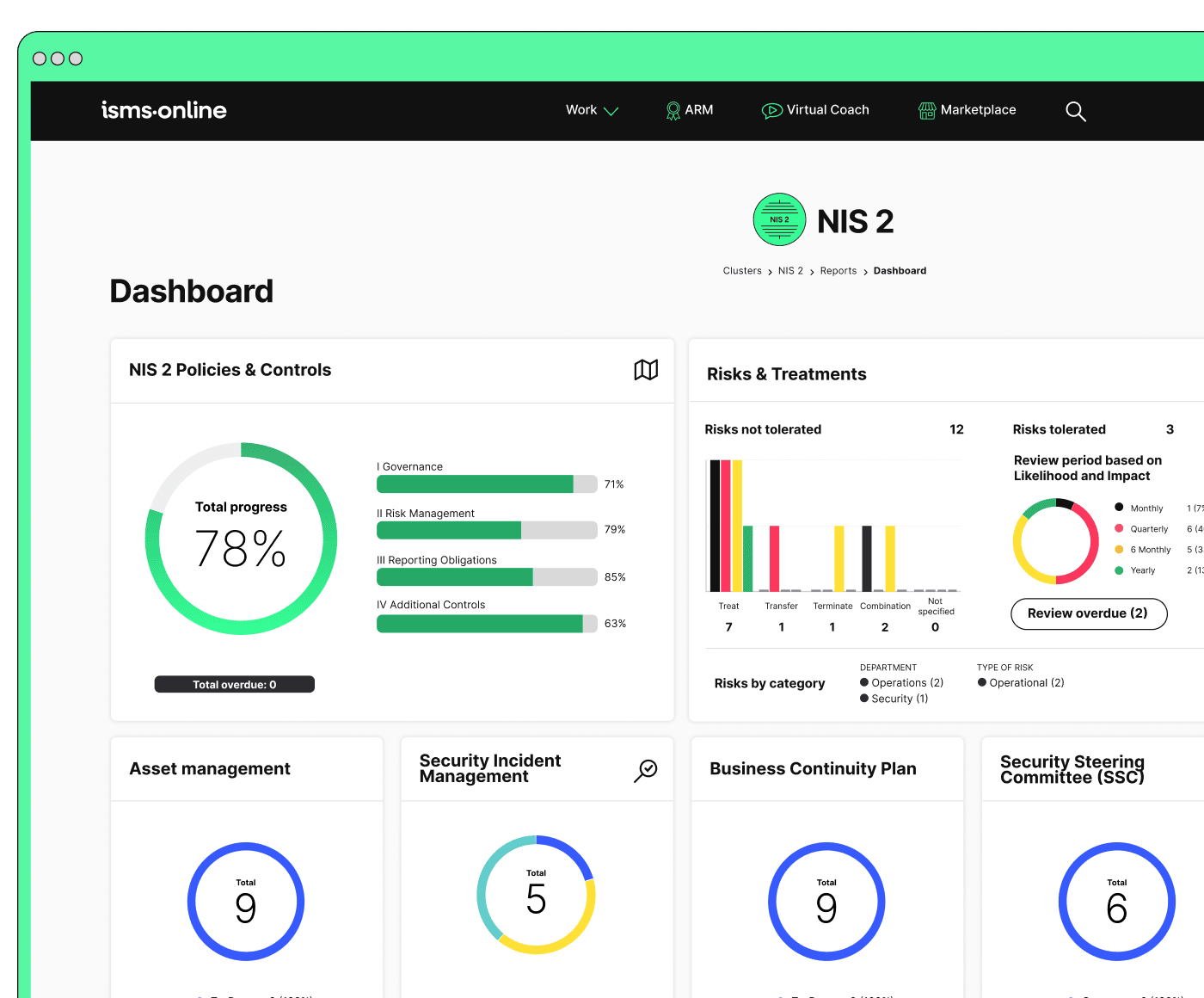
Be NIS 2-ready from day one
Launch with a proven workspace and templates – just tailor, assign, and go.
How Do You Monitor, Log, and Audit Privileged Actions-Including Vendors?
Monitoring and logging are not “checkbox” activities-they are your front line of defence, your window for detecting misuse, and your primary audit artefact. Under ISO 27001 (A.8.15, A.8.16) and NIS 2, every significant privileged action is logged and routinely reviewed.
Every privileged log is both a protective shield and a window for your auditors.
With third-party and supply chain risk now top regulatory concerns, vendor actions demand equal scrutiny. ISMS.online enables federated, unified logging-drawing logs from cloud, SaaS, and internal domains into a single register (ENISA Supply Chain Cyber-Security). SIEM integration ensures that privilege use, elevations, and anomalies are all detected, while alerting workflows and responsibilities drive rapid response.
Every review, escalation, or remediation is logged-who acted, what was changed, when, and what was confirmed-with exportable audit evidence (Splunk). ISMS.online auto-associates these events with privileged register entries, ensuring reports and board summaries are always based on real events, not best guesses or outdated records.
How Do You Achieve Automated, Auditable, and Immediate Privileged Revocation?
Best-in-class privileged access revocation means real-time response. Whether triggered by HR events, contract changes, or detected threats, privileged accounts must be removed or adjusted the moment the operational need disappears (DUO Security).
The only meaningful privilege is one you can revoke instantly, before it turns into unavoidable risk.
ISMS.online delivers this through:
- IAM/HR event integration: Departures trigger privilege removal-not only internally, but across connected supplier and cloud assets (ISMS.online IAM Features).
- Supplier contract endpoints: Supplier exits trigger asset and identity review and evidence capture.
- Automated documentation: Every change (trigger, review, revocation) is logged, timestamped, and tied to the privileged account register.
| Trigger | Risk Update | Control / SoA Link | Evidence Logged |
|---|---|---|---|
| HR leaver event | All admin/privileged rights enter removal workflow | A.8.18, A.6.5 | IAM log, workflow export |
| Supplier offboarding | Asset and user privileges reviewed and retired | A.5.21, A.8.2 | Contract logs, removal proof |
| Emergency/incident | Immediate rollback, SoA cross-check, notification | A.5.3, A.8.2 | Alert log, workflow archive |
Sudden supplier or staff departures become controlled events-no privilege lingers unowned, every action is exportable and reviewable for both audit and assurance.
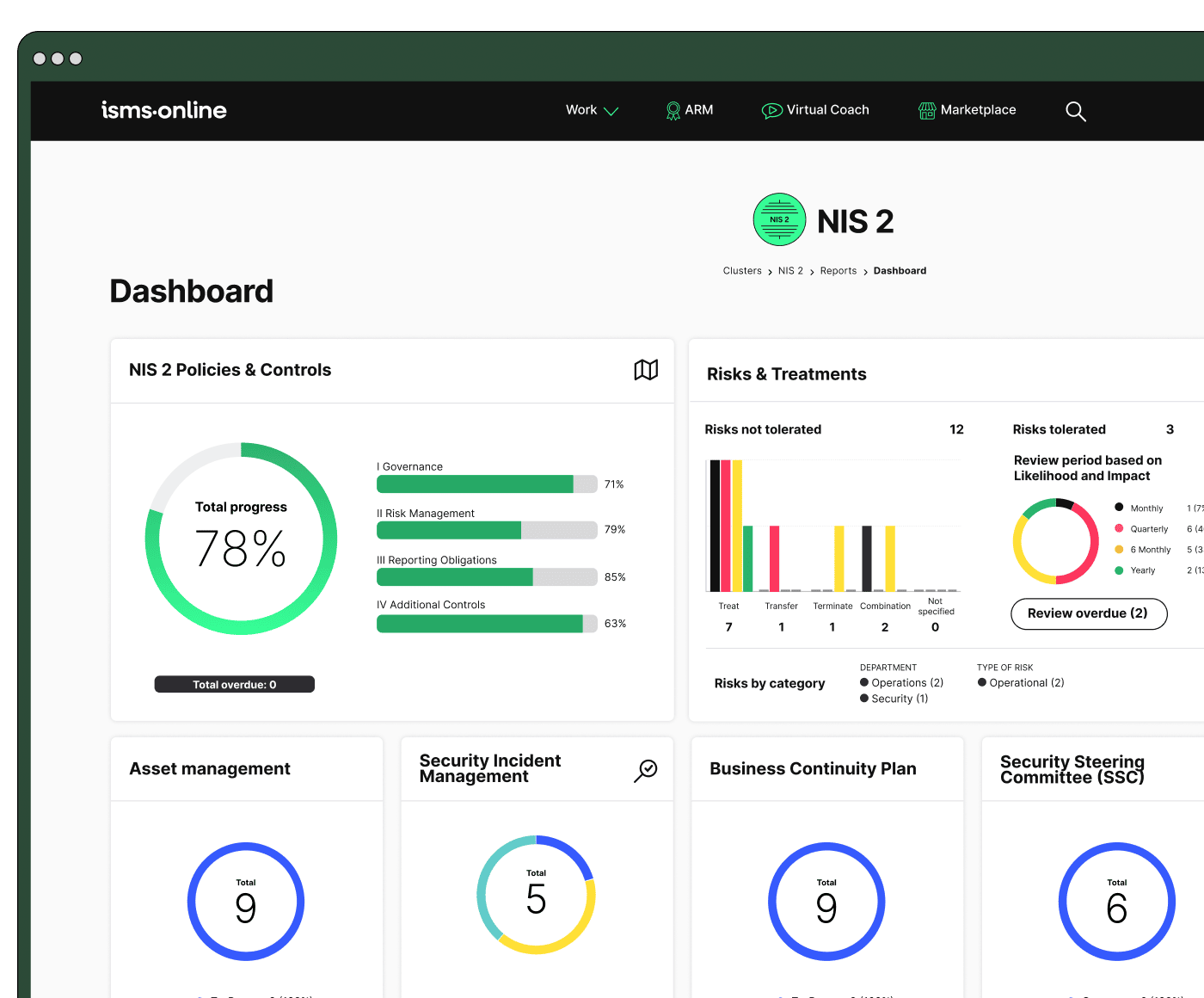
All your NIS 2, all in one place
From Articles 20–23 to audit plans – run and prove compliance, end-to-end.
How Do You Review, Audit, and Report on Privileged Accounts for Compliance?
Compliance means pace and evidence, not just policies. Quarterly reviews, not annual checkups, drive continuous assurance (TechTarget). Management sign-off is embedded, not optional. Attestations, sign-offs, and logs merge into a trail so clear that both external auditors and internal boards see “lived” compliance, not lip service.
True compliance is practised daily, not performed once a year.
ISMS.online structures this:
- Auto-cycled reviews: Never missed, always logged, escalated if overdue.
- Manager sign-off: Digital totals, dashboard exports, reports ready for every review cycle.
- Evidence linkage: Every exception, attestation, and remediation solidly attached to the privileged access register and SoA item.
Metrics such as time to privilege removal after event, SoD violations over time, and audit remediation cycles become not just security KPIs but operational signals for business continuity (ISACA). When auditors, insurers, or boards ask for proof, you provide it at pace-demonstrating that resilience and compliance are daily practises, not a once-a-year show (ISMS.online Blog).
How Do You Export, Evidence, and Act on Privileged Control-Instinctively?
Velocity and clarity trump “audit panic.” When the register, control logs, SoD records, and approval flows are unified, privileges are managed proactively, not retroactively. ISMS.online makes evidence of control frictionless: policy, privilege matrix, offboarding logs, and SoA approvals are all exportable on-demand (ISMS.online Solutions).
The most reliable control is the one you can prove at a moment’s notice.
Illustrative scenario:
A supplier contract ends without warning. ISMS.online flags every relevant privilege across related assets, notifies owners, launches a removal workflow, and collates the evidence bundle for audit. No scramble, no gaps, no ambiguous responsibility-demonstrated compliance, clear risk containment, and resilience displayed to the board and regulator.
| Expectation or Trigger | Operational Evidence | ISO 27001 / NIS 2 Reference |
|---|---|---|
| Staff/supplier lifecycle change | Register, workflow output, approval | A.5.18, A.6.5, A.8.18 |
| Temporary privilege escalation | Dual sign-off, time-bounded evidence | A.5.3, A.8.2 |
| Scheduled or ad hoc review | Attestation record, exception path | 9.2, A.8.2, A.5.35 |
| Supplier engagement change | Asset/supplier revocation trail | A.5.21, A.8.2 |
| Incident/near miss | Alert logs, SoA/policy correction | A.5.15, 6.1.3 |
No blurred edges, no trust gaps-just testable, proven, daily compliance.
Be Known for Visible, Resilient Privileged Access: Join ISMS.online Today
Regulators and boards are crystal clear: it’s not policy writing or technical prowess that builds trust-it’s continuous, visible control demonstrated across every privileged identity. The master keys to your digital estate must always be accounted for, reviewable, and ready to be changed or revoked. NIS 2 and ISO 27001 are not checklists-they are frameworks for living assurance.
ISMS.online replaces paperwork and confusion with an integrated system that proves compliance at every turn. Its automated workflows, mapped controls, and living registers turn the “master key” risk into an asset-one that inspires audit resilience, board confidence, and regulatory trust.
Step forward with a system that proves its controls, and yours-at every turn.
Experience robust, board-grade privileged access management today. ISMS.online is your partner for frictionless, defensible identity control.
Frequently Asked Questions
Who is accountable for privileged account controls under NIS 2, and how is enforceability secured in audits?
Under NIS 2, every essential or important entity-from digital infrastructure and critical services to regulated commercial organisations-must implement privileged account policies that are real, actionable, and persistently enforced. Accountability belongs not just to IT, but is a cross-functional obligation: the board or top management must delegate clear ownership down to named individuals for every privileged account. This is more than assigning nominal responsibility-each admin, system, or supplier account needs a documented, unique owner, with no shared or “generic” use permitted anywhere in the environment.
Regulatory enforceability is driven by operational evidence: every privilege grant, change, review, and removal must trigger a recorded event in a digital workflow-ideally automated, always exportable. You must show a policy that doesn’t simply define “privileged” but embeds control into HR, onboarding, supplier management, and joiner/mover/leaver routines. If an auditor asks to see an end-to-end chain-from policy wording to evidence of daily practise-your system should surface the logs in minutes, mapping every access to named people and business context.
Privileged access is not a theoretical risk; gaps are actively targeted by attackers, and regulators now mandate daily proof that what’s on paper is reflected in live system behaviour.
Policy checklist essentials
- Scope: Covers all admin, superuser, system, and supplier accounts-across IT, cloud, SaaS, and OT.
- Unique assignment: No shared IDs; each privileged account mapped to one named individual.
- Access controls: Enforced MFA, prohibition of generic credentials, well-defined SoD (Segregation of Duties).
- Lifecycle management: Automated joiner/leaver/removal processes; clear escalation rules for missed reviews.
- Auditability: Linkage of policy terms to workflow logs and management review; easily exportable for inspection.
Reference: NIS 2 Regulation – Official Journal
What are the ironclad authentication and authorization requirements for privileged accounts?
The bedrock of privileged access control under NIS 2 (and ISO 27001:2022) is strong authentication tied to unique, traceable identities. Multi-factor authentication (MFA) is mandatory for every privileged login, ideally using a FIDO2 key, hardware token, or TOTP app-SMS is insufficient. No admin function can be accessed unless MFA is passed-not only at login but on critical actions (“step-up authentication”).
Shared admin accounts are explicitly prohibited. Every assignment, change, or removal of admin rights requires a dual-approval (SoD-enforced) workflow: one person proposes, another approves (granting themselves privileges is never allowed). This process extends to all environments-cloud, infrastructure, SaaS, third-party platforms. Every workflow step must generate a durable, timestamped log, providing an immutable chain for auditors.
Authentication and approval: At-a-glance table
| Control Step | NIS 2 Requirement | Example Evidence |
|---|---|---|
| MFA on login/action | Mandatory, robust method | System logs: challenge, device used |
| Unique ID/ownership | No shared/generic admin use | IAM/HR registry per admin |
| Workflow dual control | Initiator ≠ approver | Dual-signed, timestamped record |
| Session logging | Activity captured, not editable | Exportable SIEM/audit logs |
| Periodic review | Min. quarterly for all assignments | Review logs with exception handling |
ENISA guidance: NIS 2 Implementation Guide (Scribd, p.44)
How should organisations structure admin and privileged accounts for real-world security?
Admin and privileged accounts must be reserved solely for technical tasks (configuration, troubleshooting, installation, maintenance), never used for email, SaaS, routine browsing, or non-admin operations. Every admin account should be uniquely tied to one person, with justification for every privilege granted. Separation between admin and business accounts must be both technical and organisational-no overlap in credentials, authorizations, or session use is permitted.
The least privilege model must be enforced: accounts only receive the rights needed for their purpose, with periodic reviews (at least quarterly) to strip outdated or excess rights. Suppliers and contractors are not exempt: their privileged access must be governed, reviewed, and removed with the same rigour as internal staff. Every assignment/change/removal should be tightly linked to HR or contract events; access must be terminated instantly on departure or contract cessation.
Admin vs. user accounts-what’s required?
| Feature/Requirement | Admin Account | Standard User |
|---|---|---|
| MFA enforced | Always | Recommended |
| Unique ownership | Mandatory | Strongly encouraged |
| Non-business use | Never allowed | Allowed |
| Full activity logging | Comprehensive, SIEM | Standard, less granular |
| Review cadence | At least quarterly | Annually/as needed |
Tip: Platforms like ISMS.online automate these separations, reviews, and audit-ready logs, letting you prove every control on demand.
Reference: ISO 27001 Annex A8.2 – Privileged Access Rights
What privileged account evidence must you show during an NIS 2 or ISO 27001:2022 audit?
Auditors and regulators require an unbroken, timestamped trail for every privileged account, for the full lifecycle-creation, usage, and removal. Evidence must include:
- Account register: Comprehensive inventory of every privileged account, owner, MFA status, assigned permissions, with up-to-date mapping against HR/supplier status.
- Signed approval and removal records: Every privilege grant/revocation, showing initiator and approver, timestamp, digital signature, and SoD compliance.
- Session and activity logs: Exportable records that capture every admin login, action, and revocation event-internal and external (supplier) alike.
- Quarterly review and remediation logs: Documented evidence of each scheduled review, who performed it, what was changed, and any exceptions resolved.
- Management and board oversight: Review minutes, KPI dashboards, and trend summaries reflecting privileged access status, current exceptions, and incident history.
If you can’t show a complete privilege lineage-account to owner, approvals, every session, and cleanup-within a day, you’re risking both compliance and security.
ISMS.online provides ready-to-export logs and registers with workflow links to SoA, risk, and management review, arming teams with a defensible audit chain.
(https://www.isms.online/features/iam/)
How do compliant organisations automate privileged access review and revocation cycles?
Best-in-class NIS 2 programmes automate privileged access control in three key cycles:
- Event-driven triggers: Integration with HR and supplier management ensures that as soon as a person changes role, leaves, or a supplier’s contract ends, automated workflows instantly launch privilege reviews and revocations. This removes the risk window where orphaned privileges can be abused.
- Quarterly review automation: Admin account owners are systematically prompted with reminders; overdue actions are escalated, and all actions, exceptions, and overrides are digitally logged. SoD enforcement is built-in, preventing anyone from reviewing their own access.
- Immediate, tracked removal: Automated privilege revocation executes instantly, logging initiator, approver, and exact timestamp. Delays trigger escalation and are logged to strengthen the audit trail.
Simulate a supplier or key staff leaver-can your system export a full trail (request, approval, removal, timestamp, reviewers) for every admin account, across all systems, within a day? If not, you are at operational and compliance risk.
For more depth:
What privileged access failures are most common-and how do you demonstrate daily Segregation of Duties (SoD) compliance?
Frequent privileged access failures include:
- Shared or generic admin accounts: Destroys traceability; SoD can’t be enforced, creating audit headaches and attack vectors.
- Missed or infrequent reviews: Privilege creep persists after staff or role transitions-access lingers long past need.
- Disconnected HR/IT/IAM workflows: Manual processes lag shifts, creating orphaned privileges and increasing breach risk.
- Delayed removals: Admin rights that persist for days after role/contract changes.
SoD: How to demonstrate proof
| Lifecycle Stage | Required Separation | Evidence Produced |
|---|---|---|
| Grant/approve | Initiator ≠ Approver | Workflow logs showing dual control |
| Use/review | Not self-reviewed | Review logs, exception tracking |
| Revoke/escalate | Different individuals, dual sign | Removal logs, escalation/board reports |
No one should ever request, approve, and review their own admin access-refer to your SoD matrix and export review/exception logs for each workflow. ISMS.online logs every action for transparent board and auditor reporting.
Further reading:
- ACM: Segregation of Duties in Access Management (2023)
- ISACA – User Access Review Guidance
How does ISMS.online equip boards and auditors with privileged access assurance?
ISMS.online brings privileged access compliance to board and audit level through:
- Visual, centralised privileged account inventories: Every admin, system, or supplier account mapped to unique ownership, role, and SoA/control mapping.
- Workflow-driven approvals: Privilege grants, changes, and removals require dual-approval, SoD enforcement, and digital signatures-automatically logged and linked.
- Automated review rhythms: Quarterly review prompts reach all account owners, and overdue/exception actions are tracked and escalated so nothing slips through.
- End-to-end auditability: Exports (CSV, PDF) are instant, tying registers, workflows, and activity logs to SoA and management review, creating a closed evidence loop.
- Board dashboards: Live privileged access status, overdue actions, and risk flags are visible on demand for directors, auditors, and management.
Boards and auditors want to see controls working, not just policies. With ISMS.online, you can show full-cycle evidence at a click-no more scramble, no more exposed blind spots.
Explore practise tips: ISMS.online Blog – ISO 27001 Access Control
ISO 27001 & NIS 2 Privileged Account Bridge Table
| Requirement | Operationalisation | ISO 27001 / Annex A Reference |
|---|---|---|
| MFA for every admin login | Enforced for all privileged/admin accounts | A.8.5, A.8.2, A.5.16 |
| Unique, owned accounts | Registry, no shared credentials permitted | A.8.2, A.7.2, A.8.9 |
| Quarterly review/removal workflow | Scheduled, logged in GRC/ISMS platform | A.5.18, A.5.27, A.6.5 |
| Segregation of Duties (SoD) split | Initiator/approver enforced in workflows | A.5.18, A.8.2, A.6.4 |
| Audit-traceable evidence | Exportable logs, mgmt. minutes, SoA link | A.9.3, A.8.15, A.5.35 |
Privileged Access Traceability Table
| Trigger | Action Required | SoA/Control | Evidence Produced |
|---|---|---|---|
| Staff/supplier leave | Immediate access removal | A.8.2 | Removal log, owner signature |
| Quarterly review | Review/removal/modify | A.5.18 | Review log, updated registry |
| Policy update | Revise workflows, SoD | A.5.18 | Workflow export, board minutes |
| Privilege escalation | MFA step-up, approval | A.5.16 | Signed approval, logged activity |
Elevating your privileged access programme means closing the loop: every access mapped, every workflow signed, and every review or removal auditable at the speed the board and regulators now demand.






