





































How Do ISO 27001 Clauses Map to NIS 2 Configuration Management, and What Evidence Proves It in ISMS.online?
Evidence-led configuration management has become the new benchmark for compliance maturity. Under both the NIS 2 Directive and ISO 27001:2022, an auditor’s judgement or a regulator’s readiness test will hinge on your ability to connect intent, implementation, and proof-seamlessly, and on demand. ISMS.online isn’t just a digital filing cabinet; it is your living proof chain, designed to ensure that every configuration and change you make moves from plan to practise with a clear audit trail.
Compliance is no longer proved by narrative-it's proven by the immediacy and traceability of your evidence.
This comprehensive guide decodes exactly which ISO 27001 controls and clauses matter for NIS 2 configuration management, what evidence they demand, and how to orchestrate a seamless experience for your team, board, and external reviewers using ISMS.online. Whether you’re a first-time compliance builder, a battle-tested CISO, a privacy specialist, or the IT practitioner carrying the weight of day-to-day controls, this is the roadmap for evolving from theory to auditable proof.
Which ISO 27001 Clauses Are Directly Mapped to NIS 2 Configuration Management?
Mapping intent to action is the core challenge of regulatory change. NIS 2 Article 6.3 leaves no room for hand-waving: organisations must “establish and maintain configuration management processes appropriate to the level of risk.” This requirement finds operational teeth in ISO 27001:2022, where a series of annex controls transform broad directives into auditable, evidence-backed tasks. Your system must not only articulate a policy, but prove-continuously-that each configuration is planned, approved, reviewed, and if needed, adapted in real time.
Here’s the mapping you need, distilled for operational clarity:
| NIS 2 Expectation | ISO 27001 Clause / Annex Reference | Example Evidence in ISMS.online |
|---|---|---|
| **Config management policy/process** | A.8.9 (Configuration Management) | Signed policy (with versioning/audits) |
| **Baseline configs/versioning** | A.8.9, A.8.22 (Network Segments) | Baseline files, network diagrams |
| **Change workflow / approval** | A.8.32 (Change Management), 6.1.3 | Change tickets, risk log, approval notes |
| **Audit/review cycles** | A.8.9c, 9.2 (Audit), 9.3 (Mgmt Review) | Audit logs, review minutes, NC reports |
| **Exception/deviation tracking** | A.8.9, 6.1.3 | Exception registers, risk sign-offs |
| **Segregation of duties/access** | A.5.3, A.5.15, A.5.18 | Org chart, access logs, admin reviews |
| **Audit trails for admin action** | A.8.15 (Logs), A.8.16 (Monitoring) | SIEM logs, alert evidence, screenshots |
Every row links one NIS 2 expectation to a set of actionable ISO controls and the types of evidence an auditor expects to see in ISMS.online. This bridge turns compliance from static text to a living, queryable system of record-evidence is never hypothetical, always just a few clicks away.

Master NIS 2 without spreadsheet chaos
Centralise risk, incidents, suppliers, and evidence in one clean platform.
What Evidence Should Be Uploaded in ISMS.online to Prove Control?
Intent is easy. Proof is hard. Auditors and regulators demand to see how intentions convert to actions and how actions are recorded, reviewed, and improved. ISMS.online is built for this discipline, serving as your single workspace to aggregate, tag, and evidence every policy, baseline, change, and exception.
Policy Foundation: Configuration Management Policy (A.8.9)
- Upload: your board-signed, version-controlled configuration management policy as a core document in Policy Packs.
- Maintain: a version history to showcase continuous commitment and change discipline.
- Attach: digests of approval and scheduled review, demonstrating active governance.
A static policy signals compliance in the past; a versioned, reviewed policy signals compliance now and in the future.
Baseline Configs: Establishing Known-Good States (A.8.9, A.8.22)
- Upload: “known good” baseline config files (firewall, server builds, templates) into the Evidence Bank.
- Add: network/segmentation diagrams with version control tags and last review dates.
- Cross-link: baseline artefacts to relevant assets in the Info Asset Inventory for full traceability.
Change Management: The Backbone of Risk Control (A.8.32, 6.1.3)
- For every change: Upload change request forms, tickets, or logs with risk assessments attached.
- Approval records: Ensure sign-offs with date and responsible owner are attached-ideally using ISMS.online’s approval modules.
- Rollback plans: Attach remediation or rollback plans so every change shows a tested route to safety.
Exception/Deviation Handling: Beyond Process Conformance (6.1.3, A.8.9)
- Maintain: an Exception Register-attach documents or logs for every deviation from policy, with sign-off and expiry.
- Tag: each exception to its risk assessment(s) and reference affected SoA controls.
- Schedule: routine exception review and attach closure documentation confirming corrective action or risk acceptance.
Audit and Review Cycles: Showing Controls Are Alive (A.8.9c, 9.2, 9.3)
- Upload: signed audit logs, workflow trail screenshots, and management review minutes into versioned, searchable folders.
- Log: nonconformity and corrective action records with owner/date/next review.
- Connect: each review cycle to both the system artefact and management’s decision trail.
Access Control: Duty Separation and Privilege Review (A.5.3, A.5.15, A.5.18)
- RACI/Org charts: Upload and keep versioned; tag access rights to current asset list.
- Access/privilege reviews: Generate reports from SSO/SIEM, attach admin review logs, and assign next review owner.
- Logging: Ensure admin actions and privilege escalations are traceable, logged, and tied to periodic review.
Logging and Monitoring: Forensic Foundations (A.8.15, A.8.16)
- SIEM logs / endpoint exports: Regularly upload summary outputs (with alert context) into the Evidence Bank, tagged by control and event owner.
- Incident links: Attach logs to specific incident reports, with cross-reference back to controls and audit logs.
- Retention & review: Show retention schedules and document reviews of logging policy/cycles.
When all evidence is tagged, versioned, and owner-assigned within ISMS.online, your configuration management is no longer a checklist-it’s a living, auditable system.
ISO 27001 Bridge Table: From Expectation to Audit-Ready Upload
Mapping expectations to specific operational tasks-and tracking them all the way to system upload-turns standards from theory into your everyday workflow. Use this as your real-world checklist:
| Expectation | Operationalisation | ISO 27001 Reference |
|---|---|---|
| Policy/plan exists | Approved policy uploaded | A.8.9 |
| Baselines documented | Baseline files in Bank | A.8.9, A.8.22 |
| Change tracked | Change & risk log files | A.8.32, 6.1.3 |
| Exceptions registered | Signed risk/exception | 6.1.3, A.8.9 |
| Periodic review logged | Review minutes/files | A.8.9c, 9.2, 9.3 |
| Role/access logs | Org chart/report upload | A.5.3, A.5.15, A.5.18 |
| Logging evidence | SIEM/admin logs | A.8.15, A.8.16 |
Best practise tip: Use a consistent naming convention-include the control ID, asset/service, and date in every file name (e.g. “A8_9-FW-Baseline-2024-06.pdf”) and tag it when uploaded.
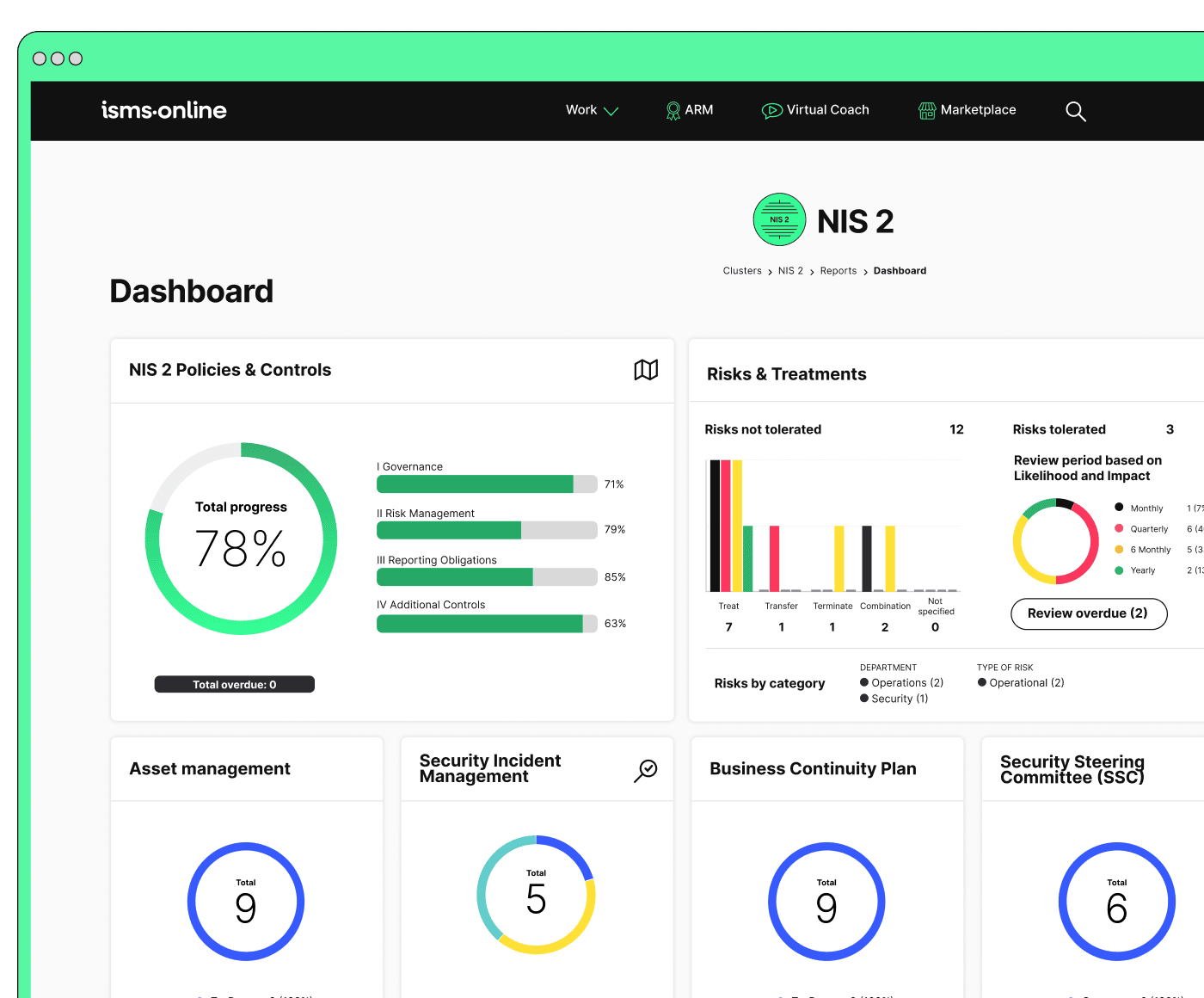
Be NIS 2-ready from day one
Launch with a proven workspace and templates – just tailor, assign, and go.
How Can You Build Instant Traceability from Event to Audit Trail in ISMS.online?
The difference between “ready” and “at risk” is the ability to instantly trace a configuration event-from trigger, to control, to evidence, to audit file. This table is your fast path for building, testing, and presenting this traceability:
| Trigger Event Example | Risk/Change Update | Control Reference | Evidence Uploaded |
|---|---|---|---|
| Firewall rule changed | Change log, risk approval | A.8.9, A.8.32 | “CHG-523.pdf”, “RiskAssmt-042.docx” |
| Legacy patch exception | Exception register, sign-off | 6.1.3, A.8.9 | “Exception-Payroll.pdf” |
| Quarterly config audit | Audit log, approved actions | 9.2, 9.3 | “AuditLog-Q1-25.xlsx” |
| Admin privilege review | Access review report | A.5.15, A.5.18 | “AccessReview-Jun25.pdf” |
Operational reminders:
- Always link files and logs to the relevant asset, system, or project.
- Use ISMS.online folders dedicated to each workflow (e.g., “Quarterly Config Reviews”).
- Make every item no more than three clicks from its control, and assign an approval owner.
When every document and artefact is tagged and named for quick searchability, audit questions lose their power to induce panic and become checklist moments for your team.
How Should Evidence Be Presented in ISMS.online for Instant Audit Retrieval?
Instant audit retrieval is not magic-it is meticulous preparation, clear linking, enforced review cycles, and robust version control.
Artefact-to-Control Linking and Tagging
- Each upload: must be tagged to an ISO/NIS 2 control.
- Leverage: ISMS.online’s asset selection features to cross-link artefacts to their system or configuration component.
- Assign: an approval or control owner with a clear review/expiry date (use ISMS.online approval workflows where possible).
Bundling by Review Cycle
- Bundle: artefact sets for every review cycle (e.g., quarterly review folders).
- Link: audit minutes, change requests, and exception logs to scheduled management review items and policy versions.
Owner/Approval Tags and Metadata
- Every artefact should display: owner, approval date, next review.
- Approval logs are a built-in feature; attach them for each reviewed item, not just policies.
Exception & Incident Cross-Linking
- Each exception/incident record must cross-link to the control, risk register update, and relevant remediation artefact.
- Use the “Linked Work” or folder structure to ensure every audit trail has an unbroken evidence chain.
An auditable ISMS.online is three steps from any audit question to digital proof.
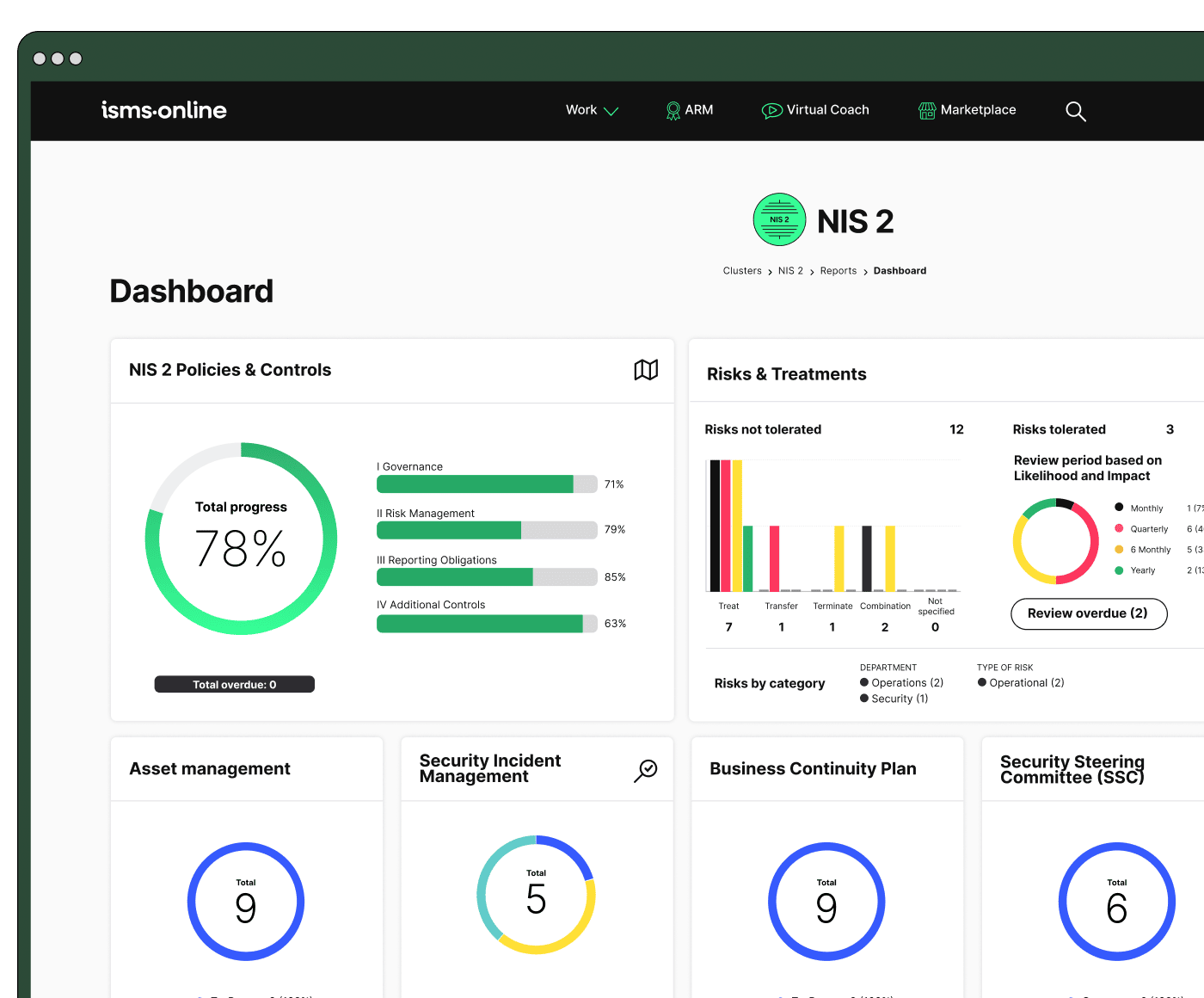
All your NIS 2, all in one place
From Articles 20–23 to audit plans – run and prove compliance, end-to-end.
What Are Pitfalls and Real-World Evidence Fails in NIS 2/ISO 27001 Configuration Management?
Even experienced teams stumble-often due to overloaded practitioners, disconnected controls, or documentation comfort. By persona, these are the chronic mistakes:
Compliance Kickstarter
- Policy uploaded, but no version history or prior approvals.
- Baseline configs/network diagrams missing: or not linked to assets.
- Review cycles ignored: after the first pass.
CISO/Senior Security
- Change approval records lack risk logs or rollback documentation.
- Admin access reviews not cross-linked to associated controls.
- Org charts outdated, violating segregation mandates.
Privacy/Legal
- Deviations/incident logs not mapped to controlling policy or risk.
- No links from incidents to management review notes: .
Practitioner
- SIEM log exports uploaded without tagging for incident or change.
- Change requests lacking approvals: , buried outside ISMS.online.
Universal Pitfalls
- Exception sign-offs lost in email, never attached to the system record.
- Audit/minutes saved but with no action/finding trail.
- Evidence folders untagged, making search by control/owner impossible.
Checklist: Bulletproof Your Evidence Chain
- Goal: Every artefact is tagged, assigned, versioned, and traceable.
- Upload versioned, authorised policies as Policy Packs.
- Save all baselines/configs/diagrams, with explicit review dates.
- Log every significant event with request, risk, approval, and plans attached.
- Every deviation/exception: risked, signed, cross-linked, and expiry set.
- Audit and review actions logged to management review cycles, with next owner.
- Tag org charts, admin review logs, and access reports by control.
- Use unique IDs and ISMS.online search to retrieve in seconds.
Audits aren’t about perfection-they're about unbroken proof and confident retrieval.
Elevate Configuration Management: ISMS.online as the Audit-Ready Evidence Hub
ISMS.online transforms configuration management into a living compliance nervous system: every change, baseline, exception, and review is mapped, logged, ownable, and immediately accessible. For the Kickstarter, it means a first audit can be won with confidence. For the CISO, risk and governance posture is continuously visible and provable to the board. For Privacy and Legal, regulator-facing evidence is a click away. For Practitioners, panic is replaced by automation-no more evidence lost in someone’s desktop or inbox.
Every moment you invest in structured uploads, tagging, and review pays back twice-first in faster, calmer audits, and again in ongoing resilience.
Align Your Configuration Management Proof with ISMS.online Today
Regardless of your compliance journey-setting up an ISMS for the first time, building board trust, withstanding regulatory scrutiny, or supporting relentless practitioner workloads-a living, structured evidence system changes the game. ISMS.online delivers the foundation for always-on, audit-ready configuration management.
An ideal audit isn’t one you rehearse for-it’s one you can answer confidently, anytime.
Schedule ten minutes to review your configuration policy, upload and tag your latest baselines, link every review cycle, and experience what real, always-on evidence feels like. Make ISMS.online your living proof engine-because storing policies is only the start; living them out loud is what defines modern, resilient, and truly compliant organisations.
Frequently Asked Questions
How does effective configuration management under NIS 2 Article 6.3 translate to operational success with ISO 27001:2022?
Configuration management under NIS 2 Article 6.3 isn’t just policy on paper-it’s a set of live practises that must be documented, auditable, and mapped directly to real operational controls in ISO 27001:2022. NIS 2 mandates you maintain comprehensive processes for how configurations are created, changed, approved, reviewed, and managed-requiring clear ownership, version control, exception handling, and regular review. ISO 27001:2022 answers this with an interlinked structure: A.8.9 (Configuration management), A.8.32 (Change management), 6.1.3 (Exception management), and a matrix of access, approval, and review controls (A.5.3, A.5.15, A.5.18, 9.2, 9.3). Integrating these means you produce real, evidence-backed demonstrations that satisfy both regulatory inspectors and internal leadership-turning compliance from a static checklist into a living, defensible process.
Every time a change is logged, reviewed, and approved, you add another layer of proof for auditors and another barrier for attackers.
NIS 2 & ISO 27001 Integrated Mapping
| NIS 2 Configuration Requirement | ISO 27001:2022 Control | Real-World Evidence or Practise |
|---|---|---|
| Documented, versioned config policy | A.8.9 | Signed policy, version control logs |
| Formal change approval & record-keeping | A.8.32, 6.1.3 | Change tickets, approval notes, risk analysis |
| Baseline config/segmentation | A.8.9, A.8.22 | Baseline config files, VLAN/network diagrams |
| Exception reporting & closure | 6.1.3, A.8.9, A.8.32 | Exception register, approval trails |
| Access/role documentation & reviews | A.5.3, A.5.15, A.5.18 | Org chart, access review, privilege audits |
| Management review & evidence | 9.2, 9.3, A.5.35, A.8.15, A.8.16 | Audit logs, SIEM alerts, review meeting notes |
By operationalising this mapping within your ISMS.online environment, each change or configuration update can be traced from decision to evidence, ensuring robust oversight and streamlined audits.
What evidence impresses both NIS 2 regulators and ISO 27001 auditors in configuration management?
Auditors and regulators aren’t looking for abstract policies-they expect practical, time-stamped records with clearly assigned owners, tight version controls, and explicit linkage to the assets and risks involved. The key is to show living evidence: policies that are not only documented but reviewed and approved, change records that map to assets and include risk assessments, exceptions that are explained and tracked through resolution, and access reviews that prove only the right people have the right permissions.
Audit-Ready Evidence Examples
| Evidence Artefact | ISO 27001:2022 Link | Audit Strength Factor |
|---|---|---|
| Config policy (signed, reviewed) | A.8.9 | Evidences policy ownership and top-down control |
| Change request & approval records | A.8.32, 6.1.3 | Shows operational discipline |
| Baseline configurations/segment docs | A.8.9, A.8.22 | Proves “known good” set points |
| Exception register, risk assignments | 6.1.3, A.8.9 | Highlights real-world decision-making |
| Privileged access & review logs | A.5.15, A.5.18 | Limits drift and signals continuous oversight |
| External/internal audit documentation | 9.2, 9.3, A.5.35 | Demonstrates engagement and traceability |
Tip: When using ISMS.online, upload, tag, and link each of these artefacts directly to their corresponding controls and assets-making traceability simple during time-pressured audits.
How do you document configuration management with ISMS.online for robust, defensible compliance?
ISMS.online enables a closed-loop audit trail that transforms each configuration management step into an owned, living record-not just a static upload. Begin by uploading your signed and versioned configuration management policies to Policy Packs, assigning explicit owners and review dates, and linking them directly to the relevant ISO 27001 controls. For each baseline configuration, network diagram, or key control file, attach and tag them to assets and change events. Log every configuration change-including ticket, approval, and risk evaluation-while immediately recording any exceptions with justifying detail and risk linkage. Afterward, schedule and attach management review minutes, linking these to every affected artefact. Assign clear responsibility for each process step using metadata fields for owner, review cycle, and stakeholder.
ISMS.online Best Practise Loop
- Policy upload and ownership assignment → Policy Pack, owner tagged, ISO/NIS 2 control linkage
- Upload baselines/diagrams → Asset-tagged, baseline labelled
- Log every change → Change ticket, approval, risk, and rollback plan attached
- Register exceptions instantly → Cross-linked to control, asset, risk, and reviewer
- Review, schedule, and log progress → Attach minutes, outcomes, new deadlines
- Assign/review ownership → All evidence is traceable from “who” to “what” to “when”
This “living record” approach ensures every touchpoint in configuration management is transparent, secure, and constantly review-ready.
Which ISO 27001 controls are essential for NIS 2 Art. 6.3 compliance-and what files should you actually upload?
To bulletproof your NIS 2 and ISO 27001 compliance, you must directly upload and tag evidence for all configuration and change management related controls. Don’t just store them; proactively link each file to the respective control, asset, and owner. Here’s what to prioritise:
| ISO 27001 Control | Evidence to Upload | ISMS.online Example |
|---|---|---|
| A.8.9 | Signed, versioned config policy | “ConfigPolicy2024_v1.pdf” |
| A.8.22 | Segmentation/VLAN diagrams, baselined config | “NetSeg_Q2_2024.pdf” |
| A.8.32 | Change requests, approval notes, risk reviews | “ChangeRequest_2024-07.xlsx” |
| 6.1.3 | Exceptions register, signed-off deviation docs | “ExceptionRegister_July2024.csv” |
| A.5.15, A.5.18 | Org chart, access review cycle, sign-offs | “AccessReview_Q2_2024.pdf” |
| 9.2, 9.3, A.5.35 | Internal/external review minutes, audit logs | “AuditReview_June2024.docx” |
| A.8.15, A.8.16 | Monitoring & admin logs, SIEM exports | “SIEM_Logs_May2024.zip” |
Best practise: Use descriptive filenames, include control IDs, assign owners, and reference assets for every evidence upload-making audits seamless and credible.
What change-tracking habits guarantee reliable compliance and audit trails with NIS 2 and ISO 27001?
Audit-ready change management isn’t occasional; it’s routine, digital, and always-hailed from a single point of truth. Build these habits using ISMS.online to ensure zero gaps:
Change Management “Live Evidence” Checklist
- Mandatory sign-off before implementation: -institutionalise approval with risk/impact notes on every ticket.
- Single digital change-log for the org: -no local silos; all events are in one, versioned stream.
- Version baseline configs: -never overwrite; every update is an owned, time-stamped file.
- Exception cross-linking: -tag any deviation to the related risk/control entry and assign a reviewer.
- Schedule and track regular reviews: -each review/minute is attached, with the next action and due date set.
- Surveillance for missing/rogue changes: -use platform alerts for deviations, late uploads, or missing approvals.
Every step you automate with ISMS.online makes compliance a proactive feature, not a scramble at audit time.
How do you avoid “static-compliance” failures and prove always-on security under NIS 2 and ISO 27001?
The real threat is evidence that sits motionless-uploaded once, never revisited, invisible to owners until the auditor arrives. Static-compliance organisations falter because controls, risks, and evidence are disconnected from actual changes and ownership. To stay compliant and trusted, design routines where every artefact is versioned, tagged, traceable to asset/risk/owner, and actively managed until its review or retirement. Monitor review cycles, enable dashboards for overdue artefacts, and periodically sample the trail from trigger (change/incident) to closure (approval/evidence upload) and back.
Security that stands up to regulators and attackers is always-alive-every change leaves an ownable, auditable trail.
Organisations with this discipline-and the automation to support it-don’t just survive annual audits; they build trust with their board, customers, and national regulators every single day.






