





































What Happens When Asset Returns Slip? Why Broken Loops Cost You Real Trust
Asset return might sound like a formality-until a single missed handback exposes your team, your audit, or your entire business to real-world risk. Under NIS 2 Article 12.5, the expectation is unyielding: you must not only declare but prove every asset return, every deletion, every closure. Yet in countless organisations, the chain breaks quietly: an uncollected laptop after an exit interview, a USB drive handed to a supplier but never logged back, or teams maintaining separate lists that never quite align. Each slip renders your register unreliable, eroding both organisational trust and regulatory assurance.
When asset returns aren’t closed and evidenced, trust evaporates faster than you can rebuild it.
These gaps are not rare-ENISA calls out “ghost kit” as one of the most chronic silent threats in asset management, where assets fall off the radar due to spreadsheet chaos or a lack of coordinated handoff. Every missed or undocumented return quietly invites risk into the business: leaving HR uncertain about completion, IT guessing about network inventory, and the board facing unanswered audit questions. In severe cases, as seen in major due diligence stalls, a single asset left off the books during vendor changes can place a full M&A deal at risk until closure proof is digitally validated.
Siloed workflows compound the pain: uncoordinated checklists and manual handovers mean even the best policies become paper-thin without operational bite. Regulators now demand role-stamped, timestamped, and irrevocable closure for every asset touchpoint. That standard is rising-fall behind, and the penalty is not just a technical breach, but the loss of organisational credibility.
Siloed Workflows and Missing Evidence
Manual lists maintained by isolated departments leave too many gaps at handoff and handback moments. Without a single system of record, closure depends on memory-or simply luck that someone notices the device’s status has drifted. Regulators like ENISA and IT Governance are unsparing: unless each return and deletion has operational evidence, signed and dated at the right moment, it isn’t real.
Accountability Unravels in Distributed Teams
Ghost assets-those left untallied after employee exit or a change in supplier-break the chain of custody and become latent threats. In distributed or hybrid working environments, its even easier for leadership to lose sight of which assets are in, out, or missing, intensifying operational and reputational risks. For each asset the register claims as active beyond a staff offboarding or contracts end, you accumulate both risk and auditor suspicion.
If your organisation leaves open asset handbacks or deletion records unclosed after personnel or vendor change, youve already lost ground on compliance-and board-level trust.
Book a demoWhat Real-World Damage Comes From Missed Returns? The Unseen Risks and Evidence Gaps
Every missed return writes a story auditors and stakeholders will one day read. For CISO, DPO, or the practitioner on call, the cost goes well beyond inconvenience. A single unreturned device can pull the business into investigation mode, with the spectre of data leakage and untraceable hardware leading to compliance failures-or worse, damaging headlines.
One missed handover creates holes: a lack of proof, inconsistent logs, or “wandering” hardware that undermine confidence from the top down. Regulators specifically investigate these trails, looking for evidence of closure-with nonconformity leading directly to penalties or trust erosion at board level.
Audit and Regulatory Fallout
A device containing regulated or sensitive data, recorded as “returned” only by intention and not by versioned audit log, becomes a reporting incident. Offboarding or contract closes that aren’t reflected in the asset register move a company into the regulator’s line of sight. The audit trail must be unbroken: every question leads eventually to the weakest evidence link. ENISA and EUR-Lex have flagged asset return failures as common points of data breach investigations and supply chain stalls.
- Supply Chain & M&A Stall: Unreturned endpoints disrupt acquisition timelines; a device not logged can halt a deal while forensics confirm control.
- Rogue Device Escalation: Devices uncollected appear as exposures in vulnerability scans, triggering urgent remediation cycles and increasing security incident tickets.
Persona-Driven Risks
- CISO: Uncollected assets reduce confidence in cyber insurance coverage, stress board trust, and widen the gap executives must cross to demonstrate proactive oversight.
- Privacy / DPO Officer: Irrecoverable devices or missed deletion logs create regulatory exposure under GDPR and NIS 2, hindering defensibility in the event of audits or subject access requests.
- Practitioner / IT: Lines in the sand-when gaps are revealed during internal or external audit, IT is thrust into a defensive position, explaining why hardware assigned to former staff remains unclosed.
You avoid these pain points only when every asset and credential return is actually closed, evidenced, and available for scrutiny-well before a regulator, auditor, or business critic demands it.

Master NIS 2 without spreadsheet chaos
Centralise risk, incidents, suppliers, and evidence in one clean platform.
What Exactly Does NIS 2 Article 12.5 Expect? Procedural Evidence, Not Just Policy
No ambiguity, no deferred responsibility: NIS 2 Article 12.5 expects verifiable, role-mapped, timestamped evidence every time an asset or identity is returned or deleted. It is no longer sufficient to “intend” or even document the process-the living, auditable artefact is the bar.
Operators shall ensure the return of all assets provided and the deletion of all accounts or accesses granted, including those of suppliers or external staff, upon termination of employment or contract.
Every asset issued, every login or credential assigned, must have its closure logged at the moment of staff exit or supplier disengagement-not once a quarter, nor after the fact. BYOD and vendor assets demand digital, signed (or photo-confirmed) logs. Electronic deletion requires system-generated evidence-destruction certificates or timestamped log entries-so auditable proof is always ready, not just “on request.” Exception handling is not a loophole: unrecovered assets demand escalation and documented, rationale-based closure, with version history protected from after-the-fact edits.
If the closure process leaves any ambiguity, your compliance status is already at risk.
How Does ISO 27001:2022 Anchor These Requirements in Practise? Bridging Standards to Workflows
Where NIS 2 sets the “what,” ISO 27001:2022 delivers the “how.” It operationalises asset returns and deletion obligations, mapping compliance responsibilities to day-to-day controls, ownership, and process automation.
| Expectation | Operationalisation | ISO 27001 / NIS 2 Clause |
|---|---|---|
| Asset return & deletion | Role-assigned logs, closure checks, proof stored | NIS 2 Art. 12.5 · A.5.11 (Return) / A.8.10 (Deletion) |
| Unique asset tracking | Asset register, lifecycle trace, label, chain | A.5.9, A.5.13 |
| Data deletion evidence | Erasure logs, wipe certificates, signed-off logs | A.8.10, GDPR Art. 32 |
| Supplier/vendor chain | Contractual clauses, handover documentation | A.5.21, A.5.22 |
A compliant ISMS (Information Security Management System) transforms NIS 2 legal demand into a stepwise operational flow, assigning ownership, lifecycle tracking, and closure artefact creation to all roles-including third parties. Evidence must bridge the asset’s entire journey: from assignment to decommissioning, with each event chronicled and protected by automated workflows-not informal handoff.
When you operationalise return and deletion with ISO 27001, you build a chain of trust that’s visible, verifiable, and immune to paper policy drift.
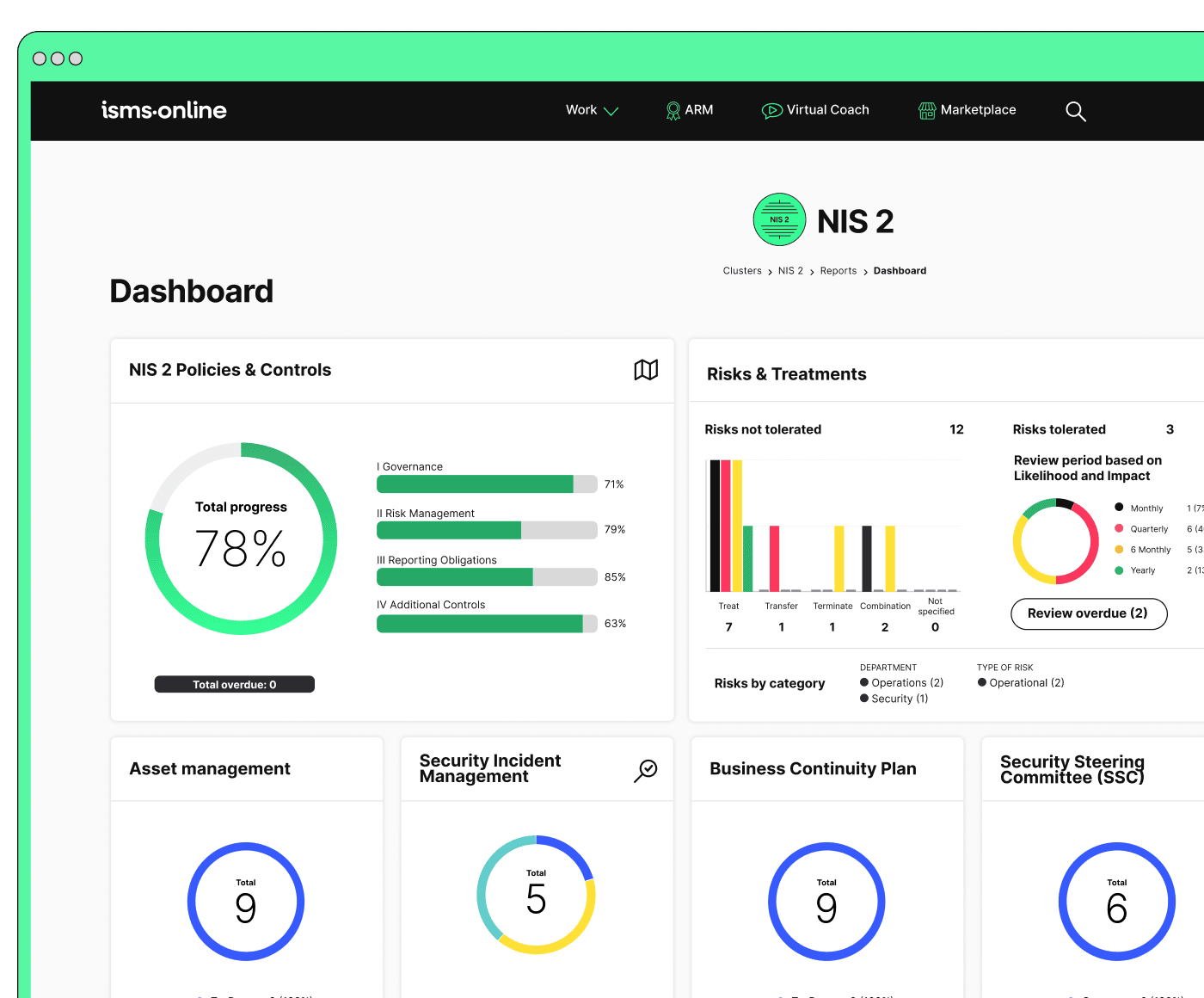
Be NIS 2-ready from day one
Launch with a proven workspace and templates – just tailor, assign, and go.
Who Owns Asset Decommissioning? Role Mapping, Escalation, and Evidence
Assigning ownership for asset return is not one meeting’s decision-it’s a systematic chain mapped to every point of the asset lifecycle. NIS 2 and ISO 27001:2022 demand assignment, logging, and closure at every handoff, with digital evidence at each step.
Real-World Role Clarity Map
- HR: Triggers return process at offboarding, assigns follow-up tasks to IT and InfoSec.
- IT/Infrastructure: Handles collection, disables access, confirms secured return, and documents deletion with technical proof.
- Compliance/InfoSec: Audits process, ensures logs are complete and accurate, escalates exceptions.
- Procurement/Supply Chain: Ensures supplier/third-party assets are contractually bound to return or e-deletion, tracks their receipt and closure.
- Deputy Owners: Step in during absence or exception events, closing gaps and maintaining continuity-reducing errors due to absence or staff turnover.
Automated escalation is essential: workflows must detect delays, reassign tasks, notify stakeholders, and log every outcome or incident for compliance and audit readiness. Role-mapped process avoids “tossing into the void,” driving resilience as each actor closes their loop.
How Do You Build a Provable Audit Trail? ISMS.online Examples for Resilient Compliance
Traceability is your strongest defence-and your greatest reassurance in audit or investigation. Each trigger, incident, or asset event must leave an evidence trail: role-logged, timestamped, and available at a moment’s notice.
| Trigger | Risk Update | Control/SoA Link | Evidence Logged |
|---|---|---|---|
| Offboarding event (HR) | Return initiation | A.5.11 | E-signed return log / Photo |
| Lost device reported | Open incident | A.5.11, A.8.10 | Exception record, escalation log |
| Device wiped/deleted | Wipe confirmed | A.8.10 | Wipe/destruct certificate |
With ISMS.online, every returned or deleted asset attaches digital artefacts-logs, signatures, photos-directly to each lifecycle event. No step is lost in translation; everyone from HR to the board, and every auditor in between, can see the closure record and its evidence.
Top 3 Auditor-Requested Signals at Returns
- Immutable event logs: digital, edit-proof, assigned to a person and timestamp.
- Closed-loop signoff: visible, completed return and deletion, not just policy intent.
- Exception-driven incident handling: open gaps become incidents, not buried issues.
When dashboards show these are part of routine operation, compliance anxiety and audit drama vanish.
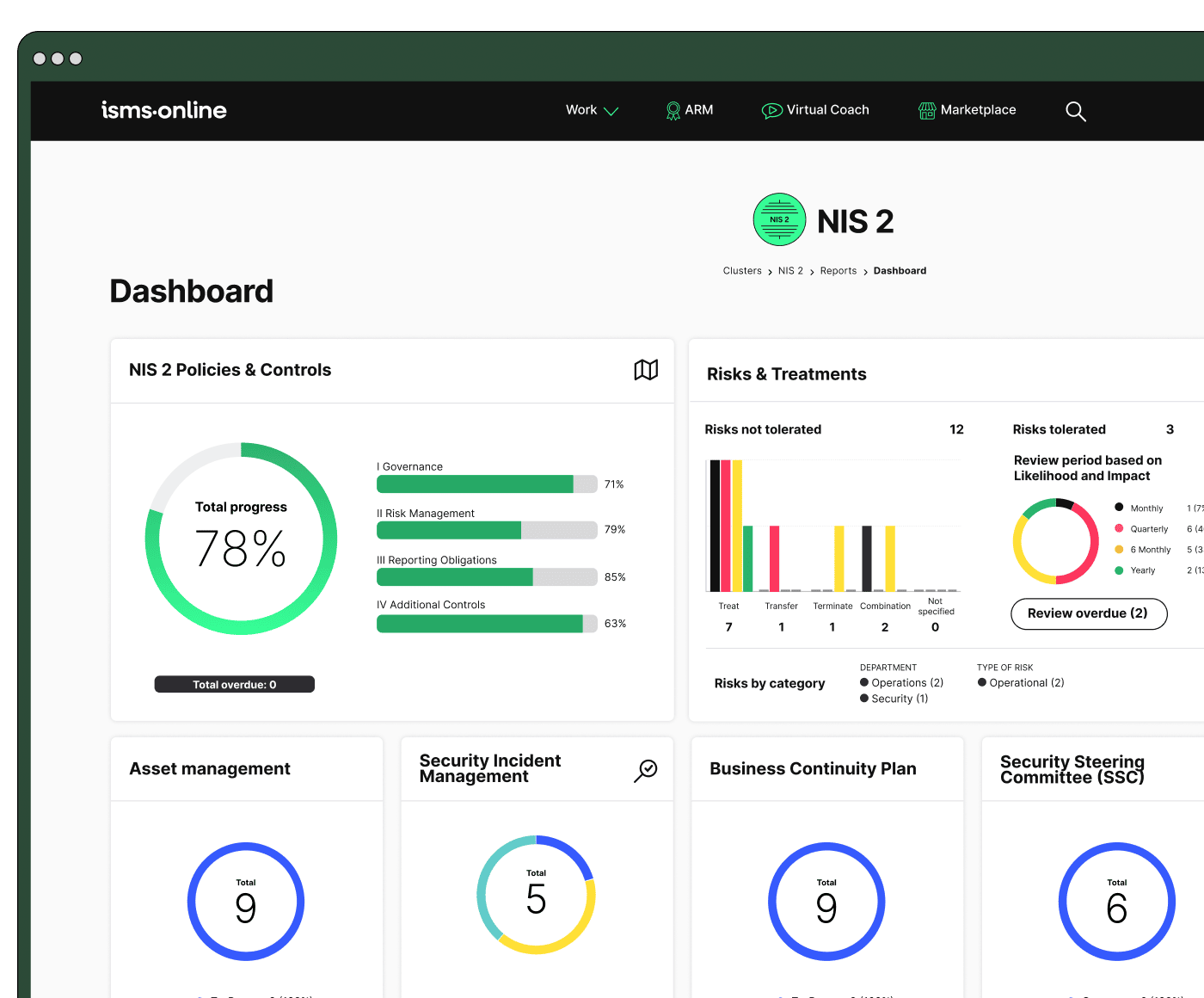
All your NIS 2, all in one place
From Articles 20–23 to audit plans – run and prove compliance, end-to-end.
What Does Automation Change? Embedded Workflows, Escalations, and KPIs in Everyday Practise
Manual tracking puts your process at the mercy of memory and motivation; automation enforces compliance regardless of stress, turnover, or time pressure. Every key event-handover, deletion, exception-is tracked, enforced, and evidenced, freeing people from remembering and allowing the system to prove trust.
- Workflow integration: HR offboarding triggers IT and InfoSec checkpoints, with automated reminders and escalations if any step lags.
- Visual Dashboards: Everyone sees every asset’s status-who owns it, where it is, whether it’s been returned, deleted, or logged with an exception.
- Incident generation: Any missed action triggers an incident ticket-making sure nothing stays open unnoticed.
- KPI monitoring: % on-time asset returns, average closure time, and exception rates-empowering real-time learning and accountability.
Automation doesn’t replace people; it protects them by turning please remember into already done.
How Are Lessons Learned Kept Alive? Continuous Improvement, Feedback Loops, and Proving Resilience
Resilience is not static; it is built by adapting to every slip, analysing every missed return or incident, and evolving the process. Under NIS 2 and ISO 27001, evidence isn’t just a snapshot-it’s a living chain of improvements, each version and root-cause analysis mapped and retrievable.
- Incident response and root-cause analysis: Each gap triggers an analysis, a retraining event, and a change to the process if needed.
- Living controls: Asset management and return processes are updated, versioned, and tracked-making improvement both routine and auditable.
- Stakeholder visibility: Dashboards and reports share closure status, incidents, and lessons learned with the board and regulators.
- Systemic assurance: When the audit comes, organisations can show the rhythm of closure, exception management, and improvement-not just intent.
A system that proves every lesson learned, every closure logged, earns trust not in policy, but in practise-one asset, one action at a time.
Ready to Build Trust? ISMS.online Today
The true leap isn’t installing a new tool or auditing once a year-it’s embedding a system that delivers traceable compliance every day, for every asset, across every workflow. With ISMS.online, every handback, deletion, and exception is recorded, evidenced, and ready for review-giving assurance to your team, the board, and the regulator.
The path to resilient asset management is not built with hope, but with action. Assign every return. Evidence every deletion. Automate every escalated event. Then, when trust is challenged, you can prove-instantly-that your organisation not only meets NIS 2 and ISO 27001 standards but exceeds them.
Systematised evidence speaks louder than any policy. Build your compliance resilience one closure at a time-because trust is built, not claimed.
Frequently Asked Questions
What does NIS 2 Article 12.5 require for asset return and deletion, and why is this a game-changer for compliance?
NIS 2 Article 12.5 establishes a clear, enforceable standard: every asset that can access sensitive data-regardless of whether it’s company hardware, BYOD, vendor-issued, or purely virtual-must be either physically returned or securely destroyed at the end of its lifecycle, and every step must be evidenced, role-attributed, and audit‑ready. Gone are the days of generic “all assets returned” forms or passive policy signoffs; modern compliance now demands that you can prove, with digital timestamped artefacts, that every device, credential, and account has been traced to closure or incident-reviewed as an exception.
This shift is not just a technical one-it transforms asset handling into a test of organisational integrity. Regulators, board members, and customers expect ironclad proof that nothing is left floating after staff departure, vendor offboarding, or device retirement. Data breaches and regulator investigations increasingly begin with a single missed laptop, ghost user, or dormant cloud login.
Proven asset closure isn’t paperwork; it’s tangible trust and an operational resilience benchmark in the eyes of regulators, customers, and shareholders.
Table: NIS 2 Article 12.5 – From Law to Daily Practise
| Expectation | In Practise (Action/Evidence) | Risk if Missed |
|---|---|---|
| Each asset logged to end-of-life | Asset register, closure logs, photo/cert | Audit failure, breach escalation |
| BYOD/vendor/cloud in scope | Ownership tracked, exceptions logged | Data leaks, regulatory probe |
| Evidence for every step | Digital logs, approval workflow, incident record | Board distrust, operational holes |
How does ISO 27001:2022 turn asset closure into an operational process, and where do organisations fail to deliver?
ISO 27001:2022 doesn’t just align with NIS 2-it powers its requirements with daily, role-driven routines. Annex A.5.11 (Return of assets) formalises the need for complete, up-to-date asset inventories that track each item from assignment to return, destruction, or acceptable exception. Annex A.8.10 (Information deletion) demands secure erasure protocols (e.g., following NIST 800-88) with proof attached-no “delete and hope” allowed.
Failure almost always appears where the real world and the policy library diverge: offboarding may look robust on paper, but manually tracked returns, late device pickup, delayed account deletion, and one-time “I’ll get it later” exceptions generate risky blind spots. Auditors and regulators don’t just want to see policies-they want uneditable evidence: asset ID, responsible user, action taken, timestamp, and digital attachments (sign-offs, photos, destruction certificates).
ISO 27001:2022 expects you to tie asset handling triggers (HR exit, contract end) into real workflows, verify asset closure with logs and assigned reviews, and draw a clear path from assignment to evidence-locked decommission.
Table: Bridging NIS 2 and ISO 27001:2022 – Audit-Ready Asset Handling
| Legal Requirement | Operational Artefact / Evidence | ISO 27001 Clause/Annex A Ref |
|---|---|---|
| Each asset tracked/signed off | Asset register, closure checklists/log | A.5.9, A.5.11 |
| Secure, evidenced data deletion | Destruction/wipe certificate, digital proof | A.8.10 |
| Triggered workflows, version control | Autoinitiated closure tasks, process logs | 7.5.3 |
| BYOD/vendor: exception logs | Incident/exception register, SoA review | A.5.21, SoA |
How do you structure bulletproof accountability so no asset is missed, and which teams must own each step?
No single person or team can achieve audit-proof asset closure-accountability must be distributed and automated across HR, IT/Security, Procurement/Vendor Management, and Compliance, with each playing a defined role:
- HR: Triggers workflows at exit, updates the asset roster, and coordinates with IT/security.
- IT/Security: Logs, wipes, disables, or collects all assets/accounts; attaches digital proof (photo, destruction certificate, signed checklist).
- Procurement/Vendor: Ensures third-party and contractor assets/accounts are returned, deleted, or reviewed for exceptions, all supported by contract-driven obligations and artefacts.
- Compliance: Verifies the evidence, reviews and escalates exceptions, and maintains live, immutable audit logs for board, audit, and regulatory review.
Automation platforms such as ISMS.online make these handoffs robust by assigning each closure step to a real owner, tracking status and deadlines, and blocking completion without supporting evidence. Incidents (e.g., lost devices, inaccessible ex-staff, delayed closure) are automatically created and must be closed out with root cause and remediation documented.
Table: Swimlane – Asset Closure Handoffs in a Resilient Workflow
| Step/Action | HR | IT/Security | Compliance | Procurement/Vendor |
|---|---|---|---|---|
| Initiate offboarding | Starts workflow, updates asset list | – | – | – |
| Asset/account closure | – | Disables/collects/erases, logs evidence | – | Co-ordinates vendors |
| Evidence review | – | Attaches checklists/certs | Audits, escalates | Confirms closure |
| Final exception review | – | – | Signs-off/Flags | Reviews contractually |
Why does automation close loopholes and what does a digital asset closure routine look like?
Without digital workflows, asset return/deletion is patchy and error-prone: checklists are ignored, spreadsheets drift out of date, and “ghost” assets linger long after offboarding. Automated platforms collapse these cracks-executing role-based, sequential steps where nothing is considered done until evidence is uploaded and certified.
- Initiation: HR offboarding triggers an automatic asset audit and closure task list.
- Action: IT/Security disables all access, collects/wipes hardware, uploads evidence (photo, digital cert), and closes the account in the register.
- Review: Compliance confirms closure or escalates missing steps-incidents are logged for exceptions (lost items, unreachable staff, incomplete info).
- Visibility: Operations dashboards display closure KPIs, outstanding items, exception trends, and active audits to leadership/board/auditor in real time.
Every returned or deleted asset becomes a data point in your resilience story-proving your compliance isn’t intent, but a lived, measurable discipline.
Example: Automated Asset Closure Workflow (Visual Outline)
Step 1: HR triggers exit → Step 2: Tasks assigned to IT/Security/Vendor → Step 3: Evidence uploaded, validated → Step 4: Unresolved issues generate incident review → Step 5: Compliance reviews/locks closure.
What makes an audit-ready asset closure trail, and how do you handle exception cases so they’re defensible?
An audit- or regulator-ready trail is built on immutable, role-attributed, and time-stamped evidence:
- Trigger: Offboarding (staff exit, vendor contract end)
- Risk Update: Asset/account flagged, risk owner notified
- Control/SoA Link: A.5.11 (return), A.8.10 (deletion), A.5.21/SoA (vendor/BYOD)
- Evidence: Digital proof-signed checklists, photos, wipe/destruction certificates, incident or exception review logs
Exception cases (lost assets, non-returned BYOD, inaccessible staff) must never be “assumed closed.” Instead:
- Log an incident, assign a root cause reviewer, require action (e.g., remote wipe, supplier alert, legal notice).
- Document full closure, signed by compliance.
Table: Closure Traceability Matrix-Real and Exception Case Examples
| Trigger | Risk Update | Control Ref | Evidence/Proof |
|---|---|---|---|
| HR exit | Asset flagged | A.5.11 | Signed return photo |
| Device EOL | Scheduled wipe | A.8.10 | Destruction cert |
| Vendor contract end | 3rd party review | A.5.21/SoA | Closure checklist |
| Asset lost | Incident logged | SoA, incident | Flag, close-out doc |
How does continuous improvement make evidence-based asset management real resilience, not a compliance checkbox?
Resilient organisations don’t just “comply” in the moment-they learn, adapt, and prove it. Every closure event, missed deadline, or exception is tracked, reported, and folded into process updates or training, accelerating response next time. Management review meetings, board packs, and audit reports are powered by living KPIs: closure lead-times, frequency of exceptions, incident root causes, and evidence of compliance improvements over time.
NIS 2 and ISO 27001 expect organisations to “surface, analyse, and resolve” every deficiency-not to hide, ignore, or postpone. Continuous improvement moves asset management from a one-off control to a board-level pillar of operational resilience and trust.
Audit‑proof asset management turns every evidence gap into a learning signal-organisations that adapt, lead.
What evidence will auditors and boards expect for asset return and deletion under NIS 2 or ISO 27001?
Auditors want the facts, not intentions:
- Asset Register: Uniquely identifies each device/account by assignment, status (returned/destroyed/lost), and closure details.
- Closure Documentation: Digital/offboarding checklists, photo uploads, signatures with time-stamps, and workflow logs for every closure event.
- Destruction/Wipe Proof: Certificates or digital logs for each erased or zeroised device or data-bearing medium.
- Incident & Exception Logs: Real-time tracking and closure reports for missed/lost assets, including investigation and corrective actions.
- Version-Controlled Policies & Workflows: Policy change history, procedural records, and version logs accessible for all asset handling controls.
- Board/Management Dashboards: Real-time KPIs-closure time, outstanding actions, exception frequency, improvement trends.
- Vendor Asset Proof: Contracts, delivery sign-offs, closure checklists from procurement/suppliers as evidence of third-party compliance.
Collectively, these artefacts guard against fines, reputational damage, and operational inertia-ensuring your asset management is a shield, not a liability.
What is the next step for turning asset closure from a risk into a competitive advantage?
To make asset return and deletion a driver of resilience-rather than a compliance grind-your teams need more than a policy. They need daily workflows that prove every closure, reveal every gap, and prompt response before risks crystallise. If you’re ready to shift from “asset intent” to “closure certainty,” consider a walkthrough of automated asset management in ISMS.online, with NIS 2/ISO-matched closure checklists and live operational dashboards. Equip HR, IT, compliance, and procurement to treat every asset event as a chance to reinforce trust-one closure, one proof, one step at a time.
Organisations that prove every asset closure-no matter how routine-don’t just survive audits. They earn trust and set the resilience bar for their entire sector.






