





































Why Is Audit-Grade Awareness and Hygiene Now the Critical Test for NIS 2 and ISO 27001?
The landscape of cyber compliance has shifted: under NIS 2, awareness and hygiene aren’t soft skills-they’re live operational controls, measured as rigorously as access management or device encryption. When a compliance officer, CISO, or audit lead faces a board or regulator, it’s never enough to claim, “We train our people.” The decisive test is evidence: precise, living records, mapped from boardroom to department, down to the last desk-logs that answer, “Who, exactly, did what, when, and which control does it fulfil?”
You hold audit trust only as long as you can prove, not just assert, your readiness.
Regulators now treat “missing proof” of cyber hygiene and awareness as critical failures-even in the absence of a breach (ENISA, 2023). The UK ICO reports that 70% of failed audits in 2023 traced directly to gaps in live evidence: missing logs, untracked refresher completions, or regional shortfalls (ICO, 2023). If your staff records, policy acknowledgements, and hygiene checklists live in fragmented PDFs, or worse-in annual Excel sheets-you’re exposed, no matter your intentions.
The modern bar is much higher. Enforcement begins with mapping: every NIS 2 requirement, from onboarding to role-based regional refreshers, must be traceable to exactly the right ISO 27001 controls, with exportable proof-not just jargon or stories, but time-stamped, living artefacts. This isn’t a burden; this is your competitive edge. Teams that implement continuous, automated, dashboard-driven awareness and hygiene not only pass audits-they accelerate procurement cycles, win trust with major buyers and partners, and preempt reputational damage.
If you’re still betting on legacy measures-annual training, static sign-offs, unstructured policy packs-the question is no longer if you’ll be challenged, but how soon. With ISMS.online, your audit story begins and ends with incontrovertible proof: always-ready, mapped, and exportable in seconds.
How Can Cyber Hygiene and Awareness Move from “Training” to Measurable, Continuous Engagement?
Audit-grade resilience doesn’t start in the IT room or the legal department-it starts where your people remember, respond, and act when it matters. Awareness and hygiene only “live” in the organisation when people are continuously engaged, not just sent a course link once a year.
True engagement endures when the last nudge, test, or policy was received weeks-or months-ago, and staff can still spot a threat or make the right choice from memory, not obligation.
The new requirement is twofold: continuous and context-driven. ENISA research highlights that rolling, risk-driven training sequences-timed to risk events and local working trends-increase engagement retention by 30–50% versus annual refresher models (ENISA, 2023). In practise, that means your platform must:
- Launch real-world “fire drills,” such as phishing simulations linked to retraining for those at risk
- Assign policy sign-offs by risk profile, geographic region, and role type
- Trigger pulse feedback at every content touchpoint, surfacing gaps before an audit does
- Log all completions, issues, escalations, and improvement cycles in a single, auditable record-not in scattered spreadsheets
With ISMS.online’s embedded training flows and real-time feedback mechanisms (ISMS.online Staff Training), every policy, test, and feedback loop is live, role-mapped, and region-aware. The entire journey is tracked-not just endpoints. Remediation is triggered automatically: staff who fail, skip, or question content are flagged for management long before findings escalate. Critically, every touchpoint-reminder, completion, escalation-is time-stamped and versioned, so nothing slips into the “null zone” that kills audit trust.
If your system can’t show rapid, gapless engagement cycles-by location, function, and risk-you’re not just missing a technical best practise; you’re at risk of sanction. In the new world, evidence is both the journey and the destination.

Master NIS 2 without spreadsheet chaos
Centralise risk, incidents, suppliers, and evidence in one clean platform.
What Does It Take to Prove NIS 2 Awareness: Live ISO 27001 Mapping and Audit-Ready Traceability
The new gold standard is live traceability: every NIS 2 awareness and hygiene expectation must be dynamically mapped to specific ISO 27001/Annex A controls, with time-stamped evidence always ready for both auditors and internal stakeholders.
A static mapping is a fossil; only living crosswalks pass regulator tests.
Below is the operational crosswalk most auditors expect to see-not as a theoretical mapping, but as a real-time export from your compliance dashboard:
| NIS 2 Expectation | Real-World Operationalisation | ISO 27001 / Annex A Ref |
|---|---|---|
| Staff Awareness | Automated log, per-role delivery, reflected in staff training modules | 7.3, A.6.3 |
| Hygiene Policy Control | Policy sign-off, versioned audit logs, escalations for non-completion | A.7.7, A.8.7 |
| Regional/Role Coverage | Mapping by department, location-completion logs for all permutations | A.5.6, A.5.8, A.7.9 |
| Issue Escalation & Remed. | Built-in escalation for failed quizzes or overdue evidence | A.6.3, 10.2 |
Example, live in ISMS.online: Rolling phishing simulations assign retraining for failed users; every touchpoint is logged by timestamp, role, region, and mapped to SoA export, ready at audit (ISMS.online Staff Training Features).
If you can’t produce, in one click, a mapping that starts with NIS 2’s “hygiene” and ends with the artefacts in your live ISO 27001 records, you’ll face extended audit cycles, delays in onboarding with customers, or worse-regulatory findings with significant impact.
ISMS.online’s “update once, crosswalk to all” methodology eliminates 40%+ of redundant compliance admin and ensures every audit trigger surfaces mapped, current, and complete evidence, instantly (Klavan Security). No more crosswalking by spreadsheet. Live linkage is resilience in practise.
How Does an Evidence-Driven Stack Build Ongoing Board and Auditor Confidence?
It’s not enough to show that your people completed a course-audit resilience is defined by the ability to surface every detail about “who, what, when, under which control and policy version” across locations, roles, and risk levels. A living, evidence-driven ecosystem is the new baseline, demanded by both boards and auditors under NIS 2.
Every click, completion, and correction is a line in your story-ensure it’s one auditors and boards trust.
ISMS.online gives you a continuous, real-time evidence journey:
- Trigger: Any of-policy update, audit event, incident, new regulatory rule, role change, or region onboarding.
- Evidence produced: Time-stamped, role-located, feedback-enabled logs-audit-ready by default.
- Control link: Mapped, synchronised with SoA and ISO 27001/Annex A references.
- Dashboard view: All operational states-completion, lateness, remediation-surfaced instantly.
- Export on demand: Tailored proof for boards, procurement, or regulators; mapped to organisational, geographic, and risk axes.
Trace Example Table (ISMS.online dashboard, always up to date):
| Trigger | Risk Update/Action | Control/SoA Link | Evidence Logged |
|---|---|---|---|
| Failed phishing test | Auto-remediation assigned | A.6.3, A.8.7 | User, retrain, timestamped |
| Policy revision | Organisation-wide sign-off | A.7.7 | Version, user, time, IP log |
| New branch onboard | Local content deployed | A.5.6, A.7.9 | Region, staff, completion log |
KPI dashboards built into ISMS.online (isms.online/features/kpi-dashboards/) provide drill-throughs for audit and board reviews-showing trending improvement, completion gaps, and real-time feedback closes. Boards see audit readiness, not just plans.
Boards and auditors both need two things: proof you saw gaps before external challenges, and a living demonstration of your capacity to improve. You don’t get there by piecing together legacy training records-you do it by engineering confidence from first principles.
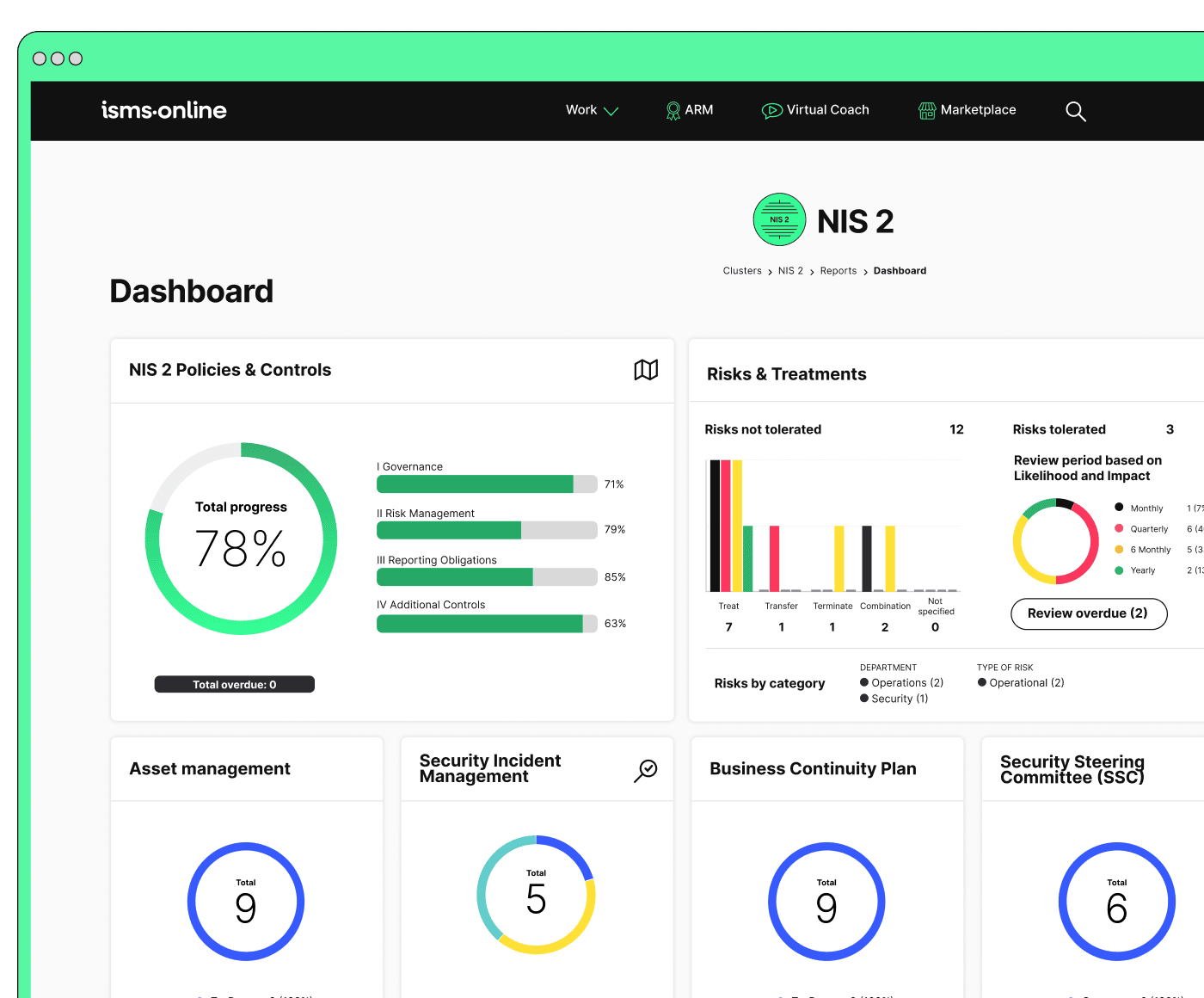
Be NIS 2-ready from day one
Launch with a proven workspace and templates – just tailor, assign, and go.
How Do You Engineer Persona-Specific, Role-Based Hygiene That Overcomes Audit Blind Spots?
Not all risks, people, and geographies are equal. Under NIS 2, “one-size-fits-all” is obsolete. Audit and compliance are now won by segmentation and precision-by role, by geography, by risk and behaviour-and by generating targeted evidence aligned to every layer.
Below is a persona-based architecture for audit outputs-each with specific needs and evidence requirements:
- Kickstarter / Operator: Needs guided flows and audit-ready exports; output is a complete, per-role, per-region evidence map.
- CISO / Senior Security Leader: Works in board language, seeks aggregated dashboards, improvement cycles, trendlines, and scenario evidence.
- Privacy & Legal Officer: Focuses on defensibility to regulators; needs detailed mapping to GDPR and ISO 27701, and proof of region- and role-compliance.
- IT / Security Practitioner: Automates reminders and retraining, surfaces full logs, incident feedback, escalation, and role-based remediation.
For each, ISMS.online enables focused exports, tailored feedback, and “blind spot” surfacing. Before audit, you run a compliance check by risk, role, and locality-flagging incomplete or outdated evidence, with remediation built in.
Segmentation isn’t ‘extra credit’-it’s now the pass/fail line for audit survival.
When every role is tracked, every incident triggers risk-based awareness, and every “blind spot” is surfaced and closed before audit day, you’ve moved from passive to active assurance. ISMS.online automates these checks-so every team, every stakeholder, sees the panel most relevant to them, and every action is audit-mapped, time-stamped, and recoverable.
Why Does Evidence Export Matter-and How Does ISMS.online Make It Effortless?
Regulators, boards, procurement leads-they want different slices. What was, until recently, a days-long scramble to collect, philtre, and cross-reference is now-if engineered right-a one-click operation.
ISMS.online’s evidence stack delivers each stakeholder exactly what they need:
- Policy packs (versioned and mapped) per team, region, and risk
- Completion logs, granular by event, role, time, task, and geography
- Audit logs charting review, approval, improvement, and escalation actions
- Real-time feedback records, signed-off and tracked by control/SoA
- Exportable in PDF, Excel, or dashboard format-redacted or filtered per recipient
You can satisfy procurement with customer-facing role evidence, boards with trend and risk improvement cycles, and regulators with granular compliance packs-all generated and mapped in minutes, not days.
Evidence isn’t about volume; it’s about precision and accessibility-proving what matters, to the right people, at the right moment.
Boards trust data they can see and philtre. Procurement values clarity and speed. Regulators demand precision and mapping. With ISMS.online, you deliver all three, earning trust as soon as the request lands.
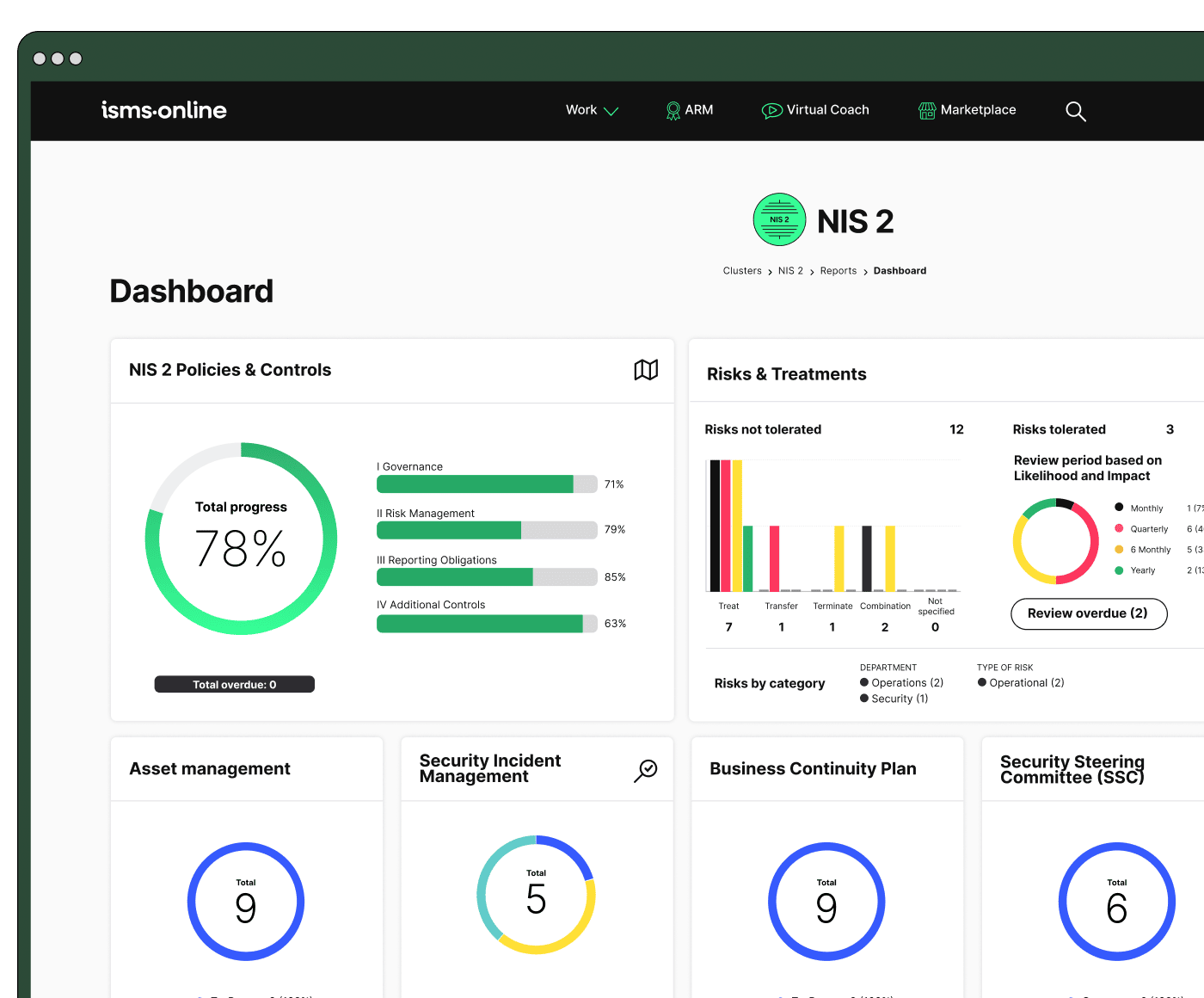
All your NIS 2, all in one place
From Articles 20–23 to audit plans – run and prove compliance, end-to-end.
How Can Continuous Improvement and Automated Errorproofing Turn Awareness into Measured Board Assurance?
Complacency is the friend of cyber risk and the enemy of audit resilience. NIS 2 forces you to engineer not just completion, but the continuous surfacing and closing of gaps-before a regulator, auditor, or attacker gets there first.
Automation is your safeguard in a dynamic compliance world:
- Live KPIs and issue flags: Missed tasks or acknowledgements trigger dashboards and escalate to management
- Targeted retraining: Staff who fail policy or phishing tests are assigned and tracked for targeted follow-up
- Automated “blind spot” surfacing: Departments, roles, or locations with lower engagement are flagged well ahead of audit time
- Continuous feedback cycles: Internal simulation and feedback data elevate the platform beyond “what happened” to “how we improve it”
ISMS.online’s real-time dashboards aren’t static reports-they’re living scoreboards where progress, issues, and improvement loops are visible at every scroll and click (ISMS.online Staff Training). Internal self-audit cycles, remediation assignments, and stakeholder-specific reporting all drive the constant evolution that both boards and regulators reward.
You can’t fake improvement. Only living, automated feedback cycles prove a culture of vigilance and learning.
Boards-and their stakeholders-see not just compliance, but a commitment to resilience. And that’s the currency of lasting trust.
How Do You Demonstrate “Always Audit-Ready” NIS 2 and ISO 27001 Compliance-Not Just at Audit, But Every Day?
Audit readiness isn’t about the ability to work harder as a deadline looms; it’s about the ability to prove, every single day, that you are audit-grade-regardless of when the inspector, customer, or regulator appears.
With ISMS.online:
- You assign, log, and export every policy, training, and hygiene control in real time
- Compliance gaps are surfaced instantly-per staff, per region, per risk-never discovered in panic mode
- Every action, escalation, completion, and retraining is mapped to controls, cross-framework references, and version histories
- Exports for boards, procurement, or regulators are assembled in clicks, not days-filtered and ready for _that_ audience
In the world of NIS 2 and ISO 27001, audit readiness is a culture, not a calendar event.
With ISMS.online, you become the compliance leader everyone counts on-exemplifying resilience, trust, and confidence not by claim, but by repeatable proof. The new gold standard isn’t passing an audit-it’s having nothing to hide and everything to show, any time, to any stakeholder, every day of the year.
Build that trust, reduce risk, and empower your team-as the compliance hero every board, customer, and regulator now looks for.
Frequently Asked Questions
Who is actually accountable for NIS 2 cyber hygiene and awareness, and how is responsibility made real at every level of the business?
Ultimate accountability under NIS 2 is vested in the board and executive management, but compliance only works when accountability is explicitly delegated, operationalised, and evidenced through every tier of your organisation-including IT, regional leads, all staff, and supply chain partners.
Unlike legacy models, NIS 2 creates a provable chain of responsibility that doesn’t blur at the executive suite. Boards and senior management remain legally and personally accountable for cyber hygiene and awareness, but this accountability must be enforced and evidenced through a living web of assigned roles, tracked actions, and closed feedback loops. In practise, compliance sponsors allocate responsibilities via written assignments or workflow tools. Operational and regional managers localise, adapt, and enforce awareness for their staff and contractors, assuring content fits both language and role. IT/security teams deliver and monitor targeted content, simulations, and retraining, closing gaps swiftly. Every staff member and critical supplier must not only complete required training but also actively participate in awareness cycles-recorded by time-stamped signoff and quiz performance.
When a breach or audit occurs, the evidentiary requirement is not “Who owns the policy?” but “Who did what, when, and who chased the laggards?” Modern platforms such as ISMS.online make this web visible and auditable, with exportable logs demonstrating every handoff-protecting both the business and the board.
Accountability is no longer abstract-if you can’t show operational records proving every role acted, your board risks regulatory scrutiny.
Accountability Chain Table
| Role | Key Actions | Prove With |
|---|---|---|
| Board / Executives | Approve, assign, monitor accountability | Assignment logs, reviews, closure |
| IT/Security | Deliver training, deliver simulations | Completion logs, incident audits |
| Regional Leads | Localise, chase, confirm coverage | Coverage maps, signed feedback |
| Staff/Suppliers | Actively complete, respond, retrain | Sign-offs, quiz pass/fail logs |
| Audit/Regulator | Test evidence chain, review records | End-to-end digital audit trail |
How has NIS 2 changed cyber hygiene training-and why is “continuous” now non-negotiable?
Cyber hygiene under NIS 2 and ISO 27001:2022 is a continual, adaptive process-driven by risk, scenario, and role-not a “once-a-year” tick-box.
Annual “awareness” programmes fail today’s compliance test. Both NIS 2 and ISO 27001:2022 require ongoing, role-specific training: campaigns must adapt to changing threats, incorporate real-world scenarios (like phishing simulation drills), and have mechanisms to retrain and retest after failures. Awareness is tracked and evidenced not annually, but monthly or even more frequently-across every department, region, and staff level, with automated escalation when someone falls behind.
The board and management must see not only overall completion rates but also targeted improvements-who improved after failure, which domains needed extra support, how quickly incident-driven retraining was delivered. Staff in riskier roles get more frequent, scenario-driven learning. Remote or non-native teams receive contextually adjusted material. Inaction (or a lack of living evidence) is itself a compliance violation; “just show last year’s attendance sheet” doesn’t survive an audit or an incident.
Vigilance is measured in weeks, not years-NIS 2 demands live evidence of progress, not historic proof of participation.
Key Shifts Table
| Training Model | Old Standard | NIS 2 / Modern Standard |
|---|---|---|
| Frequency | Annual | Monthly/Continuous |
| Scope | Generic staff-wide | Role- and region-specific |
| Scenario coverage | Static content | Simulations, tailored quizzes |
| Proof | Sign-in/Certificates | Timestamped logs, remediation |
What evidence do auditors and regulators require for cyber awareness and hygiene-and what no longer passes?
Auditors and regulators expect a living, digitally linked chain of assignment, action, and follow-up-per individual, per region, per training version.
Static records-such as sign-in sheets, PDFs, or certificate dumps-are insufficient under NIS 2 and ISO 27001:2022. What consistently passes audit today:
- Assignment logs: explicit documentation of who issued and who received each training or policy, with roles tied to job requirements.
- Digital sign-offs: timestamps of completion, including which policy version was reviewed.
- Simulation outcomes: individual phishing, scenario quiz, or drill results, with automatic assignment of retraining for misses.
- Exceptions/escalations: overdue assignments, repeat failures, and proof of closures or managerial escalation.
- Management cycle: evidence of board and management review, action item completion, and documentation of continuous improvement.
ISMS.online makes all of this instantly visible and exportable; if your system can’t immediately show who failed last month and was retrained, or who lagged behind in a supplier group, your audit trail is incomplete.
If you can’t instantly tie every assignment, outcome, and improvement back to real people, your evidence fails-even if all boxes are ticked.
Old vs. New Audit Evidence (Sample Table)
| Evidence Item | Old Model | Modern Required |
|---|---|---|
| Attendance | Annual sheet | Monthly per role |
| Policy sign-off | Hire-only | On-update, all staff |
| Simulation | Irregular drill | Regular, with logs |
| Review logs | Yearly minutes | Action, closure cycles |
How do you unify awareness and evidence across NIS 2, GDPR, DORA, and other overlapping frameworks-without waste and repetition?
Build modular, role-based content mapped to all frameworks, and tag evidence so every completed assignment serves multiple compliance demands-saving time and boosting audit readiness.
Modern compliance programmes defeat “framework sprawl” by architecting core awareness packages that satisfy multiple overlapping requirements-then refine for risk, region, or role only where needed. Training, simulations, and evidence are mapped to all relevant clauses (NIS 2, GDPR, DORA, TISAX) at the assignment level, ensuring users aren’t burdened by redundant tasks and your proof is unified.
ISMS.online allows a single training instance (like a phishing simulation) to fulfil, evidence, and export for every applicable regulation. This reduces admin effort by up to 40%, minimises staff compliance fatigue, and shores up auditor and regulator trust through living, cross-framework traceability. When requirements shift, you update the module and re-map evidence-no need for parallel, overlapping admin.
One training, many frameworks: eliminate redundant effort, and let your evidence prove compliance to every regulator, from NIS 2 to GDPR.
ISO 27001 Bridge (Operationalization Table)
| Expectation | Operational Action | ISO 27001 Ref. |
|---|---|---|
| Phishing vigilance | Simulate, retrain, log | A.6.3, A.8.7, 7.3 |
| Board oversight | Review KPIs, close actions | 9.3, A.6.3, A.8 |
Cross-Regulatory Traceability
| Event | Risk Update | Control/SoA Link | Evidence Tracked |
|---|---|---|---|
| Failed simulation | Retraining logged | NIS 2 Art 21 | User progression |
| Policy revision | Notification out | ISO 27001 7.3 | New sign-off proof |
| DPIA flagged in GDPR | Awareness module | GDPR Art 39 | Confirmation/quiz |
What KPIs distinguish successful NIS 2 compliance and board confidence?
Success is evidenced by KPIs that show not just completion, but risk reduction: timely participation, knowledge improvement, prompt closure of incidents-and that all roles, regions, and recalcitrant cases are visible and actioned.
Boards and regulators look for metrics such as:
- Real-time training completion: ≥95% across roles/regions, per cycle
- Simulation/quiz fail rates: <5% (and improving quarter-on-quarter)
- Retraining resolution: 100% of failed users retrained and retested within one cycle
- Exception handling: all overdue cases detected, escalated, and resolved within policy timeline
- Management review closure: actions tracked from recommendation to full closure
- Evidence export speed: ≤5 minutes from request to proof pack
- Continuous improvement: trend lines not just for pass/fail, but for faster risk closure and recurrent issue reduction
ISMS.online enables live dashboards and traceability reporting for all these KPIs, letting you proactively steer compliance before the next audit or regulatory request.
KPIs that track improvement, not just attempts, are the signature of mature, board-trusted compliance.
What audit traps most often break NIS 2 or ISO 27001 readiness-and how can you proactively close these gaps?
The most lethal audit failures stem from fragmented or “dead” evidence-unmapped versions, missed roles, absent retraining, static dashboards, and unclosed improvement cycles.
Common audit pitfalls include:
- Outdated or unmapped policy versions: staff signed off on an old policy, without clear version history
- Siloed or manual evidence: key proof scattered in email threads, shared drives, or lost to turnover
- Incomplete coverage: missing suppliers, remote staff, subsidiaries, or contractors, especially in other regions or languages
- Neglected post-incident cycles: failure to retrain after a phishing fail or live breach
- False dashboard comfort: averages hide disengagement in vital pockets (e.g., regional teams or critical third parties)
- Leadership action with no closure: management sets review actions without tracking execution or confirming issue resolution
To futureproof, automate assignment, reminders, and escalation, route completion and incidents to both line and regional managers for validation, and ensure every improvement or incident cycle is mapped to people, roles, and evidence. Regular scenario-based self-audits-supplementing annual reviews-close hidden gaps.
Resilience comes from living, mapped records-proving not just that staff participated, but that you improved, everywhere, after every risk event.
How do you “prove, not just claim” NIS 2 and ISO 27001 compliance-live, to boards, auditors, or regulators?
With ISMS.online, every operational and strategic compliance proof-assignments, completions, incident logs, retraining cycles, management reviews-is mapped, time-stamped, and instantly exportable for any stakeholder, in any region.
The board can see role- and region-specific dashboards: which teams lag, who improved, where retraining closed a risk. CEO and audit leads can generate an up-to-the-minute report-including evidence of completed assignments, policy versions, incident responses, and closure of every improvement cycle. For regulators, complete audit packs are ready in minutes when requested-mapped to frameworks, risks, and legal references, with proof tracked down to the individual. You demonstrate operational maturity, not just paper compliance, and support both continual resilience and robust stakeholder trust.
With living compliance, audits are no longer a quarterly fire drill-they’re just another day’s work in a resilient organisation.
With this approach, your business doesn’t scramble at audit time-it communicates trust and readiness every day, earning both regulatory confidence and a competitive edge.






