





































Why Are Supporting Utilities Now a Top Compliance Priority-and What’s at Stake?
Gone are the days when supporting utilities-power, water, telecoms, heating, and cooling-could be relegated to the background of your compliance framework. Today, breaches, failures, or undocumented moments in utility management have become direct compliance flashpoints under the NIS 2 Directive and ISO 27001:2022 (ENISA 2023). Europe’s regulatory landscape has undergone a seismic shift: every time a generator contract expires, a water system is left untested, or an asset registry becomes a static spreadsheet, your operational resilience-and legal standing-are at risk.
Operational silence is no longer protection-auditors now look for evidence, not promises.
The real vulnerability isn’t dramatic blackouts or data-centre floods. Instead, it’s traced to mundane oversights: untracked supplier contracts, missing or outdated logs, single-owner knowledge, and processes that exist only “on paper.” The NIS 2 Directive and ISO 27001 drive a new benchmark-living, digital traceability. Auditors and regulators don’t care about policies unless you can instantly show who owns the risk, when the last review occurred, and how you respond when an outage or incident disrupts the organisation.
The consequence? Businesses are now evaluated-and penalised-based on the completeness, currency, and accessibility of their utility evidence. Fines, reputational damage, and even service pauses now flow directly from “missing artefact” failures. It’s not enough to have intentions; you need an always-on evidence engine that lets your team, auditors, and board see resilience in action.
How Do You Map NIS 2 Utility Controls to ISO 27001-and Actually Operationalise Them?
Audit fitness is about living connections, not checklists. Mapping Article 13.1 of the NIS 2 Directive to ISO 27001 isn’t about copying requirements across a spreadsheet. It means establishing a provable link from European regulatory expectations to every operational action: from asset registers to supplier contracts, to maintenance logs and incident responses.
ISMS.online’s approach? Directly embed every supporting utility-assets, suppliers, contracts, incidents-within a unified register, mapped to ISO 27001 Annex A.7.11 (supporting utilities), A.8.13 (information backup), A.7.5 (environmental threats), and A.8.14 (redundancy). For each, you don’t just “copy” a policy; you create a digital artefact: a contract upload, a log file, a timestamped test, and a named owner.
When an auditor knocks, you don’t hand over a policy; you surface live, linked, date-stamped actions-all in one environment.
Failure to operationalise-such as relying on contracts lost in email chains or logs stored on individual hard drives-now equates to non-compliance. The moment your controls are proven to be “theoretical,” exposure accelerates. ISMS.online closes this gap by enabling operationalization as a daily discipline, not a last-minute audit scramble.
ISO 27001/NIS 2 Bridges: From Expectation to Living Control
| Expectation (NIS 2, Regulator) | Actionable Operationalisation | ISO 27001 Annex Reference |
|---|---|---|
| Utility breakdown never halts business | Register asset, automate test logs, assign review owner | A.7.11, A.8.14 |
| Supplier reliability is proven | Upload contracts, review grippage, escalation logs | A.5.19, A.5.20, A.8.13 |
| All maintenance current & tracked | Timestamped logs, named reviewers, auto-escalation | A.7.13, A.8.13 |
| Incident responses update controls | Post-incident reviews feed control updates | A.5.27, A.5.29, A.8.13 |
Every box in this table is designed to move your organisation from “promise” to “proof.”

Master NIS 2 without spreadsheet chaos
Centralise risk, incidents, suppliers, and evidence in one clean platform.
How Do You Build a Living Audit Trail for Utility Compliance?
Resilience is no longer judged by written policies alone; it’s measured in living, digital audit trails. Every touchpoint-asset creation, supplier update, maintenance run, incident-is now a tracked event, mapped from trigger to evidence to responsible owner. The gold standard? Audit logs that are timestamped, location-tagged, linked to relevant contracts, and reviewed by a named staff member.
A single missing log or unassigned asset can topple an entire audit-traceability is mandatory, not optional.
This living audit trail is only practical when you consolidate asset registers, contract uploads, maintenance reminders, and incident logs in one digital environment. ISMS.online weaves together asset, contract, risk, and evidence registers with workflow and role assignment-so every event is not only recorded but embedded in the compliance loop.
Audit Chain-of-Custody: Ensuring Evidence Holds in Court and Audit
| Trigger Event | Risk/Update Action | ISO 27001 Control | Audit Evidence (Example) |
|---|---|---|---|
| Generator test fails | Risk status, owner alerted | A.7.11, A.8.13 | Log file, remedial action note |
| Contract expiration | Renewal process, supplier flagged | A.5.19, A.5.20 | Contract.pdf, email record |
| Water leak incident | Response handling, control reviewed | A.5.29, A.7.5 | Incident report, lessons file |
| HVAC maintenance completed | Record entry, date, photo, owner | A.7.11, A.7.13 | Maint. report, photo upload |
With real-time dashboards, an auditor or regulator can “drill through” from any incident or maintenance to its owner, action, evidence, and control link. This is the operational difference-and the audit advantage-of shifting from “evidence at rest” to “evidence in motion.”
How Does Ownership and Automated Accountability Actually Work?
Accountability in compliance isn’t paperwork-it’s a culture made real by embedded roles, workflows, and digital reminders. In ISMS.online, every supporting utility and every compliance control is assigned to an owner, reviewed on a schedule, and escalated automatically if overdue or at risk (isms.online).
A resilient evidence loop is a system of action, not a file repository.
Facilities managers log test results directly; supplier managers update contracts; CISO or risk heads review, approve, and digitally archive every control. Automated reminders chase overdue actions-removing the risk of silent drift and unowned assets. The living audit trail flags not only what is complete, but what is missing, broken, or slipping-so you pre-empt compliance failure before it cascades into business impact.
Tracking the Evidence and Review Cycle
| Activity Stage | Responsible Owner | Required Evidence | ISMS.online Artefact |
|---|---|---|---|
| Detect control/utility event | Asset/facility manager | Log, incident, photo | Asset dashboard, upload |
| Incident response/update | Ops/Supplier manager | Remediation log | Ticket notes, lessons log |
| Overdue detected (reminder) | System/manager | Dash alert, updated notes | Dashboard, activity feed |
| Final review, approval, archive | CISO/Compliance head | Signed/dated approval | Audit export, SoA mapping |
This cycle ensures that everyone, from asset owner to board, knows their part in the resilience mosaic-and proof is no longer a guess or afterthought.
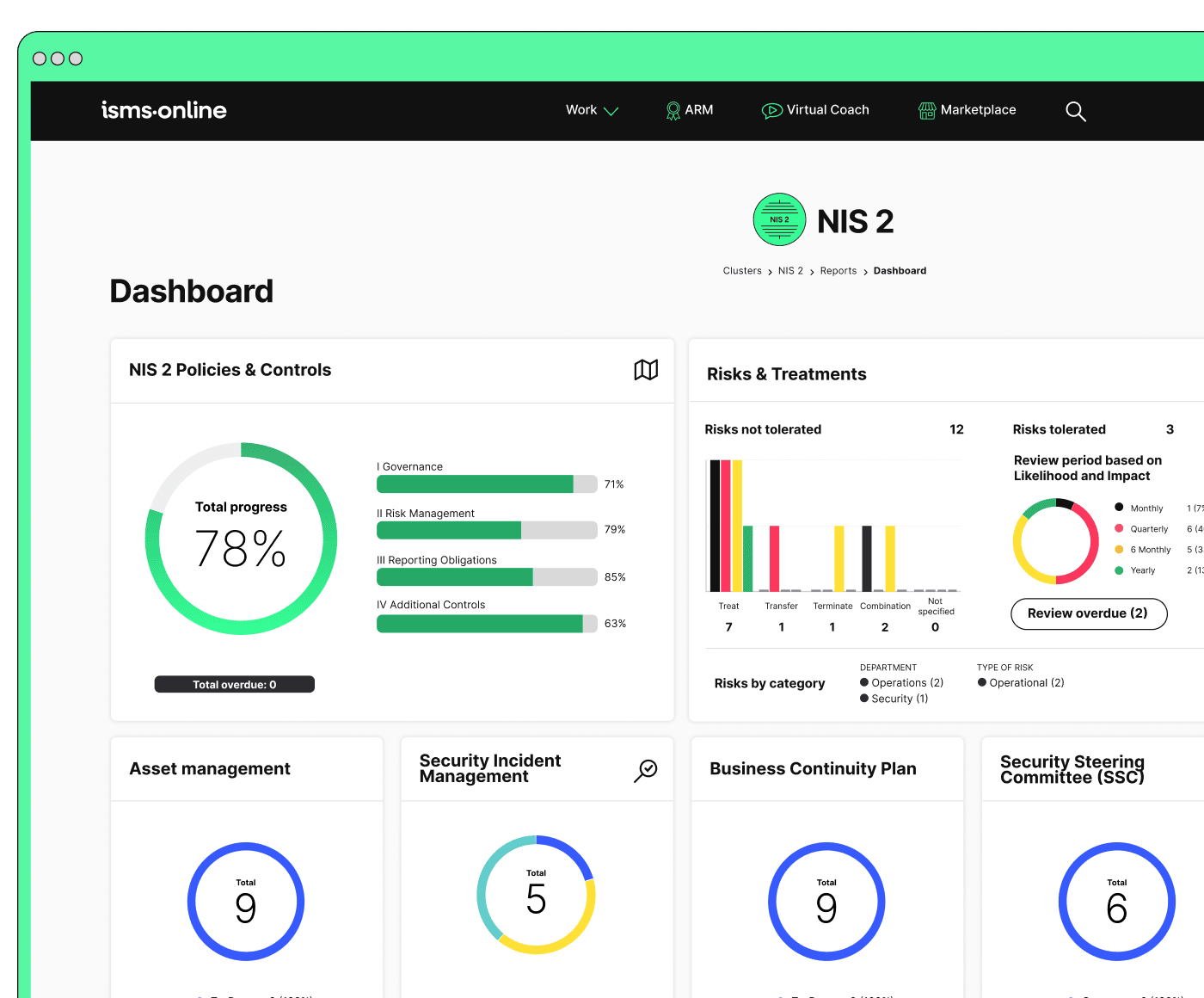
Be NIS 2-ready from day one
Launch with a proven workspace and templates – just tailor, assign, and go.
How Do You Handle Multi-Site, Multi-Jurisdiction Compliance Without Losing Control?
Cross-jurisdiction complexity threatens silent compliance gaps-one site out of sync, one contract missing a local clause, and the entire group risks audit failure or regulatory penalty. ISMS.online solves this through hierarchical jurisdictional tagging: every asset, register, incident, or supplier can be flagged by location (country, region, building). Every change, owner, and contract is both archived and searchable by jurisdiction.
Audit readiness is broken the moment you can’t map an asset, risk, or contract to its local and group-level control.
You can instantly aggregate evidence by site, generate export packs for local authorities, or drill down to any flagged gap-without duplicating effort or exposing your business to “compliance drift” with each expansion or new jurisdiction. ISMS.online’s Statement of Applicability (SoA) mapping system highlights where controls and evidence are missing, complete, or overdue-site by site, asset by asset.
Multi-Site SoA Traceability Table
| Site/Asset | SoA Control | Owner | Supplier/Contract | Evidence Attachment |
|---|---|---|---|---|
| Frankfurt Data Hall | A.7.11, A.8.13 | A. Köhler | E.ON, CoolTech AG | Contract, log, maint. notes, photo |
| London HQ | A.7.5, A.8.14 | P. Singh | BT Group, AA Air | Supplier report, log file, review |
| Barcelona Branch | A.7.13, A.7.11 | L. Romero | Gas Natural, Freddo | Maint. ticket, incident report |
This kind of traceability doesn’t just impress auditors-it unlocks operational confidence as you grow.
What Do Board and Executive Teams Need to See for True Assurance?
Modern boards want living proof, not checkbox compliance. They expect dashboards, KPIs, and evidence packs that quantify resilience: “Are all critical assets tested, reviewed, and contractually current? Were all incidents resolved and their lessons mapped?” Board-ready reporting is now a compliance necessity.
Leadership no longer tolerates compliance by hope; they want resilience they can quantify, monitor, and debate in real time.
With ISMS.online, dashboards surface at-a-glance views of:
- % of critical utility assets with current, audit-ready evidence
- Overdue or missing supplier contracts
- Maintenance/test recency and coverage rates
- Mapped asset-to-incident closure rates
These board-impact KPIs flow directly into risk committee packs or resilience dashboards, providing not just static compliance, but ongoing, actionable assurance.
KPI Table: Board-Ready Utility Compliance Report
| KPI Metric | Target/Threshold | Board-Ready Insight |
|---|---|---|
| Critical assets e-logged | 95%+ | Rapid resilience index |
| Overdue contracts | ≤1 per cycle | Supplier reliability risk |
| Recent test/review | 100% past 90 days | Assurance readiness |
| Incidents “closed loop” | 100% mapped | Accountability and closure |
Effective reporting means executive teams can spot, investigate, and direct improvements with confidence rather than after-the-fact panic.
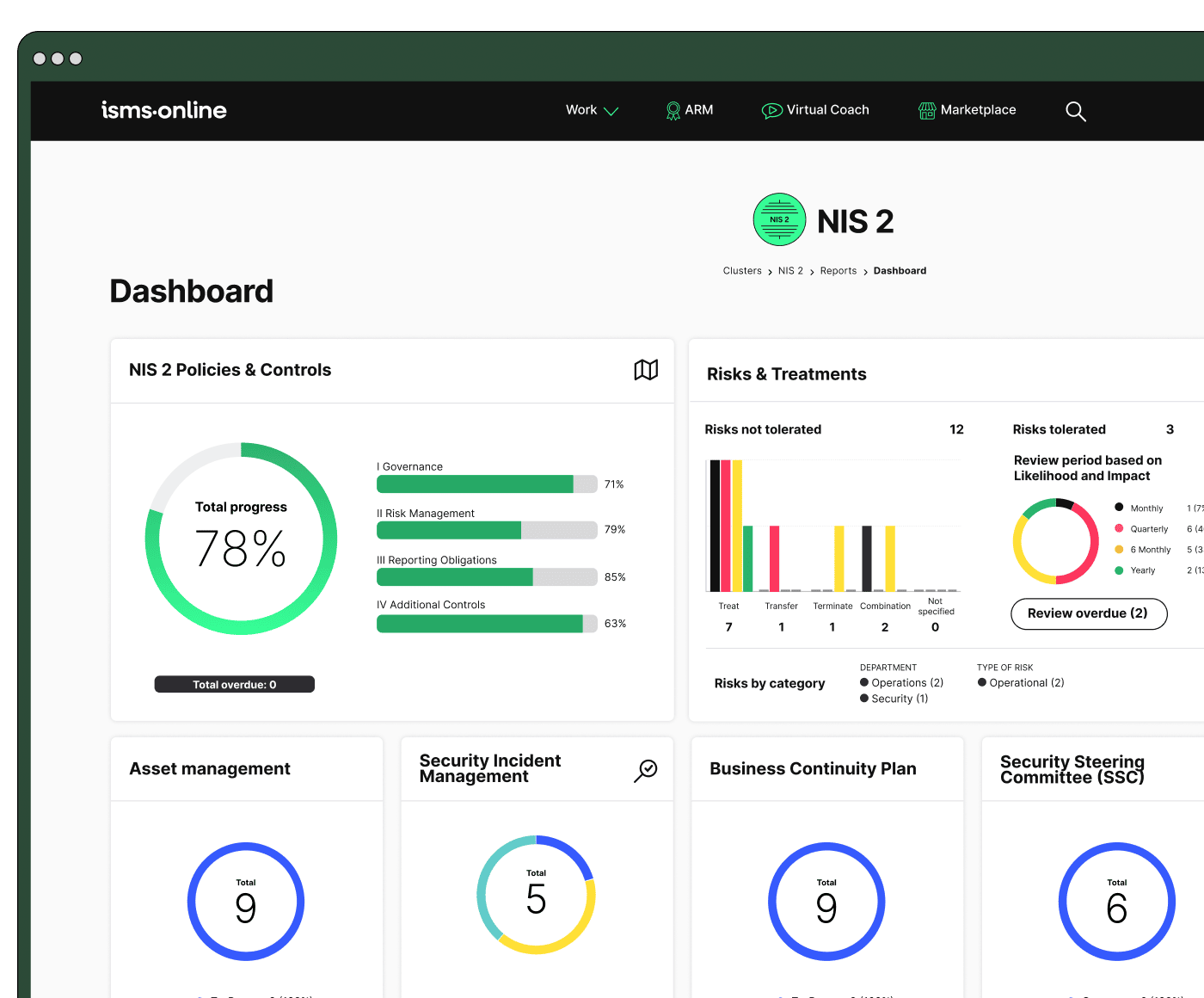
All your NIS 2, all in one place
From Articles 20–23 to audit plans – run and prove compliance, end-to-end.
What Are the First Steps to a Living, Always-Audit-Ready Evidence Engine?
Transforming policy or intent into delivered, living compliance starts with a full-spectrum audit of your current state:
1. Review every asset, contract, and utility for missing, outdated, or unassigned evidence.
2. Upload and tag every document-maintenance logs, contracts, test results-by asset, owner, and location.
3. Map all logs and contracts to living controls in your Statement of Applicability.
4. Automate reminders and dashboard alerts so nothing is missed or lapsed between cycles.
5. Empower staff across teams to keep evidence current and assign clear accountability for every gap.
6. Use central dashboards to monitor, manage, and export board or auditor packs with a click.
Resilience isn’t waiting for the audit; it’s building the muscle memory of evidence every day.
ISMS.online accelerates this feedback loop: from asset inventory through to risk registers, contract management, maintenance, incident response, and final review/archive. As evidence becomes daily practise, your risk of compliance failure-and your scramble before major audits-diminishes dramatically.
The Path Forward: Unify, Maintain, and Prove Your Resilience with ISMS.online
Supporting utilities compliance is the new test of operational maturity. Regulatory risk, business continuity, and even board confidence now converge on your ability to surface living, current, accessible evidence for every asset, contract, and incident-site by site, owner by owner.
Now is the moment to move from “hopeful” to “audit-safe.” Start by scrutinising your asset register and utility evidence in ISMS.online. Tag gaps, assign owners, and automate reminders so nothing is missed as regulations expand and pressure mounts. Upload your documents, bring your policies into a living platform, and let staff and leadership see progress every day.
With ISMS.online, audit readiness stops being a crisis and becomes a daily, measurable advantage. When the next regulator visit lands, you’ll stand resilient-with proof at your fingertips, board confidence secured, and operational risk under visible control.
Ready to banish hidden risks, win your next audit, and build the resilience your business deserves? Let’s get started-bring every utility asset, and its evidence, under your confident control in ISMS.online.
Frequently Asked Questions
Who actually decides utility compliance rules-and why does utility evidence now dominate ISO 27001 and NIS 2 audits?
Utility compliance is no longer a background detail-it’s written into law and standards. Under NIS 2 and ISO 27001:2022, both European and national authorities (ENISA for the EU, KRITIS in Germany, LPM in France, NCSC in the UK, and sector-specific regulators everywhere) define what “supporting utilities” mean for security: power, water, HVAC, telecoms, and more. If failure of any utility can disrupt your operations, audit, or confidential data, it’s now a regulated asset.
Regulators and auditors now expect organisations to treat these essential services-and the evidence tying them to risk management-at the same level as your cyber controls. You’re judged on how well you can demonstrate that each critical utility is mapped, tested, and monitored, with contracts, plans, and incident response all current and provable-not just on paper, but in your system.
What you fail to map is what will cost you-resilience is always tested at its blind spot.
Why so strict? Recent enforcement actions under NIS 2 saw regulated businesses penalised even when their IT was robust-because a missing generator contract, an untested HVAC, or an unmonitored water supply left a compliance gap. The result: failed audits, operational disruptions, and real financial hits, not to mention regulatory fines or loss of buyer trust.
What are the hidden risks of neglecting utility mapping?
- Audit failures traced to undocumented utilities during incidents or outages
- Loss of new contracts or renewals where buyers need live, mapped assurance
- Fines or regulatory censure in critical sectors when uptime evidence-or risk owner-is missing
What counts as audit-ready evidence for utility compliance in ISO 27001 and NIS 2?
Audit-ready evidence for supporting utilities must be digital, asset-linked, current, and accessible. Auditors and regulators now demand:
- Board-approved utility policies: E-signed, versioned, mapped to relevant sites and assets
- Supplier contracts/SLAs: Digitally attached, flagged for review/expiry dates, linked to the asset registry
- Maintenance and test logs: Electronic, time-stamped, signed by a named owner-for every backup, generator, cooling system, etc.
- Incident and alert reports: Complete event chain-cause, action, remedial steps, outcomes, and clear responsibility tracked in the ISMS
- Automated monitoring data: Sensor logs (BMS, SCADA, IoT), photos, and videos geotagged and stored for each asset and incident
- Change/review records: Every significant update, failure, or improvement mapped to a responsible owner, time, and location
A best-in-class ISMS like ISMS.online makes this automated: every artefact can be linked directly to controls, assets, locations, and people-making retrieval, updates, and audit exports nearly instantaneous.
Table: How Utility Evidence Maps to ISO 27001:2022
| Audit Expectation | Evidence to Capture | ISO 27001 / Annex A Ref |
|---|---|---|
| Policy approval | E-signature, version log | Cl.5.2, A.7.11 |
| Supplier contract | Digital file, asset linkage | A.15.1 |
| Maintenance/test log | Time-stamped, signed entry | A.7.11, 8.1 |
| Incident report | Event log, remediation action | A.5, 16.2 |
| Sensor/media | Digital, asset/event archived | A.7.7, 8.8 |
Audit gaps emerge where evidence is fragmented; unified, digital records become your compliance backbone.
How do you create a living audit trail connecting utilities, risks, assets, and suppliers?
A living audit trail links every utility asset to its supplier, location, risk owner, associated contract, and incident history-so that every event is traceable across your system. For robust traceability, ensure every entry is:
- Time-stamped and attributed (who, when, where)
- Linked from the ISMS to your risk register and applicable utility control
- Flagged for review and triggered with automatic reminders (contract up for renewal, recurrent outage, overdue test)
- Mapped directly to Statement of Applicability (SoA) or control for the site or asset
- Designed to escalate any missing owner, expired contract, or test failure until resolved
ISMS.online provides this interconnected record: every action-whether a generator test or a supplier contract update-can be tracked, cross-referenced, and surfaced through dashboards and audits.
Traceability mini-table
| Trigger | Risk Update | Control/SoA | Evidence Logged |
|---|---|---|---|
| Generator tested | OK’d power loss risk | A.7.11 | Log, photo, signed off |
| Water alert | Cooling risk raised | A.7.11, 17.1 | Incident + sensor log |
| Supplier lapse | Contract flagged | A.15.1 | Renewal record, alert |
Living audit trails aren’t paperwork-they are trust signals linking risk, remediation, and evidence.
What monitoring, redundancy, and automation are required for resilient, audit-proof utilities?
Resilience must be practised-not promised. Your evidence should show:
- Tested redundancy: Dual supply lines (UPS, generator, dual telecom), tested and logged routinely, with named owner and schedule
- Automated, real-time monitoring: BMS, SCADA, or IoT sensor feeds for critical utilities, with logs tied to assets and automated alerts for deviation
- Practised failover drills: Documented pass/fail results for drills and simulations, reviewed for improvement
- Incident simulation logs: Evidence every incident, near-miss, or triggered drill is analysed and lessons are implemented and logged
- Automated escalation and reminders: Actions (like overdue tests or contracts) must trigger alerts, workflow assignments, and require mitigation, not just internal emails
Your audit can only be passed with evidence that is time, asset, and owner-linked, layered to show actions were performed-not just scheduled or intended.
How do multi-country operations and evolving supply chains redefine utility audit requirements?
NIS 2 and national laws require each asset and event to be tagged with its site, owner, supplier, and jurisdiction. Organisations operating in multiple countries must:
- Tag every asset/event with legal jurisdiction and language needed for local audits (many require native and English copies)
- Track evidence of utility contracts, monitoring, and incidents in a multi-language ISMS repository
- Link every supplier, contract, and SLA to the assets and policies they underpin-gaps must trigger workflow or escalation
- Bridge procurement, IT, and risk by ensuring overdue actions or expired contracts trigger multi-department workflows
Cross-jurisdiction mapping (sample table)
| Site | Utility | Contract/Supplier | Local Reg | Status |
|---|---|---|---|---|
| Amsterdam DC | Power Chiller | Nuon, #E-23 | Yes | Green/Reviewed |
| Milan HQ | Redundant UPS | ENEL, #UPS-4 | Yes | Yellow/Due soon |
| Barcelona | Water Main Alarm | Aigues, #W-102 | LPM | Green/Active |
If you lack this tagging, you risk failing local compliance and facing procurement blockages, fines, or contract disruption. ISMS.online lets you philtre, export, and demonstrate jurisdictional readiness instantly.
What evidence and automation do boards, risk committees, and buyers now expect for utilities?
Modern boards and procurement buyers expect live dashboards showing:
- Percentage of critical utility assets with tested, up-to-date logs, contracts, incident responses, and owner mapping
- Overdue alerts for any contract, policy, or test-automated triggers reaching responsible teams and leaders, preventing silent risks
- Evidence of regular improvement and risk closure: trends by quarter, lessons learned, post-incident actions, and audits completed
With ISMS.online, these dashboards, alerts, and exports are real-time and colour-coded. Overdue or missing evidence is never invisible-it’s pushed to the right roles, in time to mitigate before it costs reputation. This is modern resilience: a single source of truth recognised by boards, auditors, and buyers.
True board trust is earned: map, log, and prove every utility so your resilience is always live, always audit-ready.
Identity affirmation:
When you unify every utility asset, owner, contract, and test in a single, living ISMS, you prove not just compliance, but operational confidence. Board-trusted resilience becomes your baseline-making your organisation a leader in both uptime and compliance.
Annex: ISO 27001:2022-Utility Controls Mapping Table
| Audit Expectation | Evidence for Audit | ISO Reference |
|---|---|---|
| Board-set utility policy | Signed, versioned board doc | Cl.5.2, A.7.11 |
| Supplier contract | Asset-linked, expiry tracked | A.15.1 |
| Tested redundancy | Log, photo, reminder, owner | A.7.11, 8.1 |
| Incident log | Action, cause, status, lessons | A.5, 16.2 |
| Monitoring records | Digital, geotagged, archived | A.7.7, 8.8, 8.11 |






