





































How NIS 2 Turns Background Checks Into a Board‑Level Compliance Priority
Today, background verification is no longer a side room in HR. The NIS 2 Directive sweeps it onto the main stage-making board members, IT, legal, and procurement directly accountable for who gets access, when, and whether proof of vetting is rock-solid. Every staff member, supplier, or third-party who touches your information or critical systems is now a potential compliance gap-and every unchecked exception is a live risk for audit failure, reputational loss, and regulatory fines. The shift is real: \
Yesterday’s HR chore is tomorrow’s evidence chain; regulators will expect nothing less.
Under NIS 2, the scope of scrutiny is profound. Contractors, temp staff, managed service providers, and supply chain partners with digital access all fall under the umbrella-no exceptions for “trusted vendors.” Gaps that once hid in onboarding forms now become visible security liabilities, especially for organisations with distributed teams and cross-border suppliers. The wake‑up call? Background checks are now subject to live audit, requiring mapped, time-stamped, retrievable evidence for every role and every access point.
Why Traditional Policy Isnt Enough
ISO 27001:2022 lifts the standard: having a policy isnt proof. Auditors require evidence that every screening, waiver, renewal, and exception is traceable-not just listed, but audit-clickable, mapped, dated, and owner-attributed. ISMS.online fuses these requirements into the real-world: proof systems, not just paper policies, tie risk registers, onboarding, and supplier management into a dashboard-driven evidence engine (isms.online).
Book a demoWhere Most Background Checks Go Wrong: Blind Spots, Manual Drags, and Expensive Gaps
Compliance breakdowns are rarely dramatic-they’re silent, buried, and always found during the scramble of an audit or the aftermath of an incident. The cracks appear everywhere:
- Fragmented evidence: Contracts, onboarding, and supplier verification scatter across emails, isolated HR or procurement tools, and informal spreadsheets. When checklists aren’t centrally maintained, ISO 27001/Annex A.6.1 audits fall at step one.
- Jurisdictional loopholes: EU, US, APAC privacy or hiring rules may generate exceptions, but these are handled via emails or informal notes, leaving no evidence trail.
- Expired or lapsed vetting: People come and go, clearances expire-without automated renewal and notifications, checks quietly lapse, sometimes for years.
- Anonymous supply chain access: Vendors, MSPs, and SaaS providers slide personnel through on generic “supplier cleared” badges; specific individuals and their clearance status become invisible.
Most audit-failures result from the gap nobody saw coming, not the risk everyone anticipated.
Audit chaos erupts because exceptions and waivers-often handled via side‑channels or lost ownership chains-end up unexplained, unclosed, or ownerless. What’s the consistent audit finding? Missing, incomplete, or non‑retrievable background check evidence.
The Automation Divide
ISMS.online closes these gaps with real‑time dashboards: alerts, exception logging, and time-stamped closures replace the scramble of “who, when, where, and why.” Every check, renewal, and waiver is tied to an owner, status, and policy reference.
Bottom line: Only automated, traceable, and role-driven proof chains stand up to auditors, regulators, and business partners. Manual tracking-no matter how diligent-creates inevitable audit and operational exposures.

Master NIS 2 without spreadsheet chaos
Centralise risk, incidents, suppliers, and evidence in one clean platform.
Scoping Background Checks Correctly: Who, When, and How Deep?
Audit failures spike when organisations misjudge who needs checking, when checks expire or must renew, and how deep evidence must go for different roles or suppliers. Here’s where regulations and reality diverge:
- Who: Not just full-time staff, but every temp, contractor, outsourced IT, regional MSP, and third-party with system access.
- When: At onboarding, role/privilege shifts, contract renewals, and after any incident or regulatory event.
- What depth: Level of screening varies by access; high-privilege or data-system roles demand more depth, and every exception needs its own (time-stamped, owner-logged) reason and closure chain.
It’s not just about who you checked, but who you forgot, that makes the real audit risk.
Scoping Table: From Expectation to Execution
| Expectation | Operationalization | ISO 27001/Annex A Reference |
|---|---|---|
| All access holders screened | Role-driven trigger matrix + workflow integration | A.5.2, A.6.2 |
| Re-check at onboarding, privilege change | Automated triggers, reminders, live status | A.7.2, A.6.3 |
| Exceptions/waivers tracked and closed | Registry with time-stamped e-signatures | GDPR, A.5.3 |
| Suppliers mapped to real individuals | Supplier-person mapping + per-access log | A.8.1, A.8.1 |
Live Traceability Table
| Step | Event | System Response | Proof Logged |
|---|---|---|---|
| Onboard new user | HR/Supplier add triggers | Checklist, alert | File, time, owner |
| Privilege change | Escalation detected | Alert, screening required | Exception log, closure |
| Exception | Waiver logged | Approval, timestamp | Cause, closure, signoff |
| Renewal | Contract refresh | Re-check prompt | New evidence, owner log |
Key takeaway: Live, owner-attributed, time-stamped logs are essential. Anything less is a latent failure.
Supplier and Contractor Vetting: Why Your Supply Chain Audit Fails First
The supply chain is usually the weak link-ENISA highlights the point: supply chain breaches begin with poorly tracked, poorly evidenced, or unenforced vendor vetting. Third-party personnel are rarely scrutinised with the granularity of in-house staff, and bulk clearance or “access before vetting” happens under pressure.
The easiest route in is often through the least-watched vendor or a dormant ‘temporary’ exception.
ISMS.online enables supply chain resilience by:
- Forcing every contractor, MSP, and supplier onto a *named, per-person* screening list-no generic supplier clearances.
- Colour-coded dashboard views: Green (current), Amber (soon to expire), Red (overdue or exception).
- Exception and waiver log columns: every outlier gets a living, signed trail with closure deadlines and explanations.
Traceability Table: Trigger to Audit-Ready Proof
| Trigger | Risk Update | Control/SoA Link | Evidence Logged |
|---|---|---|---|
| New supplier | Risk/role assign | A.5.3, A.5.9 | Screening file, signoff |
| Contract renewal | Region check/waiver | A.8.1, GDPR | Exception file, owner log |
| Privilege change | Escalation/exception | A.6.2, A.8.2 | Background check, closure note |
Supply chain controls live or die by evidence speed and granularity; dashboards, exportable logs, and owner attribution keep you audit-proofed.
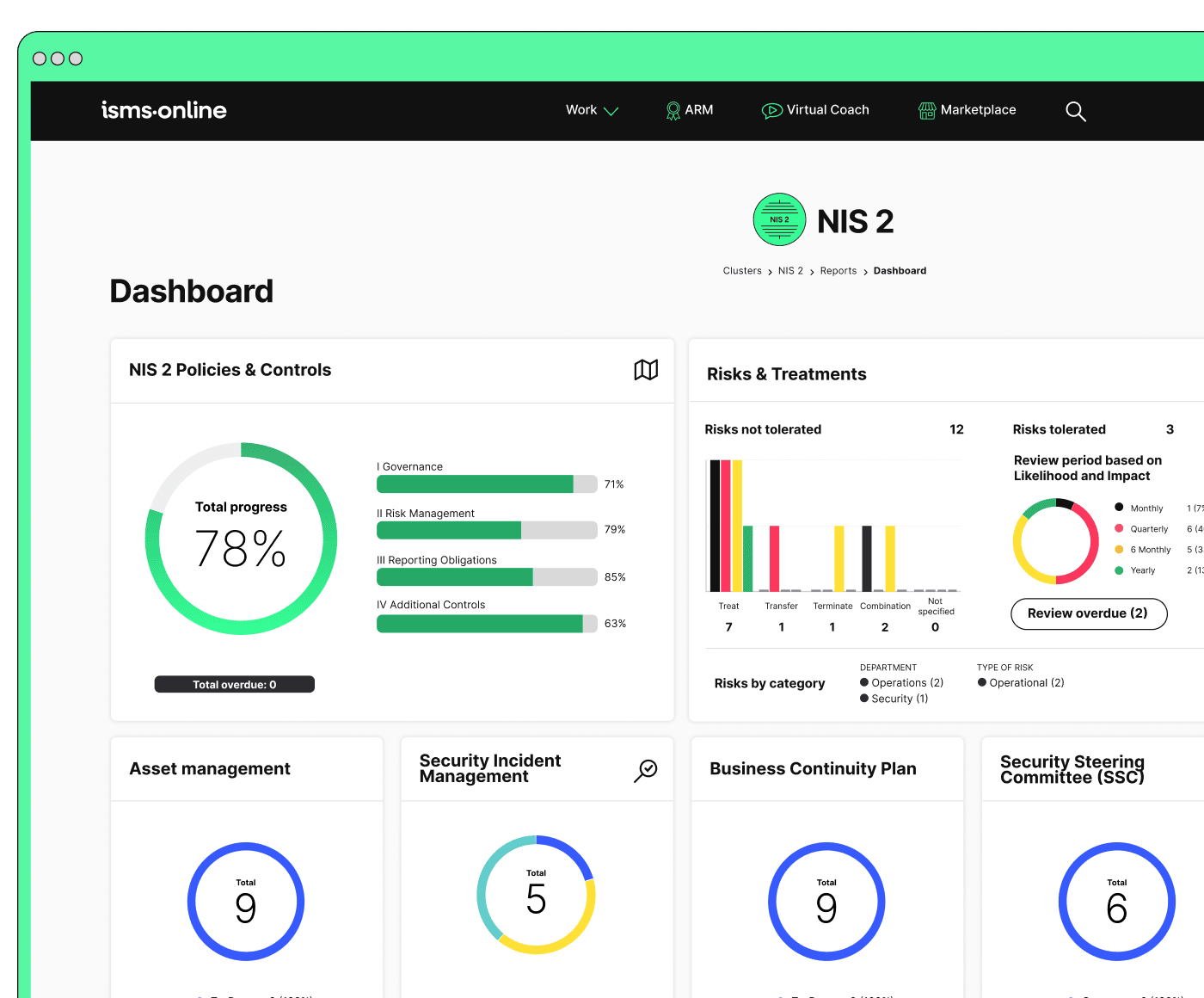
Be NIS 2-ready from day one
Launch with a proven workspace and templates – just tailor, assign, and go.
Real-World Screening Flow: Linking Policy, Process, and Evidence for ISO 27001
Paperwork and policy alone are not acceptable to regulators or auditors-direct mapping from policy to process to evidence is now table stakes under NIS 2 and ISO 27001. ISMS.online drives this loop:
- Policy linkage: Every onboarding, offboarding, role-change, and exception is tagged to a live ISO 27001 clause, with the policy/process mapped as a clickable reference.
- Chronological, versioned audit logs: Every action, renewal, waiver, and owner signature is captured-the “why,” “when,” and “by whom” is always visible.
- Exception rigour: Every exception demands an owner, rationale, and an explicit closure/remediation-never silent, never “resolved by nobody.”
- Exports for auditors/regulators: Any compliance event transforms into a ready-to-send, reference-anchored package.
Screening Flow Example Table
| Event | Policy/Process Reference | Evidence File | Exception Log |
|---|---|---|---|
| IT admin escalation | A.6.1, A.8.2 (IT/HR) | Check/report, signoff | Exception note |
| Supplier access expand | A.8.1, A.8.1 (Proc.) | New screening, contract | Waiver, closure |
Best-practise means every process step is audit-ready, owner-stamped, time-detailed, and ready for download the moment an auditor knocks.
Centralising Audit-Ready Evidence: Why ISMS.online Is the Truth Engine
For NIS 2 and ISO 27001 compliance, instant, irrefutable, role-attributed proof is non‑negotiable. ISMS.online lets every user, supplier, renewal, and privilege change be:
- Individually attributable: (not “the system”): Who, when, why-never ambiguous.
- Timestamped and trackable: Every checkpoint and exception present, visible, and closure-tracked.
- Mapped to a policy/control: The auditor sees the journey from statement of applicability to real-world evidence-no gaps.
- Exportable on demand: Audit/regulator packs can be produced *immediately*, lowering stress and reducing audit cycle times.
Great compliance is when your evidence answers the auditor before you do.
Living Audit Table
| Event | Evidence File | KPI/Metric |
|---|---|---|
| Privilege change | Screening, owner log | % privilege-checked |
| Contractor shift | Regional signoff, file | Exceptions per region |
| Audit-lag find | Closure log, root cause | Avg. closure time (days) |
ISMS.online transforms compliance inertia into systemic trust-evidence is no longer firefighting, but a strategic asset.
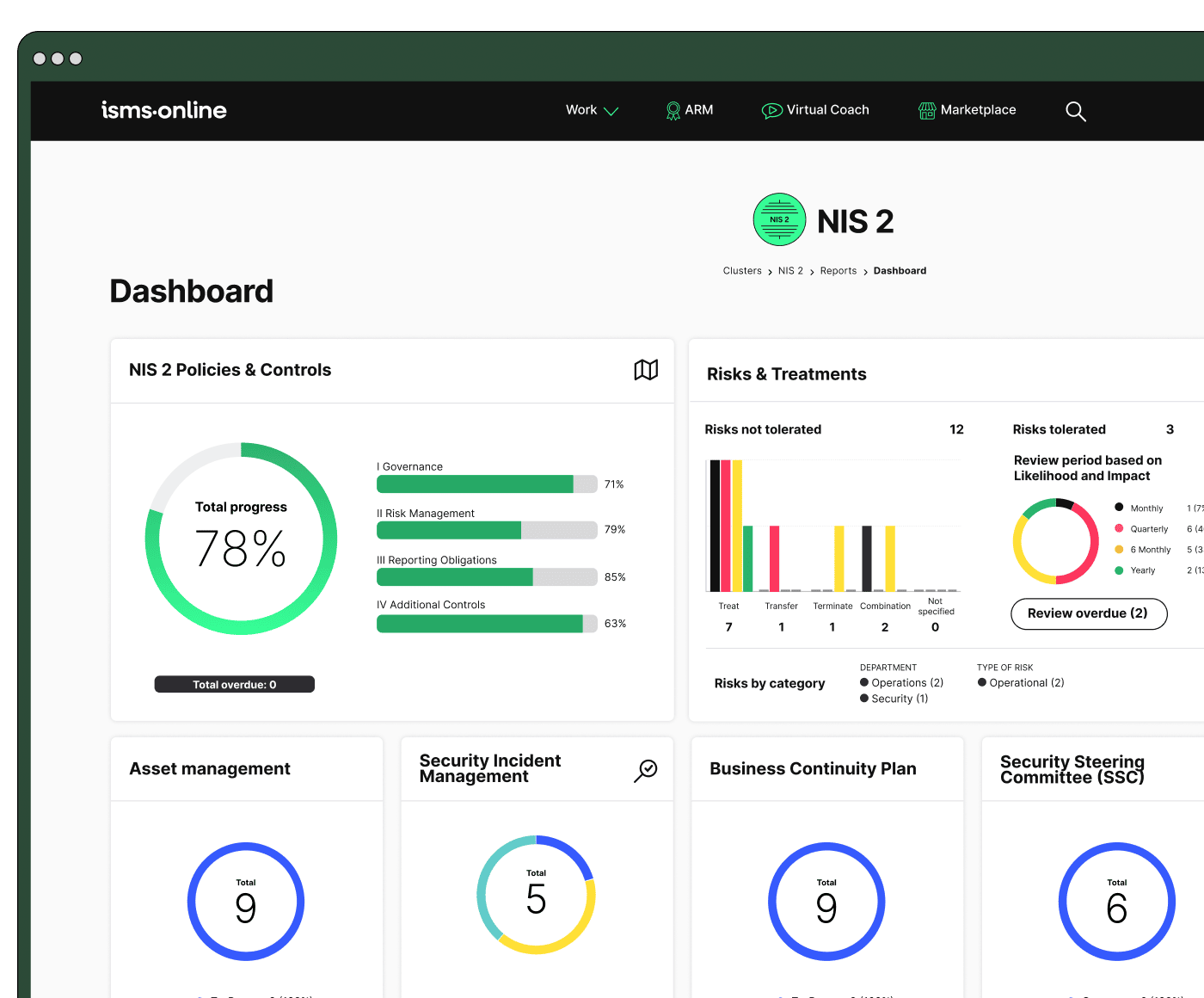
All your NIS 2, all in one place
From Articles 20–23 to audit plans – run and prove compliance, end-to-end.
Continuous Assurance: Celebration of Correction, Not Just Pass/Fail
Modern regulators and auditors want to see learning loops in your screening system: not just “tick-box” checks, but proof that incidents, gaps, and exceptions are caught, owned, and closed quickly. KPIs around missed renewals, lagged exceptions, and closure times are real indicators of resilience, not just “maintenance mode.”
- Renewal lag → prompt and closure: The system assigns, tracks, and closes renewals with embedded reminders and dashboards.
- Exception drift → assignment and closure: Every unclosed exception surfaces as an operational risk, not a hidden liability.
- Management review / board oversight: Live dashboards contextualise KPIs and trends-renewal misses, ownerless exceptions, and evidence gaps-into meaningful improvement actions.
Corrective Action Table
| Incident | Corrective Action | Owner | Closure Proof | KPI |
|---|---|---|---|---|
| Missed renewal | Renewal automates | HR admin | Closure login, signoff | % lapsed renewed |
| Region escalation | Legal reviews | Legal | Owner closure, signoff | Exception closure |
Resilient compliance doesn’t fear gaps. It closes them-fast, visibly, credibly-for the board, the auditor, and the regulator.
Making Background Checks Your Trust Signal: Confident Compliance in Action
Compliance excellence is now measured by real-time, end‑to‑end evidence-proving not just intent, but execution and closure. ISMS.online empowers you to:
- Automate the check cycle: Onboarding, renewals, exceptions/waivers, suppliers, and privilege changes-all logged and tracked, never ownerless.
- Export proof instantly: Regulators, auditors, clients see mapped, timestamped, owner-attributed evidence on demand.
- Embed resilience KPIs: Get dashboards tracking closure cycles, exception trends, renewal lag, and overall compliance health.
- Earn stakeholder trust: Demonstrate, not just declare, control over your critical risk surfaces-showing boards and partners a security and compliance posture ahead of regulatory demands.
The mark of leadership is when your compliance story is told by your evidence-before auditors or partners ever ask.
Ready to shift from compliance firefighting to board-level reputation? \
- Request an ISMS.online walkthrough.:
- Benchmark your NIS 2 / ISO 27001 compliance against industry standards.:
- Show live, exportable, mapped evidence to your board, auditors, and regulators-no scramble required.:
When evidence is always one step ahead, compliance becomes confidence-and proof becomes your organisation’s loudest trust signal.
Frequently Asked Questions
Who bears ultimate responsibility for NIS 2 background checks, and how expansive is this legal duty?
Ultimate responsibility for NIS 2 background verification rests squarely on organisational leadership-including your board-but the obligation now extends throughout your entire privileged workforce and supplier chain. NIS 2 Articles 10.2 and 21, reinforced by ISO 27001 Annex A.6.1 and A.5.19, make it clear: accountability begins with those who determine or oversee access-not just HR, but CISOs, IT and security admins, procurement leads, supplier managers, risk and compliance teams, and executives. If your organisation grants privileged access to sensitive systems or supports its operations via external suppliers, you are required to ensure comprehensive, role-appropriate screening before access is allowed and at every significant change: onboarding, contract renewal, promotions, incidents, or handovers-regardless of whether the individual is on your payroll or contracted externally.
Missing a check for just one consultant, privileged admin, or supplier support engineer can now trigger regulatory scrutiny or enforcement that travels up the governance ladder. In regulated sectors or those with critical infrastructure, management teams must be ready to defend not just policies and intentions, but operational records documenting every onboarding and third-party engagement.
Sometimes the first sign of a compliance gap is an unexpected request from a regulator-not a missed process, but missing proof that you’ve enforced it at the right levels.
Accountable Roles under NIS 2 & ISO 27001
- CISO, IT Security Leadership: Own access control, lead screening, and ensure full lifecycle closure.
- HR & Onboarding Teams: Uphold evidence for hiring, renewals, and document local legal restrictions.
- Procurement & Supplier Management: Build screening into contract clauses, collect and track third-party evidence.
- Board, Legal, Compliance: Oversee process completion, demand regular management review, track metrics, and drive policy revision.
What specific evidence must organisations present for NIS 2-compliant background checks, and how does ISO 27001 close audit gaps?
NIS 2 and ISO 27001 now compel you to show not only that screening happens, but that living, granular evidence exists for every in-scope person and third party. “Policy in a drawer” is obsolete; auditors and regulators expect a live, role-mapped register where every check-identity, criminal, reference, or attestation-links to the individual, the rationale, legal basis, and the supporting document. Blanket policies or spreadsheet snapshots are rejected if they cannot prove up-to-date, owner-assigned execution, closure, and exception handling ((NIS 2: ), (ISO: )).
What must you evidence?
- Screening Policy: Updated, role-specific, with clear triggers and renewal intervals.
- Register per Staff/Supplier: Individual entries for every check, date, type, decision-maker, legal basis, expiry, and supporting file.
- Consent/Ethics Records: GDPR or equivalent consent when required; notes of constraints/barriers by jurisdiction.
- Exception Log: Rationale, manager signoff, mapped mitigating action, closure evidence.
- Supplier Attestation Evidence: Supplier contracts and renewal logs, linked to staff and privilege changes.
- Management Review Trail: Signoffs, policy updates, assigned owners, and audit trails.
| Expectation | Operational Example | ISO 27001 Annex Reference |
|---|---|---|
| Register for all in-scope roles | Live checklist, triggers, and renewals | A.6.1, A.5.19, A.5.21 |
| Supplier checks, attestations | Supplier evidence bank, expiry report | A.5.19 |
| Exception/waiver management | Logged, mapped to risk & closure | A.5.20, A.6.1 |
| Consent/logs/legal mapping | Documented decision per individual | A.6.1, GDPR, DPA |
Failure to produce live, owner-attributed evidence for staff and suppliers-down to the exception or local adaptation-can now mean an automatic nonconformity.
How does ISMS.online eliminate spreadsheet chaos and make day-to-day background check compliance audit-ready?
ISMS.online centralises and automates the background check lifecycle, transforming compliance from a paper chase to a transparent, always-on record. The platform acts as a compliance command centre: onboarding, role changes, renewals, supplier contract updates, and incidents automatically trigger assigned tasks, reminders, and evidence uploads. Every background or supplier screening, waiver, or exception is logged with owner, date, renewal, supporting file, and closure status-creating an immediate, audit-ready trail.
You receive dashboards and KPIs highlighting gaps, overdue actions, pending signoffs, and closure progress, ensuring nonconformities (like a missed supplier renewal or an unresolved exception) are quickly surfaced and resolved. At audit time-or during a management, procurement, or regulator review-clause-mapped registers, exception records, and full trail exports are available in minutes, proven by versioned management review logs.
When all evidence is mapped and surfaced in real time, background checks become proactive signals of trust, not post-hoc defences for scrutiny.
ISMS.online ensures exceptions or region-specific waivers are never invisible: every gap is visible, assigned, managed, closed, and evidenced, supporting both risk mitigation and cultural confidence in your compliance system.
Where do background check processes fail under NIS 2/ISO 27001-and what critical fixes must leaders prioritise?
The most frequent and costly failures flow not from lack of policy, but from patchwork processes and disjointed evidence.
Core failure scenarios:
- Gaps in coverage: Not all privileged users, contractors, or supplier personnel are captured and reviewed at every trigger.
- Outdated/lost evidence: Checks run only at hiring and never revisited; documents trapped in email, drives, or legacy HR systems.
- Exceptions not managed or closed: Where checks are impractical or prohibited, no formal log, rationale, mitigating control, or closure chain exists.
- Supplier attestation decay: Renewals or staff changes in supplier teams aren’t tracked or re-verified.
- Policy–jurisdiction misalignment: Blindly following a “universal” screening policy ignores local legal limits or fails to adapt to sector overlays.
Essential fixes:
- Centralise all screening triggers (onboarding, renewal, privilege, incidents) and automate reminders and nonconformity logs.
- Make every exception explicit, manager-reviewed, and closed within a set timeframe, with audit and policy review signoff.
- Use dashboards/KPIs to surface any overdue, at-risk, or incomplete logs for owner intervention.
- Maintain sector/country registers to account for local requirements, adaption, and prohibition, with signed evidence for every adaptation.
| Trigger/Scenario | Risk/Event | Clause/SoA Link | Evidence Logged |
|---|---|---|---|
| New onboarding (France) | Criminal check not allowed | A.6.1/HR Policy | Reference file, signed waiver |
| Supplier renewal | Expired attestation | A.5.19 | Reminder, contract, closure log |
| Role/privilege change (IT) | Overdue background check | A.5.20/A.6.1 | New check, closure, audit trail |
How do you adapt background check policies for cross-border, sector, and legal complexity?
For global or high-trust organisations, a “one-size-fits-all” approach will fail. The standard is now local adaptation, which means:
- Build a country-sector matrix: Detail exactly which checks are required, permitted, or banned in each jurisdiction, for each role and supplier type. Refresh the matrix on law or policy change.
- GDPR/Privacy overlays: Record explicit consent for every check. If consent/legality is missing, show what alternative control (reference, supervision, limited access) is used-documented with closure and signoff.
- Sector overlays: Financial, critical infrastructure, and regulated industries add enhanced screenings (e.g., ECB/ENISA overlays) and vendor documentation as required.
- Evidence every adaptation: Log not only the screening you run, but every decision, adaptation, or rationale that influences the process.
Treating every exception as evidence of diligence-not embarrassment-signals real resilience to regulators.
Legal context moves fast; every adaptation, exception, and rationale must be documented, logged, tracked, and ready for management review.
What makes an NIS 2/ISO 27001 background check process resilient-and how do you prove it to auditors or the board?
A resilient process is defined by dynamic evidence, coverage, and governance-not written policy alone:
- Complete coverage: Every staff, contractor, and supplier is included, status is live and linked to role; waivers are signed, justified, and mitigated.
- Nonconformity logs: All exceptions are tracked from event to closure, mapped to risk and mitigating actions, with clear owner signoff.
- Executive visibility: KPIs, dashboards, and review meetings monitor open, overdue, and exception cases; policy and process updates are versioned.
- Clause-mapped exports: Board, audit, or regulatory enquiry is answered with a full, clause-linked register and signoff log, not piecemeal or ad-hoc files.
| Expectation | Operationalisation | Annex A / NIS 2 Ref |
|---|---|---|
| All roles/suppliers current | Centralised live register | A.6.1, A.5.19, NIS 2.21 |
| Waivers tracked and closed | Exception/nonconformity log | A.5.20, A.5.21 |
| Management & board review | KPIs, dashboards, reviews | A.6.1, A.5.19 |
How can you transform background checks from compliance anxiety into a board-level trust signal?
When background checks are automated, owner-assigned, mapped to clause and risk, and live in one system, compliance itself becomes a living source of trust capital-not an exam to be crammed for or a cost to be minimised. By centralising triggers, surfacing exceptions, and tracking resolutions, your evidence base is ready for anything: regulator inquiry, board risk review, major procurement, or customer trust signal.
The strongest compliance cultures don’t hide exceptions-they manage and close them, proving real-time accountability and human diligence.
Empower your team by using a platform that makes evidence effortless, transforms every onboarding and supplier event into a trust resource, and signals to the board that compliance is not a risk-they are ready, every day, to prove it.






