





































Why Do Traditional NIS 2 Audits Miss Real Ongoing Risk?
Every organisation wants validation for its cyber resilience, and passing a scheduled NIS 2 audit feels like a badge of honour. But what this approach misses is the pace and persistence of modern risk-cyber threats and regulatory changes unfold on their own timelines, not conveniently aligned with a calendar audit. Passing the annual check may win you a certificate, but it’s a fleeting snapshot, not a living proof of who you are today. A passing audit might reflect only how effectively you can tidy up for show, not how robustly you are protected on an ordinary Tuesday, or during the fog of a real incident (enisa.europa.eu).
Trust built on one-off audits quickly crumbles if it can’t stand up to surprise.
With NIS 2’s mandate to “prove ongoing compliance at any time”, the rules have changed. Regulators are more likely to ask for evidence covering the entire period between audits. Boards that lean on certificates are beginning to realise that every gap between reviews is a window of exposure. Modern resilience, whether for cyber, regulatory, or operational threats, is a product of continuous improvement-a routine that is always visible, always provable, and always adapting.
The Danger of Rear-View Compliance
Look at recent regulatory incidents and youll find a common denominator: teams were calm after passing a third-party audit but panicked during the real event. In one 2023 case, a critical control failure went undetected for months because no one tested it after audit day. Management believed in pass once safety-but attackers, and regulators, measure your vigilance every day, not just when your auditor visits.
When you build your approach around annual panic sprints, you arent fooling the risks waiting outside the door. True NIS 2 resilience requires you to show not only that the systems work, but how you keep making them stronger over time.
Book a demoWhat’s the True Cost of Point-in-Time Compliance and Manual Audit Sprints?
Many organisations default to intensive evidence-gathering just before audits, giving everyone a brief rush of activity followed by operational “downtime”. This cycle appears sensible at first, but the hidden costs add up quickly: manual sprints burn out knowledgeable staff, increase error rates, and waste time on non-essential documentation. Worse, while teams focus on paperwork, real-world risks may slip by unnoticed.
Compliance by sprint means risk lingers unresolved for most of the year.
The real expense of this pattern is measurable in several hard-to-ignore ways:
- Direct cost: Paying for consultants, repeated audit fees, and overtime wages racks up quickly.
- Indirect cost: Team morale falls, absenteeism rises, and institutional memory is lost as burnt-out employees look elsewhere.
- Strategic cost: Trust with regulators and the board erodes, especially when audit stories sound rehearsed or logs are hastily backfilled.
ENISA’s 2024 benchmarks highlight that about 70% of NIS 2 fines relate to missing or non-continuous documentation, not solely technical lapses. A reactive culture is a red flag for both regulators and attackers: if you only strengthen your system at audit time, you’re building a habit that encourages blind spots (enisa.europa.eu).
Why Reactivity Erodes Resilience
Regulators notice when organisations operate in feast-or-famine mode. In 2022, an energy company avoided a major penalty solely due to a staff member’s whistleblower report; their risk register hadn’t changed since the prior audit. Once pressure fades, complacency sets in. Modern resilience-operational, cyber, or compliance-depends on a rhythm of regular, logged improvements, not on one-off performances. Only a continuous approach closes those windows of risk before they become headlines.

Master NIS 2 without spreadsheet chaos
Centralise risk, incidents, suppliers, and evidence in one clean platform.
What Are the Three Pillars of Continuous NIS 2 Compliance?
Organisations trying to demonstrate true NIS 2 resilience embed continuous improvement into their DNA-making compliance a living, breathing routine rather than a once-a-year chore. This isn’t achieved by heroic individual efforts but by systematising three fundamentals:
- Constant, Documented Management Reviews: Regular appraisal of risk registers, incident logs, and improvement cycles. These meetings aren’t theatre-they’re logged, action-oriented, and visible to both leadership and auditors.
- Time-stamped, Traceable Evidence Capture: Every action-policy update, incident, access change, or training completion-creates a time-stamped log. Auditors want evidence that is both current and traceable through time (isms.online).
- Role-based, Live Dashboards: Stakeholders from the security team to the board see tailored dashboards. These dashboards highlight overdue actions, trend lines, and gaps-triggering timely interventions (enisa.europa.eu).
Continuity transforms compliance from a cost into a proactive competitive asset.
With platforms that automate reminders and log every update, you can surface gaps long before an auditor-or attacker-does. Front-office and back-office teams alike become active risk partners, no longer limited to last-minute fixers.
The Compliance Loop, Visualised
True compliance is circular, not linear: Incident → Logging → Management Review → Improvement → Dashboard Update → Board Presentation → Next Event. Role-specific dashboards act as both a signal and an early warning, so issues can be resolved on their timeline, not the auditor’s.
What Evidence Do Auditors and Regulators Really Want to See Under NIS 2?
“Evidence” under NIS 2 means you’re always a step ahead-with living, granular documentation, not just written policies on a shelf. Auditors and regulators will probe for:
- Dynamic evidence banks: Clear, time-stamped logs of every policy revision, control update, incident, review, or improvement action (isms.online).
- Documented accountability: Each control/process mapped to a named owner or team, with sign-offs and provenance trails.
- Continuous improvement logs: Not just reactive patches, but evidence showing how each incident or lesson led to a systemic update.
- Live dashboards: Showing the state of open/overdue actions, improvement trends, and risk movement per team or domain (enisa.europa.eu).
If you “freeze” your compliance until just before the audit, your evidence will scream “after the fact.” Modern regulators are more impressed by steady, logged activity than by a backfilled stack of documents.
Boards and regulators trust routine, not rehearsed displays.
Why “Living Evidence” Increases Trust
Active, dynamic evidence banks do more than protect you at audit time; they empower informed questioning from your board and enforce a baseline of accountability for every staff role. More importantly, this living trail is what signals true intent-not just to auditors, but to partners and customers who are increasingly risk-aware themselves.
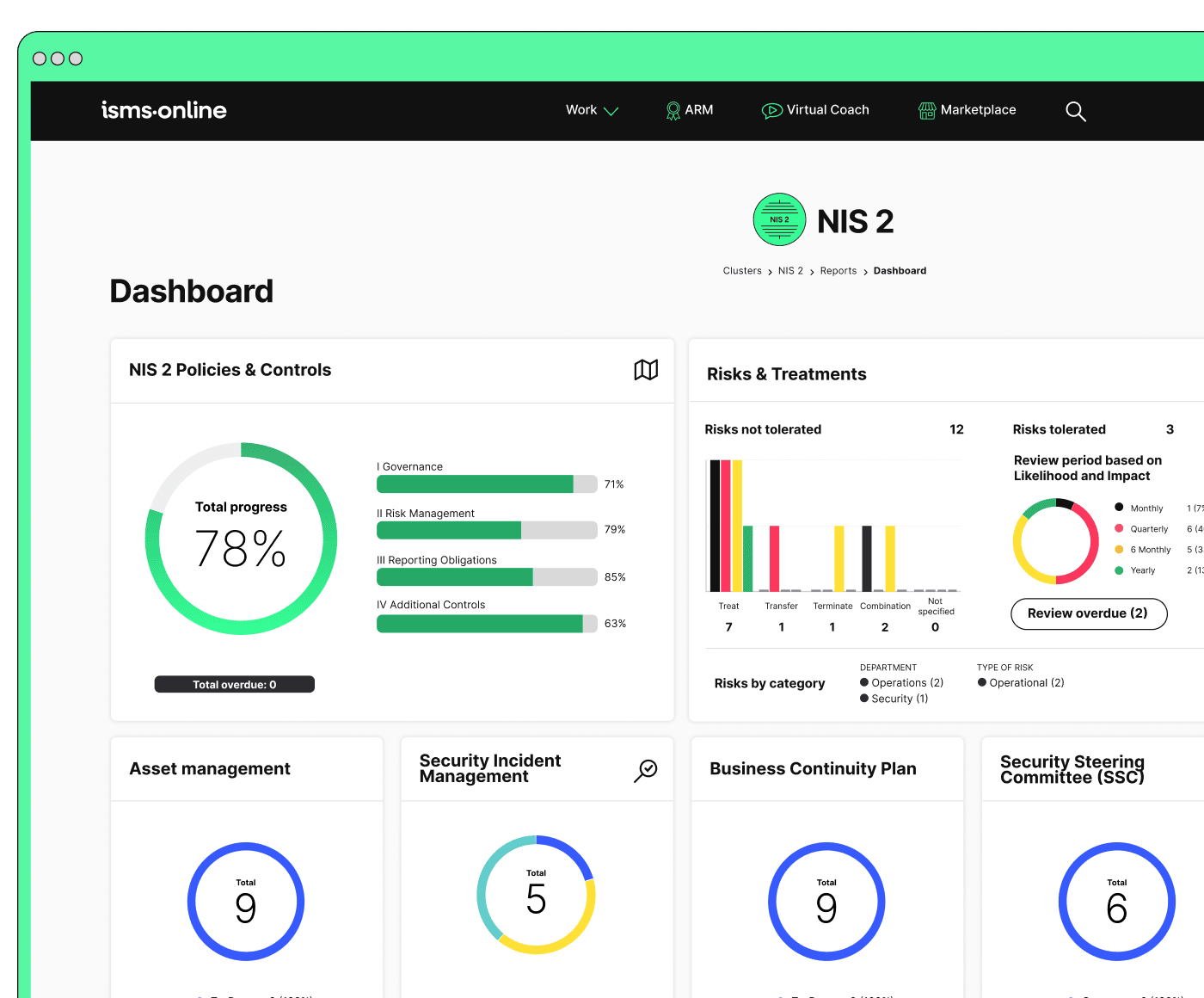
Be NIS 2-ready from day one
Launch with a proven workspace and templates – just tailor, assign, and go.
How Can Teams Build and Scale a Continuous Improvement Engine for NIS 2?
Building an always-on improvement engine requires a blend of automation and culture:
- Automate KPIs and Incident Handling: Integrate workflows that capture incident logs, assign reviews, and close evidence trails promptly.
- Recurring Reviews and Digital Prompts: Use platforms that send role-specific reminders for policy/risks reviews so that no task falls between the cracks (isms.online).
- Third-Party Risk Management: Keep supplier risk assessment in a live cycle, rather than batch review at audit time (enisa.europa.eu).
- Explicit Role Assignment: Every task must have a current owner, visible in dashboards (not forgotten in static lists).
- Board-Facing Visuals: Make ongoing improvement visible-dynamic dashboards and snapshots for incident logs, improvement rates, and management review outputs.
Early issue detection and logged resolution replace drama and panic with routine, visible control.
Extending Across Teams and Functions
Compliance work accelerates and matures when it’s shared. HR, IT, Security, Procurement, Operations-each needs a clear, timely role. Organisation-wide dashboards showing traffic light risk heat, overdue items, and recent improvements help everyone connect their daily work to compliance momentum.
How Do You Make Management Data Actionable for Board and Regulator Confidence?
It’s not enough to show compliance today-boards and regulators want proof that you’re better than you were last quarter. Actionable, visually compelling dashboards transform raw data into strategic decisions.
Boards measure leaders not by checklists, but by a persistent trajectory of improvement, evidenced by real-time logs.
Routine management reviews must close the loop: tracking when incidents occur, who resolved them, and how lessons have been baked back in. Visual dashboards break the monotony: red for urgent, amber for in-progress, and green for completed/accepted statuses. Risk heatmaps with sector, team, or regional philtres can convert overwhelming complexity into actionable insight.
Red means action; green means resilience. By moving from ad hoc story-telling to data-driven visualisation, confidence rises at every level-from boardroom to frontline.
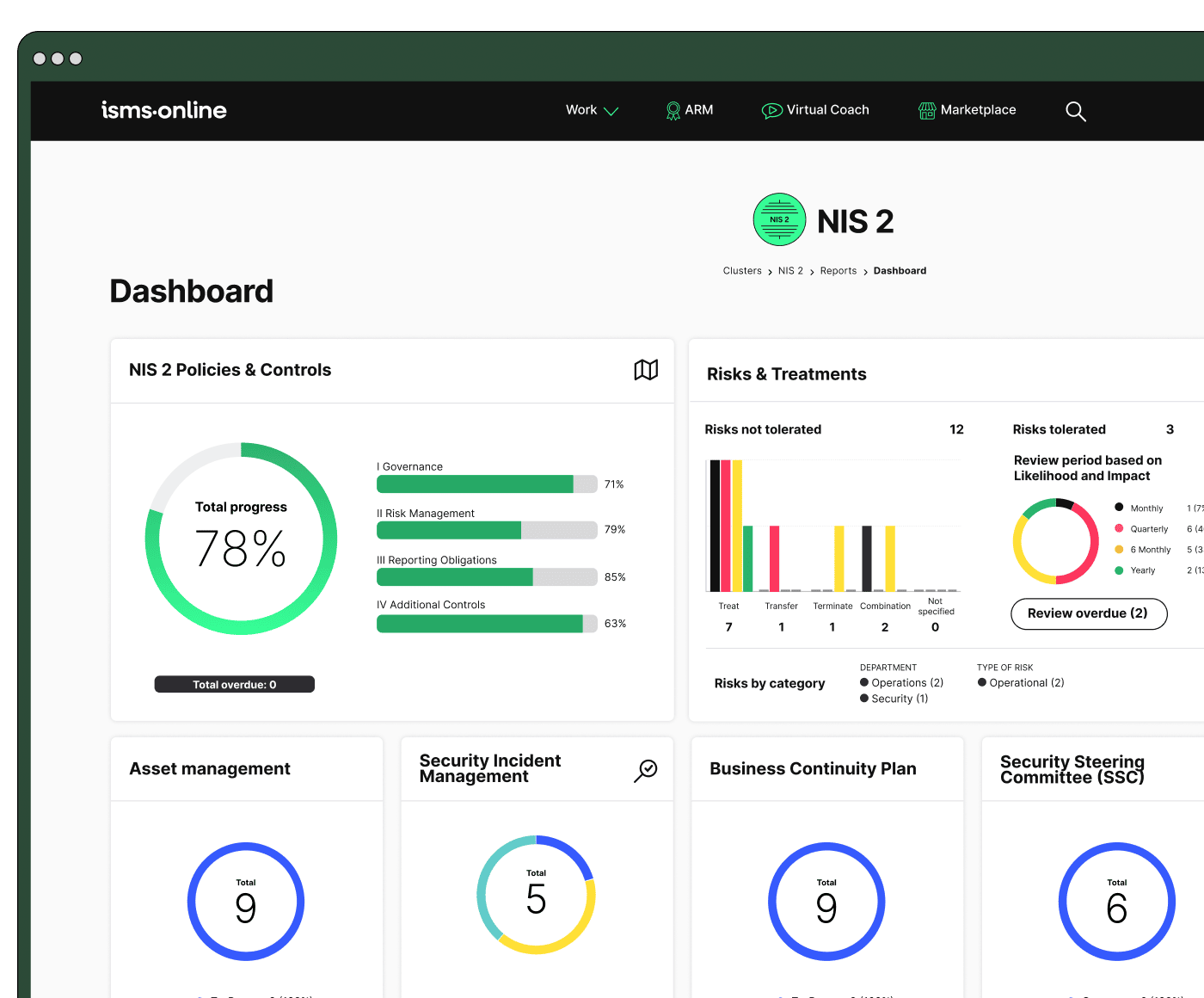
All your NIS 2, all in one place
From Articles 20–23 to audit plans – run and prove compliance, end-to-end.
How Do You Prove Ongoing NIS 2 Compliance Across Frameworks and Over Time?
Resilient organisations harmonise continuous compliance across NIS 2, ISO 27001, NIST CSF, and sector regulators-a practise sometimes called “compliance bridging” (enisa.europa.eu). Instead of scattering evidence across disjointed files, leading teams create live, linkable records for each control, risk, and incident.
Compliance Bridge Table: NIS 2 in Practise
A clear mapping table is essential for auditors and internal reviewers:
| Expectation (NIS 2) | Operationalisation | ISO 27001 / Annex A |
|---|---|---|
| Timely incident reporting | Logged incidents, event notification trails | A.5.24, A.5.26, A.5.27 |
| Risk assessment cycles | Dated register reviews, change logs | Cl.6.1.2, A.5.7, A.5.29 |
| Evidence of staff training | Staff acknowledgements, tracked completions | Cl.7.2, A.6.3, A.7.7 |
| Management review/board oversight | Review logs, performance dashboards | Cl.9.3, A.5.4 |
| Supplier risk controls | Supplier reviews, contract trails, corrective logs | A.5.19–A.5.22 |
| Improvement actions traceable | Change, closure status, timestamped logs | A.10.1, A.9.2, A.8.34 |
| Regulator requests/changes | Mapped triggers in risk and SoA logs | A.5.7, A.5.25, Cl.6.1.2 |
Real-world events, such as a regulatory change or supplier incident, can now be traced from trigger to updated control, closing the time gap between risk and resolution.
Traceability Table: From Trigger to Evidence
Every time a trigger event occurs, it should prompt end-to-end traceability:
| Trigger | Risk Update | Control / SoA Link | Evidence Logged |
|---|---|---|---|
| Phishing incident | Risk register note | A.5.24, A.5.26 | Incident/action report |
| Supplier onboarded | Supplier risk update | A.5.20, A.5.21 | Review, approvals, alerts |
| Policy change | Change log entry | A.5.4, Cl.9.3 | Version/approval records |
| Staff role change | Access risk update | A.5.15, A.8.2 | Access/audit log update |
| Staff training event | Training register | Cl.7.2, A.6.3, A.7.7 | Completion, policy ack |
| New regulation | Risk/policy update | A.5.7, A.5.25 | Regulator comms, revision |
The “final row” is key: new regulations land year-round, not on audit day-making the link from trigger to logged improvement absolutely critical for NIS 2 resilience.
Prove and Strengthen Your Compliance Loop-Today
ISMS.online brings NIS 2 resilience into your daily DNA by automating logging, evidence, and improvement. When every role, change, and review is tracked, compliance shifts from a necessary task to a proving ground for leadership and trust (isms.online).
Your credibility doesn’t wait for audit day-it’s built with every improvement you log.
ISMS.online keeps your evidence bank live and always export-ready-so you’re never left scrambling before a board meeting, audit, or regulator request. Traffic-light dashboards, pulse graphs, and role-driven notifications ensure the right teams act at the right time, making resilience visible from operations to the boardroom.
As risk landscapes shift, your compliance loop keeps pace-ready for any evidence request, board question, or external challenge. If you’re tired of binders and “fire drill” audits, it’s time to operationalise improvement as your best defence and your badge of leadership.
See how ISMS.online transforms your compliance work: turn every improvement into a story of trust, recognition, and proactive value. Make your routine visible, prove your strength-every day.
Frequently Asked Questions
Who is obligated to prove continuous improvement under NIS 2, and what constitutes irrefutable evidence?
If your organisation is categorised as an “essential” or “important” entity under NIS 2-in critical infrastructure, health, energy, digital, financial, supply chain, or core public/private services-you are now unequivocally required to show continuous, demonstrable security improvement. This remit includes EU and non-EU providers that serve the EU market. “Proof” means live, granular, and ongoing operational evidence, not just annual certificates or audit snapshots.
Expectations from auditors and regulators have shifted to require:
- Time-stamped, version-controlled risk assessments updated after changes or incidents
- Digital logs of incidents, near-misses, and root cause investigations, linked to corrective actions
- Policy and procedure reviews with tracked updates, approvals, and board oversight
- Management and board review minutes showing actions, outcomes, and follow-up
- KPIs or real-time dashboards tracking unresolved risks, overdue actions, and training engagement
- Complete audit trails tracing every change or response to an owner, date, and implemented fix
A static audit file is obsolete; NIS 2 readiness is proven through up-to-date, live trails that make improvements and learning visible at all times (Eur-lex, Art. 3–4).
Practical example
A digital bank designated as essential must show its quarterly penetration testing logs, risk register updates following a vulnerability, board review minutes, and the complete workflow linking incidents to verified corrective actions-all exportable from an ISMS platform.
Why have annual certificates or single-point audits become a liability under NIS 2?
Relying on annual audits alone leaves organisations vulnerable to business disruption, regulatory enforcement, and loss of trust. Threats and partner vulnerabilities emerge on weekly or monthly cycles; NIS 2 recognises nearly all material risks manifest between audits-not conveniently just before one. Modern compliance failures are exposed not only via external breaches but through regulator demand for proof of ongoing attention and learning.
A static certificate is now a fig leaf-continuous evidence is your defence.
In today’s landscape, fines, contract losses, and reputation damage are commonly triggered when an organisation cannot provide time-lined logs of action, decision, or evidence tied to real events (ENISA guidance, 2024). Static files or “tidying up for audits” can no longer withstand scrutiny-evidence must be available on demand, as regulators and boards increasingly audit the state of improvement, not just the intent.
Which operational processes must be scheduled, automated, and digitally traceable for robust NIS 2 evidence?
Continuous NIS 2 compliance demands digital scheduling, workflow enforcement, and uncompromised traceability for all major processes:
- Risk assessment: annually and after substantive business change
- Policy and procedure review: at least yearly and after incidents or regulatory updates
- Vulnerability scanning and penetration testing: quarterly minimum, plus post-patch events
- Incident response drills and BCM testing: annually and post-incident, with lessons learned
- Supplier and third-party reviews: on boarding, annually, and following supplier changes
- Access and privilege reviews: quarterly or after employment/status shift
- Asset inventory: maintained live, especially for cloud and remote assets
Table: Key Automated Controls
A modern ISMS enables you to schedule, assign, and digitally record each control, eliminating manual logbooks and proving compliance at the point of demand.
| Process | Minimum Frequency | NIS 2 / ISO Reference |
|---|---|---|
| Risk Assessment | Annual/+change | Art. 21(2)a / Cl. 6.1.2 |
| Vulnerability Testing | Quarterly/post-patch | Art. 21(2)c / A.8.8 |
| Access Review | Quarterly/staff change | A.5.18, A.8.2 |
| Incident Drill | Yearly/+events | A.5.26, A.5.27 |
Automated scheduling and audit trails turn evidence from a panic task to a culture of resilience.
What living KPIs and dashboards do boards and regulators want as proof of NIS 2 continuous improvement?
Boards and authorities now vet the operational reality-not just the absence of red flags. They want to see:
- Open/closed risk rates and average time to closure, rather than a “green light” across the board
- Lists of overdue actions tied to responsible owners and timestamps
- Incident logs linked to process reviews, root causes, and real corrective outcomes
- Board/management review attendance, action tracking, and outcome sign-offs, all dated
- Staff training completion and policy acknowledgment rates, verified and time-stamped
- Planned versus completed tests and reviews, with momentum highlighted as much as status
| KPI | Status | Updated | Owner | Evidence Snapshot |
|---|---|---|---|---|
| Vulnerability Scan | Green | 2024-06-01 | CISO | () |
| Access Review | Yellow | 2024-05-27 | IT Lead | () |
| Incident Closure | Red | 2024-06-10 | DPO | () |
Modern dashboards offer drill-down: from top-level trends to logs, sign-off, and linked reviews. This transparency eliminates ambiguous evidence and audit-day uncertainty.
How do you prove traceable, end-to-end improvement from incident to control closure under NIS 2?
Every security or compliance event must travel a closed, digitally signed feedback loop:
- Trigger: Any incident, risk, supply chain anomaly, or audit finding is detected.
- Risk Register: Entry is immediately logged, assigned to an owner, time-stamped, and detailed.
- Linked Control/Policy: Referenced to the applicable ISMS clause or risk, e.g. A.5.26 for incident response.
- Corrective/Preventive Action: Specific fix or task logged, assignable, with a due date and tracked status.
- Evidence Logging: Screenshots, workflow exports, approvals, or attestation files tied to the action.
- Management/Board Review: Closure and effectiveness reviewed/approved, with attendance and timestamp.
- Regulator/Customer Notification: For critical risks, notifications are sent and logged per NIS 2 deadlines.
| Trigger | Register | Control | Evidence | Review | Regulator Notice |
|---|---|---|---|---|---|
| Data breach | Open, CISO | A.5.26 | IR audit log | Q3 board review | Notified ENISA |
| Vendor failure | Closed, DPO | A.5.19 | Supplier audit | Q2 mins | Not required |
ISMS.online automates this cycle, meaning improvements, fixes, and outcomes cannot be lost, forgotten, or faked-every event, update, and review step is chained, exportable, and audit-ready.
How should customer, partner, and regulator communication change in a continuous improvement era?
Best-in-class teams proactively share “living trust packs”: non-technical, board-friendly snapshots showing:
- The current state-including headlines, open/closed risks, and key incident actions
- What’s changed (improved controls, completed tasks, lessons learned)
- Upcoming or overdue reviews and test cycles, with named contacts for queries or evidence access
- Timely, transparent incident notifications within required NIS 2 windows-linking affected service, controls, and improvements
Providing auditors, clients, or partners with secure, on-demand dashboard or evidence vault access builds measurable trust and accelerates due diligence ((https://www.enisa.europa.eu/publications/nis2-toolkit), (https://www.bsigroup.com/en-GB/nis-2-directive/)).
Annual recaps are out; continuous status visibility marks leadership.
How should incidents, lessons learned, and near-misses be captured and fed into NIS 2’s improvement cycle?
NIS 2 and ISO 27001:2022 Clause 10.2 require a “lessons to learning to improvement” pipeline, activated each time an incident, near-miss, or critical event occurs:
- Immediate Recording: Event details, owner, date, and initial impact are digitally captured in real time.
- Root Cause Analysis: Documented and attached to the event, not lost in reports or email.
- Corrective/Preventive Action: Fix or improvement recorded, assigned, and tracked to closure; evidence is linked.
- Risk/Control Update: Registers and controls are updated live, with a full audit log and history of changes.
- Board/Management Review: Signed-off minutes and closure records; learning is operationalised, not just remarked upon.
- Regulator Notification: If relevant, communicated and time-stamped within required periods.
| Event | RC Analysis | Corrective Action | Risk Update | Board Review | Regulator Notified |
|---|---|---|---|---|---|
| Malware hit | Done | Patch closed | Updated | Q2 sign-off | Sent, 24h deadline |
An automated ISMS guarantees this chain is never broken. Your “lessons learned” become institutional resilience-reducing repeat incidents and reassuring both board and regulator.
How does automating these processes and evidence prove real continuous improvement-and strengthen resilience?
An always-on, automated ISMS transforms the compliance mindset: instead of fire-drills and scramble before audits, your team operates in continuous, low-anxiety defence mode. Evidence is constantly captured, review actions are completed on time, and improvements flow seamlessly from risk to resolution. Workload drops, board trust rises, and regulatory questions are answered with confidence.
When your improvements are baked in, not bolted on, resilience becomes real-not just paperwork.
ISMS.online automates workflows, logs, dashboards, attestation, and version control, centralising review and evidence into one audit-ready, regulator-proof source. The result: every improvement verified, every lesson learned, every audit closed without panic-allowing your organisation to lead with resilience and trust.
Replace worry with proof. Discover how automating NIS 2 compliance with ISMS.online turns every improvement into measurable trust and sustained resilience-ready whenever you’re asked.






