





































Who Truly Owns NIS 2 Risk in the Boardroom-and What Must They Prove?
For most corporate boards, the NIS 2 Directive is not a mere revision to the compliance playbook; it is a fundamental rewrite of responsibility. Directors and executive leaders move from passive sign-off to active-sometimes personal-ownership of cyber and operational risk. There is no longer a buffer of plausible deniability or a chain of delegation wide enough to absorb latent liability: NIS 2 puts every board member’s fingerprints on the record.
Delegation may lessen workload, but it no longer transfers risk-latent liability remains at the boardroom table.
Under Articles 20 and 21, ISO 27001 and the NIS 2 crosswalk, traceable board engagement isn’t a bonus-it’s the baseline. Board members must now evidence presence and critical participation in risk, audit, and management review cycles (ENISA, enisa.europa.eu). Each signature, policy review, and incident rehearsal is logged not only as proof of process, but as the primary shield against regulatory and reputational exposure.
“Endorsement” is not enough. Continuous, provable involvement-minuted challenge in board review, signature after live Q&A, pattern of risk engagement-shows true oversight. Board logs, risk registers, and incident playbooks now speak louder to auditors and regulators than any policy packet. The new compliance reality: what isn’t surfaced in records and logs simply isn’t defensible.
What are the non-negotiable board duties under NIS 2 (ISO 27001 linkage)?
- Attend, not just delegate, risk and audit reviews-record participation in the minutes.
- Actively approve and routinely challenge information security policies-sign-off comes with evidence of deliberation.
- Oversee incident simulations; ensure learnings are both signed and later revisited.
- Monitor supply chain exposures; align to sector overlays-never rely on static reviews.
- Scrutinise audit findings, certification gaps, and dashboards-track closure, not just acknowledge delivery.
Bridge Table: Board Expectation → Operational Evidence → ISO 27001/Annex A reference
| Expectation | Operationalisation | ISO 27001/Annex A Reference |
|---|---|---|
| Lead on risk and compliance oversight | Attend & minute risk/audit reviews | Cl. 5.1, 5.3; A.5.2, A.5.4 |
| Approve and monitor InfoSec policies | Policy ownership logs, mgmt reviews | Cl. 5.2, 9.3; A.5.1, A.5.4, A.7.5 |
| Ensure incident exercises & learning | Scenario logs, feedback cycles | Cl. 9.3, 10.1; A.5.24–A.5.28, A.8.16 |
| Oversee supply chain/sector compliance | Cross-domain compliance reviews | A.5.19–22, A.7.5, A.8.8 |
| Review audit/certification artefacts | Dashboard scrutiny, SoA sign-off | Cl. 9.2–9.3; A.5.36, A.5.35 |
Your boards real liability is what lingers on the record, not whats left in inboxes. NIS 2 makes live, evidence-backed engagement the threshold for trust.
Book a demoWhy Do Compliance Gaps Recur-and Where Do NIS 2 Audits Fail?
Audit failure under NIS 2 rarely arrives as a big bang. Instead, it emerges in drifts: missed role hand-offs, ghosted reviews, or “meeting packs” never discussed live. Evidence of oversight becomes invisible, controls lose owners, tasks fade into routine.
Most compliance failures begin with a silent, unchecked box-and only grow into reputational risks when board-level evidence is missing.
ENISA’s 2024 review (enisa.europa.eu) shows recurring weak links:
- Supply chain risk logs-stale or incomplete-where sector requirements demand real-time updates.
- Board signoff via “management” proxies, never direct engagement.
- Notification or log inconsistencies-incidents unacknowledged at the top level.
- Controls without named owners or mandated review cycles.
A frequent audit killer is the “paper gap”: documentation looks robust until auditors ask for the who, when, and how-today, not last quarter.
Evidence Traceability Table: Event → Risk/Control Update → Evidence Example
| Trigger | Risk Update Action | Control / SoA Link | Evidence Example |
|---|---|---|---|
| New sector regulation | Update risk register, SoA | A.5.20, A.5.21 | Risk map, board log |
| Incident rehearsal | Update action plan, learning | A.5.24, A.5.26, A.5.27 | Tabletop logs, minuted actions |
| Supplier alert/incident | Supplier response review | A.8.8, A.5.19–21 | Supplier log, board oversight signature |
| Management review (board) | Policy confirmation | Cl.9.3; A.5.1, A.5.4 | Review minutes, sign-off logs |
If you can’t prove named ownership, review cadence, or live evidence for each link, auditors will treat the gap as a live control failure (Fieldfisher, fieldfisher.com).
Audit failure under NIS 2 is less about what’s written, and more about what’s actually lived. Absent logs equal absent compliance.
Quick-win strategies before audit:
- Log supply chain reviews and simulation attendance in a workflow tool-ensure board-level traceability (ISMS.online crosswalks).
- Assign clear review dates and sole owners for every control; evidence follow-through.
- Shift meetings to live dashboards-replace reading packs with interactive review.
- Demand board and exec presence in simulation and risk review cycles.
More proof and fewer surprises begin with ownership, traceability, and live evidence that outlast annual “approval” cycles.

Master NIS 2 without spreadsheet chaos
Centralise risk, incidents, suppliers, and evidence in one clean platform.
What Are the Legal Risks of Board (and DPO) Inaction under NIS 2?
NIS 2 does not just raise the bar for compliance-it raises the stakes for personal exposure. Directors, DPOs, and senior function heads are now individually accountable for their participation, oversight, and challenge. Passive oversight or absence from records can trigger regulatory, civil, or-in severe cases-personal sanctions (GT Law).
Enforcement action no longer just targets the logo; it names individuals by what their logs and signatures prove-or fail to show.
From 2024, European cases began spotlighting executive liability for group-level incident neglect-especially where evidence logs showed board disengagement or policy exceptions without documented review (ecs-org.eu). Per Article 20, personal risk is no longer hypothetical:
- Non-attendance at management reviews = exposure.
- Absence from challenging or explaining risk decisions = exposure.
- Failure to sign or log incident learning = exposure.
Auditor and regulatory signals of personal compliance risk now include:
- Live minuted Q&A for every critical review-passive “noted” no longer suffices.
- All directors, not just IT or security, present and evidenced in sign-off logs.
- Circulation of active engagement summaries after every major meeting or incident.
If, at review, evidence chains show absent challenge, missing sign-offs, or non-attendance, the boardroom table is no longer a shield-it becomes Exhibit A for liability.
Omission, not just commission, is now evidentiary risk under NIS 2.
Action: Every executive, DPO, or director must treat management review attendance, challenge, and sign-off as primary legal obligations. Systems must log this participation automatically and-as needed-surface records within three clicks for inspection.
How Can Organisations Prove Real Resilience-Not Just Pass Audits?
Traditional audit “success” is no longer a shield when real resilience is absent. NIS 2 and its ISO 27001 crosswalks now require that every plan, rehearsal, and improvement is logged as lived practise-not just as potential on paper. The operational gold standard moves from static evidence packs to dynamic, role-linked action logs (ENISA sector benchmarks).
Resilience becomes visible not when nothing happens, but when every owner anticipates the unexpected and triggers recovery.
What builds evidence-driven resilience?
- Role-tagged scenario rehearsals:
- Every business function, supplier, and board participant takes part, with real-time logs (ISMS.online KPI dashboarding).
- Participation rotates, evidencing depth-not heroics.
- Live, not static, dashboards:
- Boards and executive teams review emerging risks, test alert cycles, and confirm responses.
- Automatic improvement tracking:
- Every incident or simulation triggers immediate learning logs, owner assignments, and a required board review for lessons learned.
- Evidence automation:
- Logs, not manual “event packs,” ensure recall, traceability, and defensibility at event and audit.
Checklist: How ready is your resilience?
- Is there a log of scenario simulations with department and board participation?
- Does crisis planning include supply chain event overlays?
- Are ownership and rotation logs assigned, updated, and surfaced at every meeting?
- Is every major incident and rehearsal followed by improvement actions, signed-off, and publicly visible?
Teams that document what they’ve lived-not just what they plan-turn NIS 2 compliance from a cost into a source of trust and operational learning.
With ISMS.online automation, resilience is proven in process, log, and leader rotation-not post-hoc storylines.
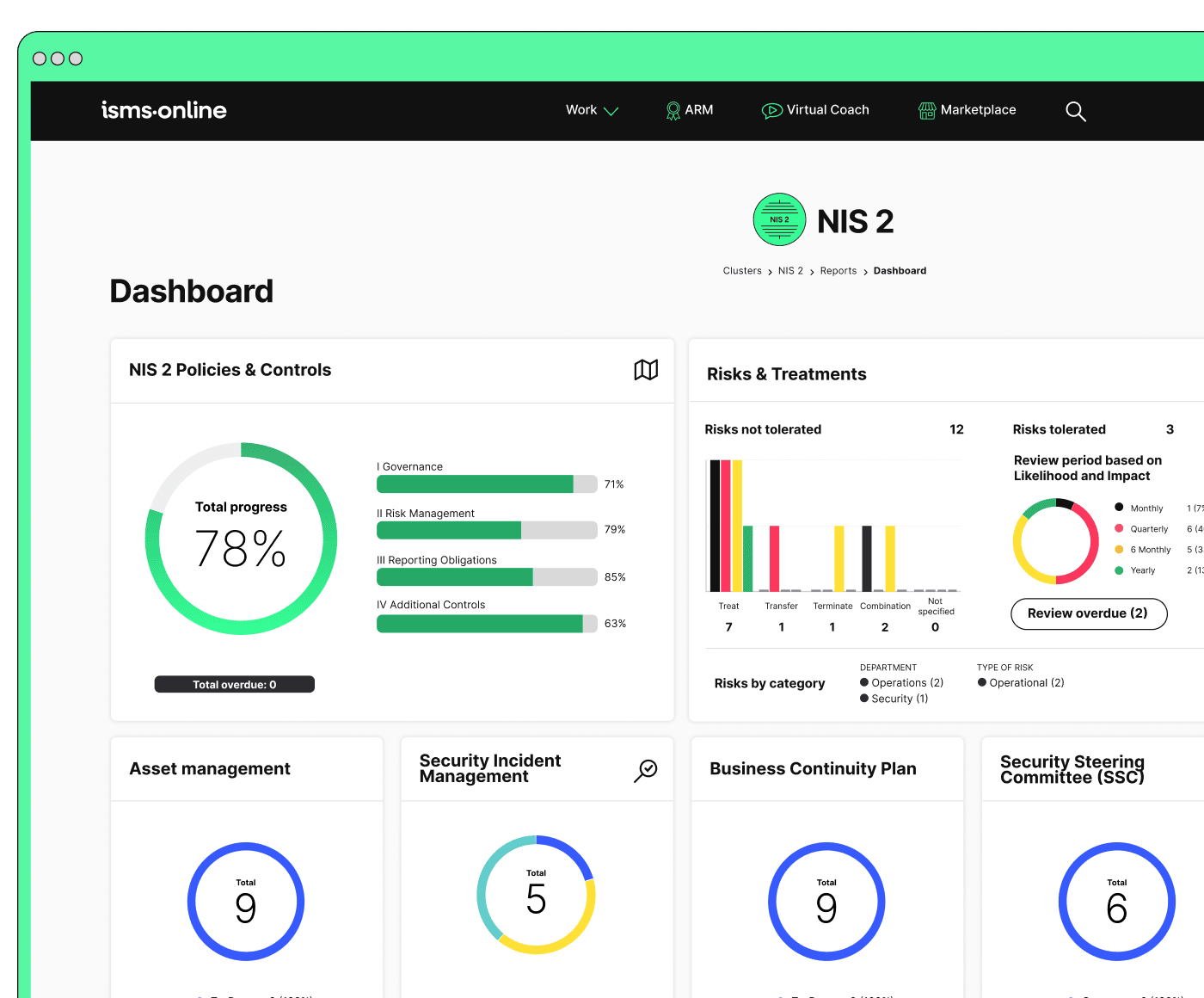
Be NIS 2-ready from day one
Launch with a proven workspace and templates – just tailor, assign, and go.
How Do Supply Chain, Sector, and Group Risks Elevate NIS 2 Board Exposure?
Large and midsize organisations with layered structures face increased audit pressure under NIS 2: accountability for supply chain and sector overlays now sits squarely with central boards, not devolved entities. Compliance cracks arise not from single points of failure, but from invisible gaps between divisions, suppliers, or cross-jurisdiction partners (ENISA/ECS tracker).
The group’s security chain is only as strong as its weakest compliance entity or sector overlay.
Where does risk visibility break down?
- Local overlays: When central policies aren’t updated in response to new sector or country rules, regional guidance outstrips group controls.
- Jurisdictional fragmentation: Control or reporting requirements vary; action logs break at hand-offs.
- Supplier transparency: Unreported incidents or “end-of-life” risks in vendor base are easy to miss when supplier logs are decentralised or ownerless.
Policy-to-Evidence Table: Trigger → Update Needed → Policy Link → Evidence Example
| Triggered Issue | Risk Update Needed | Policy Link | Evidence Example |
|---|---|---|---|
| Supplier fails to report incident (24h rule) | Update supply chain incident log | A.5.21, A.5.22 | Supplier log, board review notes |
| Stricter local guideline issued | Update group controls, crosswalks | Cl. 4.1, A.5.36 | Policy revision, board sign |
| Vendor goes end-of-life | Reassign/update risk owners | A.5.19, A.5.21 | Vendor archive, board approval |
| Merger/divestment | Integrate/delink risk registers | Cl. 6.1, Cl. 8.2 | Audit record, SoA change |
Every entity, sector, and supplier should be mapped, logged, and, where possible, surfaced through a single compliance dashboard-visible at board-level and automatically exported to every new team or jurisdiction.
By making the complex visible and accountable, compliance leaders build regulatory trust and shield the business from critical supplier or group failure.
Leaders who elevate supply chain risk logs, sector overlays, and cross-entity checks into board reviews secure not only compliance, but true business resilience.
Where Does NIS 2 “Show, Don’t Tell” Evidence Begin-and How Must You Prove It?
Board and operational trust will never be won through paperwork alone. NIS 2 demands a living, evidence-rich compliance environment: time-stamped logs, owner assignments, linked incidents, and acknowledgment records. Regulators and auditors want to see not only what happened, but exactly who acted, when, and how-in three clicks or less (ISMS.online evidence mapping).
Compliance without living evidence is a trust deficit-modern auditors seek logs, not declarations.
Required NIS 2 evidence (for any audit):
- Live logs: scenario rehearsals, access reviews, incident responses (per department/role).
- Integrated acknowledgments: sign-off for policies, events, and incidents by role.
- Automated, event-driven update cycles: Quarterly at minimum, instant after material events.
- Training/adoption logs: cross-mapped to new policies, regulatory overlays, and staff changes.
Traceability Table: Trigger → Risk Update → Evidence Example
| Trigger | Risk update | Control / SoA link | Example Evidence |
|---|---|---|---|
| Staff role change | Update access review | A.8.2, A.8.3, A.5.18 | Review log, access receipt |
| Incident notification | Log incident response | A.5.26, A.5.27, A.8.16 | Incident report, sign-off trace |
| New regulation mapped | Policy/training update | Cl. 6.1, A.5.1, A.5.14 | Policy pack issue, training log |
Teams should stress-test their readiness before facing an external auditor: if your team struggles to evidence event, owner, and review in three steps, the risk of audit failure rises exponentially.
Audit regret begins with the team that can’t surface an evidence record, not the one who misses a policy.
Living compliance proves trust; teams still chasing evidence through inboxes are subject to last-minute scramble-and the audit findings that follow.
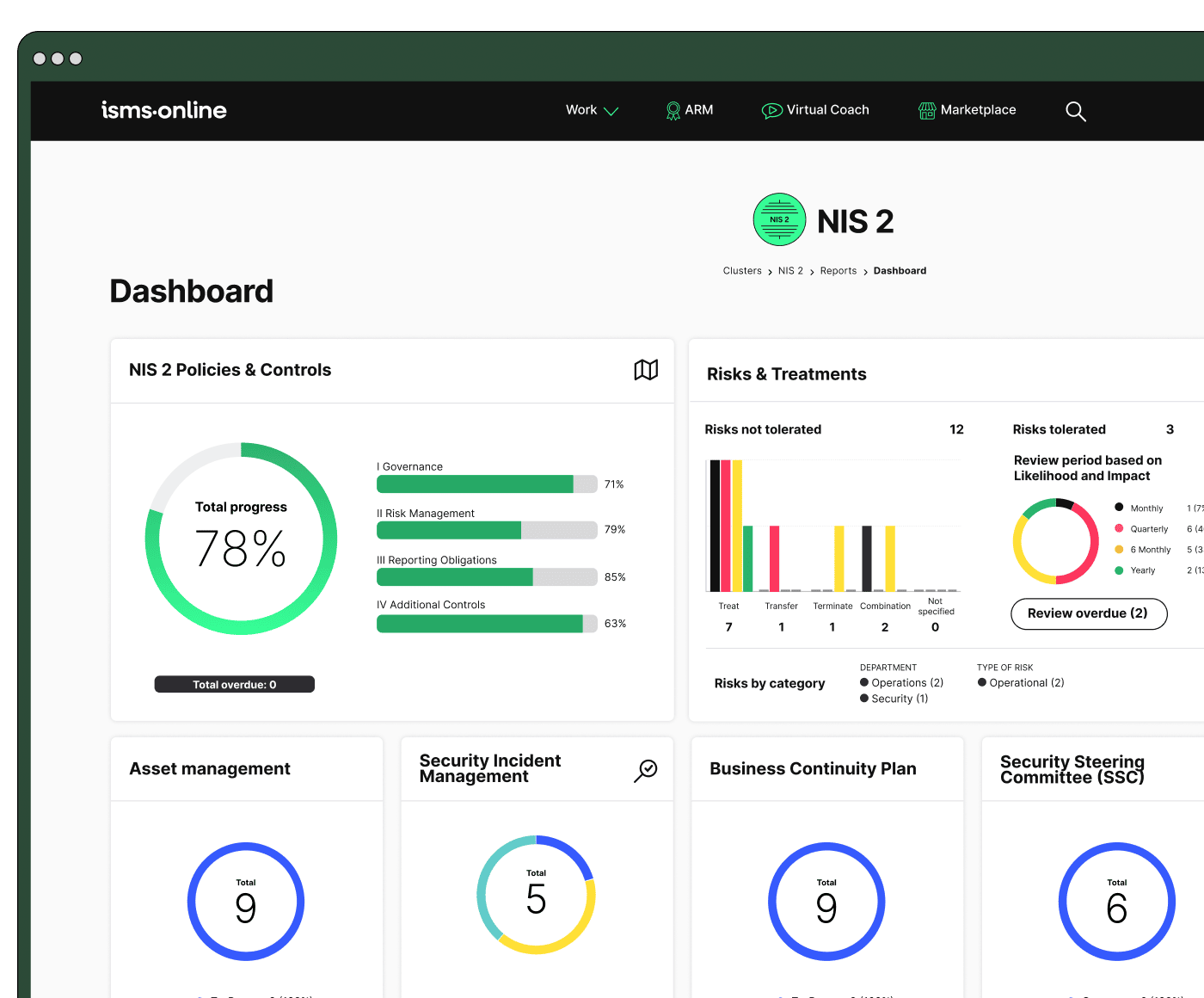
All your NIS 2, all in one place
From Articles 20–23 to audit plans – run and prove compliance, end-to-end.
How Does ISO/NIS 2 Crosswalk Supercharge Board Oversight and Active Accountability?
ISO 27001 remains the universal backbone for information security management-but NIS 2 demands something more: evidence-linked, dynamic “crosswalks” between management reviews and daily operations (ENISA/ISO crosswalk).
Passing an audit now means the board and team’s names are next to real actions-and the log runs year-round.
The robust oversight required today isn’t just about control assignment. It’s about:
- Named owner for each risk/control: Assigned, logged, and review-cycled in a central system.
- Supply chain sign-off by sector/board: Live records of review and board approval; no “ghost” suppliers.
- Incident response engagement: Participation and feedback from the board-logged, minuted, and visible in dashboards.
- Management review cadence: Logs, exports, and signatures mapped to real calendar cycles.
- Event-driven improvements: Logs of action, learning, and sign-off for every incident or regulatory change.
Crosswalk Table: NIS 2 Requirement → ISMS.online Operation → ISO 27001 Reference
| NIS 2 Requirement | ISMS.online Operation | ISO 27001 Artefact / Reference |
|---|---|---|
| Named owner for each risk/control | Assign, log, dashboard review | A.5.2, A.8.2, A.8.3, SoA, Cl. 9.3 |
| Supply chain sign-off | Crosswalk evidence, board log | A.5.19, A.5.21, Risk Register |
| Incident engagement (board) | Meeting attendance, feedback | A.5.26–A.5.28, Cl. 9.3 |
| Mgmt review cycles (board) | Signed dashboard exports | Cl. 9.3, A.5.1, Audit Programme |
| Event-driven improvement logs | Rolling, live evidence | Cl. 10.1, A.5.35, Evidence logs |
Year-round logs and live crosswalks give boards real operational command-and unmatched audit readiness.
Boards and compliance teams leveraging this linkage close the gap between management ambition and real operational maturity.
How Do You Turn NIS 2 Compliance into Boardroom Trust, Audit Readiness, and Sector Maturity?
Modern compliance is not about box-ticking. In the NIS 2 era, it is a living, traceable strategy-founded on action closure, evidence dashboards, and audit-readiness cycles that move at the speed of sector change (enisa.europa.eu).
Audit maturity earns sector trust-trust becomes your leverage for customers, investors, and regulators alike.
Boards, CISOs, and privacy/compliance teams are now measured by:
- Timeliness: % of tasks actioned on schedule-by role, not just company.
- Management review cadence: Frequency and evidence of board challenge.
- Policy/training acknowledgment: Department-level metrics replace company-wide claims.
- Incident closure: Mean time, cycle, and evidence of improvement after each event.
- Audit findings trend: Downward trajectory signals real maturity.
Boardroom Trust Table: What Levers to Pull
- Self-assess trust and maturity, not just compliance.
- Benchmark logs and dashboard evidence against ENISA and sector peers.
- Show trust metrics in customer, investor, and board reports.
- Enable real-time dashboard access for all directors-reduce last-minute briefings, increase living oversight.
- Leverage live ISO/NIS 2 crosswalks for true differentiation.
Boards closing their trust gap become magnets for customers, preferred by regulators, and steered by live data-no longer by fear of audit surprise.
NIS 2 maturity earns trust-and for the most committed teams, trust is the ultimate return on compliance.
What’s Your Next Move? Build Board Confidence and Resilience with ISMS.online
Every compliance cycle, audit, or incident is more than a hurdle-it’s a proving ground for trust, sector reputation, and business resilience. In the NIS 2 era, the organisations that thrive are those that don’t just keep up-they log, lead, and outpace the expectations.
ISMS.online is purpose-built to bring boards, CISOs, privacy leaders, and operational practitioners onto the same page: continuous engagement, evidence, and improvement in one system. No more last-minute document hunts. No more passive approvals. Here, boards own the risk log, see live dashboards, and evidence improvement-before they become audit deficiencies.
- Benchmark every control, policy, and evidence record against the latest NIS 2, ISO 27001, and sector overlays (ISMS.online dashboard).
- Set and automate your board reviews, role-assigned crosswalks, and full audit support-built exactly for real operating teams (ENISA/ISMS.online modules).
- Turn every board, CISO, and compliance cycle into a source of sector trust-not just audit relief-and secure faster incidents, fewer surprises, and continuous improvement (ISMS.online).
- Map your trust maturity alongside sector leaders-see your own dashboard evolve as teams log every new role, incident, and regulation (ENISA mapping).
Trust is the ultimate return on compliance. The most committed teams don’t chase it-they evidence it.
Turn NIS 2 readiness into a source of boardroom pride, resilience, and measurable market confidence-see how with ISMS.online today.
Frequently Asked Questions
Who really carries board-level liability under NIS 2, and what exactly must directors document to personally protect themselves?
Under NIS 2, every board member-collectively and individually-is on the hook for cyber-security failings, with personal liability proved only through live, detailed records of their direct engagement, signatures, and challenge actions. The legislation ends the era of plausible deniability. No more fence-sitting: just “being present” or relying on secondhand reports is no defence if sanctions or regulatory probes arrive. Each director must be able to show a traceable pattern of involvement-attendance at risk discussions, signed minutes, logged questions, and documented follow-ups-as regulators have started holding boards personally responsible for lapses (CMS, 2024).
Every absent question or unsigned minute is now a personal compliance risk-not just a process gap.
Boardroom-proofing under NIS 2 requires:
- Direct signatures and attendance logs: for all cyber-security risk reviews, major incidents, management reviews, and adaptation cycles-proxy sign-offs are no longer acceptable.
- Timestamped, owner-assigned action and evidence logs: that link every risk update, incident, or policy shift to a named board member.
- Explicit challenge records: Each director’s critical questions, objections, and follow-up assignments must be captured in audit-ready logs, not just buried in generic minutes.
Visual: Board accountability matrix mapping directors to risk reviews, incidents, and signatures, with live evidence hyperlinks.
Where do NIS 2 board-level audits break down, and which red flags should trigger preemptive board action?
Boardroom audit failures nearly always originate from passive, missing, or outdated records-especially when director engagement exists only on paper, not in living system logs. ENISA’s 2024 NIS360 found that fewer than half of boards could produce current, director-tagged audit trails for critical incidents or supply chain exposures (ENISA NIS360, 2024). Audit collapses typically begin with faults hiding in plain sight: unsigned board minutes, missing C-suite entries in the incident log, or policy changes rubber-stamped without proof of scrutiny or challenge.
Audit failures are almost always preceded by silence in the logs; every unasked question is a regulatory tripwire.
Watch for these audit failure signals:
- Serial absences: Board or C-suite names missing from successive register entries, especially after incidents or regulation changes.
- Stagnant supply chain risk updates: Controls and owner assignments frozen post-incident.
- Checklist “compliance” with empty evidence: Audits that tick boxes but can’t show challenge, improvement, or owner intervention.
- Unaddressed repeat failures: Issues reappear due to absent lessons-learned records or improvement cycles.
| Audit Scenario | Necessary Board Action | Evidence Required |
|---|---|---|
| Sector-specific regulation | Targeted risk review | Signed, challenge-logged minutes |
| Major incident | Lessons-learned review | Action/owner updates, evidence log |
| Supplier breach | Escalation and ownership | Owner-assigned update, signature |
ISMS.online enables boards to automate named attestation, timestamping, and escalation chain tracking, flagging gaps before the audit, not after.
How can multinational boards harmonise defensible NIS 2 evidence across divergent countries and sectors?
The only sustainable defence is “highest bar” compliance: boards must centralise live logs, dashboards, and responsibility maps group-wide, then localise overlays for each national or sector requirement. With the NIS 2 transposition diverging by country and sector (ECSO Tracker, 2024), evidence fragmentation is the default unless every local update is mapped back to a named group director with traceable logs, challenge, and sign-off. Harmonisation comes not from a single template, but from a living, interconnected record of jurisdictional overlays and adaptations mapped to board owners.
A harmonised board is one with a live overlay crosswalk: every jurisdiction, every update, every owner clearly logged and auditable.
Best practise for seamless multinational evidence:
- Dynamic audit dashboards per entity, per country: -showing which director owns, signed, challenged, or followed up on every overlay or adaptation.
- Crosswalk logs: Each national/sector update mapped against group policy, with signatures and owner logs at both group and local levels.
- Event-audit checklists: Board-signed, adaptation-logged confirmation for every major law, incident, or sector event.
| Jurisdiction | Local Overlay / Event | Board Owner | Evidence Location |
|---|---|---|---|
| Ireland | DPC Data Breach | Chair | Signed risk/adaptation log (HQ + IE) |
| Italy | Cyber resilience simulation | CISO | Incident-reviewed, sign-off (IT) |
| EU-wide | DORA overlay update | COO | Crosswalk log, HQ + subsidiaries |
ISMS.online cross-references every overlay, risk, and board action in real-time, ensuring harmonised evidence and audit readiness for global boards.
What “living” audit-ready records-beyond annual reviews-must boards produce for a NIS 2 inspection?
Live, instantly retrievable logs-mapping every event, owner, and change-are now the gold standard for NIS 2: static minutes or annual reviews have fallen out of favour. Modern boards must be able to export, on demand, a full chain: incident occurrence, risk update, action owner, board sign-off, and any challenge raised, with digital signatures and timestamps (ISMS.online, 2024). Passive meeting packs are no longer admissible; boards need a living system that traces every move.
Instantly audit-ready records:
- Board attendance, signature, and challenge logs: per event, mapped to incidents, risk updates, and management reviews.
- Automated, owner-timestamped activity logs: Every policy change, incident simulation, or improvement cycle linked to a director.
- Complete “chain of evidence”: , from trigger to outcome and audit export, with role, ownership, and adaptation readily visible.
| Trigger Event | Risk or Evidence Update | SoA / Control Reference | Logged Proof |
|---|---|---|---|
| AI-specific risk emerges | Board-reviewed risk assessment | SoA, A.5.21 | Signed evidence log |
| Major incident simulation | Lessons learned, improvement | A.5.26, A.5.27 | Signed minutes, challenge |
| Supply chain breach | Owner review, risk flag | A.5.20, A.5.35 | Signature, role log |
ISMS.online captures these automatically, making every event, question, and correction traceable, retrievable, and defensible at any audit.
How does ISO 27001 support-and where must boards exceed-their evidence obligations for NIS 2?
ISO 27001 is the backbone: it sets the continuous management and evidence baseline, but NIS 2 adds a new top layer-dynamic, granular, director-mapped logging and live crosswalks to sector/country overlays. ENISA’s crosswalks confirm: every action, challenge, and lesson must be logged at the event-a static ISMS alone is no longer enough (ENISA Crosswalk, 2023). The board must show, at any moment, who did what, when, and why, linked to both ISO 27001 and sector overlays.
Being bulletproof isn’t about certificates-it’s about owning and evidencing every action, challenge, and response in real time.
Active accountability, logged and auditable:
- Live action logs per control and director: , for every incident, adaptation, review, or improvement.
- Dashboards mapping ISO 27001, Annex A, and NIS 2 requirements: -all tied to actions, sign-offs, and role ownership.
- Management reviews and improvement cycles: evidenced in live logs, not annual archive minutes.
| Expectation | ISMS.online Operationalisation | ISO 27001 / Annex A Reference |
|---|---|---|
| Board sign-off for incidents | Digital log, named signatures | 9.3, A.5.4, A.5.36, A.5.35 |
| Lessons learned, improvement | Management review cycle, logged record | 10.1, A.5.27, A.8.34 |
| Supply chain oversight | Owner log, adaptation register | A.5.19, A.5.20, A.5.21, A.5.35 |
ISMS.online connects each of these in live dashboards, directly assigning every action to a director to meet and exceed NIS 2 expectations.
Which KPIs and board routines put you measurably ahead-turning NIS 2 audit anxiety into trust leadership?
Trust maturity is evidenced not by policies but by responsiveness: on-time board reviews, full evidence cycles, continuous lessons learned, and “three clicks to proof” for every event, all benchmarked against your sector. High-trust boards track:
- Reviews by each director-% completed, on time, audit-ready.
- Rate and timeliness of management reviews, improvements, and actions following incidents.
- Speed and completeness in retrieving evidence (e.g., any incident log to proof in three clicks).
- Uptake and closure rate for learning cycles and improvements.
- Peer comparison of log completeness and transparency.
| Routine or KPI | Maturity Indicator | Cadence |
|---|---|---|
| Board review rates | % signed, timely, director-mapped | Monthly/Quarterly |
| Learning/improvement cycles | Incident to improvement, time to closure | Event-based |
| Audit retrieval speed | Clicks/steps to log and proof | Continuous |
| Benchmarking | Sector/peer transparency, completeness | Annual/Review |
Visual: A “trust maturity” dashboard trending review, sign-off, and improvement rates per director and entity, with instant export, crosswalk, and benchmarking.
ISMS.online enables this continuous feedback: every review, learning loop, and director action is logged, trended, and instantly reportable-for regulator, market, and boardroom trust.
Ready to move from audit anxiety to boardroom trust leadership?
ISMS.online is built for this new NIS 2 era-automating live, director-mapped logs, policy crosswalks, and evidence dashboards so you (and your board) are not just compliant, but credibly trusted. Schedule your board-level trust readiness review and see how every move, question, and improvement cycle becomes a measurable reputational asset.
Trust isn’t declared-it’s documented; every board you lead should leave a trail of evidence, not just intent.






