





































What Is the Regulator’s Gold Standard for NIS 2 KPIs?
Cyber scrutiny has shifted. With NIS 2, compliance isn’t a paperwork ritual-it’s a living, evidence-driven system judged by regulators and boards in real time. The gold standard? KPIs that are objective, board-anchored, mapped to NIS 2 articles, and backed up by operational logs that leave no room for ambiguity.
Boards who treat cyber KPIs as mere checkboxes risk unravelling trust the moment an auditor digs deeper.
Organisations consistently acing audits recognise two realities: regulators want evidence that stands up to external inspection, and the board needs confidence that resilience is more than a slogan. Across ENISA and the “big four” consultancy consensus, what matters is provable control: each KPI must be mapped to an article or clause, a timestamped action, and a named owner (enisa.europa.eu; ey.com). If any part fails, the entire chain is at risk.
Table 1: Bridging NIS 2 and ISO 27001-KPI expectations and evidence
| Regulator Expectation | KPI/Evidence Type | ISO 27001 / A Ref |
|---|---|---|
| Clause-based controls mapping | % controls mapped to NIS 2 Art. 21–23 | A.5.1, A.5.24, A.8.8 |
| Data-driven audit trail | Dashboard with timestamped closure logs | A.9.1, A.8.9, Cl.9.2 |
| Ongoing, not just annual, assurance | Board sign-off cadence, risk board reviews | Cl.9.3, A.5.35 |
| Accountability/ownership | Named exec as KPI owner, sign-off log | Cl.5.3, Cl.9.3 |
A regulator’s gold standard isn’t a template-it’s the ability to surface live, mapped KPIs to demonstrate proactive, ongoing, and board-owned assurance. In this new landscape, outdated or siloed evidence doesn’t just slow audits; it signals fragility and erodes both regulator and internal trust.
What Is the Cost of Not Adapting?
Organisations relying on retrospective PDFs, generic attestations, or single points of expertise face a dual penalty: audit delays up to three times longer and a higher likelihood of regulatory escalation. Information withheld or not mapped to active controls recycles anxiety across every audit cycle.
The competitive reality is stark: companies who surface live, tied KPIs-backed by documented ownership-halve their audit cycle time and set a new bar for trust internally and externally.
When moments of scrutiny come, evidence that cannot defend itself takes your organisation out of the regulators circle of trust.
Book a demoHow Do Risk & Control KPIs Trace Directly to Regulatory Proof?
Regulators now expect a continuous thread between risk events, controls, and day-to-day governance, not just an annual ceremony. Under NIS 2 Article 21, risk management evolves into an unbroken sequence of loggable activities-each step visible, documented, and owned at the executive level.
Mapping Your KPIs to Article 21–22 (Risk & Control)
Boards and DPOs must prove that every new risk, supplier, or incident triggers a trackable sequence-risk register entries, control updates, remedial activities, and closure artefacts-all mapped to named owners and supporting logs. Passive evidence and generic process charts are now considered telltale signs of “paper compliance.”
Table 2: NIS 2 Risk-to-Control traceability: Detection to evidence
| Trigger | Risk Update | Control/SoA Link | Evidence Logged |
|---|---|---|---|
| New risk identified | Entry in risk register | A.8.8 (Vuln), A.8.29 | Log entry, linkage, owner assignment |
| Critical supplier onboarded | Supplier risk assessment | A.5.20, A.5.21 | Risk log, due diligence docs |
| Risk closure | Status = “remediated” | A.8.8 (Vuln mgmt), A.5.19 | Closure date, evidence artefacts |
| Incident response event | Post-mortem, control test | A.8.7, A.5.24 | Lessons learned, test results |
Organisations differentiating themselves surface these chains automatically on board dashboards-time to remediate, roles responsible, status by department. Quarterly reviews cycle through every open risk-ownership, log links, and closure mapped against live controls.
What Regulators & Boards Expect as “Costly Signals”
Regulators now view three traits as litmus tests for maturity:
- Non-stop risk sign-off chains-no “risk orphaning”
- Scheduled supply chain reviews cross-checked by named validators, with logs
- “Living” incident recovery logs mapped to control improvements
Failures in these domains mean weak “costly signals”: evidence that can’t defend itself results in extra regulatory scrutiny or penalties. Strong, actionable evidence flips the audit script and gives your compliance culture the benefit of the doubt.
If your KPI cannot produce a named log trail and cross-link to its control, expect an extended audit sprint.
Robust, real-time traceability is your currency of trust.

Master NIS 2 without spreadsheet chaos
Centralise risk, incidents, suppliers, and evidence in one clean platform.
What Proves Rapid and Effective Incident Response Under NIS 2?
Incident response under NIS 2 is not measured by static plans or post-facto uploads. The regulator’s threshold is set squarely by your ability to surface live, timestamped, and board-owned KPIs: namely, speed of detection and response, audit trails from incident to resolution, and the linkage of lessons-learned to updated controls.
KPIs That Demonstrate Incident Response Readiness
Modern KPIs convert incident response from a reporting exercise into a visible, repeatable discipline.
- Mean Time to Detect (MTTD) / Mean Time to Respond (MTTR): Monitored by trend and role, tied to each incident type, with dashboards that prompt quarterly review (us-cert.cisa.gov; csonews.net).
- Incident reporting rates: Percentage of events filed within 24-to-72-hour NIS 2 windows, tracked by severity and department.
- Post-incident actions: Number and timing of corrective actions logged and cross-checked against board cycles.
A drill is only as good as the evidence it leaves behind-live response logs beat tick-box paperwork every time.
The End of “Paper Plan” Evidence
Paper plans, annual uploads, or static registry files are now red flags. The gold standard is:
- Logbooks of drills with named attendees and timestamps
- Corrective action logs managed to completion, with audit-proof linkages to board minutes
- Incident reviews triggering visible, traceable improvements to controls
Incidents that “disappear” in untraceable logs or fail to generate improvement signals are now cited as audit risks. Demonstrating a habit of reviewing-then improving-upon every critical event positions your organisation as resilient, regulator-trusted, and genuinely proactive in its culture.
How ISMS.online Closes Incident Response Gaps
With ISMS.online, you replace the “paper chase” with:
- Live IR logs: tied to regulatory clocks and named owners
- Automated reminders: and board dashboards that update as each stage concludes
- Audit trails: that bind improvement, actions, and RCA to closure artefacts
Choosing evidence that is audit-strong, real-time, and role-named closes the gap between drills and reality-making your incident response demonstrably resilient and regulator-aligned.
In What Ways Do Supplier & Third-Party KPIs Satisfy Audit Demands?
A resilient organisation is now measured at its weakest external link. NIS 2 and aligned standards (DORA, ISO 27036) demand not only a supplier register, but KPIs and evidence logs that demonstrate continuous validation, supplier risk categorisation, ongoing training, and real-time issue management.
A one-time assessment is no longer enough-boards want to see a living supply chain risk landscape.
Auditable Third-Party KPIs That Meet Multi-Framework Standards
Audit-strong, board-trusted supplier KPIs include:
- % of critical suppliers risk-assessed and approved in the past 12 months:
- Median days from supplier incident notification to closure: -with logs per incident
- Attestation rates: Proof that suppliers complete training or pass security reviews – Number and scope of joint supplier drills per year Table 3: *Supplier KPIs and audit evidence examples*
| Supplier KPI | Evidence Example | Boards / Regulators Expect |
|---|---|---|
| Annual supplier risk review | Signed log, dashboard export | Trend logs, remediation |
| Incident closed with supplier | Incident tracker, event timestamps | Timing and closure evidence |
| Attestation/training complete | Certificates, system logs | Audit follow-up / board OK |
| Remediation budget allocation | Board approval, resource log | Risk/action linkage proved |
Avoiding the “Paper Trail Trap”
Regulators and auditors now review not just the existence of supplier risk logs-but the depth, recency, and linkage to actual remedial action. Static PDFs, stale uploads, or non-integrated logs signal neglect. Boards increasingly demand dashboards that tie policy sign-offs, third-party re-checks, and remediation into one transparent system.
A lagging or missing KPI in your supplier register isn’t just an audit gap-it’s a visible operational risk, and more boards are now demanding live evidence before the regulator ever calls.
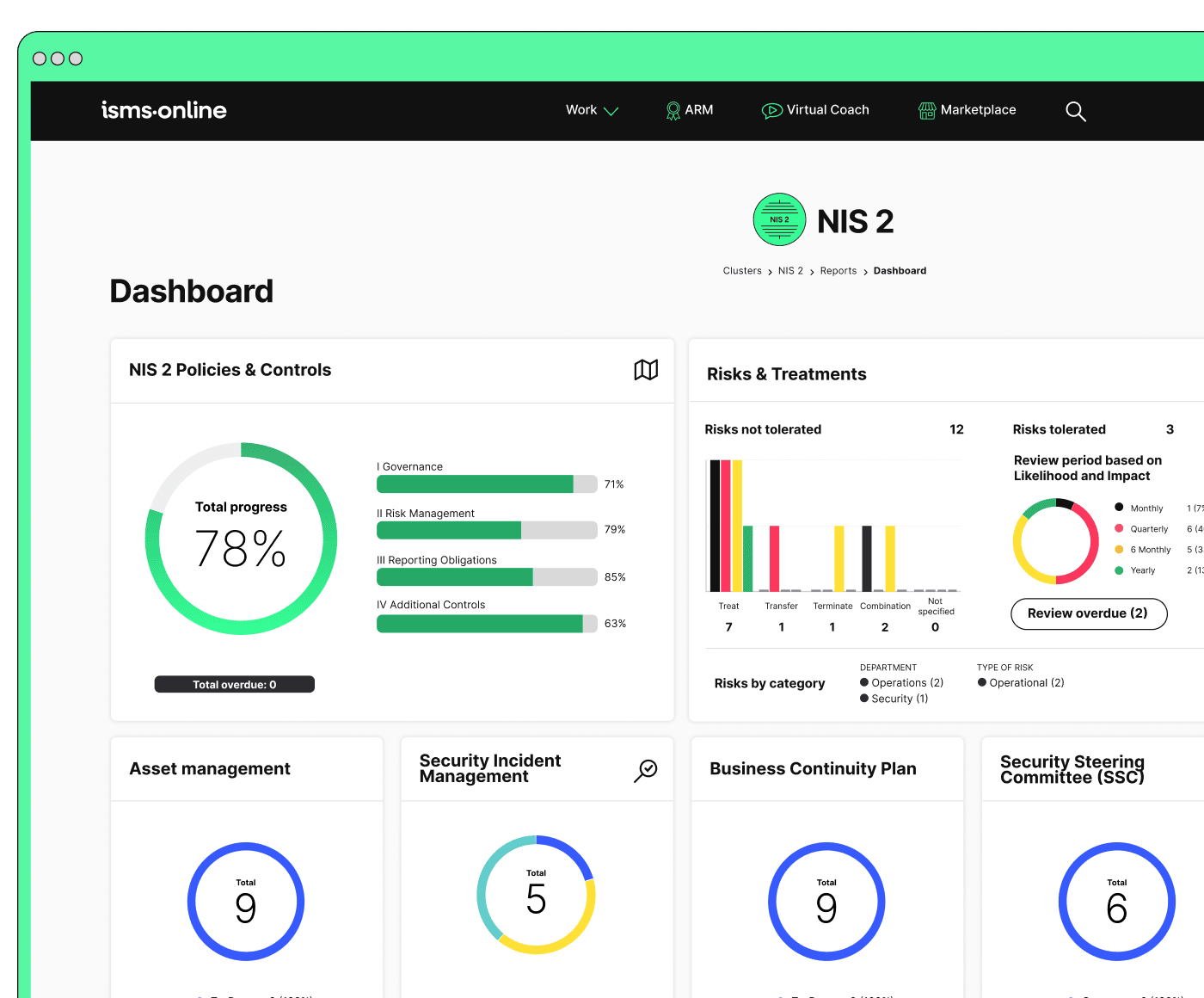
Be NIS 2-ready from day one
Launch with a proven workspace and templates – just tailor, assign, and go.
How Can You Track Staff Awareness & Culture – Beyond “Did Training Happen”?
Modern cyber-security culture lives or dies by more than a tally of “completed” training modules. NIS 2, ISO 27001, and industry best practise expect proof that security is not only taught-but also taken up, measured, and improved at the team and department level.
A culture of compliance only exists if you can prove staff are engaged-and improving.
Staff Awareness KPIs Auditors Actually Trust
Regulators, auditors, and now many boards expect:
- Role-level attestation rates: Who completed what, by role and department-not just org-wide averages.
- Phishing simulation metrics: Who participated, who reported, changes in click rates quarter to quarter.
- Error/repeat incident rates: Declining incidents and errors in high-risk teams as proof of real cultural uptake.
- Platform-driven reminders and feedback: Who was reminded, when, and how actions changed as a result.
A surface-level completion figure (“90% certified!”) actually hints at underlying risk if key departments underperform. Leading organisations show their engagement data by risk zone, department, or process-a winning move with both internal and external reviewers.
Creating a Live Engagement Proof Loop
A sustainable culture of security shows:
- Uplifts in high-risk teams, across years, not months.
- Continuous feedback cycles-what’s learned and how behaviour changes.
- Visibility of “security champions”: staff or teams regularly recognised for improvement.
ISMS.online enables you to automate assignment, capture acknowledgements, monitor role-level learning rates, and surface the data boards need to see real engagement-not just nominal training.
When the platform shows each team’s engagement and risk reduction, cyber security becomes real for everyone.
Why Real-Time Dashboards Are Now Your Primary Assurance Evidence
Boards and regulators are no longer satisfied with “evidence on demand.” They expect compliance to be visible-in real time-complete with linkage to clauses, controls, incidents, and closure logs, all mapped to the right owners and time frames.
Interactive dashboards are becoming the new lingua franca of assurance-where ‘see it now’ replaces ‘tell me later.’
What a Board/Regulator-Ready Dashboard Must Deliver
Your dashboard is now the single surface upon which compliance, resilience, and audit-readiness are projected (or found wanting):
- Coverage matrices: Map every NIS 2/ISO 27001 control and KPI to real-time status – Logged review cycles: Time-stamped board, management, and audit reviews-with traceable actions and closure links
- Incident and improvement trendlines: Graphs for detection, response, remediation, and learning-driven from actual logs, not manual updates
- Supplier/third-party scorecards: Live evidence of supply chain risk and validation
Table 4: Dashboard features for audit-strong, board-ready compliance
| Feature | Evidence Example | Audit Value |
|---|---|---|
| Control/Clause linkage | Live mapping, status matrix | Instantly proves compliance level |
| Incident trends | Real-time graphs | Flags gaps, supports board oversight |
| Staff engagement | Dept/role level logs | Reveals true cultural resilience |
| Supplier scorecard | Risk/attest. table | Spotlight on operational dependency |
Dashboards that can be drilled-down to individual log entries, acknowledgements, or supplier checks create an indelible trail for both auditors and the board-all without the need for last-minute document sprints.
Why “Boilerplate” Is Now a Risk (and a Red Flag)
Template plans or static outputs risk rejection from both boards and regulators. In contrast, a living dashboard is proof that compliance is continuous, participatory, resilient, and tightly integrated across security, privacy, and supply chain. This is why audit teams and executives are demanding evidence that’s interactive, not just “uploaded.”
ISMS.online is engineered to bridge these expectations, equipping your board with dashboards that make audit panic a thing of the past.
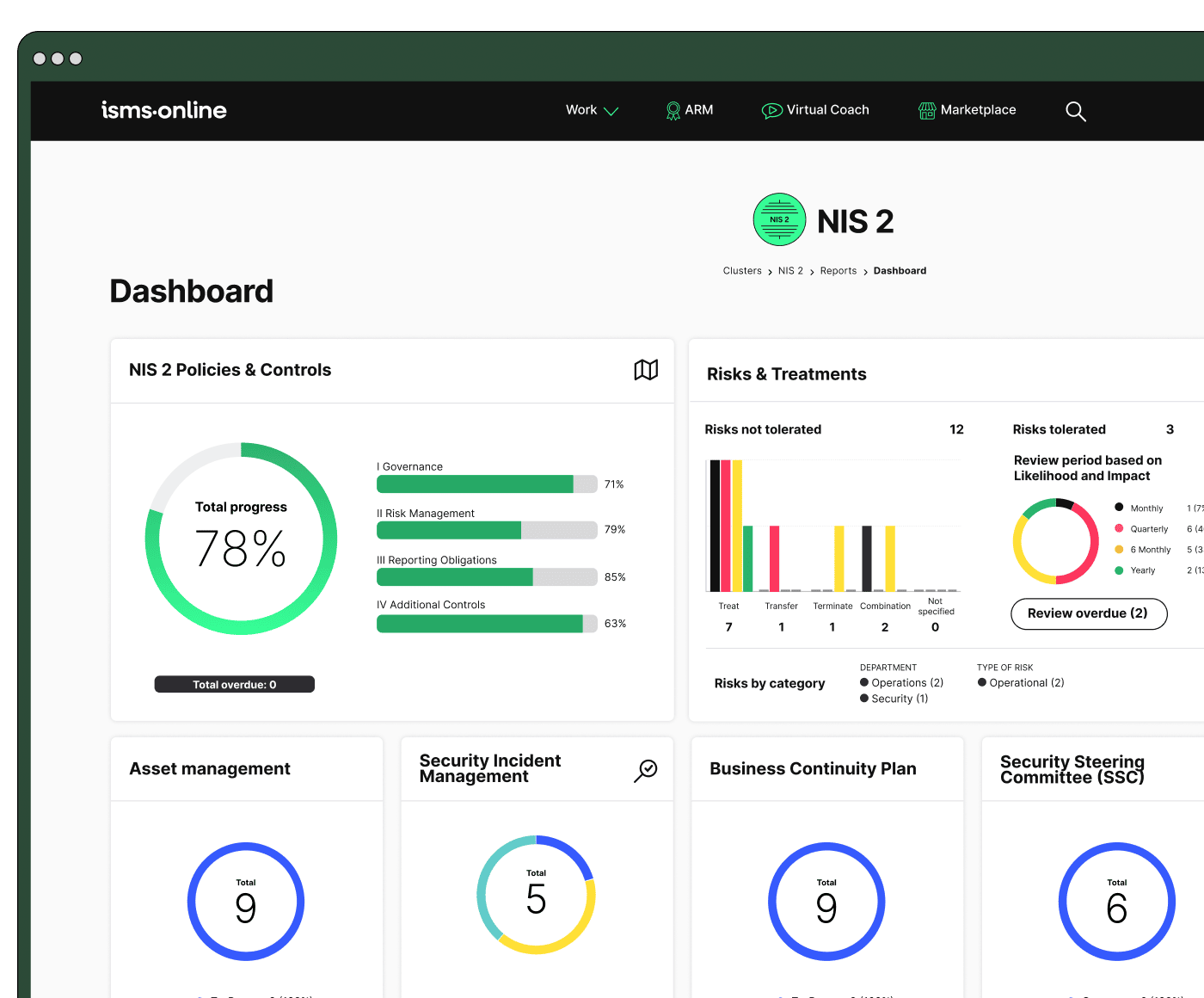
All your NIS 2, all in one place
From Articles 20–23 to audit plans – run and prove compliance, end-to-end.
What Board Evidence & Oversight Secure a “Compliant” Regulator Judgement?
NIS 2 changes the equilibrium: executive oversight and visible board-level accountability now determine whether a regulator deems a compliance programme trustworthy or fragile. Boards can no longer delegate cyber risk to the IT team and rely on sporadic reports; their fingerprints must be on every key compliance and risk milestone.
Board Oversight KPIs That Lower Enforcement Risk
Today’s audit- and enforcement-conscious board ensures:
- Management review cadence: Minimum two reviews per year, with record of agenda, participant list, and minutes
- Board sign-off on KPIs and risks: Dashboard outputs and action logs tied directly to board packs
- Audit trails for closed actions: Every follow-up mapped to a risk/control, with timestamped completion and evidence
- Clear ownership chains: Named executive responsible for every area, with log of delegation and sign-off
- Stakeholder and staff feedback cycles: Regular sentiment surveys, with board-reviewed results > Board-level involvement isn’t a switch-it’s a traceable, year-round governance habit.
From Metrics to Management Review-Securing Executive Trust
Ready to bridge this requirement, ISMS.online automation standardises board and management review tracking, sends reminders, and enforces action linkages. The outcome: when a regulator inspects, you show not just business-as-usual, but a living governance structure where every action is traceable, review cycles are never missed, and board oversight is in continuous, documented motion.
Board-room ready compliance isn’t a “department” job-it’s visible, deliberate, and logged in line with both NIS 2 and ISO 27001 leadership clauses (grantthornton.co.uk; weforum.org). This evidence habit sets apart organisations who not only talk security, but operationalise it at the highest levels-securing trust, resilience, and stronger regulator reviews.
Try ISMS.online – Unify KPIs, Compliance Evidence, and Board Clarity
When compliance moments count-during a regulator’s audit, a board review, or a live cyber incident-organisations with living, audit-ready evidence aren’t chasing folders or hoping logs are up to date. They are showing real-time status, linked to every critical requirement, and surfacing proof instantly for every KPI, control, and outcome.
Confidence is built through evidence that stands on its own-operational, auditable, always ready.
ISMS.online delivers this operational advantage at every stage:
- Instantly map any KPI to NIS 2/ISO 27001 clause and surface supporting evidence.
- Automate reminders so supply chain, incident, risk, and awareness KPIs never age out or go unlogged.
- Equip boards with dashboards and audit trails-so engagement, improvement, and board sign-off are live and provable.
When you unify your compliance evidence, there are no weak links-your resilience and audit readiness become as continuous, actionable, and visible as your operations. It’s the key reason ISMS.online customers achieve first-round audit passes and outpace regulatory changes.
Are you ready for live audit scrutiny and stronger board confidence? Move your NIS 2 compliance from “logged” to “lived”-and make every metric, control, and action count for what matters most.
Frequently Asked Questions
What specific NIS 2 KPIs do regulators and boards expect now, and why are static metrics falling short?
Modern NIS 2 KPIs must directly trace to regulatory clauses-every core metric should map to Articles 21–23, be owned by a real person, and proved through live operational evidence, not just yearly sign-off.
Boards and supervisors no longer accept vague attestations or spreadsheet lists as showing NIS 2 compliance. What’s changed is the demand for living KPIs: every key metric must be visible in a dashboard, mapped to a control or obligation, and tied to an accountable owner with an audit trail that shows review, action, and result. External auditors and ENISA now expect dashboards that link every KPI, incident response, and risk mitigation step to a board-reviewed record, going well past static checklists, stale action logs, or “annual policy reviews” (ENISA, 2023).
A dashboard is only credible when every KPI is mapped to a regulatory clause, an owner, and a timestamped action.
Key categories for NIS 2 KPIs that pass real scrutiny:
- Clause-mapped risk & control KPIs (e.g., “% of high-priority risks closed in 30 days – Article 21”)
- Evidence logs: review cycles, owner sign-off, incident closure, audit trails
- Live incident response metrics: 24/72-hour filings, corrective action status
- Third-party review metrics: supplier drill participation, notification compliance
- Cultural engagement: training completed/overdue, feedback/participation rates
- Named responsibility: every KPI and outcome must have an owner visible to the board
A single, unified ISMS dashboard-updated in real time and exportable for board packs-is already considered standard by supervisors from ENISA and national regulators (EY, 2022). If it’s not mapped, owned, and evidenced, it’s not accepted.
How do you move from policy-on-paper to living, operational KPIs for NIS 2 risk, control, and breach assurance?
Transforming policy into operational assurance means every risk or process KPI needs a workflow: ID the risk, assign a control and owner, monitor its status, and log its closure-all mapped to the right clause.
Article 21 requires more than listing risks-it demands evidence that they’re acted on in real time, with an executive or team owner tracking progress in dashboards. For every open risk, ask who owns it, how “closure” is defined (days, risk score, evidence logged), and how soon after identification it’s resolved. Effective organisations display KPIs such as “% of critical risks resolved within 30 days,” “number of board-approved risk exceptions,” and “post-incident corrective actions closed on time,” each mapped to their Article 21/23 control (ISACA, 2023).
| Expectation | Operationalised KPI | ISO 27001 / Annex A Link |
|---|---|---|
| Timely risk remediation | % of high-priority risks closed in 30 days | 8.2, A.5.7, A.8.8 |
| Supply chain risk management | % of critical suppliers reviewed annually | 5.21, A.5.19–A.5.21 |
| Post-incident improvement tracking | % of reviews with closed actions in 90 days | 6.1, A.5.24, Art. 23 |
Evidence standards have risen: Auditors seek closure rates, board oversight logs, trend lines of risk reduced/shifting, and proactive, owner-driven updates-not just annual “tick boxes” or policy attestations.
Which evidence and metrics actually prove NIS 2 incident readiness, especially for 24/72-hour reporting?
True NIS 2 incident readiness means live evidence of incident cycle speed: precise timestamps, swift notifications, closure of each corrective action, and staff participation in response-all mapped to regulatory deadlines.
Each incident must be:
- Logged at detection, with timestamp
- Notified to authorities within 24/72 hours, with audit proof
- Analysed for root cause, with action plans attached
- Closed only after post-mortem and improvement logged
Boards and auditors scrutinise trendlines: how many incidents disclosed on time, open/closed incident ratios by month, corrective action completion rates, and staff response/follow-up participation. Forrester now notes regulators expect at least 80% staff engagement in incident response training and clear escalation of any gap (Forrester, 2024).
Essential KPIs for incident assurance:
- % of incidents reported within legal windows (24/72h)
- % of follow-up actions closed in <90 days
- Staff participation % in drills/after-action reviews
- Board sign-off of major incident reviews and lessons learned
- Monthly trend in incident closure vs. opens
It’s not the incident count, it’s the response cycle and evidencing that a real fix was owned, closed, and reviewed.
How do the best organisations evidence supplier and third-party risk management with KPIs that withstand regulatory review?
NIS 2 demands every supplier risk and incident be logged, tracked, acted-on, and tied to a clause and owner-not just listed in a policy or contract.
You must show which suppliers were reviewed (date, owner, next due), who from each side attended drills or tabletop tests, which vendors met incident notification times, and which findings were actually closed out. Auditors expect to see, for Article 22 and Annex A.5.19–A.5.21, not only lists but also time-stamped reviews, attendance files, status on any post-incident remediation, and evidence that a real person owns the risk (ENISA, 2023).
| Trigger/event | Risk update | Control/SoA Link | Evidence logged |
|---|---|---|---|
| Supplier notification of incident | Board review of impact | A.5.21 | Notification time, closure proof |
| Annual supplier risk review | Owner assigned, sign-off | A.5.19–A.5.21 | Signed record, due date reminder |
| Vendor drill (tabletop/test) | Pass/fail + feedback logged | A.6.3, 5.20 | Attendance, report, owner noted |
High-credibility KPIs for supplier/third-party:
- % of critical suppliers with current, owner-signed risk review
- % of IT and business teams completing annual vendor drills
- Incident notification compliance % (on-time, per vendor)
- Corrective action closure % from vendor-related issues
These records must survive board and auditor review, not just internal “policy passes.”
How can you go beyond basic staff training metrics to assure real NIS 2 culture and engagement?
Regulators and boards demand behavioural and engagement metrics: steady improvements in risky behaviour, rising participation for key teams, live heatmaps of who’s lagging, and active feedback or security reporting-not just “training completed” stats.
For assurance, track:
- Training and policy completion by department, team, and role-not just org-wide
- Heatmaps of overdue/completed, with monthly or quarterly improvement trends
- Rates of simulated phishing, drills, or real event participation
- Number of feedback/incident/self-reporting events logged (with closure stats)
- Benchmarked trends: are high-risk teams improving, are issues resolved faster, are reminders working?
Culture is proved in improvement trends, adoption rates, and live engagement-not just completion certificates.
Using automated tools to send reminders, report progress, and publicly recognise improvement can boost engagement by more than 20% in trials (TechCrunch, 2022). ISMS.online dashboards can display these engagement maps automatically-a pivotal advantage for both regulators and management reviews.
How do unified dashboards and ISMS.online unlock true NIS 2 KPI assurance, evidence, and control-end to end?
A unified ISMS dashboard like ISMS.online gives you a “single source of truth” for every NIS 2 KPI, control, incident, and evidence log-ready for board, audit, or supervisor interrogation at any moment.
You can map every KPI, policy, and risk to the right clause and regulatory Article, assign an owner, and show audit-ready trendlines or exportable packs at the push of a button. ISMS.online’s dashboards allow you to visualise controls tied to Articles 21–23, track who signed off each risk, plot the closure of supplier drills or incident actions, and evidence continual improvement-by role, team, or board function (TechRadar, 2023; ITPro, 2023). Top-performing organisations have cut compliance preparation time by 50%, answer regulator questions in minutes, and achieve >95% real stakeholder adoption because all evidence lives in one place (IsoMetrix, 2024).
| Dashboard Feature | What It Enables |
|---|---|
| Clause-to-control mapping | Every KPI/control tied to regulatory language |
| Owner + time stamp logging | Visible accountability and audit trail |
| Real-time action trendlines | Evidence of ongoing progress, not just snap-shots |
| Automated report export | Instant board/audit packs for regulator/supervisor |
A live ISMS dashboard proves your organisation’s assurance. Every metric, owner, and piece of evidence is a click away-for the board, auditor, or regulator.
Next step:
Unite your NIS 2 KPIs, controls, and living evidence-create real-time clarity for your board and resilience for your business, with ISMS.online as your assurance backbone.






