





































How Does the Risk-Based Mindset in NIS 2 Transform Security, Accountability, and Decision-Making for Modern Organisations?
For years, compliance meant a tangle of checklists and last-minute scrambles-an endless echo of “prove you did what you said you would.” NIS 2 doesn’t just raise the standard; it flips the script. Now every major security decision must be justified by the real, live risk your business faces. It’s not about which controls you have-it’s about whether they’re defensible in the face of today’s threats and whether your board genuinely owns the outcome, not just the paperwork. This isn’t red tape for its own sake-it’s a shift from passive defence to proactive, data-driven resilience.
When risk becomes a routine focus, resilience shifts from hope to habit.
From Checklists to Agile Risk Response
Where older standards like ISO 27001 could lend themselves to a fixed, annual cycle, NIS 2 requires your risk picture to be alive-updated after incidents, threat alerts, or key business changes. The regulatory narrative now demands that your risk register, controls, and board minutes move at the speed of fast-changing cyber reality. If an attacker punches through your supplier chain tomorrow, you’re expected to review, record, and adapt-not wait until next year’s review.
Direct Board Accountability-No More Safe Harbour by Delegation
Under NIS 2, delegation is no defence. Leadership must understand, approve, and sign off on risk appetite, priorities, and the resources assigned to controls. There’s no more “not my job” refuge for directors: meeting minutes and sign-off records are legal evidence of active engagement. The days of passing the buck-or relying on a single point of failure in IT-are over.
Industry Context Drives Every Response
You can’t spray the same solution across finance, healthcare, or manufacturing and expect to pass muster. NIS 2 enshrines sector-specific risk handling as the standard: your controls and risk tiers must adapt as business flows, supply chains change, or external advisories emerge. What is “proportional” for a datacentre this quarter could fall short in six months if threat levels or vendor dependencies change.
How Much Is Enough?-Live, Documented Judgement Now Required
Proportionality is now more than a word you wave at an auditor-its a mandatory routine. Controls should go just far enough to match the risk at hand-no more, no less. Over-building is waste; under-doing is negligence. For each control, live rationale logs and evidence trails must explain why each investment matches your current exposure and posture.
Book a demoHow Does NIS 2’s Demand for Proportional Controls and Documentation Change Your Risk Posture in Practise?
Proportionality has always been mentioned in cyber standards, but NIS 2 makes it an auditable demand. Every euro spent-and every policy invoked-must be reasoned, “right-sized,” and defensible. Gone are the days of box-ticking bravado or hiding in a herd of boilerplate controls. Now, you must show that your decisions fit your true business impact, not just your regulatory box.
From “One-Size-Fits-All” to Right-Sizing by Context
The law is clear: proportionality means aligning controls to the risk, threat exposure, and business consequences of a disrupted asset or process. For critical datasets, you deploy layered safeguards; for low-value systems, sharp-but measured-controls. This de-bloats your security programme and lets your team focus energy and budget where risk-and return-are highest.
Turning Subjective Judgements into Audit-Ready Evidence
NIS 2 demands traceability for every control: risk, action, and rationale must be visible in live risk registers and documented for review. Not only what was implemented, but why and when. This means embedding review logs within your ISMS-not static spreadsheets-so you can show the story from trigger to response during any investigation.
Leveraging Established Frameworks Without Starting from Zero
ISO 27001, ENISA guidance, and the CIS Controls remain foundational. By initially mapping controls to these standards, you gain operational and audit credibility. But NIS 2 asks you to go further-tailor, add, or subtract controls, always documenting the “bridge” from standard to reality.
ISO 27001 Bridge Table: Mapping Proportionality to Action
Every organisation should maintain an audit-ready bridge table that articulates how you operationalise proportionality:
| Expectation | Operationalisation (Platform Example) | ISO 27001 / Annex A Reference |
|---|---|---|
| Documented risk assessment | Central risk register, updated post-incident | 6.1.2, 8.2, A.5.7 |
| Control mapping for each risk | Mapped controls, peer/audit review | 6.1.3, A.5.19, A.5.21, A.8 |
| Annual and ad-hoc review procedures | Scheduled and triggered policy reviews | 9.1, 9.2, A.5.36 |
| Justification for control strengths | Rationale log inside risk/control matrix | A.5.21, A.5.35 |
| Demonstration of “proportionality” | Role-based access, right-sized logging | A.5.13, A.8.15, A.7.2 |
This mapping lets you demonstrate at a glance how each expectation becomes live evidence-an essential defence when stakes are high or auditors probe deeper.
Why Over-Securing Becomes a Liability
“Security fatigue” is real. If you pile on controls for optics, you burn budget, annoy staff, and trigger behaviour such as shadow IT or unsafe workarounds. The well-protected organisation is the one whose controls are just visible enough, well-justified, and frictionless by design.
Proportionality Reviews: Who Owns Them and How Often?
Annual reviews by default, but event-driven updates are the hallmark of maturity. When supply chain, regulatory, or strategic events occur, living reviews-signed off at the board or CXO level-show auditors that accountability sits at the top.

Master NIS 2 without spreadsheet chaos
Centralise risk, incidents, suppliers, and evidence in one clean platform.
How Does Board-Level Accountability Under NIS 2 Transform Executive Responsibility?
Real accountability now reaches the highest levels: boards, risk committees, and executives are answerable for every word in the cyber-security playbook. This changes everything about how cyber decisions are documented, reviewed, and demonstrated in law.
Cyber accountability means your fingerprints are on every key policy, by design.
What’s New About Board Accountability?
No longer can security be considered “just IT’s job.” Under NIS 2, boards must demonstrate active oversight of cyber policies, risk reviews, and incident management. Executive signatures, review logs, and management minutes must show a living engagement. Failure to lead brings both personal and organisational liability.
Defining Evidence of Engagement
Audit trails now include: signed policies, risk registers with board input, incident review summaries, and management board minutes. Compliance is not a quarterly email thread or a paper trail filed by a project manager-it is an ongoing business imperative.
Reducing Legal Risk Through Documented Ownership
Every board review, policy sign-off, or incident decision should be immediately documented. In the event of a breach or regulatory review, a “paper trail”-ideally digital, centralised, and exportable-can reduce exposure. In cross-border scenarios, synchronised documentation becomes your first and best defence.
What Does Real Ownership Mean in Practise?
Ownership is active: the board signs, reviews, and asks questions about cyber policies, risk profiles, and incident response. They must see-and regularly update-the status not just of plans, but of actual reviews and lived outcomes. A policy that never changes is likely a policy nobody follows.
Inaction Is Now Grounds for Board Negligence
If a board is only involved after a major incident, or if minutes show rubber-stamping but no discussion, that’s evidence of negligence. The result isn’t just a fine-it’s regulatory action, shareholder pressure, and, increasingly, personal liability for directors who cannot show engagement.
What Does “Living” Risk Management Mean, and How Does It Change the Compliance Rhythm?
The old compliance habit-an annual fire drill, folders dusted off for the auditor-is finished. Under NIS 2, organisational resilience comes from turning risk management into a daily discipline, not a periodic panic. This is more than software: it’s process, ownership, and systemisation.
Making Risk Management Operational, Not Theoretical
A modern ISMS platform turns risk management into living rhythm: automatic reminders for reviews, instant risk updates post-incident, evidence of response logged for easy audit. No more screenshotting email threads for the regulator. If a phishing wave or supplier breach hits, your register and controls shift within days, not quarters.
Traceability Table: Linking Real-World Triggers to Controls and Evidence
| Trigger Example | Risk Update Action | Control/SoA Link | Evidence Logged |
|---|---|---|---|
| SaaS provider breach | Update supply chain risk rating | Annex A 5.19, 5.21 | Supplier risk register, review |
| New phishing campaign | Elevate social engineering threat | Annex A 5.7, 8.7 | Incident log, update training |
| Peer regulatory fine | Add sectoral enforcement risk | Annex A 5.36, 5.34 | Board minutes, policy review |
These bridges make risk evolution auditable and defensible. Auditors and boards quickly see if the system “learns”-or if nothing ever changes but the date.
The New Cadence: Annual Reviews and Instant Triggers
Annual reviews set the floor; the new normal is action after any threat, incident, or business change. An ISMS platform should make this visible by logging every review and update in real time.
Lessons Learned: A Proactive Asset, Not a Liability
Logs of failed controls, breach lessons, or “almost happened” incidents show real maturity. They are prized by regulators, as they guarantee your policies are more than shelfware.
Evidence On-Tap: What Auditors Want to See Immediately
Your risk register, board signatures, updated training records, incident logs, and policy approvals must be instantly available. No “hunt and gather”-just show the latest status, instantly, to pass the test.
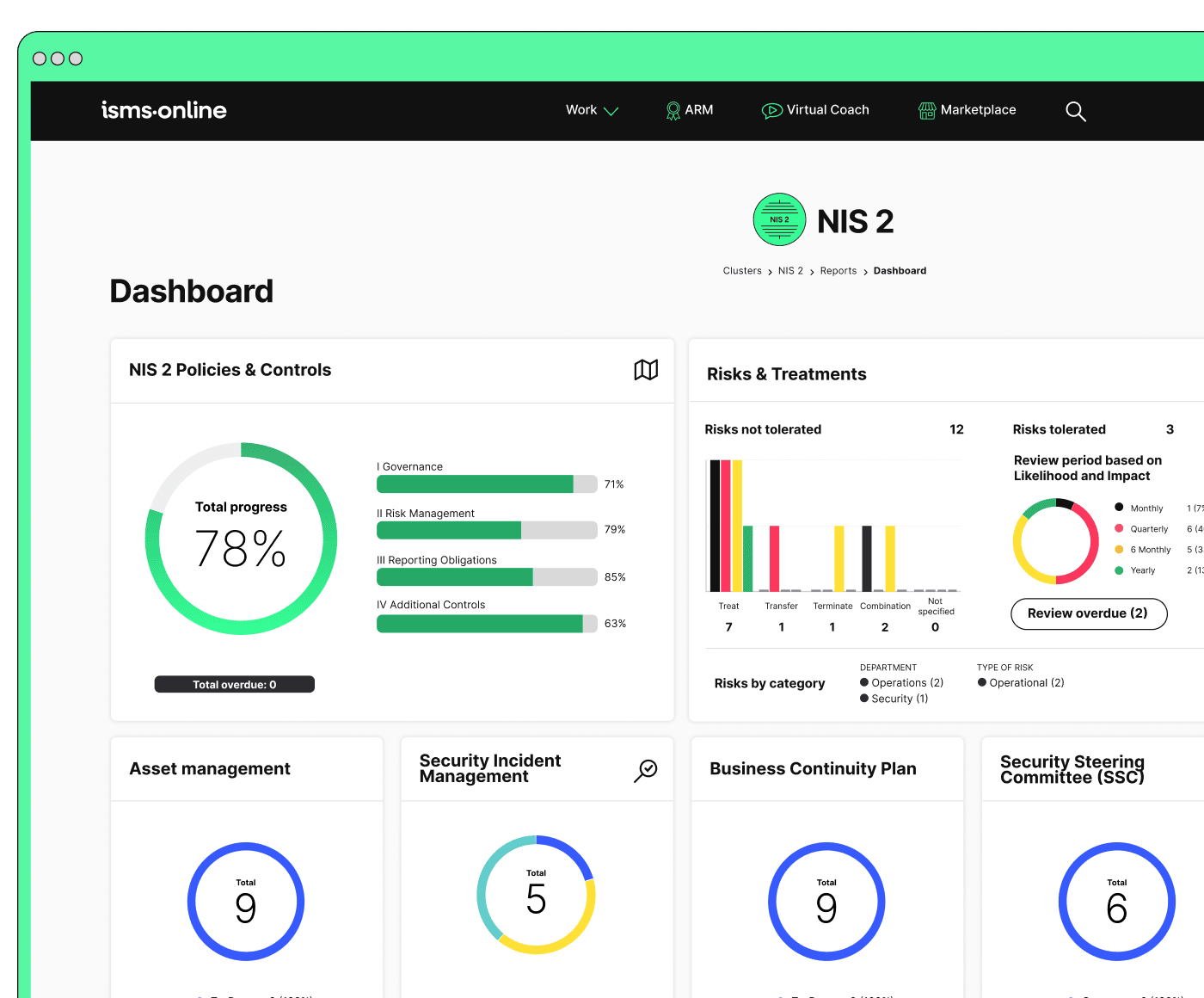
Wireframe: Dashboard-Driven Risk & Policy Tracking
A progress bar tracking policy reviews and risk register updates not only speeds up internal work but reassures board and auditors in one click.
Be NIS 2-ready from day one
Launch with a proven workspace and templates – just tailor, assign, and go.
Which KPIs Actually Matter to Regulators and Boards in Proving Cyber-Security Resilience?
Resilience must be visible, measurable, and actionable. Boards and regulators are no longer satisfied with status reports-they require metrics that predict outcomes and expose weak spots early.
Metrics Worth Tracking
Your key KPIs should include: policy review cadence; mean time to detect/respond to incidents; staff training completion rates; number and velocity of closed risks; and corrective action follow-through. These are the numbers that prove (or disprove) operational security.
Spotting Trouble Before It Hits
Trend-monitoring dashboards are now the norm, not “nice-to-have.” Weak spots-lagging departments, incomplete policies, unresolved risks-become visible early, leading to pre-emptive action.
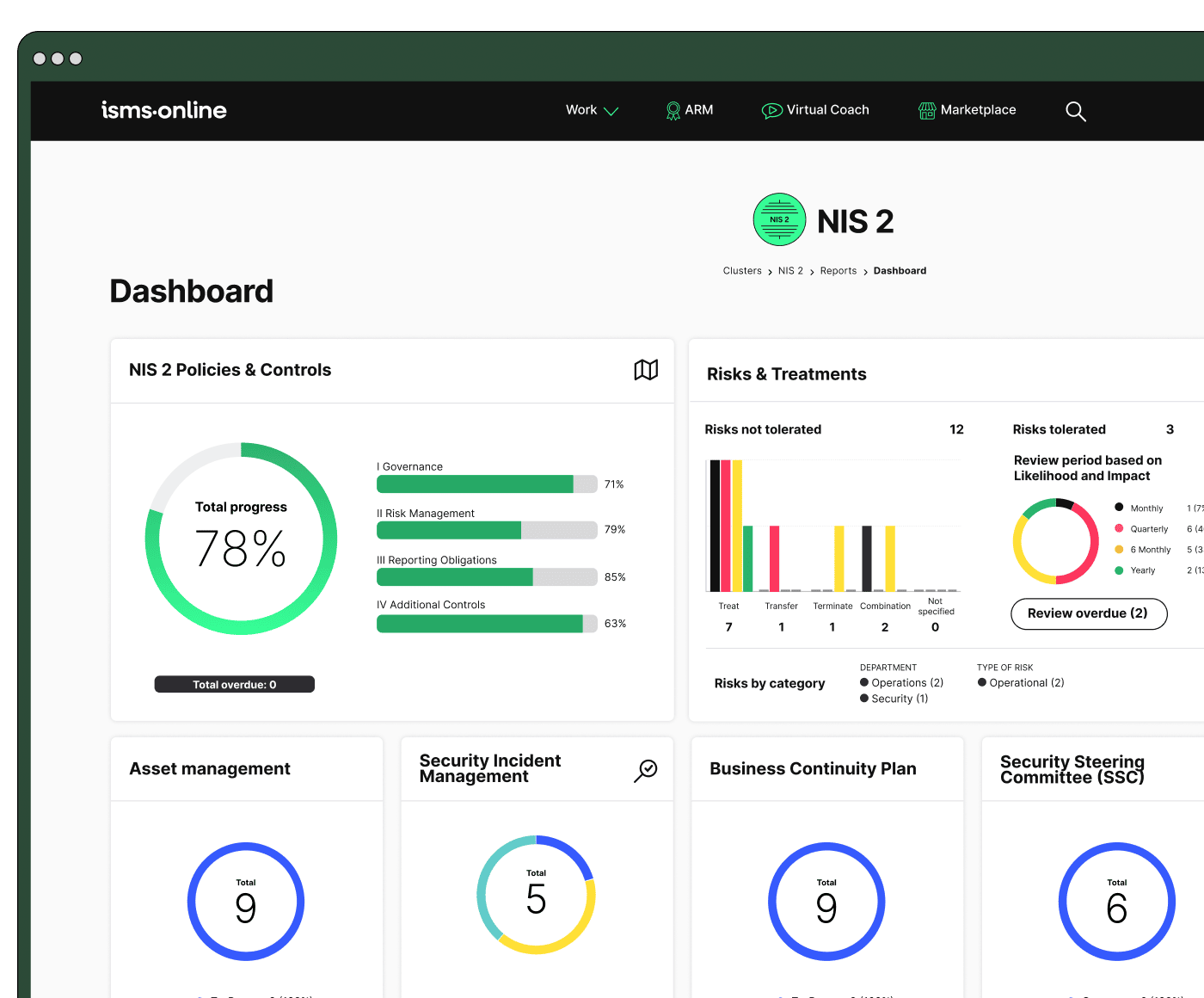
Visual Anchor: Live KPI Dashboard
A dashboard that tracks policy review recency, risk closure rates, and training completions empowers managers and boards to drill from summary down to detail. In a mature ISMS, this is not a project-it’s an every-week practise.
Documenting Failures Is a Strength, Not a Weakness
Incident logs, lessons learned, and records of setbacks present a genuine, mature cyber culture to regulators. Redacting, hiding, or apologising for “failures” now triggers questions, not trust.
Avoiding Board Overwhelm: The Art of the KPI Story
Raw data isn’t helpful; tying KPIs to board-level risk appetite and business impact turns complexity into clear signals. Boards make better decisions when they know exactly which gaps or trends threaten their core risk mandates.
Measuring just what’s easiest only counts in routine reviews-your board and auditors want what reflects true risk, especially when things go wrong.
How Do Human Factors Directly Influence NIS 2 Outcomes-From Compliance Culture to Audit Survival?
Technology alone won’t save you. As NIS 2 pulls training, awareness, and leadership into the compliance spotlight, your weakest link is no longer a device or firewall but disengaged or ill-informed staff-and a board that fails to set the tone.
Employee Engagement Cuts Real Risk
Well-designed “micro-interventions,” scenario-based learning, and realistic cyber drills demonstrably slash incident rates and loss. Policy dumps and checkbox tutorials are now evidence of a ticking time bomb rather than robust controls.
What Engagement Metrics Tell You about Culture
Track training completion, phishing test results, policy acknowledgement rates, and IR participation. Low scores signal not just risk, but urgency for leadership intervention before the next audit-or breach.
Driving Reluctant Staff Participation
Engagement follows leadership: regular, relevant updates and reward for involvement drive positive behaviour. When boards, HR, and management model engagement, risk falls and audit survival soars.
Diagnosing Security Culture Early
Surges in user-driven incidents, training non-compliance, or audit delays are your early warning signals. Catching issues at this layer is often more effective than any technical patch.
HR and Board: Joint Owners of Cyber Outcomes
Under NIS 2, responsibility can no longer be pushed down to IT alone. HR is charged with supporting engagement and tracking proof-failing to do so brings audit trouble and regulatory heat.
The lesson: Cultural inertia is now a quantifiable liability. Success or failure is shared from the boardroom to the front line.
All your NIS 2, all in one place
From Articles 20–23 to audit plans – run and prove compliance, end-to-end.
Why Supply Chain Security Is the Ultimate Proof Point for Modern NIS 2 Resilience-and What Steps Make It Work?
Supply chain and third-party risk are now at the centre of EU compliance. No business exists alone, and the greatest threats often lurk in your vendor’s vendor’s vendor. NIS 2 makes it impossible to hide behind finger-pointing.
Non-Negotiables: Registers, Real-Time Monitoring, and Rapid Response
You must maintain a live register of suppliers, ongoing risk and due diligence, and store all incident response and advisory logs. ENISA’s supply chain guidance is the baseline-not the stretch goal. Every new relationship, breach, or regulatory change must leave an evidence trail.
Top 3 Supply Chain Scenarios-Trigger-Based Control Mapping
| Trigger Event | Required Risk/Control | Key Evidence To Retain |
|---|---|---|
| New supplier onboarded | Supply chain risk assessment, contract clause review | Supplier due diligence + SLA review |
| Supplier breach or incident notice | Immediate third-party incident response, update risk | Incident log, communication record |
| Regulatory change/sector advisory | Update risk tier, policy or access control changes | Updated registers, signed-off policies |
Organisations that treat vendor questionnaires as “set-and-forget” fall short of NIS 2. Continuous oversight and control changes, linked to incidents and advisories, are now expected.
Retaining the Right Evidence
Supplier lists, contract records, incident logs, ongoing reviews, and “continuous improvement” updates are minimum requirements. Dashboards showing review cadence, risk tiering, and open actions support audit and incident response.
Smart Prioritisation: High-Risk Suppliers First
When oversight resources are tight, focus on high-risk suppliers with monthly or quarterly reviews. Use automated reminders and dashboards for others, but remember: proven oversight is always a regulatory concern.
Wireframe: Supply Chain Due Diligence Dashboard
A good ISMS will display vendors by tier, latest review dates, incident status, and live linkages to policies-giving leadership real-time assurance (and a ready answer when auditors or customers ask).
Why ISMS.online Is the Foundation for Modern, Living NIS 2 Compliance
Regulatory ratchets only tighten. Trying to play chess with siloed spreadsheets, fragmented policy files, or tool overload is a fast lane to fatigue, wasted spend, and regulatory friction. ISMS.online is the foundation that turns compliance into confidence, resilience, and measurable business value.
Moving from Static Evidence to Dynamic Proof
ISMS.online’s centralised registers, workflow automations, and mapped evidence control ensure risk, controls, and responses are live-always audit-ready, never hidden in a drawer (isms.online). When a new risk emerges or the board signs off a policy change, history logs, mappings, and review cycles align instantly.
Tangible Improvements: What High-Performers See
Organisations on our platform report faster audit-readiness, more complete evidence, near 100% first-time certification rates, and-crucially-higher staff engagement. When your compliance engine runs itself, your team can focus on resilience, not rework.
Unifying Growth, Change, and Governance
As NIS 2 expands-adding supply chain, AI governance, privacy, sectoral overlays-ISMS.online grows in step. New frameworks become additive, not disruptive. This is how you avoid expensive migrations and endless consultant cycles when the rules change again.
Consultants or Platform? You Set the Dial
ISMS.online complements outside guidance but houses your operational intelligence, workflow, and evidence. Your artefacts, decisions, and reviews remain with you-future-proofed against staff changes and auditor questions.
Onboarding: Momentum from Day One
Pre-built templates, onboarding guides, shared evidence and policy packs, and peer support mean you’ll go live rapidly with focused, clear momentum, never lost in onboarding fog.
The earlier you make the leap to living compliance, the more confidently your board leads and your team delivers.
Lead Now: Embed Board-Backed, Resilient NIS 2 Compliance with ISMS.online
NIS 2 compliance isn’t about checking a box-it’s claiming confidence capital for your entire organisation. Whether you’re a time-pressed compliance kickstarter, a board-facing CISO, a legal privacy officer, or the resilience-minded IT leader, ISMS.online makes every audit a formality, not a fire drill. Get started, set new standards for your peers, and let resilience become second nature-one policy, risk register, and supply chain action at a time.
Frequently Asked Questions
What does adopting a risk-based approach under NIS 2 mean-and how does it change the compliance playbook?
Adopting a risk-based approach under NIS 2 means your cyber-security efforts shift from static checklists to an always-on, context-aware playbook where every policy, control, and training is justified by today’s risks-not last year’s. Unlike prior tick-box routines, NIS 2 enforces live risk assessment: every time your business, threat environment, or supplier base changes, you must review your exposure and update controls accordingly. Waiting for annual cycles no longer suffices; immediate reassessment and documented action are requirements (ENISA, 2023).
Your compliance team, therefore, operates in a dynamic loop: changes trigger risk reviews, updated controls receive board scrutiny, and audit-ready evidence is logged for each update. Auditors, regulators, and boards now expect every measure to be tied to live risk data and rationale, traceable from control to incident. Staff are guided by the current threat horizon, not outdated routines, and every action is mapped back to your latest risk profile.
Having a real-time risk register means you’re always inspection-ready and never caught off guard.
Live Risk-Based Response Sequence
- Trigger: New infrastructure deployed, supplier change, or major regulatory/sector update.
- Action: Immediate risk review, board/executive assessment, control enhancement.
- Evidence: Refreshed risk log, signed approvals, up-to-date reports-exportable the moment an auditor knocks.
How does NIS 2’s proportionality principle ensure compliance drives business value-not wasted effort?
NIS 2’s proportionality doctrine replaces “cover-every-base” with an intelligent strategy: every control must be warranted by risk, business priority, and resource. Gone is the era where compliance meant redundant controls on minor assets or skimping on critical systems. You now scale controls in line with impact-allocating investments where they matter, documenting exceptions, and actively right-sizing your protections (Deloitte, NIS2 Directive).
Proportionality is demonstrated, not declared: The risk register contains live rationales for each adjustment, from beefed-up supplier clauses to reasoned downgrades for obsolete systems. Annual reviews and incident-triggered updates become snapshots of your ability to adapt in real time, creating an audit trail that boardrooms, auditors, and regulators trust.
| Compliance Event | Board/Exec Action | Evidence Logged |
|---|---|---|
| New cloud platform added | Risk review, control mapped | Cloud risk register, contracts |
| High-risk supplier onboard | Board signoff, SLA review | Supplier assessment, approval |
| Minor tool decommissioned | Control downgrade, reasoned | Exception log with rationale |
What new direct accountability does NIS 2 impose on boards and senior executives?
NIS 2 transforms board and executive involvement from distant oversight to documented, personal accountability for cyber risk management and results. Senior leaders are now responsible for reviewing, approving, and being able to defend every security posture change, risk acceptance, and significant control or policy update (BakerHostetler, 2023). The time when oversight could be delegated without documentation is over; evidence of board engagement-meeting minutes, signed decisions, and records tracing each risk to leadership review-is your only defence against regulatory scrutiny.
Executives and board members must keep a perpetual audit trail: every exception, incident response, and major policy decision is not only logged, but also acknowledged at the highest level. With increased liabilities and potential exclusion from leadership roles at stake, passivity is no longer safe. Active, traceable participation is now fundamental.
A signed risk log is a leader’s best protection; cyber resilience is a board discipline, not a delegated task.
How do organisations with complex footprints align NIS 2 compliance across borders and sectors?
With NIS 2 entangled in national laws and sector regulations-like DORA, IEC 62443, or vertical-specific overlays-multi-country and cross-sector organisations must master harmonisation. You can’t afford to meet only the lowest local or sectoral bar. The most resilient teams set their internal baseline to the highest regulatory standard across their footprint, then adjust for local flavour without undermining global controls (KnowBe4, 2023).
This strategy uses a multi-layered risk register and categorises controls by country, sector, and criticality. Local compliance leads approve any divergence-with exceptions and justifications logged in your ISMS. When an incident or audit arises, you’re equipped with a transparent rationale for every variation, preventing friction in both local and global reviews.
Key risk: Setting controls at the lowest common denominator leads to regulatory whiplash-audits delayed, investigations multiplied, and double penalties for overlooked variations. Leading organisations avoid this by centralising the highest requirements and documenting every adaptation.
Which risk assessment frameworks meet NIS 2/ISO 27001 standards, and what evidence must your ISMS capture?
Both NIS 2 and ISO 27001 demand a methodical, repeatable, and board-endorsed risk assessment framework, but don’t specify which by name. ISO/IEC 27005, ISO 31000, and NIST SP 800-30 are the most widely used (ENISA, 2023). No matter what you use, your ISMS evidence needs to include: methodology documentation, triggering events, board signoffs, risk acceptance logs, treatment plans, review cycles, and operational changes.
| Audit Expectation | How to Demonstrate | ISO 27001 Annex A / Clause |
|---|---|---|
| Repeatable methodology | ISO 27005/31000, NIST 800-30 adopted | Cl 6.1.2/6.1.3, A.5.7 |
| Acceptance/exception log | Explicit rationale & decision trail | A.8.2, A.5.35 |
| Trigger-driven review | Incident-based and cyclical reassess | Cl 9.3, A.5.27 |
| Board review evidence | Signed meeting minutes, SoA links | Cl 5.1, 5.3, A.5.4, A.5.36 |
What triggers matter?
- Material incidents (infosec, privacy, supply chain).
- Major tech or business change (migration, M&A, scaling).
- Annual or scheduled reviews.
- Sector or country-specific legal updates.
How do you make “live compliance” audit-ready-and sidestep last-minute evidence panic?
When every risk review, control update, approval, and incident is recorded in a single, versioned ISMS, compliance and evidence become a byproduct of doing your job well-not a scramble when auditors arrive. This living system means an auditor can request any decision, and your team immediately produces signed-off logs, board minutes, and links tying each control to real risk.
In a real-time ISMS, your audit trail forms itself-evidence isn’t something you chase, it’s what you live.
| Trigger | Risk Log Entry/Update | SoA Link | Evidence Generated |
|---|---|---|---|
| New vendor onboarded | Third-party risk review | A.5.19, A.5.21 | Board approval, due diligence |
| Breach detected | Incident reassessment | A.5.20, A.5.25 | Incident log, corrective log |
| Annual compliance cycle | Comprehensive review | All controls | Audit pack, meeting minutes |
| Board queries raised | Policy/risk review documented | A.5.4, A.5.36 | Signed review, action plan |
Why do high-performing teams embed ISMS.online (or equivalent) at the heart of compliance and risk management?
Organisations that centralise all policies, risk logs, controls, approvals, and regulatory records in a single ISMS accelerate audits, cut consultancy spend, and deploy new controls or scale to new frameworks in days-not months. ISMS.online users, for example, see audit prep drop from weeks to hours; incident-response and board approvals are all logged in one place; onboarding for ISO 27001, SOC 2, DORA, or sector overlays becomes repeatable, not reinvention (ISACA, 2023). Interactive dashboards and automated workflows keep every stakeholder engaged and accountable-transforming compliance from a technical afterthought into business confidence.
Leading results:
- First-time certification rate rises; regulatory reporting is frictionless.
- Staff and supply chain engagement improves.
- Policy/training adoption and audit readiness become continual, not campaign-based.
- Continuous improvement drives resilience, so you grow stronger, not just compliant.
When you unify compliance, risk, and leadership in a platform designed for auditability and end-to-end operationalization, your business runs with the confidence, agility, and trust demanded by boards and regulators alike.






