





































How Do You Pinpoint DNS Incident Significance When “Significant” Isn’t Clear?
Understanding what makes a Domain Name System (DNS) incident genuinely “significant” is foundational for any organisation bound by the NIS 2 Directive, especially Article 5. The reality is that “significance” is less a tidy metric and more a shifting operational challenge-auditors and regulators expect logic, not just luck. In a world where audit survival, resilience, and regulatory exposure hinge on how teams handle this single word, the absence of clarity isn’t a compliance footnote. It’s a daily operational hazard.
Audit shame doesn’t wait for clarity-it feeds on overlooked minor incidents.
Recent numbers reinforce the risk: over 40% of DNS incidents are not reported because staff aren’t certain what counts as significant (BSI Group). This ambiguity splits teams-some miss reportable events entirely, others flood logs with so many “possibles” that actual risk signals are lost in the noise. The cumulative effect, as flagged by the European Commission and NCSC UK, is a growing regulatory focus on minor, unlogged events-especially as small patterns may harbour serious yet hidden infrastructure risks.
Fragmented responsibility only amplifies the threat. Consider a routine operations staffer who logs, investigates, and fixes a DNS blip without looping in risk or compliance: that small oversight might morph into a boardroom-level embarrassment during an inspection. Without a system enforcing consistent, cross-team logic and rational escalation, you’re gambling with both trust and compliance.
Why Does “Significant” Matter for DNS Incidents?
“Significant” extends well beyond classic outages or downtime. DNS glitches that appear as minor performance dips-or even persistent, unexplained anomalies-can point to deeper instability, foreshadow attacks, or reveal chronic misconfigurations. Under NIS 2, even short-lived or distributed DNS events may trigger sector-wide reporting if their aggregated impact crosses certain thresholds. The burden, then, is not just on detecting impact, but on being able to evidence why something did-or did not-require escalation.
Audit expectations are clear: every significant DNS event must have a full supporting rationale. If you cannot show your logic, reporting process, and support trail after the event, your audit readiness dissolves on contact with a regulator.
What Does NIS 2 Article 5 Really Demand for DNS Incident Evidence?
NIS 2 attempts to impose legal guardrails on the slippery slope of “significance”: incidents affecting 10,000+ users, causing a 60-minute service outage, or impacting core national functions trigger mandatory reporting (EUR-Lex, 2023/2555). Yet the operational challenge is profound. Modern DNS environments are distributed and layered-responsibility often split between IT, service providers, and network teams-cumulative effects are easily missed.
Traditional DNS logs tend to be isolated and myopic. A short-lived outage at a remote office rarely covers enough ground to trigger a red flag on its own-yet the sum of comparable events across multiple branches may define a qualifying incident (Cloudflare Incident Analysis, 2023). Overlooking this aggregation creates both compliance risk and potential operational blindness.
How Do National and Sector Regulations Refine the Threshold?
NIS 2 is not the last word. National authorities, guided by the NIS Cooperation Group and ENISA, regularly introduce stricter thresholds: 1,000 affected users, 10 minutes’ downtime, any event impacting data integrity or trust. These lower bars, especially in sectors like energy, health, or digital infrastructure, directly shape audit and enforcement trends (NCSC-NL, Eurocontrol). Moreover, qualitative factors matter as much as numbers: if a DNS event exposes data, makes fraud observable, or disrupts service to any group seen as critical, escalation is required-even below numeric thresholds.
When in doubt, document, escalate, and have your rationale ready-auditors inspect both your events and your logic.
Auditors no longer judge by outcomes alone, but by the transparency and documentation of escalation decisions.
What Must the DNS Evidence Chain Include?
True compliance is built on hard evidence. For every significant DNS incident under Article 5 (and linked standards), teams must document:
- The number of users/endpoints affected-and the method of counting.
- Scope and duration of the event, including propagation and cumulatives.
- Service, supply chain, and sectoral impact.
- A qualitative statement: was integrity, trust, or data confidentiality undermined?
- The precise rationale for escalation or non-escalation-who made the call, and why.
- Timestamps and management sign-offs (no “log-only” policies).
| Legal Trigger | Operational Question | Documentation Required |
|---|---|---|
| >10,000 users affected | Did we cross a volume threshold? | Alert, log, ticket |
| 60+ min outage | Was downtime cumulative? | Outage report, RCA |
| Sector impact | Was continuity at stake? | Criticality log, signoff |
| Qualitative harm | Was data trust compromised? | Impact analysis, ticket |
Any missing link here leaves the organisation exposed during audits, at risk of fines, and undermines board confidence (KPMG Regulatory Outlook, 2023).

Master NIS 2 without spreadsheet chaos
Centralise risk, incidents, suppliers, and evidence in one clean platform.
How Can You Move DNS Significance from Guesswork to Operational Practise?
The translation from policy to action is where compliance succeeds-or stalls. Most audit failures stem not from intent but from inconsistency and memory-based triage. When DNS incident workflows remain reliant on individual skill or recall, gaps appear not just in logs but in assurance to management and the board.
Automation, not memory, makes evidence repeatable and defensible.
Are Your Workflows Trigger-Based-Or Memory-Dependent?
System-enforced workflows eliminate ambiguity: ISMS.online, for example, prompts teams to record user impact, service scope, and escalation rationale at the moment of incident logging. Staff select from pre-defined impact bands, link root causes, and must justify “not significant” outcomes with a reason and timestamp. Escalation and non-escalation are both evidenced and preserved for auditor review.
Passive screening (“log only if you’re sure”) is now a red flag for over- or under-reporting. Audit confidence demands a logged trail for all DNS anomalies-significant or not-so nothing is left to interpretation or forgotten in turnover.
| Trigger | Risk Update | Control / SoA Link | Evidence Logged |
|---|---|---|---|
| Multi-geo outage | Continuity review | A.5.29, A.8.8 | Incident, ticket |
| Supplier DNS anomaly | 3rd party review | A.5.21, A.5.19 | Alert, supplier audit |
| “Not significant” event | Rationale required | A.5.24 | Log, explicit sign-off |
Is Management Sign-Off Enforced and Audit-Ready?
A system-first approach demands that every event’s assessment and outcome are role-bound, time-stamped, and export-ready. ISMS.online enforces this with automated signature requests: no incident is “complete” until it’s reviewed and closed by the accountably defined manager. Timestamps, team actions, and rationale logs can be exported instantly-ready for board assurance or external inspection.
Auditors increasingly test not just log completeness, but the integrity of the decision-making chain that underpins each “not reportable” call.
What Makes DNS Evidence Chains Audit-Proof-Not Just Policy-Ready?
Policy alone does not secure trust. Today’s audit standard requires an end-to-end, traceable chain: every DNS event, from first detection through board-level accountability and corrective action, must be linked without missing steps. Evidence buried in private files, scattered emails, or “memory only” actions are now seen as weaknesses.
A missing link in the DNS evidence chain is a hidden risk waiting to surface at audit.
What Belongs in the DNS Evidence Chain?
- Initiation: Clear, timestamped alert-manual or automated input.
- Classification/Assessment: Pre-filled fields with NIS Article 5 required metrics (user volume, outage time, sector impact).
- Escalation/Non-Escalation: Decision and rationale, with supervisor sign-off and recorded context.
- Analysis/Remediation: Root cause, corrective actions, notifications, lessons for recurrence.
- Artefact Export: All above, packed and filterable for board, auditor, or regulator download, linked to controls.
| Phase | Required Field Example |
|---|---|
| Detection | Date/time, detector, responsible party |
| Classification | Impact, scope, user counts, thresholds |
| Escalation | Decision rationale, management approval |
| Remediation | Actions, outcomes, lessons |
| Board/Audit Review | Exportable trail, sign-off log |
How Does ISMS.online Help?
ISMS.online removes the fragility of human-based continuity by knitting these steps into a living evidence chain. Events are never siloed-each incident is audit-readable and assigned to controls (A.5.24, A.8.8, A.5.29, A.5.21). As teams, suppliers, and responsibilities shift, organisational evidence remains unbroken-legacy events can always be surfaced, exported, and defended.
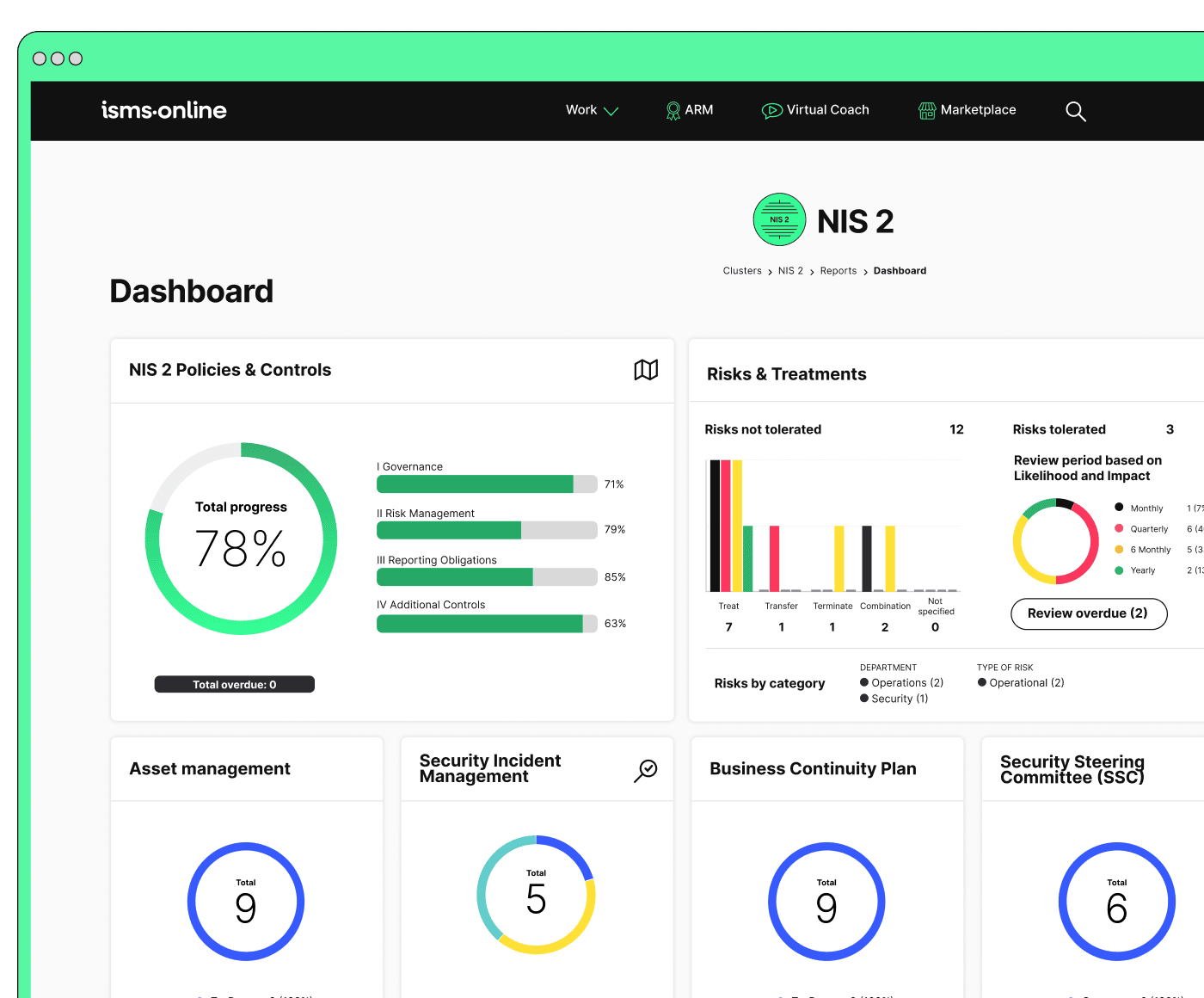
Be NIS 2-ready from day one
Launch with a proven workspace and templates – just tailor, assign, and go.
Are Your Teams and Policies Building Recurring DNS Compliance Strength-Or Just Checking a Box?
The difference between passable compliance and real operational strength is pattern evidence. NIS 2 and ISO 27001 require not just one-time artefacts but ongoing, recurring records-patterns that show staff participation, artefact accrual, feedback loops, and continual improvement, not just box-ticking.
Real evidence isn’t a policy, it’s a pattern: staff drills, real logs, and role-based acceptance.
Is DNS Incident Response Understood Beyond IT?
Modern audits probe not just technical logs, but the organisation’s “compliance muscle memory.” Who escalated the last event, who acted as backup, who has retrained in the last cycle? Artefacts such as role-based training logs, real incident walk-throughs, and repetitive involvement are now first-line defences in scrutiny.
Are Policy Improvements and Drills Regular and Artefacted?
A DNS incident, even if ultimately classed as “not significant,” should still prompt a feedback cycle: what was learned, who was involved, which playbook was updated? ISMS.online tracks and nudges for this evidence automatically, going beyond annual reviews to bring post-incident lessons into day-to-day compliance.
When the only DNS-trained staffer is on leave, does evidence survive?-Check your staff and artefact logs.
Recurrence in logs and training distinguishes resilient, audit-ready teams from merely “policy-compliant” ones.
Can You Connect Event, Consequence, Sign-Off, and Evidence in a Single Export for Board or Auditor?
Speed and sureness now define operational traceability. Modern regulators, auditors, and boards expect continuous, unbroken evidence-no gaps, no silos. When called upon following an incident, your ability to instantly export every relevant event, decision, and sign-off-fully mapped to controls-is now table stakes.
How Does ISMS.online Enable End-to-End DNS Evidence?
ISMS.online provides a persistent chain for every DNS event: logs, linked escalations, decision rationale, and auto-mapped SoA/control cross-references. Artefacts are preserved even if staff leave, suppliers change, or teams restructure. Exportability is built in: a single click can produce a ready-to-use audit, board, or regulator pack.
Audit-proof DNS events flow from logged detection to board review without missing links.
Key benefits:
- On-demand DNS evidence packs, including incident artefacts, decisions, and rationale.
- Each event mapped to ISO 27001 controls (A.5.24, A.8.8, A.5.29, A.5.21).
- Ongoing assurance-your evidence survives both team turnover and board scrutiny.
| Step | System Link |
|---|---|
| Event detection | ISMS.online Detection Log |
| Risk consequence | Control/SoA mapped (Annex A.5, A.8, etc.) |
| Approval/review | Timestamped role-based sign-off |
| Board/output export | Rapid, audit-ready download |
Why Do Speed and Sureness of Export Matter So Much Now?
“Being audit ready” is no longer just proactive. It’s the only way to keep pace with regulator and board expectations when DNS incidents are questioned months or years after the fact. Having every element mapped, role-validated, and export-ready gives your organisation a competitive edge-and makes audits, tenders, and customer inquiries a non-event.
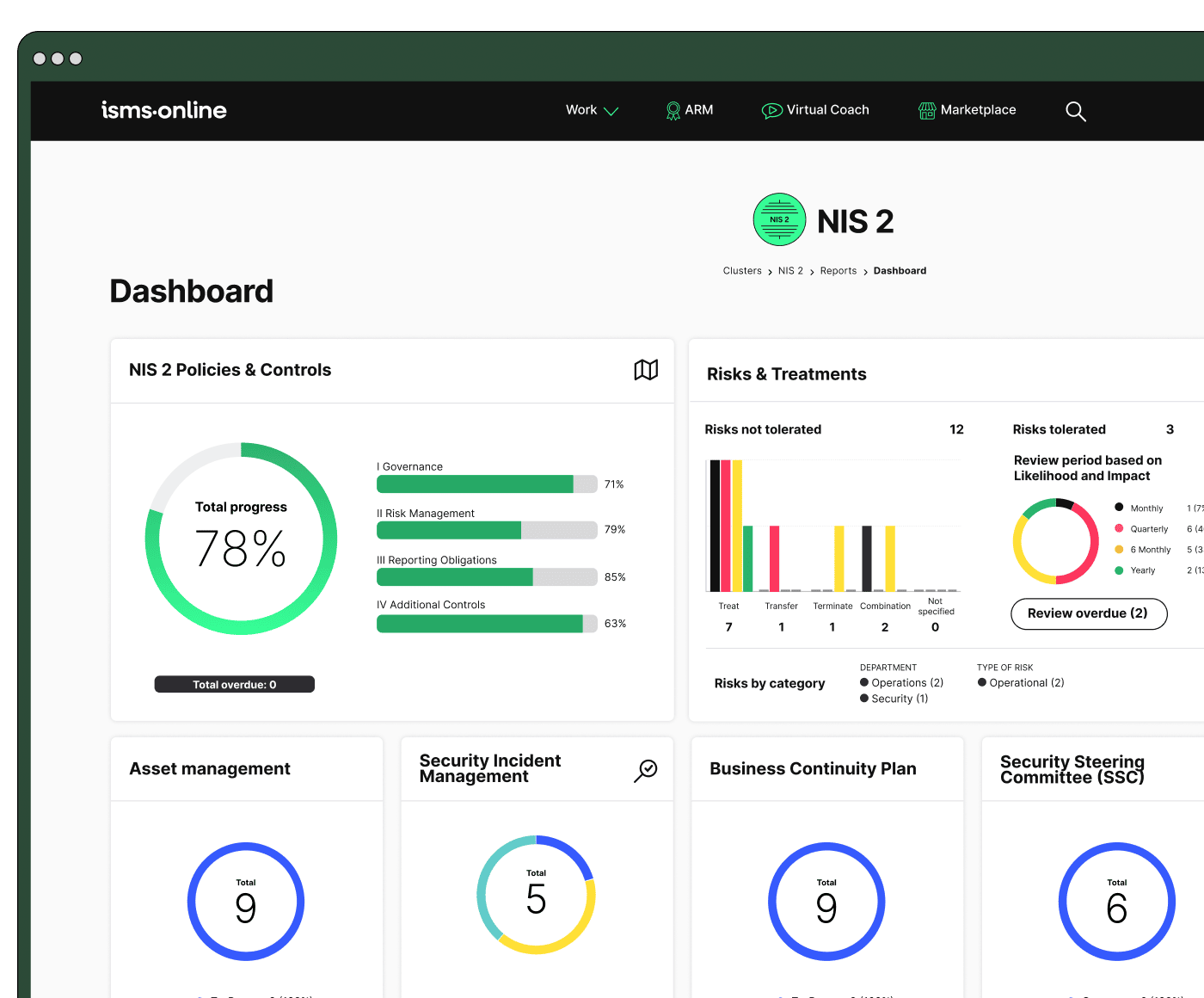
All your NIS 2, all in one place
From Articles 20–23 to audit plans – run and prove compliance, end-to-end.
How Does ISO 27001 Mapping Keep DNS Evidence Perpetually Audit-Ready?
Uniform, cross-standard mapping from DNS event to ISO 27001 control is no longer “nice to have”-it’s operational minimum. Disconnected systems and custom reporting slow responses and erode trust. ISMS.online ensures evidence is persistent, standardised, and always defensible-regardless of framework or authority.
Perpetual evidence readiness is the baseline, not the bonus.
Key ISO 27001/Annex A Controls for DNS Incidents
- A.5.24: Incident Management-event logging, classification, and reporting.
- A.8.8: Technical Vulnerability Management-identification, patching, and analysis.
- A.5.29: Information Security During Disruptions-continuity and redundancy.
- A.5.21/22: Supplier and Service Relationships-third-party DNS risk inclusion.
- A.5.27: Learning from Information Security Incidents-feedback, improvement.
Bridge Table:
| Expectation | Operationalisation | ISO 27001 / Annex A Ref. |
|---|---|---|
| Define DNS significance | Incident forms, logs, qualitative analysis | A.5.24, A.8.8, A.5.29, A.5.21 |
| Link incident to controls/SoA | Control/event mapping in evidence logs | SoA, A.5.24 |
| Evidence for board/audit | Exportable, role-stamped, time-stamped artefact | A.9.2, A.5.35 |
| Continuous improvement | Logged lessons learned, policy feedback | A.10.1, A.5.27 |
Because the platform assigns every artefact, event, and export a persistent ID directly mapped to DNS controls, your team is perpetually, defensibly audit-ready.
Start Proving DNS Significance with ISMS.online Today
The risk of ambiguity is no longer a technical nuisance-it’s a board-level liability. ISMS.online replaces DNS incident guesswork with automation, provable compliance, and a network of evidence that outlives any staff, provider, or management change. Every event, decision, and improvement is logged, mapped, and ready to support a rapid, confident response to any audit, board inquiry, or regulatory test.
Build a DNS evidence chain that survives not just audits, but the pressure of continuous change, regulator challenge, and growth. With ISMS.online, your DNS compliance is never just theory-it’s a provable pattern.
Clarity plus evidence is confidence-let’s make your next DNS incident audit a non-event.
Move forward with the confidence that every DNS event, escalation, and rationale is captured, mapped, and export-ready-because your business, board, and sector demand nothing less.
Frequently Asked Questions
What specific criteria define a “significant” DNS incident under NIS 2 Article 5 and how do you apply them in practise?
A significant DNS incident under NIS 2 Article 5 is any event that crosses objective thresholds for user impact, service downtime, recurrence, or critical sector effect, requiring formal notification and audit traceability-not just what “feels big” or has executive attention. The EU-wide legal definition ties directly to operational triggers: if a DNS incident impacts 10,000 or more users, causes at least 60 minutes of disruption, occurs repeatedly, affects connected supply chains, or compromises a critical or high-stakes sector (healthcare, finance, infrastructure), it counts as significant (EUR-Lex, NIS 2 Directive). Even if numbers are lower, incidents forming part of a pattern or hitting statutory overlays must be considered.
In practise, significance isn’t just about numbers-qualitative harm, like loss of public trust or data manipulation, now carries as much weight as quantitative impact. Real-world detection means integrating these calculations into your DNS incident workflow so no event falls through the cracks. ISMS.online operationalizes these rules with auto-flagging of thresholds, contextual escalation prompts, and required documentation fields-turning vague legalese into actionable, defensible steps. Every decision-escalation or “not significant”-is logged with rationale and timestamped approval, protecting your organisation from missed-report penalties or post-incident confusion.
In DNS compliance, we didn’t know is never a defence-build your workflow so you never have to say it.
Visual: DNS Significance Matrix (Key Triggers)
| Trigger/Factor | Typical Threshold / Red Flag | NIS 2 / ISO Ref |
|---|---|---|
| User impact | ≥10,000 affected users | NIS 2 Art.5/A.5.24 |
| Service continuity | ≥60 min. downtime | NIS 2 Art.5/A.8.8 |
| Recurrence/aggregation | Repeated/supply chain impact | NIS 2 Art.5/A.5.22 |
| Critical sector involved | Health, finance, gov’t, comms | Sector overlays |
| Qualitative harm | Data tampering, loss of trust | NIS 2/ISO 27001 |
| Documented rationale | Required for all report/no-report | A.5.24, A.5.36 |
Who sets the “significance” bar for DNS incidents-and how do sector requirements change the equation?
Under NIS 2, legal authority-not IT or management preference-sets the bar for DNS incident significance. The Europe-wide baseline in Article 5 standardises user, downtime, and context thresholds, but sectors such as health, finance, energy, and digital infrastructure layer on stricter overlays. Your organisation must align not only to the Directive, but also to national implementation laws and sectoral rules, which can lower thresholds or mandate additional reporting routes;.
Critically, the designation of significance must be recorded for every detected incident-including those not formally escalated. Boards, regulators, and auditors expect workflows that can prove, retroactively, how and why every decision was made-not just major incidents. Failing to recognise or fully document a “significant” DNS event is a leading cause of audit findings and potential regulatory penalties.
If an incident even approaches legal or sector thresholds, classify and justify-never minimise or skip logging in the hope it wasn't big enough.
Table: Legal-to-Operational Significance Mapping
| Legal Expectation | Operationalization in ISMS.online | ISO 27001 Ref |
|---|---|---|
| 10,000+ users / 60m | Pre-set auto-escalation in incident form | A.5.24, A.8.8 |
| Sector-specific | Auto-classify in workflow, sector tagging | A.5.24, SoA |
| Aggregation/Recurrence | Link events across time/sites/suppliers | A.5.22 |
| Qualitative impact | Required free-text rationale, evidence | A.5.36, SoA |
| National overlays | Reference local/industry law in log | A.5.31, SoA |
How can incident significance detection become fail-safe-not “missed” during legal or audit review?
To eliminate both missed escalations and false positives, significance detection must be automated and operationally mandatory-every step, from event logging to escalation or declassification, requires role-based ownership and documentary evidence. ISMS.online’s engine builds this into incident forms:
- Presents legal/sector overlay rules to users at data entry
- Flags and blocks form completion without a selection of significance status, rationale, and manager approval
- Records every branch, including “not escalated,” with the required justification, signature, and immutable timestamp
A 2023 ENISA study found that over half of DNS-compliance failures trace back to poor rationale documentation or ambiguity around why “not significant” calls were made.
DNS events unrecorded today reappear as regulatory fines or failed audits tomorrow. The only way to be bulletproof is to leave a living thread of rationale, not a pile of after-the-fact memos.
Traceability Table: DNS Incident to Evidence Chain
| Trigger | Risk Update | ISO/SoA Control | Evidence Logged |
|---|---|---|---|
| 10,000+ user spike | Escalate as significant | A.5.24, A.8.8 | Signed incident, approval |
| Supply chain DDoS | Vendor tagged, sector flagged | A.5.22, SoA | Supplier/partner log |
| “Uncertain” escalation | Manager rationale, explicit log | A.5.24, A.5.36 | Time-stamped approval |
| Not escalated (w/ cause) | Must log and sign justification | A.5.24, SoA | Non-escalation record |
How do you build a chain of DNS incident evidence strong enough for any audit, board, or regulator?
Resilient DNS compliance is about proving the lifecycle of every major event-from detection to final sign-off-not just responding or archiving the bare minimum. Each incident in ISMS.online is automatically linked to:
- Incident record: facts, impact, stakeholders, root cause
- Classification: significance assigned via thresholds and overlay rules (auto-check)
- Escalation log: who approved, when, rationale (including “not escalated” if applicable)
- Third-party evidence: vendor, supply chain, or SaaS logs imported as attachments
- Notifications: audit trail of all communications, from initial detection to official closure
- Policy mapping: every incident is linked to the current SoA, showing your controls are live and integrated
When board, audit committee, or a regulator demands proof, you export once-complete, up-to-date, and cross-referenced to ISO 27001, NIS 2, and sector overlays. No manual chasing means no costly misses or “gap-welding” after the fact;.
Table: DNS Audit Artefact Bridge
| Event Trigger | Reference/Policy | Exported Evidence |
|---|---|---|
| Major DNS outage | A.5.24, NIS 2 Art. 5 | Incident, sign-off, full chain |
| Supply chain disturbance | A.5.22, sector law | Vendor/partner log, audit trail |
| Policy/role update | A.5.36, staff log | Change log, training record |
How do you ensure DNS incident compliance is resilient, not just reactive, year after year?
Sustainable DNS compliance means your system instils and logs expertise, not just busywork. ISMS.online supports this by:
- Scheduling and recording periodic DNS scenario drills (incidents, roles, outcomes)
- Linking competence (training completed, policy updates acknowledged) with role and incident assignments in logs
- Rotating incident managers so DNS isn’t a single-point-of-failure; system captures changes instantly with date/user
- Enforcing a playbook of post-incident reviews, role refreshes, and policy version updates-every change leaves evidence
Auditors and regulators prioritise evidence that your team’s skills and awareness persist and adapt, not just a one-off training or a stale workflow. Compliance confidence comes from continuous readiness logs, not hope.
DNS Compliance Checklist
- Every drill and major event logged with outcomes
- Training just-in-time, acknowledged, linked to each incident
- Role assignments rotated, captured, and reviewable
- Policy and SoA updates triggered by events, traceable and signed
How does ISMS.online keep DNS incident audit and regulatory reviews effortless as standards and teams change?
ISMS.online future-proofs DNS audit-readiness by automating evidence collection, escalation logic, and export features. When requirements or staff change, every artefact remains visible, exportable, and mapped to the latest legal and standards context;;:
- Automated bundling ties each incident, action, and approval to mapped controls (NIS 2, ISO 27001, SoA, local overlays)
- Every policy, role, or third-party update linked, so there’s a live, complete narrative
- When roles turn over or regulators update requirements, your workflow, mappings, and logs flex-no “spreadsheet archaeology” or evidence holes
- Export-ready packages make passing an audit, responding to a board, or satisfying a regulator proactive and repeatable
Audit-ready in DNS means no surprises, no gaps, and proof always at your fingertips-before questions even arise.
DNS Export Bridge Table
| DNS Event | Policy Control | Evidence Export |
|---|---|---|
| Major outage | A.5.24, NIS 2 | Artefact: incident + sign-off + log |
| Vendor incident | A.5.22 | Artefact: supplier event, audit proof |
| Staff handover | A.5.36 | Role log, review cycle, export chain |
Next action: check your workflow, test export a DNS incident bundle, and confirm staff and policy logs link to incidents-so the next audit or regulator call won’t leave you scrambling.






