





































Why the Old Playbook for Cloud Service Incidents No Longer Works Under NIS 2
Cloud service incidents are no longer an “if”; they are an inevitability that demands a tightly orchestrated and regulator-grade response. For businesses leveraging SaaS, PaaS, or cloud infrastructure-even with the best contracts and security roadmaps-the perimeter of accountability has radically expanded. NIS 2 (Directive (EU) 2022/2555) shifts the stakes from IT troubleshooting to formal, defensible classification and near-real-time regulatory engagement (ENISA, 2023; ΣG). Today, audit trails, not technical logs alone, prove your organisation’s due diligence. A single ambiguous cloud incident can transform a minor disruption into a lasting reputation wound if your classifications, handoffs, or documentation miss the mark.
An unclassified cloud incident is an invitation to audit findings, regulatory fines, and boardroom anxiety you can no longer afford.
Moving to an NIS 2-aligned model means discarding gut instincts and ad hoc procedures in favour of structure: what counts as notifiable, where the business risk sits, and how every hand-off is evidenced and mapped to your ISMS. This is not just a tick-box exercise, but the foundation of your operational maturity, trust, and resilience capital.
Key Takeaway
If you want confidence in your incident workflow-and wish to earn it with your auditor and board-map every cloud incident, from SaaS flickers to upstream supplier outages, against rigorously defined criteria and real-time evidence chains. The old playbook of informal logs and patch-and-forget is obsolete.
Book a demoWhat Constitutes a “Significant” Cloud Incident Under NIS 2? Avoiding Ambiguity at the Gate
NIS 2 intentionally broadens the definition of recordable and notifiable incidents to catch the modern cloud ecosystem’s realities. You are responsible for classifying incidents that threaten service continuity, data integrity, regulatory posture, or user trust-even those that don’t originate on your infrastructure (Eur-Lex; ΣA). The bar has moved from “catastrophic breach” to “meaningful impact.” Every cloud team must unify around operational definitions that satisfy both auditors and the regulator.
Incident Types That Trigger NIS 2 Criteria
- Service outages: (even partial/systemic) with user or client impact beyond the trivial-think authentication failures or dependency downtime (ENISA notification guidance; ΣG).
- Data breaches: where accidental or malicious parties gain access to, or risk disclosing, business-critical, regulated, or personal data.
- Critical service degradations: where systemic latency, API failures, or low reliability harpoon mission-critical workflows, even for a short but high-impact time slice.
- Supplier failures: -your accountability includes major upstream incidents, regardless of whether you control the root cause (Advisera; ΣA).
Cloud Incident Reference Table
A shared language and upfront, visible definitions avert confusion and unify decision-making.
| Incident Event | NIS 2 Trigger Reason | Example Scenario |
|---|---|---|
| Service Outage | >10% user impact or SLA breach | Regional cloud authentication downtime |
| Data Breach | Unauthorised access/disclosure | Sensitive file emailed externally |
| Service Degradation | Critical workflow blocked | API lag disrupts onboarding |
| Supplier Failure | Upstream impacts user outcome | Data centre partner outage |
Make these definitions an active part of ISMS.online documentation, and ensure your whole team operates from the same manual-because “uncertainty” is the most common root cause of audit pain.

Master NIS 2 without spreadsheet chaos
Centralise risk, incidents, suppliers, and evidence in one clean platform.
Why Teams, Not Just Technology, Are the Real Failure Point in Incident Classification
If you think cloud compliance is a technology challenge, NIS 2 will prove you wrong. Most audit findings, regulatory headaches, and board complaints arise from process and role confusion-not from technical monitoring gaps (ISACA; ΣG).
Technical failures start incidents-but human ambiguity escalates them.
The Organisational Pitfalls Undermining Incident Accountability
- Gut-based classification: If incident significance is decided by noisy chat debates or “best guess,” you will create divergent histories and miss critical events when it comes to audit (Lewis Silkin; ΣG).
- Log fragmentation: If IT, compliance, security, and legal hold separate event logs, your end-to-end register will be riddled with holes-especially under audit or regulator 72-hour deadlines (ENISA report; ΣR).
- GDPR/NIS 2 confusion: If privacy and resilience are treated as unlinked silos, you risk over- or under-reporting, creating evidence gaps or unintentional exposure (EDPB, 2024; ΣA).
- Supplier blame: Passing incidents upstream, thinking it relieves your compliance burden, is a strategic error-regulators trace accountability all the way to your boardroom.
- Delayed escalation: Waiting for customer complaints or press to escalate an event is the hallmark of a weak incident workflow (TechZone; ΣO).
Team & Workflow Pitfalls Table
| Pitfall | Impact | Red Flag |
|---|---|---|
| No unified criteria | Audit confusion | IT event missing from tracker |
| Split logs | Miss/misclass events | Compliance v. Security logs vary |
| Regulatory overlap | Reporting error | GDPR alert, NIS 2 missed |
| Supplier blame | Audit exposure | Data centre fail, silent tracker |
| Delayed escalation | Lost evidence | Only logs after client panic |
ISMS.online mitigates these issues with workflow-driven role assignments, incident templates, and artefact prompts-so every critical step is evidence-backed, time-stamped, and audience-aligned.
What Article 7 of NIS 2 Actually Demands: Timelines, Triggers, Categorization
Article 7’s reporting “without undue delay” is not a suggestion-it is the new heartbeat of European digital risk accountability, especially for all entities offering essential or important cloud-based services (ENISA, 2023; ΣG). Detection is trigger-zero; from there, the regulatory clock does not stop, and every hand-off becomes audit evidence.
The authority stopwatch starts at the first detection, not after your third team meeting.
Compliance Milestones and Evidence
- Event Detection: The incident clock starts when the event is noticed-not after it’s confirmed, not after your CISO circles back from vacation.
- Regulator Notification (P1): Within hours-not days-significant incidents must be formally reported to the relevant authority (ENISA alerting; ΣG).
- Categorization: Impact (users/data/services affected), geographic/sectoral spread, and upstream links must be documented at first report.
- Resolution & Closure: Final, time-stamped updates with all evidence, mitigation summaries, and process improvement implications.
Incident Lifecycle Table
Structured workflows replace improvisation; every step becomes an audit trace.
| Step | Required Time | Task | Captured Evidence |
|---|---|---|---|
| Detect | Real-time | Observe/flag event | Log, alert, report |
| Notify | <4 hours ideally | Submit to authority | Notification record |
| Categorise | Immediate | Score/prove significance | Category/impact tag |
| Close/Update | <72 hours typical | Complete, finalise, improve | Linked artefacts/SoA |
Automated triggers, reminders, and artefact requirements in platforms like ISMS.online enforce deadlines and preserve evidence for both regulators and auditors-removing the risk of “we forgot to click submit.”
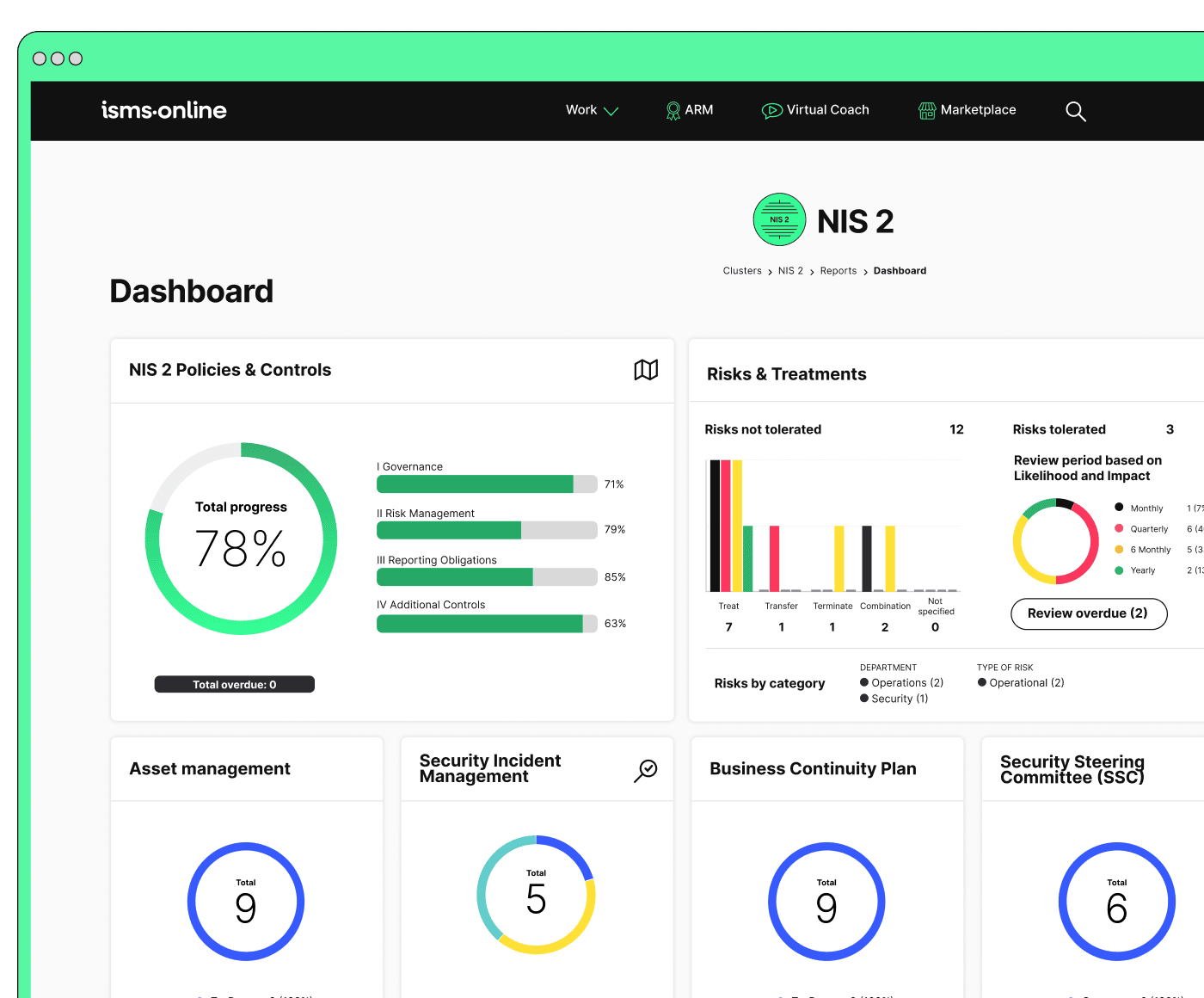
Be NIS 2-ready from day one
Launch with a proven workspace and templates – just tailor, assign, and go.
How to Design Real-Time Risk Mapping for Cloud Service Incidents
Audit-prepared risk mapping is now a mandatory business discipline, not a security luxury. Every incident, especially in the cloud, must find its home in your central risk register, trace each update as an event unfolds, and link every step to the relevant ISO 27001 control (ISACA; ΣR).
Incidents only become ‘audit gold’ when every step leaves a documentary fingerprint.
Constructing a Living Incident-to-Risk Map
- Trigger-to-risk: Every event, as soon as material, must auto-link to the right risk register item (e.g., “Cloud API service loss,” “Supplier breach,” “Access escalation”).
- Artefact capture: Attach logs, emails, user complaints, screenshots, approvals in real time-not after a post-mortem.
- Escalation chain: Let rising risk ratings escalate up to owners and reviewers automatically (dashboard alerts, email, etc.), locking timestamps to each touchpoint.
- Loop closure: Final risk impact and mitigation are documented and signed off, with every dependency (e.g., updated IoCs, revised supplier SLAs) linked to policy and SoA.
Traceability Mini-table
| Trigger Event | Risk Register Update | Control/SoA Reference | Artefacts Logged |
|---|---|---|---|
| Cloud API failure | R7: Service continuity risk | A.8.15, A.5.24 | System logs, outage emails |
| Supplier breach | R4: Vendor dependency risk | A.5.19, A.5.21 | Vendor warnings, contracts |
| Auth failure | R1: Access management risk | A.5.16, A.5.2 | Access logs, user reports |
Every handoff and update is surfaced in ISMS.online’s evidence trail-a “no gaps” compliance mesh that makes responses instant and reliable.
Who Holds the Accountability Chain? Roles, Criteria, and Approval in Incident Classification
Clarity about “Who owns what?” is the difference between a compliance win and a crisis-induced audit finding (ENISA taxonomy; ΣA). NIS 2 and ENISA both demand unambiguous, role-specified, time-stamped delegation. In emergent incidents, ambiguity is your greatest liability.
Every incident deserves a named owner, definite criteria, and a full approval trail-because process accountability is as important as outcome.
Assigning and Proving Responsibility
- Compliance Lead: Orchestrates notifications, manages evidence, and coordinates inter-regulatory thresholds for incidents with privacy and resilience overlaps.
- Service/Technical Owner: Assesses impact, compiles root cause evidence, and applies system logs directly into the ISMS.online chain.
- Legal/Privacy Officer: Flags and manages privacy risks, ensures GDPR/NIS 2 harmonised reporting, and checks legal notification duties (EDPB guidance; ΣA).
- Supplier/Vendor Lead: Coordinates external evidence and ensures supplier MLAs/SLAs are met for incident join-up.
ISO 27001 Audit-Ready Bridge Table
| Audit Expectation | ISMS.online Solution | ISO 27001/Annex A Ref |
|---|---|---|
| Notification clock | Time-triggered workflow/alerts | A.5.24, A.5.25 |
| Evidence trace | Instant artefact logging & lock | A.5.28, A.8.15 |
| Ownership/approval | Named roles, tracked sign-off | A.5.2, A.5.5 |
| Supplier evidence | Cross-org assignment + logs | A.5.19, A.5.21 |
No more hidden responsibilities or “we thought legal was owning this”-every role is logged and surfaced in the incident register and dashboard view.
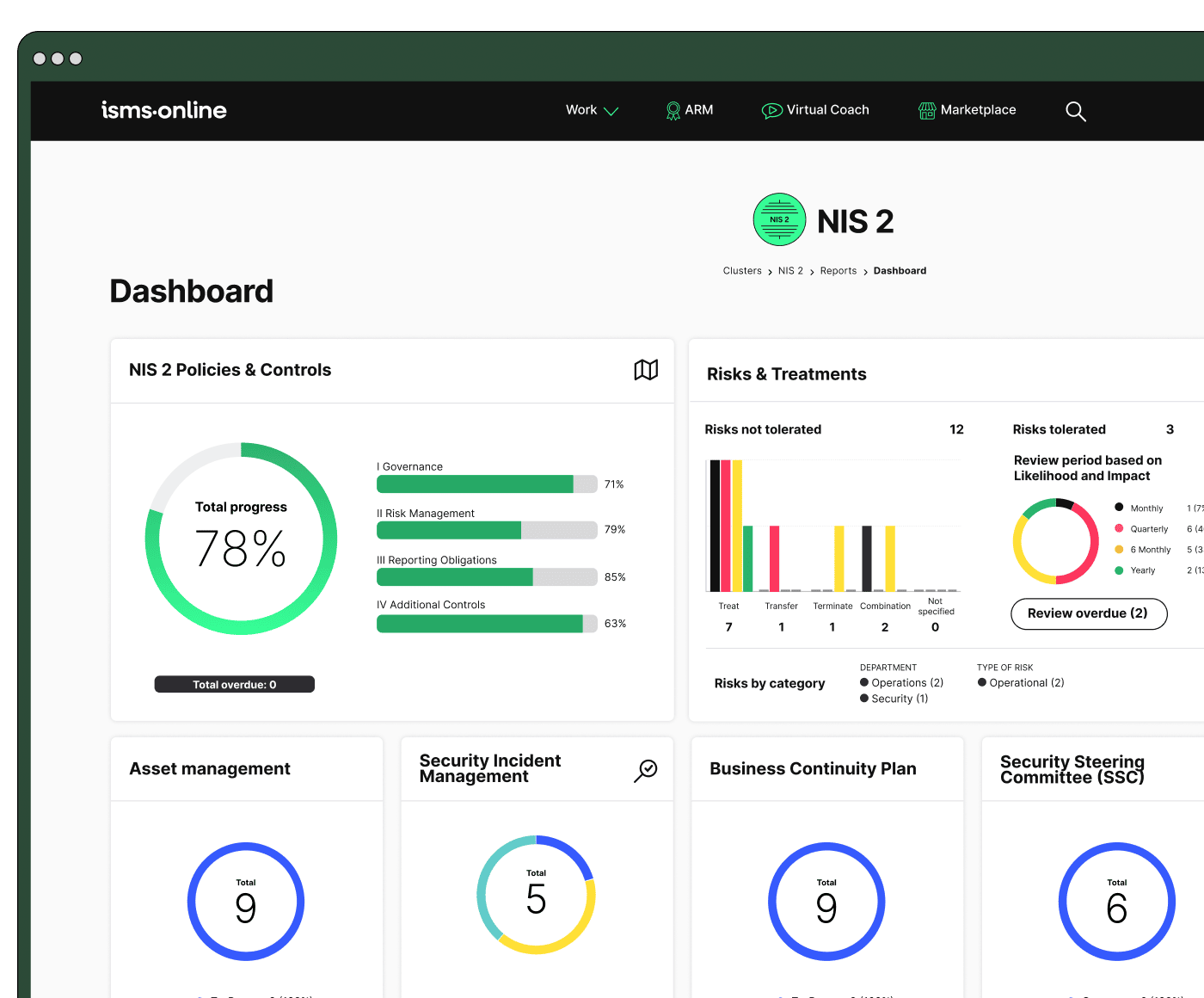
All your NIS 2, all in one place
From Articles 20–23 to audit plans – run and prove compliance, end-to-end.
Fusing Policy, Evidence, and Audit: Closing Every Compliance and Risk Loop
The heart of modern incident management is the closed loop between event, mapped control/policy, attached evidence, and audit/board review (ISO.org; ΣA). Audit gaps-missing policy links, incomplete logs, unsigned approvals-are the first target of regulators and auditors, and the most common pain points in real incidents.
A seamless policy–control–evidence loop is the surest way to immunise your business from audit surprises.
Steps for Airtight Auditability
- Mandatory control linkage: Every incident triggers a check that policies and controls are mapped-no “dead ends.”
- Live workflow adaptation: Annual and event-driven updates propagate immediately; workflows in ISMS.online flex with NIS 2, ISO and sectoral rule changes.
- Scenario training: Role-holders participate in live drills; proof is stored alongside real incident data to demonstrate readiness and cultural buy-in (Entropy Law; ΣG).
- Auto-evidence bundling: Closed incidents can export with all associated SoA links, policy docs, approvals, and role assignments.
Incident–Audit Mini-table
| Event | Policy/Control References | Audit Evidence Included |
|---|---|---|
| Data exposure | A.8.7, A.5.13 | Privacy policy, logs |
| Infra outage | A.8.14, A.8.15 | BIA, downtime plan |
| Access abuse | A.5.16, A.5.28 | Access log, approval, SoA |
Instead of scrabbling for missing links, you answer every audit challenge with a crystalline paper trail.
Mapping the Full Timeline: From Trigger to Final Audit Sign-Off
Boards and regulators want not just activity but timeline clarity-every event, every handoff, every approval and artefact captured, in living sequence (ENISA CSIRT case study, 2024; ΣR).
When every link in the chain is explicit and time-bound, audit anxiety gives way to control and assurance.
Timeline Model for Cloud Incident Management
- Notification: From real-time trigger, ISMS.online stamps the moment, incident type, and assigned owner-full visibility, instantly.
- Escalation: Team leads, compliance, and legal receive workflow-based hand-offs, each change rung time-stamped and role-attributed.
- Artefact collection: All material evidence is attached at the exact incident step-logging occurs during escalation, not “after the fact.”
- Closure and Export: Final review assembles the SoA/policy bundle, locks the record, and ensures readiness for board, auditor, or regulator retrieval.
Timeline Traceability Table
| Workflow Step | Captured Data | Role/Owning Party | Audit Artefact |
|---|---|---|---|
| Initial notify | Timestamp, event type | Incident Manager | Log, alert, registered event |
| Escalation | Owner change | Compliance/Team Lead | Workflow, approval chain |
| Artefact Logging | File, chat, approval | All roles | Evidence uploaded, SoA |
| Closure & Export | Summary, approvals | Compliance lead | Policy pack, closure bundle |
This approach transforms your compliance workflow from “last-minute scramble” to operational excellence-which, at audit and board scrutiny, sets your business apart.
Practical Next Steps to Embed This System-And Why It’s Your Reputation at Stake
World-class incident mapping, under NIS 2 and ISO 27001, is more than just compliance. Each response, classification, and artefact chain is a demonstration of operational leadership and builds board confidence (ENISA, 2024; ΣR).
Every incident you log is a rehearsal for leadership-of your business, your board, and your market.
Actionable Steps
- Catalogue every cloud dependency: , scoring its NIS 2 exposure within your ISMS-map not just your own apps but every third-party and supplier.
- Assign and automate roles in workflow: (Service, Compliance, Legal, Vendors) to eliminate ambiguity before the incident, not afterward.
- Hard-code review and test cycles;: use ISMS.online to ensure no period passes without scenario evidence and workflow review.
- Demand supplier participation: Pull in vendor/partner leads at every escalation; full cross-org evidence is now baseline compliance.
- Train all teams in “evidence at the moment;”: ISMS.online’s real-time upload flows mean nothing is lost, and every update is ready for audit retrieval.
See incident status at a glance. Know which risks are open, what’s been signed off, and when. Remove last-minute panic forever.
Build Your Board’s-and the Regulator’s-Trust in Every Cloud Incident Response
Don’t view NIS 2 incident requirements as a punitive checklist-they are your fastest path to reputational strength. By structuring every incident from trigger through audit export in ISMS.online, you close gaps, reduce risk, and instil confidence at every level of your organisation, from staff to board to regulator.
The difference between compliant and trusted is the evidence, clarity, and ownership you show when the storm hits.
Take ownership of every incident. Map it in real time. Make evidence and roles visible. Build a legacy of systemized resilience and audit-ready confidence-incident by incident, with ISMS.online.
Frequently Asked Questions
Who determines whether a cloud service incident is reportable under NIS 2, and what are the exact thresholds for mandatory notification?
A cloud service incident must be reported under NIS 2 when it meets strict EU-defined criteria: more than 30 minutes of continuous service disruption, any breach affecting regulated data, or an event that impacts 5% of EU users or over a million individuals. The ultimate responsibility doesn’t sit with IT alone. It’s assigned to a designated “significance owner”-usually your CISO, compliance officer, or ISMS leader-whose duty is agreed and logged within your ISMS.online workflow. This person leads a regulated, evidence-driven triage. The process is direct: Does the incident compromise an essential service, expose regulated data, or cross user/uptime thresholds? A single “yes” requires mandatory escalation-within strict NIS 2 notification windows. Embedding a step-by-step flowchart in your ISMS is not just best practise; ENISA highlights it as essential for ensuring staff act without hesitation or confusion. Removing ambiguity is the foundation of regulatory trust in a crisis.
Regulatory clarity means gut instinct is replaced by a documented threshold-your audit defence starts with provable role assignment and real-time threshold checks.
Table: NIS 2 Cloud Escalation Trigger Points
| Trigger Description | Action Required | Assigned Owner Example |
|---|---|---|
| Essential service hit | Immediate escalation & report | CISO, ISMS Owner |
| Regulated data breach | Report + evidence log | DPO, Compliance Manager |
| Users/uptime threshold exceeded | 24/72h notification | Incident Response Lead |
Why do organisations trip up when mapping cloud incidents to NIS 2 inside ISMS.online, and what practises close those gaps?
Teams most often stumble in two areas: fragmented or missing evidence logs (like siloed SIEM exports, emails, or incomplete comms records) and unclear mapping from NIS 2 requirements to operational incident categories-especially with GDPR or DORA overlap. Assuming that compiling evidence after the fact or relying on “good enough” logs is acceptable leads to regulator pushback and disjointed audit trails. The fix: standardise workflows in ISMS.online so that every incident record prompts for required fields (logs, comms, timestamps, user impact), ties directly to relevant regulatory tags, and names an accountable owner with locked sign-off. Schedule quarterly or annual scenario walks to ensure your incident taxonomy still aligns with the latest rules and internal structure. Companies that move from ad hoc to fully mapped incident dashboards see up to 50% fewer audit gaps and dramatically faster regulator response.
Audit readiness isn’t about volume-it’s about being able to connect every fact to a timestamp and a responsible person from first detection to closure.
H4: Common Mapping Gaps and Role-Based Solutions
| Common Failure | Recommended Practise |
|---|---|
| Logs overlooked at incident open | Automate log prompts in the ISMS workflow |
| Ambiguous incident ownership | Assign and display named owner on every incident |
| GDPR/NIS 2 mapping confusion | Link drop-down categories directly to each regime |
| Evidence stuck in email | Centralise all comms/documents in ISMS.online entry |
What specific evidence must be captured at first detection to guarantee audit and regulatory compliance for NIS 2 incidents?
Every NIS 2 incident must start with a full, time-stamped record-no waiting for later. You need:
- Detection timestamp: Record the exact first alert, not just discovery by security.
- Incident type: Pick from your mapped ISMS taxonomy (e.g., outage, breach, suspected compromise).
- System/service impacted: Name the exact platform, asset, or data store.
- Scope and user impact: Who/what is affected? State numbers, segments, regions if possible.
- Direct log exports or links: SIEM, cloud, endpoint/device logs-attached at record open.
- Associated accounts/users: Including admin and 3rd party roles touched.
- Internal/external comms: Record emails, rapid alerts, and notices sent externally.
- GDPR data category: Tag any personal data at risk, including if not yet confirmed.
ISMS.online is designed to prompt for and lock these fields at incident creation, ensuring that every data point is frozen into the audit trail. According to regulators (see, failure to log even a single field at first notice is the number one cited cause in enforcement actions.
You cannot add audit trust after the fact-your record must be regulator-ready from minute one.
Evidence-at-Detection Table
| Field | Required | Web Example |
|---|---|---|
| Detection timestamp | ✓ | 2024-07-18 11:08 UTC |
| Incident type | ✓ | Cloud API unavailability |
| System/service | ✓ | Main cloud DB cluster |
| User scope | ✓ | 1.2 million active EU users |
| Log attachment | ✓ | SIEM, CloudTrail, access logs |
| Accounts involved | ✓ | “admin@company.com”, suppliers |
| All comms logged | ✓ | Email, rapid alert, DPO memo |
| Data subject group | If GDPR | Customer PII, employee data |
How do SIEM and CASB platforms automate ISMS.online for NIS 2-and what operational changes result for incident management?
SIEM (Security Information and Event Management) and CASB (Cloud Access Security Broker) integration brings compliance into real time. The moment a SIEM detects a breach or threshold event, ISMS.online spins up an incident, auto-fills log evidence, risk mappings, and user scope, and triggers notification assignments. Every comms entry, escalation, and artefact link is time-locked, eliminating delay or manual data wrangling. CASB integrations add further protection-if a cloud app triggers excessive data transfers or suspicious access, the ISMS queue is updated with GDPR overlays and technical metadata for board review or immediate compliance export. The major impact: you shift from “posthoc patchwork” when audit season comes, to knowing your regulatory, risk, and KPI dashboards always reflect the current risk landscape, current asset status, and most recent incident chain as it unfolds. forecasts that this level of integration halves incident-to-notification timeframes and raises audit pass rates sharply.
The era of big compliance spreadsheets is over; regulators now expect live evidence streams and signed-off, time-stamped mappings.
Table: SIEM/CASB Evidence Stream Integration
| Trigger Source | ISMS Action | Immediate Audit Outcome |
|---|---|---|
| SIEM alert | Incident record/initiate | Lock detection time & logs |
| CASB anomaly | Add evidence, risk overlays | GDPR tag & board dashboard |
| Risk metrics | Score update | Audit/KPI dashboard update |
| Regulator req | Export evidence bundle | All logs, trail, and sign-offs |
What repeatable habits help avoid NIS 2 incident misclassification and regulatory criticism?
- Adopt ENISA-aligned incident taxonomies and narrative templates: Don’t rely on internal lingo; standardise incident definitions and reporting logic using regulator or sector “gold standard” examples.
- Run scenario-based reviews: At least annually, walk through last year’s biggest real incidents-ensure roles, mappings, sign-offs, and escalation all match the documented ISMS and regulatory expectations.
- Mandate locked, role-based sign-off: at each mapping or escalation handoff-every key decision must have a responsible party and timestamp in the trail.
- Document and review all mappings and taxonomies: at least once per year, after a regulatory/sector change, or following any major incident audit.
- Sync and cross-check supplier contract triggers: Your obligations aren’t met if a vendor’s definitions or evidence-sharing lags behind NIS 2 thresholds.
You avoid regulatory drift not just by tracking incidents, but by making your decision trees, signoff logic, and supplier syncs auditable, current, and externally defensible.
Transparency isn’t ‘nice to have.’ When a regulator files an inquiry, signed-off mapping logs become your primary audit defence.
Legal/Operational Checklist for Incident Classification
| Criteria | At Least Annual Review? | Sign-off Owner Named? | Supplier Definitions Synced? |
|---|---|---|---|
| ENISA taxonomy adopted | ✓ | ✓ | – |
| Escalation logic audited | ✓ | ✓ | – |
| Scenario review performed | ✓ | ✓ | – |
| Sign-off trace in ISMS.online | ✓ | ✓ | – |
| SLAs cross-checked to NIS 2 | ✓ | – | ✓ |
What contract and SLA clauses guarantee NIS 2 audit success and where do teams most often lapse?
You must include, review, and actively manage these SLA/contract elements:
- Trigger list mapped to NIS 2: Specify incident types, thresholds, and reporting timers.
- Clear notification and escalation sequences: Assign specific contacts, methods, and timeframes (e.g., “Within 24 hours for high-impact”).
- Audit and evidence-sharing clauses: Grant explicit consent for sharing logs, artefacts, and reports with regulating authorities and auditors.
- Sector/legal overlays: If NIS 2, GDPR, DORA, or others interact, include a matrix/appendix showing responsibilities, triggers, and coordination steps.
- Mandate active, rolling contract reviews: -at least annually, after regulatory change, or after substantive incident review. Store review dates and updated versions within ISMS.online or a mapped risk register.
Audit failure most often starts here-not because the contracts are missing, but because they’re outdated, undocumented, or missing signed tracing of obligations and review.
You can only prove what you’ve specified; modern audits begin with a contract mapping check-if you can’t show coverage, nothing else is persuasive.
Supplier Audit Checklist: NIS 2
| SLA/Contract Field | In Place? | Last Reviewed | NIS 2 Cited? | Evidence Clauses? |
|---|---|---|---|---|
| Incident triggers | ✓ | 2024-06-01 | ✓ | ✓ |
| Notification/escalation sequence | ✓ | 2024-06-01 | ✓ | ✓ |
| Evidence/audit access | ✓ | 2024-06-01 | ✓ | ✓ |
| GDPR, DORA, overlays | ✓ | 2024-06-01 | ✓ | ✓ |
| Annual review, DPO/CISO trace | ✓ | 2024-06-01 | ✓ | ✓ |
When your ISMS.online creates, links, and audit-locks each element of this chain, compliance transforms from reactive crisis to resilient, regulator-ready practise. Audit trust is built daily-at the point where incident, mapping, and contract evidence all converge.






