





































When Does a CDN Incident Become a Boardroom Headache? Understanding the Real Risk
You depend on your Content Delivery Network (CDN) for more than just uptime; it’s the silent protector of your brand, customer loyalty, and compliance standing. The speed with which a technical hiccup morphs into a business crisis-especially under NIS 2-is routinely underestimated. A minor regional outage can quickly pull your whole organisation, supply chain, and boardroom into the spotlight. This is not a fate reserved for tech giants or cloud hyperscalers; every organisation delivering digital services is now a visible node in Europe’s critical infrastructure, and the board’s exposure is tied inexorably to incident management.
If your CDN burp becomes a headline, your response becomes your reputation.
The Domino Effect: Small CDN Glitches, Big Business Consequences
What starts as a minor CDN service “blip” often triggers secondary effects: disrupted logins, failed transactions, or active regulatory inquiry. ENISA’s recurring incident analysis exposes how technical events ripple far beyond initial impact, dragging healthcare, e-commerce, and SaaS customers into business continuity crises. Consider the 2023 Akamai regional performance drop, which degraded user journeys for organisations several hops downstream. Or recall the Fastly outage where a single edge misconfiguration cascaded into global economic, media, and service disruption.
The Regulatory Bias: Ripple Potential, Not Just Outage Size
NIS 2 rewrote the criteria: incidents are now measured by ripple potential and sector impact-not by intentionality or event scale. If your “minor” event undermines access to financial, health, or public services, you face the same reporting threshold as a multinational. Being a “small player” doesn’t entitle you to less scrutiny; rather, your organisation becomes the fast track for regulatory and reputational notification when supply chains are tangled or affected.
Risk travels with headlines-and regulators aren’t interested in technical excuses when public trust is on the line.
Board-Level Lesson: From Technical Noise to Strategic Incident
If your organisation hasnt mapped CDN risk to executive KPIs or built out scenario drill plans mapped to customer impact, the next incident will be a board discussion not of if, but of how did we miss this-and what can we prove when challenged?
Book a demoWhat Counts as a “Significant” CDN Incident Under NIS 2 Article 9-and How Do You Defend Your Judgement?
The NIS 2 Directive transforms incident reporting from checkbox exercise to continuous, auditable discipline. Article 9 requires you to assess incident significance rapidly from real-world impact, not internal technicalities. Accountability begins the moment potential disruption is detected-and it’s your duty to bring facts to the defence, not speculative reassurance.
What appears routine on Monday can elevate to newsworthy by Friday if you hesitate or lack clear records.
Decoding “Significant” for Regulators
Article 9 obliges notifications of any event causing business-critical service disruption, bridging sector or country boundaries, or affecting core digital infrastructure. The test isn’t how much data you lost or networks you repaired, but whether real-world outcomes-like application downtime or denial of service-spilled past thresholds described in your own risk landscape.
- Did essential or regulated service delivery fail?
- Was there visible cross-sector or multi-national impact?
- Did the incident threaten public order, finance, healthcare, or safety?
ENISA’s guidance and national regulators’ post-mortem reviews revolve around these triggers, not cause or blame.
The Clock: 24-Hour Notification or Penalty
Your obligation starts with promptness: 24 hours from detection to initial authority alert, then 72 hours to a detailed incident file. Many sectors push for even faster notification, and cross-border business means a tangle of overlapping clock starts. There is no grace for weekends or holidays; by law, your evidence chain must be airtight and fast.
Regulatory clocks never stop ticking-delays or ambiguities in the log will catch scrutiny.
Evidence, Not Excuses: Chain of Custody for Decisions
NIS 2 assigns clear accountability: You must show who detected, appraised, escalated, and closed each incident, with timestamped, role-based records (isms.online/solutions). Finger-pointing, ambiguous detection, or “it looked small at the time” won’t satisfy auditors or authorities. ENISA threat landscape reports confirm that impressive, story-ready documentation is now the baseline for compliance-and for defence in front of regulators.
Avoiding Reporting Traps
Hoping a glitch “blows over” wastes the critical window for proactive, strategic response. Using ISMS.online’s role-aware, real-time monitoring not only triggers required evidence logging but ensures you won’t be caught off guard-every step is mapped and time-stamped, every escalation documented.

Master NIS 2 without spreadsheet chaos
Centralise risk, incidents, suppliers, and evidence in one clean platform.
How Do You Turn CDN Signals into Action Without Overwhelming Teams-or Missing Deadlines?
Your threat landscape is noisy: CDN hiccups, upstream errors, false positives, and the ever-present danger of missing the one event that matters. Your job is to philtre real risk signals, respond at machine speed, and log every action as defensible evidence-without burdening teams with duplicate manual reporting.
Every triaged alert is your silent defence in board review-or your vulnerability if missed.
Building a Regulator-Ready Monitoring Narrative
Continuous, role-sensitive monitoring is no longer an enhancement-under NIS 2, it’s a survival skill. ISMS.online brings all CDN feeds into a tamper-evident workspace, where:
- Automated triggers: create records at the moment of feed, user input, or API event.
- Incident tickets: embed full context and triage severity as defined by ENISA/sector criteria.
- Roles and responsibilities: are assigned programmatically; every action is mapped to accountable personnel.
- Notifications and escalation: are dynamically triggered-authorities and stakeholders are looped in, not left behind.
- Reminders and compliance clock: tags ensure no deadlines slip past unnoticed.
- Immutable logs: link detection, action, escalation, and resolution, replacing ad-hoc spreadsheets and multiple tool chains.
Centralization eliminates conflicting accounts, duplicated records, and reporting failures that attract fines.
Tuning for Operational and Regulatory Peace
Alert fatigue brings its own risk: over-notification erodes trust, just as missing signals collapse defences. Risk scoring, as implemented in ISMS.online, converts technical data into business-impact decisions, ensuring true significant events always progress-while noise remains silent evidence, not embarrassing gaps. Recent MITRE and ISACA analyses reinforce the criticality of rules-based, measured alert handling.
The hidden dividend: credible operational calm meets full regulatory assurance-boardrooms and reviewers tracking risk in real time, not hunting for missing evidence after the fact.
How Does ISMS.online Map Incident Response to NIS 2, ISO 27001, and GDPR-Delivering Defensible Actions?
Meeting multiple frameworks means more than attaching a docket to the ticket. Defensible response is a choreography of people, systems, and controls, each step mapped from detection trigger to closure-and every link evidence-ready for audit, legal, or internal quality review.
Only when actions, controls, and proof are system-linked does your incident management become bulletproof.
Audit Table: From Expectation to Operational Proof
Here’s how concrete legal and operational requirements tie into daily platform functions and global regulations:
| **Expectation** | **How ISMS.online Delivers** | **Reference** |
|---|---|---|
| Real-time detection | Alerts from log/feeds/API create incident logs | ISO 27001 A.5.24, A.5.25 |
| Escalation & reporting | Workflow-driven handoff; role tags; auto notify | ISO 27001 A.5.26, A5.35, NIS 2 |
| Evidence chain | Immutable logs + control cross-linking | GDPR Art. 33, SoA, A.8.21 |
As new standards or national guidance (e.g., NIS 2 Annex II) emerge, mappings are updated-ensuring your compliance defence evolves in step with the law (isms.online/blog).
Traceability Table: From Trigger to Evidence (Audit Trail Mini)
| **Trigger** | **Risk Update** | **Control/SoA Link** | **Evidence Logged** |
|---|---|---|---|
| CDN service loss | SLA degradation | A.5.24, A.5.26 | Timestamp, escalation chain, root-cause |
| DNS failure | User authentication risks | A.8.21, SoA | Alert logs, notification batch, resolution |
| Late notification | Cross-border reporting gap | A.5.26, GDPR 33 | Justification log, export-ready record |
A non-technical reviewer or board member can trace every handoff, escalation, and rationale-no more forensic email chains, lost spreadsheet rows, or ambiguous timelines.
This is operational discipline meeting regulatory assurance: live, auditable, fully mapped.
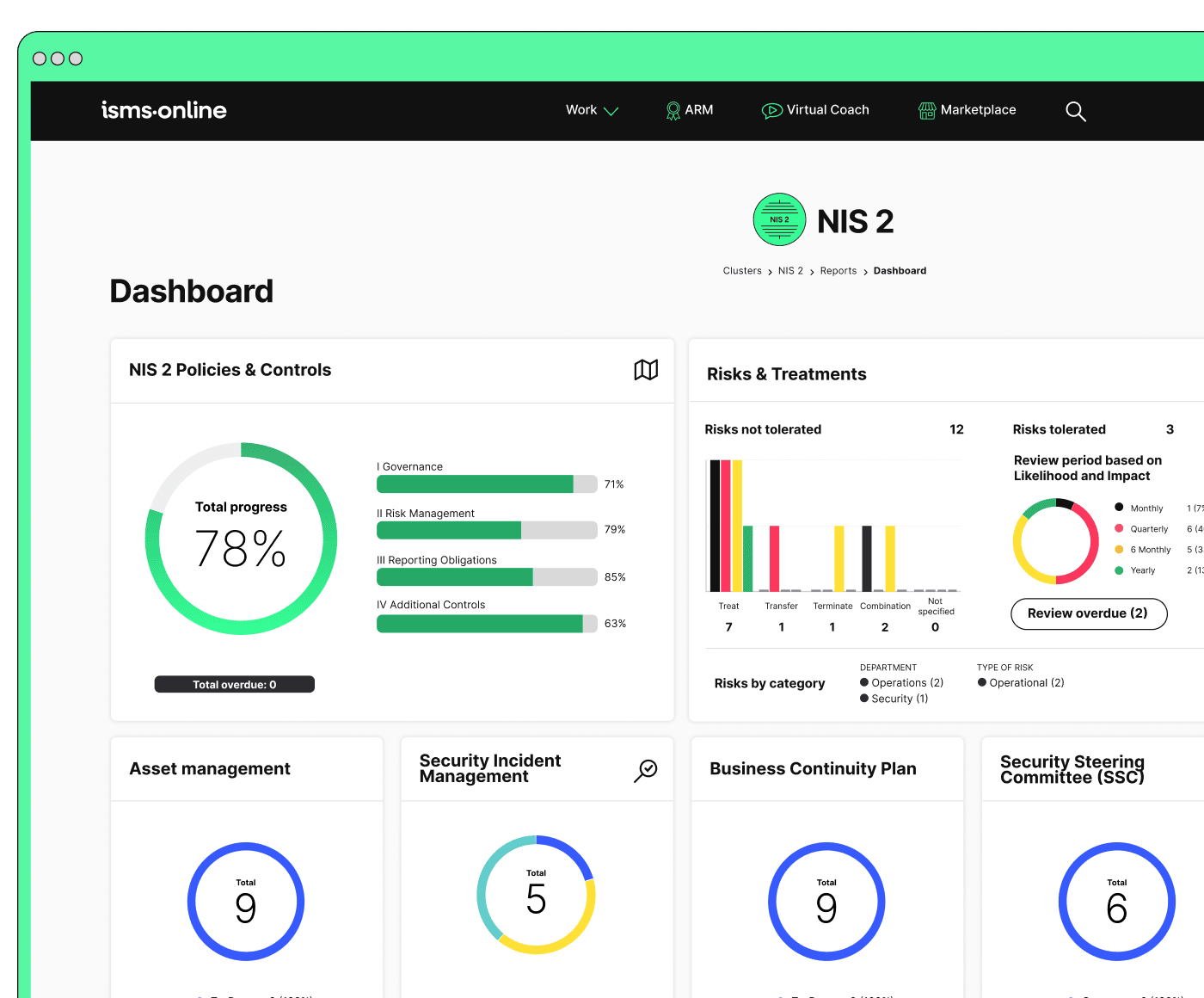
Be NIS 2-ready from day one
Launch with a proven workspace and templates – just tailor, assign, and go.
Turning Operational Data Into Trust: What Sets ISMS.online Evidence Apart?
Standard logs and “compliance checklists” are no longer enough. Boards, investors, and authorities want outputs they can trust: dashboards that show time-to-remediation; exports that unify every handoff; and audit trails that stand up under pressure. ISMS.online is engineered precisely for these demands.
Your credibility with regulators is built on what you can instantly prove, not what you reconstruct long after the fact.
Visualise Progress, Not Just Gaps
ISMS.online generates real-time dashboards for every incident flow-MTTR (Mean Time To Respond/Resolve), status by priority or respondent, and regulatory deadline hit rates (isms.online). Decision boards lean on these outputs for risk posture, while external reviewers accept them as first-ring evidence.
Deep Integration From CDN to Boardroom
APIs connect major CDNs, so system evidence flows in seamlessly-from provider disturbance to actionable record, cross-referenced to controls. No more slippage between IT, Governance, and Legal: if an event matters, every department’s evidence converges (isms.online/integrations). Board members get both the “big picture” and the technical depth as needed.
You no longer rely on heroism; you operationalise resilience into visible, repeatable proof.
Bulletproof Documentation-For Every Audience
When authorities ask, ISMS.online’s export function composes everything from granular incident logs and escalation chains to executive summary timelines and lesson-learned reports, each with crypto-verified access control for security-governed handoff (isms.online/features/security-and-privacy-compliance/).
Embedded Drills-From Practise to Audit Defence
Practise doesn’t just prepare your team, it populates your evidence bank with real-world, regulator-grade proof. Scheduled and ad-hoc exercises are fully logged: attendance, response timings, escalation chains, and improvement follow-ups-documented, exportable, and accepted by boards and authorities alike (isms.online/solutions/audit-management/).
Assurance is a practise, not an event; you bank real trust with every documented drill and simulation.
Simulation Drills: How Do You Ensure Real-World Readiness and Survive Regulator Audit?
Resilience isn’t theory-regulators and boards demand demonstration. NIS 2 Article 9.2 requires simulation of incidents spanning technical, operational, legal, and communications staff. If your drills can’t produce role-mapped evidence on demand, you may pass in theory but fail in practise.
The teams who prepare in public pass with confidence; those who rehearse only in hindsight risk avoidable failure.
Building and Proving Readiness: From Scenario to Evidence
ISMS.online enables you to define incidents, launch notifications, and track every action from start to closure-instantly exportable for assessment. Whether you simulate a CDN chain outage, a cross-border privacy breach, or a multi-entity ransomware event, you:
- Define scope and participants by scenario.
- Trigger live notifications and escalation to all players.
- Tikestamp every action and system handoff.
- Export all records: scenario plan, handoff, response time, closure, and follow-ups with names and roles.
| **Simulation** | **Audit-Grade Evidence** |
|---|---|
| Global CDN disruption drill | Role assignment, escalation log, timeline, closure proof |
| Multi-domain phishing event | Communication export, legal review chain, training evidence |
Field research shows organisations with routine, recorded drills pass real audits with minor (if any) findings. Employees internalise not only the what, but the why-raising organisational IQ and reducing incident shock.
Consistent simulation, not one-off compliance, is the hallmark of a prepared, trusted operation.
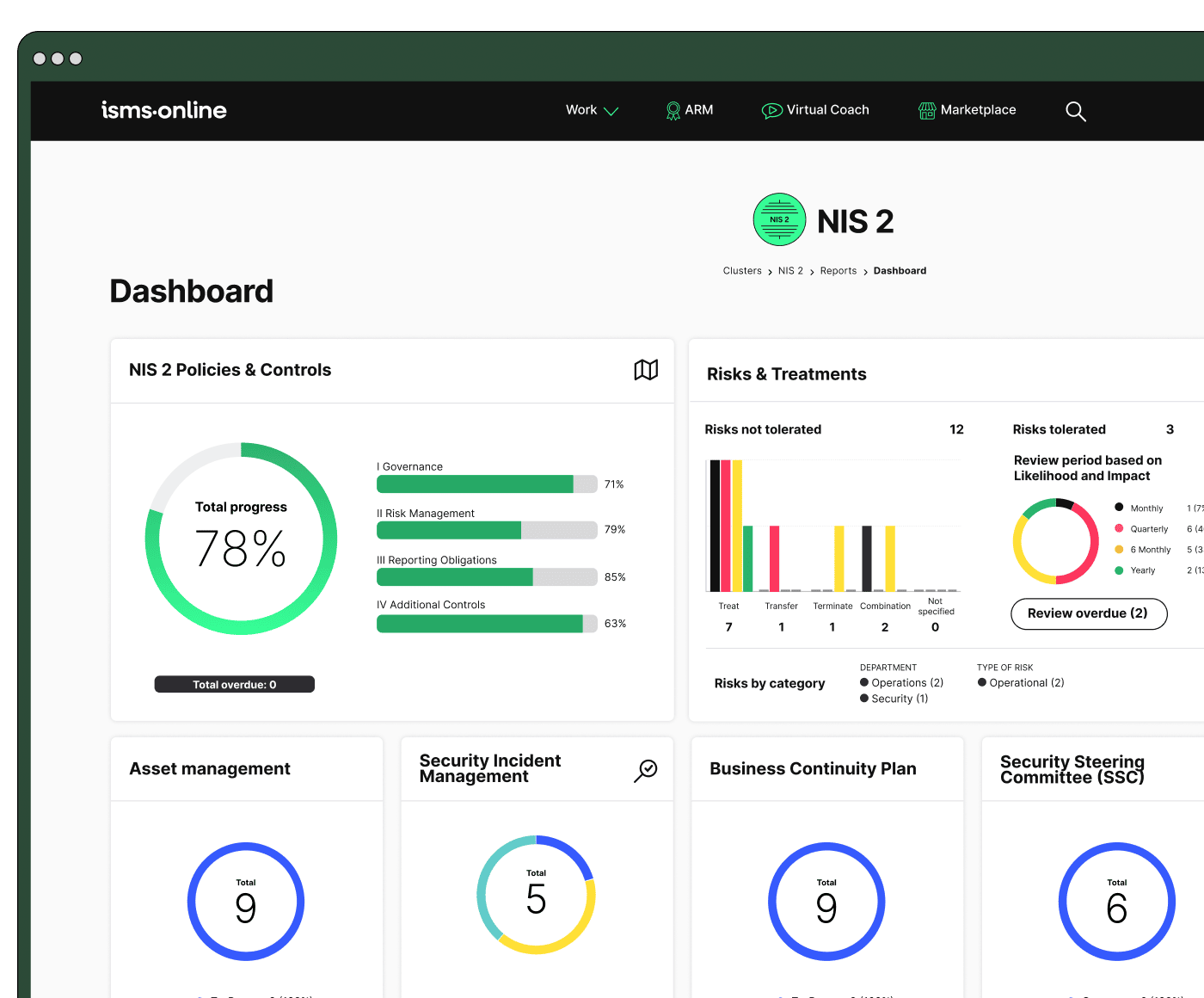
All your NIS 2, all in one place
From Articles 20–23 to audit plans – run and prove compliance, end-to-end.
Table: Mapping NIS 2 Article 9 Requirements to Practise with ISMS.online
Ensuring ironclad NIS 2 alignment means bringing regulatory words to operational life. Here’s how ISMS.online closes the gap-translating directive demands into functional trust signals:
| **NIS 2 Art. 9 Demand** | **ISMS.online Feature** | **Trust Marker** | **Authoritative Source** |
|---|---|---|---|
| 24h authority notification | Live notification chains, SPoC map | Exportable submission | enisa.europa.eu |
| Escalation + live audit clock | Time-controlled escalation, KPIs | Time-stamped evidence | isms.online |
| Lessons-learned closed loop | Drill–review linking, log version | Audit-ready summaries | isaca.org |
| Cross-border incident closure | GDPR/ISO export pack | Compatibility, completeness | cloudflare.com |
Key: Export = regulator-submittable doc; Time stamped = SIEM/verifiable; Complete = all links mapped.
Step Up as the Trust-Builder: Make Incident Proof Your Organisational Mark
The only organisations who will consistently pass NIS 2 and board review are those who convert daily incidents-from real outages to simulated drills-into discipline, learning, and trust. Every log closed, step traced, or notification exported is a visible sign of operational maturity-not fear of the regulator, but confidence in your capacity.
Resilience leadership isn’t about avoiding failure; it’s about showing how you respond, document, and improve.
From the first incident detected to the final board report, ISMS.online equips your team to lead-through daily, evidence-backed rhythm-not behind the curve, but at the operational front. Every incident, real or simulated, is your opportunity to drive lasting trust across customers, regulators, and the board.
Ready to start? It’s time to turn incident distraction into proof-positive trust: with each documented case, you not only pass review-you set the pace for resilience leadership in a fast-shifting regulatory world.
Frequently Asked Questions
Who determines if a CDN security incident is “significant” under NIS 2 Article 9, and why is escalation so urgent?
A CDN security incident becomes “significant” under NIS 2 Article 9 when it jeopardises the continuous delivery of essential digital services or the underlying trust infrastructure-especially healthcare, energy, finance, or public administration. The decision process begins with your own incident team, but national CSIRTs, ENISA, and sector-specific regulators ultimately enforce the definitions, requiring rapid notification if an incident threatens the public, cascades across borders, exposes sensitive data, or disrupts supply chains. The law demands urgency because even a brief content delivery outage or data leak can spiral into systemic risk-potentially affecting millions and shaking confidence in vital digital infrastructure.
Rapid escalation is not just best practise; it’s an explicit legal expectation-missing a deadline can trigger direct liability for both the team and executive leadership.
How is “significant” defined for CDNs?
- Sector coverage: Does your CDN support government, health, finance, utilities, or public digital services?
- Breadth of impact: Did disruption cross organisational, sector, or state lines?
- Harm threshold: Was availability, confidentiality, integrity, or authenticity of services/data affected, or was the public’s trust at risk?
If any of these thresholds are passed, you must notify authorities within 24 hours-and submit a full report by 72 hours-per Article 9. Regulators may demand intermediate updates, making robust, documented escalation chains a necessity. (ENISA summary)
ISO 27001 Mapping: Expectation ↔ Operation ↔ Reference
| Expectation | Operation | ISO 27001 / Annex A Ref. |
|---|---|---|
| Immediate triage | Playbooks, assigned leads | A.5.24, A.5.25, 9.1 |
| Timely notification | Escalation log, audit trail | A.5.35, A.7.4, 9.2, 10.1 |
| Proof of resolution | Versioned evidence record | A.8.15, A.5.27, 9.3 |
How does ISMS.online operationalise real-time detection, accountability, and evidencing for CDN incidents under NIS 2?
ISMS.online acts as the command bridge for CDN incident management: it ingests events from CDN feeds and SIEMs (Akamai, Cloudflare, Fastly), detects anomalies-DDoS spikes, cache poisoning, expiration attacks-and escalates them instantaneously. Workflow engines assign accountable owners per incident class, route handoffs by playbook, and time-stamp every action. This not only meets the NIS 2 mandate for rapid notification, but builds an unbroken, tamper-resistant audit chain from detection to resolution and regulator submission.
Your response team moves from fire-fighting to control-each action, update, and decision immutably logged, permissioned, and exportable for audit or regulatory review.
All responses (updates, escalations, closures) are role-locked and versioned. Click-to-export functions produce regulator-ready reports in the required ENISA, CSIRT, or sector formats, sliced by jurisdiction. This means both compliance and operational managers can demonstrate not just one response, but a repeatable, review-ready system that stands up across years, teams, and audits. (See ISMS.online Incident Management)
Key controls in practise:
- Live event streams: Instant ingestion and alerting of security events.
- Role/rule-based workflows: Owners, escalation chains, and deadlines mapped to NIS 2 Article 9.
- Proof-grade evidence: Immutable logs, versioned action history, audit trail ready for board and regulator.
Which KPIs and controls safeguard both operational resilience and NIS 2 compliance for CDN security events?
Reliable compliance depends on five core KPIs-each directly mapped to NIS 2 and ISO 27001:
| KPI | Tracked Metric | Regulatory Anchor |
|---|---|---|
| Incident Response Time | Detection to action | A.5.24, A.5.25, NIS 2 Art 9 |
| Uptime/SLA Attainment | CDN service availability | A.8.14, A.8.15 |
| MTTR / MTTD | Mean time to resolve/detect issue | A.5.27, A.5.35, 9.1, 10.1 |
| Critical Incidents Logged | Count vs. thresholds, by period | A.5.26, 10.1, NIS 2 Art 23 |
| Degradation Duration | Outage/slowdown time | A.7.4, SoA linkage |
ISMS.online auto-maps these KPIs to dashboards and reporting: colour-coded alerts surface when windows are breached, overdue escalations are flagged, and all logs are archived for trend analysis and board assurance. Every incident and its metrics are linked to their Statement of Applicability (SoA)-meaning, at any moment, you can evidence which control applied, how fast the response was, what remediated the risk, and what learning loop was executed (ISMS.online Measure & Report).
Traceability Example Table
| Trigger | Risk Update | Control/SoA Link | Evidence Logged |
|---|---|---|---|
| CDN outage over 1 hour | Board notified, risk added | A.5.24, 9.1 | Incident log, report, audit |
| Regulator queries | Evidence audit triggered | A.5.35, 10.1 | Exports, actions, log chain |
How does ISMS.online document and evidence NIS 2-mandated CDN incident simulations and training?
Simulations and training are recorded as living evidence-not perfunctory “tick boxes.” In ISMS.online, you can schedule and execute tabletop or live-fire CDN drills, assign participants, capture full scenario details, auto-notify stakeholders, and version-control every log from plan to post-mortem. Every improvement action, attendance roster, lesson learned, and outcome is time-stamped and mapped to ISO 27001, ISO 22301, and NIS 2 for future audit or inspection.
Instead of losing simulation proof in old folders, you hand auditors a verified chain of readiness-with every test, action, and improvement mapped and exported in seconds.
Each exercise is trackable against KPIs: who attended, who led, what improvement actions resulted, and how risk was reduced. Reports export cleanly to management reviews and SoA evidence. Auditors and regulators see not just compliance today, but a maturing culture of cyber readiness and resilience (ISMS.online Audit Management).
Simulation & Training Features
- Scheduled, versioned scenario launch and notifications
- Secure, versioned archive of all logs, outcomes, and learning actions
- Exports mapped to controls, reviews, and audits
How does ISMS.online automate and assure cross-border regulator and supply chain notifications for CDN events under NIS 2?
When your team escalates an incident, ISMS.online tags every affected jurisdiction, builds tailored notification draughts (templates, languages, supporting evidence) for each national or sector authority (ENISA, ICO, BaFin, CNIL), and logs every communication with time, recipient, and status-eliminating guesswork on deadlines or coverage. The system recognises supply chain impacts, tagging third-party CDNs/brokers, and mapping notification handoffs for comprehensive traceability-GDPR and Article 9 requirements included.
| Trigger | Notified Authority | Format/Language | Supply Chain Tag |
|---|---|---|---|
| EU-wide CDN outage | ENISA, BaFin, ANSSI | EN/DE/FR template, reg evidence | CDN vendor, B2B |
| Data exposure (UK/EU) | ICO, CNIL, partners | EN/FR, escalation chain | Internal+external |
Every notification-internal, authority, partner-is archived, versioned, and auditable, with zero ambiguity about deadline, audience, or message content.
Your teams never have to scramble to prove who was alerted, when, or how thoroughly. Everything sits, export-ready, in a central log-reassuring the board (and regulators) that no step, event, or obligation is missed (ISMS.online Integrations) |.
What pitfalls most often trip up organisations on NIS 2 Article 9 for CDN events-and how does ISMS.online avoid them?
Organisations most often fall short in three areas:
- Underestimating impact: Small CDN disruptions crossing borders, critical suppliers, or core services are missed, leading to late notification, fines, or brand damage.
- Fragmented evidence: Incident, training, and notification logs reside in siloed tools or drives, resulting in chaos come audit-or regulator deadline.
- Manual thresholds and escalation: Missed or misrouted incidents due to poorly mapped responsibilities or outdated playbooks cause deadline breaches, liability, and lost confidence.
ISMS.online counteracts each:
- Automated playbooks: Crisis templates, mapped roles, and routes ensure incidents hit only the right hands, never the wrong folders.
- Linked evidence: Every action and outcome is versioned, linked to SoA controls and the risk register, and instantly retrievable for boards or regulators.
- Centralised, time-proof record: No matter the year, country, or supply chain node, every incident and notification sits in a single, permissioned, export-ready core.
Shift your team off the panic treadmill-show auditors you have every step, outcome, and learning mapped and verifiable forever, not just for this cycle.
Ready to stop scrambling for evidence and start showing operational resilience that boards and regulators recognise? ISMS.online transforms your CDN incident management into a defensible, audit-easy engine-making everyday NIS 2 compliance the backbone of your digital trust.






