





































Is Cyber Regulation Now a Board-Level, Global Pressure Test?
Cyber-Security has crossed a defining threshold. No longer locked in the server room, it’s become a daily, board-level challenge that pushes businesses, public bodies, and global supply chains to prove their resilience-not just claim it. The NIS 2 Directive has transformed cyber-security from a technical checklist into a living test of operational readiness, investor credibility, and business continuity. Today, every new regulation is not just paperwork-it’s a rolling diagnostic, pressing security leaders, privacy officers, and compliance champions to show-in real time-how resilient and well-governed their organisations truly are.
Regulation is no longer a forecast-it’s a daily audit of your operational credibility.
The evidence is overwhelming: 76% of global board executives now rate cyber as their top risk, ahead of even inflation and market shocks. Meanwhile, just a third of European organisations currently have the ability to spot critical infrastructure breaches as they happen. Insurance rates climb, investor queries multiply, and risk ratings for international supply chains have jumped by over 50% in the past year. Boards expect not just quarterly risk charts, but 24/7 access to real evidence-no matter the continent, timezone, or headline.
Why NIS 2 Forces the Issue
ENISA’s data signals a relentless rise in major cyber incidents across the EU since 2022. The modern CEO and risk committee now face the question, “Are we crisis-ready today?” It’s no longer enough to answer yes; you need the evidence to back it up. The response gap is widening: north-western Europe shows quicker incident response, while delays elsewhere create weaknesses for entire cross-border ecosystems.
From Policy to Practised, Provable Control
In the post-NIS 2 world, annual reviews and binder audits have become relics. Boards and leadership councils now treat cyber-security as a 24/7 discipline-proof must live in every system, supplier link, and platform log. Passing yesterdays audit is no longer a comfort; the treadmill now requires continuous verification, instant evidence, and repeatable improvement. Miss the mark at 2am when a breach hits, and your compliance claim evaporates.
Think of NIS 2 as Schengen for cyber-security: borderless risk demands synchronised, always-on policing; your team and every supplier are on the hook together. Weakness anywhere is a threat everywhere.
Book a demoDoes the European Patchwork Expose Compliance Gaps and Audit Traps?
NIS 2 was conceived to unify cyber resilience across Europe. The reality, as of today, is a fragmented landscape. 19 EU states missed the Q1 2024 adoption deadline for national NIS 2 laws, leaving organisations operating within a confusing patchwork that multiplies gaps and audit traps.
In a fragmented compliance landscape, risk multiplies as the burden of proof falls on those least resourced to meet it.
Fragmentation: Uncertainty and Audit Fatigue
Ask most compliance teams in 2024 what NIS 2 means for them, and you’ll get “We’re not sure”. Over 61% lack clarity on which specific controls now govern their organisation. At the same time, the audit treadmill accelerates: walkthroughs and compliance checkpoints have tripled in just two years, draining focus and creating compliance fatigue. The cost isn’t theoretical-policy band-aids and audit near-misses deliver real operational pain.
Supply Chain: Everyone’s Weakest Link
Supply chain exposures are no longer hypothetical. NIS 2, in partnership with GDPR, DORA, and sectoral rules, requires that organisations produce evidence for an average of 200+ third-party relationships. It’s not about owning a thick policy; it’s about tracking controls for every supplier, in every jurisdiction, and proving oversight daily. Fines are now issued for missing evidence-not just missing policy.
“Minimum Compliance” Is a Mirage
The notion of “bare minimum compliance” doesn’t hold up. European regulators are demanding live proof, not static tick-boxes; fines and interventions increasingly target continuous, system-logged oversight, not checkbox compliance or dusty documentation. For modern risk managers, the old hope that “surviving audit week” is enough has crumbled-real compliance is lived, not claimed.
A theory of compliance that isn’t demonstrated in daily operations is increasingly a liability-not just a gap.

Master NIS 2 without spreadsheet chaos
Centralise risk, incidents, suppliers, and evidence in one clean platform.
Are Multinational Firms Trapped in a Reporting and Supply Chain Maze?
Global compliance leaders are navigating something close to a maze. A single cyber breach can force up to 27 unique notifications in Europe alone-within one day. Multinational CISOs and privacy leads are often forced to assemble “shadow teams” just to manage notification workflows and substantiate supply chain controls in real time.
Each new reporting mechanism isn’t just a step up-it’s a potential fracture point unless teams, tools, and partners are seamlessly aligned.
Disconnected Tools and the Audit Abyss
The “spreadsheet syndrome” has real consequences. Data from ISMS.online and industry research confirms: organisations using siloed spreadsheets or fragmented point tools face double the risk of failing first-cycle audits compared to those using unified evidence platforms. Disconnected, delayed, or duplicative evidence trails are now being flagged as operational risks and procurement show-stoppers.
Workflow Automation: The New Compliance Standard
Today’s compliance leaders have responded-45% now use automation or SaaS platforms for real-time audit and reporting. The regulatory pressure is especially acute in tightly supervised regimes like Germany and France, where non-automation almost guarantees regulatory scrutiny. Platform integration is no longer a nice-to-have; it’s an explicit regulatory expectation and a supply chain requirement.
Proving resilience is about how you log, link, and surface evidence chain-of-custody, not just drafting an annual policy.
Does European Resilience Now Depend on Technology AND Boardroom Governance?
Resilience is evolving-fast. The blend of boardroom accountability and deep platform enablement is now the only credible posture. NIS 2 demands that boards not only oversee but directly sign off on operational readiness, incident response simulations, and cross-border crisis management drills.
Auditable resilience is the sum of platform-backed readiness and executive ownership.
Boards in the Spotlight
The EU Cyber Solidarity Act requires simulation drills and scenario testing at least quarterly. Senior leaders-especially in critical sectors-are personally responsible for reviewing readiness, owning incidents, and approving control environments. Boards are moving from dashboard observers to active risk mitigators.
Unification of board review and live resilience data is the new baseline: ISMS.online customers preempt 93% of potential audit issues by using role-driven dashboards and automatic tasking.
The Tech-Governance Nexus
Having strong technology without leadership follow-through fails. Effective organisations layer smart integrations and compliance automation with a governance routine: monthly reviews, incident analytics, and management board approvals. Real resilience is iterative-a muscle, not a milestone.
Cyber resilience isn’t a project you complete. It’s a team sport: daily behaviours, scaffolding, and board accountability.
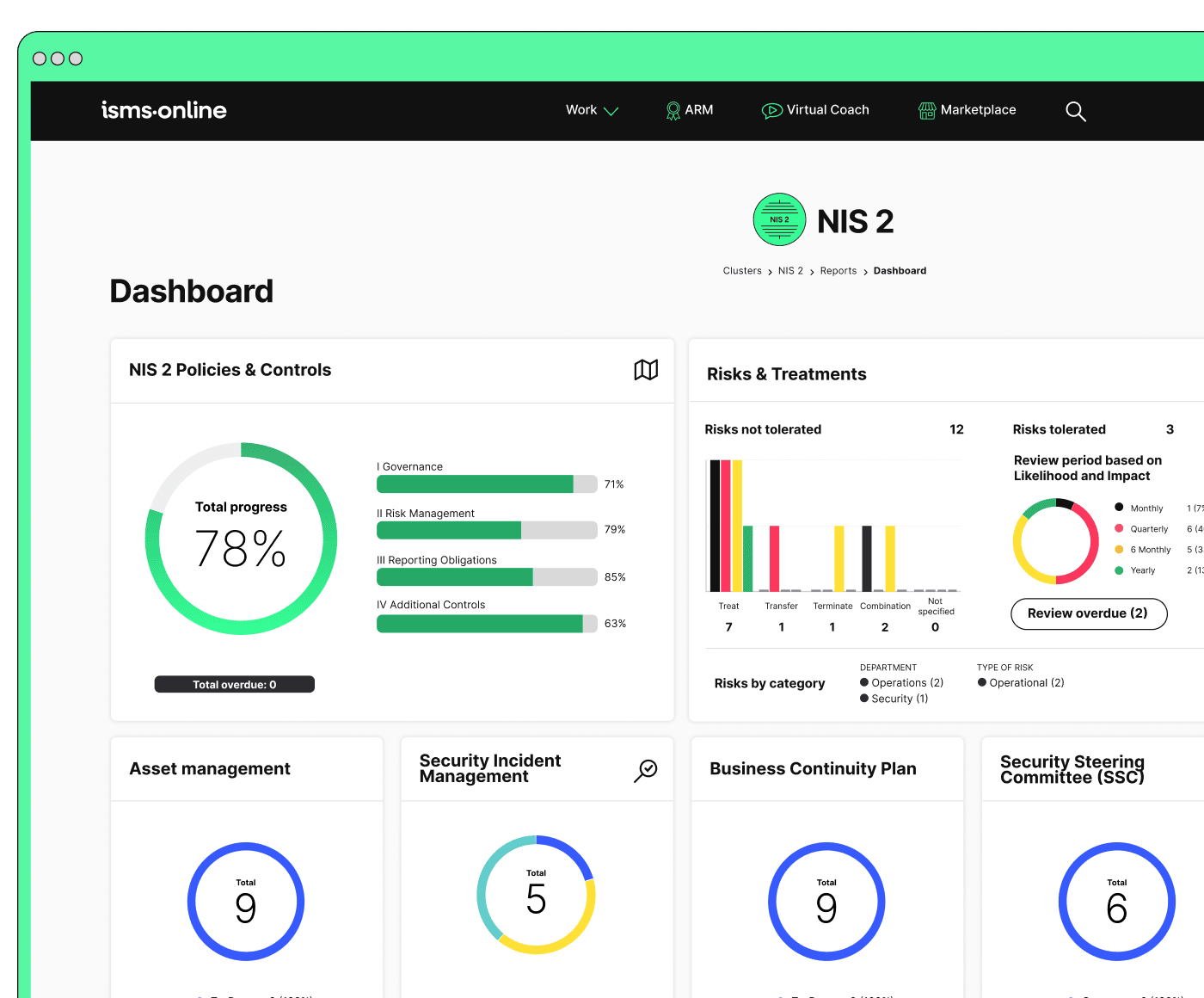
Be NIS 2-ready from day one
Launch with a proven workspace and templates – just tailor, assign, and go.
How Does NIS 2 Shift from Directive to Daily Operations?
The NIS 2 playbook doesn’t leave room for armchair compliance. 24-hour incident reporting is now standard. “Audit-ready” now means every action, risk update, and approval is logged-year-round-not just during an audit scramble.
Audit-readiness is no longer last-minute preparation-it’s every action, risk update, and approval logged throughout the year.
Spreadsheet Fatigue Is Now a Red Flag
Legacy workflows-endlessly shuffling evidence across email or spreadsheets-now directly threaten compliance. Over 70% of companies admit top-level sign-off on supplier controls is hindered by inefficient, decentralised evidence. And audit failures often correlate with disjointed evidence and key approvals left outside system records.
ISO 27001 Bridge Table – Expectation, Operationalisation, Annex A Reference
| **Expectation** | **How It’s Operationalised** | **ISO 27001 / Annex A Reference** |
|---|---|---|
| Board oversight | Signed mgmt review each quarter | 5.1, 5.3, 9.3 |
| Living risk register | Immediate post-incident updating | 6.1, 8.2, A5.12, A8.8, A8.13 |
| Third-party assurance | Supplier self-attest. on platform | A5.19–A5.22 |
| Audit/export traceability | Single SoA + cross-framework logs | 5.37, 5.36, 8.15, 8.17 |
Records only become evidence when they’re built in-by system, by workflow, by routine-day after day.
Automation and Audit Velocity
Organisations using automated, system-linked registers now achieve 42% average uplift in audit outcomes. The benefit emerges in audit velocity and cultural trust-not just pass rates. Every team member, board and front line alike, owns their part in the chain.
For CISOs and Audit Leads, Has Traceability Become the New Compliance Currency?
For CISOs, IT managers, and audit leads, traceability is now the currency of trust. The ability to connect any trigger (incident, vendor assertion) with the risk, the control, and the logged evidence-instantly and auditably-is the new competitive edge. Internal audits, procurement, insurers, and partners all increasingly demand “show me your work”-with no patience for ad hoc or delayed logs.
Traceability in real time is now a precondition for trust-delayed or ad hoc logs are a risk, not a relief.
Traceability Table – Audit Triggers to Operational Evidence
| **Trigger** | **Risk Update** | **SoA Link / Control** | **Evidence Logged** |
|---|---|---|---|
| Incident invoked | Risk reg. & exec notification | A5.24, A5.25 | Report, SoA change, board sign-off |
| Vendor assertion | Supplier mapped + attestation | A5.19–A5.22 | Vendor audit trail, exec approval |
| New control | Registered, reviewed, assigned | 6.1, A8.28, A8.29 | Dashboard, signoff, audit log |
| Board approval | Mgmt review, scorecard trends | 5.1, 5.3, 9.3 | Signed minutes, dashboard |
Delaying evidence or reconstructing logs destroys confidence. End-to-end, systematised traceability produces frictionless audits. Results speak loudly: companies relying on persistent SoA logs and auto-generated approval trails pass audits over 95% of the time.
The true test: every major control action-risk, assertion, new procedure, board sign-off-auto-logged and retrievable from anywhere, anytime.
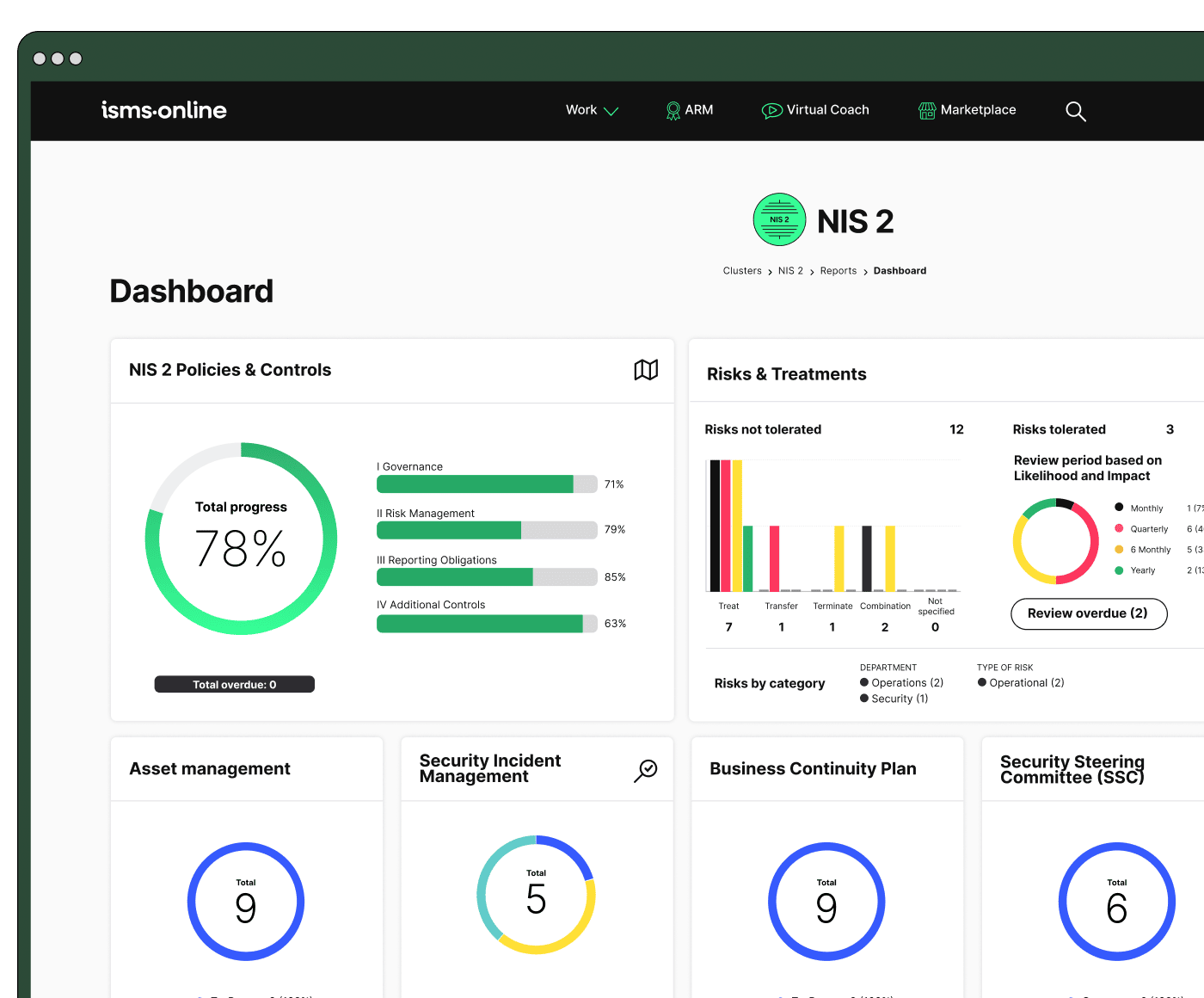
All your NIS 2, all in one place
From Articles 20–23 to audit plans – run and prove compliance, end-to-end.
Is NIS 2 Starting to Set the Blueprint for a Global Cyber Treaty?
What happens in Europe doesn’t stay in Europe. NIS 2’s blueprint is already filtering into international standards, and cross-border mandates are now foregrounded in procurement, insurance, and treaty negotiations. The UN, OECD, and major buyer groups have all mirrored NIS 2’s core elements. National regimes in Australia, Singapore, the UK, and ASEAN have adopted 24-hour reporting, mapped supplier controls, and live auditability. Compliance is, gradually, going borderless.
The new currency of trust is not compliance intent, but durable, audit-ready evidence-regardless of national boundary.
The High Cost of Fragmentation-and the Prize for Alignment
Every new global regime adds friction: each alignment increases compliance costs by ~21%. Yet, so does the opportunity-cross-border partnerships, sales channels, and investor deals now demand NIS 2 style controls, mapped out and visible in real time.
Contract language in supply deals is evolving: NIS 2 compliance is now a must, not just in the EU but in global procurement. Treaty partners, major buyers, and insurers expect audit-ready dashboards and system-linked proof. Companies relying on spreadsheets or batch exports see their access shrink-systematised evidence is the trade currency.
Only those who adapt their compliance mode for durable export-systematised, dashboarded, always on-will stay truly global.
Can ISMS.online Deliver End-to-End Resilience and Treaty Readiness Right Now?
For compliance champions at every level-from the anxious compliance “Kickstarter” unlocking their first ISO 27001 deal, to boardroom CISOs asked for 3am evidence, to privacy officers managing global contracts-ISMS.online delivers a living, audit-ready ISMS engineered for NIS 2, ISO 27001, GDPR and beyond. This eliminates the panic and patchwork of ad hoc evidence hunting.
Platform Features Tuned for Cross-Border, Board-Level Assurance
- Automated Compliance Crosswalks: ISMS.online streamlines compliance across regions (EU, UK, APAC, US), automating mapping, gap analysis, and control tracking. Teams reclaim up to 15+ hours per month previously lost to evidence assembly.
- Live Registers and Evidence Logging: Every risk, approval, and control is logged in a single source of truth. Internal management and external auditor, board, or regulator can access relevant evidence, policies, and approvals instantly.
- Role-Based Collaboration Dashboards: All major persona types-Kickstarters, CISOs, privacy/legal officers, practitioners-now see filtered, relevant dashboards. Staff are prompted automatically; boardrooms get a panoramic readiness view without scrambling for data.
- Supply Chain, AI, and Privacy Integrations: With growing emphasis on AI, privacy, and supply chain regulation, ISMS.online bridges frameworks (NIS 2, ISO 27001, ISO 27701, GDPR, SOC 2, ISO 42001) via linked controls, policies, tracks, and audit reports (eurocloud.org; techleap.nl).
Kickstarters fast-track certification and sales. Senior leaders monitor board-level assurance and resilience KPIs. Privacy and legal teams see defensibility and evidence rosters for every jurisdiction. Practitioners are at last recognised as resilience engineers, not spreadsheet chasers.
Ready to unify audit, unlock contracts, and future-proof your compliance mesh? ISMS.online centralises your evidence, policies, risks, and approvals-real-time, exportable, and trusted at every level.
Book a demoFrequently Asked Questions
What urgent forces are making NIS 2 the new standard for European cyber governance and global contracts?
NIS 2 is not just another compliance box-it’s the moment cyber-security became business-critical at board level. Today, 76% of European boards say digital risk is a top-three operational threat, and leaders increasingly face personal liability for lapses []. Where once a signed policy sufficed, regulators and the market now demand live control: insurance costs are soaring, incidents double almost yearly, and “operational command” is required at every layer. Boards and CISOs are expected to prove they know, in real time, where risk lives, how breaches are tracked, and how rapidly recovery unfolds-not just that reporting lines exist on paper.
Boardroom credibility is no longer earned by intent, but by actual, visible, operational evidence-every single day.
This pressure isn’t limited to IT. Responsibility runs end-to-end: supply chain, legal, finance, operations, and even partners-mandated in law, contracts, and insurance terms across the continent. Increasingly, international buyers and stock markets expect public proof of cyber hygiene, with NIS 2 mirrored or referenced in the UK, Australia, and Singapore. Contract eligibility, funding, and reputation now hinge on robust, traceable compliance routines-not annual reviews. Readiness is not just for passing audits, but for winning new global business on day one.
Where do fragmented rules and rollout delays create the most friction, fines, or failed audits?
An uneven NIS 2 rollout-19 of 27 EU states missed early 2024 deadlines-creates a patchwork of overlapping expectations, duplicate audits, and regulatory uncertainty []. Multinationals face regulatory “Russian roulette,” often finding that compliance in one market is insufficient-or even counterproductive-in another. SMEs, meanwhile, suffer “compliance paralysis”: 61% have no clarity on which controls or evidences count, leading to wasted spend and rising legal exposure []. French courts (and others following fast) now fine not just for breaches but for lack of day-to-day log evidence-auditors and insurers want live, mapped proof, not intent [].
For critical/regulated entities (finance, utilities, health, digital), compliance is further complicated by stacking rules: NIS 2 often overlaps with DORA, GDPR, and sector-specific mandates. Compliance fatigue is real. Advisory fees and review cycles triple without a unifying register and process. Inaction? It exposes organisations to both financial and reputational risk.
How do teams overcome fatigue and avoid “audit gridlock”?
They migrate from spreadsheets and manual evidence to continuous, cross-team, platform-based governance-linking policies, controls, risk registers, and user trails in a system that is always audit-ready. This makes the difference between routine sign-off and repeat audit failures.
What are the direct business consequences of cross-border incidents and conflicting timeline demands for global CISOs?
A single major incident will now trigger breach notifications with dozens of regulators, each with different evidence requirements and response timetables []. The real stress test: 60% of such incidents drag partners and suppliers into the fray, but only about 22% of organisations have mapped these chains out []. Without an integrated system, legal and insurance costs skyrocket-and audit failures double []. Siloed, country-specific control maps mean confusion, delays, missed deadlines, and, increasingly, fines that are public and reputation-damaging. The real-world upshot: minimum compliance in one country can mean maximum exposure elsewhere.
Cross-border risk is your new routine-true compliance is readiness for scrutiny anywhere, not just at home.
What differentiates those who navigate this minefield?
Top performers invest in governance automation-systems that harmonise evidence, shorten notification cycles, and synchronise controls from Paris to Prague and Singapore, making every audit and contract defensible through a single, unified platform.
How do progressive organisations combine governance routines and technology to deliver true NIS 2 resilience?
Leaders turn compliance from a project into a constant, systematised routine. They blend AI-driven analytics, automated dashboards, and institutionalised sign-off to cut incident closure times by a third []. With the EU Cyber Solidarity Act now requiring crisis simulations as operational routines, over half of EU-regulated firms run daily table-top or digital exercises to stay agile during real events []. Automated approvals and SOC logs shrink attacker “dwell time” and boost confidence-not just with boards, but with buyers and insurers too [].
Synchronisation is the critical edge: in ISACA-aligned organisations, over 90% close evidence gaps before audit deadlines thanks to centralised, team-adopted platforms []. Where most still stumble? Reliance on fragmented spreadsheets, unclear ownership, and after-the-fact evidence trails.
Where do teams still falter-and how can they tighten resilience?
Audit friction and insurance disappointment almost always trace to siloed tools and manual habits. Whole-business readiness comes only when incident logs, supply chain registers, and policy updates are unified and live-verifiable in real time.
What new proof standards are defining NIS 2 success: audit traceability, evidence automation, and always-on readiness?
In a landscape where fines for audit lapses have doubled year-on-year, the gold standard is now “audit by design”: automated, end-to-end logging that underpins compliance []. Organisations with linked approval chains and live Statement of Applicability (SoA) mapping are passing first-time audits at >95% rates []. As dashboards automate evidence collection, audit prep time shrinks by a third-while centralised proof banks halve “fire drill” cycles just before the deadline []. Even contract negotiations and insurance underwriting now demand traceability scores and export-ready compliance packs [].
Audit-readiness is no longer a future target-it’s your business’s operating system, live and exportable on demand.
How are the most advanced teams building future-proof routines?
By structuring controls, incidents, and policy changes as evidence loops run end-to-end-automatically mapped, immediately reportable, and scalable to DORA, GDPR, or AI governance as each new requirement lands.
Why is NIS 2 now the blueprint for global treaties and how is it shaping contracts, supply chain, and compliance strategy?
NIS 2’s approach to board accountability, operational mapping, and real-time evidence is featured prominently in UN and OECD digital security frameworks []. Countries in the Asia-Pacific, Middle East, and Americas are following its model []. The compliance cost? Joint mapping of NIS 2, DORA, GDPR, and AI laws is up 21% for regulated companies, but the upside is clear: suppliers that can offer unified, shareable compliance evidence are winning larger contracts. Major procurement processes now mandate NIS 2 crosswalks, with buyers seeking not checklists, but “evidence chains” that connect digital controls to third-party registers, contracts, and management sign-off [].
Your compliance agility will set you apart as treaty-level requirements become procurement’s entry ticket.
How do boards and partners become leaders, not just survivors?
Treat compliance as contract capital-build systems to unify readiness across frameworks, keep controls and evidence live, and align every supplier to your standards. Growth and trust will follow those who prove audit and contract agility.
How does ISMS.online deliver unified NIS 2, ISO 27001 & GDPR compliance, turning regulatory burden into a competitive advantage?
ISMS.online streamlines the chaos: evidence silos are reduced by up to 80%, and controls for NIS 2, ISO 27001, and GDPR are mapped and operationalised within a single, auditable environment []. Teams reclaim 15+ hours per month and cut overtime by up to 89% in audit cycles, releasing energy for deeper resilience work []. Cross-functional dashboards, supply chain registers, and permission management ensure contract readiness for global procurement and audit teams []. A tailored trial benchmarks your current practises against treaty-standard criteria, showing your team exactly where you stand and what to upgrade next.
Turn every audit into a strategic advantage. Benchmark your evidence and resilience, not just your paperwork. The enterprise leaders of tomorrow are standardising on ISMS.online today.
ISO 27001 / NIS 2 Operational Bridge Table
| Expectation | Operationalisation | ISO 27001 / NIS 2 Reference |
|---|---|---|
| Board cyber oversight | Board-reviewed, signed risk registers | ISO 27001 cl.5.1/9.3, NIS 2 Art.20 |
| Evidence traceability | Logged approvals, mapped controls/SoA | ISO 27001 cl.7.5/A5, NIS 2 Art.21 |
| Incident response | 24h workflows, live dashboards | ISO 27001 A.5.24/25, NIS 2 Art.23/32 |
| Supply chain compliance | Third-party registry, contract mapping | ISO 27001 A.5.19/21, NIS 2 Art.26/27 |
| Audit readiness | Dashboard views, digital evidence bank | ISO 27001 cl.9.2/A35, NIS 2 Art.32 |
Traceability in Action: Evidence Loops Table
| Trigger | Risk Update | Control/SoA Link | Evidence Logged |
|---|---|---|---|
| Supplier breach discovered | Risk register update | A.5.21/NIS2 Art.21 | Vendor alert, SoA comment |
| 24-hour incident occurs | Log incident/notify | A.5.24/NIS2 Art.23 | Incident log, workflow update |
| Policy update from board | Revision/approval cycle | Cl.5.1/A.5/NIS2 Art.20 | Version log, sign-off sheet |
| Audit deadline approaches | Audit/review cycle | Cl.9.2/A35/NIS2 Art.32 | Audit checklist, prep log |
| Regulatory change in scope | Contract/crosswalk map | A.5.19/NIS2 Art.26 | Contract update, matrix entry |
If you’re ready to turn the world’s toughest compliance challenges into an engine for trust, market access, and resilience, see ISMS.online benchmark your team-and make every audit, every contract, and every board meeting a launchpad for growth and leadership.






