





































How Much Is “Just” for Fines? Compliance as a Growth Enabler, Not a Tax
The usual narrative around NIS 2 compliance is obsessed with fines, but the reality is far more consequential: Lost growth is the invisible tax paid by teams slow to operationalise compliance. The fastest organisations aren’t racing to avoid penalties-they’re capturing deals and partner agreements while slower peers struggle in endless documentation loops.
It’s not the size of the fine that stings-it’s the silent deals lost to a more compliant competitor.
You’re likely already seeing evidence: sales cycles stalled by due diligence, procurement questionnaires lingering in inboxes, awards quietly slipped from your grasp. ENISA research estimates an average of €400,000 per NIS 2-related delay in Europe this year, usually absorbed as “pipeline slippage” rather than a write-off (ENISA, 2024). These aren’t theoretical-they’re delays you’ll see when quarterly forecasts suddenly drop.
Buyers and partners have reshaped their philtres: RFPs demand ISO 27001 or mapped NIS 2 proof, not in a year but today. Enterprises shortlist on evidence, not intention. Leading teams provide this by default, and their reward is first-mover advantage-early access to pilots, partnerships, and recurring contracts.
So, how do you transition from “auditable” to “audit-ready” for commercial advantage?
Best-in-class teams operationalise control-to-evidence in four steps:
| Expectation | Operationalisation | ISO 27001/Annex A Reference |
|---|---|---|
| Proof of cyber posture for deals | Live SoA mapped to customer need | 6.1.3, A.5.1 |
| Documented risk management | Central Risk Register, dashboards | 6.1.2, 8.2, A.5.7 |
| Staff and supplier accountability controls | Policy acknowledgements, logs | 7.2, 5.21, A.6.3 |
| Board and customer audit trails | Automated management review logs | 9.2, 9.3, A.5.36 |
With these paths clear, the real question is whether you’re surfacing your compliance story for your buyers before your competitors do. Teams who wait for an audit, or hope for spreadsheet evidence to suffice, are already falling behind new procurement barriers.
If your next deal is on hold, check first for a compliance bottleneck-often, it’s not the IT system but the proof signal buyers want.
Why Sales-Led Compliance Wins: Turning NIS 2 Into a Go-To-Market Superpower
Organisations who treat compliance as a living, sales-facing discipline-not an annual audit afterthought-are quietly eating market share. NIS 2, far from being red tape, unlocks new business by making you the partner procurement teams want to fast-track.
The most forward-looking vendors now embed mapped compliance frameworks into their sales decks. They don’t wait for RFPs or send rushed “we’re working on it” emails-a mapped control library means their proposal is ready before the first question arrives (Alvarez & Marsal, 2024). These teams win tie-breaks in high-value bids on the strength of crisp, audit-grade answers.
The difference in a €2M tender might be the clarity of your evidence, not your price.
In critical infrastructure and regulated sectors, compliance isn’t just a selection criterion-it’s a default expectation. Your risk register and supply chain audit logs now rank beside technical specs as primary proof points (enisa.europa.eu; ted.europa.eu). Service providers who update the playbook tie compliance milestones directly to onboarding, making themselves the easy “yes” for busy buyers.
If your compliance achievements are hidden away in an IT folder, your competition is already rolling them onto investor calls and market-facing materials. The business winners bring these credentials front and centre-embedding them as trust signals throughout every commercial channel.
So, who on your team owns the sales advantage embedded in your NIS 2 records? If no one is surfacing mapped, audit-grade proofs as a sales asset, you’re volunteering to lose on a technicality that shouldn’t exist.

Master NIS 2 without spreadsheet chaos
Centralise risk, incidents, suppliers, and evidence in one clean platform.
Modern Evidence Is Built, Not Assembled: The New Standard for Trust
Boards, procurement, and investors aren’t moved by documentation for its own sake-they want live, verifiable proof. The new standard under NIS 2 is the operational audit trail: records that are as actionable for internal decisions as they are compelling for external partners and regulators.
Why is self-certification fading out? In the current landscape, public RFPs require “show-me” evidence-Statements of Applicability, incident plans signed off at board level, third-party audit logs. Platforms like ISMS.online are now aligning their core features directly with these demands, enabling any team to produce the controls and logs buyers or regulators expect.
Boards aren’t waiting passively for annual reviews. CISOs are presenting interactive dashboards that tie risks, controls, and SoA status to real, up-to-date audit evidence. For deals of consequence, the speed and transparency of your evidence win confidence not just from customers, but from the board.
The best sales decks today don’t just show logos-they show compliance evidence trails that your competitors can’t match.
Deal acceleration, smoother onboarding, and tangibly reduced scrutiny are the practical results. The teams enabling automated audit logging, mapped risk updates, and board-level evidence cycles move out of scramble-mode and into strategic selection. The examples below illustrate how top-performing organisations operationalise traceability:
| Trigger | Risk Update | Control/SoA | Evidence Logged |
|---|---|---|---|
| New Client Onboarding | Supplier risk assessed | A.5.21 Supply Chain | Due diligence, signed SoA |
| RFP Compliance Request | Security risk updated | A.5.1 Policies for IS | Policy doc, approval, audit log |
| Board Review Cycle | Top risk reprioritised | 8.2 Risk Assessment | Dashboard, management minutes |
| Incident Drill Outcome | Plan tested | A.5.24 Incident Response | Drill log, sign-off file |
Each trigger, control, and evidence log aligns with both NIS 2 and ISO 27001-crucial for passing the scrutiny of any high-trust buyer or partner.
Operational Excellence: How Teams Turn Controls into Competitive Reflexes
Most see NIS 2 as an extra layer of paperwork, but high-performing teams understand it’s designed to drive both security and operational efficiency. Compliance isn’t a bureaucratic grind-it’s your licence to move faster, with fewer errors and clearer lines of accountability.
When compliance routines are embedded in IT service desks, project reviews, or supplier onboarding, they deliver practical wins: reduced audit friction, faster risk resolution, and less time lost to repetitive evidence requests. Automating To-do flows and mapped control assignments means audits become a passive check-not an active escalation.
Simulation-style compliance (think: annual paper drills) doesn’t protect against live risk. ENISA warns that checklist reviews bring a false sense of readiness, leaving essential teams vulnerable. That’s why robust, system-driven review and evidence cycles aren’t optional.
Compliance is best when it’s invisible: baked into your daily rhythm, never a separate box-ticking exercise.
Cross-mapped compliance systems further accelerate incident response: when an alert is raised, the controls, evidence logs, and management reviews are already in place-so actions are taken sooner and mitigations close faster, halving potential impact.
Where to focus automation?
- Supplier onboarding, quarterly evidence recertification, and incident response planning are the most efficiently automated steps.
- Each step logs evidence against controls like A.5.21 (Supply Chain), 8.2 (Risk Assessment), A.5.24 (Incident Response).
- Audit logs, management reviews, and drill tracking are routine outputs, not custom side projects.
This level of operational maturity turns compliance into muscle-not “admin.”
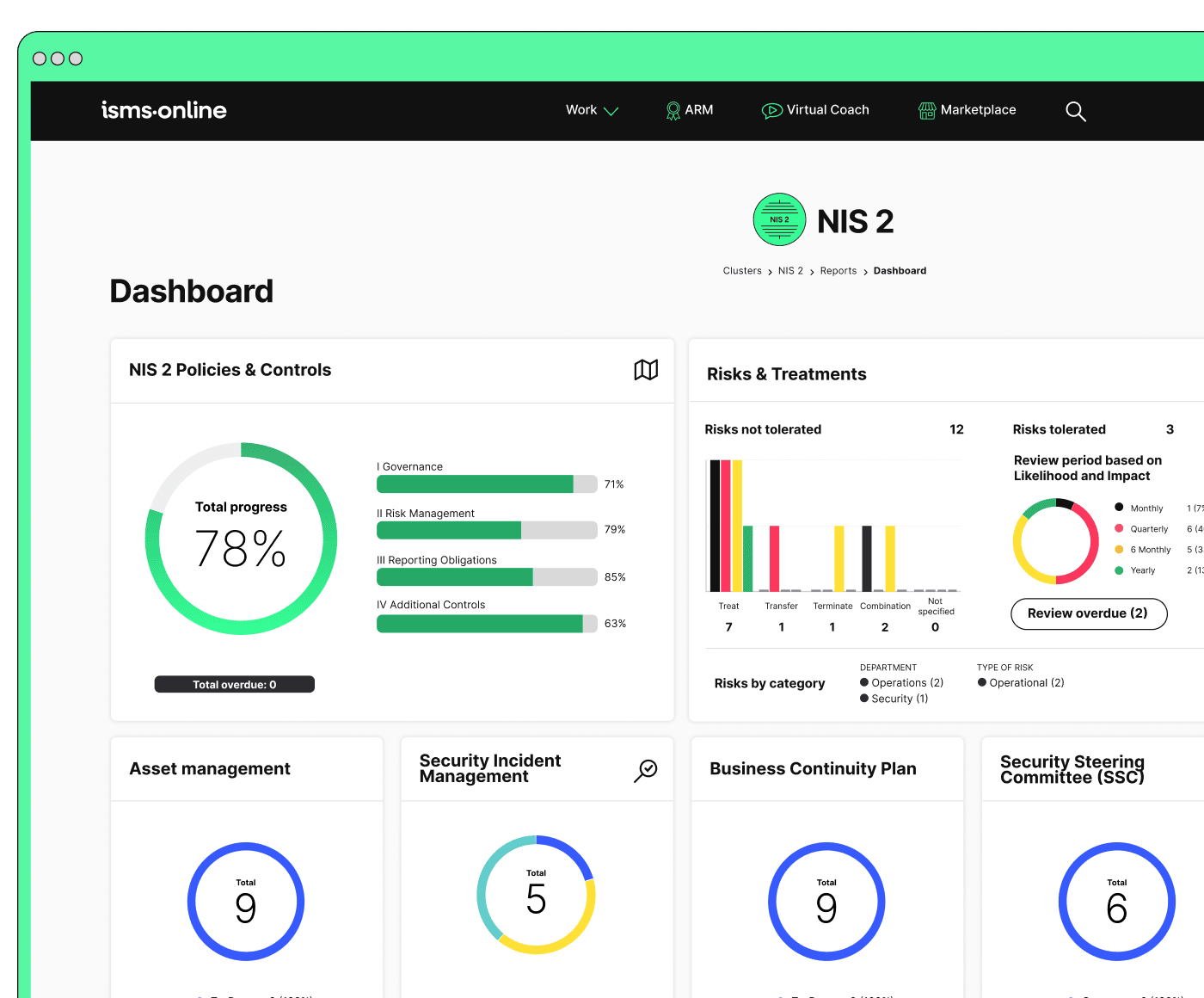
Be NIS 2-ready from day one
Launch with a proven workspace and templates – just tailor, assign, and go.
Supplier Trust and Chain Resilience: Where Proof Is Partnership Currency
Every buyer now evaluates your supplier record-are you a weak link, or the reason their supply chain is resilient? NIS 2 makes standardised supplier assurance, ongoing compliance checks, and transparent recertifications mandatory for high-impact procurements.
ENISA’s latest research shows standardised, repeatable supplier vetting not only reduces onboarding friction, but actually builds new lines of business. Delayed or incomplete evidence can down-tier your status, removing you from preferred panels before final selection.
Procurement officers increasingly require live supplier logs-compliance checks performed and re-performed, with evidence shared back up the chain. You can’t risk unknown gaps; today’s advantage is in documented proactivity.
In a competitive chain, the only weakest link is a missing, outdated compliance log.
Make recertification not just routine, but a marketing asset: alert buyers of quarterly evidence updates, participate in simulated drills, and offer transparent incident logs with sign-off. Organisations who automate supplier assurance demonstrate strong, fair approaches to dispute resolution, minimising downtime and friction-and building trust for long-term partnerships.
Five steps to a resilient supply chain under NIS 2:
- Maintain an up-to-date supplier risk register, mapped to NIS 2/ISO controls.
- Implement automated onboarding with compliance templates.
- Schedule and share quarterly recertification evidence with top buyers.
- Require incident logs for all critical suppliers.
- Link supplier policy reviews directly to procurement and compliance workflows.
Companies making these practises visible don’t just survive NIS 2-they thrive, as buyers and partners identify them as low-risk, high-value allies.
The Returns Are Real: From Insurance Discounts to Shareholder Value
It’s time to re-calculate the “cost of compliance” as an investment in value. When NIS 2/ISO 27001 controls are integrated, financial rewards follow-across insurance premiums, risk reduction, and capital markets.
Insurance brokers now price discounts and faster renewals for teams with fully logged controls and evidence, averaging 17% premium reductions over non-compliant peers. Finance teams who leverage compliance logs in board packs and investor memos can demonstrate materially lower risk, improving their negotiation stance for capital and acquisition.
ENISA’s 2024 guide takes this further: missed downtime and silent compliance gaps routinely cost five- and six-figure sums per incident. Finance and risk leaders who align compliance evidence cycles to executive dashboards can convert these figures from cost-avoidance into quantifiable savings.
When compliance becomes a living, logged practise, it becomes defensible value-visible to underwriters, investors, and boards alike.
Best-in-class teams go further: surfacing compliance cycle completion rates, incident logs, and management review outcomes in quarterly reporting, making compliance an asset, not a mere escape from penalty.
Market analysts and ratings agencies (S&P, ESG houses) now explicitly cite cyber-security maturity, mapped frameworks, and “always-on” compliance as criteria in credit scoring. Your compliance journey today sets the tone for your access to finance tomorrow.
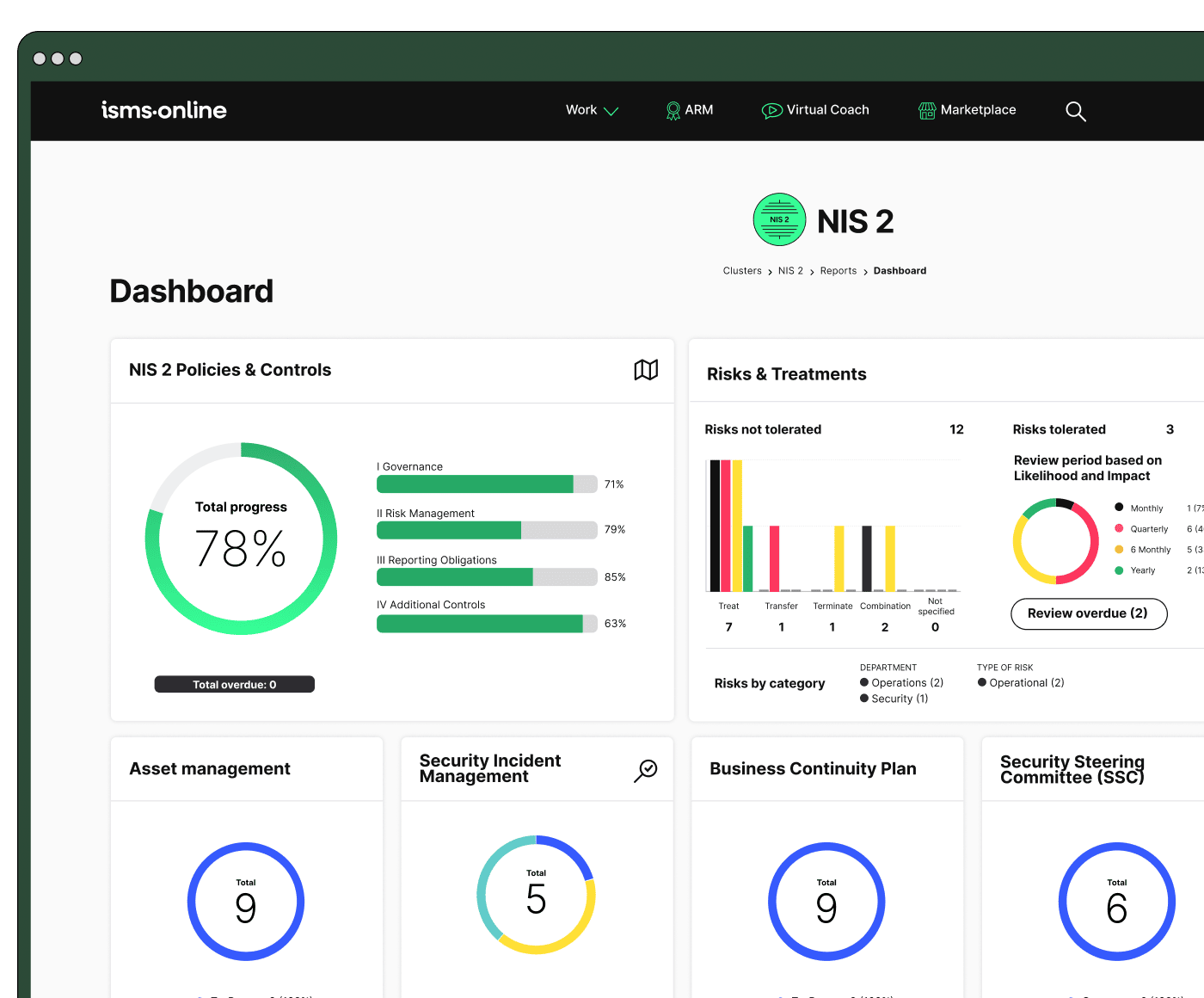
All your NIS 2, all in one place
From Articles 20–23 to audit plans – run and prove compliance, end-to-end.
ESG, Innovation, and Growth: Compliance as Market Signal
NIS 2 compliance sits at the centre of a wider shift: ESG funds, cross-border venture panels, and analyst reports are measuring resilience by live compliance metrics and mapped frameworks as headline signals.
ESG audits now require mapped compliance frameworks and cycle completion rates as part of their top-line scoring criteria (Alvarez & Marsal, 2024). Boards proactively surface these metrics to ensure their credibility with investors and external partners.
International expansion and M&A panels depend not just on legal review, but on the freshness and completeness of compliance logs. Outdated or incomplete records often mean missed opportunities, even when product/fit is strong.
Award programmes now routinely use mapped compliance cycles as a line item-what was once “nice to have” is now a deciding factor in public and private recognitions. A single missing or stale log can quietly shift the winner.
Analyst and investor forecasts show a clear correlation between time-to-certification, audit record freshness, and long-term partnership success. The most valuable companies treat compliance as a living metric, reviewed not sporadically but as an active company asset.
Proactive compliance reviews, policy logs, and traceable workflows enrich not just audit packs but routine board and shareholder reports. The new normal: compliance wins you growth, not just a pass mark.
From Documentation Project to Living Competitive System: What Comes Next
The leaders who emerge from the NIS 2 regime are those who transform compliance from a static project into a living system-with embedded, always-on, cross-mapped evidence. Audit and procurement forms become checkmarks in a system that’s been logging, reviewing, and improving all along.
Compliance that’s always on becomes opportunity that never switches off.
Modern platforms like ISMS.online give you instant access to audit-ready Statements of Applicability, mapped controls-turning the scramble of “pre-audit” into a routine, low-friction check (cheops.com; isms.online). In rapidly moving markets, reduced “time to audit pass” directly correlates to faster revenue realisation and deal close.
The shift from internal self-reports to actionable, logged proof-policy acknowledgements, approvals, management dashboards-generates trust signals embedded in every commercial and regulatory engagement. CISOs, privacy leads, and practitioners alike gain recognition: managers see their teams as enablers, boards see value creation, and buyers see a reliable partner.
The question isn’t whether your organisation needs evidence, but whether that evidence will lag behind your ambitions-or lead them.
If you’re ready to make compliance your edge-not your tax-start with the right system. The only sustainable leadership is visible, provable, and ongoing.
Ready to close the gap between compliance and growth? Your next board deck, partnership, or audit is the perfect place to show what living compliance means.
Step forward confidently. Compliance is your new passport; let’s use it to travel faster than the competition-today, not one more deal or audit cycle from now.
Frequently Asked Questions
Who benefits most and fastest from NIS 2 compliance-and how does sector or function influence that advantage?
Organisations in regulated and procurement-heavy sectors-such as finance, energy, utilities, manufacturing, healthcare, and digital infrastructure-gain the quickest, largest advantage from early NIS 2 compliance. Procurement, sales, legal, and security teams in these industries see immediate payback: compliance unlocks eligibility for EU public tenders, expedites complex B2B deals, and provides legal and risk teams with auditable, mapped controls for contracts and regulator disclosures. In these sectors, NIS 2 is not just a tick-box; it’s now a commercial precondition-buyers and partners treat cyber resilience as the entry ticket, not a differentiator.
The speed and size of your benefit are shaped by your sector’s risk appetite and customer trust requirements. Finance and digital infrastructure rely on visible, proven auditability, while healthcare and manufacturing require quick supplier onboarding and robust cross-border risk assurance. If you can surface digital, up-to-date NIS 2-aligned evidence at the speed of procurement (think: mapped risk registers, incident logs, policy acknowledgments), your position upgrades from “eligible” to “preferred partner.” Those missing this digital pipeline face stalled reviews, lost deals, and increasing scrutiny from buyers who can’t wait for compliance laggards to catch up.
A trusted supplier in the NIS 2 era isn’t the one with the loudest promise, but the one with operational proof at every decision point.
NIS 2 Impact by Sector/Team
| Sector/Function | NIS 2 Acceleration Effect |
|---|---|
| Procurement/Sales | Fast-tracked onboarding, public tender eligibility |
| Legal/Compliance | Defensible contracts, risk evidence, fewer disputes |
| Finance/Digital Infra | Board trust, lower insurance, resilience proof |
| Manufacturing/Health | Smoother cross-border deals, supply chain stability |
How does NIS 2 compliance remove procurement friction and build B2B trust?
NIS 2 compliance operationalised through a digital ISMS transforms procurement from a pace-slowing barrier into a revenue accelerator. By digitising policies, mapping controls, and maintaining up-to-date evidence (like Statements of Applicability and incident logs), your team answers risk and audit queries instantly. This speed matters: buyers can validate your security posture, issue approvals, and move to contract in days-not months-because your readiness is always provable.
Buyers now actively require proof-not just statements-of mapped controls, real-time logs, and third-party risk assessments. With NIS 2, your organisation shifts from paperwork cycles to digital review: procurement objections melt when you present evidence rather than intention. This not only gets you through supplier prequalification faster but earns trust as a partner who minimises bureaucratic drag for every tender or contract renewal.
When compliance evidence is digital and on demand, procurement cycles shrink, stakeholders trust faster, and your teams focus on opportunity-not chasing paperwork.
What commercial proof points have early NIS 2 adopters reported, and what distinguishes them from slower peers?
Early adopters using digital, real-time NIS 2 compliance frameworks report clear commercial wins: tender win rates up 20–30%, onboarding cycles trimmed by a third or more, and reduced resource and insurance overheads. For example, one EU energy supplier reduced supplier vetting from 60 to 40 days after digitising incident management and control mapping-time explicitly cited by procurement reviewers. Health tech organisations use ISO 27001 and NIS 2 crosswalks in audit dashboards to impress investors, shrink due diligence cycles, and secure funding ahead of slower peers.
By contrast, organisations slow to operationalise NIS 2 face bids stuck in review, lost contracts, higher insurance costs, and auditors as perpetual gatekeepers. Instead of “complied vs. not,” the race is now “provable, living compliance” at the exact moment buyers or partners call. Laggards risk both market share and regulatory action.
Table: NIS 2 Early Adopters vs. Laggards
| Practise | Early Adopters | Laggards |
|---|---|---|
| Tender Wins | 20–30% higher, fewer clarifications | Lost eligibility, slow review |
| Onboarding Time | −30% or more | Weeks/months added |
| Insurance Terms | Lower premiums, faster approval | Higher cost, delays |
| Audit Outcomes | “No findings,” streamlined recert. | Persistent clarifications |
How has NIS 2 changed the selection logic in tenders and RFPs-and is this a competitive edge?
NIS 2 has reset the selection baseline for both public and high-value private tenders. Where buyers once accepted a “policy on letterhead” or an intent to certify, they now demand mapped controls, live incident/response logs, and supply chain risk evidence up front. Compliance maturity is often hardcoded as a pre-qualifying philtre, not an afterthought-especially in regulated infrastructure, digital, and financial markets.
Organisations who present live, third-party-audited dashboards and real-time evidence see clarification phases shorten-or vanish. RFP scoring increasingly favours suppliers who provide living, operational proof instead of retrospective paperwork. The result: preferred lists tighten, trust accelerates deal flow, and commercial margin grows thanks to reduced negotiation drag. Those who rely on homework-done-later languish in “maybe” piles or face outright rejection.
Procurement has become a compliance competition, and those with operational proof at proposal time become the new default winners.
What operational gains-beyond passing audits-come from embedding NIS 2 into daily practise?
When NIS 2 is woven into your workflows, compliance shifts from crisis-driven to continuous-and the operational benefits multiply. Automatic control updates, continuous evidence collection, and digitised playbooks turn quarterly audit sprints into manageable weekly tasks. Finance teams increasingly showcase:
- 17% reduction in average cyber insurance premiums: for NIS 2-audited firms (industry surveys).
- 30% decrease in incident response time: , driven by automated notifications and live tracking.
- Less administrative friction: evidence is pre-captured, incident logs are current, risk updates are clickable-not chased.
- Fewer regulatory and contract delays: findings are resolved in hours or days, rather than crisis-fueled weeks.
- IT and compliance teams are empowered to direct resource to proactive improvements, instead of patching last-minute audit gaps.
These gains transform compliance from a cost centre into a growth engine-one that turbocharges resilience, trust, and board-level confidence.
Which trust signals and proof-points most move boards, regulators, and investors in the NIS 2 era?
The most effective signals are dynamic, audit-validated, and transparently shared. Boards, investors, buyers, and regulators rarely trust promises-they act on operational proof. The leading trust cues:
- ISO 27001 certification cross-mapped to NIS 2: -covering both technical and process controls.
- ENISA-aligned incident logs and external awards: -reinforcing market recognition.
- Live Statements of Applicability and digital dashboards: -evidence surfaces in meetings, not months later.
- Third-party audit and compliance reports: -sector-recognised letters or awards vault suppliers to preferred status.
- Continuous incident and training logs: -not annual pulses, but rolling, verifiable discipline.
When visible, these signals accelerate negotiation, audit, and regulatory review-and create credibility far in advance of due diligence. Organisations who showcase proof across their board decks, procurement packets, and public sites become the default models for regulatory and buyer trust.
When trust is decided at digital speed, living compliance signals cut through noise and set your reputation above the rest.
ISO 27001 / NIS 2 Bridge Table
| Expectation | Operationalisation | ISO 27001 / NIS 2 Reference |
|---|---|---|
| Audit-ready evidence | Digital ISMS, SoA, live logs | ISO 27001 Cl.8; Annex A5.24; NIS 2 Art.21/23 |
| Supply chain risk proof | Digitised risk, third-party reviews | A5.19, A5.21; NIS 2 Art.21/22 |
| Incident response maturity | Live playbooks, notification logs | A5.28; NIS 2 Art.23/24 |
| Board trust signal | External audits, dashboards, certifications | Cl.9; A5.35; NIS 2 Art.21 |
Traceability Mini-Table
| Trigger | Risk Update | Control/SoA Link | Evidence Logged |
|---|---|---|---|
| New RFP | Controls review | A5.1; NIS 2 Art.21 | SoA, RFP tracker |
| Board request | Dashboard update | A5.35; NIS 2 Art.21 | Board pack, dashboard |
| Supplier breach | Policy and risk | A5.19; NIS 2 Art.22 | Breach log, risk reg. |
| Regulator audit | Incident logs sent | A5.24; NIS 2 Art.23 | Audit portal, logs |
When your ISMS evolves into a “proof engine,” every compliance upgrade unlocks commercial opportunity. The question is no longer “Are you compliant?” but “How fast can you prove it, in the room, at deal time?” Trusted partners aren’t waiting to catch up-they’re setting the pace.
NIS 2 isn’t a finish line to cross; it’s the starting gate to tomorrow’s contracts, partnerships, and reputation as the preferred ally in your market.






